Variation in APS — Where Does Novelty Come From?
In the Agency–Process–Scale (APS) framework, variation is not treated as random deviation from a fixed template, but as the generation of differences within inherited, persistence-sustaining organisation. Variation emerges through ongoing reorganisation within inherited lineages of viability-oriented organisation and provides the differences in continuity upon which fitness and natural selection subsequently operate. This article explains the sources of biological novelty by integrating development, organism–environment coupling, and multiscale dynamics into a unified account of how new forms of organisation arise.
Key Points
- Variation arises from the reorganisation of inherited, persistence-sustaining organisation.
- Novelty is generated through development, not added to it.
- Organism–environment coupling is a source of variation, not merely a context for selection.
- Genetic mutation contributes to variation but does not exhaust its sources.
- Variation is structured by organisation and constrained by viability.
- Evolution depends on the continuous production of viable variation within organised systems.
Variation as Reorganisation
In APS, variation is understood as the reorganisation of viability-oriented, constraint-closed systems. It is not a departure from a fixed blueprint, but an intrinsic feature of living organisation.
Because evolution in APS is the transformation of such organisation over time, variation arises as the ongoing production of differences within systems that sustain organised persistence.
Living systems continuously respond to changing conditions, reorganise internal processes, and modify their coupling with the environment. Variation emerges through these ongoing activities rather than appearing as an external addition to an otherwise fixed system.
Novelty, therefore, is not externally introduced but generated within the ongoing activity of living systems.
Variation in this sense arises only within systems capable of sustaining organised persistence. These differences become evolutionarily consequential when they are stabilised through inheritance and incorporated into historically continuous lineages. Variation therefore occupies a distinctive position within the APS continuity architecture. Inheritance reproduces lineage continuity across generations, while variation generates differences within that continuity. These differences subsequently contribute to fitness and become subject to natural selection. Variation is therefore not external to continuity but one of the processes through which continuity becomes historically transformable.
Beyond Random Deviation
Conventional evolutionary accounts often describe variation as random mutation followed by selection. APS retains the importance of mutation but rejects the idea that variation is fundamentally random in origin.
Variation is constrained by organisation, shaped by developmental pathways, and influenced by environmental interactions. Although randomness may characterise certain molecular events, the expression and consequences of variation are structured by the organisation of the system within which those events occur. Variation therefore emerges within an already organised context rather than as unstructured noise imposed upon living systems.
Randomness may characterise certain molecular events, but the expression and consequences of variation are structured by the organisation of the system.
Variation is therefore not noise around a fixed form, but structured possibility within viable organisation.
Development as a Source of Novelty
Development is a primary source of variation in APS because it is the process through which inherited organisation is reconstituted, environmental inputs are integrated, and viable organisms are produced. Because development is dynamic and context-sensitive, it does not generate identical outcomes on every occasion. Differences in initial conditions, environmental circumstances, and internal system dynamics contribute to systematic variation, allowing novelty to emerge through the developmental process itself.
Novelty emerges from the flexibility and responsiveness of developmental processes, not from isolated mutations alone.
Development therefore does more than reconstruct inherited organisation. It also contributes to the generation of differences within inherited continuity. Variation emerges through the dynamic re-establishment of viable organisation rather than through the addition of novelty to an otherwise fixed system.
Organism–Environment Coupling
Variation also arises from the ongoing coupling between organisms and their environments.
Living systems actively engage with their surroundings, modifying and being modified by them. These interactions create new conditions for development, alter the constraints under which systems operate, and generate novel organisational possibilities. Environmental factors are therefore not merely selective pressures acting upon organisms from outside but active contributors to the generation of variation itself.
Environmental factors are therefore not merely selective pressures but sources of variation in their own right.
This perspective integrates ecological and developmental processes into a unified account of novelty.
The Role of Genetic Mutation
Genetic mutation remains an important contributor to variation, but its role is reframed.
Mutations introduce changes at the molecular level, but their significance depends upon how those changes are integrated into development, how they affect system-level organisation, and whether they contribute to viable function. Molecular change becomes biologically consequential only through its incorporation into the larger organisation of the living system.
Most mutations have no lasting effect because they are either buffered by organisational stability or eliminated when they fail to contribute to continued viability. The persistence of a change therefore depends less upon its molecular origin than upon its relationship to the organisation of the system as a whole.
Those that do contribute to variation do so within the constraints of the system, not as independent drivers of novelty.
Variation and Viability
Variation is constrained by viability. Not all possible changes can be realised because systems must remain within bounds that allow continued existence.
This constraint gives variation its distinctive character. Variation is open-ended without being arbitrary, flexible without being unconstrained, and creative without escaping the organisational requirements of viability. Variation is therefore best understood as the exploration of viable possibilities within a structured space of organisation rather than the unrestricted generation of novelty.
Variation is therefore the exploration of viable possibilities within a structured space of organisation.
This relationship is important because viability not only constrains variation but also helps determine which differences become evolutionarily consequential. Variation generates differences within continuity, but only some differences contribute to future continuity under particular developmental and ecological conditions. Variation therefore provides the raw differences upon which fitness is later assessed.
Variation in the Evolutionary Framework
Within APS, biological agency sustains viability-oriented activity, viability enables organised persistence, inheritance reproduces continuity across generations, and variation introduces differences within inherited lineages of organised persistence. These differences contribute to fitness by affecting the continuity of persistence-sustaining organisation under particular developmental and ecological conditions. Natural selection then differentially stabilises those differences through evolutionary time, contributing to long-term evolutionary transformation.
Variation is therefore the source of evolutionary novelty, but it is not an isolated process. It operates within an inherited continuity architecture and becomes evolutionarily significant through its relationships to fitness, natural selection, and historical continuity. Without variation there would be no evolutionary transformation. Without inherited continuity there would be no continuity within which variation could occur.
The relationship between variation and fitness is particularly important. Variation generates differences among forms of persistence-sustaining organisation. Fitness reflects differences in the continuity of those forms across generations. Natural selection then differentially stabilises those differences. Variation therefore initiates a sequence that links novelty to historical transformation.
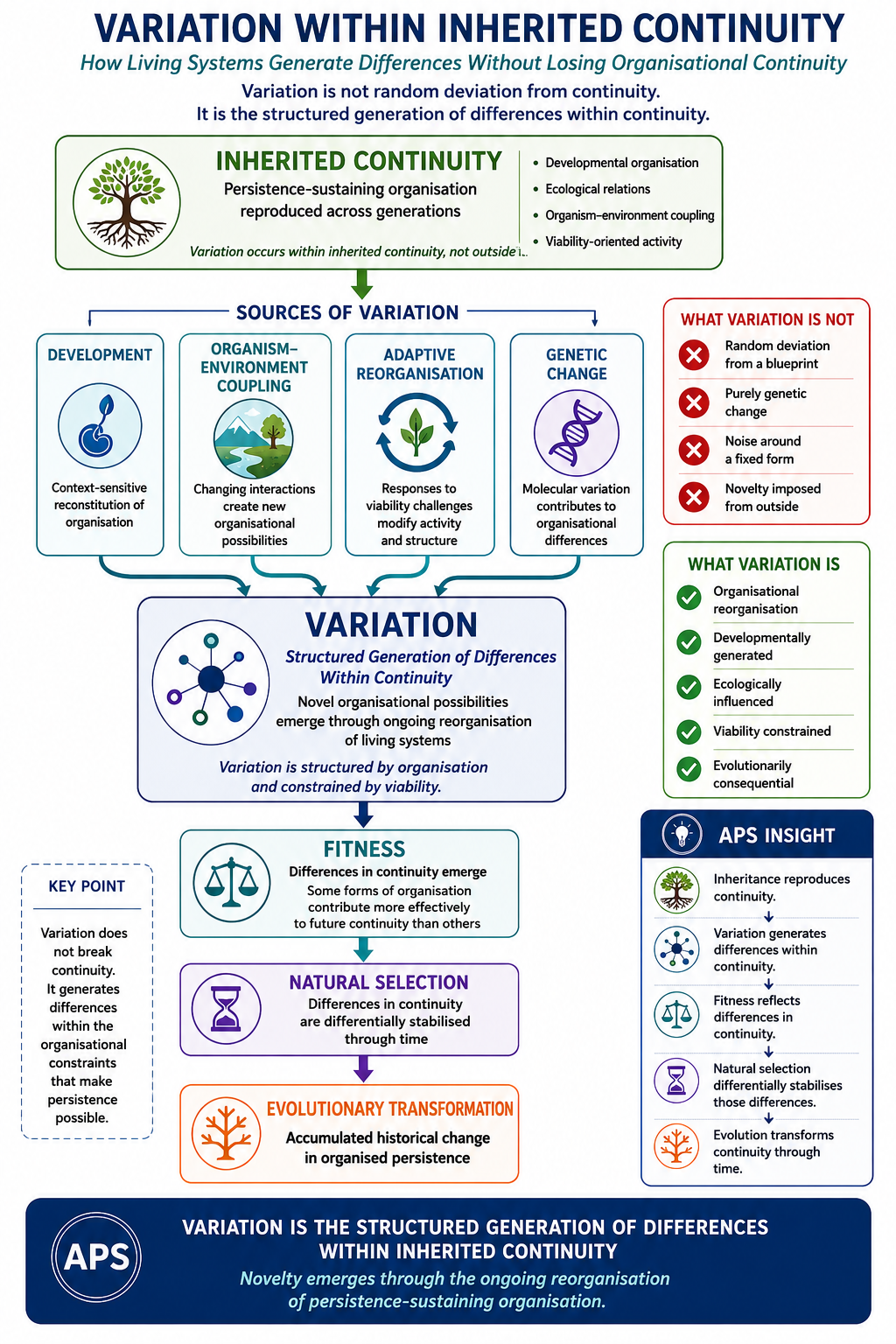
Primary Variation Visual. APS interprets variation as the structured generation of differences within inherited continuity. Development, organism–environment coupling, adaptive reorganisation, and genetic change contribute to variation, which generates differences in continuity that become relevant to fitness, natural selection, and evolutionary transformation.
Variation is the source of novelty, but it is inseparable from the processes that generate and constrain it.
Without variation, there is no transformation. Without organisation, variation has no structure.
From Mutation to Organisation
By reframing variation as reorganisation, APS shifts the focus from isolated events to system-level dynamics.
This shift integrates molecular, developmental, and ecological sources of variation into a unified explanatory framework. It avoids reducing novelty to random mutation while explaining how variation can be simultaneously structured, creative, and biologically consequential.
Viewed in this way, variation is best understood not as a departure from continuity but as a transformation within historically continuous lineages of organised persistence. Living systems generate differences while preserving the organisational conditions required for viability. Novelty therefore emerges from the ongoing reorganisation of persistence-sustaining organisation rather than from isolated disruptions imposed upon it.
Variation is thus not an external input to evolution, but an intrinsic feature of living organisation in motion.
Inheritance, variation, fitness, and natural selection therefore perform distinct but complementary roles within evolutionary organisation. Inheritance reproduces continuity across generations, variation generates differences within that continuity, fitness reflects differences in continuity among alternative forms of organisation, and natural selection differentially stabilises those differences through time. Together these processes explain how organised persistence remains simultaneously continuous and transformable, allowing evolutionary history to emerge from the ongoing reorganisation of living systems.
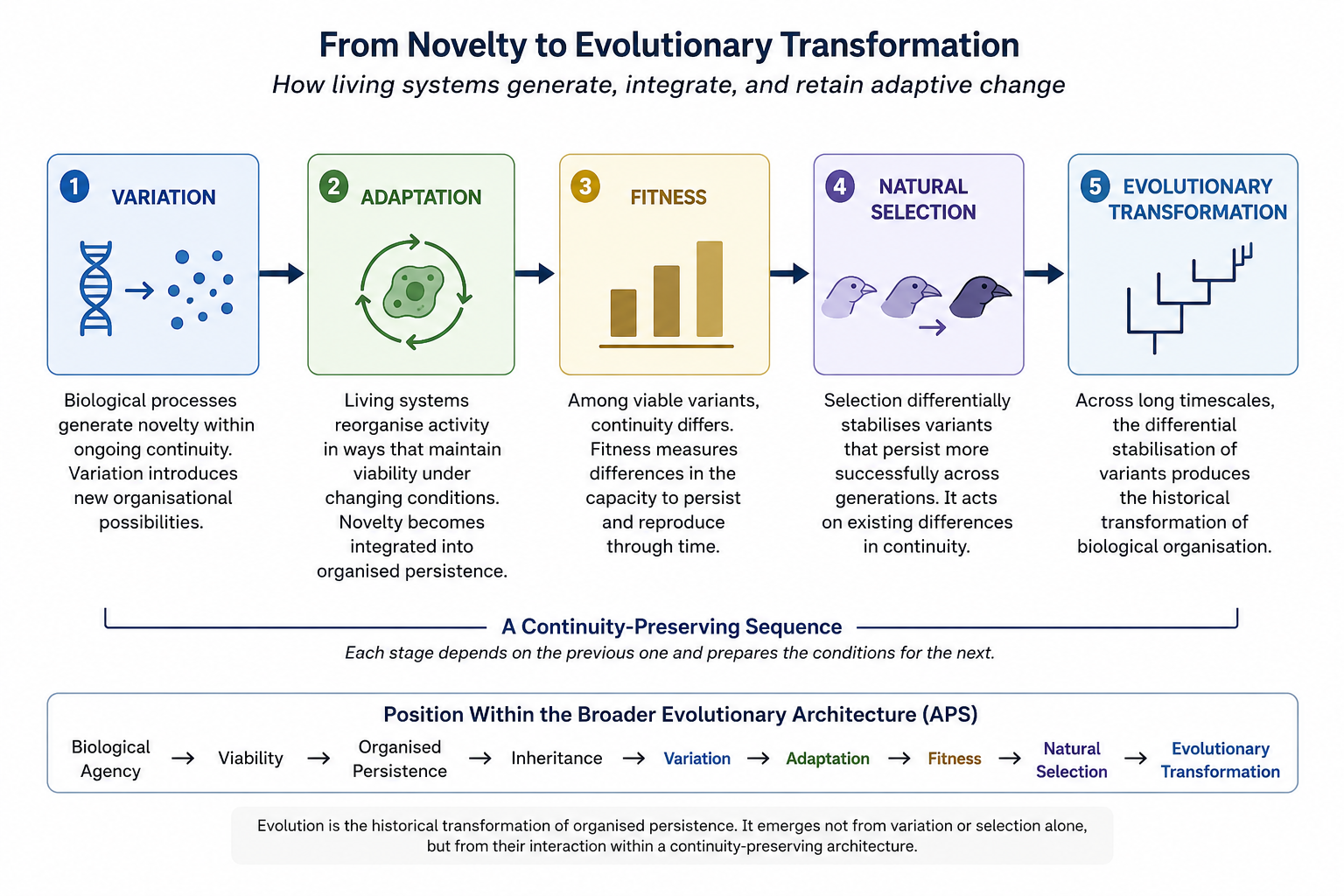
Evolutionary Concepts Visual. APS distinguishes variation, adaptation, fitness, and natural selection as successive explanatory moments within a continuity-preserving architecture. Variation introduces novelty, adaptation integrates novelty into viable persistence, fitness differentiates among viable variants, and natural selection differentially stabilises those variants across evolutionary time.
Continue Exploring
- Inheritance and Continuity in APS
- Selection Revisited — What Does Selection Actually Act On?
- Adaptation — How Living Systems Sustain Themselves Through Change
- What Is evolution in APS?
Key Point
Variation in APS is the structured generation of differences within inherited lineages of persistence-sustaining organisation. It introduces the novelty upon which fitness and natural selection operate, linking lineage continuity in the present to evolutionary transformation through time.
See Also
Related Articles
References
- (2003). Niche Construction: The Neglected Process in Evolution. Princeton University Press.
- (2026). Agency as the defining activity of life: A viability-oriented framework integrating process and scale. Biological Theory . https://doi.org/10.1007/s13752-026-00547-6
- (2015). Organisms, Agency, and Evolution. Cambridge University Press.
- (2003). Developmental Plasticity and Evolution. Oxford University Press.