Evolution, Taxonomy, and the Reorganisation of Biological Explanation
Taxonomy and evolutionary theory remain distinct scientific enterprises, but their explanatory targets frequently intersect around historically organised biological continuity. APS uses organised persistence to examine what remains sufficiently continuous for evolutionary transformation to constitute a history rather than mere succession or replacement. Species and lineages make this problem especially important because genealogical, reproductive, developmental, ecological, and genetic histories need not coincide. Contemporary multidimensional approaches to phylogeny sharpen this question by challenging the assumption of a single absolute evolutionary history. APS accommodates such complexity without treating organised persistence as a new evolutionary mechanism, requiring process ontology, or construing biological organisation as a hierarchy of causal levels. Process asks how continuity is maintained despite change; Scale asks where persistence relevant to an explanandum is organised across spatial and temporal extents. Whether this organisational analysis provides explanatory gain beyond established evolutionary and phylogenetic explanations remains a comparative question.
Introduction
Where This Article Fits
This article extends the APS account of organised persistence into evolutionary time. It asks what persists through evolutionary transformation, how species and lineages can be understood as historical continuities, and how taxonomy and phylogenetic explanation relate to those continuities.
Its purpose is not to provide an alternative theory of evolution, species, or phylogeny. Existing evolutionary, phylogenetic, population-genetic, developmental, ecological, and systematic explanations retain their own targets, mechanisms, and evidential requirements. APS instead asks when the persistence and transformation of biological organisation itself becomes an explanatory target and whether making that target explicit provides explanatory gain.
The article therefore connects the APS projections of Process and Scale with the historical transformation of living organisation. Process asks how continuity is maintained despite change; Scale asks where the persistence relevant to an explanandum is organised across spatial and temporal extents. Evolutionary history can make both questions salient, but neither projection is an independent cause, entity, domain, or hierarchical level.
Taxonomy and evolutionary theory are often presented as distinguishable biological enterprises. Taxonomy identifies, names, and organises biological diversity, while evolutionary theory explains how biological forms originate, persist, diverge, and change through time. Modern systematics has profoundly integrated classification with evolutionary history, yet important differences remain between identifying historical continuities and explaining the processes through which those continuities are generated and transformed.
APS approaches this relationship through the explanatory target of organised persistence. Living systems maintain forms of organisation through continual material change, while reproduction extends biological continuity beyond the lifetime of individual organisms. Evolutionary history consequently involves both continuity and transformation: something must persist sufficiently for inherited differences, divergence, selection, and other evolutionary processes to have histories at all, while that persistence is continually modified through evolutionary change.
Taxonomy and evolution can therefore address related aspects of historically extended biological organisation without becoming equivalent enterprises. Taxonomy identifies and systematises biological continuities relevant to classification. Evolutionary theory investigates the histories and mechanisms through which biological organisation is reproduced, diversified, transformed, and sometimes lost. APS does not replace either enterprise. It asks how their explanatory targets are related and whether making organised persistence explicit clarifies that relationship.
Organised Persistence and Historical Continuity
Living organisation persists through change rather than through material invariance. Organisms continually replace components, alter physiological states, develop, respond to environmental conditions, and reorganise activity while maintaining sufficient continuity to remain viable living systems. Reproduction extends a different form of continuity across generations, enabling inherited organisation to be reproduced with variation.
Evolutionary explanation therefore necessarily has a historical dimension, but historical continuity should not be equated with simple sameness. Biological persistence can include transformation. Development, reproduction, ecological interaction, inheritance, and evolutionary change can modify biological organisation while preserving relations sufficient for histories to remain connected.
APS uses organised persistence to bring this relationship between continuity and transformation into explanatory focus. The term does not identify an additional evolutionary mechanism or a substance upon which evolution acts. It identifies a possible explanandum: how materially realised biological organisation remains historically continuous while being reproduced, modified, diversified, or reorganised through time.
This distinction matters because continuity cannot simply be assumed from the persistence of a name, taxonomic category, gene, trait, population, or lineage designation. The relevant continuity must be specified for the explanatory question being asked. Different evolutionary explananda may therefore require attention to different materially realised relations and different temporal and spatial extents.
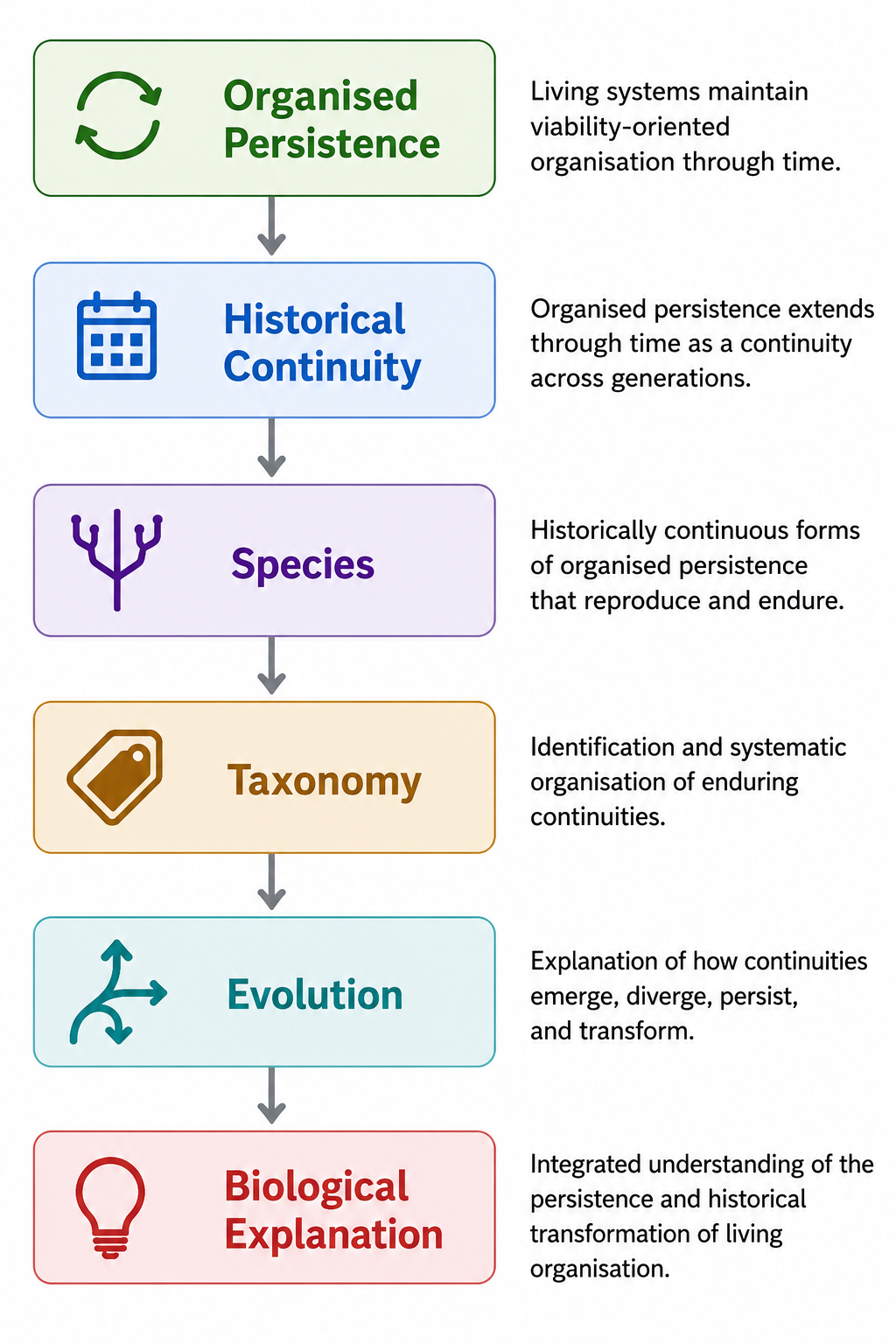
From Organised Persistence to Biological Explanation. APS treats organised persistence and its historical transformation as explanatory targets through which relationships among species, lineages, taxonomy, and evolutionary explanation can be investigated without treating them as a hierarchy of biological levels.
Species as Historical Continuities
Species occupy a distinctive place in evolutionary biology because species concepts must accommodate both continuity and change. Species are not ordinarily understood simply as collections of organisms sharing an invariant set of properties. Lineage-based approaches instead emphasise historically extended descent and the processes through which populations remain connected or diverge through time (de Queiroz 1998).
APS is compatible with this historical emphasis but adds a narrower explanatory question. If a species is treated as a historically extended lineage, what materially realised continuity makes that lineage the relevant persistence for the explanandum under investigation?
The answer need not be the same for every biological question. Reproductive relations, genealogical descent, ecological organisation, developmental organisation, genetic continuity, population structure, and other processes may contribute differently depending upon what is being explained. APS therefore should not turn organised persistence into another universal species criterion. Rather, it asks which forms of biological organisation actually sustain the continuity relevant to a particular case.
Species can consequently be understood as historically extended continuities without being treated as static essences. Their histories involve inheritance, reproduction, variation, ecological interaction, divergence, and transformation. Taxonomic practice seeks to identify and represent such continuities, while evolutionary explanation investigates how they arise and change.
Lineages and the Problem of Historical Continuity
The concept of lineage makes the relationship between persistence and evolutionary history especially clear, but it also exposes an important explanatory difficulty. A lineage is historical by definition, yet the relevant historical continuity cannot always be assumed to consist in one simple, undivided genealogy.
Contemporary phylogenetics increasingly confronts histories involving different biological organisations and processes whose trajectories need not coincide. Gene histories may differ from organismal or species histories; horizontal processes can complicate strictly branching representations; and biological relations relevant to phylogeny can extend across different spatial and temporal extents.
Kearney and Haber (2026) develop this problem explicitly. They argue that contemporary phylogeny is better understood as a multidimensional processual system rather than as a single absolute history, incorporating spatial, temporal, and hierarchical dimensions together with vertical and horizontal processes, emergence, constraint, and interacting lineage histories. They interpret these developments as supporting process ontology as a foundation for contemporary phylogenetics.
APS can accept the explanatory importance of historically extended, dynamically changing, and differently distributed phylogenetic relations without requiring that stronger ontological conclusion. Nor does APS need to assume that the relevant organisation forms a hierarchy of causally efficacious levels. Its question is more specific: where is the persistence relevant to the phylogenetic explanandum organised, and which materially realised relations across those spatial and temporal extents make an explanatory difference?
This reframes lineage persistence as a target-sensitive problem. There need not be one privileged scale at which the real lineage resides, nor need every relation occurring across different extents be included in every explanation. What matters is whether particular genealogical, reproductive, developmental, ecological, genetic, or other relations contribute to explaining the continuity and transformation specified by the explanandum.
Kearney and Haber’s multidimensional phylogeny therefore provides a valuable contemporary comparator for APS. Both approaches resist an overly static representation of evolutionary history and take distributed historical relations seriously. They differ, however, in explanatory architecture. Kearney and Haber explicitly employ process ontology and a hierarchical dimension; APS treats Process and Scale as analytic projections and requires the explanatory relevance of relations across spatial and temporal extents to be materially demonstrated rather than inferred from their position within a hierarchy.
What Evolves?
Asking what constitutes historical continuity leads naturally to the question: what evolves?
Evolutionary theory supplies well-established accounts involving variation, inheritance, drift, selection, developmental processes, population structure, ecological interaction, and many other mechanisms. APS does not propose organised persistence as a replacement evolutionary mechanism or as a competing evolutionary unit.
Instead, the question concerns the explanandum. Evolutionary change requires histories in which earlier and later biological states are related in ways that make transformation, rather than mere succession or replacement, intelligible. Genes, traits, organisms, populations, species, symbioses, and other biological organisations can each become relevant to evolutionary explanation depending upon the phenomenon under investigation.
Organised persistence provides a way of asking what continuity makes such transformation historically coherent. Variation modifies something already organised; inheritance establishes relations between earlier and later biological organisation; selection differentiates among heritable variants under specified conditions; developmental processes contribute to the production of phenotypes; ecological relations alter conditions under which biological forms persist and reproduce. None of these mechanisms is reduced to persistence, and persistence itself does not cause evolutionary transformation.
The APS question is therefore not answered simply by saying that organised persistence evolves. It is answered by identifying which organisation persists, through which materially realised relations, across what temporal and spatial extents, and how the mechanisms specified by evolutionary theory transform that organisation.
This formulation also allows different evolutionary questions to have different answers. What persists in explaining the evolution of a gene family need not be identical to what persists in explaining a species lineage, a developmental system, a host–symbiont association, or a major evolutionary transition. Explanatory adequacy depends upon the target rather than upon assigning all evolutionary phenomena to one privileged unit or level.
Evolution as the Historical Transformation of Organised Persistence
APS can therefore describe evolution, at a sufficiently general explanatory level, as the historical transformation of organised persistence. This formulation does not constitute a definition intended to replace standard evolutionary theory. It identifies a relationship between continuity and transformation that evolutionary explanations often presuppose and sometimes need to make explicit.
Historical transformation requires both difference and continuity. If nothing relevant persists between earlier and later states, there is no single historical transformation to explain. If nothing changes, there is no evolutionary transformation. Evolutionary histories therefore involve continuities that are reproduced while being modified.
The mechanisms producing those histories remain the mechanisms identified by evolutionary science. Variation, inheritance, mutation, recombination, drift, selection, developmental processes, ecological interaction, migration, horizontal transfer, and other processes make different contributions in different cases. APS does not combine them into a single organisational mechanism. It asks how their operation produces, modifies, maintains, divides, or terminates the historical continuities relevant to the explanandum.
This perspective also helps clarify evolutionary novelty. Novel forms do not appear outside history. They arise through transformations of existing biological organisation, even when the resulting organisation differs substantially from its predecessors. Major evolutionary transitions, speciation, developmental innovation, and new forms of biological individuality can therefore be investigated partly by asking which continuities are maintained, which are reorganised, and which new dependencies become capable of persistence.
Organised persistence thus provides an explanatory perspective on evolutionary continuity without making persistence itself the mechanism of evolution.
Taxonomy as the Representation of Historical Continuity
Taxonomy requires sufficiently stable biological reference points for organisms and histories to be identified, compared, and communicated. Evolutionary systematics, cladistics, phylogenetics, and lineage-based species concepts have progressively incorporated historical relations into classification, although taxonomic practice remains methodologically diverse.
APS treats classification as dependent upon biological continuities rather than as constituting those continuities. A taxonomic category does not make a lineage persist. Instead, classification attempts to identify and represent patterns within biological history using criteria appropriate to particular systematic purposes and evidence.
This does not make taxonomy merely conventional. Historical relations, descent, reproductive structure, morphological and molecular evidence, and other biological features constrain defensible classifications. At the same time, no APS principle guarantees that every taxonomic rank corresponds to a distinct form of viability-oriented organisation or to a natural hierarchy of biological levels.
This distinction becomes particularly important in light of multidimensional approaches to phylogeny. If different biological histories can intersect, diverge, or require representation across different extents, taxonomy cannot simply be assumed to map one uniquely ordered hierarchy of biological reality. Its classifications must instead be evaluated against the historical and biological relations they are intended to represent.
APS therefore approaches taxa as explanatory and classificatory instruments constrained by real biological histories. Their scientific value lies in enabling biological continuities and divergences to be identified, compared, communicated, and investigated without confusing the classificatory representation with the organisation being represented.
Taxonomy and Evolution as Complementary Explanatory Perspectives
Taxonomy and evolutionary theory can now be related without collapsing one into the other. Both engage with historically extended biological organisation, but they ask different questions and employ different explanatory resources.
Taxonomy foregrounds identification and representation of continuity and difference. Evolutionary theory foregrounds explanation of the processes through which biological histories arise, diverge, transform, and sometimes terminate. Phylogenetics occupies an especially important position between these enterprises because reconstructing historical relationships contributes both to systematic representation and to evolutionary explanation.
APS therefore does not claim that taxonomy and evolution have one identical subject matter in every operational sense. The more defensible claim is that their explananda frequently intersect around historically organised biological continuity. Making that intersection explicit can clarify why changes in evolutionary understanding reshape classification and why systematic evidence can generate new evolutionary questions.
Species and lineages illustrate the relationship particularly clearly. Their histories provide objects of classification, but those histories themselves require evolutionary explanation. Conversely, evolutionary claims require ways of identifying the continuities and divergences whose histories are being reconstructed. Classification and explanation are therefore distinct but mutually informative activities directed toward overlapping aspects of biological history.

Taxonomy and Evolution as Complementary Perspectives. Taxonomy identifies and represents historical biological continuities relevant to classification, while evolutionary theory explains how such continuities arise, diverge, persist, and transform. APS investigates their intersection through organised persistence without reducing either enterprise to the other.
Process, Scale, and Evolutionary Explanation
Evolution makes the distinction between Process and Scale especially important.
Process asks how continuity is maintained despite change. In evolutionary contexts, this can include questions about reproduction, inheritance, developmental reconstruction, lineage continuity, and the maintenance or reorganisation of biological relations through historical transformation.
Scale asks where the persistence relevant to the explanandum is organised across spatial and temporal extents. An evolutionary explanation may concern molecular relations, organisms, populations, species histories, ecological associations, or relations extending across generations and geological time. The explanatory relevance of these extents depends upon the target.
Neither projection establishes a causal hierarchy. Scales do not act upon one another, and wider extents do not supersede local causal processes. Where relations extending beyond a local boundary alter what occurs locally, the explanation should identify the materially implemented interactions, constraints, inheritances, environmental conditions, or other relations through which that difference is produced.
This provides an important point of comparison with Kearney and Haber’s multidimensional conception of phylogeny. APS can agree that contemporary evolutionary histories may require more than a single linear or exclusively vertical representation while remaining neutral about whether those relations should be organised ontologically as a hierarchy. The APS requirement is explanatory: include the spatial and temporal extent necessary to explain the target, and specify the materially realised relations through which that extent matters.
The result is neither methodological individualism nor an automatic preference for wider explanation. A local evolutionary account may be sufficient for one explanandum; another may require genealogical, ecological, developmental, or historical relations extending considerably further. Scale is therefore an explanatory question about the organisation of persistence, not an instruction to seek a highest or most inclusive biological level.
Towards a Reorganisation of Biological Explanation
The relationship between taxonomy and evolution illustrates a broader APS proposal. Biological disciplines remain scientifically distinct because they address different explananda, use different methods, and identify different mechanisms and evidential relations. APS does not seek to replace those distinctions with a single universal explanatory scheme.
Organised persistence can nevertheless reveal connections among some of their explanatory targets. Physiology may investigate activities through which organismal organisation is maintained. Development investigates transformations through which organisms acquire and reorganise form. Ecology investigates relations affecting organisms and populations under environmental conditions. Evolutionary biology investigates historical transformation across generations. Taxonomy and systematics identify and represent biological continuities and relationships.
These enterprises need not be redescribed as instances of one mechanism or arranged into an APS hierarchy. Their connection is explanatory rather than reductive: different biological questions can concern different aspects of how living organisation persists, changes, reproduces, diverges, or ceases to persist.
This is also why APS must earn rather than assume explanatory gain. If an existing phylogenetic, population-genetic, developmental, ecological, or mechanistic explanation already fully explains the specified target, redescribing its subject as organised persistence adds no explanatory content. APS becomes useful only where explicitly analysing the organisation, continuity, dependencies, or spatial and temporal extent of persistence resolves an explanatory question that the comparator leaves open.
The multidimensional phylogenetic problems identified by Kearney and Haber provide a useful test. If existing phylogenetic theory already specifies the relevant histories and relations adequately, APS should not claim improvement merely because those relations can be redescribed organisationally. If, however, a particular explanandum depends upon clarifying what persists across non-coincident histories, how different relations jointly sustain lineage continuity, or why a wider spatial or temporal extent is explanatorily required, APS may provide a useful comparative analysis. The difference must be demonstrated case by case.
Explanatory Architecture
Central Question
How are biological continuity, classification, lineage history, and evolutionary transformation related when living organisation is considered across historical time?
Architectural Role
This article extends organised persistence from organismal continuity into evolutionary and systematic explanation. It distinguishes the persistence relevant to evolutionary explananda from the mechanisms that produce evolutionary change and examines how taxonomy, species, lineages, and phylogenetic histories represent or explain different aspects of historical biological continuity.
It does not propose organised persistence as a new evolutionary mechanism, species criterion, unit of selection, or phylogenetic ontology.
Builds On
- Life as viability-oriented, constraint-closed organisation
- Agency
- Process
- Scale
- Organised Persistence
- Biological Organisation
- Biological Individuality
- Species
- Evolution
- Biological Explanation
Develops Into
- lineage persistence
- evolutionary Scale
- multiscale evolution and organised persistence
- species and species concepts
- phylogenetic explanation
- evolutionary individuality
- major evolutionary transitions
- comparative explanatory methodology in evolutionary biology
Related Explanatory Questions
- What persists through evolutionary transformation?
- What constitutes lineage continuity when different phylogenetic histories do not coincide?
- Which biological relations sustain the continuity relevant to a particular evolutionary explanandum?
- Where is that persistence organised across spatial and temporal extents?
- When do horizontal and vertical histories require different representations of evolutionary continuity?
- Does phylogenetic complexity require a hierarchy of biological levels?
- When does an organisational analysis provide explanatory gain beyond an existing evolutionary or phylogenetic explanation?
Position within APS
Agency, Process, and Scale are analytic projections of one viability-oriented, constraint-closed organisation rather than components of evolutionary reality. Evolutionary questions can extend these projections through historical time without converting them into causal levels.
Process concerns how continuity is maintained despite change. Scale concerns where persistence is organised across spatial and temporal extents. Evolutionary explanation may require both projections when the explanandum concerns historically extended transformation, but their relevance must be established rather than assumed.
Organised persistence is likewise an explanatory target, not an independent evolutionary cause. APS therefore complements rather than replaces evolutionary mechanisms and phylogenetic methods. Its contribution must be assessed by comparison with the strongest established explanation of the same target.
Corpus Significance
This article provides the principal APS bridge between organised persistence and historically extended evolutionary explanation. It establishes the conceptual route from organismal continuity to species, lineage, taxonomy, and phylogeny while preventing that extension from becoming either a hierarchy of biological levels or a claim that organised persistence replaces established evolutionary theory.
It also establishes Kearney and Haber (2026) as an important contemporary comparator: their multidimensional, process-ontological conception of phylogeny shares APS’s concern with historically extended and distributed biological relations while differing over the necessity of process ontology and hierarchical explanatory architecture.
Conclusion
Evolutionary biology and taxonomy encounter a common problem from different directions: biological history involves continuity through transformation. Classification requires identifiable continuities, while evolutionary explanation investigates how biological histories are generated, modified, diversified, and sometimes terminated.
APS approaches this relationship through organised persistence. The concept does not identify what evolution really is, supply an additional evolutionary mechanism, or establish a universal unit of evolution. It asks what biological organisation remains sufficiently continuous for a specified historical transformation to be intelligible and which materially realised relations sustain that continuity.
Species and lineages make this question especially important because their histories can extend across generations while involving genetic, reproductive, developmental, ecological, and other relations that need not form one simple or universally privileged history. Contemporary multidimensional approaches to phylogeny sharpen this problem by showing why evolutionary history cannot always be treated as a single absolute trajectory.
APS can accommodate that complexity without requiring process ontology or treating biological organisation as a hierarchy of causally efficacious levels. Process asks how continuity is maintained despite change; Scale asks where the relevant persistence is organised across spatial and temporal extents. Which relations and extents matter must be established for the explanandum under investigation.
Taxonomy and evolution therefore remain distinct scientific enterprises, but their explanatory targets can intersect around historically extended biological organisation. Making that intersection explicit may clarify the relationship among classification, lineage, phylogeny, and evolutionary transformation. Whether it provides explanatory gain beyond existing evolutionary explanations remains a comparative question to be demonstrated rather than assumed.
Key Point
Evolutionary transformation requires historically identifiable continuity, but APS does not treat that continuity as a single privileged level, lineage, or evolutionary mechanism. Organised persistence provides an explanatory target for asking what persists, through which materially realised relations, and across which spatial and temporal extents as biological organisation is historically transformed.
See Also
Related Articles
References
- (1998). The General Lineage Concept of Species, Species Criteria, and the Process of Speciation. Oxford University Press.
- (2018). A Manifesto for a Processual Philosophy of Biology. Oxford University Press.
- (1965). The Effect of Essentialism on Taxonomy: Two Thousand Years of Stasis. British Journal for the Philosophy of Science, 15(60), 314–326 .
- (2026). Common Ancestry, Contemporary Phylogenetics, and Process Ontology. Systematic Biology . https://doi.org/https://doi.org/10.1093/sysbio/syag053
- (2026). Agency as the Defining Activity of Life: A Viability-Oriented Framework Integrating Process and Scale. Biological Theory . https://doi.org/https://doi.org/10.1007/s13752-026-00547-6