What Is a Species in APS?
Species are indispensable to biological classification and evolutionary inquiry, yet what species are, how they should be delimited, and what explanatory roles they can play remain contested. APS approaches these questions by distinguishing historical biological continuity, species, and the scientific classifications through which species are identified. It interprets species concepts as attempts to track biologically significant patterns within evolving lineages while resisting both the treatment of species as fixed, context-independent kinds and their reduction to arbitrary classificatory labels. This perspective does not supply a uniquely correct species concept, determine species boundaries in advance, or establish that organised persistence has explanatory priority over established biological approaches. Instead, it provides an organisational framework within which questions of lineage continuity, species delimitation, classification, and evolutionary explanation can be distinguished and investigated.
Key Points
- Species, lineages, and species classifications are related but non-identical explanatory objects.
- APS interprets species concepts as attempts to track biologically significant patterns within historically changing lineages.
- Historical continuity does not by itself determine which species concept or delimitation criterion is appropriate in a particular biological case.
- Species boundaries may be sharp, graded, contested, or historically changing according to the biological relations and criteria relevant to the case.
- APS does not infer a universal pathway to species formation from inheritance, variation, development, adaptation, fitness, natural selection, or other evolutionary processes.
Where This Article Fits
This article extends the APS account of Evolutionary Dynamics to the problem of species and biological classification. Its purpose is not to replace established species concepts with an APS definition, but to clarify how questions about species change when historical biological continuity, species delimitation, and scientific classification are treated as related but distinct explanatory problems.
Within APS, evolutionary history concerns the persistence and transformation of living organisation through time. Species concepts can be understood as attempts to identify biologically significant patterns within that history, but the existence of historical continuity does not by itself determine where species boundaries should be drawn, which criteria should be used to recognise them, or what causal and explanatory roles species may have. Those questions remain matters for biological investigation and for explicit comparison among alternative species concepts.
The article therefore connects APS with the species problem without treating APS architecture as a substitute for species biology. Inheritance, variation, development, adaptation, natural selection, ecology, and other processes may all matter to lineage continuity, divergence, and speciation, but their relevance and relationships must be established for the biological case and explanatory question concerned.
Introduction — What Is the Species Question?
Few concepts are as familiar in biology as species, yet few have generated such persistent disagreement about their meaning and application. Biologists routinely identify species, reconstruct their histories, compare their characteristics, investigate their origins, and use them to organise knowledge of biological diversity. At the same time, reproductive, phylogenetic, ecological, morphological, genetic, and other approaches can emphasise different features when species are recognised or delimited.
This plurality does not necessarily show that species are unreal or that biological classification is arbitrary. Nor does it follow that one criterion must capture everything biologically important about species. An influential response to the species problem has been to distinguish a more general conception of species from the operational criteria used to recognise or delimit them. Mayden’s hierarchical treatment of primary and operational species concepts and de Queiroz’s distinction between a general lineage concept and species criteria are important attempts to separate questions about what species are from the criteria used to recognise or delimit them.
For APS, this provides an important starting point. The central question is not simply, “What definition should APS give to species?” It is instead: what biological continuities and differences are species concepts intended to identify, and what follows when those phenomena are considered within an organisational and historical account of life?
Approaching the question in this way prevents APS from treating an existing taxonomic category as though it were automatically a fundamental biological entity. Equally, however, it prevents the opposite mistake of treating species as nothing more than names imposed upon an otherwise unstructured evolutionary continuum. Biological history exhibits structure, continuity, divergence, interaction, and transformation. Species inquiry concerns how scientifically significant patterns within that history should be identified and explained.
What Species Concepts Are Trying to Track
The long-standing diversity of species concepts reflects, in part, the fact that different biological properties become informative in different organisms and explanatory contexts. Reproductive relations may be especially important in some cases, phylogenetic history in others, while ecological differentiation, morphology, genetic divergence, or combinations of evidence may become relevant elsewhere. Difficulties arise when a criterion that is informative for one purpose or biological system is assumed to provide a universal definition applicable without qualification across all of life.
The distinction between a species concept and a species criterion is therefore important. De Queiroz’s general lineage approach is particularly relevant because it argues that many apparent disagreements among species concepts arise from treating properties used as criteria for recognising or delimiting species as though they were themselves competing definitions of what species fundamentally are. On this account, properties such as reproductive isolation, diagnosability, ecological differentiation, or monophyly can develop at different points during lineage divergence and need not coincide.
APS should not redescribe this existing insight as an original consequence of its own framework. The significance for APS is instead methodological. If species identification concerns historically developing biological relations, then the classificatory criteria appropriate to a particular case cannot be inferred merely from the position of species within a conceptual architecture. They must be connected to the biological history and explanatory purpose for which the classification is being used.
This shifts attention from the search for a single timeless diagnostic property toward the relationships among historical continuity, biological differentiation, and scientific delimitation. It also leaves open the possibility that different criteria can legitimately illuminate different aspects of the same evolutionary history without implying that all classifications are equally adequate or that species have no biological basis.
Species, Lineages, and Classification
Three objects that are easily conflated must be distinguished: lineages, species, and species classifications.
A lineage concerns historical biological continuity. Organisms arise from prior organisms, populations have histories, and biological organisation is reproduced and transformed through time. Such historical relations exist whether or not scientists subsequently delimit, name, or classify them. Classification therefore does not create the historical processes upon which it operates.
A species is not, however, simply synonymous with a lineage. Lineages can be individuated at different extents and for different biological purposes, and not every historical continuity thereby constitutes a species. De Queiroz’s lineage-oriented account provides one influential way of understanding species as segments of population-level lineages, but that proposal belongs to an established biological debate rather than following automatically from APS.
Nor should a species be equated with its classification. Species classification is the scientific activity through which biologically significant groupings or patterns are identified, delimited, named, and related to one another. The classification is therefore an epistemic and scientific representation of biological organisation and history, even when what it tracks is biologically real.
This distinction also prevents APS from resolving the ontology of species by stipulation. Hull’s influential argument that species can be understood as spatiotemporally extended individuals and potential units of evolution illustrates how much is at stake in moving from questions of classification to claims about what species themselves are. APS need not decide in advance whether species are best understood as individuals, kinds, classes, lineage segments, population-level entities, or through some other ontology. What it can require is that these alternatives not be conflated with the classificatory practices through which species are recognised.
The resulting position is deliberately modest but important: historical biological continuity, species, and species classifications are related, but they are not identical explanatory objects.
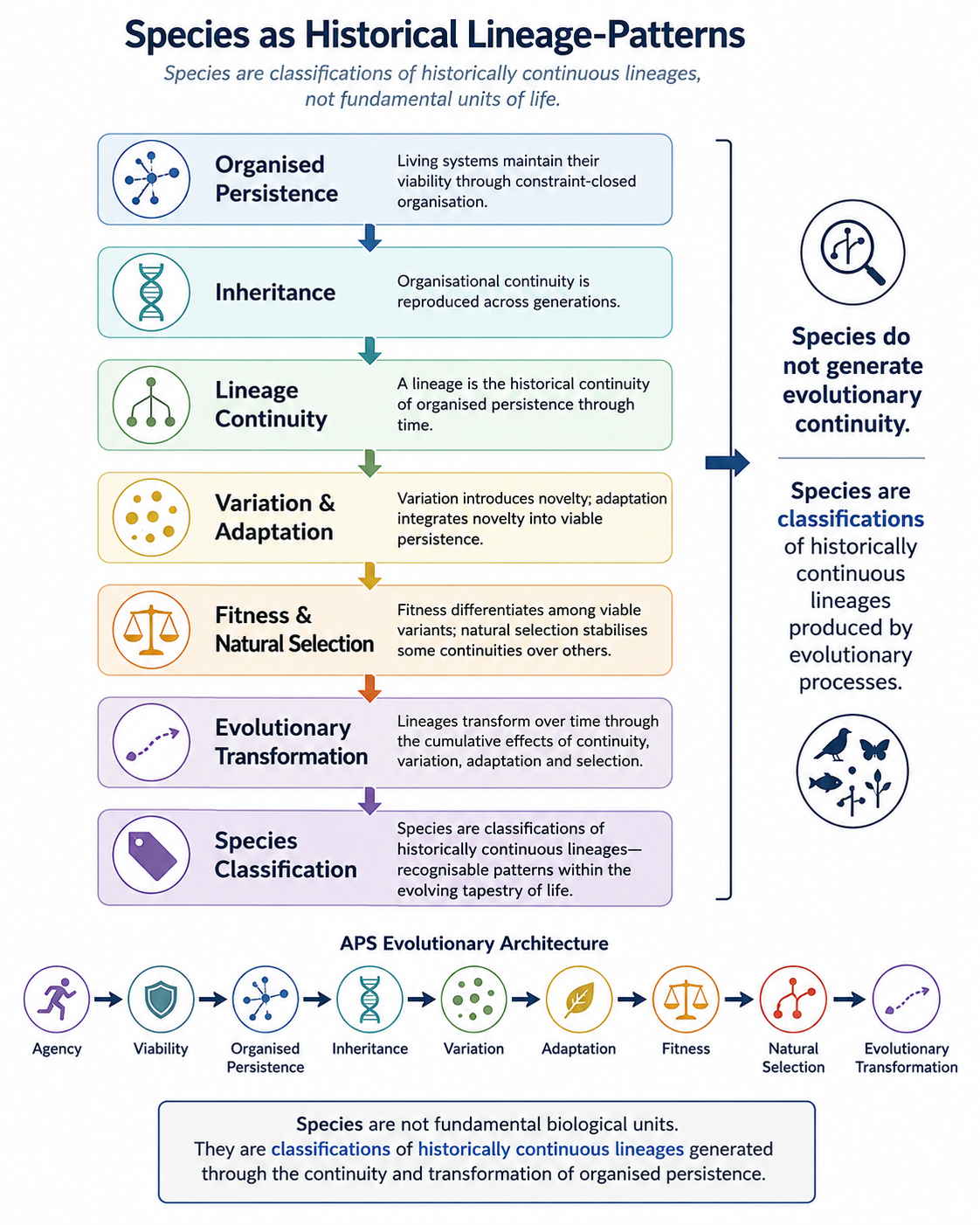
Species and Evolutionary Lineages. Species can identify biologically significant patterns within historical lineage continuity without implying that every species arises through the same causal pathway or temporal sequence.
The APS Interpretation — Historical Patterns of Organised Persistence
APS begins from living organisation rather than from taxonomic categories. Living systems persist through viability-oriented, constraint-closed organisation, while evolution concerns the historical transformation of such organisation. From this perspective, the history within which species are identified is not simply a succession of static forms but an ongoing pattern of biological continuity and change.
Species concepts can therefore be investigated as attempts to identify significant patterns within the historical continuity and transformation of living organisation. This provides an APS interpretation of the species problem, but it should not be mistaken for a new universal definition of species. To say that species inquiry concerns historically organised continuity is not yet to say which continuities constitute species, which differences establish their boundaries, or which species criterion should be used.
The concept of organised persistence contributes a particular explanatory orientation. It directs attention to how living organisation is maintained and transformed through time, and therefore to the biological histories within which recurrent lineage-patterns can become identifiable. This can help relate species questions to broader questions about evolutionary continuity without turning species into fixed categories detached from the processes that produce biological history.
The qualification is crucial. Organised persistence does not acquire explanatory priority simply because it is central to APS. A phylogenetic reconstruction, population-genetic analysis, reproductive criterion, ecological account, or other biological approach may provide the explanation required for a particular species-related question. APS must therefore be assessed against the explanandum and the strongest relevant comparator rather than assumed to provide explanatory gain because it embeds species within a broader organisational vocabulary.
Species Boundaries and Historical Change
Species boundaries become especially informative when classification encounters biological change. If lineage differentiation occurs through time, properties used to recognise species need not arise simultaneously. Reproductive separation, ecological differentiation, morphological distinction, genetic divergence, and phylogenetic diagnosability may become evident at different stages or may have different significance in different biological systems.
This is one reason that disagreements over species delimitation cannot always be resolved by searching for a single property that must be present in every case. It does not follow, however, that all species boundaries are inherently vague or that APS predicts that boundaries must always be graded. Some biological cases may support relatively clear delimitations, whereas others may remain contested, changing, or dependent upon the criteria relevant to the investigation.
APS can accommodate this diversity because its account of evolution does not require historically changing organisation to fall naturally into timeless classificatory compartments. At the same time, the framework provides no licence to treat every possible delimitation as equally satisfactory. Classifications remain answerable to biological evidence, historical relations, and the explanatory purposes for which they are constructed.
Species boundaries should therefore be investigated rather than prescribed by the framework. Where different criteria yield different delimitations, the explanatory task is to determine what each criterion tracks, how those tracked properties arose, and which distinctions matter to the question under investigation. Historical change makes classification difficult in some cases, but it also supplies the biological structure that makes species inquiry scientifically meaningful.
Species in Evolutionary Explanation
The relationship between species and evolutionary explanation is more complex than the claim that species are simply products of a fixed sequence of evolutionary processes. Inheritance, variation, development, adaptation, natural selection, ecological interaction, genetic change, and other processes can contribute to lineage continuity and divergence, but their relationships differ among organisms, histories, environments, and explanatory targets.
APS therefore does not infer a universal causal pathway to species formation from the ordering of concepts within its evolutionary architecture. Inheritance concerns forms of continuity across generations; variation concerns differences arising within historical continuity; adaptation, fitness, and natural selection identify other evolutionary relations; development and ecology can contribute in ways that are indispensable in particular cases. None of these conceptual distinctions establishes by itself that every species must arise through the same dependency structure or temporal sequence.
The same control applies to the causal status of species. It would be too strong to say that species are merely outcomes of evolution and can never enter evolutionary explanations as causally or explanatorily relevant entities. Hull’s treatment of species as individuals and possible units of evolution provides a direct reason not to settle that issue by definition. Whether species-level organisation contributes causally to a particular evolutionary phenomenon is an empirical and theoretical question.
APS can nevertheless clarify an important distinction. Naming or delimiting a species does not by itself explain the historical processes through which the relevant biological pattern arose, persisted, or changed. Species classification can identify an explanandum without supplying its causal explanation. Conversely, a process explaining lineage divergence does not by itself determine how the resulting diversity should be classified.
This separation of tasks allows species to remain important within evolutionary explanation without requiring them to be either fundamental causes of evolution or merely passive labels attached to its products.
Scale and Explanatory Extent
Species have often been discussed as though they occupied a particular level in a biological hierarchy, situated above organisms and populations but below larger evolutionary or ecological groupings. APS does not require this picture. Scale concerns the spatial, temporal, and organisational extent over which biologically relevant relations are investigated, not a fixed ladder of entities to which explanatory priority can be assigned.
Species questions can consequently extend across many biological relations. A delimitation problem may concern reproductive interactions among organisms, genetic structure within and among populations, ecological differentiation, developmental variation, or phylogenetic relationships extending across long periods of evolutionary history. Different questions can therefore require attention to different spatial and temporal extents without implying that the species itself occupies a privileged intermediate scale.
This matters because scale can otherwise be mistaken for explanation. Locating a pattern at a population, lineage, ecological, or historical extent does not determine which causes generated it or which explanatory description is most adequate. Nor does APS require causal influence to be equal or reciprocal across all relevant extents. Strong causal asymmetries may occur, but they must be established by biological evidence rather than inferred from the APS triad.
The appropriate scale of a species explanation is therefore determined by the explanandum. APS contributes by making that choice explicit and by discouraging the assumption that the name of a biological entity already determines the spatial, temporal, or organisational extent at which it should be explained.
What APS Adds — and What It Does Not Establish
The principal contribution of APS to the species problem is not a new criterion for species recognition. Existing biological work already provides sophisticated lineage concepts, multiple operational criteria, and extensive debate over species ontology. In particular, the historical and lineage-oriented character of species cannot be claimed as a distinctive APS discovery.
APS instead contributes a way of relating species inquiry to a broader account of living organisation while preserving distinctions that are easily collapsed. Historical biological continuity is not identical with a species; a species is not identical with its scientific classification; and a classification does not itself explain the biological processes responsible for the pattern it identifies. By placing these distinctions within an account of organised persistence and historical transformation, APS can help specify what kind of question is being asked before competing explanations are compared.
That organisational framing also imposes limits. APS does not establish a uniquely correct species concept, determine species boundaries in advance, show that every species has the same ontological status, or demonstrate that species can never function as evolutionary units. It does not establish that inheritance, variation, development, adaptation, fitness, natural selection, and ecology form a universal causal sequence leading to species formation. Nor does it make organised persistence explanatorily superior merely because species can be redescribed in organisational terms.
Any stronger claim of explanatory gain would require comparison with the strongest existing account of the same explanandum. For questions concerning the relation between species concepts and criteria, de Queiroz already supplies a demanding lineage-based comparator. For questions about the ontological and evolutionary status of species, Hull demonstrates that treating species themselves as historically extended entities has a substantial existing theoretical history. AAPS can claim explanatory gain only where its organisational analysis distinguishes relevant dependencies, resolves an explanatory problem, or otherwise improves explanation relative to the strongest comparator addressing the same explanandum.
The value of APS here is consequently methodological as well as conceptual. It keeps questions of historical continuity, species delimitation, classification, causal explanation, and scale sufficiently distinct that agreement at one level is not mistaken for an answer at another.
Species Within Evolutionary History
Species remain indispensable to biological science because they provide ways of identifying and investigating structured biological diversity through evolutionary history. Their scientific importance does not depend upon treating them as immutable natural kinds, but neither is it diminished by recognising that their delimitation can depend upon historically developing biological relations and the criteria relevant to particular investigations.
APS interprets species inquiry within the historical continuity and transformation of organised persistence. This perspective encourages attention to what species concepts track, how classifications relate to biological history, and which processes are relevant to the emergence and maintenance of the patterns being investigated. It does not determine those relations in advance.
The resulting account is therefore neither an eliminative view of species nor a claim that APS has solved the species problem. It is a framework for distinguishing questions that can otherwise be conflated. Lineages concern historical biological continuity; species identify biologically significant entities or patterns within evolutionary history according to substantive biological accounts; and species classifications provide scientific means of delimiting and organising them. The adequacy of any particular species concept or classification remains answerable to biological evidence and to the explanatory task for which it is used.
Within APS, species are consequently best approached not as fixed points in a predetermined evolutionary hierarchy, but as subjects of historically informed biological explanation whose identity, boundaries, causal roles, and classificatory treatment must be established rather than assumed.
Key Point
Species, lineages, and species classifications are related but non-identical. APS interprets species inquiry in relation to the historical continuity and transformation of living organisation, but this organisational framing does not determine species boundaries, impose a universal pathway to speciation, settle the ontology of species, or establish explanatory superiority over existing biological approaches.
See Also
Related Articles
References
- (1998). The General Lineage Concept of Species, Species Criteria, and the Process of Speciation: A Conceptual Unification and Terminological Recommendations. Oxford University Press. https://doi.org/10.1093/oso/9780195109009.003.0005
- (1976). Are Species Really Individuals?. Systematic Zoology, 25(2), 174–191 . https://doi.org/10.2307/2412744
- (1997). A Hierarchy of Species Concepts: The Denouement in the Saga of the Species Problem. Chapman & Hall.
- (2026). Agency as the Defining Activity of Life: A Viability-Oriented Framework Integrating Process and Scale. Biological Theory . https://doi.org/10.1007/s13752-026-00547-6