Biological Explanation — What Needs to Be Explained
This article clarifies what makes explanation distinctively biological by arguing that biological inquiry is ultimately concerned with organised persistence: the capacity of living systems to maintain continuity through continual transformation. APS proposes that viability-oriented, constraint-closed organisation provides the organisational basis through which organised persistence is achieved, sustained, and transformed across time.
What Does Biology Explain?
Biology is often described as the science of life. But this leaves open a deeper question: what does biological explanation actually explain?
Standard answers point to mechanisms, components, or processes. Biology explains how genes are expressed, how metabolic pathways operate, how organisms develop, and how populations evolve. These explanations have achieved extraordinary success.
Yet they often proceed without specifying what makes their subject matter distinctively biological. They describe how systems behave, but not what makes those systems living.
The central question is therefore not only how biological systems work, but what kind of biological organisation must be in place for such explanations to be meaningful.
APS proposes organised persistence as a principal explanatory target for understanding living organisation: the capacity of living systems to maintain continuity through continual transformation. Living systems are not merely collections of interacting components. They are organised systems that sustain themselves through ongoing change.
For a guided entry into how APS develops biological explanation, see:
→ How APS Explains Life — A Two-Step Guide
Mechanism and Its Limits
Much of modern biology is organised around mechanistic explanation.
Mechanistic accounts identify parts, specify their interactions, and show how these interactions produce observable outcomes. This approach has been highly productive, especially in molecular and cellular biology.
However, mechanism alone does not explain why a system is a living system rather than a complex physical arrangement.
A mechanism can operate without sustaining itself. It can produce outputs without maintaining the conditions required for its own continued operation. In such cases, the system remains externally grounded: its persistence depends on conditions imposed from outside.
Living systems differ in a crucial respect. Their processes contribute to maintaining the very conditions that allow those processes to continue.
Mechanistic description can clarify how organised persistence is enacted. Where the explanatory question concerns living organisation as such, APS additionally asks how those mechanisms participate in maintaining the conditions under which the living system persists.
APS therefore supplements mechanistic inquiry with an organisational question without treating mechanistic explanations as intrinsically incomplete. The relevance of that additional question depends upon the explanandum.
From Description to Explanation
This distinction reveals a deeper issue.
Descriptions catalogue what happens. Explanations account for why it happens in a way that is characteristic of the system under study.
In biology, description often precedes explanation. We identify structures, trace pathways, and measure changes. But without a clear account of what makes these processes biologically organised, such descriptions risk remaining incomplete.
Where the explanandum concerns what makes those mechanisms part of a living system, APS asks how they participate in biological organisation rather than treating their mechanistic description alone as sufficient for that particular question.
The question is not simply:
What happens?
but:
Why do these processes contribute to the persistence of a living system?
Answering that question requires identifying the organisational conditions that make biological continuity possible.
Organised Persistence as the Explanatory Target
The APS framework clarifies this target.
Biology is ultimately concerned with systems that maintain themselves through time. Living systems grow, repair, regulate, adapt, reproduce, and evolve, yet throughout these transformations they preserve forms of organisational continuity.
This capacity for continuity through change is what APS calls organised persistence.
Organised persistence is therefore a central explanatory target within APS.
Understanding how living systems persist requires understanding the organisational conditions that make persistence possible.
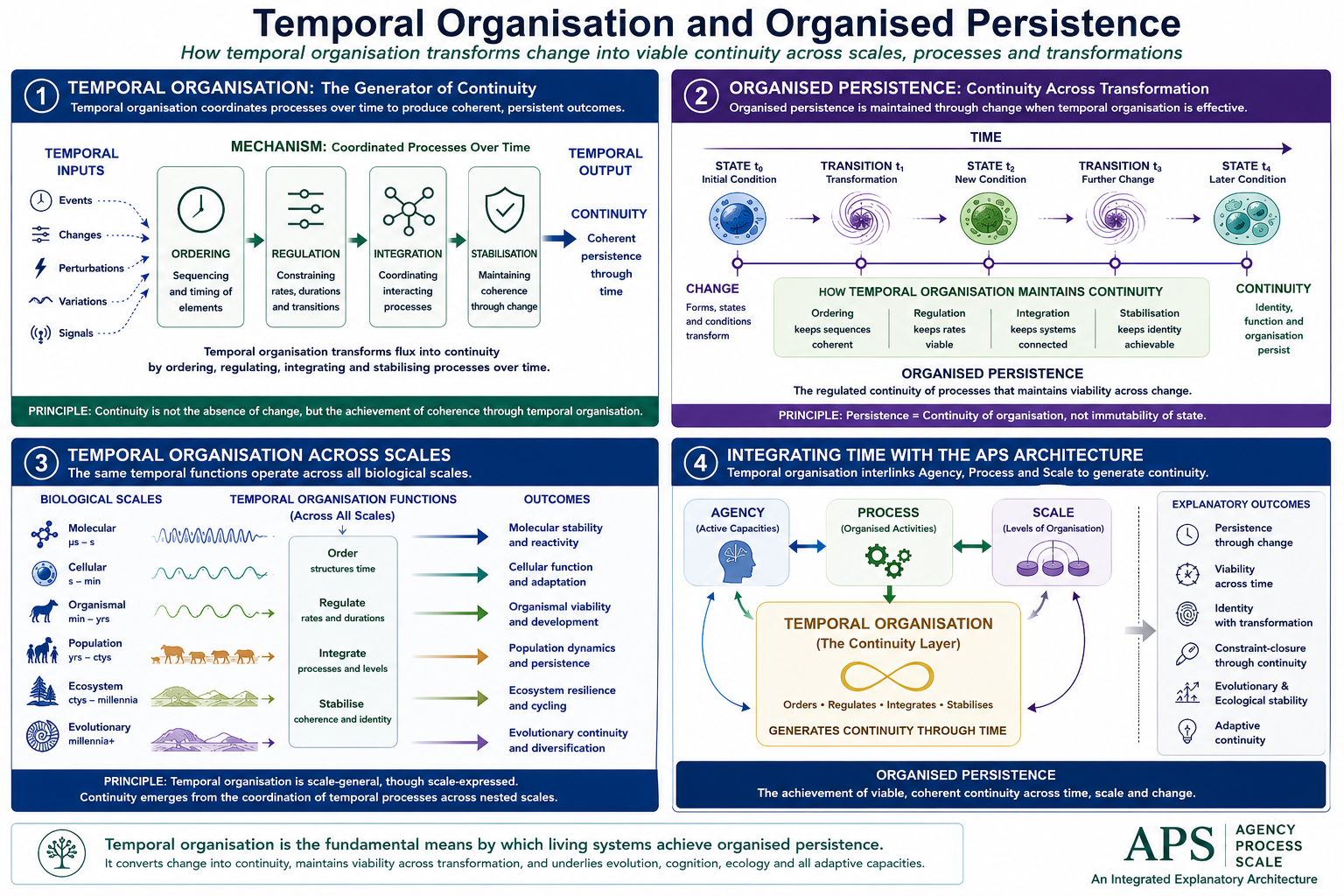
Temporal Organisation and Organised Persistence. Living systems maintain continuity not by remaining unchanged but by continually reorganising themselves through development, regulation, repair, adaptation, and environmental interaction. Biological persistence is therefore an achievement of temporal organisation rather than static structure.
Within APS, two concepts are particularly important. The first is viability orientation. Living systems are organised in ways that tend to preserve the conditions required for their continued existence. Their activity is not merely coordinated; it contributes to maintaining viability.
The second is constraint closure. The processes of the system contribute to maintaining the constraints that enable those very processes to occur. Living systems therefore participate in sustaining the organisational conditions upon which they depend.
Together, viability orientation and constraint closure help explain how biological continuity is maintained through change.
Within APS, explaining organised persistence therefore requires attention not merely to what living systems do, but to how their activity contributes to maintaining continuity across changing conditions.
This organisational perspective addresses a question that narrower explanations need not themselves answer: how the processes under investigation participate in the continuing organisation of a living system.
Agency and Normativity in Explanation
Once organised persistence is adopted as a principal explanatory target within APS, additional features of living systems become easier to understand.
Living systems exhibit biological agency. Their activity is organised around maintaining the conditions required for continued existence. Organisms regulate internal conditions, respond to environmental change, repair damage, acquire resources, and modify behaviour in ways that contribute to persistence.
This introduces a form of biological normativity. Because living systems can succeed or fail in maintaining themselves, biological activity possesses an inherently normative dimension.
Some states support persistence. Others undermine it. Some processes contribute to viability, while others impair it. The distinction between success and failure therefore arises from the organisation of the living system itself rather than from external evaluation.
This is why biological explanations routinely employ concepts such as function, regulation, adaptation, success, failure, and malfunction. These concepts reflect real features of systems whose activity is organised around persistence.
Where APS asks about the organisational role of a biological process, explanation concerns how that process contributes—successfully, unsuccessfully, or not at all—to the viability of the system.
Process and Scale in Biological Explanation
Organised persistence unfolds through process and across scale.
Living systems maintain continuity not by remaining unchanged, but by continually transforming. Metabolism, development, behaviour, ecology, and evolution all involve processes through which continuity is preserved despite ongoing change.
At the same time, biological organisation extends across multiple scales. Molecular processes contribute to cellular organisation, cells contribute to organisms, and organisms participate in ecological systems. Processes organised across these scales may interact, and their explanatory relevance depends upon the phenomenon under investigation.
APS therefore examines not only relevant mechanisms but also the processual organisation and spatial and temporal extents through which persistence is maintained. These are explanatory priorities within APS rather than mandatory dimensions of every biological explanation.
Beyond Gene-Centric and Trait-Based Accounts
Many explanatory frameworks in biology focus on genes, traits, or population-level patterns.
These approaches provide powerful explanatory tools. However, they presuppose systems capable of maintaining organised persistence.
Genes influence biological outcomes only within living systems capable of sustaining development, regulation, and reproduction. Evolutionary processes depend upon biological systems in which heritable variation and differential persistence or reproduction can occur.
APS therefore shifts attention from isolated explanatory units toward the organisational conditions that make those units biologically meaningful.
The question is not whether genes, traits, or populations matter. It is how they participate in the organised persistence of living systems.
Explanatory Adequacy within APS
What counts as an adequate explanation depends upon the explanandum, the explanatory product sought, the relations claimed, and the evidence appropriate to them.
Where APS investigates organised persistence, explanatory adequacy requires showing how the processes or relations invoked bear upon the maintenance, re-establishment, or transformation of living organisation. This is an APS-relative criterion for that explanatory task, not a universal test of biological explanation.
A causal, mechanistic, developmental, evolutionary, ecological, or other explanation may be adequate for its own explanandum without also explaining organised persistence. APS asks an additional organisational question where doing so produces relevant explanatory understanding.
Why This Matters
Clarifying the target of biological explanation has both conceptual and practical consequences.
It helps explain why concepts such as function, regulation, adaptation, resilience, and malfunction remain indispensable within biology. These concepts are not optional additions to biological discourse. They reflect the organisational realities of systems that must maintain themselves through time.
It also clarifies the relationship between different explanatory traditions. Mechanistic, developmental, ecological, and evolutionary explanations need not compete for explanatory priority. Each illuminates different aspects of the organised persistence of living systems. APS applies the same comparative methodology to contemporary theoretical biology. Frameworks such as the Free Energy Principle investigate important aspects of biological organisation using different explanatory priorities and formal methods. Rather than assuming that different frameworks must converge upon a single explanatory architecture, APS can compare what explanatory work each performs, the questions it addresses, and whether relating those achievements to organised persistence produces additional understanding. A detailed comparison is presented in APS and the Free Energy Principle: Complementary Explanatory Frameworks in Theoretical Biology.
The framework is equally relevant to questions at the boundaries of biology. Understanding what biological explanation explains helps clarify how life might be identified in unfamiliar contexts, how synthetic systems should be evaluated, and how biological continuity can be recognised across diverse forms of organisation.
APS seeks to make explicit organisational relations that may remain implicit when biological inquiry addresses persistence, adaptation, regulation, repair, and continuity. Whether making those relations explicit produces explanatory gain must be assessed rather than assumed. Biologists routinely explain persistence, adaptation, regulation, repair, and continuity. APS seeks to clarify the organisational reality that makes these explanatory practices intelligible as biology.
Identifying organised persistence as a principal APS explanatory target is only the first step.
A further APS question follows:
How does APS organise explanation in order to investigate organised persistence?
This question is addressed in Biological Explanation and Organised Persistence, which develops APS as an explanatory grammar and examines how biological explanations achieve explanatory adequacy.
Conclusion
Biology explains many different phenomena through different explanatory practices. APS focuses upon one particularly general biological problem: how living systems maintain and transform their organisation through time.
APS proposes organised persistence as a principal explanatory target for investigating this problem.
Viability orientation and constraint closure provide the organisational basis through which APS interprets biological continuity, while Agency, Process, and Scale provide analytic projections through which that organisation can be investigated.
This does not establish organised persistence as the obligatory explanandum of every biological explanation. Rather, it specifies the explanatory target around which APS organises its own account and against which its contribution must be assessed.
Identifying that target is only the first step. The next question concerns how APS structures explanation around it. For this, see:
→ The Structure of Biological Explanation in APS
Explanatory Architecture
Central Question
What explanatory target does APS propose for investigating the distinctive organisation and continuity of living systems?
Architectural Role
This Core article establishes organised persistence as a principal explanatory target within APS: the capacity of living systems to maintain continuity through continual transformation. It connects APS’s account of life with its subsequent account of how biological organisation can be investigated without treating organised persistence as the obligatory explanandum of biological explanation generally.
Preceding Explanatory Dependencies
These concepts and articles establish the explanatory foundations presupposed by this article. They identify explanatory dependencies within the APS corpus rather than chronological order, hierarchy, or levels of organisation.
- What Is APS?
- How APS Explains Life
- Agency as the Defining Activity of Life
- Biological Organisation
- Viability
- Constraint Closure
- Organised Persistence
Subsequent Explanatory Developments
The explanatory architecture established here is developed, extended, or applied in the following articles.
- Biological Explanation and Organised Persistence
- Explanatory Grammar
- Description, Explanation, and Definition in Biology
- Organisational Realism in Biology
- Why APS Reframes Biology
- APS and Contemporary Theories
- APS and the Free Energy Principle: Complementary Explanatory Frameworks in Theoretical Biology
Related Explanatory Questions
- What distinguishes biological explanation from mechanistic description?
- Why does APS treat organised persistence as a principal explanatory target?
- How do viability orientation and constraint closure contribute to biological explanation?
- What makes an explanation adequate for the particular explanandum it addresses?
- How does APS compare with other contemporary explanatory frameworks in theoretical biology?
Position Within APS
This article establishes a principal explanatory question within APS: how living systems maintain continuity through continual transformation. By identifying organised persistence as a central APS explanatory target, it provides a conceptual bridge between APS’s account of life and its subsequent development of explanatory architecture, comparative methodology, and biological explanation across Agency, Process, and Scale.
See Also
Related Articles
References
- (2000). Thinking About Mechanisms. Philosophy of Science, 67(1), 1–25 . https://doi.org/10.1086/392759
- (2015). Biological Autonomy. Springer. https://doi.org/10.1007/978-94-017-9837-2
- (2018). Everything Flows: Towards a Processual Philosophy of Biology. Oxford University Press.
- (2012). A Theory of Biological Relativity: No Privileged Level of Causation. Interface Focus, 2(1), 55–64 . https://doi.org/10.1098/rsfs.2011.0067
- (2026). Agency as the Defining Activity of Life: A Viability-Oriented Framework Integrating Process and Scale. Biological Theory . https://doi.org/10.1007/s13752-026-00547-6