Multiscale Evolution and Organised Persistence
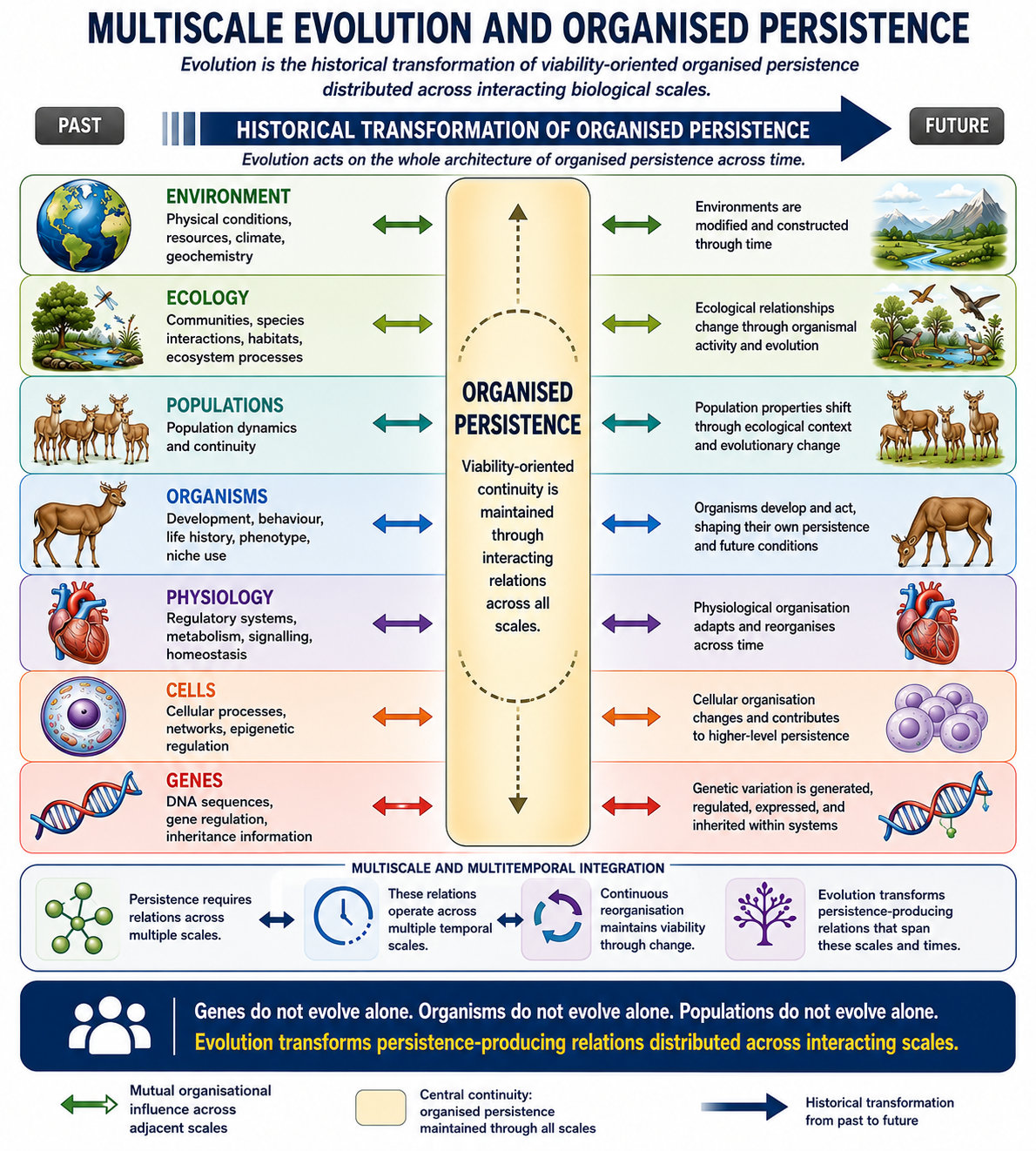
Evolution is the historical transformation of organised persistence, but the spatial and temporal extent required to explain a particular evolutionary transformation cannot be fixed in advance. Evolutionary explanations may focus successfully on genes, organisms, populations, developmental systems, ecological relations, or other materially realised organisation depending on the explanandum. In other cases, adequate explanation requires relations extending beyond an initially selected spatial or temporal boundary. APS treats this as a question of explanatory extent rather than as evidence that evolution is inherently multiscale. Scale is the analytic projection concerned with where persistence relevant to the explanandum is organised across spatial and temporal extents. A broader extent is therefore warranted only when additional materially realised relations make an explanatory difference to the evolutionary target.
Key Points
- Evolution is the historical transformation of organised persistence.
- Evolutionary explanation should not assume a single privileged biological level.
- Nor should it assume in advance that every evolutionary transformation is inherently multiscale.
- Scale asks where the persistence relevant to an evolutionary explanandum is organised across spatial and temporal extents.
- A wider explanatory extent is warranted only when additional materially realised relations make an explanatory difference to the target.
- Development, adaptation, inheritance, selection, and organism–environment relations can enlarge the required explanatory extent in appropriate cases.
- Agency, Process, and Scale are analytic projections of one living organisation, not interacting dimensions.
- Multiextent explanation is a diagnostic outcome rather than a universal APS premise.
Multiscale Evolution and Organised Persistence
Where this article fits: This article examines when evolutionary explanation requires biological relations extending across more than one spatial or temporal extent. APS does not assume either that evolution has one privileged explanatory level or that every evolutionary transformation is necessarily multiscale. Evolution is understood as the historical transformation of organised persistence. Scale then asks where the persistence relevant to a particular evolutionary explanandum is organised and how far the explanation must extend to include the materially realised relations that make a difference to that target.
Why Evolutionary Scale Matters
One of the enduring questions in evolutionary biology concerns where evolutionary change should be explained. Genes, organisms, populations, developmental systems, ecological relations, and environments can all become important explanatory targets. Different evolutionary questions consequently direct attention toward different biological entities, processes, relations, and temporal horizons.
These differences need not be resolved by identifying one universally privileged level. A genetic explanation may be adequate for one explanandum, a population-level analysis for another, while other questions may require developmental, physiological, behavioural, ecological, or environmental relations that extend beyond an initially selected boundary.
APS approaches this problem by distinguishing biological organisation from the explanatory role of Scale. Evolution is the historical transformation of organised persistence. Scale does not identify a biological level at which evolution truly occurs. It asks where the persistence relevant to an evolutionary explanandum is organised across spatial and temporal extents.
The important question is therefore not whether evolution is intrinsically single-scale or multiscale. It is whether the materially realised relations required to explain a particular evolutionary transformation are adequately represented within the initially selected extent. When they are, no broader extent is required. When they are not, the explanation must widen accordingly.
Organised Persistence and Explanatory Extent
Living systems depend upon materially realised relations among components, processes, constraints, and surroundings. Genes depend on cellular organisation for expression and replication. Cells participate in physiological organisation. Organisms develop through continuing interactions among genetic, cellular, physiological, behavioural, and environmental processes. Populations arise through the activities, reproduction, inheritance, and differential persistence of organisms.
These dependencies can extend beyond the boundary at which an investigator first locates an explanandum. A local molecular event may depend upon cellular regulation. A developmental outcome may depend upon environmental conditions. A population trajectory may depend upon ecological relations. Such cases can require explanation across a broader spatial or temporal extent.
That does not mean that organised persistence is itself an interacting system of scales. The biological work is performed by materially realised processes, constraints, interactions, and organisational relations. Scale is the analytic projection through which APS asks how far those relations must be followed in order to explain the target.
A broader explanatory extent is therefore justified only when relations beyond a narrower boundary make an explanatory difference. Multiextent explanation is an outcome of analysis, not a premise imposed upon every evolutionary case.
Evolutionary Explanation and Explanatory Extent. APS does not assume that evolution is inherently multiscale. The evolutionary explanandum determines which materially realised processes, constraints, interactions and organisational relations are relevant; Scale then identifies the spatial and temporal extent required to explain them. A broader extent is warranted only when additional relations make an explanatory difference to the target.
Agency and Evolutionary Extent
Biological agency is viability-oriented organisational activity. Evolution can transform the organisation through which that activity is realised, including the regulatory, developmental, physiological, behavioural, and environmental relations relevant to persistence.
Whether all of those relations belong in a particular evolutionary explanation depends on the target. A genetic change can sometimes be explained without reconstructing the complete ecology of the organism. In another case, the consequences of genetic variation may depend upon developmental processes, physiological organisation, behavioural activity, or environmental conditions that cannot be excluded without losing explanatory adequacy.
The role of Scale is not to declare biological agency inherently wide-ranging. It is to ask where the organisation relevant to the explanandum must be considered. If relations outside an initially chosen boundary change the explanation, the required extent widens. If they do not, a more bounded explanation may remain sufficient.
Inheritance reproduces continuity across generations, fitness concerns differences in the continuation of lineages under specified conditions, and natural selection can differentially stabilise heritable differences through time. These relations may connect multiple forms of biological organisation, but their explanatory extent must be established for the case rather than stipulated beforehand.
Development and Evolutionary Extent
Development is important to evolutionary explanation because developmental outcomes are produced through materially organised processes rather than through genetic specification considered in isolation. Genetic activity, cellular regulation, physiology, organismal organisation, environmental conditions, and other relations can jointly influence developmental trajectories.
This does not make development an integrator of biological scales. Development consists in materially realised processes occurring through time. Those processes can connect relations extending across different spatial and temporal extents, and their evolutionary relevance depends on the explanandum.
For some evolutionary questions, inheritance and population dynamics may provide the required explanation without detailed developmental analysis. For others, the generation of phenotypic variation, developmental plasticity, robustness, or environmentally responsive organisation may be essential. In such cases, developmental relations enlarge the explanatory extent because excluding them would omit mechanisms or dependencies that make a difference to the target.
Development therefore provides an important test of explanatory extent. Its relevance must be demonstrated through the biological relations required to explain the evolutionary transformation under investigation.
Adaptation and Explanatory Extent
Adaptation can refer to different biological phenomena, and those phenomena need not all require the same explanatory extent. Physiological regulation, behavioural modification, developmental plasticity, ecological adjustment, and historical evolutionary change involve distinct processes and timescales.
Living systems can remain viable under changing conditions through materially realised reorganisation. Physiological responses can compensate for altered internal conditions. Behaviour can modify environmental exposure. Developmental plasticity can alter trajectories of growth and organisation. Ecological relations can change the opportunities and constraints under which organisms persist.
These processes can also become relevant to longer-term evolutionary transformation. A feature contributing to viability in a particular developmental, physiological, behavioural, or ecological context may enter a historical trajectory of inheritance, differential persistence, and modification.
The explanatory question is therefore not whether adaptation occurs across interacting scales. It is which material relations must be included to explain the adaptive phenomenon at issue, and across what spatial and temporal extent those relations are organised.
Selection and the Organisation It Presupposes
Natural selection is a major evolutionary process, but selection acts on biological systems that already possess organisation, development, inheritance, and capacities for persistence and reproduction.
This distinction matters because selection does not by itself explain every biological condition that makes differential persistence possible. Organismal viability may depend on physiological organisation. Development can shape phenotypic variation. Behaviour can alter exposure to environmental conditions. Ecological relations can affect survival and reproduction. Environmental modification can alter future selective conditions.
Whether these relations must be included in a particular explanation of selection remains target-dependent. A population-genetic model can be entirely appropriate for some questions. Other explananda require additional developmental, ecological, physiological, or environmental relations because those relations alter the causes, constraints, or consequences being explained.
Selection therefore acts on materially organised systems. APS does not need to describe those systems as inherently scale-integrated. The relevant question is how much of their organisation must be included to explain the selective outcome under investigation.
This preserves an important distinction between the organisation that makes biological persistence possible and the differential historical consequences analysed through selection.
Organism–Environment Relations and Evolutionary Extent
Organisms do not merely encounter environments as passive external backgrounds. Through metabolism, behaviour, resource use, habitat modification, symbiosis, niche construction, and other activities, organisms can alter conditions relevant to their own persistence and to the persistence of other organisms.
These organism–environment relations are materially realised. Their evolutionary importance depends on whether they make a difference to the explanandum. In some cases, environmental conditions can be represented as parameters without requiring detailed analysis of how organisms modify them. In others, ecological inheritance, niche construction, symbiosis, environmental modification, or reciprocal organism–environment dependence becomes central to explaining an evolutionary trajectory.
Such cases can extend the explanatory boundary beyond an individual organism. That extension should follow from the biological dependencies under investigation rather than from a prior commitment that evolutionary organisation always spans organism and environment.
Organism–environment analysis therefore provides a clear example of the APS Scale test. The explanation should extend beyond the organism when extra-organismal relations materially alter the persistence, inheritance, variation, development, selection, or historical transformation relevant to the target.
Temporal Extent and Historical Transformation
Evolutionary explanation is necessarily historical, but different evolutionary explananda require different temporal extents. Molecular events can occur over fractions of a second, physiological regulation over minutes or hours, development over substantial portions of a life history, ecological relations over multiple generations, and lineage transformation over much longer historical periods.
These are durations of materially realised biological processes, not interacting temporal scales. Processes occurring over different durations can nevertheless stand in causal or organisational relations. A short-term regulatory event can alter development. Development can affect behavioural capacities. Behaviour can modify environmental conditions. Environmental changes can influence future survival, reproduction, or selection.
The explanatory task is to determine which of these relations matter to the evolutionary target. A short temporal window may be adequate for one question, while another requires reconstruction across generations or longer lineage histories.
Scale therefore asks how far through time the persistence relevant to the explanandum must be followed. A longer temporal extent is warranted when processes or relations outside the narrower window make a difference to the explanation.
Evolutionary history is not simply the accumulation of events over ever larger timescales. It is the transformation of materially organised persistence through relations whose relevant temporal extent must be established case by case.
Evolutionary Extent within the APS Architecture
Agency, Process, and Scale are complementary analytic projections of one viability-oriented, constraint-closed organisation. Agency concerns what living systems do; Process concerns how continuity is maintained despite change; Scale concerns where persistence is organised across spatial and temporal extents. They are analytic projections rather than components of reality, and none is an independently acting biological cause.
An evolutionary explanation may make one, two, or all three projections useful. APS does not assume that every evolutionary explanandum requires all three.
Agency may be especially relevant when the target concerns viability-oriented organisational activity. Process may be especially relevant when the target concerns how continuity is maintained, reorganised, or transformed through change. Scale becomes relevant when the question concerns the spatial or temporal extent across which the persistence necessary for explanation is organised.
These perspectives do not interact to produce evolution. The relevant biological work is performed by materially realised processes, constraints, interactions, and organisational relations. APS uses the projections to clarify different explanatory questions about that organisation.
Evolutionary explanation is therefore not made multiextent merely by invoking APS. A broader spatial or temporal extent must earn its place in the explanation by identifying additional relations that make an explanatory difference to the target.
Why Multiscale Evolution Matters
The expression multiscale evolution can still identify an important class of evolutionary explanations, provided it is used diagnostically rather than as a universal claim about life.
Some evolutionary explananda are adequately addressed within relatively bounded domains. Others cannot be explained without following relevant relations across broader spatial or temporal extents. Developmental dependencies, organism–environment relations, ecological inheritance, niche construction, physiological organisation, or long-term historical continuity can each enlarge the explanation when the target requires them.
This target-sensitive approach avoids two opposite errors. It avoids treating one biological level as universally privileged, but it also avoids assuming that a wider explanation is automatically better simply because it includes more domains.
Explanatory gain depends on the target. A broader account is warranted when it identifies material dependencies, constraints, interactions, or historical relations that a narrower account omits and when those additions improve explanation of the explanandum. If widening the extent adds no relevant explanatory difference, APS provides no reason to require it.
Multiscale evolutionary explanation is therefore best understood as a possible result of biological analysis. It is established when the materially relevant organisation of the evolutionary target genuinely extends across multiple spatial or temporal extents.
Conclusion
Evolution is the historical transformation of organised persistence. That transformation can involve genes, organisms, populations, developmental processes, physiological organisation, behaviour, ecological relations, environments, and lineages, but no evolutionary explanation is required to include all of them simply because they exist within biology.
APS rejects both the search for a universally privileged level and the assumption of universal multiscalarity. Scale is the analytic projection concerned with where persistence is organised across spatial and temporal extents. Its contribution to evolutionary explanation is therefore diagnostic: it helps determine how far the materially relevant organisation must be followed in order to explain a particular transformation.
A relatively bounded explanation is sufficient when the relations within that boundary adequately explain the target. A broader extent becomes necessary when materially realised relations beyond it alter the explanation.
Multiscale evolution should therefore not be treated as a consequence stipulated by the organisation of life. It is an explanatory conclusion warranted in those cases where evolutionary transformation genuinely depends upon relations extending across multiple spatial or temporal extents.
Explanatory Architecture
Central Question
When does explaining evolutionary transformation require relations extending across more than one spatial or temporal extent?
Architectural Role
This article is a Scale extension within APS. It applies the Scale projection to evolutionary explanation without assuming that evolutionary transformation is inherently multiscale or that wider explanatory extent is automatically superior.
Builds On
This article builds on the APS account of evolution as the historical transformation of organised persistence; the definition of Scale as the analytic projection concerned with where persistence is organised across spatial and temporal extents; Biological Agency as viability-oriented organisational activity; Process as the analytic projection concerned with how continuity is maintained despite change; and the established roles of inheritance, variation, development, adaptation, selection, and organism–environment relations in evolutionary explanation.
Develops Into
The article develops a target-sensitive method for determining evolutionary explanatory extent. It provides a basis for later analysis of ecological organisation, organism–environment relations, development, and other cases in which materially relevant biological organisation may extend beyond an initially selected spatial or temporal boundary.
Related Explanatory Questions
Relevant questions include whether a relatively local evolutionary explanation is sufficient; when developmental relations must be included; when ecological or environmental relations enlarge the explanandum; when a longer temporal horizon changes the explanation; and what evidence establishes that widening the spatial or temporal extent produces explanatory gain.
Position within APS
Agency, Process, and Scale are analytic projections of one viability-oriented, constraint-closed organisation. They are not interacting dimensions, biological levels, or independent causes. An evolutionary explanandum may make one, two, or all three projections useful, and APS does not assume triadic necessity.
Scale contributes specifically by asking where the persistence relevant to the explanandum is organised. A wider explanatory extent is warranted only when materially realised relations outside a narrower boundary make an explanatory difference to the target.
Corpus Significance
This article replaces the earlier APS claim that organised persistence is inherently scale-integrated and that evolutionary transformation must therefore be multiscale. It establishes instead a target-sensitive criterion: multiextent evolutionary explanation is warranted when the materially relevant relations required to explain a particular transformation extend across more than one spatial or temporal extent. Multiscalarity is therefore a possible explanatory result, not a universal premise of APS.
See Also
Related Articles
References
- (1970). The Units of Selection. Annual Review of Ecology and Systematics, 1, 1–18 . https://doi.org/10.1146/annurev.es.01.110170.000245
- (2015). Biological Autonomy: A Philosophical and Theoretical Enquiry. Springer.
- (2018). Everything Flows: Towards a Processual Philosophy of Biology. Oxford University Press.
- (2016). Dance to the Tune of Life: Biological Relativity. Cambridge University Press.
- (2003). Niche Construction: The Neglected Process in Evolution. Princeton University Press.
- (2006). Evolution and the Levels of Selection. Oxford University Press.
- (2026). Agency as the defining activity of life: A viability-oriented framework integrating process and scale. Biological Theory . https://doi.org/10.1007/s13752-026-00547-6
- (2003). Developmental Plasticity and Evolution. Oxford University Press.