Biological Individuality — Organised Persistence Through Time
Biological individuality is not adequately explained through static structure, genetic uniqueness, fixed material boundaries, or organismhood alone. Within APS, biological individuals are understood as dynamically stabilised, viability-oriented systems of organised persistence sustained across continual transformation. Individuality emerges through temporal continuity, developmental reconstruction, biological agency, constraint organisation, and organism–environment coupling. APS further distinguishes biological individuality from organismhood, agency, specieshood, and taxonomic classification by grounding individuality in continuity-producing organised persistence. Biological individuals therefore persist not as fixed objects, but as organisational unities enacted across changing conditions, interacting scales, and ongoing processes of transformation.
Key Points
- Biological individuals are continuity-producing systems of organised persistence.
- Individuality depends upon viability-oriented continuity rather than static material identity.
- Living systems persist through continual reconstruction across developmental and ecological transformation.
- Biological individuality is processual, temporal, developmental, and ecological.
- Constraint organisation and biological agency stabilise continuity across changing conditions.
- Individuality extends through organism–environment coupling and distributed persistence systems.
- APS distinguishes individuality from organismhood, agency, specieshood, and taxonomic classification.
- Biological individuality is explained as dynamically stabilised organised persistence across time.
Biological Individuality — Organised Persistence Through Time
Where this article fits: This article develops the APS account of biological individuality as viability-oriented organised persistence sustained across continual transformation. It integrates persistence, temporal organisation, development, biological agency, constraint organisation, and organism–environment coupling within a unified continuity-based account of biological individuality.
Biology has long treated individuals as discrete entities occupying a privileged position within biological explanation. Organisms are often assumed to be bounded objects possessing stable identities, coherent structures, and clearly defined material limits. Genetic uniqueness, physiological integration, and structural cohesion have frequently been invoked as criteria through which individuality can be identified and explained. These approaches capture important features of living systems, but they struggle to explain how biological continuity persists despite continual material turnover, developmental transformation, ecological dependence, and ongoing environmental interaction.
APS approaches individuality from a different starting point. Rather than asking what static properties make something an individual, APS asks how living systems preserve continuity through time despite continual change. Living systems do not persist because their material composition remains fixed. Cells are replaced, structures are reorganised, developmental trajectories unfold, and ecological conditions continually shift. Yet individuals remain recognisable across these transformations. APS argues that this continuity cannot be explained adequately through material identity alone. Biological individuality therefore depends upon the organised persistence through which viability is actively maintained across changing conditions.
From this perspective, individuality is not fundamentally a matter of possessing particular components, boundaries, or structures. It is a matter of sustaining continuity through processes that preserve viability despite transformation. Biological individuals are therefore understood not as static objects but as continuity-producing organisational unities whose persistence emerges through the active maintenance of organised relations across time.
Beyond Static Individuality
Traditional accounts of biological individuality often seek a defining criterion capable of separating individuals from non-individuals. Some emphasise physical boundaries, others genetic identity, reproductive cohesion, developmental integration, or physiological organisation. Each captures an aspect of biological reality, yet none adequately explains how living systems maintain continuity while undergoing continual reconstruction.
The difficulty arises because living systems are not materially static. Cells die and are replaced, tissues remodel themselves, developmental processes reorganise bodily structure, and ecological interactions alter the conditions under which persistence occurs. If individuality depended solely upon material composition, living systems would repeatedly cease to be the individuals they appear to remain. If individuality depended solely upon genetic identity, many forms of biological organisation would remain difficult to explain. The persistence of individuality therefore requires a different explanatory foundation.
APS locates this foundation in organised continuity. What persists through time is not a fixed collection of material components but a viability-oriented organisation capable of preserving itself through continual transformation. Biological individuality consequently emerges through continuity-producing organisation rather than static material identity. Living systems remain individuals because organisational continuity is maintained despite the continual changes through which life unfolds.
Individuality as Organised Persistence
APS defines biological individuality through organised persistence. Biological individuals are systems whose organisation contributes to maintaining viability across time despite changing internal and external conditions. Their continuity depends upon ongoing activity that preserves the conditions required for persistence rather than upon the passive retention of stable structure.
This perspective shifts the focus of individuality away from static properties and toward organisational dynamics. Individuals sustain continuity by regulating activity, compensating for perturbation, reconstructing degraded organisation, and maintaining viability under changing circumstances. Persistence is therefore not something possessed by biological individuals but something continually achieved through their organisation.
The significance of this shift becomes particularly apparent when continuity is threatened. Perturbations, developmental transitions, ecological challenges, and physiological disruptions all place demands upon persistence. Biological individuals remain identifiable because their organisation enables continuity to be maintained across these challenges. Individuality therefore depends upon viability-oriented organisation capable of preserving persistence through transformation rather than upon resistance to change itself.
Temporal Organisation and Individuality
Biological individuality is inherently temporal. Individuals cannot be understood adequately by examining isolated moments in time because the continuity that defines them unfolds across ongoing processes of maintenance, development, adaptation, repair, and environmental interaction. Persistence is therefore not an instantaneous property but an organisational achievement extending across time.
Living systems continuously coordinate multiple processes whose activities contribute to continuity. Metabolism maintains physiological organisation, development reconstructs and transforms bodily structure, repair compensates for damage, adaptation responds to changing conditions, and ecological interactions shape persistence opportunities and constraints. Temporal organisation integrates these processes into a sufficiently coherent trajectory for continuity to remain stabilised despite continual change.
For this reason, APS treats biological individuals as temporally organised continuities rather than static objects. The persistence of individuality depends upon the ongoing coordination of continuity-preserving processes rather than upon material permanence. Biological individuals therefore exist as organised trajectories whose continuity is actively enacted across time.
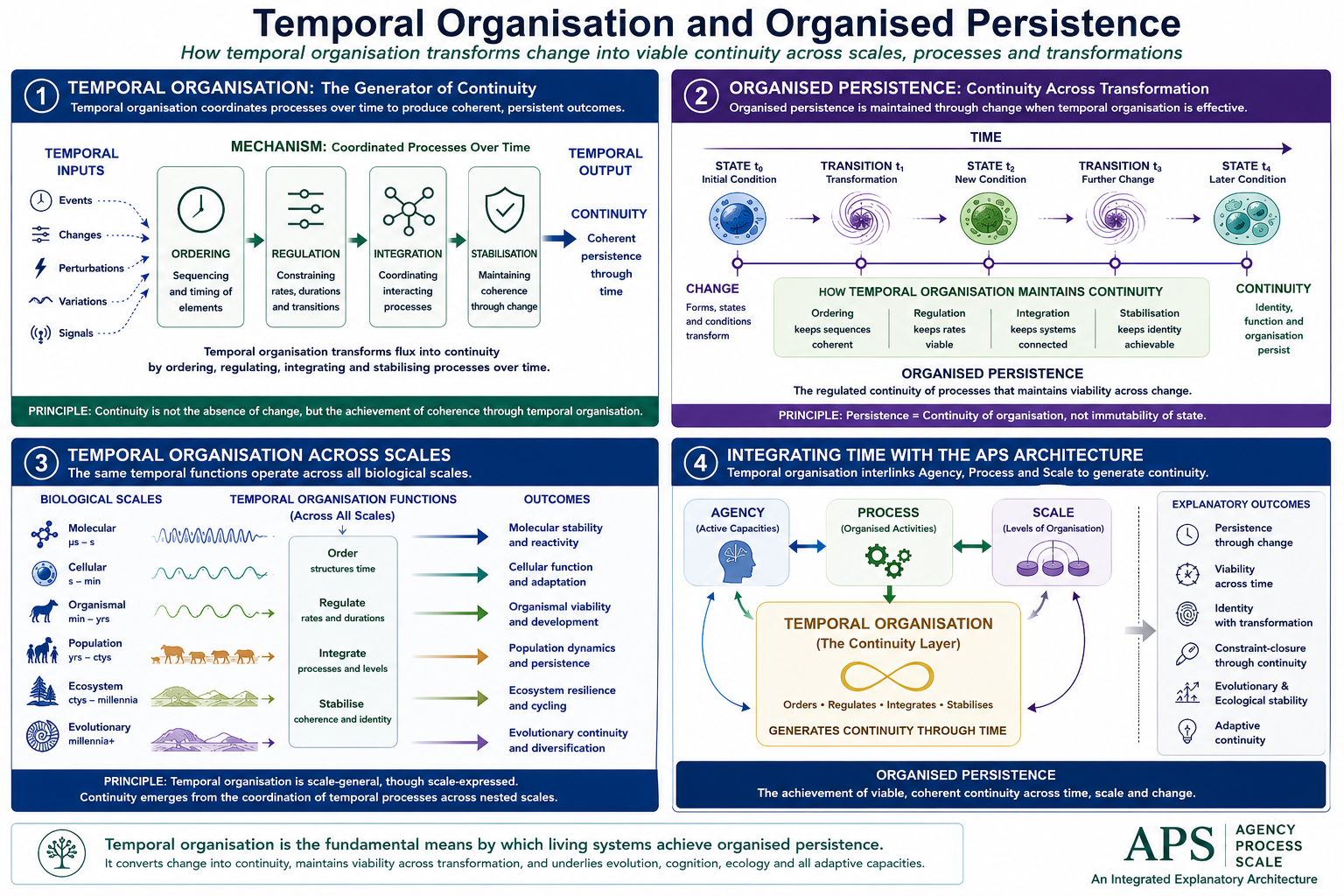
Temporal Organisation and Organised Persistence. Biological individuals persist through temporally organised continuity-preserving organisation enacted across continual transformation.
Constraint Organisation and Individuality
Biological individuality depends upon organised constraint relations through which continuity is maintained across changing conditions. Living systems do not persist because their activities occur independently of organisation. Rather, persistence depends upon networks of constraints that channel, coordinate, stabilise, and regulate biological processes in ways that contribute to viability. Individuality therefore emerges through organisational relations that preserve continuity despite continual transformation.
Constraint organisation contributes to individuality by integrating diverse biological activities into a coherent persistence-maintaining system. Metabolism, regulation, development, repair, ecological interaction, and behavioural activity do not operate independently. Their significance derives from the way they collectively support continuity across time. Individuals therefore persist because constraint relations organise these processes into viability-oriented activity capable of maintaining persistence under changing circumstances.
APS consequently treats individuality as a property of organised persistence rather than of isolated components. Constraint closure contributes to this continuity by enabling living systems to maintain and regenerate the organisational relations upon which persistence depends. Biological individuals are therefore not merely collections of interacting processes. They are continuity-producing organisations whose persistence emerges through dynamically maintained constraint relations.
Biological Agency and Individuality
Biological individuality is closely connected to biological agency. Individuals do not simply undergo change. They actively participate in regulating the conditions under which continuity remains possible. This capacity for viability-oriented regulation provides one of the principal mechanisms through which individuality is stabilised across perturbation, development, and environmental change.
Agency contributes to individuality because continuity requires active maintenance. Living systems regulate physiological organisation, modify behaviour, compensate for disruption, and reorganise activity in response to changing conditions. These activities are not external additions to individuality. They are among the organisational processes through which individuality persists. Without agency, continuity would become increasingly vulnerable to disruption, degradation, and eventual collapse.
APS therefore treats agency as one of the central organisational dimensions of biological individuality. Individuals persist because they are capable of participating in the regulation of their own continuity. Biological individuality is consequently not a passive state but an active organisational achievement sustained through viability-oriented agency.
Development and Individuality
Development is not merely something that happens to biological individuals. It is one of the principal processes through which individuality itself is maintained. Living systems persist through continual developmental reconstruction, growth, differentiation, plasticity, maturation, and transformation. The continuity of individuality therefore depends upon developmental organisation rather than despite it.
This perspective challenges the assumption that development threatens individuality by introducing change. APS argues that developmental transformation is one of the mechanisms through which continuity is preserved. Organisational stability does not require developmental stasis. Instead, continuity is maintained because developmental processes continually reorganise the system in ways that support viability under changing conditions.
Biological individuality therefore cannot be understood apart from development. Individuals remain continuous not because development leaves them unchanged, but because developmental organisation actively reconstructs continuity through time. The persistence of individuality is thus inseparable from the developmental processes through which living systems sustain themselves.
Organism–Environment Coupling and Individuality
Traditional accounts often treat individuals as self-contained entities existing independently of their environments. APS rejects this separation. Living systems persist only through ongoing exchanges with surrounding conditions, and these interactions contribute directly to the maintenance of continuity. Individuality therefore extends beyond the simple possession of internal organisation and depends upon the coupling relations through which viability is sustained.
Organism–environment coupling includes energetic exchange, ecological interaction, environmental scaffolding, behavioural engagement, microbial participation, and numerous other forms of distributed persistence. These relationships do not merely influence already complete individuals. They help constitute the conditions under which continuity remains possible. Biological individuals therefore emerge through organisational relations extending across organism–environment systems rather than through complete isolation from them.
This does not imply that individuals dissolve into their environments. Rather, APS argues that individuality depends upon understanding how continuity is maintained through coupled organisational systems. Persistence is achieved neither entirely within the organism nor entirely within the environment, but through the ongoing organisation of relations connecting the two.
Individuality Across Scale
Biological individuality unfolds across multiple interacting scales of organisation. Molecular processes contribute to cellular continuity, cells participate in tissues and organisms, organisms engage ecological systems, and ecological conditions influence developmental and evolutionary trajectories. These domains remain interconnected because persistence depends upon coordinated organisation extending across spatial and temporal scales.
APS therefore rejects the assumption that individuality must be located exclusively within a single domain of organisation. The continuity of biological individuals emerges through interactions distributed across multiple scales whose activities contribute to maintaining viability. Individuality is consequently relational, multiscale, and organisationally distributed without becoming unreal or merely descriptive.
This perspective helps explain why biological individuality can exhibit considerable diversity across living systems. Different forms of life maintain continuity through different organisational arrangements, yet each depends upon coordinated persistence across interacting scales. Individuality therefore reflects a common organisational principle rather than a single structural pattern.
Individuality and Other Forms of Biological Unity
APS distinguishes biological individuality from several related concepts that are often treated as interchangeable. Although these concepts overlap in important ways, they refer to different forms of biological unity and therefore perform different explanatory functions.
| Concept | APS Focus | Primary Criterion |
|---|---|---|
| Biological Unit | Participation in biological organisation | Biological relevance |
| Organism | Autonomous viability-oriented organisation | Self-maintaining organised persistence |
| Biological Agent | Viability-oriented regulation | Active maintenance of viability |
| Biological Individual | Persistence-bearing organisational unity | Organised continuity through time |
| Processual Individual | Dynamic continuity through transformation | Persistence despite material change |
| Species | Historical lineage continuity | Persistence across generations |
| Taxon | Explanatory classification | Biological grouping for explanation |
A biological unit is the broadest category. Any entity that participates in biological organisation in an explanatorily significant way may qualify as a biological unit. Cells, organs, symbionts, organisms, and even viruses may function as biological units without necessarily possessing autonomy, agency, or individuality.
Organisms constitute a more specific category. APS defines organisms as viability-oriented systems whose organisation actively maintains the conditions required for their own persistence. Organismhood therefore concerns autonomous organised persistence rather than biological participation alone.
Biological agency concerns viability-oriented regulation. Agents actively participate in maintaining continuity relative to viability conditions. Most organisms are agents, but the concepts remain analytically distinct because agency refers to regulatory activity while organismhood refers to organisational unity.
Biological individuality concerns organised continuity through time. Individuals are persistence-bearing organisational unities whose continuity remains sufficiently stabilised despite ongoing transformation. Individuality therefore focuses upon continuity rather than autonomy alone.
Processual individuality emphasises a further aspect of continuity. Living systems persist despite continual material turnover, developmental reconstruction, and environmental interaction. Processual individuals therefore derive their identity primarily from continuity-producing organisation rather than from static material composition.
Species and taxa represent different forms of biological unity altogether. Species are historically continuous lineage structures extending across generations, whereas taxa are classificatory groupings used to organise biological explanation. Neither should be confused with biological individuals even though important relationships exist among them.
Individuality at the Boundaries of Life
Many of the most challenging cases in biology arise precisely because different forms of biological unity overlap. Endobionts, symbionts, holobionts, lichens, superorganisms, colonies, and other boundary systems frequently exhibit features associated with individuality while simultaneously challenging traditional assumptions about organismal boundaries.
APS approaches these cases by asking what form of organised persistence is present rather than by imposing a single criterion of individuality. Endobionts may function as biological units and sometimes as biological individuals while remaining dependent upon broader host systems. Symbiotic systems reveal that persistence may be distributed across interacting organisations rather than confined entirely within a single organismal boundary.
Holobionts and lichens are particularly instructive because they demonstrate how continuity can emerge through the persistent coupling of distinct biological lineages. APS does not assume that all such systems either qualify or fail to qualify as biological individuals. Instead, it asks whether the coupled organisation exhibits sufficient continuity, integration, and persistence to justify treatment as a persistence-bearing organisational unity.
Similar considerations apply to superorganisms and colonies. Eusocial insect colonies, for example, often display forms of coordination, regulation, and continuity that resemble organismal organisation. APS therefore investigates where viability is regulated and how persistence is maintained rather than assuming that individuality must reside exclusively within either the colony or its members.
These cases are not failures of biological theory. They are opportunities to clarify the diverse forms through which organised persistence can be realised. APS consequently treats fringe systems as valuable diagnostic probes of biological individuality because they reveal the organisational conditions under which continuity, agency, organismhood, and persistence become integrated into distinct forms of biological unity.
Individuality and Normativity
Biological individuality is intrinsically normative because persistence is never guaranteed. Living systems exist under conditions where continuity may be stabilised, disrupted, repaired, enhanced, or lost. The maintenance of individuality therefore depends upon organisational distinctions between conditions that support persistence and conditions that undermine it. These distinctions are not imposed externally by observers. They arise from the viability requirements of the individual itself.
Normativity emerges because biological individuals must continually preserve continuity despite changing circumstances. Some forms of regulation contribute to persistence, while others contribute to degradation. Some developmental trajectories maintain viability, while others threaten it. Some ecological relationships support continuity, while others destabilise it. Individuality therefore exists within a landscape of organisational possibilities whose consequences differ relative to viability.
APS consequently treats normativity as an inherent feature of biological individuality rather than as an additional interpretive layer. Individuals are organised around the maintenance of continuity, and this organisation necessarily differentiates between conditions that support persistence and those that do not. Biological individuality is therefore not merely a descriptive category but an organisational reality structured by viability-oriented distinctions.
Individuality and Resilience
The persistence of biological individuals depends not upon resistance to change but upon resilience in the face of change. Living systems continuously encounter perturbations arising from injury, developmental instability, ecological disruption, environmental fluctuation, and internal degradation. Individuality therefore cannot be explained through static stability alone.
Resilience concerns the capacity of continuity-producing organisation to reorganise itself when challenged. Repair, compensation, adaptation, and recovery all contribute to preserving continuity despite perturbation. Biological individuals persist because their organisation can accommodate disruption without losing the viability-oriented relations upon which persistence depends.
This perspective further reinforces the processual nature of individuality. Living systems remain individuals not because they avoid disturbance, but because they continually reconstruct continuity under changing conditions. Resilience therefore reveals the organisational capacities through which individuality is maintained and demonstrates that persistence is an ongoing achievement rather than a passive state.
Individuality and Evolution
Evolution transforms biological individuality historically. The forms through which continuity is organised have changed repeatedly across evolutionary time, producing new developmental architectures, novel ecological relationships, altered persistence conditions, and increasingly complex forms of biological organisation. Individuality is therefore neither timeless nor fixed. It has its own evolutionary history.
At the same time, evolutionary transformation depends upon continuity. Selection, adaptation, diversification, and innovation occur because persistence-bearing systems remain sufficiently continuous for historical change to accumulate across generations. Evolution therefore both modifies individuality and depends upon it. Biological individuals provide the organisational continuity through which evolutionary processes become possible.
APS consequently treats individuality as simultaneously historical and organisational. The forms individuality takes may change, diversify, and evolve, yet each remains grounded in viability-oriented organised persistence. Evolution therefore reveals not the abandonment of continuity, but the continual transformation of the organisational structures through which continuity is maintained.
Biological Individuality Within APS
APS situates biological individuality within the broader explanatory grammar organised through agency, process, and scale. Individuality is not an isolated concept standing apart from the rest of the framework. It emerges from the interaction of the same organisational principles that explain biological agency, development, adaptation, constraint organisation, ecological coupling, semiosis, and persistence across time.
Agency contributes to individuality because continuity requires active regulation. Process contributes because individuality is maintained through ongoing transformation rather than static permanence. Scale contributes because persistence depends upon organisational relations extending across multiple spatial and temporal domains. Individuality therefore becomes intelligible only when these dimensions are considered together.
This integration allows APS to avoid many traditional disputes concerning the nature of biological individuals. Rather than searching for a single defining property, APS asks how continuity is maintained, how viability is preserved, and how persistence is organised across changing conditions. Biological individuality therefore emerges as a consequence of organised persistence rather than as an independently defined category.
Why Biological Individuality Matters
Biological individuality occupies a central position within biological explanation because many other biological concepts presuppose it. Agency, development, adaptation, regulation, resilience, reproduction, evolution, and ecological interaction all depend upon some account of what persists through time. Without a coherent understanding of individuality, these concepts become difficult to integrate within a unified explanatory framework.
APS provides such an account by grounding individuality in organised persistence. This approach explains how continuity can survive material turnover, developmental transformation, ecological dependence, and environmental change without appealing to static substance ontologies or rigid boundary criteria. Individuality remains biologically real because continuity-producing organisation remains biologically real.
The significance of this perspective extends beyond organisms traditionally regarded as obvious individuals. It provides a framework for understanding the diverse forms of biological unity found across living systems, including distributed, coupled, processual, and boundary cases. APS therefore transforms individuality from a classificatory problem into an explanatory question concerning how continuity is organised and maintained across time.
Conclusion
Biological individuality is not adequately explained through static structure, genetic identity, fixed boundaries, or material continuity alone. Living systems persist despite continual reconstruction, developmental transformation, ecological dependence, and environmental change. Any adequate account of individuality must therefore explain how continuity remains possible under such conditions.
APS addresses this problem by treating biological individuals as viability-oriented systems of organised persistence. Individuality emerges through the continuity-producing organisation that preserves viability across changing circumstances rather than through the passive retention of stable material structure. Temporal organisation, developmental reconstruction, biological agency, constraint organisation, resilience, and organism–environment coupling all contribute to maintaining this continuity.
This perspective also clarifies why individuality cannot be equated simply with organismhood, agency, specieshood, or taxonomic classification. Each identifies a different form of biological unity. Biological individuality concerns the organised continuity through which persistence-bearing systems remain sufficiently coherent across time. Once individuality is understood in these terms, many traditional boundary disputes become more tractable because the focus shifts from assigning entities to fixed categories toward understanding how continuity is organised and maintained.
APS therefore reconceives biological individuality as a processual, viability-oriented, and organisational phenomenon. Living systems persist not because they remain unchanged, but because their organisation continually reconstructs the conditions required for continued existence. Biological individuals are thus best understood not as static objects occupying predetermined boundaries, but as continuity-producing organisational unities enacted through organised persistence across time.
See Also
Related Articles
References
- (2013). Darwinian Populations and Natural Selection. Oxford University Press.
- (2015). Biological Autonomy: A Philosophical and Theoretical Enquiry. Springer.
- (2018). Everything Flows: Towards a Processual Philosophy of Biology. Oxford University Press.
- (2012). The Limits of the Self: Immunology and Biological Identity. Oxford University Press.
- (2009). Beyond Society: The Evolution of Organismality. Philosophical Transactions of the Royal Society B, 364, 3143–3155 . https://doi.org/10.1098/rstb.2009.0095
- (2026). Agency as the defining activity of life: A viability-oriented framework integrating process and scale. Biological Theory . https://doi.org/10.1007/s13752-026-00547-6