Biological Agency as the Activity of Self-Maintenance
Biological agency is one of biology's most widely used yet least consistently defined concepts. APS defines biological agency as viability-oriented organisational activity: the present-tense activity through which living systems maintain and re-establish the conditions of their own organised persistence. Agency is therefore distinguished from behaviour, cognition, intention, conscious choice, and attribution based upon hierarchical level. Not every component, subsystem, or organisational extent participating in living activity thereby constitutes an independent agent; agency attribution requires viability-oriented organisation instantiated by the candidate system. Scale addresses the spatial and temporal extent across which persistence relevant to an explanandum is organised rather than identifying levels at which agents occur. Even warranted agency attribution does not guarantee explanatory gain: the explanatory contribution of Agency must be assessed relative to the specified target and strongest relevant comparator. This account establishes Agency as the APS analytic projection concerned with what living systems do while connecting self-maintenance, viability, organised persistence, function, normativity, constraint closure, Process, Scale, and biological explanation.
Key Points
- Biological agency is viability-oriented organisational activity.
- Agency is the present-tense activity through which living organisation is enacted and sustained.
- Agency is distinct from behaviour, cognition, conscious intention, and goal language that is not grounded in living organisation.
- Self-maintenance is the principal expression of biological agency.
- Participation in the organisation through which agency is enacted does not by itself establish that a component or subsystem is an independent biological agent.
- Agency attribution depends on the viability-oriented organisation instantiated by the candidate system, not on its position within a hierarchy or at a particular spatial scale.
- Scale identifies the spatial and temporal extent required to explain relevant organisation; it does not identify a hierarchy of agents.
- Even warranted agency attribution does not guarantee explanatory gain for every biological explanandum.
Introduction
What are living systems doing when they remain alive?
Biology answers this question indirectly. Organisms regulate internal conditions, acquire resources, repair damage, coordinate development, respond to environmental change, and reproduce. These activities are investigated through physiology, ecology, development, evolution, and behaviour. Beneath this diversity, however, lies a more fundamental question: what unifies these activities as expressions of life?
This article answers this question through the concept of biological agency.
Agency is not a specialised capacity possessed only by animals, nor is it synonymous with behaviour, cognition, intelligence, or conscious intention. Biological agency is the viability-oriented activity through which living systems continually maintain and re-establish the conditions required for their own organised persistence. Organisms remain alive because they continuously participate in maintaining themselves.
Within APS, this understanding gives Agency a central analytic role. Living systems do not merely persist. They actively contribute to maintaining the organisation that makes persistence possible. A bacterium regulating its internal chemistry, a plant reorganising growth in response to changing conditions, and an animal repairing damage each exemplify biological agency because the activity of the living system contributes to sustaining its viability. Their mechanisms differ profoundly, but the relevant organisational principle remains the same.
Within APS, Agency is the analytic projection concerned with what living systems do. Biological agency is the present-tense viability-oriented organisational activity through which living organisation is enacted and sustained. It is not an additional characteristic that appears once life already exists, nor an independent cause alongside Process and Scale.
Understanding agency in this way clarifies why living systems possess functions, why biological processes can succeed or fail, why normativity arises within biology, and why biological explanation differs from explanations of non-living systems. Agency provides one analytic projection through which these phenomena become conceptually connected within APS.
Whereas Agency as the Defining Activity of Life introduced the APS rationale for treating Agency as the defining activity of life, the present article develops the APS account of biological agency through self-maintenance, viability, organised persistence, function, normativity, and biological explanation. It also addresses a further question that becomes unavoidable once agency is recognised throughout living organisation: where is attribution of biological agency warranted?
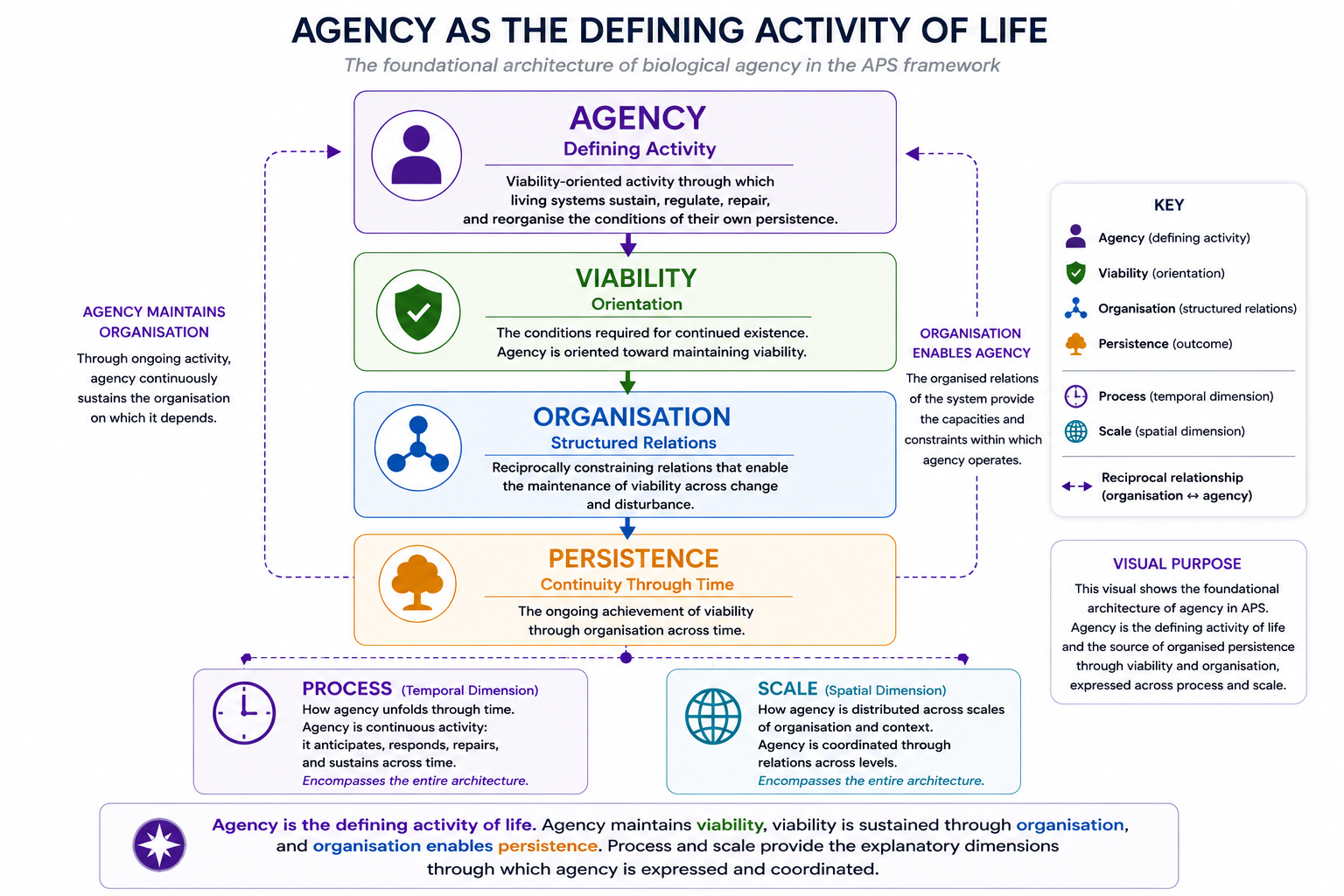
Agency as the Defining Activity of Life. Agency is the viability-oriented activity through which living systems sustain themselves across time. Agency maintains viability, viability is sustained through organisation, and organisation enables persistence. Process and Scale provide complementary explanatory perspectives through which this activity is understood.
Where This Article Fits
This article provides the core APS account of biological agency. Its principal task is to explain what Agency means within APS: biological agency is viability-oriented organisational activity, enacted through the continuing self-maintenance by which living systems maintain and re-establish the conditions of their own persistence.
Other APS articles develop distinct questions arising from this account. Agency as the Defining Activity of Life addresses why Agency occupies a defining position in the APS account of living organisation. Biological Agency Without Intentions distinguishes biological agency from intention, deliberation, and psychological goal attribution. Agency and Organised Persistence develops the relationship between present-tense viability-oriented activity and the continuity that activity sustains. Biological Agency, Evolution, and the Architecture of Biological Explanation extends the analysis into evolutionary and explanatory questions, while Agency in Contemporary Biology — The Emerging Agency Tradition and the APS Framework compares the APS account with contemporary approaches to biological agency.
The present article therefore owns the foundational question of what biological agency is and where its attribution is warranted. It does not follow from APS that every biological component, subsystem, collective, or organisational extent constitutes an independent agent. Nor does an attribution of agency follow from assigning a system to a particular biological level. Agency must be grounded in the viability-oriented organisation instantiated by the candidate system, while Scale asks across what spatial and temporal extent the organisation relevant to that attribution and explanandum must be followed.
This distinction also separates agency attribution from agency explanation. A biological organisation may warrant analysis as an agent without Agency necessarily providing explanatory gain for every phenomenon involving that organisation. APS therefore requires both the attribution of agency and its explanatory use to be justified relative to the biological organisation and explanandum under investigation.
Why Agency Requires Clarification
Biology has achieved extraordinary explanatory success in revealing how living systems function. It explains metabolism, development, physiology, evolution, ecology, behaviour, and countless other aspects of biological organisation with increasing precision. Yet the success of these disciplines does not by itself resolve a more fundamental conceptual question: what unifies these diverse activities as the characteristic activity of life?
Biologists routinely describe organisms as regulating, repairing, adapting, developing, reproducing, and interacting with their environments. These descriptions identify important biological processes, but they do not by themselves make explicit the organisational activity through which these processes collectively sustain a living system. The concept of biological agency remains widely employed across the life sciences, yet its meaning often shifts between behaviour, autonomy, control, goal-directedness, cognition, or decision-making according to disciplinary context. The result is not conceptual failure but conceptual plurality.
This plurality reflects an underlying explanatory question that has not always been explicitly distinguished from the many biological phenomena through which it is expressed. The issue is not whether organisms act, but what kind of activity their actions collectively instantiate. Clarifying biological agency therefore requires identifying the organisational activity common to the diverse processes through which living systems maintain themselves.
Within APS, biological agency is not introduced as an additional biological mechanism, a competing theory, or a replacement for existing explanations. Rather, Agency provides an analytic projection through which activities already investigated across biology can be examined in relation to viability-oriented living organisation. Agency identifies the ongoing activity through which organisms continually sustain the conditions required for their own organised persistence.
The status of Agency as an analytic projection is clarified in Living Reality and Biological Explanation — What Does APS Mean by an Analytic Projection?. That article explains how Agency can concern a materially real feature of living organisation while the distinction between Agency, Process, and Scale belongs to explanatory analysis rather than constituting a division of biological reality.
Clarifying agency in this way also clarifies its relationship to neighbouring biological concepts. Function describes the present contribution of traits and processes to viability. Development investigates the continuing reorganisation of living organisation across an individual life history. Evolution explains the historical transformation of biological organisation across generations. Ecology examines how organisms maintain viability within changing environmental relations. These remain distinct explanatory domains with their own explananda, methods, and evidential requirements. APS does not infer from their relation to living organisation that Agency supersedes their established explanations.
The purpose of this article is therefore not to argue that biology has overlooked agency, nor to replace existing biological explanations with a single organising principle. It is to make explicit the APS concept of biological agency and to establish the conditions under which its attribution and explanatory use are warranted.
Agency as Activity Rather Than Property
Biological agency is often described as though it were a property that living systems possess. Organisms are said to have agency in much the same way that they have mass, shape, or genetic material. Within APS, however, agency is understood differently. Agency is not a static attribute added to an already living system. It is the continuing activity through which living organisation is enacted and sustained.
This distinction is fundamental because living systems do not remain alive simply by possessing particular structures or components. Every organism continually regulates, repairs, reorganises, exchanges matter and energy with its surroundings, and responds to changing conditions. These activities are not secondary consequences of life; together they contribute to the ongoing organisational activity through which living systems maintain themselves. Agency therefore exists only in and through the continuing organisational activity of living systems.
Understanding agency as activity rather than property also explains why it cannot be identified with particular biological capacities such as movement, nervous systems, cognition, intelligence, or conscious intention. A bacterium regulating its internal chemistry, a plant reorganising its growth in response to environmental conditions, and an animal repairing damage all exhibit biological agency despite profound differences in their mechanisms. What unites them is not a shared behavioural repertoire but viability-oriented organisational activity.
Agency is therefore something living systems continually enact rather than something they simply possess. Agency is realised through the ongoing modulation of the organisational constraints and relations through which the conditions required for continued living are maintained. It is inseparable from the activity through which organisms sustain themselves despite continual internal and external change.
Viewing agency in this way also clarifies its relationship to the organisation of life itself. If agency were merely a property of living systems, it would remain unclear how that property contributes to biological continuity. Within APS, by contrast, agency is the present-tense activity through which living organisation continually maintains and re-establishes the conditions of its own persistence. The explanatory focus therefore shifts from identifying a characteristic possessed by organisms to understanding the activity through which biological organisation is continuously realised.
Where Should Biological Agency Be Attributed?
Defining biological agency as viability-oriented organisational activity raises an important question of attribution. Living systems contain cells, tissues, organs, regulatory networks, symbiotic partners, and other organised structures and processes. Some biological phenomena also involve collectives extending beyond the conventional boundary of an individual organism. It does not follow that every identifiable organisation within, around, or beyond an organism constitutes an independent biological agent.
This problem has become increasingly prominent in contemporary discussions of biological agency. Bourrat and Barron (2026), examining proposals that agency and goal-directedness occur at multiple levels of biological organisation, distinguish the question of whether an entity is a plausible candidate for goal-directedness from the further question of whether goal-directed explanation is useful in a particular case. Their analysis is important because it resists the indiscriminate extension of agent language while retaining the possibility that agency-relevant organisation need not be confined to one conventionally privileged biological level.
APS shares the need for discrimination but approaches the problem through viability-oriented organisation rather than hierarchical position. A cell does not qualify as an agent merely because cells are conventionally assigned to one biological level, just as a tissue, organism, colony, or other collective does not acquire agency simply by occupying a wider organisational extent. Conversely, membership within a larger organisation does not by itself establish that a candidate cannot instantiate agency. The relevant question is whether the candidate organisation itself enacts viability-oriented activity through which the conditions of its own persistence are maintained or re-established.
This requires distinguishing being an agent from participating in the organisation through which agency is enacted. A molecular process, tissue structure, regulatory constraint, or cellular activity may make an indispensable contribution to the viability of a living system without thereby constituting an independent agent. Its causal and functional importance is not in question. What remains to be established is whether the candidate itself instantiates the viability-oriented organisation required for attribution of biological agency.
Nor should independent reproduction be treated as a universal APS criterion of agency. Reproduction can provide important evidence concerning biological autonomy and historical continuity, but the APS definition of agency concerns present-tense viability-oriented organisational activity. Sterility, developmental dependence, or participation within a larger biological organisation therefore cannot settle the attribution question by themselves. What matters is the organisation actually instantiated and the dependencies through which its viability is maintained.
Scale enters only after this distinction is made clear. Scale does not identify a hierarchy of candidate agents, nor does increasing spatial extent generate progressively higher forms of agency. It asks where the organisation relevant to the attribution is materially realised across spatial and temporal extents. Determining whether a candidate is an agent may therefore require following relations beyond an initially selected boundary, but widening the explanatory extent does not itself create another agent.
A further distinction concerns explanatory use. Even where attribution of biological agency is warranted, it does not follow that Agency provides the best explanation of every phenomenon involving that system. A mechanistic, physiological, developmental, ecological, or evolutionary explanation may already adequately explain the specified target. Agency provides explanatory gain only where making viability-oriented organisational activity explicit clarifies something about the explanandum that the relevant comparator leaves unresolved.
Bourrat and Barron therefore provide an important pressure test for APS. The APS account must be permissive enough to recognise biological agency wherever the requisite viability-oriented organisation is materially realised, but discriminating enough to prevent distributed biological organisation from becoming indiscriminate agent attribution. Agency is neither reserved for a privileged level nor multiplied automatically across every organisational extent.
Self-Maintenance and Viability
If biological agency is an ongoing organisational activity rather than a property possessed by living systems, then that activity must itself be identified. Within APS, the principal expression of biological agency is self-maintenance organised relative to viability. Living systems continually maintain and re-establish the conditions required for their own continued organisation despite persistent internal change and environmental perturbation.
Self-maintenance is not simply the preservation of existing structures. Living organisms continuously replace molecular components, reorganise physiological processes, regulate exchanges with their surroundings, repair damage, and modify their organisation in response to changing conditions. The persistence of a living system therefore consists not in static continuity but in the continual renewal and reorganisation through which its viability is maintained.
Viability provides the normative reference for this activity. Biological organisation is not evaluated according to an external purpose or predetermined design but according to whether activity contributes to maintaining the conditions under which the organism can continue functioning as a living system. Activities that sustain those conditions contribute positively to viability; activities that undermine them contribute negatively. In this sense, viability establishes the biological asymmetry through which the organisation of living systems becomes intelligible.
Agency is therefore expressed through the continual organisational activity of self-maintenance. Organisms do not first exist as complete entities and subsequently engage in self-maintenance. Rather, their continuing existence depends upon the organisational activity through which viability is sustained. Agency is realised in the ongoing regulation and modulation of the relationships, processes, and constraints that enable living organisation to continue through change.
Understanding self-maintenance in this way also clarifies why biological agency differs from mere physical persistence. A flame may persist while fuel remains available, and a river may maintain a recognisable course despite continual material change, but neither thereby instantiates the viability-oriented, constraint-closed organisation characteristic of life. Living systems continually contribute to generating, regulating, and re-establishing the organisational conditions upon which their viability depends. Self-maintenance is therefore not merely persistence through time; it is a principal expression of the activity through which living organisation maintains itself.
Agency and Organised Persistence
Self-maintenance explains a principal form through which biological agency is enacted. Organised persistence identifies the continuing organisation sustained through that activity. These concepts are closely related within living systems yet remain analytically distinct. Agency identifies viability-oriented organisational activity; organised persistence identifies continuity of organisation through change.
Organised persistence should not be understood as a static condition or an enduring state. Living systems persist while molecular components are replaced, cells divide, tissues remodel, physiological processes fluctuate, and environmental conditions change. Biological continuity therefore does not require material invariance. It depends upon organisation being sufficiently maintained, renewed, reorganised, or re-established for the living system to continue functioning as that system.
This distinction clarifies why persistence can itself become a biological explanandum rather than a passive consequence of existence. A living organism does not continue merely because particular material components endure. Its persistence depends upon ongoing activity that regenerates, regulates, and reorganises conditions relevant to viability. Organised persistence is therefore neither a fixed structure nor an independently operating process. It identifies the continuity of living organisation maintained through change.
Agency and organised persistence are consequently closely related without being conceptually identical. Agency identifies the present-tense viability-oriented organisational activity through which living systems maintain and re-establish the conditions of their persistence. Organised persistence identifies the continuity of organisation that this activity helps sustain through change. Distinguishing them allows APS to ask separately what living systems do and what continuity that activity maintains.
This relationship is central to the explanatory architecture of APS, but it does not make Agency a substitute for the mechanisms investigated across biology. Mechanistic, physiological, developmental, ecological, and other explanations identify the processes and relations through which particular biological phenomena occur. Agency becomes explanatorily relevant when the explanandum concerns how such activity contributes to maintaining or re-establishing viability-oriented organisation.
The relationship between Agency and organised persistence also raises a question about explanatory extent. The organisation relevant to agency may depend upon materially realised relations extending beyond an initially selected boundary. APS addresses this through Scale.
Agency and Explanatory Scale
Biological agency is enacted through materially realised biological activity in the present. Regulation, repair, growth, development, metabolism, and organism–environment interaction occur through identifiable processes, structures, constraints, and relations. Explaining an instance of agency therefore requires identifying the organisation through which viability-oriented activity is realised.
The spatial and temporal extent required for that explanation is a separate question. Within APS, Scale is the analytic projection concerned with where persistence relevant to an explanandum is organised across spatial and temporal extents. It does not divide biological reality into independent hierarchical levels, and it does not identify progressively wider or higher forms of agency.
This distinction is especially important when biological organisation is nested or distributed. Cellular activity can contribute to tissue organisation; tissue organisation can contribute to organismal viability; organism–environment relations can alter the conditions under which self-maintenance occurs; and developmental or evolutionary history can help explain why present organisation has the capacities it does. Which of these relations must be included depends upon the explanandum. Their relevance cannot be inferred merely from their occurrence at different spatial or temporal extents.
Nor does the inclusion of wider organisation establish another agent. A tissue may be indispensable to organismal agency without itself satisfying the conditions for independent attribution of biological agency. Conversely, a candidate organisation should not be excluded from agency merely because it occurs within, overlaps with, or depends upon a wider organisation. Attribution depends upon the viability-oriented organisation instantiated by the candidate; Scale concerns the extent across which that organisation and its relevant dependencies must be followed.
APS therefore does not treat wider extents as exerting independent causal control over local biological processes. Scales do not act upon one another. Where organisation extending beyond an initially selected boundary alters local activity, explanation should identify the materially implemented interactions, constraints, environmental conditions, inheritances, or other relations through which that difference is produced.
This also makes explanatory extent target-dependent. Some instances of agency may be adequately explained within a relatively bounded organisation. Others may require relations extending across broader spatial or temporal extents. A wider explanation is warranted only when those additional relations make a difference to explaining the specified target.
Agency and Scale are therefore complementary analytic projections rather than different locations of biological reality. Agency asks what living systems do: they enact viability-oriented organisational activity. Scale asks where the persistence relevant to explaining that activity is organised. Neither determines the other, and neither establishes a hierarchy of agents.
The distinction between agency attribution and explanatory Scale prepares the transition to function and normativity. Once the relevant viability-oriented organisation has been identified, particular processes, traits, and activities can be assessed according to the contributions they make to maintaining that organisation.
Agency, Function, and Normativity
Understanding biological agency as viability-oriented organisational activity clarifies the meaning of biological function. Within APS, functions are not defined simply by the structures that perform them, nor solely by the evolutionary histories through which those structures arose. A biological function is the present-tense organisational contribution that a trait, process, or activity makes to maintaining the viability of the living system in which it participates.
This perspective follows directly from the conception of agency developed in the preceding sections. If living systems continually maintain themselves through viability-oriented organisational activity, then the functional significance of a biological activity concerns its contribution to that continuing organisation. Evolutionary history may explain how a trait or capacity arose and why it has its present organisation, but history does not by itself constitute the function the activity presently performs.
Viewing function in this way also clarifies biological normativity. Living systems instantiate a viability-relative asymmetry between conditions and activities that sustain their organisation and those that undermine it. This asymmetry is neither imposed from outside the organism nor derived from conscious judgement. It arises from the organisation of the living system itself.
Within APS, biological normativity should not be confused with morality, conscious evaluation, or intentional purpose. It concerns the viability-relative difference made by conditions and activities to continued living organisation. Nor does it require deliberation, representation, or cognition. Biological normativity is therefore compatible with forms of life lacking the cognitive capacities required for reflective evaluation.
Agency, function, and normativity are analytically distinguishable aspects of living organisation. Agency identifies viability-oriented organisational activity. Function identifies the present organisational contribution of particular traits, processes, or activities to viability. Normativity identifies the viability-relative asymmetry through which those contributions differ biologically. Their relationship does not make them interchangeable.
This understanding also clarifies why APS treats biological purpose without requiring intention. Living organisation can be viability-oriented without consciously anticipating future states, representing goals, or acting under external design. Purpose in this restricted biological sense concerns viability-oriented organisation rather than psychological intention. More demanding forms of goal-directedness, cognition, and reflective purpose require additional criteria and should not be inferred from biological agency alone.
The organisational activity described by Agency also depends upon constraints through which biological processes are channelled and maintained. This introduces the relationship between agency and constraint closure.
Agency, Constraint Closure, and Organisational Maintenance
The continuing activity of biological agency depends upon an organisation capable of maintaining and re-establishing conditions through which that activity remains possible. Within APS, this organisational architecture is described through constraint closure. Agency identifies viability-oriented organisational activity; constraint closure identifies the organisation of mutually dependent constraints through which that activity can be sustained.
Biological constraints should not be understood merely as external restrictions imposed upon otherwise independent processes. They are materially realised organisational conditions that channel biological activity. Enzymatic regulation, membrane organisation, developmental control, physiological regulation, and many other biological processes involve constraints whose operation depends upon other parts of the living organisation.
These constraints are themselves maintained, modified, repaired, or replaced through biological activity. Living organisation therefore persists not because its constraints remain unchanged but because the organisation through which they make a difference is continually maintained and reorganised.
Constraint closure describes the organisation through which mutually supporting constraints contribute to maintaining the conditions required for their continued operation. It does not eliminate the need to identify the particular mechanisms, processes, and material relations through which this organisation is realised. Nor should constraint closure be treated as an independently acting cause.
This relationship clarifies the complementary roles of agency and constraint closure within APS. Agency asks what living systems do: they enact viability-oriented organisational activity. Constraint closure characterises the organisation through which relevant constraints are mutually maintained. These descriptions concern different explanatory relations within the same living organisation rather than identifying separate entities or causal levels.
Their relationship also clarifies organised persistence. Persistence is not produced by Agency or constraint closure acting as independent causes. It is the continuity of living organisation realised through materially implemented activity and relations. Agency, constraint closure, and organised persistence therefore make different explanatory distinctions within one viability-oriented organisation.
This prevents constraint closure from becoming a complete explanation of life by itself. Constraint closure identifies a defining organisational feature of living systems, while Agency identifies the present-tense activity through which living organisation is enacted. The canonical APS definition therefore remains: Life is viability-oriented, constraint-closed organisation. Biological agency is the activity through which that organisation is enacted and sustained.
Why Agency Is Fundamental to Life
The preceding sections have developed an integrated account of biological agency. Agency is the viability-oriented organisational activity through which living systems continually maintain and re-establish the conditions of their persistence. Self-maintenance identifies a principal expression of this activity; organised persistence identifies the continuity sustained through it; function and normativity articulate viability-relative contribution and asymmetry; constraint closure characterises the organisation through which relevant constraints are maintained; and Scale asks where persistence relevant to an explanandum is organised across spatial and temporal extents. Together, these distinctions locate Agency within APS without turning it into an independent mechanism, property, or hierarchical level.
Agency is fundamental not because it replaces existing biological explanations but because it identifies what living systems do as living systems. Biological disciplines investigate metabolism, physiology, development, evolution, ecology, behaviour, and cognition through different explananda, methods, and bodies of evidence. Their explanatory achievements do not depend upon being redescribed in agency language. APS instead asks when making viability-oriented organisational activity explicit helps clarify how a specified phenomenon relates to living persistence.
This perspective also explains why Agency should not be confined to behaviour, movement, cognition, or decision-making. These are particular biological capacities or phenomena. Agency identifies the more general viability-oriented organisational activity presupposed by living persistence. Cognition can therefore involve agency without agency thereby becoming cognition, just as behaviour can express agency without defining it.
The explanatory importance of Agency follows from the APS definition of life. If life is viability-oriented, constraint-closed organisation, then biological agency identifies the activity through which that organisation is enacted and sustained. This does not make Agency an additional substance or force. It identifies an analytic projection of the living organisation itself.
For this reason, APS proposes biological agency as the defining activity of life. The proposal does not alter the empirical content of biological science or introduce a new biological mechanism. It identifies an explanatory relation between the organisation characteristic of life and the activity through which that organisation continues.
The attribution boundary developed in this article is essential to that proposal. If Agency were attributed wherever biological causation, organisation, function, or goal-like behaviour occurred, the concept would lose discriminatory value. Biological agency must therefore be grounded in viability-oriented organisation rather than inferred from complexity, hierarchical position, functional contribution, or suggestive behavioural description alone.
Implications for Biological Explanation
The account of biological agency developed throughout this article has implications beyond the definition of a single biological concept. If agency is understood as viability-oriented organisational activity, it provides one analytic projection through which APS can compare explanations concerned with how living systems maintain and re-establish the conditions of their persistence. Agency itself is not a comparative explanatory methodology; it functions within the broader APS methodology.
Modern biology encompasses a wide range of explanatory traditions. Molecular biology investigates biochemical processes and their organisation, physiology examines regulation and organismal activity, developmental biology explains transformation across individual life histories, evolutionary biology accounts for historical change across generations, and ecology investigates organism–environment relations. Each retains its own explanatory targets, methods, concepts, and standards of evidence.
APS does not seek to replace this explanatory plurality with a single theory or organising principle. Agency analysis becomes relevant when viability-oriented organisational activity forms part of the explanandum or when making that organisation explicit contributes something not supplied by the strongest established explanation of the same target.
This distinction is important because attribution and explanation can come apart. A bacterium may unambiguously qualify as a biological agent while a particular biochemical event within it is best explained mechanistically without invoking Agency. Conversely, an investigation of recovery from perturbation, self-maintenance, or viability-relative reorganisation may make the organisation of agency directly relevant to what requires explanation.
The distinction also clarifies the organisation of life and the organisation of explanation. Living organisation can be materially integrated without biological explanations forming a single hierarchy or unified explanatory theory. Different questions legitimately require different explanatory resources. APS therefore seeks comparative intelligibility rather than explanatory uniformity.
The methodological contribution of APS lies in asking when Agency makes an explanatory difference. An attribution of agency may be biologically warranted while adding little to the explanation of a particular phenomenon. Conversely, an explanandum concerned with self-maintenance, viability-relative activity, or the organisation through which persistence is re-established may require Agency to be made explicit. The appropriate judgement is comparative: APS must assess the agency-based analysis against the strongest established explanation of the same target rather than assuming explanatory gain from the vocabulary of agency itself.
Conclusion
Biological agency is not a specialised capacity confined to behaviour, cognition, or intentional action. Within APS, biological agency is viability-oriented organisational activity: the present-tense activity through which living systems maintain and re-establish the conditions of their own persistence.
Understanding agency in this way clarifies why living systems differ from merely persistent physical structures. Organisms continually regulate, repair, reorganise, and modify conditions relevant to their viability. Self-maintenance is therefore a principal expression of biological agency rather than an additional property possessed by an otherwise complete living system.
This account also places limits on agency attribution. Biological organisation can contain many causally important components, processes, constraints, and nested or distributed relations without every such organisation constituting an independent agent. Participation in the organisation through which agency is enacted is not sufficient for independent agency attribution. The relevant question is whether the candidate itself instantiates viability-oriented organisation through activity that maintains or re-establishes conditions of its own persistence.
Neither hierarchical position nor spatial extent answers that question. Scale does not identify levels at which agents appear. It asks where persistence relevant to the explanandum is organised across spatial and temporal extents. Determining whether agency is instantiated may require following materially realised relations across those extents, but explanatory extent and agency attribution remain distinct questions.
A further distinction concerns explanatory gain. Even warranted agency attribution does not establish that Agency provides the best explanation of every phenomenon involving an agent. Existing mechanistic, physiological, developmental, ecological, or evolutionary explanations may already be sufficient. Agency becomes explanatorily useful where making viability-oriented organisational activity explicit clarifies the specified target beyond what the relevant comparator explains.
APS therefore neither reserves agency for a privileged biological level nor distributes agents indiscriminately throughout biological organisation. Agency is attributed where viability-oriented organisational activity is materially instantiated and used explanatorily where that attribution makes a demonstrated difference to the explanandum.
Life is viability-oriented, constraint-closed organisation.
Biological agency is the activity through which that organisation is enacted and sustained.
Explanatory Architecture
Central Question
What is biological agency, where is its attribution warranted, and when does Agency contribute to explaining the maintenance and re-establishment of living organisation?
Architectural Role
This article establishes biological agency as viability-oriented organisational activity: the present-tense activity through which living systems maintain and re-establish the conditions of their persistence. It distinguishes Agency from behaviour, cognition, intention, goal language, hierarchical position, and explanatory Scale. It also establishes the boundary between an agent that enacts viability-oriented organisation and components, processes, constraints, or subsystems that participate in the organisation through which agency is realised.
Builds On
- Life
- Biological Organisation
- Viability
- Constraint Closure
- Organised Persistence
Develops Into
- Biological Evaluation
- Function
- Process
- Scale
- Cognition
- Biological Explanation
- Agency attribution
- Comparative analysis of contemporary agency frameworks
Related Explanatory Questions
- What distinguishes biological agency from behaviour, cognition, and intentional action?
- How is agency realised through self-maintenance?
- How does viability provide the reference condition for biological agency?
- What is the relationship between agency and organised persistence?
- When does a biological component or subsystem participate in agency without constituting an independent agent?
- What organisation must a candidate instantiate for attribution of biological agency to be warranted?
- How should agency attribution be distinguished from hierarchical level or spatial extent?
- Across what spatial and temporal extents must the organisation relevant to an agency explanandum be followed?
- When does Agency provide explanatory gain beyond an established comparator explanation?
- How do function and biological normativity arise within viability-oriented organisation?
- How does constraint closure contribute to the organisation through which agency is enacted?
Position within APS
This is an Anchor article within the Conceptual Foundations cluster. It establishes the canonical APS account of Agency: biological agency is viability-oriented organisational activity.
Agency is not an independent component or cause alongside Process and Scale. Agency, Process, and Scale are analytic projections of one viability-oriented, constraint-closed organisation rather than components of biological reality. Process asks how continuity is maintained despite change. Scale asks where persistence relevant to an explanandum is organised across spatial and temporal extents.
This article also establishes the principal APS boundary conditions for agency attribution. Agency cannot be inferred from hierarchical position, spatial extent, complexity, functional contribution, or participation in a wider living organisation. It must be grounded in the viability-oriented organisation instantiated by the candidate system. Even where attribution is warranted, its explanatory value remains target- and comparator-relative.
Corpus Significance
This article is the canonical Agency anchor for the APS corpus. It establishes the definition of biological agency, its relationship to self-maintenance and viability, the boundary of agency attribution, the distinction between Agency and Scale, and the requirement that explanatory use of Agency demonstrate gain relative to the specified explanandum and comparator.
The remaining Agency articles therefore develop, defend, delimit, compare, or extend claims established here rather than independently redefining biological agency.
Explanatory Architecture
Central Question
Why does cognition, where present, depend upon organised biological persistence, and why does that dependency not make organised persistence itself sufficient for cognitive attribution?
Architectural Role
This article establishes the relationship between cognition and organised persistence within APS. It explains why cognition cannot be treated as a detachable informational, computational, or representational architecture independent of living organisation, while also preserving the boundary between the organisation required for life and the additional organisation required for cognition.
The article situates Biological Agency, Biological Evaluation, Significance, and Integration as pre-cognitive explanatory dependencies. These establish conditions within which cognition may become possible but do not themselves establish cognitive status. Cognitive attribution becomes a separate explanatory question where integrated biological significance modulates activity across a temporal field of viability-relevant possibilities in ways not exhausted by immediate or fixed regulation.
Builds On
- Life
- Biological Organisation
- Biological Agency
- Viability
- Constraint Closure
- Organised Persistence
- Biological Evaluation
- Significance
- Integration
Develops Into
- The biological organisation of cognition
- Cognitive attribution
- Mind
- Selfhood
- Reflective Agency
- Meaning
- Evolutionary analysis of cognitive organisation
- Cross-scale analysis of cognitive dependencies
- Comparative evaluation of cognitive explanations
Related Explanatory Questions
- Why must cognition be explained within living organisation rather than as a detachable functional architecture?
- What does organised persistence contribute to explaining cognition?
- Why does organised persistence not itself establish cognition?
- How does viability provide the biological reference condition for the dependencies relevant to cognition?
- What roles do Biological Evaluation, Significance, and Integration play before cognitive attribution becomes warranted?
- What distinguishes widespread biological regulation and responsiveness from cognition?
- When does integrated biological significance support cognitive rather than non-cognitive explanation?
- Why are information processing, representation, computation, and inference insufficient by themselves to establish cognition?
- How can cognition have an evolutionary history without being treated as the endpoint of a general progression of living organisation?
- Across what spatial and temporal extents must the dependencies relevant to a cognitive explanandum be followed?
- What does constraint closure contribute to the living organisation within which cognition is realised?
- When does cognitive attribution provide explanatory gain beyond the strongest adequate non-cognitive comparator?
Position within APS
This article is a dependency article within the Cognition and Mind cluster. It does not independently redefine cognition. Within APS, cognition is the organisation of biological significance across time. Biological agency becomes cognitive when integrated biological significance modulates activity across a temporal field of viability-relevant possibilities in ways not exhausted by immediate or fixed regulation.
The article establishes where that cognitive organisation is situated biologically. Cognition, where present, is materially realised within viability-oriented, constraint-closed living organisation already engaged in maintaining and re-establishing the conditions of its persistence. Life, Agency, Biological Evaluation, Significance, and Integration therefore provide explanatory dependencies relevant to cognition without making cognition an automatic consequence of living organisation.
This dependency is not a chronology, developmental succession, evolutionary progression, hierarchy, or sequence of levels. Nor does the presence of viability regulation, information use, adaptive flexibility, temporal extension, multiscale organisation, or constraint closure by itself warrant cognitive attribution. Cognitive claims remain dependent upon the specified explanandum, materially implemented dependencies, and comparison with the strongest adequate non-cognitive explanation.
Corpus Significance
This article is the principal APS treatment of the relationship between cognition and organised persistence. Its corpus function is not to serve as the canonical definition of cognition, but to establish why warranted cognition remains biologically dependent upon living organisation while remaining explanatorily distinguishable from the organisation required for life itself.
The article therefore connects the core APS architecture of Life, Agency, Process, and Scale with the Cognition and Mind corpus. It provides the dependency bridge between viability-oriented organised persistence and the more specific question of cognitive attribution, while preventing either detached accounts of cognition or an unrestricted identification of cognition with life, regulation, or adaptive organisation.
See Also
Related Articles
References
- (2026). Agency, goal directedness, and the levels of biological organization. BioScience, 76(8), 744–752 . https://doi.org/10.1093/biosci/biag030
- (2012). Processes of Life: Essays in the Philosophy of Biology. Oxford University Press. https://doi.org/10.1093/acprof:oso/9780199691982.001.0001
- (2015). Biological Autonomy: A Philosophical and Theoretical Enquiry. Springer. https://doi.org/10.1007/978-94-017-9837-2
- (2018). Everything Flows: Towards a Processual Philosophy of Biology. Oxford University Press. https://doi.org/10.1093/oso/9780198779636.001.0001
- (2026). Agency as the Defining Activity of Life: A Viability-Oriented Framework Integrating Process and Scale. Biological Theory . https://doi.org/10.1007/s13752-026-00547-6
- (2007). Mind in Life: Biology, Phenomenology, and the Sciences of Mind. Harvard University Press.
- (1979). Principles of Biological Autonomy. North Holland.
- (2015). Organisms, Agency, and Evolution. Cambridge University Press.