Time and Biological Organisation — An APS Perspective
Living systems do not merely exist through time; they continually organise themselves through time in ways that preserve viability. This article develops an APS interpretation of biological temporality, arguing that continuity, organised persistence, and temporal organisation are fundamental requirements of living systems. Regulation, development, learning, adaptation, ecology, and evolution are interpreted as complementary temporal expressions of viability-oriented organised persistence. Rather than treating time as an external backdrop to biological activity, APS understands temporality as an intrinsic organisational dimension of life and a central component of biological explanation.
Key Points
- Living systems organise themselves through time rather than merely existing within it.
- Living systems maintain continuity through continual change rather than through permanence.
- Organised persistence requires the continual maintenance of viable continuity.
- Regulation, development, learning, adaptation, ecology, and evolution are complementary temporal expressions of organised persistence.
- APS interprets temporality as an organisational dimension of viability rather than an external background to biological activity.
Introduction
Life is inseparable from time, yet biology has rarely treated time itself as a central explanatory problem. Every organism develops, regulates itself, responds to changing conditions, reproduces, and eventually dies through time, but these observations alone reveal little about the distinctive nature of living systems. Mountains erode, rivers flow, stars evolve, and planets orbit through time as well. The biological question is therefore not whether organisms exist in time, but why living systems require a unique form of temporal organisation in order to remain alive.
This question becomes increasingly important as biology expands beyond the study of static structures. Developmental biology has shown that organisms continually transform throughout their lives while preserving their identity. Physiology reveals continuous regulation rather than stable equilibrium. Ecology demonstrates that organisms remain coupled to environments that themselves change over multiple temporal scales. Learning, memory, adaptation, and evolution likewise depend upon relationships extending beyond the present moment. Although these phenomena are often investigated separately, each confronts the same underlying problem: how living systems preserve continuity while continually changing.
The challenge is not simply change itself. Change is ubiquitous throughout the natural world. The distinctive biological problem is continuity through change. Living systems must continually replace components, reorganise internal processes, respond to disturbances, and accommodate changing environments while nevertheless remaining viable as organised entities. The question is therefore not how organisms avoid change, but how they maintain sufficient continuity for persistence, development, reproduction, and adaptation to remain possible.
The Agency–Process–Scale (APS) framework proposes that these apparently diverse biological phenomena can be understood as complementary expressions of a single organisational principle. Living systems persist only because they continually organise their activities across time in ways that sustain viability. Biological temporality is therefore not an additional characteristic layered upon living organisation. It is one of the fundamental organisational conditions through which organised persistence becomes possible.
This perspective changes the role that time plays within biological explanation. Rather than treating time as a neutral backdrop against which biological events unfold, APS understands temporality as an intrinsic dimension of living organisation itself. Regulation, development, learning, memory, ecological interaction, adaptation, and evolution all become different expressions of the same continuing organisational achievement: maintaining viable continuity despite continual material and environmental change.
Why Time Matters in Biology
Perhaps the most remarkable property of living systems is not that they change, but that they remain organised while changing continuously. Every organism undergoes incessant transformation. Cells divide, proteins are synthesised and degraded, tissues are repaired, environments fluctuate, and behaviour continually adjusts to new circumstances. Yet throughout these changes organisms preserve sufficient organisational continuity to survive, develop, reproduce, and interact effectively with their surroundings. The biological puzzle is therefore one of continuity rather than permanence.
This continuity cannot be explained by appealing to static structure alone. The organisation of a living system is not preserved because its components remain unchanged, but because countless biological processes are continually coordinated across multiple timescales. Some occur within milliseconds, others over hours or days, others throughout development, and still others across evolutionary history. These processes differ enormously in duration and mechanism, yet they share a common biological requirement: sustaining the viability of an organised living system despite continual internal and external change.
Continuity therefore has a deeper biological significance than mere persistence through time. Living systems must preserve enough organisational coherence for viability to remain possible. The challenge is not simply to endure but to maintain the functional relationships upon which continued existence depends. Continuity is therefore not merely observed in living systems; it is actively produced and continually renewed through biological activity.
Seen from this perspective, biology differs fundamentally from disciplines that primarily explain stable structures or isolated events. Biological explanation must account not only for what organisms are, but also for how they continually remain themselves while everything about them is changing. Persistence is therefore not the absence of change. It is the successful organisation of change in ways that preserve viable continuity.
Time consequently acquires a distinctive biological significance. It is not simply the sequence within which biological events occur. It is the organisational medium through which living systems continually regulate themselves, coordinate development, recover from disturbance, incorporate previous experience, anticipate recurring conditions, and extend organised persistence across generations. Living systems do not merely pass through time; they actively organise themselves through time.
Biological Organisation Is Temporal
Descriptions of living systems often begin with structures, components, or mechanisms. Such descriptions are indispensable, but they remain incomplete if detached from the temporal organisation that continually maintains those structures. A cell is not alive because it contains particular molecules, nor is an organism alive because it possesses particular organs. Both remain viable only because their organisation is continuously produced, maintained, repaired, and reorganised through ongoing activity.
This temporal character becomes apparent throughout biology. Physiological regulation continually adjusts internal organisation as circumstances change. Development preserves the continuity of the organism while transforming its structure and function. Learning modifies future behaviour through previous interaction. Ecological relationships emerge through repeated engagement with changing environments. Evolution extends organised continuity across generations while simultaneously transforming it. These processes differ profoundly in duration and mechanism, yet all depend upon maintaining organisation through time rather than at isolated moments.
APS therefore interprets biological organisation as intrinsically temporal. Organisation is not a static arrangement that happens to endure. It is an ongoing achievement sustained through viability-oriented activity. Every living system continually coordinates inherited organisation, present regulation, and future possibilities for persistence. Its history remains embodied within its present organisation, while its present activity continually shapes the range of viable futures available to it.
Understanding organisation in this way reveals an unexpected unity across biology. Regulation, development, learning, adaptation, ecology, and evolution are often treated as separate explanatory domains because they operate over different temporal scales and employ different mechanisms. APS instead interprets them as complementary temporal expressions of organised persistence. In each case, the underlying challenge is the same: maintaining viable continuity despite continual change. What differs is not the organisational principle itself but the temporal scale across which that principle is expressed.
Regulation maintains continuity across moments. Development maintains continuity across lifetimes. Learning maintains continuity across experience. Ecological interactions maintain continuity across organism–environment systems. Evolution maintains continuity across generations while simultaneously transforming the forms through which viability is achieved. Viewed together, these processes reveal a common organisational logic. They are not separate biological phenomena linked only by analogy, but different temporal manifestations of the same continuing achievement: organised persistence through time.
Contemporary Perspectives on Biological Time
Recognition of the temporal character of life has become increasingly prominent across contemporary biology. Developmental biology has shown that organisms cannot be understood adequately as static structures but as continuously transforming organisations whose identities emerge through developmental continuity. Process biology similarly emphasises that living systems are ongoing activities rather than collections of enduring substances. Research on circadian organisation, biological rhythms, stress memory, anticipatory behaviour, ecological dynamics, and predictive regulation has reinforced the same broad conclusion: living systems continually integrate previous organisation, present conditions, and future possibilities into coherent patterns of activity.
These developments represent an important shift in biological thinking. Time is no longer regarded merely as the sequence in which biological events occur but as an active dimension of biological organisation itself. Development depends upon ordered organisational transformation. Physiological regulation coordinates processes operating across multiple temporal scales. Organisms modify present behaviour in ways shaped by previous interactions and by recurring environmental conditions. Even microorganisms exhibit forms of temporal organisation that enable them to anticipate predictable changes in their surroundings, while plants continually coordinate growth, physiology, and reproduction with daily and seasonal cycles. Across biology, temporal organisation increasingly appears not as an incidental feature of life but as one of its defining characteristics.
Although these developments emerge from different biological disciplines, they increasingly converge upon a common insight. Developmental biology, process biology, ecological theory, predictive regulation, and studies of biological rhythms all point toward the same conclusion: living systems are not merely situated in time but are intrinsically organised through time. Biological organisation depends upon maintaining continuity across changing conditions, and this requirement generates forms of temporal coordination that appear across every scale of living systems.
Despite these advances, contemporary accounts often remain fragmented because they emerge from different biological disciplines and emphasise different explanatory concepts. Developmental biology investigates morphogenesis and differentiation. Neuroscience studies learning, prediction, and memory. Ecology examines seasonal dynamics and environmental coupling. Evolutionary biology explains historical continuity across generations. Each discipline contributes important insights, yet the relationships among them frequently remain implicit because they lack a common organisational framework capable of integrating biological temporality across all scales of living organisation.
Some recent philosophical approaches extend these biological observations into broader metaphysical accounts of time itself. Existential Realism, for example, distinguishes between present existence and a wider reality extending across past and future through causal and informational relationships. Such approaches rightly emphasise that living systems continually behave in ways influenced by previous states and directed toward future conditions. Memory, developmental history, anticipation, and predictive regulation all demonstrate that organisms cannot be understood solely in terms of an isolated present.
APS shares much of the biological motivation underlying these perspectives while proposing a different explanatory emphasis. Rather than grounding biological temporality in a particular metaphysical account of time, APS asks why viability-oriented organisation necessarily becomes temporally organised. The emphasis therefore shifts from the ontology of time to the organisation of life itself. Biological systems continually coordinate inherited organisation, present regulation, and prospective viability because persistence is possible only through ongoing temporal organisation. Time becomes biologically significant because living organisation depends upon continuity rather than because organisms possess explicit concepts or representations of time.
The APS Interpretation of Biological Time
APS begins with a simple but far-reaching observation: living systems persist only through continuous viability-oriented activity. Unlike many physical systems, organisms cannot remain unchanged while continuing to exist. Every living system continually acquires resources, repairs damage, reorganises internal processes, exchanges materials with its surroundings, and responds to changing environmental conditions. Persistence is therefore never passive. It is an active organisational achievement continually renewed through time.
This observation establishes the starting point for an APS understanding of biological temporality. Viability is not something achieved once and then retained. It must be continually maintained despite ongoing internal turnover and changing environmental circumstances. Continuity therefore becomes a biological necessity rather than a descriptive feature of living systems. If viability is to be sustained, organisational continuity must be preserved across time despite continual change.
Organised persistence emerges from this requirement. Living systems remain viable because they continually maintain sufficient organisational continuity for biological activity to continue. Yet continuity itself cannot be taken for granted. Every regulatory adjustment depends upon previous organisational states. Every developmental transition preserves continuity with earlier stages of the organism. Every adaptive response reshapes future possibilities for persistence. Organised persistence therefore requires continual temporal coordination linking past organisation, present activity, and future viability.
Once this principle is recognised, the biological significance of temporality becomes much clearer. Temporal coordination is not an optional feature added to otherwise complete biological systems. It is one of the fundamental organisational requirements of life itself. Living systems therefore exist not as sequences of disconnected moments but as continuously maintained organisational trajectories whose continuity must constantly be renewed.
From this perspective, memory, anticipation, and prediction become specialised expressions of a more general organisational principle rather than independent biological capacities. The simplest organisms need not possess explicit representations of time in order to exhibit temporally organised behaviour. Their present organisation already embodies the cumulative consequences of previous interactions while simultaneously constraining future possibilities for viable persistence. More complex organisms elaborate this continuity through specialised mechanisms such as learning, symbolic reasoning, episodic memory, and long-term planning, but these capacities extend rather than create the fundamentally temporal character of living organisation.
APS therefore interprets temporality as an intrinsic property of organised persistence itself. Past organisation continues to influence present organisation because living systems continually preserve continuity with their own histories. Future conditions influence present activity because viability depends upon maintaining organisational trajectories capable of surviving changing circumstances. Time is therefore not simply an external dimension through which life passes but an organisational dimension through which life continually maintains and recreates itself.
This interpretation also reveals why many biological concepts are more closely related than they first appear. Regulation maintains viability over short timescales. Development preserves continuity through organisational transformation. Learning preserves continuity through experience. Adaptation reorganises persistence under changing conditions. Evolution extends organised continuity across generations while transforming its historical expression. These processes differ in duration and mechanism, yet each represents a distinct temporal manifestation of the same underlying organisational requirement: sustaining viability through continual change.
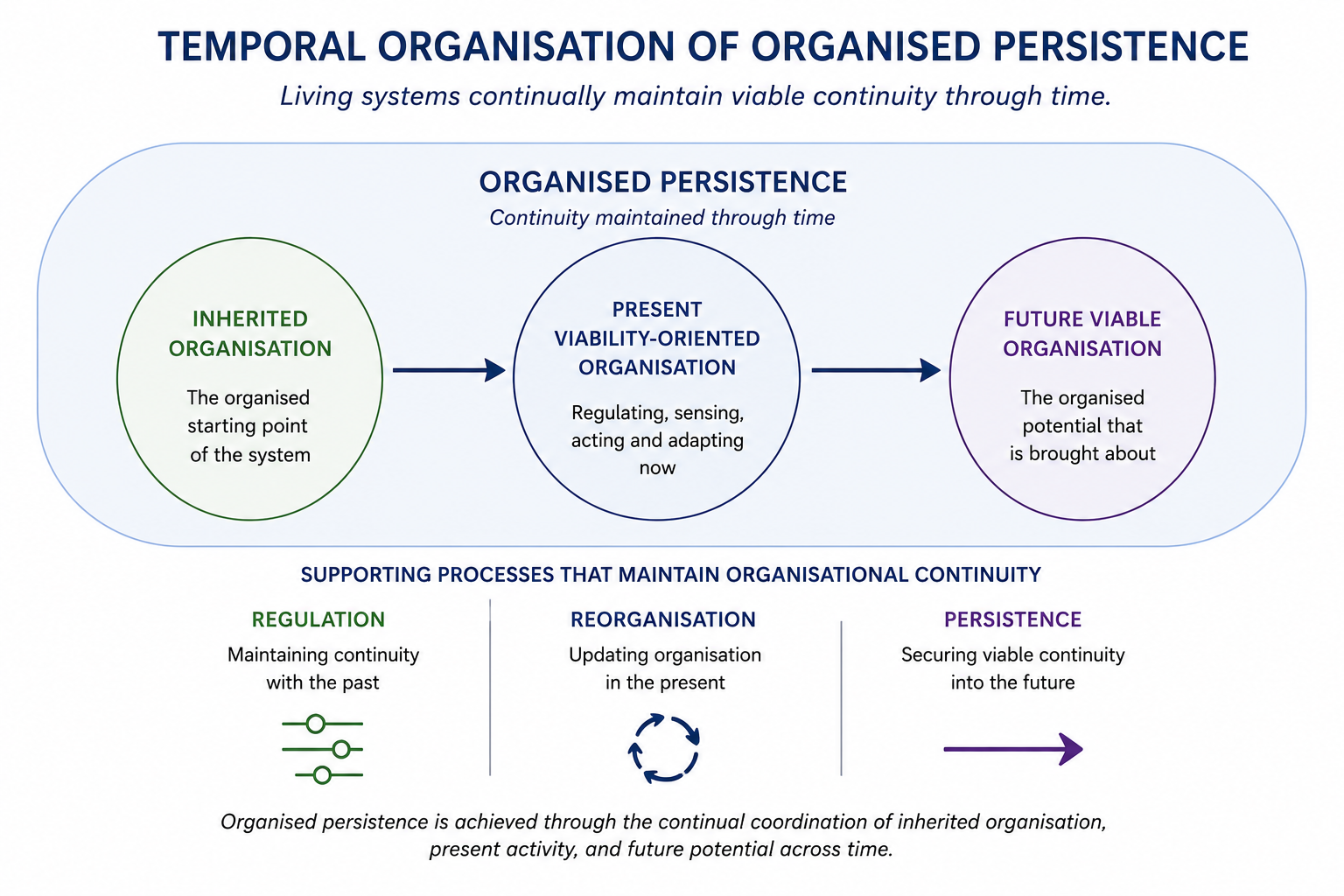
Temporal Organisation of Organised Persistence. Living systems do not merely exist through time; they continually maintain viable continuity through time. Inherited organisation, present viability-oriented organisation, and future viable organisation are coordinated through organised persistence, while regulation, reorganisation, and persistence provide the continual organisational activity that sustains viability despite ongoing change.
Temporal Organisation Across Biology
Viewing biology through the lens of temporal organisation reveals an unexpected unity among phenomena that are usually treated as belonging to separate disciplines. Physiology, development, behaviour, ecology, and evolution differ greatly in their mechanisms and timescales, yet each addresses the same fundamental biological problem: how organised living systems maintain viable continuity despite continual change. APS therefore proposes that these familiar domains are best understood not as independent explanatory categories but as complementary temporal expressions of organised persistence.
Physiological regulation provides the most immediate illustration of this principle. Every living organism continually adjusts metabolism, repairs molecular damage, maintains internal chemical conditions, reallocates resources, and responds to changing environmental demands. These activities do not merely preserve a particular physiological state. They continually preserve the organisational continuity required for the organism to remain viable. Homeostasis, allostasis, immune responses, cellular repair, and metabolic regulation therefore become different expressions of the same underlying temporal requirement: maintaining organised persistence from moment to moment despite continual disturbance.
Regulation thus represents the most immediate temporal expression of organised persistence. It maintains continuity across moments, continually renewing the conditions required for viability despite ongoing change.
Development extends this principle across the lifetime of the organism. Rather than viewing development simply as the execution of genetic programmes or the accumulation of structural complexity, APS interprets it as the continual reorganisation of organised persistence. The embryo, juvenile, and adult differ profoundly in morphology, physiology, and behaviour, yet each stage preserves the organisational continuity of the same living system. Development therefore illustrates one of biology’s most remarkable achievements: maintaining biological identity precisely through continual organisational transformation.
Development thus maintains continuity across lifetimes. What changes is organisation; what persists is the continuity of the living system through those changes.
Learning and memory reveal the same principle operating across behavioural timescales. Previous interactions influence future behaviour because they become incorporated into the continuing organisation of the organism. The biological significance of memory therefore lies not in preserving information about the past for its own sake, but in allowing present organisation to remain informed by previous experience. Even relatively simple organisms exhibit forms of biological memory through altered physiological states, developmental plasticity, stress responses, or modified regulatory behaviour. These diverse mechanisms differ substantially, yet all contribute to maintaining viable continuity across time.
Learning therefore maintains continuity across experience. The past remains biologically significant because it becomes incorporated into the continuing organisation of the organism.
Ecological organisation extends temporal continuity beyond the organism itself. Organisms remain coupled to environments whose own organisation changes across daily, seasonal, developmental, and evolutionary timescales. Resource availability fluctuates, communities reorganise, climates vary, and ecological relationships continually develop. Living systems therefore persist not by adapting to isolated environmental events but by maintaining ongoing coordination with temporally structured environments. Organism and environment together form a continuously evolving system whose persistence depends upon reciprocal temporal organisation.
Ecology therefore maintains continuity across organism–environment systems. Persistence is achieved not by organisms alone but through continuing coordination with changing ecological conditions.
Evolution expresses this organisational continuity across the greatest temporal scale of all. Persistence makes reproduction possible. Reproduction extends organisational continuity across generations. Variation introduces historical differences into that continuity, while evolutionary processes influence which forms of organisation continue to persist. Evolution therefore does not replace the organisational principles observed within physiology, development, learning, or ecology. It extends those same principles across evolutionary history, revealing organised persistence as a phenomenon that is simultaneously immediate and historical.
Evolution therefore maintains continuity across generations while continually transforming the forms through which viability is achieved.
Seen together, these examples reveal a common explanatory architecture extending throughout biology. Regulation preserves continuity across moments. Development preserves continuity across lifetimes. Learning preserves continuity across experience. Ecology preserves continuity across organism–environment systems. Evolution preserves continuity across generations. These processes differ not because they embody different biological principles, but because they express the same organisational principle across progressively broader temporal scales.
APS therefore reveals temporality not as another biological topic but as one of the organising dimensions through which all living systems achieve organised persistence. Regulation, development, learning, ecology, and evolution are not independent explanatory domains joined by analogy after the fact. They are progressively broader temporal expressions of the same continuing biological achievement: maintaining viable continuity through time.
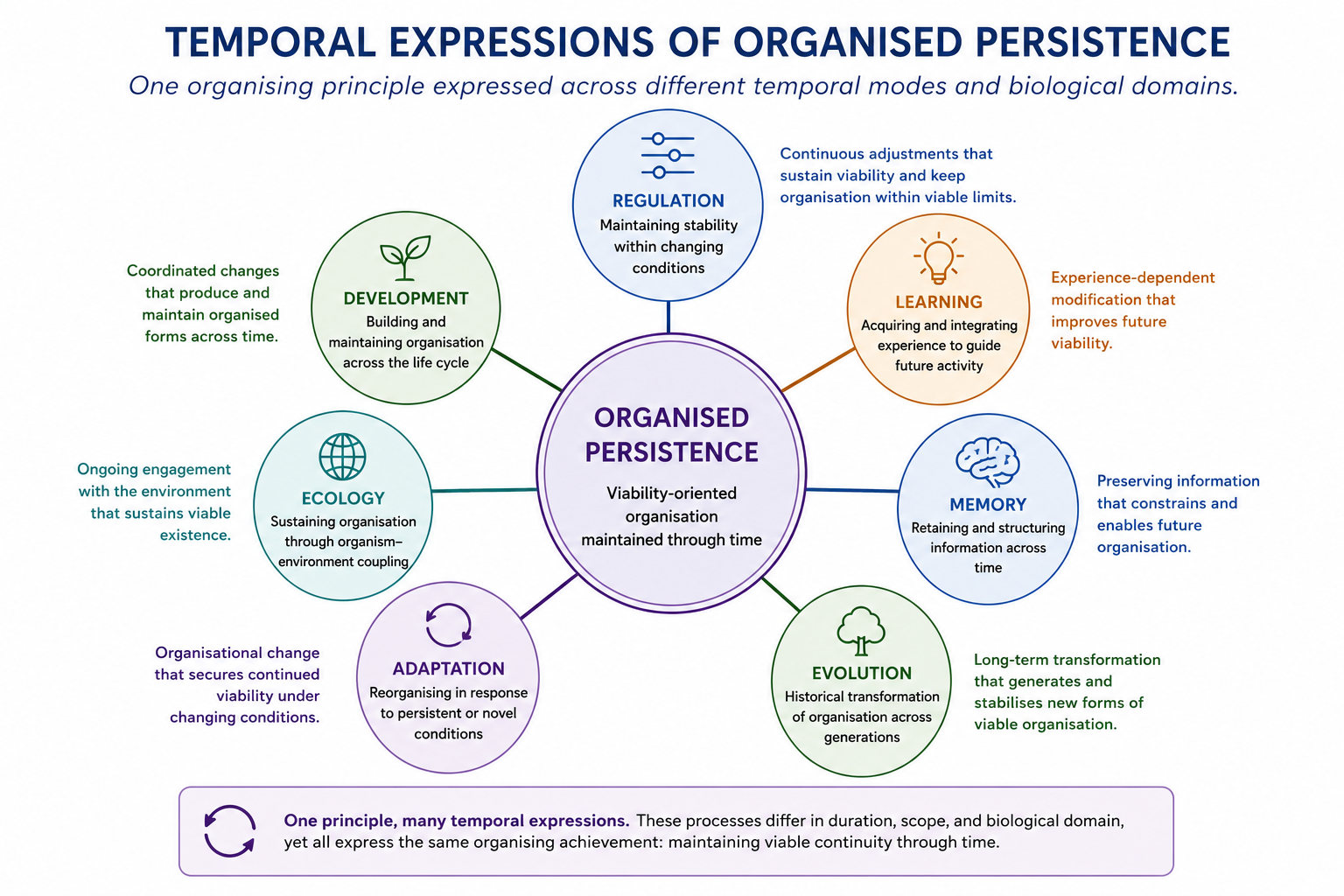
Temporal Expressions of Organised Persistence. Regulation, development, learning, memory, ecology, adaptation, and evolution differ in duration, mechanism, and biological domain, yet all express the same organisational principle: the maintenance of viability-oriented organised persistence through time. Together they reveal that biological organisation is unified by continuity rather than divided into independent explanatory domains.
Why Temporal Organisation Changes Biological Explanation
Recognising that organised persistence is intrinsically temporal also changes the nature of biological explanation itself. Traditional explanations often concentrate on mechanisms, structures, or causal interactions operating at particular moments. Such analyses remain indispensable, yet they are necessarily incomplete when considered in isolation. Mechanisms explain how biological activities occur, but they do not by themselves explain why those activities contribute to the continuing persistence of the living system.
APS therefore extends biological explanation beyond instantaneous causation by placing organisational continuity at its centre. Living systems remain viable only because continuity is continually maintained despite ongoing change. Explanation must therefore address not only the mechanisms that produce biological activity but also the organisational processes through which viable continuity is preserved across time. The significance of regulatory mechanisms lies in the way they contribute to sustained viability. Developmental processes become intelligible because they preserve continuity while transforming biological organisation. Behaviour becomes intelligible because it contributes to maintaining future viability under changing circumstances. Evolutionary explanations become intelligible because they describe the historical transformation of organised continuity across generations. In every case, explanation requires attention not only to immediate causal events but also to the temporal organisation through which living systems continually preserve themselves.
This perspective also clarifies the relationship among mechanism, function, and evolution. Mechanistic explanations describe how biological organisation is produced and maintained. Functional explanations describe why particular processes contribute to organised persistence. Evolutionary explanations describe how these organisational relationships originate, diversify, and change historically. APS does not treat these explanatory perspectives as competing alternatives. Instead, it understands them as complementary explanatory perspectives on the same underlying organisational reality. Each addresses a different aspect of how viability-oriented organisation persists and changes through time.
Viewed in this way, continuity becomes one of biology’s central explanatory concerns. Mechanisms, functions, behaviours, developmental trajectories, ecological relationships, and evolutionary histories all become intelligible because they contribute to the maintenance or transformation of organised persistence. The explanatory focus therefore shifts from isolated biological events to the organisational continuity that connects those events into coherent living systems.
Temporal organisation consequently becomes part of biology’s explanatory grammar rather than merely one of its subjects. It links processes that otherwise appear disconnected because they occur over different durations or are investigated by different biological disciplines. Once continuity rather than isolated events becomes the central explanatory concern, regulation, development, learning, ecology, and evolution emerge as interconnected dimensions of a single organisational framework centred on viability-oriented persistence.
Conclusion
Living systems differ from non-living systems not simply because they possess particular molecules, structures, or mechanisms, but because they continually organise themselves through time in ways that preserve their own viability. Persistence is therefore not the passive continuation of an existing state. It is the continual achievement of organisational continuity despite unceasing material turnover, environmental change, developmental transformation, and evolutionary history.
APS places this temporal organisation at the centre of biological explanation. Regulation, development, learning, memory, adaptation, ecology, and evolution are not isolated biological phenomena but complementary temporal expressions of organised persistence. Each reveals a different way in which living systems maintain continuity while continually changing. Together they demonstrate that temporality is not merely the backdrop against which biology unfolds but one of the fundamental organisational dimensions through which life exists.
The argument developed throughout this article can be summarised as a progression from viability to explanation. Living systems must remain viable despite continual change. Viability therefore requires continuity. Continuity requires organised persistence. Organised persistence requires temporal organisation capable of coordinating inherited organisation, present activity, and future possibilities for persistence. Regulation, development, learning, ecology, and evolution emerge as different temporal expressions of this organisational requirement. Biological temporality is therefore not an additional feature of life but one of the conditions through which life remains possible.
This perspective reshapes the explanatory landscape of biology. Rather than asking only how biological mechanisms operate or how biological structures are organised, APS asks how living systems continually sustain viable organisation across time. Continuity becomes the unifying biological problem, viability becomes the organising criterion, and organised persistence becomes the explanatory target. Time therefore acquires a distinctive biological significance, not because organisms simply occupy it, but because living organisation can exist only by continually organising itself through it.
Seen from this perspective, the familiar divisions between physiology, development, ecology, cognition, and evolution become less absolute than they first appear. Each investigates a different temporal expression of the same continuing organisational achievement. Biology consequently emerges not as the study of isolated mechanisms operating at different scales, but as the science of how viability-oriented organisation continually preserves itself through time. Temporal organisation is therefore neither an additional topic within biology nor merely the background against which life unfolds. It is one of the fundamental principles through which organised persistence becomes intelligible.
See Also
Related Articles
References
- (2026). Plant Agency: From Senome and Electrome to Plant Semiosphere. Biosemiotics .
- (2005). Explanation: A Mechanist Alternative. Studies in History and Philosophy of Biological and Biomedical Sciences, 36, 421–441 .
- (2016). Plants Are Intelligent, Here's How. Annals of Botany, 118, 607–610 .
- (1932). The Wisdom of the Body. W. W. Norton.
- (2007). Explaining the Brain. Oxford University Press.
- (1975). Functional Analysis. Journal of Philosophy, 72, 741–765 .
- (2011). Incomplete Nature. W. W. Norton.
- (1999). Molecular Bases for Circadian Clocks. Cell, 96, 271–290 .
- (2017). Developmental Biology. Sinauer Associates.
- (1973). Resilience and Stability of Ecological Systems. Annual Review of Ecology and Systematics, 4, 1–23 .
- (2018). Why?. Oxford University Press.
- (1966). The Phenomenon of Life. Harper & Row.
- (2000). Investigations. Oxford University Press.
- (1998). Ecosystems and the Biosphere as Complex Adaptive Systems. Ecosystems, 1, 431–436 .
- (1968). Evolution in Changing Environments. Princeton University Press.
- (1970). The Units of Selection. Annual Review of Ecology and Systematics, 1, 1–18 .
- (2000). Thinking About Mechanisms. Philosophy of Science, 67, 1–25 .
- (1961). Cause and Effect in Biology. Science, 134, 1501–1506 .
- (2015). Biological Autonomy: A Philosophical and Theoretical Enquiry. Springer.
- (2013). Organisms ≠ Machines. Studies in History and Philosophy of Biological and Biomedical Sciences, 44, 669–678 .
- (2018). Everything Flows: Towards a Processual Philosophy of Biology. Oxford University Press.
- (2012). A Theory of Biological Relativity: No Privileged Level of Causation. Interface Focus, 2, 55–64 .
- (1971). Fundamentals of Ecology. Saunders.
- (1993). Temporal Organization: Reflections of a Darwinian Clock-Watcher. Annual Review of Physiology, 55, 17–54 .
- (2024). Plant Behaviour and Biological Agency. BioSystems .
- (2025). Biological Agency as the Context for Plant Cognition. Zenodo. https://doi.org/10.5281/zenodo.16938193
- (2026). Agency as the Defining Activity of Life: A Viability-Oriented Framework Integrating Process and Scale. Biological Theory . https://doi.org/10.1007/s13752-026-00547-6
- (2005). Green Plants as Intelligent Organisms. Trends in Plant Science, 10, 413–419 .
- (2003). Developmental Plasticity and Evolution. Oxford University Press.