Plant Agency — An APS Perspective
Contemporary research has transformed our understanding of plants from passive organisms into active biological agents whose persistence depends upon continual regulation, signalling, development, and ecological organisation. Rather than treating these discoveries as independent explanatory domains, APS interprets them as complementary expressions of viability-oriented organised persistence. This article synthesises the contemporary literature on plant agency and shows how signalling, cognition, organism–environment coupling, ecological interaction, and distributed regulation become mutually intelligible within a single organisational framework centred on biological agency.
Key Points
- Contemporary biology increasingly recognises plants as active biological agents rather than passive organisms.
- Plant signalling, development, cognition, and ecological interaction are complementary expressions of organised biological agency.
- Agency does not arise from brains or nervous systems but from the viability-oriented organisation of living systems.
- Signalling serves biological agency by coordinating the regulation required for organised persistence.
- Plant agency reveals general organisational principles shared across all living systems rather than uniquely botanical phenomena.
- APS integrates contemporary theories of plant agency within a unified explanatory framework centred on viability-oriented organised persistence.
Introduction
Few developments in contemporary biology have reshaped scientific thinking as profoundly as the transformation in our understanding of plants. Organisms once regarded as passive, rooted, and largely reactive are now increasingly recognised as active participants in their own persistence. Research over the past two decades has revealed plants that coordinate activities across their bodies, integrate information from changing environments, communicate through multiple signalling systems, modify the ecological conditions in which they live, and continually reorganise themselves as those conditions change. The cumulative effect of these discoveries has been to shift plants from the periphery of theoretical biology to the centre of one of its most important contemporary debates.
The implications extend well beyond botany. They challenge a deeply rooted assumption that has shaped biological thinking for centuries: that agency depends upon brains or nervous systems. As evidence has accumulated, it has become increasingly difficult to maintain this distinction. Plants demonstrate that highly organised, coordinated, and adaptive activity can emerge in organisms that possess neither neurons nor centralised control. The question is therefore no longer whether plants simply respond to their environments, but how agency itself should be understood as a property of living organisation.
This question has stimulated an extraordinary convergence of research traditions. Plant physiologists have revealed increasingly sophisticated systems of electrical, hydraulic, chemical, and mechanical communication. Developmental biologists have shown that growth is not merely the execution of genetically specified programmes but a continual process of regulation shaped by changing internal and external conditions. Ecologists have demonstrated that plants actively modify soils, recruit microbial partners, communicate through volatile compounds, and transform the environments within which future development occurs. At the same time, researchers working in plant cognition, enactivism, autopoiesis, and biosemiotics have proposed new conceptual frameworks for understanding learning, memory, anticipation, environmental responsiveness, and biological meaning.
Taken together, these developments have transformed the scientific conversation. They suggest that agency is not an exceptional property confined to animals but a more general characteristic of living systems. Yet they also leave an important explanatory question unresolved. Although contemporary theories illuminate many different aspects of plant organisation, they often emphasise different mechanisms, different conceptual foundations, or different explanatory languages. How these diverse insights belong together within a single biological account remains much less clear.
APS begins from this point of convergence rather than disagreement. It accepts that plants are genuine biological agents and regards the emergence of plant agency as one of the most significant developments in contemporary biology. Its contribution lies elsewhere. Rather than asking whether signalling, cognition, semiosis, or ecological interaction individually explain agency, APS asks why living organisms must possess agency in the first place. This shift in perspective moves the discussion from identifying the mechanisms through which agency is expressed to understanding the biological necessity that those mechanisms collectively serve.
From an APS perspective, agency is not an additional characteristic acquired by sufficiently complex organisms. It is the viability-oriented activity through which living systems continually maintain, regulate, and reorganise the conditions of their own organised persistence. Signalling, learning, memory, anticipation, ecological interaction, and environmental modification therefore become complementary organisational expressions of this more fundamental biological reality. Each contributes to the ongoing maintenance of viable organisation, even though each operates through different mechanisms and across different temporal and spatial scales.
Seen in this way, APS does not compete with contemporary theories of plant agency. Instead, it provides an explanatory framework within which their strongest insights become mutually intelligible. The purpose of this article is therefore not to replace existing perspectives, but to show how the diverse discoveries that have transformed our understanding of plants can be integrated into a unified account of living organisation centred upon viability-oriented organised persistence.
Why Plants Changed the Conversation
For much of the history of biology, plants occupied an unusual conceptual position. Their remarkable physiological complexity was widely recognised, yet they were generally portrayed as passive organisms whose activities could be explained as the automatic consequences of genes, chemistry, and environmental stimuli. Agency belonged to animals because animals explored their surroundings, made behavioural choices, and coordinated their activities through nervous systems. Plants, rooted in place, appeared simply to grow.
Over time, this distinction became increasingly difficult to sustain. Improvements in experimental techniques revealed forms of organisation that extended well beyond simple stimulus–response behaviour. Plants integrate information arriving simultaneously from many sources, coordinate long-distance communication through electrical, hydraulic, chemical, and mechanical signalling, regulate development in response to changing environmental conditions, establish and maintain symbiotic partnerships, reshape the physical and biological properties of soils, and modify their future possibilities through continual interaction with their surroundings. None of these discoveries, viewed in isolation, required a fundamental revision of biological thinking. Together, however, they revealed organisms that actively participate in generating and sustaining their own organisation.
As these discoveries accumulated, previously separate areas of research began to converge. Plant physiology, systems biology, electrophysiology, ecology, developmental biology, biosemiotics, philosophy of biology, and cognitive science all found themselves addressing different aspects of the same underlying problem. Although their conceptual vocabularies differ considerably, they increasingly point towards a common conclusion: plants are active participants in their own persistence rather than passive recipients of environmental influence.
What remains uncertain is not the existence of these organisational capacities but their biological interpretation. Some approaches emphasise distributed cognition, others electrical signalling, autopoietic organisation, embodied interaction, ecological construction, or semiotic interpretation. Each captures an important dimension of plant life, yet none fully explains why these apparently different phenomena repeatedly emerge together across the biological sciences.
APS approaches this question by changing the level of explanation. Rather than treating these perspectives as competing theories, it interprets them as complementary descriptions of the different ways living systems organise viability. From this perspective, the diversity of contemporary plant agency research reflects not competing biological realities but different windows onto the same underlying organisational process.
The Emergence of Plant Agency
The modern concept of plant agency did not arise from a single discovery or a single theoretical innovation. It emerged gradually as independent lines of research, each pursuing different questions and employing different methods, began to converge upon remarkably similar conclusions about the organisation of living systems.
Studies of plant signalling revealed unexpectedly sophisticated systems of internal coordination capable of integrating activity across the entire organism. Research into development demonstrated that growth is not simply the unfolding of genetically predetermined programmes but an ongoing process of regulation that continually incorporates environmental conditions into the organisation of the organism. Ecological investigations showed that plants actively modify soils, establish microbial partnerships, influence neighbouring organisms, and reshape the environments within which future growth occurs. At the same time, work in plant cognition suggested that capacities such as learning, memory, anticipation, and flexible behavioural coordination need not depend exclusively upon nervous systems but could emerge from distributed biological organisation itself.
Although these developments originated within different scientific traditions, they converged upon a common insight. Plants do not merely undergo biological processes. They actively participate in generating, coordinating, and sustaining them. Agency therefore became increasingly understood as an organisational property of living systems rather than a specialised consequence of neural complexity.
APS fully accepts this conclusion. Its distinctive contribution lies in asking what biological principle makes this convergence possible. Rather than interpreting signalling, cognition, ecological interaction, or organisational closure as independent explanations of agency, APS proposes that they become fully intelligible when understood as complementary expressions of viability-oriented organised persistence. Contemporary theories of plant agency therefore illuminate different dimensions of the same organisational reality. APS provides the explanatory framework within which those dimensions can be understood together.
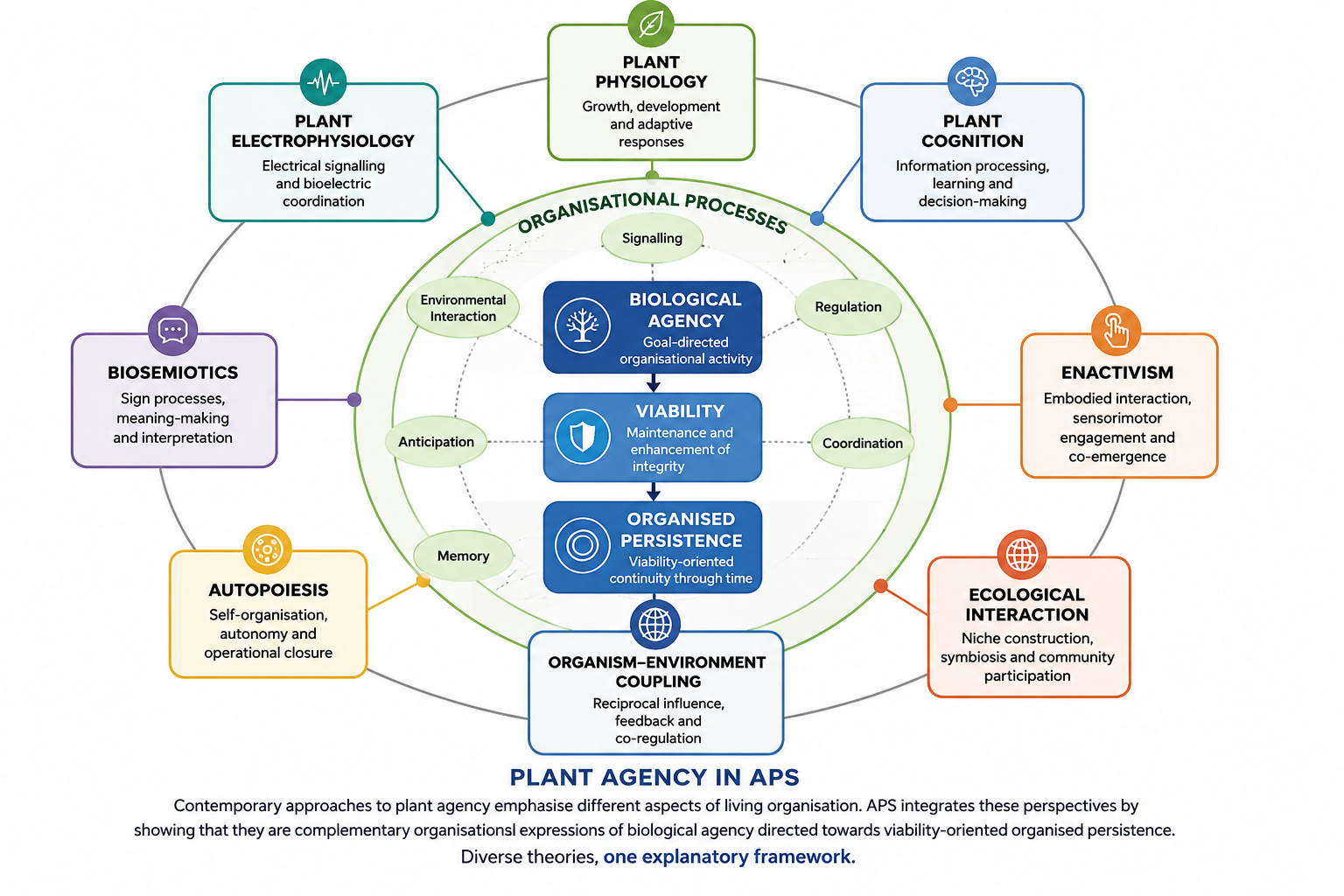
Plant Agency in APS. APS interprets signalling, regulation, cognition, ecological interaction, and organism–world coupling as complementary organisational expressions of viability-oriented organised persistence. Contemporary theories illuminate different aspects of this organisational reality, while APS provides the explanatory framework that integrates them.
From Observation to Explanation
The contemporary literature on plant agency has fundamentally changed what requires explanation in plant biology. It has established that plants are not passive organisms governed by fixed developmental programmes or simple stimulus–response mechanisms. Instead, they exhibit distributed regulation, long-distance coordination, physiological plasticity, environmental responsiveness, ecological interaction, and remarkable organisational continuity throughout their lives. These observations are no longer exceptional claims but increasingly form part of the empirical foundation upon which modern plant biology is being built.
The central question has therefore shifted. The challenge is no longer to demonstrate that plants exhibit organised, adaptive behaviour, but to understand why such diverse phenomena consistently appear together. Contemporary theories frequently answer this question by emphasising one aspect of living organisation above others. Some locate the foundations of agency in distributed cognition, others in autopoietic organisation, embodied interaction, biosemiotic interpretation, electrical signalling, or ecological construction. Each perspective illuminates genuine features of plant life, yet each also approaches the problem through its own conceptual language and explanatory priorities.
APS approaches the same body of evidence from a different direction. Rather than asking which organisational feature gives rise to agency, it asks what biological requirement makes all of these organisational features necessary. This seemingly modest shift changes the structure of the explanation. Instead of treating signalling, cognition, semiosis, or ecological interaction as alternative foundations of agency, APS understands them as complementary processes through which living systems maintain themselves under continually changing conditions.
The organising principle is viability-oriented organised persistence. Living systems do not merely exist; they must continually sustain the organisation that makes continued existence possible. Every moment of life requires the coordination of processes that preserve integrity despite material turnover, developmental change, environmental uncertainty, injury, competition, and reproduction. Agency is therefore not an optional characteristic acquired by sufficiently complex organisms but the continual activity through which viable organisation is maintained. Once this principle becomes the explanatory starting point, the diverse discoveries of contemporary plant biology no longer appear as separate phenomena requiring separate theories. They become different expressions of the same organisational necessity.
Why Plants Are Agents
APS defines biological agency as viability-oriented, self-regulating activity through which living systems sustain, modulate, and continually recreate the conditions of their own organised persistence. This definition differs from many contemporary accounts not because it rejects signalling, cognition, or behaviour, but because it asks a more fundamental question. Before an organism can learn, anticipate, communicate, or make decisions, it must first remain alive. Every subsequent organisational capacity therefore depends upon the continual preservation of viability.
Plants illustrate this relationship with exceptional clarity. Unlike many animals, they cannot respond to changing conditions simply by moving elsewhere. Every challenge must instead be met through continual internal reorganisation. Growth patterns alter as light conditions change. Root systems expand, contract, or redirect themselves as soils become more or less favourable. Water transport is continually adjusted to changing environmental demands. Developmental pathways remain responsive throughout the life of the organism, while defensive systems, reproductive strategies, and symbiotic relationships are all reorganised according to changing circumstances. These activities differ profoundly in mechanism and timescale, yet they remain united by a common biological objective: sustaining the organisation that allows the plant to continue living.
From this perspective, agency is fundamentally regulatory before it becomes behavioural. Behaviour is one expression of agency, not its definition. The continual coordination of development, physiology, metabolism, ecological interaction, and environmental responsiveness all belong to the same organisational process because each contributes to maintaining viable organisation. APS therefore understands agency as the activity that integrates these diverse processes into the continuing persistence of the living organism.
Signalling Serves Agency
Among the most important achievements of contemporary plant biology has been the demonstration that plants possess sophisticated systems of internal communication. Electrical activity coordinates responses across tissues. Hydraulic signals redistribute physiological activity throughout the organism. Hormonal networks integrate development with changing environmental conditions. Mechanical and chemical signals continually modify growth, defence, reproduction, and ecological interaction. Together these discoveries have transformed our understanding of how plants achieve coordinated organisation without nervous systems.
APS fully accepts the significance of these discoveries while proposing a different explanatory relationship between signalling and agency. Contemporary discussions sometimes present increasingly sophisticated signalling systems as the basis from which agency emerges. APS reverses this explanatory direction. Living systems require signalling because they are already agents engaged in maintaining their own viability. Communication systems evolve and diversify because coordinated regulation becomes progressively more effective as organisms increase in complexity. Signalling therefore serves agency rather than creating it.
This distinction provides a unified way of interpreting the extraordinary diversity of biological communication. Animals rely heavily upon nervous systems, plants upon distributed physiological networks, fungi upon filamentous organisation, and microbial communities upon entirely different modes of coordination. The mechanisms differ because evolutionary history has produced multiple solutions to the problem of biological organisation. The underlying requirement, however, remains constant. Every living system must coordinate activity in ways that preserve viability across changing internal and external conditions. APS therefore interprets signalling as one family of regulatory processes through which agency is enacted rather than as the origin of agency itself.
Plant Cognition Without Anthropomorphism
Few areas of contemporary biology have generated more discussion than the proposal that plants exhibit forms of cognition. Experimental evidence for learning, memory, anticipatory regulation, environmental discrimination, and flexible behavioural coordination has challenged the long-standing assumption that cognition requires neurons or brains. These discoveries have encouraged researchers to reconsider not only the nature of plants but also the biological meaning of intelligence itself.
APS welcomes this reconsideration while introducing an important conceptual clarification. Agency, cognition, intelligence, and consciousness describe different aspects of living organisation and should not be treated as interchangeable concepts. Every living organism must regulate itself if it is to remain viable, but not every organism necessarily exhibits the same forms or degrees of cognitive organisation. Conflating these concepts risks obscuring rather than clarifying the biological phenomena under investigation.
From an APS perspective, the capacities commonly described as learning, memory, anticipation, and decision-making can all be understood as organisational extensions of viability-oriented regulation. Learning modifies future regulatory responses in light of previous experience. Memory preserves aspects of organisational history that remain relevant to future viability. Anticipation prepares the organism for conditions that have not yet occurred but are biologically probable. Decision-making coordinates alternative courses of action when multiple regulatory demands compete. Each represents a distinct mode of biological organisation, yet each ultimately contributes to the same underlying task of sustaining organised persistence.
This interpretation allows APS to recognise the remarkable sophistication of plant organisation without either diminishing its significance or relying upon anthropomorphic language. Plant cognition becomes neither a metaphor borrowed from animal biology nor a claim requiring controversial assumptions about consciousness. Instead, it is understood as one important organisational expression of biological agency itself. In doing so, APS preserves the empirical achievements of contemporary plant cognition while locating them within a broader explanatory framework capable of encompassing all living systems.
One Organisational Principle, Many Biological Expressions
The growing diversity of theories surrounding plant agency reflects an important development in contemporary biology. Researchers working in different disciplines have approached living organisation from different directions, each emphasising phenomena that had previously received insufficient attention. Autopoiesis has highlighted the self-producing organisation of living systems. Enactivism has explored the inseparability of organism and environment in biological activity. Biosemiotics has examined the emergence of biological meaning through living interactions. Plant electrophysiology has revealed unexpectedly sophisticated systems of distributed communication, while ecological approaches have demonstrated that organisms continually construct, modify, and inhabit the environments that sustain them.
Viewed independently, these perspectives can appear to compete for explanatory priority. Each proposes a different language through which biological organisation should be understood, and each naturally emphasises those aspects of living systems most visible within its own research tradition. Yet the remarkable convergence of their empirical observations suggests that the apparent diversity may conceal a deeper unity.
APS proposes that this unity lies in the organisation of viability itself. Every one of these theoretical perspectives describes processes through which living systems maintain, regulate, or extend the conditions necessary for their continued persistence. Autopoiesis explains how organisation continually reproduces itself. Enactivism explains how that organisation remains dynamically coupled to its surroundings. Biosemiotics explains how environmental differences acquire biological significance because they matter for viability. Signalling coordinates activity throughout the organism, while ecological interactions extend regulation beyond the immediate boundaries of the individual. Each therefore contributes an essential perspective on the same underlying organisational reality.
Rather than replacing these theories, APS provides an explanatory grammar through which their contributions become mutually intelligible. Their differences remain important because they illuminate different organisational processes, but they need no longer be understood as competing accounts of life. They become complementary descriptions of how viability-oriented organised persistence is achieved across different biological systems, different mechanisms, and different scales of organisation.
Plant Agency Beyond the Individual
One of the most important developments in recent plant biology has been the growing recognition that agency cannot always be understood solely by examining individual organisms in isolation. Plants continually regulate their relationships with soils, microbial communities, fungal symbionts, neighbouring plants, and wider ecological systems. Root exudates modify the physical and biological properties of soils. Mycorrhizal partnerships alter nutrient acquisition, development, and resilience. Volatile organic compounds influence defensive responses both within individual plants and across neighbouring communities. In each case, biological organisation extends beyond the visible boundaries of the organism itself.
APS interprets these observations as natural consequences of viability-oriented organisation rather than as exceptions requiring separate explanatory principles. Organisms remain viable by regulating the relationships upon which their persistence depends. As those relationships become increasingly complex, regulation necessarily extends into the surrounding environment. Agency therefore cannot be confined to events occurring within the physical boundaries of the organism alone. It encompasses the continual organisation of organism–world coupling through which viable persistence is achieved.
This perspective also clarifies why ecological organisation occupies such a central position within APS. Ecology is not simply the external context in which organisms exist. It forms part of the organisational processes through which living systems continually sustain themselves. Plant agency therefore reveals that biological organisation is simultaneously physiological, developmental, behavioural, and ecological. These are not separate explanatory domains but interconnected expressions of a single organisational reality unfolding across multiple scales.
What APS Contributes
The principal contribution of APS is not to introduce another theory of plant agency but to provide a common explanatory framework capable of integrating the diverse insights emerging across contemporary biology. The remarkable expansion of research into signalling, cognition, ecology, development, electrophysiology, biosemiotics, and organism–environment interaction has greatly enriched our understanding of plant life. At the same time, it has produced an increasingly diverse conceptual landscape in which different explanatory languages often coexist without an obvious organising principle.
APS addresses this problem by shifting attention from particular mechanisms to the biological organisation those mechanisms collectively sustain. Signalling is understood in relation to regulation. Regulation is understood in relation to agency. Agency is understood in relation to viability. Viability is understood in relation to organised persistence. In this way, phenomena that initially appear conceptually distinct become integrated within a single explanatory architecture.
This approach also provides a framework that extends naturally beyond plants themselves. The same organisational principles apply across animals, fungi, microbial communities, and other living systems despite the enormous diversity of mechanisms through which biological organisation is achieved. APS therefore does not propose a specifically botanical theory. It proposes that plant biology has revealed particularly clearly a more general principle governing life itself. By demonstrating that agency does not depend upon brains or nervous systems, plants expose the organisational foundations shared by all living systems.
Conclusion
The emergence of plant agency represents one of the most important conceptual developments in contemporary biology. It has challenged assumptions that long confined agency to organisms possessing nervous systems and has revealed plants as active participants in generating, regulating, and sustaining their own biological organisation. Research across plant physiology, ecology, development, cognition, electrophysiology, autopoiesis, enactivism, and biosemiotics has collectively transformed the questions that biology now asks about living systems.
APS fully embraces this transformation. Rather than questioning whether plants are genuine biological agents, it asks what makes agency biologically necessary in the first place. Its answer is that agency arises from the continual organisation of viability. Living systems persist only because they continually regulate the conditions that allow organised persistence to continue. Signalling, learning, memory, anticipation, ecological interaction, and environmental modification therefore become different organisational expressions of the same underlying biological imperative.
From this perspective, the growing diversity of contemporary theories no longer represents a collection of competing explanations but a progressively richer understanding of living organisation viewed from different directions. APS neither replaces these perspectives nor reduces their distinct contributions. Instead, it provides an explanatory framework within which they can be understood together, revealing the common organisational principles that unite them.
Plant agency therefore becomes more than a specialised topic within botany. It becomes one of the clearest demonstrations that life is fundamentally an organised, viability-oriented process whose defining characteristic is neither structure nor mechanism alone, but the continual activity through which living systems sustain, reorganise, and extend the conditions of their own persistence.
See Also
Related Articles
References
- (2025). The Pursuit of Plant Agency. Plant Signaling & Behavior .
- (2026). Plant Agency: From Senome and Electrome to Plant Semiosphere. Frontiers in Plant Physiology .
- (2008). Biosemiotics: A New Understanding of Life. Springer.
- (2016). Plants as Adaptive Agents. Oxford University.
- (2023). Planta Sapiens: The New Science of Plant Intelligence. W. W. Norton.
- (2024). Enactive Plant Cognition. Adaptive Behavior .
- (2011). Incomplete Nature. W. W. Norton.
- (2022). Linguistic Bodies: The Continuity Between Life and Language. MIT Press.
- (2007). Electrical Signals and Their Physiological Significance in Plants. Plant, Cell & Environment, 30, 249–257 .
- (2018). Thus Spoke the Plant. North Atlantic Books.
- (2008). Biosemiotics. University of Scranton Press.
- (1966). The Phenomenon of Life. Harper & Row.
- (1998). Ecosystems and the Biosphere as Complex Adaptive Systems. Ecosystems, 1, 431–436 .
- (1980). Autopoiesis and Cognition. D. Reidel.
- (2015). Biological Autonomy: A Philosophical and Theoretical Enquiry. Springer.
- (2018). Everything Flows: Towards a Processual Philosophy of Biology. Oxford University Press.
- (2012). A Theory of Biological Relativity. Interface Focus, 2, 55–64 .
- (2003). Niche Construction. Princeton University Press.
- (2024). Plant Agency and Distributed Biological Organisation. Plant Signaling & Behavior .
- (2025). Biological Agency as the Context for Plant Cognition. Zenodo. https://doi.org/https://doi.org/10.5281/zenodo.16938193
- (2026). Agency as the Defining Activity of Life: A Viability-Oriented Framework Integrating Process and Scale. Biological Theory . https://doi.org/10.1007/s13752-026-00547-6
- (2005). Green Plants as Intelligent Organisms. Trends in Plant Science, 10, 413–419 .
- (2014). Plant Behaviour and Intelligence. Oxford University Press.
- (2019). Plant Electrophysiology: Signalling and Responses. Springer.