Plant Cognition — A Critical Review and APS Interpretation
Whether plants are cognitive cannot be decided either by the absence of nervous systems or by the presence of adaptive responsiveness, signalling, plasticity and learning-like activity. APS approaches plant cognition as a comparative explanatory problem. Plants clearly exhibit biological agency, biological evaluation and biological significance, but these pre-cognitive capacities do not by themselves establish cognition. APS defines cognition as the organisation of biological significance across time and currently proposes that cognitive attribution becomes warranted where integrated biological significance modulates activity across a temporal field of viability-relevant possibilities in ways not exhausted by immediate or fixed regulation. Applying this boundary to plant phenomena produces a differentiated result. Distributed sensing, systemic signalling and developmental plasticity establish sophisticated biological organisation but do not independently warrant cognition. Stress priming provides a stronger boundary case but remains cognitively indeterminate because temporally extended molecular, physiological and developmental regulation remains an adequate explanation of current evidence. Habituation-like phenomena are suggestive, while stronger associative-learning claims remain empirically contested. Plants therefore provide a demanding test of whether cognition can be extended beyond nervous systems without collapsing into biological regulation in general.
Key Points
- Plant biological agency, Biological Evaluation, Significance, signalling, plasticity and temporal retention do not individually or cumulatively establish cognition.
- APS defines cognition as the organisation of biological significance across time and treats the current cognitive-boundary proposal as provisional rather than as a second definition.
- Plant stress priming is a principal boundary case but remains cognitively indeterminate because sophisticated temporally extended regulation remains an adequate comparator.
- Habituation-like plant phenomena are suggestive, while stronger associative-learning claims remain empirically contested.
- Plant cognition should be adjudicated for specified phenomena relative to adequate non-cognitive comparators rather than attributed globally to plants as a taxonomic group.
1. The Plant Cognition Problem
Debates over plant cognition have long oscillated between two unsatisfactory poles. At one extreme, cognition is tied so closely to nervous systems, representation, consciousness, or animal-like behaviour that plants are excluded largely by definition. At the other, cognition is extended to adaptive responsiveness, signalling, plasticity, learning-like change, or biological complexity so broadly that the distinction between cognition and regulation becomes difficult to maintain (Alpi et al. 2007; Taiz et al. 2019; Segundo-Ortín et al. 2025).
Both positions respond to genuine features of biological explanation. Neural systems support forms of integration, learning, representation and behavioural flexibility central to many familiar cases of cognition. Plants, by contrast, lack nervous systems yet display extensive environmental sensitivity, systemic signalling, developmental plasticity, history-dependent regulation and coordinated adjustment to changing conditions. The difficulty arises when either anatomical similarity or adaptive complexity is treated as a sufficient criterion for cognitive attribution.
The plant cognition debate therefore exposes a broader problem:
A biologically grounded account of cognition must be permissive enough to recognise genuinely non-neural cognitive organisation if it exists, but restrictive enough to distinguish cognition from the sophisticated regulation already required by living systems.
This problem cannot be solved merely by deciding whether plants appear intelligent, whether their behaviour resembles that of animals, or whether particular mechanisms are sufficiently complex. The relevant question is explanatory: what organisation must be demonstrated before cognitive description contributes something beyond an adequate biological account of regulation, development and adaptation?
APS approaches the issue from this direction. It does not begin by classifying plants globally as cognitive or non-cognitive. Nor does it infer cognition from viability, biological agency, signalling, learning, temporal extension, or distributed organisation alone. Instead, it asks which specified plant phenomena, if any, warrant cognitive explanation once the strongest adequate non-cognitive account has been considered.
This shifts the debate from taxonomic classification to comparative explanation.
Where This Article Fits
This article applies the APS cognition boundary to the plant-cognition debate. It does not own the general definition or demarcation of cognition, the broader continuity from Life to Mind, or the account of what cognition contributes once cognitive attribution has been warranted.
Those questions are developed elsewhere in the APS cognition corpus. The present article has a narrower task: to ask whether specified plant phenomena warrant cognitive explanation relative to adequate non-cognitive comparators.
Plants are especially informative for this purpose because they combine sophisticated viability-oriented regulation, distributed sensing, systemic signalling, developmental plasticity and history-sensitive activity without nervous systems. They therefore provide a demanding test of whether cognitive attribution can extend beyond familiar neural cases without collapsing cognition into biological regulation in general.
2. What Counts as Evidence for Plant Cognition?
Plants possess many capacities that are relevant to cognition research without independently establishing cognition.
They detect and discriminate environmental conditions through distributed sensory mechanisms. Electrical, hormonal and chemical signalling can coordinate activity over considerable portions of the organism. Growth and development change in response to light, water, nutrients, mechanical conditions, herbivory and other perturbations. Previous exposure can alter later physiological responses, sometimes over substantial intervals. These phenomena demonstrate complex biological organisation and provide legitimate material for investigating cognition (Sultan 2000; Toyota et al. 2018; Segundo-Ortín et al. 2025).
But evidence relevant to cognition is not the same as evidence sufficient for cognition.
Environmental sensing establishes discrimination among conditions. Systemic signalling establishes material coordination. Developmental plasticity establishes history-sensitive adjustment. Stress priming establishes that prior perturbation can alter later responsiveness. Learning-like experiments may indicate modification through experience. None of these findings by itself determines whether cognition is required to explain the phenomenon.
The distinction is especially important because living systems are already organised historically. Regulatory networks can retain state. Development can alter later response possibilities. Molecular persistence, epigenetic modification, hormonal state, structural change and altered resource allocation can produce temporally extended effects without requiring cognitive organisation. A plant can therefore exhibit activity that is selective, integrated, adaptive and historically modulated while the relevant dependencies remain adequately explained through biological regulation.
Evidence for plant cognition must consequently do more than establish complexity or temporal persistence. It must discriminate between at least two hypotheses:
- the phenomenon results from sophisticated but sufficiently fixed biological regulation; or
- biological significance is organised across time in a way that modulates present activity relative to viability-relevant possibilities beyond what the regulatory account explains.
That distinction places the burden of proof on the organisation itself rather than on the vocabulary.
The comparative test therefore proceeds in four steps: specify the plant phenomenon and explanandum; reconstruct the strongest adequate non-cognitive explanation; ask whether the phenomenon exhibits the organisation required by the provisional APS cognitive boundary; and assign an evidential grade according to whether cognitive explanation is unnecessary, suggestive, unresolved against the comparator, or positively warranted. The test concerns explanatory gain for the specified phenomenon, not the cognitive status of plants as a whole.
3. The Strongest Case for Plant Cognition
The strongest case for plant cognition does not depend on claiming that plants possess consciousness, brains, or human-like mental states. It arises from phenomena in which prior conditions appear to alter later activity in context-sensitive ways.
Several candidate families are important.
Stress Priming
Plant stress priming is particularly significant because exposure to a non-lethal perturbation can alter responses to later stress. Drought or dehydration priming can produce persistent physiological and developmental changes that alter later stress responsiveness (Bruce et al. 2007).
This makes priming more than an instantaneous stimulus-response relation. Earlier conditions continue to influence later organisation, and those effects can matter to viability.
Habituation-Like Response Modification
Some plant experiments have been interpreted as demonstrating habituation or memory-like modification through repeated exposure (Gagliano et al. 2014). If a plant becomes selectively less responsive to a recurrent non-harmful stimulus while retaining responsiveness to other significant conditions, this would be relevant to a cognition boundary because history would be affecting present significance.
The explanatory issue, however, is whether the phenomenon reflects flexible organisation of retained significance or physiological adaptation, fatigue, altered thresholding, or some other non-cognitive mechanism.
Associative-Learning Claims
The strongest plant-learning claims attempt to go further by showing that a previously neutral cue can acquire behavioural significance through association with another condition. Gagliano et al. (2016), for example, reported conditioning-like effects in pea seedlings in which fan position was associated with subsequent light location.
If reproducible, such a phenomenon would be important. A neutral condition would apparently acquire altered significance through its relation to another outcome, and that acquired relation would later modulate growth.
But this case is also methodologically contested. Markel (2020) reported no evidence of the associative-learning effect in an attempted replication of the pea paradigm. Subsequent analysis has emphasised methodological differences and the need for improved comparative experimental protocols rather than treating either the original claim or its rejection as automatically decisive (Ponkshe et al. 2024).
The strongest case for plant cognition therefore exists not in generic claims about intelligence but in specific phenomena involving retained significance, changed cue relations, context-dependent deployment and consequence-sensitive modification.
The central question is whether those relations are actually demonstrated.
4. The Strongest Non-Cognitive Explanation
A fair cognitive interpretation must be compared with the strongest available biological alternative rather than with a simplistic model of plants as passive stimulus-response machines.
Plants possess sophisticated non-cognitive mechanisms capable of generating many of the phenomena used to motivate cognitive language.
Prior stress, for example, can produce persistent physiological and developmental changes that alter later responsiveness. A later stress can therefore produce a different response because the organism is materially different from the unprimed plant (Bruce et al. 2007).
Nothing in such an explanation requires that the plant represent future drought, evaluate alternative hypothetical worlds, or cognitively retrieve a memory. The earlier perturbation has changed the regulatory organisation that encounters the later one.
Developmental plasticity provides a related comparator. Plants can alter morphology, growth allocation and other developmental outcomes as environmental conditions change (Sultan 2000). Such organisation is temporally extended and may be adaptive, context-sensitive and consequential for viability. Yet developmental regulation can remain governed by evolved conditional relations without requiring a separate cognitive explanation.
Systemic signalling presents another important control. Long-distance calcium signalling can coordinate local events across plant tissues during defence responses (Toyota et al. 2018). This establishes that organism-wide coordination need not depend upon a central nervous system. It does not establish that the organisation is cognitive.
The strongest non-cognitive explanation of stress priming can therefore be stated as follows:
Earlier stress produces persistent physiological and developmental changes that alter later activity through evolved regulatory relations. The organism is history-sensitive and may be functionally prepared for recurrent conditions, but its activity need not involve contextual reorganisation of significance among alternatives.
This comparator is not a residual explanation used only when cognition fails. It is a serious biological account that cognitive explanation must outperform.
APS should therefore agree with sceptical interpretations whenever fixed or conditionally regulated physiological organisation adequately explains the phenomenon. Cognitive terminology adds no explanatory gain merely because regulation is distributed, adaptive, anticipatory in function, or extended through time.
5. The APS Cognitive Boundary
APS distinguishes the biological foundations of cognition from cognition itself.
Life is viability-oriented, constraint-closed organisation. Biological agency is viability-oriented organisational activity. Through Biological Evaluation, differences acquire significance relative to the maintenance and re-establishment of the organism’s continued functioning.
Plants clearly satisfy these pre-cognitive conditions. Water availability, tissue damage, nutrient conditions, light, temperature and other environmental relations matter because they alter the conditions under which plant organisation can persist. Plant activity is therefore normatively structured in the biological sense: some trajectories better sustain viability than others.
APS expresses this explanatory dependency as:
Biological Agency → Biological Evaluation → Significance → Integration → Cognition
The sequence is not a hierarchy, chronology, or set of independent components. It identifies explanatory dependencies.
Most importantly, the earlier terms do not entail the later one.
Biological significance can exist without cognition. A plant can evaluate conditions in the APS sense—that is, its viability-oriented organisation can generate differential significance—without cognitively organising those conditions. Integration also does not settle the issue. Living systems necessarily coordinate multiple processes, and highly integrated regulation may remain non-cognitive.
Biological significance is central because it provides the content of minimal cognition: cognition does not introduce a new source of what matters biologically, but organises what already matters for viability across time.
The canonical APS definition is:
Cognition is the organisation of biological significance across time.
The current APS boundary proposal adds a provisional attribution criterion:
Biological agency becomes cognitive when integrated biological significance modulates activity across a temporal field of viability-relevant possibilities in ways not exhausted by immediate or fixed regulation.
Put more simply, biological agency counts as cognitive when the system organises what matters for its viability across time in relation to relevant possibilities, in ways that modulate present activity and cannot be adequately explained by immediate cues or fixed regulatory routines.
This is not a second definition of cognition. It is a testable proposal about the point at which cognitive attribution becomes justified.
The distinction is decisive for plants. Stress responses, signalling networks, developmental plasticity and temporal retention may establish Biological Agency, Biological Evaluation, Significance and Integration without crossing the proposed cognitive boundary.
The plant question is therefore not whether plants have biological significance. They plainly do within APS. The question is whether some plant phenomena organise that significance across time in the stronger sense identified by the provisional boundary.
6. Plant Phenomena Against the Boundary
6.1 Stress Priming: The Central Borderline Case
Recurrent drought or dehydration priming provides the strongest current plant case for testing the APS boundary.
It satisfies several important conditions.
-
First, the phenomenon is viability related. Water deficit materially affects continued plant functioning.
-
Second, it includes retention. Earlier conditions alter later organisation after the original perturbation has ended.
-
Third, it can involve distributed integration. Later changes may be expressed through multiple physiological and developmental processes.
-
Fourth, primed and unprimed plants can respond differently to later stress.
These properties make stress priming significantly richer than immediate physiological regulation.
They do not, however, establish cognition.
A retained molecular, physiological or developmental state can directly modify later response. Temporal displacement therefore does not necessarily demonstrate cognitive temporal organisation. Likewise, the fact that priming prepares a plant for recurrent stress establishes functional preparation, not necessarily cognitive anticipation.
The distinction can be sharpened experimentally.
Suppose drought priming is first established. Some plants then encounter recurrent drought, under which retaining the primed state remains beneficial. Others encounter prolonged favourable conditions under which continued priming is costly. The relation between prior conditions and later consequences can subsequently be altered and later restored.
The critical question is whether deployment of the primed response changes according to the changed consequences.
If the response simply persists, decays, or resets according to fixed regulatory dynamics, the non-cognitive interpretation remains sufficient.
If the organism can modify how the retained relation matters—reducing, reversing and later reacquiring the response as its consequences change—then the phenomenon would provide stronger evidence of cognitive organisation.
The present evidence does not yet establish this distinction clearly enough.
Stress priming should therefore be classified as:
Grade 2 — cognitively indeterminate.
This classification is substantive. It means that sophisticated temporally extended biological organisation is well supported, while cognitive and non-cognitive explanations remain insufficiently discriminated.
6.2 Associative-Learning Claims: Suggestive but Contested
Pea associative-learning experiments potentially address the missing discriminator more directly.
If a physically neutral cue genuinely acquires altered significance through association with a later outcome, and the plant subsequently uses that acquired relation to modulate growth, the case would provide evidence beyond simple environmental responsiveness (Gagliano et al. 2016).
But the empirical foundation is not currently secure enough to carry a positive cognitive verdict.
Markel (2020) reported no evidence of the associative-learning effect in an attempted replication of the pea paradigm, while subsequent analysis has emphasised methodological differences and the need for improved experimental discrimination (Ponkshe et al. 2024).
Under APS this receives:
Grade 1 — suggestive, empirically contested.
The case remains theoretically important because robust evidence under strong controls could move plant evidence closer to the cognitive boundary. It cannot currently function as the foundation for a general claim that plants are cognitive.
6.3 Habituation-Like Learning
Habituation-like effects are also potentially relevant because they concern the modification of present response by previous experience (Gagliano et al. 2014).
But apparent habituation must be distinguished from physiological adaptation, fatigue, depletion, fixed threshold change and other non-cognitive mechanisms.
Existing evidence therefore supports treating such phenomena as suggestive candidates, not as established cognition.
6.4 Developmental Plasticity, Sensing and Systemic Signalling
Developmental plasticity, distributed sensing and whole-plant signalling remain important to the analysis but have a different evidential role.
They demonstrate that plants possess:
- viability-oriented agency;
- Biological Evaluation;
- biological significance;
- material integration;
- temporally extended organisation.
These properties provide biological conditions within which cognition could occur.
They do not independently show that it does.
Accordingly, generic developmental plasticity and systemic sensing or signalling should function principally as pre-cognitive baselines and non-cognitive comparators rather than as positive cognition criteria (Sultan 2000; Toyota et al. 2018).
7. Evidence Grades and Case Verdicts
The plant evidence can now be differentiated rather than aggregated into a single global judgement.
The evidential grades distinguish outcomes of the comparative test rather than degrees of biological complexity. Grade 0 identifies phenomena adequately explained by non-cognitive biological organisation. Grade 1 — suggestive identifies cognition-relevant evidence that does not yet establish a genuine cognitive boundary case. Grade 2 — cognitively indeterminate identifies a genuine boundary case in which cognitive and adequate non-cognitive explanations have not yet been sufficiently discriminated. Grade 3 — minimal-cognitive positive identifies a phenomenon for which the evidence warrants cognitive attribution relative to the specified explanandum and comparator. These grades apply to phenomena, not organisms.
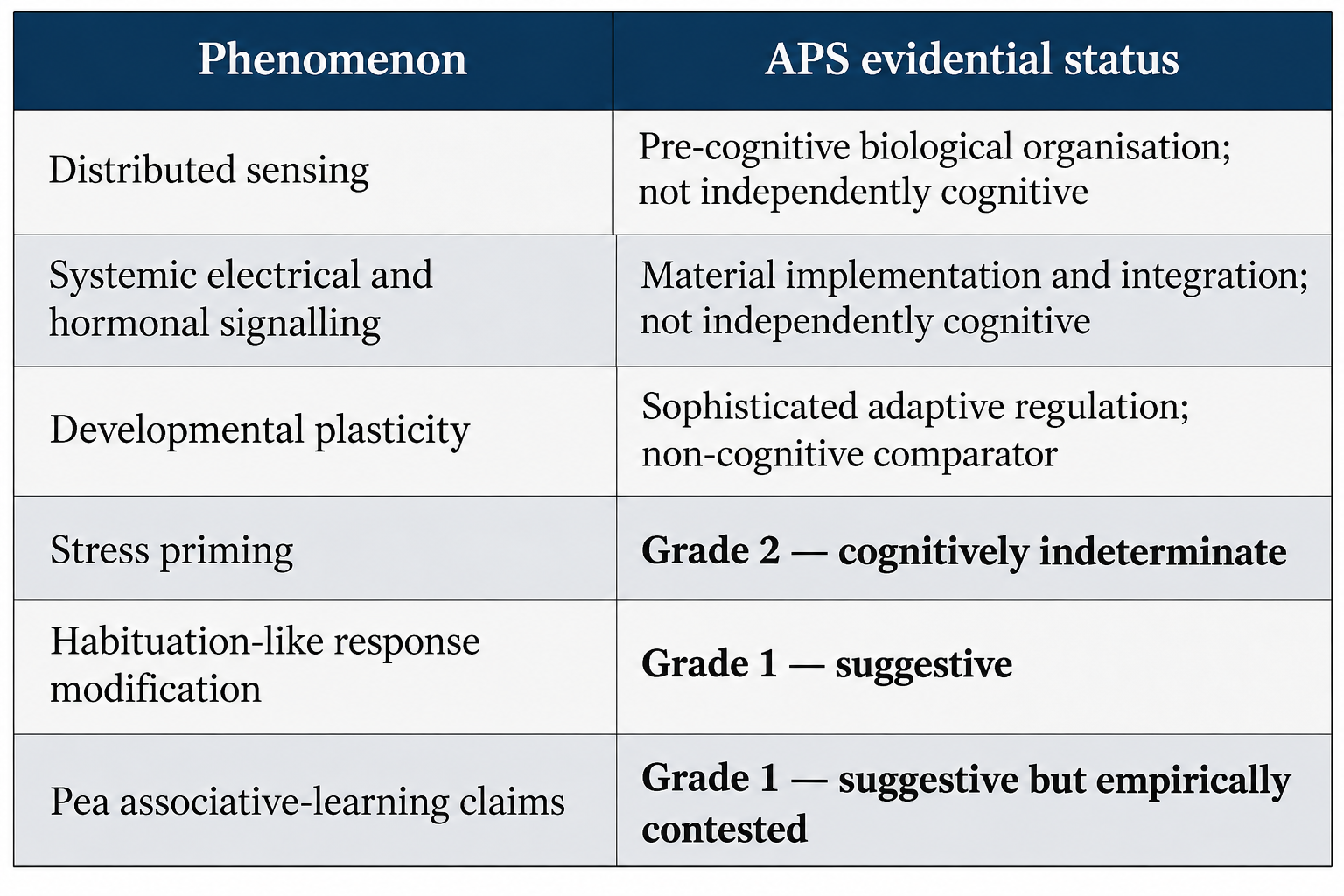
No plant phenomenon considered here presently warrants Grade 3 — minimal-cognitive positive.
That conclusion should not be interpreted as evidence that plants are intrinsically non-cognitive. It establishes only that the present evidence does not yet discriminate cognitive organisation from adequate non-cognitive explanation strongly enough.
Equally, Grade 2 should not be treated as a rhetorical compromise. It identifies the missing evidence.
For stress priming, stronger cognitive warrant would require evidence of relations such as:
- contextual redeployment of retained significance;
- consequence-sensitive updating;
- cue–consequence reversal;
- reacquisition after reversal;
- significant generalisation or discrimination;
- organism-level integration of those changes.
These are experimentally addressable questions.
The evidential grades also apply to phenomena rather than organisms. A particular plant may exhibit ordinary regulation in one context and a stronger candidate phenomenon in another. Even a future Grade 3 result would initially justify cognitive attribution relative to that phenomenon, not automatically to every activity of the species or to plants generally.
8. What Plant Cognition Would—and Would Not—Show
If a plant phenomenon eventually satisfies the cognitive boundary, several conclusions would follow.
-
First, cognition would not be restricted in principle to nervous systems. Neural tissue would remain a powerful implementation of cognition rather than a constitutive requirement.
-
Second, a positive plant case would support organisational rather than taxonomic classification. Cognitive status would depend on how biological significance is organised, not on whether the organism belongs to a familiar cognitive lineage.
-
Third, a positive case would reinforce the distinction between cognition and consciousness. Nothing in the minimal boundary requires phenomenal awareness.
-
Fourth, plant cognition would not automatically entail representation. APS remains neutral concerning representational explanation at the minimal boundary. Representation may be useful or required for particular phenomena, but it should not be assumed simply because cognition is attributed.
-
Fifth, a positive result would not show that all living systems are cognitive. On the contrary, the possibility of demonstrating a plant case would depend upon maintaining a meaningful distinction between cognition and the Biological Agency, Biological Evaluation, Significance and Integration already present more widely in life.
Conversely, failure to establish cognition in current plant cases would not diminish plant agency. Plants remain viability-oriented, evaluative living organisations regardless of the outcome of the cognitive debate.
This point is especially important. Cognitive vocabulary should not function as a measure of biological importance or organisational sophistication. A non-cognitive plant is not thereby passive, mechanistically trivial, or biologically deficient.
9. Implications for Minimal Cognition and Biological Explanation
The plant case is valuable precisely because it resists easy classification.
Much discussion of minimal cognition begins with rapidly moving organisms, behavioural choice or paradigms derived from animal learning. Plants organise activity differently. Growth, physiology, distributed signalling, resource allocation and development unfold over different spatial and temporal extents.
A viable criterion for minimal cognition must therefore be applicable without importing locomotion, nervous systems, rapid decision-making or animal-specific behavioural paradigms as hidden requirements.
At the same time, adapting cognitive tests to plant organisation cannot mean weakening the boundary until all adaptive plasticity qualifies.
Plant stress priming makes this methodological problem particularly clear.
It shows that:
- temporal extension is not cognition;
- memory terminology is not cognitive memory;
- functional preparation is not cognitive anticipation;
- multiple physiological possibilities are not automatically cognitively organised alternatives;
- organism-wide signalling is not cognition;
- material integration is necessary to many biological explanations without being cognitively diagnostic.
The plant case therefore provides a demanding test of the APS proposal.
If experiments demonstrate that retained significance can be contextually redeployed and updated as its consequences change, plant priming could move from sophisticated regulation toward minimal cognition.
If fixed molecular, physiological and developmental relations continue to explain the results adequately, cognitive attribution should be withheld.
If the evidence remains unable to distinguish these alternatives, indeterminacy is the appropriate scientific outcome.
This is also a test of APS itself.
A comparative explanatory methodology should not guarantee the preferred attribution. It should identify what would count against it. If plant cognition can be asserted whenever signalling, history dependence or adaptive coordination is found, APS would add little to the existing debate. Its value lies instead in specifying what further evidence would be required and accepting a null or indeterminate result when that evidence is absent.
The plant cognition problem therefore becomes more scientifically productive once the answer is no longer built into the framework.
10. Conclusion
The plant cognition debate cannot be resolved by choosing between neural exclusivity and unrestricted cognitive extension. Plants plainly exhibit rich biological agency: they sense environmental conditions, coordinate activity through distributed signalling, alter development and physiology under changing conditions, retain effects of prior perturbation, and generate biological significance relative to viability. Within APS, none of these capacities by itself establishes cognition.
The cognitive question begins only after these pre-cognitive capacities are acknowledged.
Cognition is the organisation of biological significance across time. The current APS boundary proposal holds that biological agency becomes cognitive when integrated biological significance modulates activity across a temporal field of viability-relevant possibilities in ways not exhausted by immediate or fixed regulation. Put more simply, cognition becomes a candidate explanation when what matters to an organism because of past or possible conditions modulates its present activity in ways that an adequate account of immediate cues or fixed regulatory routines cannot explain.
This distinction is crucial in the plant case. A drought-primed plant may respond differently to a later drought because the earlier event produced persistent molecular, physiological or developmental changes. Temporal retention and altered later activity are therefore not sufficient for cognitive attribution. A stronger cognitive case would require evidence that retained biological significance is deployed differently as circumstances and their viability consequences change, in ways not adequately explained by such regulatory persistence.
Applied to the present evidence, the APS boundary therefore produces a differentiated rather than a global verdict. Distributed sensing, systemic signalling and developmental plasticity demonstrate sophisticated biological organisation but do not independently warrant cognition. Stress priming provides a stronger boundary case because prior viability-relevant conditions can alter later organismal activity after the original perturbation has ceased. Yet temporally extended molecular, physiological and developmental regulation remains an adequate explanation for much of the available evidence. Stress priming is therefore cognitively indeterminate.
Habituation-like response modification provides suggestive evidence but is not decisive. Associative-learning claims would provide stronger evidence if robustly established, but their current empirical status remains contested. None of the principal plant phenomena considered here therefore presently warrants a Grade 3 minimal-cognitive-positive classification.
The current evidence consequently supports neither a global attribution of minimal cognition to plants nor the conclusion that plant cognition is impossible. Plants instead occupy an important methodological position: they provide a demanding test of whether cognitive explanation can extend beyond nervous systems without collapsing cognition into biological regulation in general.
This is the productive outcome of the plant cognition debate. The relevant question is no longer whether plants should be classified as cognitive because they are complex, adaptive, responsive or biologically impressive. It is whether specified plant phenomena organise biological significance across time in ways for which cognitive explanation provides explanatory gain over the strongest adequate non-cognitive account.
For the principal cases presently available, that question remains open.
Explanatory Architecture
Central Question
Do specified plant phenomena warrant cognitive explanation when tested against the APS cognition boundary and the strongest adequate non-cognitive comparators?
Architectural Role
This article is the principal APS domain-specific application of the cognition boundary to plants. It examines whether sophisticated plant regulation crosses from pre-cognitive biological organisation into cognition without assuming either neural exclusivity or universal plant cognition.
Builds On
The article builds on the APS accounts of Life, Biological Agency, Biological Evaluation, Significance, Integration and Cognition. It takes as given the canonical definition of cognition as the organisation of biological significance across time and uses the current provisional cognitive-boundary proposal as an attribution criterion rather than as a second definition.
Develops Into
The analysis develops into comparative adjudication of specified plant phenomena. Stress priming functions as the principal cognitively indeterminate boundary case; habituation-like response modification and pea associative-learning claims provide stronger but currently suggestive or contested cases. These results contribute to the wider empirical testing of minimal cognition without determining the cognitive status of plants as a taxonomic group.
Related Explanatory Questions
The article connects directly with questions about where cognition belongs in biology, what distinguishes cognition from sophisticated regulation, how cognitive organisation contributes to living activity once warranted, and how non-neural candidate cases should be tested. It does not attempt to resolve Mind, Consciousness, Intelligence or Representation as independent explanatory problems.
Position within APS
Plant Cognition is a Core article within the cognition-and-mind cluster. Agency, Process and Scale remain complementary analytic projections of one viability-oriented, constraint-closed living organisation rather than independent causes, components or hierarchical levels. The article applies APS comparatively: cognitive attribution is relative to a specified explanandum, relevant materially implemented dependencies and an adequate non-cognitive comparator.
Corpus Significance
The article provides a stringent test of APS’s ability to discriminate rather than merely extend cognitive terminology. Its present result is deliberately asymmetric: plant agency, Biological Evaluation and Significance are robust; stress priming remains cognitively indeterminate; stronger learning claims remain suggestive or contested; and no plant-wide cognitive verdict follows. The article therefore demonstrates that APS can preserve non-neural cognitive possibility while accepting null and indeterminate outcomes where explanatory gain has not been established.
See Also
Related Articles
References
- (2007). Plant Neurobiology: No Brain, No Gain?. Trends in Plant Science, 12(4), 135–136 . https://doi.org/10.1016/j.tplants.2007.03.002
- (2007). Stressful “Memories” of Plants: Evidence and Possible Mechanisms. Plant Science, 173(6), 603–608 . https://doi.org/10.1016/j.plantsci.2007.09.002
- (2014). Experience Teaches Plants to Learn Faster and Forget Slower in Environments Where It Matters. Oecologia, 175(1), 63–72 . https://doi.org/10.1007/s00442-013-2873-7
- (2016). Learning by Association in Plants. Scientific Reports, 6 . https://doi.org/10.1038/srep38427
- (2020). Lack of Evidence for Associative Learning in Pea Plants. eLife, 9 . https://doi.org/10.7554/eLife.57614
- (2024). A Case Study of Learning in Plants: Lessons Learned from Pea Plants. Quarterly Journal of Experimental Psychology, 77(6), 1272–1280 . https://doi.org/10.1177/17470218231203078
- (2025). Plant Cognition—A Methodological Primer: Theories, Methods and Challenges. Philosophy Compass, 20(12) . https://doi.org/10.1111/phc3.70068
- (2000). Phenotypic Plasticity for Plant Development, Function and Life History. Trends in Plant Science, 5(12), 537–542 . https://doi.org/10.1016/S1360-1385(00)01797-0
- (2019). Plants Neither Possess nor Require Consciousness. Trends in Plant Science, 24(8), 677–687 . https://doi.org/10.1016/j.tplants.2019.05.008
- (2018). Glutamate Triggers Long-Distance, Calcium-Based Plant Defense Signaling. Science, 361(6407), 1112–1115 . https://doi.org/10.1126/science.aat7744