What Is a Gene in APS?
Genes are among the most important concepts in biology, yet they are often misunderstood as blueprints, programs, or controllers of life. In APS, genes are understood as inherited molecular resources that contribute to development, viability, and evolutionary continuity. This article explains how genes participate in organised persistence while remaining embedded within the broader organisation of living systems.
Key Points
- Genes are inherited molecular resources rather than autonomous biological agents.
- Genes contribute to development but do not function as complete blueprints for organisms.
- Biological organisation emerges from interactions among genes, cells, organisms, and environments.
- Genes play a central role in inheritance and evolutionary continuity.
- APS places genes within the broader framework of viability-oriented organised persistence.
Introduction
Where this article fits: Genes are among the most influential concepts in modern biology, yet they are often misunderstood. APS treats genes neither as master controllers nor as mere molecular sequences. Instead, genes are inherited molecular resources that contribute to development, viability, and evolutionary continuity. Understanding genes therefore requires understanding the larger organisation of living systems within which they operate.
Few concepts have shaped modern biology more profoundly than the concept of the gene. Genes are routinely invoked to explain inheritance, development, disease, adaptation, and evolution. They are often described as the instructions for building organisms, the carriers of biological information, or even the fundamental units of life itself. Yet despite their centrality, biologists and philosophers of biology have long disagreed about exactly what genes are and how they should be understood.
Part of the difficulty arises because genes are frequently assigned explanatory roles that extend beyond what genes themselves do. Popular accounts often portray genes as biological blueprints, programs, or controllers that direct the construction and behaviour of living organisms. Such descriptions capture important aspects of genetic inheritance, but they can also obscure the broader organisational processes through which living systems develop, maintain themselves, and persist through time.
APS approaches the question differently. Rather than asking how genes control organisms, APS asks what role genes play within viability-oriented organisation. From this perspective, genes are neither autonomous causes nor passive molecular objects. They are inherited molecular resources that participate in the development, maintenance, and evolutionary continuity of organised persistence.
Understanding genes therefore requires understanding the living systems within which genes operate. Genes matter because they contribute to viability-oriented organisation, but they do not by themselves constitute that organisation. APS consequently treats genes as important components of biological persistence while locating them within a broader framework of agency, development, inheritance, and evolution.
Why Genes Are Difficult to Define
The concept of the gene has changed repeatedly throughout the history of biology. Early geneticists used the term to refer to hypothetical hereditary factors responsible for transmitting traits across generations. With the emergence of molecular biology, genes came to be identified with specific regions of DNA associated with the production of proteins. More recent research has revealed complex regulatory networks, overlapping coding regions, non-coding sequences, epigenetic modifications, and context-dependent patterns of gene expression that resist simple characterisation.
As biological knowledge has expanded, the apparent simplicity of the gene concept has diminished. A gene can be understood as a hereditary unit, a DNA sequence, a functional element within regulatory networks, a source of molecular products, or a participant in developmental processes. Different definitions may be appropriate for different explanatory purposes, yet none fully captures every aspect of genetic activity.
The resulting conceptual diversity is not merely a technical problem. It reflects the fact that genes perform multiple roles within living systems and cannot be understood independently of the organisational contexts in which they operate. A DNA sequence isolated from a living system is not functioning as a gene in the biological sense. Genes become biologically significant through their participation in developmental, regulatory, and evolutionary processes.
APS therefore approaches genes by asking what role they play in organised persistence. Rather than seeking a single essence underlying every use of the term, APS seeks to clarify how genes contribute to the continuity and transformation of viability-oriented organisation across time.
Genes as Components of Organised Persistence
APS begins from the premise that the primary reality of biology is viability-oriented, constraint-closed organisation. Living systems persist because their activities contribute to maintaining the conditions required for their own continued existence. Biological explanation is therefore directed toward understanding how organised persistence is achieved, maintained, and transformed.
Within this framework, genes are best understood as inherited molecular resources that contribute to that persistence. They are carried across generations through inheritance and participate in the developmental and regulatory processes through which living systems maintain viability. Genes therefore contribute to organised persistence without themselves constituting the organisational whole.
This interpretation differs from both reductionist and anti-reductionist extremes. APS does not minimise the importance of genes. Genetic inheritance is among the most important mechanisms through which continuity is reproduced across generations. At the same time, APS does not treat genes as autonomous causal agents capable of generating living organisation independently of the systems in which they function.
Genes matter because living systems employ them. Their biological significance derives from their participation in organisational processes rather than from any independent status as the primary units of life. Understanding genes therefore requires understanding the viability-oriented systems that interpret, regulate, and utilise them.
Why the Blueprint Metaphor Is Misleading
Genes are often described as biological blueprints. The metaphor is attractive because it captures an important feature of inheritance: genes provide resources that contribute to the development of future organisms. Like a blueprint, genetic inheritance helps ensure continuity across generations.
The metaphor becomes misleading, however, when it is treated as a complete account of development. Architectural blueprints exist independently of the buildings they describe and can be interpreted by external agents who construct those buildings. Organisms do not develop in this manner. Development occurs through ongoing interactions among genes, cells, tissues, organisms, and environments, all operating within an already existing context of living organisation.
Genes do not contain a complete specification of an organism in the way a blueprint specifies a building. The same genetic resources can contribute to different developmental outcomes depending on cellular conditions, environmental influences, developmental history, and regulatory context. What emerges during development reflects the organisation of the system as a whole rather than the isolated content of genetic sequences alone.
APS therefore regards the blueprint metaphor as partially informative but ultimately incomplete. Genes contribute to development, yet development remains an active organisational process carried out by living systems. Organisms do not simply execute genetic instructions. They continuously generate, maintain, and reorganise themselves through viability-oriented activity.
Genes are consequently better understood as inherited resources within organised persistence than as complete plans for constructing living systems.
Genes and Development
Genes play a central role in development, but their role is often misunderstood. Development is sometimes portrayed as the execution of a genetic program in which genes direct the construction of an organism from beginning to end. APS rejects this interpretation because it assigns explanatory priority to genes rather than to the organised systems within which genes operate.
Development is an ongoing process of organised persistence. Living systems do not emerge through the passive unfolding of genetic instructions. They develop through continuous interactions among cells, tissues, physiological processes, environmental conditions, and inherited resources. Genes contribute to this process by providing molecular resources that participate in developmental regulation, but they do not independently generate developmental organisation.
This distinction is important because genes always function within already existing biological contexts. Gene expression depends upon cellular machinery, metabolic activity, regulatory networks, and environmental inputs. A gene does not act in isolation. Its effects depend upon the organisational circumstances within which it is embedded.
APS therefore treats development as a system-level process rather than a gene-driven process. Genes contribute to development because they participate in organisational activity, but development itself remains a property of the living system. The explanatory focus consequently shifts from genes as controllers to organised persistence as the context within which genetic resources acquire biological significance.
This perspective also helps explain why development exhibits both stability and flexibility. Genetic continuity contributes to developmental reliability across generations, yet developmental outcomes remain responsive to changing conditions because organisation is distributed across multiple interacting processes. Development is therefore neither genetically predetermined nor unconstrained. It is the ongoing production and maintenance of viable organisation through coordinated activity across many dimensions of biological organisation.
Genes and Biological Information
Genes are frequently described as carriers of biological information. APS accepts this description but interprets it within a broader organisational framework.
The concept of information is often misunderstood because information is treated as if it possessed independent causal power. In reality, information is meaningful only within systems capable of interpreting and employing it. A written sentence contains information only for a reader capable of understanding it. Similarly, genetic information becomes biologically significant only within living systems capable of using it.
Genes carry information because cellular and developmental systems interpret genetic sequences in ways that contribute to viability-oriented organisation. The informational content of genes is therefore inseparable from the organisational context within which genes function. Genetic information is not a self-sufficient cause of biological form. It is a resource employed by living systems in the maintenance and reproduction of organised persistence.
This interpretation helps clarify why genes alone cannot explain development. Possessing genetic information is not equivalent to possessing an organism. The same sequence can produce different outcomes under different developmental circumstances because information acquires meaning through organisational context. Genetic information therefore contributes to development without determining it independently.
APS consequently treats information as an organisational relation rather than a substance stored in genes. Genes carry information because living systems use genetic resources in the ongoing production and maintenance of viability. Information remains biologically meaningful only within that broader organisational framework.
Genes and Biological Agency
APS identifies agency as the defining activity of life. Living systems are agents because their activities contribute to maintaining the conditions required for their own continued existence. Agency therefore belongs to viability-oriented systems rather than to the molecular components from which those systems are composed.
Genes do not possess agency in this sense. They do not maintain themselves, regulate their own viability, or actively sustain the conditions of their continued existence. Genes participate in organisational processes through which living systems achieve these outcomes, but the agency resides in the organised system rather than in any individual component.
This distinction is often obscured by language that attributes action directly to genes. Genes are commonly described as controlling development, directing behaviour, or determining biological outcomes. Such language may be convenient shorthand, but it can encourage the mistaken impression that genes function as autonomous actors within biological systems.
APS instead treats genes as contributors to agency rather than bearers of agency. Genes provide inherited resources that support the organisational capacities through which living systems maintain viability. They participate in the regulatory and developmental processes that make agency possible, yet they do not themselves act in the viability-oriented sense that characterises living organisms.
Recognising this distinction helps preserve explanatory clarity. Biological agency belongs to the organised system as a whole. Genes contribute to that agency through their participation in organisational processes, but they do not replace the living system as the primary agent of biological activity.
Genes and Inheritance
The importance of genes becomes particularly clear in the context of inheritance. Evolutionary continuity depends upon the reliable reproduction of organisational capacities across generations. Genes contribute fundamentally to this continuity by providing inherited molecular resources that help re-establish developmental organisation in successive generations.
Inheritance occupies a central position within the APS evolutionary architecture because it reproduces the continuity upon which all subsequent evolutionary processes depend. Without inherited continuity there could be no enduring lineages, no accumulation of variation, no adaptation, and no evolutionary transformation through time. Genes therefore contribute to one of the most important forms of continuity in biological systems.
APS does not, however, reduce inheritance to genes alone. The reproduction of viable organisation also depends upon cellular continuity, developmental organisation, ecological conditions, and numerous other forms of inherited context. Genetic inheritance remains indispensable, but it operates within a broader architecture of continuity that extends beyond DNA sequences alone.
This broader perspective strengthens rather than diminishes the significance of genes. Genes remain among the most important mechanisms through which biological continuity is reproduced. Their importance derives not from their status as independent causal agents but from their role in sustaining the continuity of organised persistence across generations.
Understanding inheritance in this way helps integrate genetics with the larger APS framework. Genes are central because they contribute to continuity. Continuity, in turn, provides the foundation upon which development, adaptation, and evolution become possible.
Genes and Evolution
Genes occupy an important position within evolutionary processes because they contribute to the continuity and variability upon which evolution depends. Genetic inheritance reproduces organisational capacities across generations, while genetic variation contributes to the emergence of evolutionary novelty. Genes therefore participate directly in the historical transformation of organised persistence.
APS nevertheless avoids treating genes as the primary subjects of evolution. Evolution concerns the continuity and transformation of viability-oriented organisation through time. Genes contribute to this process because they form part of the inherited organisation carried across generations, but evolution ultimately concerns lineages of organised persistence rather than isolated genetic sequences.
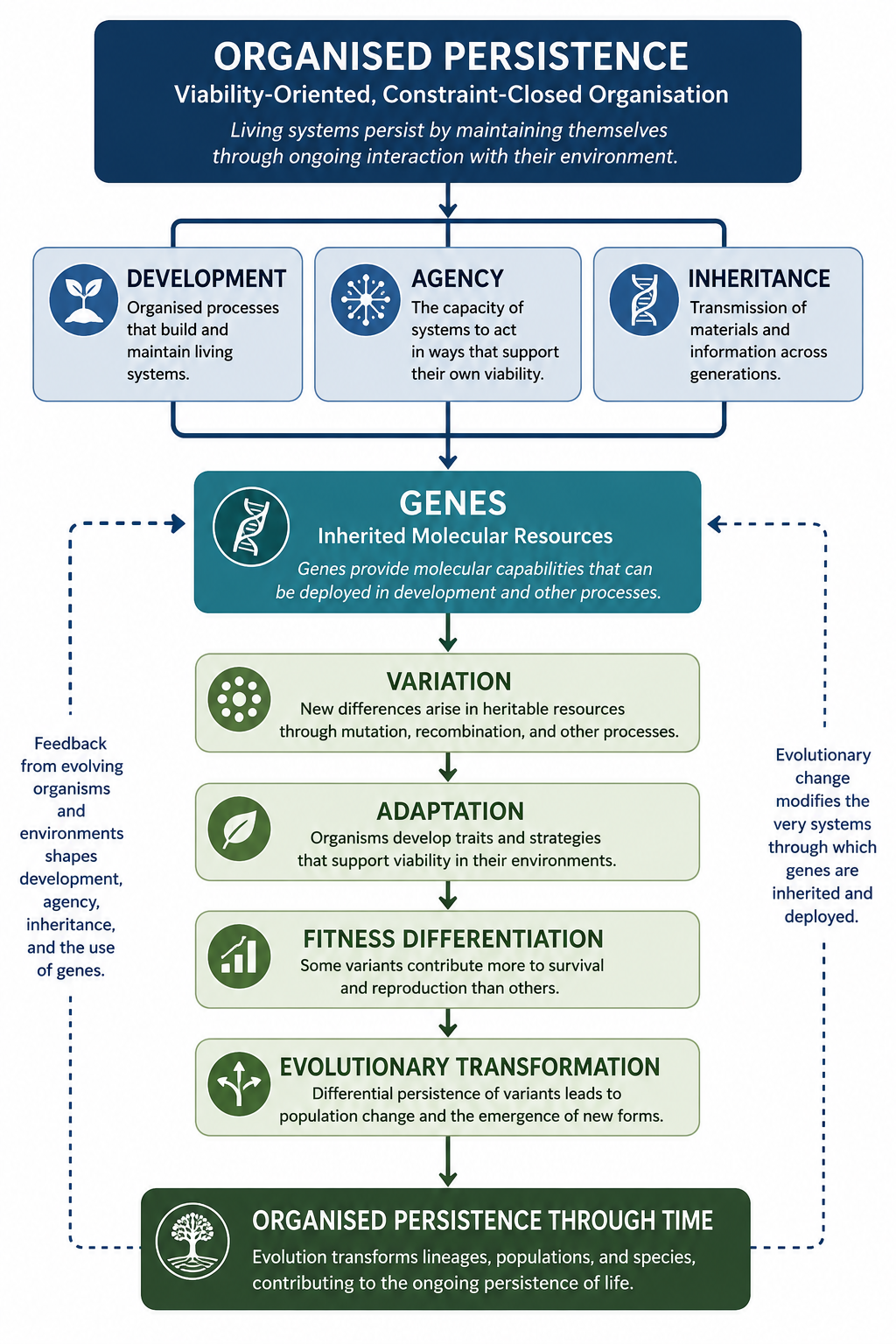
Genes as Inherited Resources Within Organised Persistence. Genes are inherited molecular resources that contribute to development, continuity, and evolutionary change. Their biological significance derives from their role within viability-oriented organised persistence rather than from autonomous control of living systems. Variation, adaptation, fitness differentiation, and evolutionary transformation occur within this broader organisational framework.
Inheritance reproduces genetic continuity while simultaneously allowing variation to emerge. Variation introduces novelty into ongoing lineages. Adaptation determines whether that novelty can be incorporated into viable persistence. Fitness differentiates among viable variants according to their continuity through time, while natural selection contributes to the historical stabilisation of some forms of organised persistence relative to others.
Genes participate throughout this sequence. They contribute to inherited continuity, developmental organisation, evolutionary variation, and adaptive transformation. Yet at no point do genes operate independently of the living systems and lineages within which they are embedded. Evolution is therefore not simply a story about genes. It is a story about the historical transformation of organised persistence, with genes functioning as important participants in that larger process.
APS consequently treats genes as components of evolutionary continuity rather than as the sole units of evolutionary explanation. Their significance derives from the role they play in sustaining and transforming organised persistence across generations and through evolutionary time.
Genes Are Not the Sole Carriers of Biological Continuity
The importance of genes can sometimes create the impression that biological continuity is transmitted exclusively through genetic inheritance. APS rejects this conclusion because continuity in living systems is distributed across multiple forms of organisation. Genes contribute to continuity, but they do not exhaust it.
Developmental continuity provides one example. Every generation inherits not only genetic resources but also developmental contexts within which those resources become biologically meaningful. Cells, tissues, regulatory networks, physiological processes, and environmental conditions all contribute to the re-establishment of viable organisation. Genetic inheritance alone cannot account for the continuity of these organisational relationships.
Cellular continuity is equally important. New generations do not emerge from DNA in isolation. They arise from existing living systems that provide the material and organisational context necessary for development. Cellular structures, metabolic capacities, and developmental machinery contribute to continuity alongside genetic inheritance. Genes therefore function within organisational systems that themselves persist through time.
Ecological continuity also contributes to persistence. Organisms inherit environments modified by previous generations, including ecological conditions, social structures, developmental niches, and other features that influence viability. These inherited contexts help shape developmental and evolutionary outcomes without being reducible to genetic transmission alone.
APS consequently treats continuity as an organisational phenomenon distributed across multiple interacting processes. Genes remain indispensable because they contribute fundamentally to inherited continuity. Yet continuity itself extends beyond genes to include the broader systems through which organised persistence is maintained and reproduced.
Recognising this broader architecture does not diminish the importance of genetics. Instead, it clarifies why genes are so effective. Genetic inheritance contributes to persistence because it operates within a larger network of organisational continuities that together sustain viability across generations.
Implications for Biological Explanation
Understanding genes as components of organised persistence has important consequences for biological explanation. It changes neither the reality of genes nor their importance, but it changes how their explanatory role is understood.
Gene-centred explanations often seek to account for biological phenomena by tracing them to underlying genetic causes. Such explanations can be highly informative, particularly when investigating inheritance, development, disease, or evolutionary change. APS does not reject these forms of explanation. Rather, it situates them within a broader account of biological organisation.
Genes explain because they contribute to the processes through which living systems maintain, reproduce, and transform viability-oriented organisation. Their explanatory power derives from their role within organised persistence rather than from any status as autonomous causal entities. Genetic explanations therefore remain important, but they are most informative when connected to the organisational contexts within which genes function.
This perspective also helps integrate different explanatory traditions within biology. Mechanistic explanations describe how genetic and cellular processes operate. Functional explanations clarify how those processes contribute to viability. Evolutionary explanations account for how inherited organisational capacities are transformed through time. Genes participate in all three explanatory modes, yet none of these modes reduces biological explanation to genes alone.
APS therefore places genes within a unified explanatory framework directed toward organised persistence. Genes remain indispensable explanatory resources because they contribute to continuity, development, and evolutionary transformation. At the same time, the ultimate target of biological explanation remains the viability-oriented organisation whose persistence genes help sustain.
Understanding genes in this way allows genetics to be integrated with development, agency, inheritance, and evolution without reducing biology to any single level of explanation. Genes become neither privileged causes nor secondary details. They become essential participants within the broader organisation of life.
Key Point
Genes are inherited molecular resources that contribute to the development, maintenance, and evolutionary continuity of viability-oriented organisation. They are neither complete blueprints nor autonomous biological agents. Genes carry information, participate in development, support inheritance, and contribute to evolutionary transformation, but they do so only within the broader organisational context of living systems. In APS, the significance of genes derives from the role they play in organised persistence. Understanding genes therefore requires understanding the viability-oriented organisation whose continuity they help sustain across generations and through evolutionary time.
See Also
Related Articles
References
- (1976). The Selfish Gene. Oxford University Press.
- (2006). The Selfish Gene (30th Anniversary Edition). Oxford University Press.
- (2018). A Manifesto for a Processual Philosophy of Biology. Oxford University Press.
- (1986). What Is a Gene?. Studies in History and Philosophy of Science, 17(2), 133–173 .
- (1994). Developmental Systems and Evolutionary Explanation. Journal of Philosophy, 91(6), 277–304 .
- (2013). Genetics and Philosophy: An Introduction. Cambridge University Press.
- (2000). The Century of the Gene. Harvard University Press.
- (2000). The Ontogeny of Information. Duke University Press.
- (2026). Agency as the Defining Activity of Life: A Viability-Oriented Framework Integrating Process and Scale. Biological Theory . https://doi.org/https://doi.org/10.1007/s13752-026-00547-6