What Is Selfhood?
Selfhood is often associated with consciousness, self-awareness, identity, or the human experience of being a self. Within APS, however, selfhood addresses a more fundamental biological question: how living systems remain themselves despite continual change. Organisms replace components, develop, learn, adapt, and reorganise while maintaining continuity across time. APS interprets this continuity not as the persistence of matter, essence, or identity, but as persistent integrative organisation. Selfhood therefore explains how living systems maintain continuity of agency, significance, cognition, and mind despite ongoing material, developmental, and experiential change. It occupies a pivotal position between mind and reflective agency within the APS architecture.
Key Points
- Selfhood is the persistent integrative organisation through which living systems remain themselves despite continual change.
- Selfhood is not identical with consciousness, self-awareness, identity, or personality.
- Identity describes continuity, whereas selfhood explains how continuity is maintained.
- Mind establishes coherent self–world organisation; selfhood maintains that organisation through time.
- Selfhood provides the organisational bridge between mind and reflective agency.
Introduction
Living systems are never static. Cells replace their components, organisms grow and develop, behaviours change through experience, and cognitive systems continuously adapt to new conditions. Across a lifetime, the material composition of an organism may change substantially, yet the organism remains recognisably the same living system. This apparent continuity presents a fundamental biological and philosophical question: how does a living system remain itself despite continual change?
Many traditional accounts answer this question by appealing to some form of enduring identity. Classical philosophical theories often invoke substances, essences, or stable identities that persist beneath change. Psychological approaches frequently focus on self-awareness, memory, personality, or subjective experience. While these perspectives illuminate important aspects of human existence, they do not fully explain how continuity is maintained within living systems more generally.
APS approaches the problem from a different starting point. Rather than beginning with human consciousness or introspection, it begins with life itself. The central question is not how human beings become aware of themselves, but how living systems maintain continuity across time despite ongoing material, developmental, cognitive, and behavioural transformation. This shift moves the discussion of selfhood from the domain of exclusively psychological phenomena to the broader domain of biological organisation.
From an APS perspective, continuity cannot be explained by the persistence of matter alone. Organisms continually replace molecules, cells, and tissues while remaining the same organised living systems. What persists is not a fixed material substrate but an organised pattern of biological activity. The problem of selfhood is therefore fundamentally a problem of persistence through change.
Selfhood provides APS’s answer to this problem. It explains how living systems maintain continuity of agency, significance, cognition, and mind despite continual transformation. In doing so, it occupies a pivotal position within the broader architecture of biological organisation, linking coherent minded activity to the emergence of reflective forms of agency.
Why Selfhood Is Difficult to Define
Selfhood is one of the most widely discussed and least consistently defined concepts in philosophy, psychology, and cognitive science. Different traditions use the term to refer to different phenomena, often resulting in ambiguity about what exactly the self is supposed to be.
Some approaches identify selfhood with personal identity. In these accounts, the self is what remains the same through time despite change. Other approaches associate selfhood with consciousness or subjective experience, treating the self as the subject of awareness. Psychological perspectives often emphasise personality, memory, self-concept, or autobiographical narrative, while cognitive theories may focus on self-representation and self-monitoring. Although each of these perspectives captures important aspects of human experience, they frequently address different questions while using the same terminology.
A common feature of many traditional approaches is that they begin with highly developed forms of selfhood and work backwards. Human self-awareness, reflective thought, autobiographical memory, and conscious experience become the starting point for understanding the self. As a result, selfhood is often treated as something that appears only in cognitively sophisticated organisms.
APS adopts a different strategy. Rather than beginning with reflective consciousness, it begins with the more fundamental question of biological continuity. Before an organism can become aware of itself, it must first remain itself. Before reflective agency can emerge, there must be a persistent organisation capable of sustaining continuity across time. The problem of selfhood therefore arises prior to questions concerning introspection, self-awareness, or conscious identity.
This perspective also reveals why selfhood should not be equated with consciousness. Consciousness may be one possible expression of selfhood, but continuity through change is a more fundamental phenomenon. Likewise, selfhood should not be confused with personality, identity, or self-concept. These may contribute to how selfhood is expressed in particular organisms, especially humans, but they do not explain the organisational basis of persistence itself.
APS therefore reframes the problem. The central question is not “What is the self?” understood as an object, entity, or inner essence. Rather, the question becomes: how is continuity maintained within living systems despite continual change? Selfhood emerges as APS’s answer to that question.
Selfhood in APS
APS defines selfhood as the persistent integrative organisation through which living systems maintain continuity of agency, significance, cognition, and mind across time despite continual material, developmental, and experiential change.
This definition reflects the broader APS commitment to understanding life as a process rather than a substance. Living systems are not static objects that endure unchanged through time. They are dynamic organisations that continuously regenerate, reorganise, and adapt while preserving functional continuity. Selfhood refers to the persistence of this organised continuity.
The concept rests upon four closely related ideas: persistence, integration, continuity, and organisation. Persistence refers to the maintenance of a living system through time despite ongoing change. Integration refers to the coordination of diverse biological processes into a coherent organisational whole. Continuity refers to the preservation of organisational identity across successive moments of existence. Organisation refers to the structured relationships through which agency, significance, cognition, and mind are maintained.
Within APS, selfhood does not represent an additional component added to living systems. Nor does it refer to an inner entity residing within an organism. Instead, selfhood describes a particular mode of biological organisation. It is the persistent integrative organisation through which living systems remain coherent agents despite continual transformation.
Within APS, selfhood occupies the position between mind and reflective agency. Mind establishes coherent self–world organisation, selfhood maintains that organisation through time, and reflective agency emerges when persistent organisation becomes capable of evaluating, directing, and transforming itself. Selfhood therefore provides the organisational bridge between coherence and self-direction.
This perspective distinguishes selfhood from both identity and self-awareness. Identity describes continuity; selfhood explains how continuity is maintained. Self-awareness may emerge in some organisms as a consequence of increasingly sophisticated forms of selfhood, but selfhood itself is not dependent upon reflective awareness. A living system can maintain continuity through change long before it becomes capable of consciously representing itself.
Selfhood therefore occupies a distinctive position within the APS architecture. Agency explains how living systems act. Significance explains what matters for their continued existence. Cognition organises significance across time, while mind integrates cognition and significance into coherent self–world relations. Selfhood emerges when this organisation becomes sufficiently persistent to maintain continuity despite ongoing change. It is through selfhood that coherent minded organisation becomes enduring organisation.
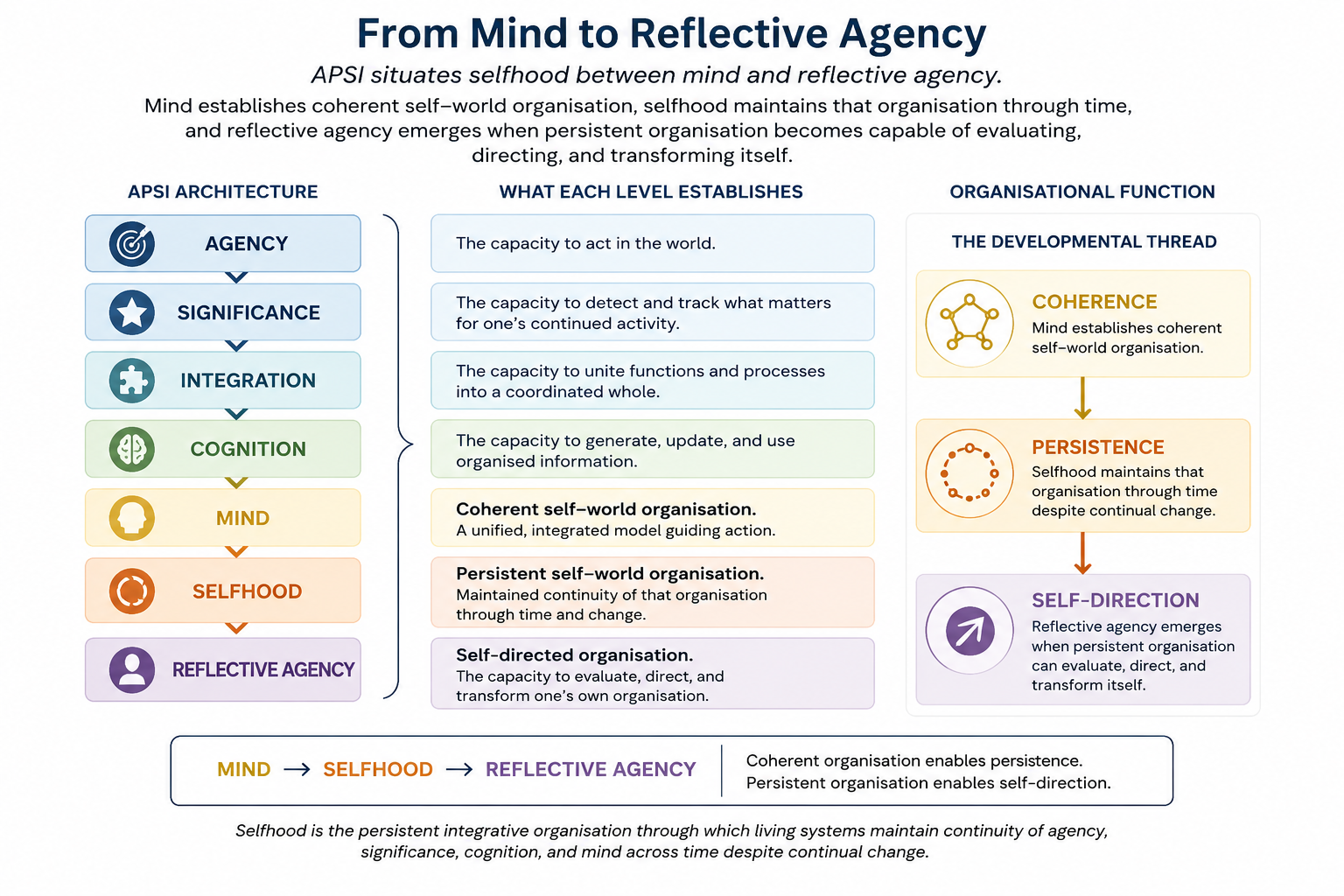
From Mind to Reflective Agency. APS situates selfhood between mind and reflective agency. Mind establishes coherent self–world organisation, selfhood maintains that organisation through time, and reflective agency emerges when persistent organisation becomes capable of evaluating, directing, and transforming itself.
Understanding selfhood in this way shifts attention away from static notions of identity and toward the dynamic persistence of living organisation. The self is not a thing that remains unchanged beneath change. It is the continuing organisation through which change itself becomes compatible with continuity.
Continuity Through Change
The defining challenge addressed by selfhood is continuity through change. Living systems are never static. They continuously exchange matter and energy with their environments, replace components, reorganise internal structures, adapt to changing conditions, and modify their behaviour in response to experience. Yet despite this continual transformation, they remain recognisably the same living systems through time.
This phenomenon presents a fundamental explanatory problem. If organisms are constantly changing, what exactly persists? Traditional answers often appeal to some enduring substance, essence, or identity that remains unchanged beneath observable variation. APS rejects this approach. Living systems are not static entities temporarily undergoing change. They are dynamic processes whose very existence depends upon continual transformation. The persistence of living systems therefore cannot be explained by the persistence of matter alone.
Cellular turnover provides a clear illustration of this problem. The molecules composing a cell are continuously replaced through metabolism, yet the cell remains the same organised living system. Multicellular organisms exhibit the same pattern on a larger scale. Cells divide, die, and are replaced; tissues develop and reorganise; physiological states fluctuate; and yet continuity is maintained. Development makes the problem even more striking. A seedling and a mature tree differ enormously in structure and function, but they remain phases of the same living individual. Likewise, a human infant and an adult differ biologically, cognitively, and behaviourally, yet continuity persists across the entire developmental trajectory.
The same principle applies to cognition and behaviour. Organisms learn from experience, modify behavioural strategies, acquire new information, and alter patterns of interaction with their environments. Cognitive organisation itself is continually changing. Memories are formed and forgotten, expectations are revised, and behavioural tendencies adapt to new circumstances. If continuity depended upon the preservation of identical cognitive states, selfhood would disappear with every significant act of learning. Instead, continuity is maintained despite continual cognitive reorganisation.
APS interprets this persistence as an organisational phenomenon. What remains through change is not a fixed collection of components but a continuing pattern of integrated organisation. Agency persists because the processes sustaining adaptive activity remain organised. Significance persists because evaluative relationships remain coordinated. Cognition persists because meaningful organisation remains continuous despite revision and learning. Mind persists because coherent self–world relations are maintained through ongoing adaptation. Selfhood refers to the persistence of this organised continuity.
This perspective transforms the traditional understanding of what it means for a living system to remain itself. Selfhood is not the persistence of matter but the persistence of organisation. It is the continuing integrative organisation through which agency, significance, cognition, and mind remain coordinated despite continual material, developmental, and experiential change. Continuity therefore emerges not from resistance to change but from the capacity to maintain organised persistence through change.
Understanding selfhood in this way places persistence at the centre of biological organisation. Living systems do not remain themselves because they avoid change. They remain themselves because they continuously reorganise in ways that preserve continuity. Selfhood is the organisational achievement that makes this possible.
Selfhood Is Not Consciousness
Discussions of selfhood are often closely associated with consciousness. In many philosophical and psychological traditions, the self is treated primarily as the subject of experience, the locus of awareness, or the centre of conscious thought. From this perspective, selfhood appears inseparable from subjective experience. APS challenges this assumption.
Consciousness and selfhood address different explanatory questions. Consciousness concerns experience. It asks what it is like for an organism to perceive, feel, or be aware. Selfhood concerns persistence. It asks how a living system remains itself despite continual change. Although these phenomena may interact, they are not identical.
The distinction becomes clear when considered in biological terms. Living systems exhibit continuity long before questions concerning conscious awareness arise. Cells maintain organisational continuity despite constant metabolic turnover. Plants maintain developmental continuity across years or even centuries of growth and environmental change. These systems exhibit persistent organisation, adaptive regulation, and continuity through time, yet whether they possess consciousness remains uncertain or disputed. The persistence of organised agency therefore cannot depend upon the presence of conscious experience.
This observation reveals an important asymmetry. Consciousness may presuppose some form of selfhood because experience must occur within a continuing organised system. Selfhood, however, does not require consciousness. A living system can maintain continuity without being capable of subjective awareness. Selfhood therefore occupies a more fundamental organisational position within APS than consciousness itself.
The distinction is equally important when considering human beings. Human selfhood is often experienced through conscious awareness, autobiographical memory, narrative identity, and reflective thought. These capacities can create the impression that selfhood and consciousness are the same phenomenon. Yet even in humans, continuity extends beyond conscious experience. Much of the organisation sustaining persistence operates below the level of awareness through physiological regulation, developmental processes, memory consolidation, and adaptive coordination. Conscious awareness contributes to human selfhood but does not exhaust it.
APS therefore treats consciousness as a possible expression of selfhood rather than its foundation. Conscious experience may emerge within sufficiently complex forms of organised persistence, but the organisational continuity characteristic of selfhood precedes and supports such experience. The self is not created by consciousness. Rather, consciousness, where it occurs, develops within a continuing organised self.
Recognising this distinction prevents selfhood from becoming restricted to a narrow class of highly cognitive organisms. It allows selfhood to be understood as a biological phenomenon expressed in varying forms across the living world. Continuity through change remains the defining criterion, regardless of whether consciousness is present.
Selfhood Is Not Identity
Selfhood is also frequently confused with identity. At first glance, the two concepts appear closely related. Both concern continuity through time, and both attempt to address the question of what makes a living system remain the same despite change. However, APS distinguishes them sharply.
Identity is primarily descriptive. It identifies continuity when continuity is already present. To say that an organism is the same organism today that it was yesterday is to make a claim about identity. The concept describes the fact of continuity. It does not by itself explain how continuity is maintained.
Selfhood addresses precisely this explanatory gap. Rather than describing continuity, selfhood explains the organisational basis through which continuity becomes possible. The distinction can be expressed simply: identity describes continuity; selfhood explains continuity.
This difference becomes especially important when considering biological change. A mature tree may be identified as the same individual that once existed as a seedling. Identity recognises continuity across these developmental stages. Yet the question remains: how is this continuity maintained despite enormous changes in structure, function, and material composition? APS answers by pointing to persistent integrative organisation. Selfhood explains how continuity survives continual transformation.
The same distinction applies to cognition and behaviour. An organism may learn, adapt, and modify its interactions with the environment while remaining the same individual. Identity records this persistence. Selfhood explains how organised continuity is maintained despite behavioural and cognitive change. Without selfhood, identity becomes a description of an unexplained phenomenon.
This perspective also helps clarify why selfhood should not be understood as an inner essence. Traditional identity theories sometimes seek a stable core that remains unchanged beneath all variation. APS rejects this search for an immutable substrate. Living systems persist not because some hidden essence remains untouched by change, but because organised processes continuously regenerate and maintain continuity. Selfhood therefore resides in the persistence of organisation rather than in the preservation of any particular component.
The distinction between identity and selfhood has important implications for the broader APS architecture. Identity may be recognised wherever continuity is observed. Selfhood explains how that continuity is maintained. By providing an account of persistence itself, selfhood bridges the gap between coherent minded organisation and the enduring continuity required for reflective forms of agency.
This distinction also prepares the way for the next stage of the discussion. If selfhood explains how organised continuity is maintained through time, then it becomes necessary to examine how this persistence relates to cognition, mind, and increasingly sophisticated forms of agency. The relationship between selfhood and mind therefore represents the next step in understanding how continuity becomes organised within living systems.
Selfhood and Mind
Selfhood is closely related to mind, yet the two concepts address different explanatory problems. Both concern the organisation of living systems, both emerge from the integration of agency, significance, and cognition, and both contribute to the continuity of adaptive engagement with the world. Nevertheless, they perform distinct functions within the APS architecture.
Mind explains how cognition and significance become organised into coherent relationships between an agent and its environment. Through minded organisation, perception, evaluation, memory, anticipation, and behaviour become coordinated into a unified pattern of engagement. Mind therefore addresses the problem of coherence. It explains how diverse cognitive and evaluative processes operate together as aspects of a single organised system.
Selfhood addresses a different problem. Coherence alone does not explain continuity. A system may be coherent at a particular moment while still undergoing continual transformation. The question then becomes how coherent organisation remains the same organised system through time despite ongoing change. Selfhood provides the answer by explaining the persistence of organised continuity.
The distinction may be expressed succinctly. Mind is coherent self–world organisation. Selfhood is persistent self–world organisation. Mind explains how an organism maintains coordinated engagement with itself and its environment. Selfhood explains how that organisation endures despite continual material, developmental, cognitive, and behavioural change.
This distinction clarifies the architectural relationship between the two concepts. Mind makes organised continuity possible by integrating significance and cognition into coherent patterns of engagement. Selfhood emerges when this organisation becomes sufficiently persistent to maintain continuity through time. In this sense, selfhood depends upon mind but is not reducible to it. Mind provides coherence; selfhood provides persistence.
Understanding this relationship helps explain why selfhood occupies a pivotal position within APS. It bridges the transition from coherent minded organisation to the more advanced capacities associated with reflective forms of agency. Before an organism can direct or evaluate itself, it must first remain itself. Selfhood therefore extends the organisational achievements of mind into enduring continuity.
Selfhood Across the Living World
If selfhood is understood as persistent integrative organisation, it should not be restricted to organisms possessing consciousness, language, or reflective thought. The defining criterion is not subjective awareness but continuity through change. This perspective reveals that selfhood is expressed across the living world in diverse forms.
At the cellular level, selfhood appears in its most minimal form. Cells continuously exchange matter with their environments, replace molecular components, and regulate internal processes while maintaining organisational continuity. Although cellular selfhood lacks cognition, consciousness, or self-awareness in any conventional sense, it nevertheless exhibits the persistence characteristic of organised living systems.
Multicellular organisms extend this principle by coordinating continuity across vast numbers of interacting cells. Development, repair, physiological regulation, and environmental responsiveness all contribute to maintaining persistence despite continual internal change. The self is no longer sustained by a single cell but by the integration of many cells into a continuing organismal whole.
Plants provide a particularly important illustration of this principle. They grow, adapt, communicate internally through distributed signalling systems, and maintain continuity across decades or even centuries of environmental variation. A mature tree differs enormously from the seedling from which it developed, yet continuity persists throughout its existence. APS therefore interprets plant selfhood as a genuine expression of persistent integrative organisation rather than as a metaphorical extension of human concepts.
Animals exhibit increasingly elaborate forms of selfhood because continuity becomes coordinated across physiology, behaviour, cognition, and environmental interaction. Learning, memory, anticipation, and behavioural flexibility contribute to increasingly sophisticated forms of organised persistence. Yet the underlying principle remains the same: continuity is maintained through persistent organisation rather than through the preservation of fixed components.
Human selfhood represents the most extensively integrated form currently known. Language, symbolic thought, autobiographical memory, culture, and reflective cognition contribute additional dimensions of continuity. These capacities enrich selfhood but do not create it. Human selfhood remains an elaboration of the same organisational principle present throughout the living world.
This continuity across scales suggests that selfhood is neither binary nor uniquely human. It exists in varying degrees and forms wherever persistent integrative organisation maintains continuity through change. Selfhood is therefore scale-independent in principle while remaining scale-dependent in expression. Different organisms realise selfhood through different biological mechanisms, but the organisational role remains fundamentally comparable.
Selfhood and Reflective Agency
The architectural position of selfhood becomes particularly clear when considered in relation to reflective agency. APS places selfhood between mind and reflective agency because persistence provides the organisational foundation upon which reflection becomes possible.
Reflective agency involves the capacity of a system to evaluate, direct, and modify its own activity. Such capacities require more than coherent engagement with the environment. They require an enduring organisational framework capable of sustaining continuity across time. Reflection presupposes something sufficiently stable to become an object of evaluation and regulation.
This is precisely the contribution of selfhood. By maintaining continuity of agency, significance, cognition, and mind, selfhood provides the persistence necessary for recursive forms of organisation. A system can only evaluate itself if there is a continuing self whose activity can be evaluated. It can only direct itself if there is an organised continuity capable of sustaining directed change. Without persistence, self-direction becomes difficult to explain.
The relationship may therefore be understood as a developmental progression. Mind establishes coherent self–world organisation. Selfhood establishes the persistence of that organisation through time. Reflective agency emerges when persistent organisation becomes capable of monitoring, evaluating, and transforming itself. Each stage builds upon the organisational achievements of the previous one while introducing a distinct explanatory function.
This distinction is important because selfhood is sometimes conflated with reflective awareness. APS rejects this identification. Reflective agency depends upon selfhood, but selfhood does not depend upon reflective agency. Organisms may exhibit selfhood without possessing the advanced capacities required for self-reflection. Persistent organisation therefore precedes and supports the emergence of self-directed forms of agency.
Selfhood thus serves as the critical bridge between continuity and self-direction. It explains how organised systems remain themselves long enough for reflective forms of regulation to emerge. In doing so, it occupies a crucial transitional position within the broader architecture of biological organisation.
Why Selfhood Matters
The importance of selfhood becomes apparent when considering what would be lost if the concept were removed from APS. Agency explains action. Significance explains what matters. Cognition explains the organisation of significance across time. Mind explains coherent self–world organisation. Yet none of these concepts directly explains how organised continuity is maintained despite continual change.
Without selfhood, persistence remains underexplained. Living systems would still act, evaluate, learn, and maintain coherent engagement with their environments, but the continuity linking these processes across time would lack a dedicated explanation. The persistence of organised agency would become an assumed feature rather than an explained phenomenon.
Selfhood therefore fills a distinct explanatory role. It addresses the problem of continuity itself. By explaining how living systems remain themselves despite continual transformation, it provides a conceptual bridge between coherence and self-direction, between organisation and persistence, and between minded engagement and reflective agency.
This explanatory role cannot be fully absorbed by neighbouring concepts. Mind explains coordination, not persistence. Identity describes continuity, not its organisational basis. Reflective agency explains self-direction, not the continuity required to make self-direction possible. Selfhood therefore occupies a unique and necessary position within the APS framework.
Recognising this role deepens the broader APS understanding of life. Living systems are not merely organised; they are persistently organised. Their continuity is not an incidental consequence of biological activity but a central feature requiring explanation in its own right. Selfhood provides that explanation.
Conclusion — Selfhood as Persistent Organisation
The problem of selfhood has often been approached through questions of consciousness, identity, self-awareness, or subjective experience. Although these phenomena are important, they do not fully address the deeper biological question of how living systems remain themselves despite continual change. APS approaches the problem from this more fundamental perspective.
Selfhood explains the persistence of organised continuity. It describes neither a hidden substance nor an enduring essence beneath change. Instead, it refers to the continuing integrative organisation through which agency, significance, cognition, and mind remain coordinated across time. Living systems persist not because they avoid change but because they continuously reorganise in ways that preserve continuity.
This perspective reveals selfhood as a scale-independent biological phenomenon expressed throughout the living world. From cells to plants, from animals to humans, living systems maintain continuity through persistent organisation despite continual material, developmental, behavioural, and cognitive transformation. The expression of selfhood varies across scales, but the underlying organisational principle remains the same.
Selfhood therefore occupies a pivotal position within the APS architecture. It extends the coherence established by mind into enduring continuity and provides the persistence necessary for reflective forms of agency to emerge. In doing so, it bridges the transition from organised engagement with the world to the capacity for self-directed change.
Selfhood is not a thing, substance, essence, or inner entity. It is the persistent integrative organisation through which living systems maintain continuity despite continual change.
Understanding selfhood in this way naturally leads to a further question. If living systems can maintain continuity through persistent organisation, how do some of them become capable of evaluating, directing, and transforming themselves? The answer lies in the emergence of reflective agency, where organised persistence becomes organised self-direction.
See Also
Related Articles
References
- (2009). Defining Agency: Individuality, Normativity, Asymmetry, and Spatio-temporality in Action. Adaptive Behavior, 17(5), 367–386 . https://doi.org/10.1177/1059712309343819
- (2005). Autopoiesis, Adaptivity, Teleology, Agency. Phenomenology and the Cognitive Sciences, 4(4), 429–452 . https://doi.org/10.1007/s11097-005-9002-y
- (2018). A Manifesto for a Processual Philosophy of Biology. Oxford University Press.
- (2015). The Cognitive Cell: Bacterial Behavior Reconsidered. Frontiers in Microbiology, 6, 264 .
- (2015). Biological Autonomy: A Philosophical and Theoretical Enquiry. Springer.
- (2026). Agency as the Defining Activity of Life. Biological Theory . https://doi.org/10.1007/s13752-026-00547-6
- (2007). Mind in Life. Harvard University Press.
- (1991). The Embodied Mind. MIT Press.