What Is Mind?
Mind is the integrated organisation of cognition and significance through which an agent maintains a coherent relationship with itself and its world. Within APS, mind emerges from the integration of cognition and serves as the organisational bridge between cognition and selfhood.
Key Points
- Mind is not a mental substance but an organisational achievement.
- Mind emerges from integrated evaluative cognitive processes.
- Mind is distinct from both cognition and consciousness.
- Mind integrates organised significance into coherent agent–world relations.
- Selfhood develops from the stabilisation of minded organisation through time.
Introduction
Mind is one of the most familiar and yet most contested concepts in science and philosophy. In everyday language, mind is often associated with thoughts, feelings, awareness, consciousness, or subjective experience. In scientific contexts, it has been linked to information processing, intelligence, neural activity, cognition, and behaviour. Despite this widespread use, there remains little agreement about what mind actually is or where it belongs within the organisation of living systems.
Part of this difficulty arises because mind has frequently been treated as something separate from biology. In some traditions, mind is understood as a distinct mental realm existing alongside the physical world. In others, mind is viewed primarily as a product of consciousness, language, or advanced intelligence. Even when mind is approached scientifically, it is often associated almost exclusively with brains and nervous systems. These perspectives have contributed to the impression that mind is a uniquely human phenomenon or a specialised property found only in complex animals.
The APS framework approaches the problem differently. Rather than beginning with consciousness, intelligence, or subjective experience, APS begins with biological organisation. Living systems continuously evaluate conditions according to their significance for viability, functioning, and adaptive persistence. As these evaluative relationships become stabilised, they generate meaning; as meaningful significance is retained and coordinated across time, cognition emerges. Through the increasing integration of these processes, organisms develop coherent relationships with themselves and their environments. Mind emerges within this broader organisational context.
APSI identifies integration as a core organisational principle operating throughout living systems. Significance determines what matters for an agent, cognition coordinates significance across time, and mind emerges when these processes become sufficiently integrated to support a coherent and ongoing relationship between agent and world. Mind therefore represents an organisational achievement rather than a separate substance, faculty, or realm.
APS therefore defines mind as the integrated organisation of cognition and significance through which an agent maintains a coherent relationship with itself and its world. From this perspective, mind is not a separate substance or an additional component added to biological systems. It is an organisational achievement arising from the integration of processes already present within living activity.
This article examines how mind emerges within biological organisation, how it relates to cognition and selfhood, and where it belongs within the broader architecture of life.
Mind Within the APS Architecture
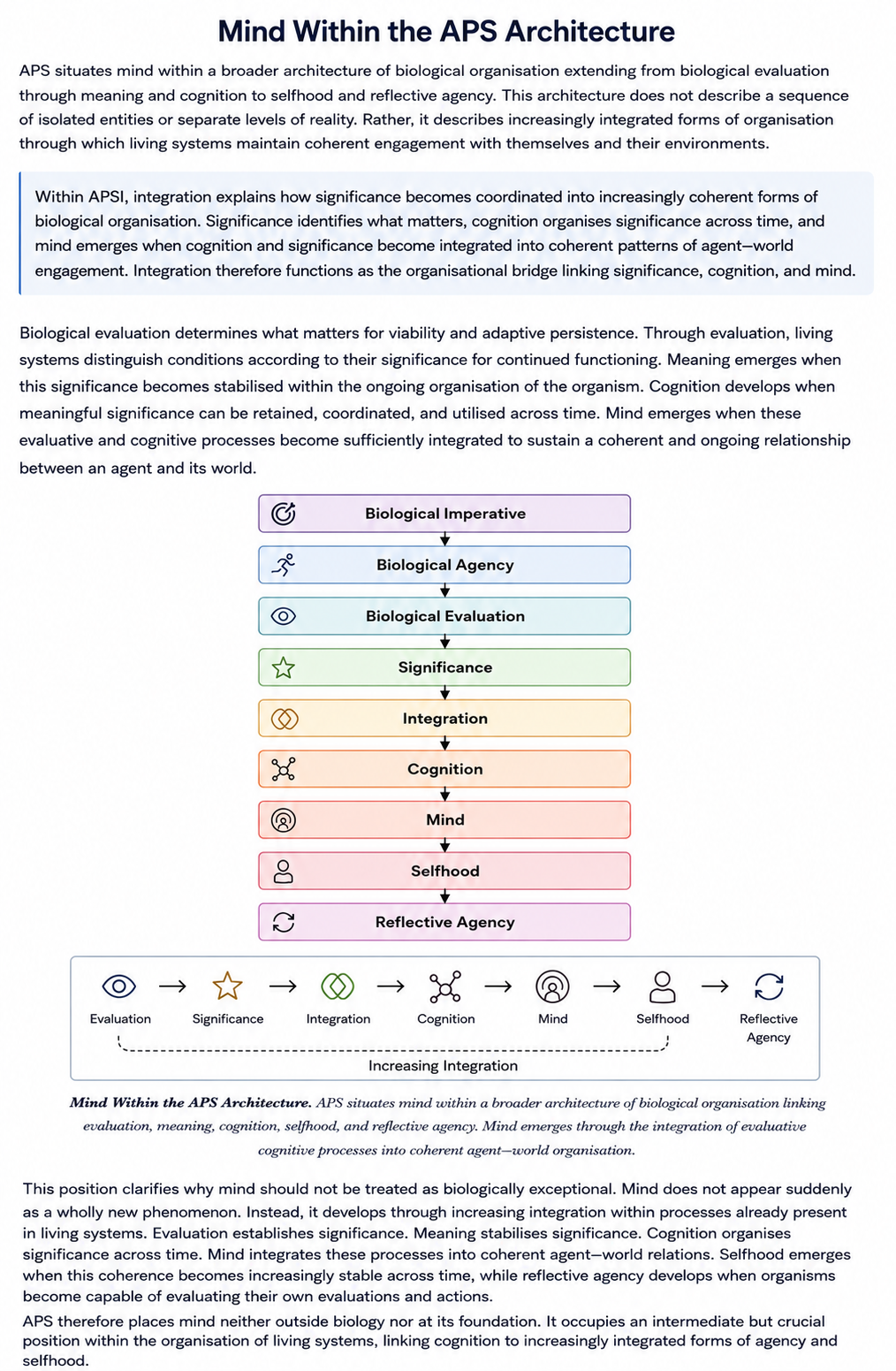
Mind Within the APS Architecture. APS situates mind within a broader architecture of biological organisation linking evaluation, significance, integration, cognition, selfhood, and reflective agency. Mind emerges through the integration of cognition and significance into coherent agent–world organisation.
Within APS, integration explains how significance becomes coordinated into increasingly coherent forms of biological organisation. Significance identifies what matters, cognition organises significance across time, and mind emerges when cognition and significance become integrated into coherent patterns of agent–world engagement. Integration therefore functions as the organisational bridge linking significance, cognition, and mind.
Why Mind Became Separated from Biology
The concept of mind has often appeared difficult to explain because it has historically been separated from the biological processes from which it emerges. Many philosophical and scientific traditions have treated mind as something fundamentally different from the organisation of living systems, creating a conceptual divide between mentality and biology that continues to influence contemporary thinking.
One influential tradition viewed mind as a distinct mental substance existing alongside the physical world. In such accounts, thoughts, experiences, and awareness belonged to a separate realm whose relationship to biological processes remained difficult to explain. Although modern science has largely abandoned explicit substance dualism, many contemporary discussions still inherit assumptions that treat mind as something added to biological organisation rather than arising from it.
Other approaches have associated mind primarily with consciousness, rational thought, language, or intelligence. Because these capacities are especially prominent in humans, mind often became identified with advanced cognition rather than with the broader organisation of living systems. As a result, questions about mind frequently focused on subjective experience or human mental abilities while overlooking the biological processes that make such capacities possible.
A further source of separation emerged through the close association between mind and nervous systems. The remarkable complexity of animal brains understandably encouraged the view that mind originates exclusively from neural activity. While neural systems contribute to many forms of minded organisation, this perspective can obscure the more general organisational processes through which significance is evaluated, integrated, and coordinated within living systems.
APS addresses these difficulties by relocating mind within biology itself. Rather than treating mind as a separate substance, a uniquely human capacity, or a property generated exclusively by brains, APS interprets mind as an organisational achievement arising from the integration of evaluative and cognitive processes. This approach does not diminish the importance of consciousness, intelligence, or neural organisation. Instead, it situates them within a broader biological context that explains how minded organisation becomes possible in the first place.
By restoring mind to the dynamics of living systems, APS transforms a traditionally isolated phenomenon into a natural component of biological organisation. The question is no longer how an independent mental realm interacts with biology, but how biological organisation gives rise to increasingly integrated forms of minded activity.
Mind Is Not Consciousness
Mind and consciousness are often treated as interchangeable terms, but APS distinguishes them. Although consciousness may represent one expression of mind, it does not define mind itself. Equating mind with consciousness risks obscuring the broader organisational processes through which living systems maintain coherent relationships with themselves and their environments.
Consciousness is commonly associated with subjective awareness, phenomenal experience, or the capacity to experience sensations and perceptions. These phenomena remain important subjects of investigation, but they address only part of the broader question of minded organisation. An organism may exhibit integrated evaluative and cognitive organisation without requiring the particular forms of conscious awareness often associated with human experience.
APS therefore approaches mind independently of debates concerning consciousness. The defining feature of mind is not subjective experience but organisational coherence. Mind emerges when evaluative and cognitive processes become sufficiently integrated to sustain coherent organism–environment relations. This coherence enables organisms to coordinate activity, maintain adaptive engagement with changing conditions, and preserve meaningful organisation across time.
From this perspective, consciousness may be understood as a specialised form of minded organisation rather than its defining characteristic. Some organisms may possess forms of mind that involve little or no consciousness in the human sense, while others may exhibit highly developed forms of conscious experience. The existence or degree of consciousness does not determine whether mind is present. What matters is the extent to which evaluative and cognitive processes are integrated into coherent agent–world organisation.
Distinguishing mind from consciousness also clarifies why minded activity should not be restricted to a narrow range of organisms. If mind is defined exclusively in terms of consciousness, questions concerning its distribution become inseparable from unresolved debates about subjective experience. APS avoids this difficulty by focusing on organisational relationships that can be investigated biologically. The central question becomes not whether an organism is conscious in a human-like sense, but whether it exhibits the integrated evaluative and cognitive organisation characteristic of mind.
Mind is therefore broader than consciousness. Consciousness may emerge within some forms of minded organisation, but mind itself concerns the integration of biological processes that enable coherent engagement with the world. Understanding this distinction is essential for locating mind within biology and for explaining how more complex forms of mentality arise from the organisation of living systems.
Mind Is Not Cognition
Mind and cognition are closely related, but they are not identical. APS distinguishes them because they perform different organisational functions within living systems. Cognition concerns the organisation of biological significance across time. Through cognition, organisms retain, coordinate, and utilise meaningful conditions in ways that extend beyond immediate circumstances. Mind emerges when these cognitive processes become sufficiently integrated to sustain coherent organism–environment relations.
This distinction can be clarified through the relationship between significance, meaning, cognition, and mind. Meaning identifies significance within biological organisation. Cognition organises significance across time. Mind integrates that organised significance into coherent agent–world relations. Although these processes depend upon one another, each represents a distinct organisational achievement. Meaning establishes what matters. Cognition allows what matters to influence activity across temporal horizons. Mind unifies these organised patterns into a coherent framework through which organisms engage with themselves and their environments.
For this reason, cognition is necessary for mind but not sufficient. An organism cannot maintain coherent agent–world organisation unless significance can first be retained, coordinated, and utilised across time. Without cognition, meaningful conditions would remain restricted to immediate circumstances and could not contribute to the broader integration characteristic of minded activity. Yet cognition alone does not produce mind. Organising significance across time does not necessarily generate the coherence required for an ongoing relationship between agent and world.
The distinction becomes particularly important because cognition is often treated as synonymous with mentality. Many scientific traditions use cognitive language to describe processes such as information processing, memory, learning, prediction, or decision-making. APS recognises the importance of these activities but argues that they do not by themselves constitute mind. They become components of mind only when integrated into a coherent organisation capable of sustaining meaningful engagement with changing conditions.
Mind therefore should not be understood as a replacement for cognition, nor as a separate phenomenon added to it. Rather, mind emerges through the increasing integration of evaluative and cognitive organisation. Cognition provides the temporal organisation of significance upon which mind depends. Mind transforms that organised significance into a coherent relationship through which an organism maintains ongoing engagement with itself and its world.
From an APS perspective, cognition and mind perform distinct organisational functions. Cognition is the integrated organisation of significance across time, enabling evaluation, learning, anticipation, and adaptive regulation. Mind emerges when these cognitive processes become integrated into a coherent and ongoing relationship between agent and world. Cognition organises significance; mind organises cognition into stable patterns of engagement.
Evaluation, Meaning, and Cognition Before Mind
Mind does not arise independently of biological organisation. It emerges from processes that are already present within living systems, and understanding mind therefore requires understanding the organisational conditions that make it possible. APS locates these conditions within a developmental sequence extending from evaluation through meaning and cognition to mind itself.
The foundation of this sequence is biological evaluation, through which living systems distinguish conditions according to their significance for viability, functioning, and adaptive persistence. Meaning emerges when this significance becomes stabilised within the ongoing organisation of the organism, allowing conditions to matter in enduring ways relative to continued activity. Cognition develops when meaningful significance can be retained, coordinated, and utilised across time through processes such as memory, anticipation, learning, and adaptive regulation.
Mind depends upon these prior achievements because coherent agent–world organisation requires more than immediate evaluation or temporally extended cognition alone. Organisms must be able not only to distinguish what matters and coordinate significance across time, but also to integrate these activities into a coherent framework that guides ongoing engagement with changing conditions. Mind emerges through this increasing integration.
This emergence should not be understood as the appearance of a new substance or an additional layer imposed upon biological systems. Rather, it reflects the progressive organisation of processes already present within living activity. As evaluation generates significance, meaning stabilises it, and cognition extends it across temporal horizons, mind emerges through their integration into coherent patterns of agent–world engagement.
APS further clarifies that cognition does not emerge directly from significance alone. Multiple significance relations must first become integrated into coherent adaptive organisation. Integration therefore provides the organisational transition through which significance becomes coordinated into cognition and subsequently contributes to the emergence of mind.
Mind as Integrated Cognitive Organisation
APS defines mind as the integrated organisation of cognition and significance through which an agent maintains a coherent relationship with itself and its world. This definition places integration at the centre of minded organisation. Mind is not simply a collection of cognitive activities, nor a repository of representations, experiences, or information. It is an organisational achievement that arises when evaluative and cognitive processes become sufficiently unified to sustain coherent engagement with changing conditions.
APSI identifies integration as the organisational principle through which cognition and significance become coordinated into coherent minded organisation. Mind is therefore not merely a collection of cognitive capacities but a higher-order organisational achievement in which perception, memory, evaluation, anticipation, and behavioural orientation become integrated into a unified pattern of agent–world engagement.
Integration refers to the coordination of diverse evaluative and cognitive activities within a larger organisational whole. Living systems continuously perceive, evaluate, remember, anticipate, regulate, and respond. Individually, these activities contribute to adaptive functioning, but mind emerges when they operate as components of an integrated system rather than as isolated processes. Through integration, information acquired in one context can influence behaviour in another, evaluations can shape future activity, and cognitive organisation can contribute to coherent adaptive regulation across time.
This integration gives rise to coherence. Coherence does not imply rigidity, uniformity, or complete internal consistency. Living systems remain dynamic, adaptive, and responsive to changing circumstances. Coherence instead refers to the capacity to maintain organised relationships among diverse processes while preserving meaningful engagement with the world. Through coherence, organisms sustain patterns of activity that remain intelligible and functionally integrated despite continual environmental and internal change.
Mind therefore concerns relationships rather than isolated mechanisms. Its defining feature is not the presence of particular structures but the organisation of interactions through which an agent maintains coordinated engagement with itself and its surroundings. Different organisms may achieve minded organisation through different biological mechanisms, yet the organisational role remains functionally comparable. Mind is characterised by what integrated evaluative cognitive organisation accomplishes rather than by any single physical substrate.
The concept of agent–world relations is central to this understanding. Living systems do not exist as isolated entities separated from their environments. Their organisation continuously depends upon interactions with external conditions, resources, opportunities, threats, and other organisms. Mind emerges through the integration of processes that allow these relationships to become coherent, adaptive, and meaningful. Through minded organisation, organisms do not merely react to their environments; they maintain ongoing engagement with them.
Seen in this way, mind is neither a mysterious inner realm nor a specialised feature restricted to advanced intelligence. It is an organisational development within biological systems through which evaluation, meaning, and cognition become integrated into coherent agent–world relations. Mind therefore represents a distinctive but natural achievement within the broader organisation of life.
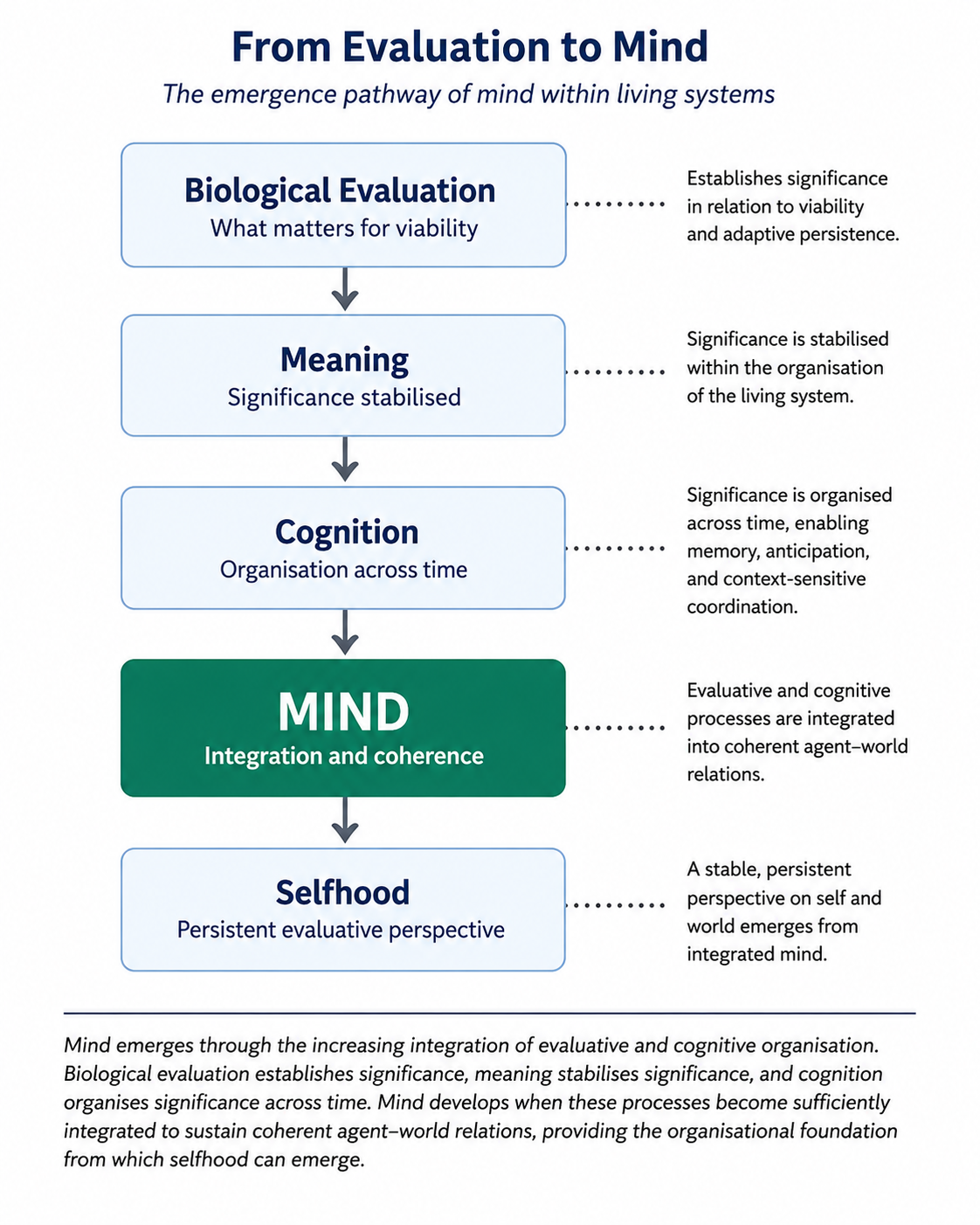
From Cognition to Mind. Biological evaluation establishes significance. Meaning stabilises significance. Cognition organises significance across time. Mind emerges when organised significance becomes integrated into coherent agent–world relations.
Mind and Agent–World Coherence
The defining characteristic of mind within APS is coherence. Although evaluation, meaning, and cognition each contribute essential components to biological organisation, mind emerges only when these processes become sufficiently integrated to sustain a coherent organisation of agent–world relations. Coherence therefore represents the organisational achievement that distinguishes minded activity from the individual processes upon which it depends.
This coherence arises through the continual integration of evaluation and cognition. Evaluation determines what matters for viability and adaptive persistence, while cognition organises significance across time. Neither process operates in isolation. Evaluations influence cognitive organisation, cognitive organisation shapes future evaluations, and both contribute to the ongoing regulation of behaviour. Mind emerges when these reciprocal relationships become integrated into a coherent system capable of maintaining meaningful engagement with changing conditions.
Coherence should not be understood as rigidity or perfect internal consistency. Living systems exist within environments characterised by continual variation, uncertainty, and change. Organisms must adapt to new opportunities, respond to unexpected threats, and continually reorganise activity in relation to shifting circumstances. Minded organisation therefore remains dynamic rather than fixed. Its coherence lies not in resisting change but in preserving meaningful organisation through change.
This dynamic coherence allows organisms to maintain ongoing relationships with their environments. Rather than responding to isolated stimuli, minded organisms engage with their surroundings through integrated patterns of significance. Past experience, present conditions, and anticipated outcomes contribute to a coordinated framework within which behaviour becomes intelligible and adaptive. Through this process, organisms maintain continuity in their interactions despite the continual transformation of both internal and external conditions.
Agent–world relations therefore occupy a central place within the APS understanding of mind. Organisms are not detached observers confronting an external world from a position of isolation. They are continuously embedded within networks of biological, ecological, and social relationships. Mind emerges through the integration of processes that allow these relationships to become coherent, meaningful, and adaptive. The world matters because it bears upon the organism’s continuing activity, and the organism’s activity continually reshapes its relationship with the world.
For this reason, coherence provides the most useful criterion for understanding minded organisation. Intelligence, representation, memory, and consciousness may all contribute to particular forms of mind, but none defines mind itself. What defines mind is the integration of evaluative and cognitive processes into a coherent organisational framework through which living systems maintain ongoing engagement with themselves and their environments.
The coherence characteristic of mind reflects the successful integration of multiple cognitive and evaluative processes into a unified organisational system. APSI therefore interprets agent–world coherence not as an additional property added to cognition, but as the organisational achievement through which cognition becomes minded engagement.
Do All Organisms Have Minds?
The question of whether all organisms possess minds has long generated disagreement. Some perspectives reserve mind for humans or for organisms exhibiting advanced forms of cognition, while others extend mentality much more broadly across the living world. APS approaches this issue cautiously because the answer depends upon how mind is defined.
If mind is identified with human-like consciousness, symbolic reasoning, or reflective thought, then it appears restricted to a relatively small number of organisms. If mind is defined more broadly as the integrated organisation of evaluative cognitive processes through which organisms maintain coherent relationships with their environments, the question becomes more complex. The issue is no longer whether organisms possess particular human capacities, but whether they exhibit the degree of integration and coherence characteristic of minded organisation.
APS therefore treats mind as an organisational phenomenon rather than a categorical property. Organisms differ substantially in the complexity, integration, and flexibility of their evaluative and cognitive organisation. Some may exhibit relatively limited forms of integration, while others sustain highly complex patterns of coordinated activity. These differences suggest continuity rather than a sharp boundary separating organisms with minds from organisms without them.
This continuity does not imply that all organisms possess identical forms of mind. The organisation of mind may vary significantly across biological systems. Different organisms confront different environmental challenges, employ different mechanisms of regulation, and exhibit different forms of cognitive organisation. The resulting forms of minded activity may therefore differ substantially in complexity and scope while still reflecting the same underlying organisational principles.
APS consequently avoids both extremes. It does not restrict mind exclusively to humans or to organisms possessing advanced nervous systems, nor does it assume that all living systems possess equivalent forms of minded organisation. Instead, mind is understood as emerging through increasing integration and coherence within evaluative cognitive processes. The distribution of mind across living systems is therefore best approached as a question of organisational degree rather than a simple binary distinction.
APS interprets mind as a matter of organisational degree rather than a binary property. As integrative organisation increases, richer forms of mindedness become possible. Simple organisms may exhibit rudimentary forms of mind, while more complex organisms exhibit increasingly elaborate forms of cognitive integration and agent–world coherence.
Mind Across Scale and Time
Mind is not confined to a single spatial or temporal scale. Like other biological phenomena, it emerges through interactions occurring across multiple scales of organisation and persists through ongoing processes unfolding across time. APS therefore approaches mind as a multiscale organisational achievement rather than as a property located within a particular structure or scale.
Because these interactions unfold across multiple scales, their integration must also be maintained across time.
The evaluative and cognitive processes contributing to mind occur through interactions among physiological regulation, behaviour, environmental engagement, and, in some organisms, social and cultural organisation. These processes influence one another continuously. Mind emerges through their integration rather than through the activity of any single component considered in isolation.
The temporal dimension of mind is equally important. Organisms maintain coherent relationships with themselves and their environments not at a single moment but across continuously changing conditions. Mind therefore depends upon the persistence of organised relationships through time. Evaluations, memories, expectations, behaviours, and adaptive responses contribute to ongoing patterns of organisation that remain coherent despite continual transformation.
This perspective differs from approaches that seek to locate mind at a privileged level of organisation. APS instead views minded activity as emerging through interactions spanning multiple scales and temporal horizons. Mind is neither reducible to smaller components nor separable from the broader processes through which living systems maintain coherent engagement with the world.
Meaning, cognition, mind, and selfhood are closely related concepts, but they describe different organisational achievements within the APS framework.
Meaning concerns significance. Meaning emerges when conditions matter in relation to an organism’s ongoing activity and adaptive persistence.
Cognition concerns the organisation of significance across time. Through cognition, organisms retain, coordinate, and utilise meaningful conditions beyond the immediate present.
Mind concerns integration and coherence. Mind emerges when evaluative and cognitive processes become sufficiently integrated to sustain a coherent relationship between an agent and its world.
Selfhood concerns persistence. Selfhood develops when minded organisation becomes organised around a persistent evaluative perspective that maintains coherence through time.
These concepts therefore describe a continuous organisational progression:
Meaning
↓
Cognition
↓
Mind
↓
Selfhood
Each depends upon the preceding achievement while contributing new forms of organisation. APS consequently treats mind not as a replacement for cognition or selfhood, but as the integrative bridge between them.
The multiscale character of mind reflects the scale-independent operation of integration itself. APSI therefore interprets minded organisation as emerging through increasingly integrated forms of significance and cognition across biological scales rather than appearing abruptly at a particular level of complexity.
Mind and Selfhood
Mind and selfhood are intimately related, but they are not identical. Mind concerns the integration of evaluative and cognitive processes into coherent agent–world relations. Selfhood concerns the persistence of that coherence through time. Understanding the distinction is essential because it clarifies how increasingly integrated forms of biological organisation emerge from one another without collapsing into a single concept.
APS distinguishes mind and selfhood while recognising their close relationship. Mind concerns the coherent organisation of cognition and significance into a stable self–world relationship. Selfhood concerns the persistence of that organisation through time. Mind explains coherence; selfhood explains continuity. The emergence of selfhood therefore depends upon minded organisation, but selfhood represents a distinct organisational achievement involving the maintenance of that organisation despite ongoing material, developmental, and experiential change.
Mind provides the organisational foundation upon which selfhood depends. An organism cannot maintain a continuing evaluative perspective unless evaluative and cognitive processes have already become integrated into coherent patterns of engagement with the world. Through minded organisation, significance becomes coordinated, relationships become coherent, and adaptive activity acquires continuity across changing conditions. These achievements create the organisational conditions necessary for the emergence of selfhood.
Yet mind alone does not constitute selfhood. An organism may exhibit coherent minded organisation without necessarily possessing the degree of persistence and stability associated with selfhood. Selfhood requires that coherence itself become organised through time. The focus therefore shifts from maintaining coherent engagement with the world to maintaining continuity in the perspective through which that engagement occurs.
This distinction reflects a broader organisational progression within APS. Meaning identifies significance. Cognition organises significance across time. Mind integrates organised significance into coherent agent–world relations. Selfhood emerges when this coherence becomes increasingly stabilised around a continuing evaluative perspective. Each stage depends upon earlier organisational achievements while contributing new forms of integration and continuity.
The emergence of selfhood should therefore be understood as a development within minded organisation rather than as the appearance of a separate entity. Selfhood is not added to mind from outside. It develops through the increasing persistence and integration of the organisational relationships that mind already establishes. The resulting continuity allows organisms to maintain increasingly stable forms of engagement with themselves, their environments, and, in some cases, their own ongoing activity.
As minded organisation becomes increasingly stable and persistent, new possibilities emerge for self-monitoring, self-evaluation, and self-directed change. APSI therefore interprets reflective agency as a downstream development of mind and selfhood rather than an independent capacity appearing abruptly within biological systems.
A full account of selfhood extends beyond the scope of this article. What is important here is that mind occupies a crucial position within the broader architecture of biological organisation. By integrating evaluative and cognitive processes into coherent agent–world relations, mind creates the conditions from which selfhood can emerge. Understanding this relationship helps clarify why mind functions as the bridge between cognition and selfhood within the APS framework.
Why Mind Matters
Mind matters because it enables living systems to maintain coherent relationships with themselves and their worlds. Living systems do not simply encounter isolated conditions requiring immediate responses. They exist within continually changing environments in which significance must be evaluated, organised, and coordinated across time. Mind emerges as the organisational achievement through which these diverse processes become integrated into coherent patterns of adaptive engagement.
This integration allows organisms to maintain continuity amid change. Evaluations of significance, memories of previous conditions, present circumstances, and anticipated outcomes can all contribute to ongoing regulation because they become incorporated within a coherent organisational framework. Through mind, adaptive activity becomes more than a series of disconnected responses. Behaviour, perception, evaluation, and cognition become coordinated components of an ongoing relationship between agent and environment.
Mind is therefore central to biological agency. Agency depends upon the capacity of organisms to regulate activity in ways that preserve viability and adaptive persistence. Such regulation requires more than isolated evaluations or cognitive processes. It requires their integration into coherent patterns of organisation capable of coordinating activity across changing conditions. Mind provides this integrative capacity and thereby contributes to the maintenance of organised living systems.
The importance of mind also extends beyond immediate regulation. Through coherent agent–world organisation, organisms develop increasingly stable relationships with features of their environments. Opportunities, threats, resources, social interactions, and environmental regularities can become integrated into meaningful patterns that guide future activity. Mind therefore contributes to the continuity, flexibility, and adaptive responsiveness characteristic of living systems.
APS consequently treats mind as a biologically significant organisational achievement rather than as a specialised feature associated only with advanced intelligence or consciousness. Mind matters because it enables living systems to organise significance into coherent forms of engagement with themselves and their worlds. Through this integration, organisms become capable of maintaining meaningful and adaptive relationships across continually changing conditions.
Where Mind Belongs
The central question addressed by this article is where mind belongs within biology. APS answers this question by locating mind within the broader organisation of living systems rather than outside it. Mind is neither a separate mental substance nor a phenomenon detached from biological activity. It emerges through processes that are already present within living organisation and develops through increasing integration among them.
Within APS, biological evaluation establishes what matters for viability and adaptive persistence. Meaning stabilises significance within the organisation of the organism. Cognition organises significance across time, allowing meaningful conditions to influence activity beyond the immediate present. Mind emerges when these evaluative and cognitive processes become sufficiently integrated to sustain coherent agent–world relations. Selfhood develops when this coherence becomes increasingly stabilised through time.
Mind therefore occupies a specific position within the broader architecture of biological organisation. It is not biologically foundational because evaluation, meaning, and cognition must already exist before minded organisation can emerge. Nor is mind external to biology or independent of living processes. Rather, it is an organisational achievement arising from the integration of processes already present within living systems.
This position helps clarify longstanding misunderstandings concerning mentality. Mind appears mysterious when treated as a separate realm existing alongside biological organisation. It becomes intelligible when understood as an organisational development emerging through the integration of evaluation, meaning, and cognition. APS therefore restores mind to its proper place within biology by explaining how coherent agent–world organisation arises within the dynamics of living systems.
Mind belongs neither outside biology nor at its foundation. It belongs within the unfolding organisation of life itself, occupying the crucial position through which cognition becomes integrated into coherent agent–world relations and through which selfhood becomes possible.
Within APSI, mind occupies a pivotal position between cognition and selfhood. Integration provides the organisational bridge through which significance becomes cognition and cognition becomes mind, while selfhood emerges through the continuing persistence of minded organisation across time. Mind therefore represents a crucial stage in the developmental architecture linking biological agency to increasingly sophisticated forms of awareness, identity, and meaning.
Key Point
Mind is the integrated organisation of cognition and significance through which an agent maintains a coherent relationship with itself and its world. It emerges when cognitive and evaluative processes become sufficiently integrated to support stable patterns of agent–world engagement and provides the organisational foundation from which selfhood and reflective agency can later develop.
See Also
Related Articles
References
- (2009). Defining Agency: Individuality, Normativity, Asymmetry, and Spatio-temporality in Action. Adaptive Behavior, 17(5), 367–386 . https://doi.org/10.1177/1059712309343819
- (2005). Autopoiesis, Adaptivity, Teleology, Agency. Phenomenology and the Cognitive Sciences, 4(4), 429–452 . https://doi.org/10.1007/s11097-005-9002-y
- (2018). A Manifesto for a Processual Philosophy of Biology. Oxford University Press.
- (2019). The Evolution of the Sensitive Soul. MIT Press.
- (2006). The Biogenic Approach to Cognition. Cognitive Processing, 7(1), 11–29 . https://doi.org/10.1007/s10339-005-0016-8
- (2015). The Cognitive Cell: Bacterial Behavior Reconsidered. Frontiers in Microbiology, 6, 264 .
- (2015). Biological Autonomy: A Philosophical and Theoretical Enquiry. Springer.
- (2026). Agency as the Defining Activity of Life. Biological Theory . https://doi.org/10.1007/s13752-026-00547-6
- (2007). Mind in Life. Harvard University Press.
- (1991). The Embodied Mind. MIT Press.