What Is Integration?
Living systems constantly encounter conditions that matter to their continued existence. Food, danger, opportunity, memory, social relationships, and environmental change can all be significant. Yet significance alone does not produce cognition, meaning, mind, or selfhood. What matters must also be organised into coherent patterns of relation. In APS, this process is called integration. Integration is the process by which significant relations are organised into coherent functional wholes capable of coordinated activity. It provides the bridge between significance and cognition and helps explain how increasingly complex forms of biological organisation give rise to meaning, mind, selfhood, and reflective agency.
Key Points
- Integration is the process by which significant relations become organised into coherent functional wholes capable of coordinated activity.
- Integration provides the bridge between significance and cognition within the APS framework.
- Cognition depends on integrated significance rather than significance alone.
- Integration occurs across biological scales, from cells and organisms to cognitive, social, and ecological systems.
- Increasingly integrated forms of cognition contribute to the emergence of mind, selfhood, meaning, and reflective agency.
Introduction: The Problem of Fragmentation
Living systems do not merely encounter what matters. They must organise what matters.
Every living system exists within a world of opportunities, constraints, threats, resources, and possibilities. Cells respond to chemical gradients and environmental fluctuations. Plants adjust to changing light conditions, water availability, nutrient distributions, and competition. Animals navigate complex landscapes of perception, memory, behaviour, and social interaction. Human beings must balance biological needs, emotions, relationships, responsibilities, values, and imagined futures.
In every case, what matters is rarely singular. Multiple significant conditions exist simultaneously, often reinforcing, competing with, or constraining one another. A plant responding to drought must also regulate growth, maintain metabolism, allocate resources, and respond to neighbouring plants. An animal searching for food must balance hunger against predation risk, reproductive opportunities, social obligations, and environmental uncertainty. Human decision-making routinely involves competing commitments, conflicting values, and long-term consequences.
This raises a fundamental problem. How do many significant conditions become part of a coherent life rather than a collection of disconnected responses?
The answer cannot lie in significance alone. Conditions may matter to an organism without being related to other conditions that also matter. Living systems must therefore do more than distinguish significance; they must organise it into patterns capable of supporting coherent activity across changing circumstances.
In APS, this organising process is called integration.
Integration is the process by which significant relations are organised into coherent functional wholes capable of coordinated activity.
Integration occupies a crucial position within the APS framework because it explains how what matters becomes available for cognition, meaning, mind, selfhood, and reflective agency. Without integration, significance remains fragmented. Through integration, it becomes part of larger patterns of organisation capable of supporting increasingly sophisticated forms of biological and cognitive activity.
Why Significance Is Not Enough
Significance concerns what matters to a living system. Through biological evaluation, organisms continuously distinguish among conditions according to their consequences for viability, functioning, adaptive persistence, and future possibilities. Nutrients matter, threats matter, reproductive opportunities matter, and information about changing conditions matters. Life depends upon this continual discrimination between what is relevant and what is not.
Yet recognising what matters does not by itself explain how living systems coordinate their responses.
Organisms rarely encounter significance one factor at a time. Multiple significant conditions coexist, interact, reinforce one another, compete with one another, and change through time. A plant may simultaneously experience water limitation, nutrient deficiency, competition from neighbouring plants, and changing light conditions. An animal may confront hunger, social obligations, reproductive opportunities, and environmental threats at the same moment. Human beings routinely navigate complex combinations of practical needs, emotional commitments, social expectations, and long-term goals.
The challenge, therefore, is not simply identifying significance but relating multiple significant conditions to one another in ways that support coherent activity. A condition may matter in isolation, yet still fail to contribute to effective behaviour if it remains disconnected from other relevant concerns.
Without such organisation, significance remains fragmented. Individual conditions may be important, but they do not yet form part of a coherent pattern capable of guiding learning, anticipation, decision-making, or adaptive regulation. What matters must somehow be related, prioritised, balanced, and coordinated.
This is the role of integration.
Significance identifies what matters.
Integration organises what matters.
The question, therefore, is not simply what matters, but how what matters becomes organised into coherent forms of activity. APS addresses this problem through the concept of integration.
What Is Integration?
Integration is the process by which significant relations are organised into coherent functional wholes capable of coordinated activity.
At its core, integration concerns the organisation of what matters. Living systems encounter many significant conditions, but those conditions do not automatically form coherent patterns. Integration is the process through which they become related to one another in ways that support ongoing activity, persistence, and adaptation.
Several features of the definition are important.
First, integration concerns significant relations. It is not simply the organisation of any relations whatsoever, but the organisation of relationships that matter to the functioning, persistence, or future possibilities of a system.
Second, integration produces coherence. Significant conditions cease to function as isolated concerns and instead become part of a larger pattern in which their relationships to one another also matter.
Third, integration creates functional wholes. The result is not merely a collection of connected parts but an organised pattern capable of operating as a coherent system.
Finally, integration supports coordinated activity. By relating multiple concerns within a common organisation, integration allows living systems to balance competing demands, maintain continuity, and respond adaptively to changing conditions.
Integration therefore does more than connect things together. It organises what matters into coherent functional relation.
This becomes clearer when viewed within the broader APS architecture. Agency establishes an active centre of organisation. Biological evaluation distinguishes what matters to that agent. Significance identifies relevant conditions, opportunities, constraints, and possibilities. Integration then organises those significant relations into coherent patterns that can support adaptive regulation across time.
This sequence can be summarised as:
Agency → Biological Evaluation → Significance → Integration → Cognition
Integration therefore serves as the bridge between significance and cognition. Without it, significance remains a collection of disconnected concerns. Through it, significant conditions become available for learning, memory, anticipation, behavioural flexibility, and increasingly sophisticated forms of adaptive organisation.
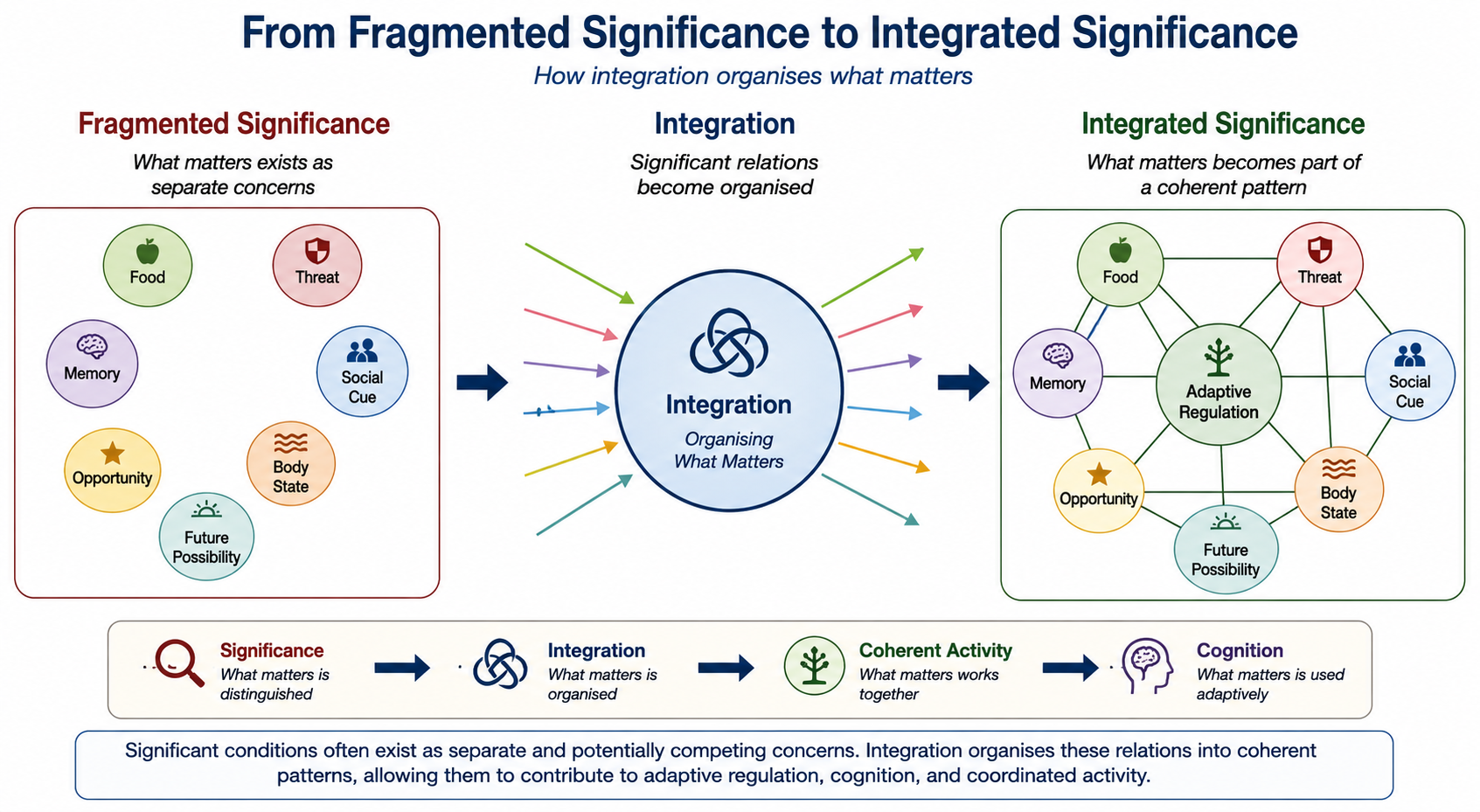
From Fragmented Significance to Integrated Significance. Significant conditions may initially exist as separate and potentially competing concerns. Integration relates these conditions to one another, allowing them to contribute to coherent patterns of regulation, behaviour, cognition, and decision-making.
Is Integration Just Another Word for Organisation?
Integration is closely related to organisation, but the two concepts are not identical.
Organisation refers broadly to structured arrangement. A system may be organised because its components exhibit order, pattern, or regularity. Integration refers more specifically to the organisation of significant relations into coherent functional wholes.
The distinction matters because organisation alone does not necessarily produce coherence. A library may be organised, a filing system may be organised, and a machine may be organised, yet organisation by itself does not guarantee that multiple significant conditions are related in ways that support coordinated activity.
Integration requires more than arrangement. It requires functional coherence.
The same distinction applies to concepts such as coordination, communication, and regulation. Coordination concerns the mutual adjustment of activities. Communication concerns the transmission of signals. Regulation concerns the modulation of activity in response to changing conditions. Each can contribute to integration, but none is equivalent to integration itself.
Integration refers to the broader process through which significant conditions become organised into coherent patterns capable of supporting adaptive activity. It is therefore best understood as a specialised form of organisation rather than a synonym for organisation.
Organisation describes structure.
Integration describes the coherent functional organisation of what matters.
Integration Across Living Systems
Integration is not restricted to cognition, consciousness, or human experience. It occurs throughout the living world and appears wherever significant conditions must be related to one another in ways that support continued activity.
Although the specific mechanisms differ across scales, the underlying principle remains remarkably consistent. Integration organises what matters into coherent patterns capable of supporting persistence, adaptation, and coordinated action. For this reason, integration is best understood as a general feature of living organisation rather than a specialised property of nervous systems.
Cellular Integration
The most basic living systems already depend upon integration.
Cells must continuously coordinate metabolism, membrane regulation, signalling pathways, resource acquisition, waste removal, repair processes, and responses to environmental change. None of these activities occurs in isolation. Each influences and constrains the others, contributing to a larger pattern of cellular organisation.
A living cell therefore functions not as a collection of separate biochemical reactions but as a coherent organisation of mutually related processes. The significance of a nutrient gradient, a signalling molecule, or a change in temperature depends upon how it relates to many other conditions affecting cellular viability.
In this sense, integration precedes cognition and is already present at the foundations of life.
Organismal Integration
Multicellular organisms extend integration across larger spatial and temporal scales.
Tissues, organs, physiological systems, developmental processes, behaviour, and environmental interactions must all be coordinated within a continuing pattern of activity. Internal conditions influence behaviour, behaviour alters environmental relationships, and environmental changes feed back into physiology and development. The organism persists because these processes remain connected within a coherent organisation rather than fragmenting into independent activities.
This does not make the organism a privileged ontological level. Rather, organisms function as important integrative hubs where diverse biological processes converge and influence one another. They are places where many significant relations become coordinated within a continuing pattern of agency.
Developmental Integration
Development provides one of the clearest examples of integration in action.
Growth, differentiation, morphogenesis, regeneration, repair, and reproduction all require local activities to remain coordinated with broader patterns of organisation. Cells must continually relate their own activities to the changing needs of the developing whole.
Regeneration after injury illustrates this particularly well. Damaged tissues are not simply rebuilt piece by piece. Local cellular activities must be coordinated with larger organismal patterns so that restoration contributes to the coherence of the organism rather than producing disconnected growth.
Development is therefore not simply the execution of a genetic programme. It is an ongoing process through which significant biological relationships are organised, maintained, and reorganised across time.
Ecological Integration
Integration extends beyond individual organisms.
Ecological systems consist of networks of dependency, exchange, competition, cooperation, and coevolution. Species modify environments that subsequently influence other species. Nutrients cycle through ecosystems. Organisms participate in relationships that no single organism fully controls.
Pollination networks provide a familiar example. The activities of plants, pollinators, and environmental conditions become linked within larger ecological patterns that influence the persistence of all participants. What matters to one organism often becomes part of a wider web of significance extending far beyond the individual itself.
Ecological integration demonstrates that coherent organisation can emerge across distributed networks rather than requiring a single centralised agent.
The recurrence of integration across cells, organisms, development, and ecosystems suggests that it is not a specialised phenomenon but a general feature of living organisation. The details vary enormously across scales, yet the underlying principle remains the same: significant relations become organised into coherent patterns capable of sustaining coordinated activity.
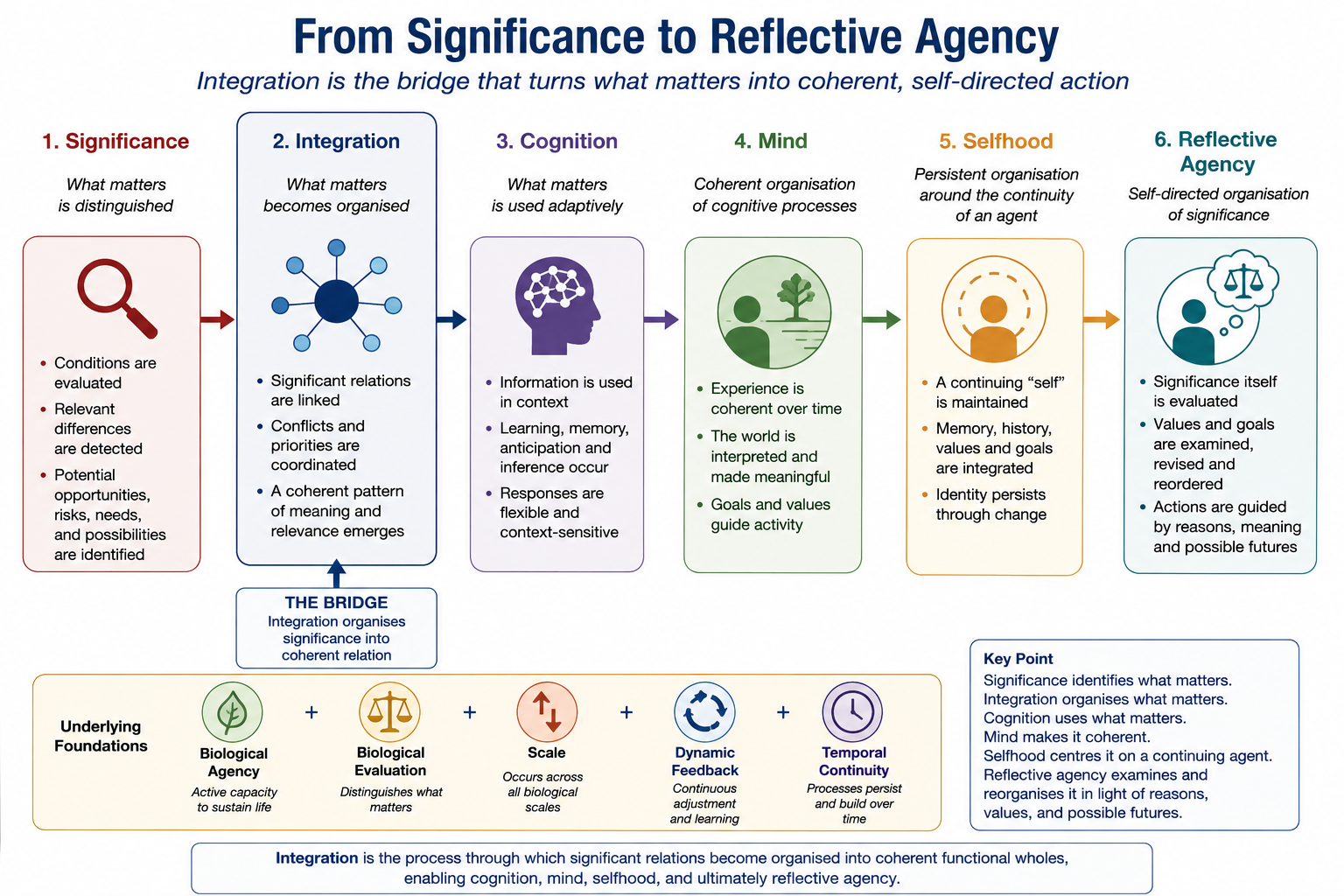
From Significance to Reflective Agency. Agency establishes what matters. Biological evaluation distinguishes significant conditions. Integration organises significance into coherent functional relations, making cognition, mind, selfhood, and reflective agency possible.
Although integration appears throughout biology, its significance becomes especially clear when we ask how cognition emerges.
From Significance to Cognition
The explanatory importance of integration becomes most apparent when we ask how cognition emerges.
Living systems constantly encounter conditions that matter. Yet significance alone does not produce cognition. A condition may be relevant to an organism’s persistence without being related to other significant conditions, retained through time, or incorporated into adaptive regulation.
Cognition requires a further step.
For an organism to learn from experience, anticipate future possibilities, coordinate responses, or adjust behaviour according to changing circumstances, significant conditions must become related to one another within coherent patterns of organisation. Present conditions must be interpreted in light of past experience. Possible futures must be related to current circumstances. Multiple concerns must be balanced, prioritised, and coordinated.
These are fundamentally integrative achievements.
Integration therefore provides the missing bridge between significance and cognition.
This relationship can be summarised as:
Agency → Biological Evaluation → Significance → Integration → Cognition
Within this sequence, cognition is neither the simple detection of information nor mere responsiveness to environmental conditions. It involves the adaptive use of significance that has already been organised into coherent patterns of relation.
Memory, anticipation, learning, behavioural flexibility, and context-sensitive decision-making all depend upon this organisation. Without integration, significant conditions remain fragmented and disconnected. With integration, they become available for adaptive regulation across time.
In APS:
Cognition is integrated significance in adaptive use.
This formulation helps explain why cognition appears across such a wide range of living systems. Different organisms may employ very different mechanisms, structures, and behaviours, yet all cognitive systems depend upon the capacity to organise what matters into forms that can guide adaptive activity.
Integration therefore provides a common foundation for understanding cognition across biological scales.
From Cognition to Mind
If integration helps explain how cognition emerges, it also helps explain how cognition becomes mind.
The two concepts are closely related, but they are not identical. Cognition concerns the adaptive use of integrated significance. Mind concerns the increasingly coherent organisation of that cognitive activity.
This distinction matters because cognitive processes can exist in many forms and degrees. Perception, memory, evaluation, anticipation, and behavioural regulation do not automatically constitute mind. What matters is how these processes become organised into a continuing field of significance centred on an agent’s ongoing relationship with itself and its world.
Integration again plays a central role.
As cognitive processes become increasingly interconnected, they contribute to larger patterns of coherence. Memories influence present evaluations, expectations shape perception, emotional states affect interpretation, and past experiences contribute to future planning. Activities that might otherwise remain separate become organised within a broader and more enduring pattern.
The result is not merely a collection of cognitive events but a coherent organisation through which an agent maintains continuity across changing circumstances.
Mind emerges from this increasing coherence.
APS therefore understands mind not as a mysterious substance or separate entity, but as a particular mode of integrated organisation. Mind is the coherent organisation of integrated cognitive significance.
This formulation avoids reducing mind to isolated mental states while also avoiding the assumption that cognition and mind are interchangeable. Instead, mind is understood as a more unified, persistent, and organised expression of the same integrative processes that make cognition possible.
Integration thus serves as a bridge not only between significance and cognition but also between cognition and mind. As significance becomes organised, cognition becomes possible. As cognition becomes increasingly integrated across time, mind emerges as a coherent field of cognitive significance through which an agent relates to itself and its world.
The consequences of integration, however, extend beyond cognition and mind. As integrated significance becomes increasingly stable across time, it contributes to the emergence of both selfhood and meaning.
Integration, Selfhood, and Meaning
The consequences of integration do not end with cognition or mind.
As integrated significance becomes increasingly stable across time, it contributes to the emergence of selfhood and meaning. These are not separate additions to cognition but further developments of the same organisational processes that allow living systems to maintain coherent relationships with themselves and their worlds.
Integration and Selfhood
One of the enduring questions in philosophy, psychology, and biology concerns the nature of the self.
APS rejects the view that the self is a hidden substance or immutable essence located somewhere within the organism. At the same time, it rejects the view that the self is merely an illusion. Living systems exhibit genuine continuity despite continual material, physiological, developmental, and environmental change.
The challenge is to explain how this continuity is maintained.
Integration provides part of the answer.
A self persists because significant experiences, memories, dispositions, relationships, values, and future possibilities become organised into enduring patterns centred on the continuity of an agent. These elements are not simply accumulated over time. They are continually related, reinterpreted, and reorganised in ways that preserve coherence despite ongoing change.
The self is therefore not something added to biological organisation. It emerges from increasingly persistent forms of integrated significance.
In APS:
Selfhood is the persistent organisation of integrated significance around the continuity of an agent.
Integration and Meaning
Meaning is similarly rooted in processes of integration.
Significance identifies what matters. Meaning arises when what matters becomes situated within broader patterns of consequence, interpretation, and orientation. A signal becomes meaningful because it is connected to possible outcomes. A memory becomes meaningful because it is related to personal history. A value becomes meaningful because it influences future choices and behaviour.
Meaning therefore depends not simply on significance but on the organisation of significance within larger contexts.
Without integration, significant conditions remain isolated events. They may matter in themselves, yet they do not contribute to a broader framework of understanding. Integration brings these conditions into relation with one another, allowing experiences, actions, and expectations to acquire coherence and direction.
Through this process, organisms come to inhabit not merely environments but meaningful worlds.
In APS:
Meaning is significance integrated into broader patterns of relation, consequence, and orientation.
This perspective helps explain why meaning is not restricted to language, culture, or conscious reflection. Human forms of meaning represent highly developed expressions of a more general biological process through which significant relations become organised into patterns that guide activity and orient behaviour.
Selfhood and meaning therefore emerge together. As significance becomes organised around a continuing agent, it simultaneously becomes embedded within increasingly rich networks of consequence, interpretation, and possibility.
Integration and Reflective Agency
Human beings exhibit a distinctive form of agency because they can reflect upon significance itself.
Most forms of biological agency involve responding to what matters. Reflective agency extends this capacity by allowing agents to examine, compare, revise, and reorganise their own patterns of significance. What matters can itself become the subject of evaluation.
People can ask:
- Why does this matter?
- Should this matter?
- What should matter more?
- Which values should guide action?
- What kind of future should be pursued?
- What sort of person should I become?
Such questions are possible because integrated significance becomes available for further interpretation and reorganisation.
Reflection therefore depends upon highly developed forms of integration.
Memories, values, emotions, beliefs, social norms, aspirations, and anticipated futures must all be brought into relation within a coherent field of concern. Reflection allows these relationships to be examined, compared, and reorganised in light of changing circumstances and emerging possibilities.
Integration thus becomes recursive. The system no longer merely organises what matters; it can also evaluate and reorganise its own organisation of what matters.
This capacity underlies planning, deliberation, moral reasoning, identity formation, cultural participation, and long-term self-direction.
In APS:
Reflective agency is the self-directed organisation of integrated significance in light of reasons, values, meanings, and possible futures.
Reflective agency therefore represents one of the most sophisticated forms of integration currently known. It extends organisational principles already present throughout life into the domains of culture, ethics, symbolic thought, and conscious self-understanding.
Integration and the Matter-to-Mind Question
One of the deepest questions in science and philosophy asks how matter became aware of itself.
Traditionally, this question has often been framed as a sharp divide between physical processes and conscious experience. APS approaches the problem differently. Rather than asking how mind suddenly appears within a material world, it asks how increasingly complex forms of organisation emerge within living systems and how these forms gradually give rise to increasingly sophisticated modes of awareness.
The framework therefore begins not with consciousness but with life.
Living systems actively maintain themselves through biological agency. Through biological evaluation they distinguish conditions according to their significance. Significant conditions become organised through integration, allowing cognition to emerge. Increasingly coherent forms of cognition support mind, while more persistent patterns of integrated significance contribute to selfhood. Reflective agency emerges when these organised patterns become available for self-directed evaluation and revision.
This progression can be summarised as:
Matter → Living Organisation → Agency → Biological Evaluation → Significance → Integration → Cognition → Mind → Selfhood → Reflective Agency
APS does not claim that this sequence completely resolves the problem of consciousness. Questions concerning subjective experience remain among the most difficult problems in philosophy and science.
What the framework does provide is a continuous explanatory pathway linking biological organisation to increasingly sophisticated forms of cognition, meaning, selfhood, and awareness. Rather than treating mind as an abrupt departure from the rest of nature, APS seeks to understand it as part of a broader developmental continuum.
Integration occupies a pivotal position within this pathway.
It explains how what matters becomes organised into coherent forms capable of supporting higher-order biological and cognitive organisation. Without integration, the transition from significance to cognition remains obscure. With integration, a substantial portion of the route from life to awareness becomes intelligible.
The question of how matter became aware of itself therefore remains open. Yet integration helps reveal an important part of the answer by clarifying how increasingly complex forms of significance can become organised into increasingly complex forms of cognition, mind, selfhood, and reflective agency.
Conclusion: Organising What Matters
LLiving systems do not merely encounter what matters.
They must organise what matters.
This simple observation captures the central insight of integration. Through biological evaluation, organisms distinguish among conditions according to their significance. Yet significance alone is not enough. Living systems exist within a world of multiple and often competing concerns. Opportunities, constraints, needs, risks, memories, relationships, and future possibilities must somehow be related to one another if coherent activity is to emerge.
Integration is the process through which this occurs.
Across cells, organisms, developmental systems, ecosystems, cognitive processes, minds, selves, and reflective agents, integration transforms what matters into coherent patterns of organisation. It provides the bridge linking significance to cognition, cognition to mind, mind to selfhood, and selfhood to reflective agency.
For this reason, integration occupies a central position within the APS cognition-and-mind architecture. It helps explain how learning, memory, anticipation, meaning, identity, and self-directed action emerge from the organisation of significant relations across time.
More broadly, integration contributes to one of the largest questions confronting both science and philosophy: how increasingly complex forms of biological organisation give rise to increasingly sophisticated forms of awareness.
Integration is the process by which significant relations are organised into coherent functional wholes capable of coordinated activity.
It is the process through which what matters becomes part of a coherent world—and through which coherent worlds become possible.
See Also
Related Articles
References
- (2016). Biological Regulation: Controlling the System from Within. Biology & Philosophy, 31(2), 237–265 . https://doi.org/10.1007/s10539-015-9497-8
- (2005). Autopoiesis, Adaptivity, Teleology, Agency. Phenomenology and the Cognitive Sciences, 4(4), 429–452 . https://doi.org/10.1007/s11097-005-9002-y
- (2015). The Cognitive Cell: Bacterial Behavior Reconsidered. Frontiers in Microbiology, 6, 264 . https://doi.org/10.3389/fmicb.2015.00264
- (2015). Biological Autonomy. Springer.
- (2026). Agency as the Defining Activity of Life: A Viability-Oriented Framework Integrating Process and Scale. Biological Theory . https://doi.org/10.1007/s13752-026-00547-6
- (2007). Mind in Life: Biology, Phenomenology, and the Sciences of Mind. Harvard University Press.
- (2002). Life After Kant: Natural Purposes and the Autopoietic Foundations of Biological Individuality. Phenomenology and the Cognitive Sciences, 1(2), 97–125 . https://doi.org/10.1023/A:1020368120174