What Is Biological Significance?
Living systems do not inhabit neutral worlds. Some conditions support survival, functioning, and adaptive persistence, while others threaten or constrain them. Explaining why certain conditions matter is therefore a fundamental biological problem. Within the Agency–Process–Scale (APS) framework, biological significance refers to the relevance that conditions acquire for living systems through biological evaluation. Significance emerges when agents distinguish conditions according to their consequences for ongoing activity, organisation, and persistence. It is therefore not identical with information, function, meaning, or value, although it contributes to each. Biological significance occupies a central position within the APS architecture because it provides the bridge between biological agency and the later emergence of meaning, cognition, and mind. Understanding biological significance helps explain how living systems organise their interactions with the world around what matters and why increasingly complex forms of cognition and experience remain grounded in this fundamental biological reality.
Key Points
- Biological significance explains how conditions come to matter for living systems.
- Significance emerges through biological evaluation.
- Significance is distinct from information because it concerns relevance rather than difference.
- Meaning, cognition, and mind depend upon significance.
- Significance provides a bridge between biological agency and cognition.
Why Do Some Things Matter?
Living systems do not respond equally to everything they encounter. A bacterium moving through a chemical gradient encounters some molecules as resources and others as irrelevant background conditions. A plant responds differently to sunlight and shade, water and drought, support and obstruction. Animals continually distinguish opportunities from dangers, food from inedible material, and social partners from competitors. Human beings likewise navigate worlds structured by relationships, obligations, goals, risks, and possibilities. In every case, some conditions matter while others do not.
This observation may seem obvious, yet it points toward a profound biological question. Why do some aspects of the world acquire importance for living systems while countless others remain irrelevant? The physical world contains an immense number of differences, events, and interactions, but organisms do not respond to all of them equally. Their activities are organised around distinctions that affect their continued functioning, persistence, and adaptive engagement with their environments.
Within APS, the concept of biological significance addresses this problem. Biological significance refers to the relevance that conditions acquire for living systems. It explains why organisms encounter worlds structured not simply by physical events but by patterns of importance. Understanding biological significance therefore helps explain how living systems distinguish what matters from what does not and why this distinction forms the basis for all subsequent developments in cognition and mind.
Biological Evaluation and the Emergence of Significance
Biological significance emerges through biological evaluation. Living systems continually distinguish conditions according to their consequences for viability, functioning, and adaptive persistence. Conditions that support continued activity become relevant in one way, while conditions that threaten or undermine that activity become relevant in another.
Biological evaluation is the process through which these distinctions are generated. Through ongoing interactions with their environments, organisms differentiate resources from threats, opportunities from constraints, and favourable conditions from unfavourable ones. Evaluation therefore establishes patterns of relevance within the organism’s world.
Biological significance is the outcome of this process. Evaluation determines what matters; significance is the relevance that results from those determinations. The two concepts are therefore closely related but not identical. Evaluation describes how distinctions are made, whereas significance refers to the importance those distinctions acquire for a living system.
This distinction clarifies why significance occupies a unique position within the APS architecture. Biological agency makes evaluation possible, evaluation generates significance, and significance subsequently provides the foundation upon which more complex forms of biological organisation develop.
What Is Biological Significance?
Biological significance is the relevance of conditions, events, or possibilities to a living system. More specifically, it refers to the degree to which something matters because of its relationship to the organism’s ongoing activity, organisation, functioning, or persistence.
Within APS, significance is neither a purely objective property of the environment nor a purely subjective construction imposed by an observer. Instead, it is a relationally real feature of agent–environment interactions. Conditions become significant because they stand in genuine relationships to the organisation, activity, functioning, and persistence of living systems. Significance is therefore not merely perceived or projected; it emerges from real biological relations through which conditions come to matter for an agent. Food is significant to an animal because it contributes to continued functioning. A toxin is significant because it threatens that functioning. Light is significant to a plant because it affects photosynthetic activity. In each case, significance emerges through the relationship between organism and condition.
This relational character distinguishes significance from simple physical description. The physical world contains innumerable events and differences, but only some acquire relevance for a particular organism. Biological significance therefore explains how living systems inhabit worlds structured by importance rather than merely by physical occurrence.
Significance is also distinct from meaning, cognition, and mind. It precedes these developments. Before conditions can become meaningful, cognitively organised, or mentally integrated, they must first matter. Biological significance identifies this foundational layer of relevance that makes later developments possible.
Why Significance Matters
Biological significance helps explain several features of living systems that otherwise appear disconnected. Most fundamentally, it explains why organisms do not respond indiscriminately to every available condition. Living systems selectively engage with aspects of their environments because some conditions bear directly upon their continued existence and activity.
Significance also helps explain why biological organisation is inherently directional. Organisms do not simply undergo change; they continually regulate their interactions in ways that preserve, modify, or enhance their functioning. Such regulation depends upon distinctions concerning what matters and what does not. Without significance, adaptive behaviour would lack orientation because there would be no basis for prioritising one condition over another.
The concept also clarifies why biological systems cannot be fully understood through information alone. Information identifies differences, but significance explains why certain differences become important. Organisms are not merely information-processing systems. They are systems organised around relevance. Significance therefore provides a biological account of importance that avoids reducing living activity either to physical mechanism alone or to exclusively human forms of meaning and value.
For APS, significance is particularly important because it provides a common explanatory foundation linking diverse biological phenomena. The same underlying principle that explains why a cell responds to a stress signal also helps explain why animals attend to predators, why plants alter growth patterns in response to environmental conditions, and why humans organise their lives around goals, commitments, and concerns. The specific mechanisms differ, but the underlying reality that some conditions matter remains continuous.
If significance is the relevance that conditions acquire for living systems, it should not be confined to organisms with nervous systems, language, or consciousness. Rather, significance should appear wherever living systems distinguish conditions according to their consequences for continued activity and persistence.
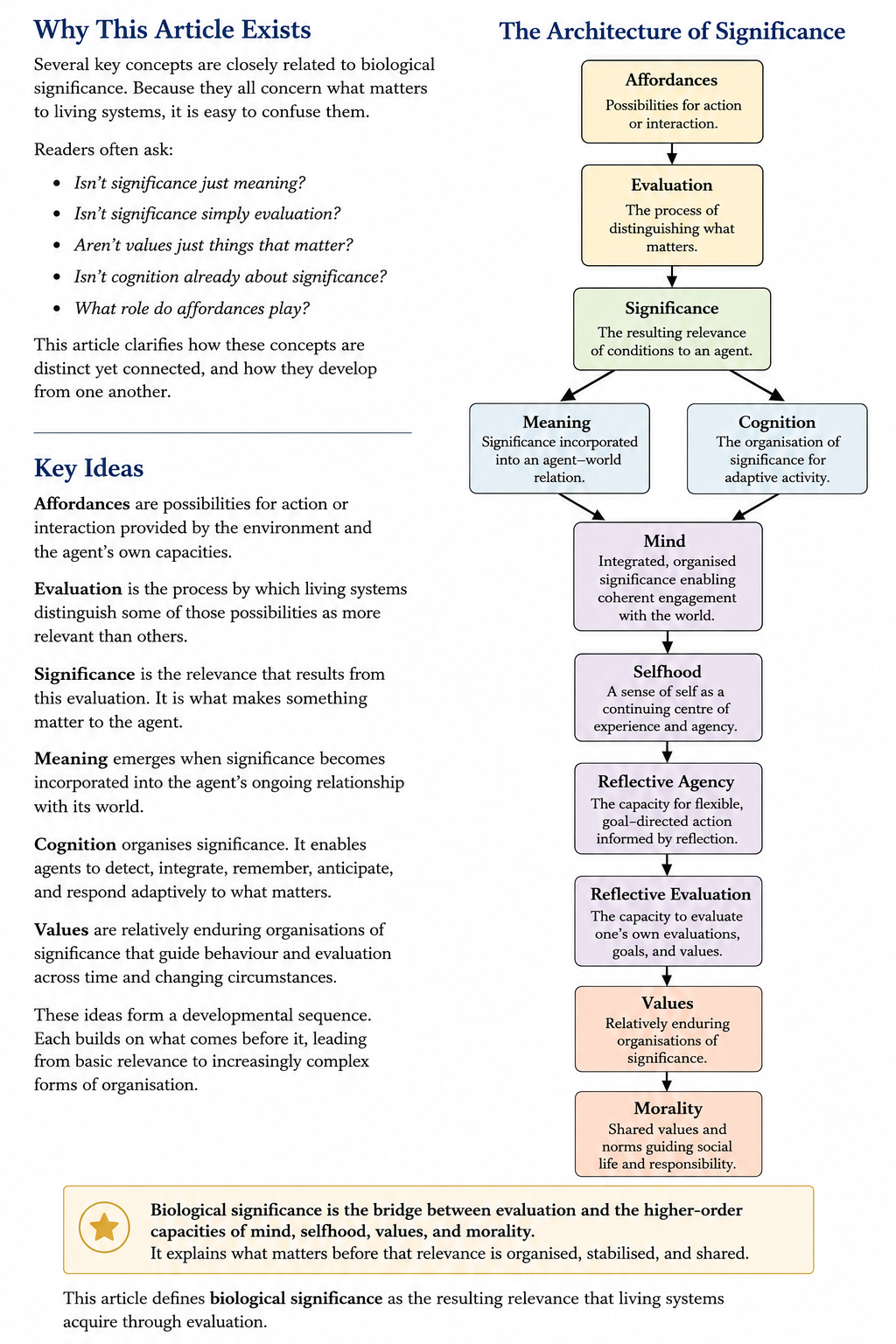
From Significance to Mind. Biological significance occupies a pivotal position within the APS cognition and mind architecture. Affordances provide possibilities for action or interaction, evaluation distinguishes which possibilities matter, and significance is the resulting relevance of those conditions to an agent. Meaning and cognition emerge as complementary developments of significance and together contribute to mind. Subsequent developments include selfhood, reflective agency, reflective evaluation, values, and morality. The diagram illustrates how increasingly complex forms of cognition and social organisation develop from the fundamental biological reality that some conditions matter more than others.
Biological Significance Across Scales
Biological significance appears throughout the spectrum of living organisation. Although its specific forms vary, its fundamental role remains remarkably consistent.
At cellular scales, significance appears whenever conditions influence ongoing metabolic activity, regulation, or survival. Nutrient availability, signalling molecules, temperature changes, and environmental stressors acquire significance because they affect the continuation of organised cellular processes.
At organismal scales, significance becomes evident in behaviour and physiological regulation. Organisms distinguish food from non-food, danger from safety, and suitable environments from unsuitable ones. These distinctions guide adaptive responses and contribute to persistence within changing environments.
As biological organisation becomes increasingly complex, significance supports more elaborate forms of engagement. Memory, learning, anticipation, and decision-making all depend upon distinctions concerning what matters. Yet significance itself remains more fundamental than any particular cognitive mechanism because it concerns the relevance that such mechanisms organise rather than the mechanisms themselves.
Human beings extend significance into domains such as identity, knowledge, beauty, responsibility, and purpose. These developments are more complex than cellular or organismal forms of significance, but they remain continuous with the broader biological reality that living systems organise themselves around conditions that matter. Significance is therefore scale-independent in its role while remaining context-dependent in its specific expression.
Beyond Significance
Biological significance occupies a foundational position within the Cognition and Mind domain because it provides the basis from which several later developments emerge. Once conditions become significant, they can become incorporated into increasingly complex forms of organisation.
Meaning emerges when significance becomes part of an agent’s ongoing relationship with its world. Cognition emerges through processes that organise, retain, anticipate, and respond to significant conditions. Mind emerges through the integration of meaningful cognition into coherent patterns of engagement across time and context. Although each of these developments introduces additional forms of organisation, all remain dependent upon the prior existence of significance.
For this reason, biological significance should not be regarded as a specialised concept relevant only to early biological processes. Instead, it represents a foundational layer of organisation that remains present throughout the subsequent development of cognition and mind. Later forms of organisation transform and extend significance, but they do not replace it.
APS Perspective
Within the APS framework, biological significance explains how conditions come to matter for living systems. Emerging through biological evaluation, significance establishes patterns of relevance that guide activity, regulation, and adaptive engagement with the world. It occupies a central position within the APS architecture because it links biological agency to the later emergence of meaning, cognition, and mind.
The importance of biological significance lies in its ability to connect seemingly disparate phenomena through a common principle. Living systems continuously distinguish what matters from what does not, and this distinction shapes their interactions at every scale of organisation. Whether expressed through cellular regulation, organismal behaviour, or human reflection, biological significance identifies the relevance that structures biological existence.
Understanding biological significance therefore helps clarify one of the most fundamental features of life itself. Living systems do not merely exist within environments; they inhabit worlds organised around importance. Through biological evaluation, conditions acquire significance, and through significance, the foundations are established for increasingly complex forms of cognition, experience, and agency.
See Also
Related Articles
References
- (2009). Defining Agency: Individuality, Normativity, Asymmetry, and Spatio-Temporality in Action. Adaptive Behavior, 17(5), 367–386 . https://doi.org/10.1177/1059712309343819
- (2005). Autopoiesis, Adaptivity, Teleology, Agency. Phenomenology and the Cognitive Sciences, 4(4), 429–452 . https://doi.org/10.1007/s11097-005-9002-y
- (2026). Agency as the defining activity of life: A viability-oriented framework integrating process and scale. Biological Theory . https://doi.org/10.1007/s13752-026-00547-6