Can Environmental Ethics Be Naturalised?
Environmental ethics asks why organisms, species, ecosystems, landscapes, climate systems, and future generations should constrain present action. APS explains how environmental conditions acquire biological significance through viability-oriented organisation, but viability alone cannot determine moral legitimacy. This article examines how environmental significance may become environmental value, moral standing, and responsibility, while identifying the unresolved questions that a future APS environmental ethic must address.
Key Points
- Environmental conditions acquire biological significance through their relation to viability-oriented organisation.
- Viability explains the origin of biological normativity but does not determine moral legitimacy.
- Environmental value can extend beyond the immediate viability interests of particular organisms.
- Environmental ethics requires moral evaluation where organismic, ecological, social, and intergenerational claims conflict.
- APS provides an architecture for naturalising environmental responsibility but does not yet offer a complete environmental ethic.
Introduction
Environmental ethics asks us to protect organisms, species, ecosystems, landscapes, climate systems, and future generations. APS explains why environments matter before ethical reflection begins. The harder question is how what matters to living systems becomes something that ought to constrain human action.
When Protecting Nature Requires Harming Life
A conservation programme proposes killing large numbers of invasive animals to protect threatened native species and restore a damaged ecosystem.
The ethical difficulty is immediate. The animals marked for removal are not inert obstacles within an environmental management plan. They are living agents engaged in the ongoing activity through which they maintain the conditions of their own persistence. They seek resources, avoid danger, reproduce, and respond to changing circumstances in ways organised around continued functioning. The native organisms being protected are doing the same. Their populations may be declining because of predation, competition, habitat disruption, or ecological changes associated with the introduced animals. Their continued persistence may depend on intervention.
The situation becomes more complex when the ecosystem itself enters the discussion. Ecosystems contain interacting organisms, material conditions, historical trajectories, feedback processes, and patterns of ecological organisation. Yet an ecosystem is not obviously a unified agent capable of evaluating conditions or acting for its own persistence. What, then, does it mean to protect an ecosystem? Whose interests are being protected, and what could justify harming particular organisms for the sake of ecological relations or collective continuity?
Similar tensions appear throughout environmental ethics. Predator restoration may strengthen ecological organisation while increasing the suffering and mortality of prey animals. Climate decisions may provide immediate benefits while imposing severe environmental risks on communities that will not exist for another century. Habitat protection may preserve biodiversity while restricting the livelihoods of people who depend upon access to land and resources.
In each case, the problem is not that life confronts something opposed to life. Rather, different forms of life, value, relation, and future possibility become entangled in ways that cannot all be satisfied simultaneously. Environmental ethics begins where multiple legitimate claims intersect and where biological facts alone do not determine what ought to be done.
APS sharpens this problem because it takes the interests of living systems seriously. Biological agency is viability-oriented organisational activity. Conditions support or undermine the organisation through which organisms maintain and re-establish their continued functioning. Living systems therefore possess a viability-relative good of their own before human beings recognise, describe, or value them.
But if every living agent has conditions that support or undermine its organised persistence, what allows environmental ethics to favour some organisms, relations, systems, or futures over others?
This is the environmental-ethics challenge for APS:
Can a framework that grounds biological normativity in viability-oriented organisation explain environmental obligations that exceed, constrain, or oppose the viability interests of particular organisms?
The answer cannot simply be that whatever persists should be protected. Nor can it be that the interests of the most extensive system automatically prevail. Environmental ethics requires a way of understanding how biological significance becomes environmental value and how environmental value can generate justified obligations when forms of life, organised relations, human communities, and future possibilities conflict.
The article therefore investigates a question that reaches beyond environmental policy and into the foundations of value itself. If environments matter because living systems depend upon them, how do those relations become objects of responsibility, protection, and ethical concern? The challenge is not merely to explain why environments matter, but to explain how concern for them can become justified.
The central claim of this article is therefore:
Viability explains how environments first come to matter, but not by itself what ought to be protected.
The Environmental-Ethics Challenge
APS grounds biological normativity in the asymmetry between conditions that support organised persistence and conditions that undermine it.
This does not mean that organisms make explicit judgments about every condition they encounter. Biological evaluation begins before reflective awareness. Through their activity, living systems distinguish conditions that contribute to continued functioning from those that disrupt, damage, or threaten it. Biological Evaluation is the process through which agency generates significance.
Environmental ethics introduces a different kind of question.
It asks not only why a condition matters to an organism, but how organisms, communities, institutions, and societies ought to respond to the living and non-living world. Environmental concern frequently extends beyond immediate biological dependence. It includes endangered species, ecological communities, rivers, landscapes, climatic systems, and future generations whose interests cannot be reduced to the present viability of any particular organism.
A forest may provide conditions necessary for the persistence of many forms of life. That fact establishes its biological and ecological significance. It does not by itself determine which interests should be prioritised, how competing claims should be weighed, what sacrifices may be justified, or what responsibilities are owed to future communities.
Similarly, a population may increase its own security by exploiting another population or degrading shared environmental conditions. Such activity may contribute to the persistence of the successful population. It does not automatically follow that the activity is ethically defensible.
The challenge is therefore not that APS lacks an account of why environments matter. APS already provides a strong account of biological significance. The challenge is that significance alone does not settle questions of value, standing, responsibility, or obligation. Environmental ethics begins when agents capable of wider evaluation ask how the many things that matter should be related to one another and what forms of action become justified in response.
The environmental-ethics challenge therefore concerns a series of transitions:
- from biological significance to environmental value;
- from environmental value to moral standing;
- from moral standing to competing claims;
- from competing claims to justified obligation;
- from present interests to responsibility for future conditions.
These transitions cannot be compressed into a single appeal to viability.
APS must distinguish the natural origin of normativity from the moral justification of particular norms. Viability-oriented organisation explains how significance becomes possible in nature. It does not establish that every action promoting persistence is right, that every persistent system should be preserved, or that the viability interests of every organism should receive equal priority.
This distinction becomes especially important because environmental ethics frequently requires agents to limit their own interests. Individuals may accept restrictions on consumption. Communities may preserve habitats rather than maximise immediate economic benefit. Governments may protect future environmental possibilities at present cost. Conservation programmes may intervene against organisms whose own activity threatens other forms of life.
Such actions do not leave biological normativity behind. They depend upon living, cognitive, social, and reflective agents capable of recognising significance beyond immediate circumstances. But they cannot be reduced to the direct regulation of organismic persistence.
APS must therefore explain not how ethical obligation appears independently of life, but how evaluative capacities grounded in living organisation become capable of examining, revising, and constraining particular viability interests.
Why Environments Matter Before Ethics Begins
Environmental ethics does not create the fact that environments matter.
Long before organisms possess language, reflective awareness, moral systems, or explicit concepts of nature, their continued functioning depends upon relations with conditions beyond their boundaries.
A living organism is not an isolated object that first exists and then enters an external environment. Its organisation is continually enacted through exchanges, dependencies, and regulatory relations extending across organism and surroundings.
Nutrients must be obtained. Waste must be removed. Temperature, moisture, chemical composition, physical support, shelter, and exposure must remain within tolerable ranges. Other organisms may provide food, protection, competition, symbiosis, disease, or predation. The organism persists only through ongoing activity conducted within this structured field of possibilities and constraints.
The environment is therefore not merely a container in which life happens.
It is a relational domain within which the conditions of organised persistence are encountered, modified, used, resisted, and sometimes reconstructed.
Different environmental conditions do not have the same consequences for a living system. Some contribute to continued functioning. Others disrupt it. Some permit repair, growth, reproduction, or adaptive reorganisation. Others produce damage, deprivation, or loss of organisational integrity.
These differences are normatively asymmetric because their significance is relative to viability-oriented organisation. A condition can be favourable, harmful, tolerable, threatening, or irrelevant according to the difference it makes to the continued enactment of living organisation.
APS calls the activity through which these differences acquire significance Biological Evaluation.
Biological evaluation need not involve thought, deliberation, representation, or conscious judgment. It is enacted through the regulatory and organisational activity by which living systems respond differently to conditions according to their consequences for continued functioning.
A bacterium moving through a chemical gradient, a plant altering growth in response to light, an animal seeking water, and an immune system responding to disruption do not merely undergo physical change. Their activity is organised in relation to conditions that support or undermine persistence.
Through such activity, conditions come to matter.
Environmental significance begins wherever conditions make a difference to the continued functioning of living organisation.
This principle sits at the centre of the APS account of life. Living systems are not passive recipients of environmental influence. Through agency they engage with conditions that matter to their persistence, and through biological evaluation those conditions acquire significance. The result is a world already structured by asymmetries of relevance before cognition, morality, or ethical reflection emerge. Environmental significance is therefore not imposed upon nature from outside; it arises through the ongoing organisation of living activity itself.
This provides environmental ethics with an important naturalistic foundation.
The living world is not composed of morally neutral matter upon which human beings later project all significance. Organisms are already centres of viability-relative activity. Conditions can genuinely support or undermine them, whether or not humans notice, describe, or value what is occurring.
A plant does not need human recognition for drought to matter to it. An animal does not need moral status to experience injury as a disruption of its living organisation. A microbial community does not require human approval for changes in temperature, acidity, or nutrient availability to alter the conditions of its persistence.
APS therefore rejects the idea that significance enters nature only with human preference.
But biological significance is not yet environmental ethics.
An organism evaluates conditions in relation to its own organisation. Environmental ethics asks reflective agents to consider a much wider field:
- the significance of conditions for other organisms;
- relations among organisms with competing interests;
- the continuity of populations and species;
- the organisation of ecological communities;
- environmental systems that are not themselves alive;
- consequences distributed across space and time;
- the conditions inherited by future generations.
The transition from biological significance to environmental responsibility therefore requires more than an expansion in the number of organisms considered. It requires forms of cognition, integration, meaning, shared evaluation, and moral judgment through which agents can organise significance beyond immediate regulation.
Ethics begins when agents capable of wider evaluation ask what should be done about what matters.
Viability Is Not a Moral Rule
Because APS grounds biological normativity in viability-oriented organisation, it may appear to follow that persistence is the framework’s ultimate moral standard.
That conclusion would be mistaken.
Viability explains why conditions can be favourable or harmful to a living system. It does not establish that every action supporting viability is morally legitimate.
A parasite may secure its persistence by damaging its host. An invasive population may flourish by displacing native organisms. A social institution may sustain itself through exclusion or exploitation. A human community may increase its short-term security by transferring environmental damage to another community or to future generations.
In each case, persistence is being achieved. But persistence alone does not justify the means through which it is secured.
This distinction is already central to the APS morality–ethics architecture. Viability, success, continuity, consensus, power, and persistence are not sufficient grounds of moral legitimacy.
Biological normativity and moral evaluation perform different explanatory functions. Biological normativity concerns the difference conditions make to living organisation. It explains why some states support continued functioning while others undermine it. Moral evaluation begins when reflective agents assess how competing claims, consequences, vulnerabilities, responsibilities, and possibilities should be judged. The first makes value-bearing activity possible; the second examines whether particular forms of action and organisation are defensible.
The environmental implications are substantial.
A conservation decision cannot be justified merely by claiming that it promotes persistence. The question remains: whose persistence, secured through what means, at what cost, across which domain, and with what consequences for other agents and future possibilities?
Nor can the problem be solved by moving automatically to a broader scale. An ecosystem does not acquire overriding moral authority merely because it encompasses many organisms. A species does not automatically outweigh its individual members. Planetary continuity does not by itself justify sacrificing vulnerable communities.
Scale alters the extent and resolution of what explanation reveals. It does not determine what ought to prevail.
Environmental ethics is required precisely because viability interests are plural and frequently incompatible. Organisms consume one another. Populations expand into conditions required by others. Ecological change benefits some forms of life while undermining others. Human environmental decisions redistribute risks, opportunities, and losses across communities and generations.
No outcome preserves every interest.
Moral evaluation must therefore assess more than whether persistence occurs. It must examine:
- the kinds of harm imposed;
- the vulnerability of those affected;
- the distribution of benefits and burdens;
- the availability of alternatives;
- the reversibility of loss;
- the historical causes of the conflict;
- the power of agents to alter outcomes;
- the future possibilities preserved or foreclosed.
Viability remains foundational because there could be no biological significance, value, or moral concern without living organisation. But foundations do not determine every structure built upon them.
APS naturalises the origin of normativity. It does not reduce ethical justification to biological function.
[[Viability Is Not Moral Legitimacy]]
A system may persist through exploitation, domination, exclusion, or destruction. APS therefore distinguishes the biological conditions of persistence from the moral legitimacy of the means through which persistence is secured. Viability explains why outcomes matter to living systems. It does not establish that whatever promotes persistence is ethically right.
The central environmental question is therefore not whether viability matters. It plainly does.
The question is how living, cognitive, social, and reflective agents become capable of judging among competing forms of significance and of accepting obligations that constrain their own immediate interests.
That question leads from biological significance to environmental value—and from environmental value to the more difficult problems of moral standing, conflicting claims, irreversible loss, and responsibility for future life.
How Environmental Value Extends Beyond Immediate Interest
Biological significance explains why environmental conditions matter to living systems. Environmental value introduces a broader question.
A condition may be biologically significant because it contributes directly to the continued functioning of an organism. Water matters to a plant. Shelter matters to an animal. Nutrients matter to a microbial community. These relations arise from the organisation of living systems and their dependence upon environmental conditions.
Environmental value frequently extends beyond such immediate relations.
People may care deeply about places they have never visited, species they will never encounter, landscapes from which they derive no direct benefit, or environmental conditions they will never personally experience. Ancient forests, coral reefs, wetlands, glaciers, rivers, and endangered species may become objects of concern even when their preservation contributes little or nothing to the present viability of particular individuals.
Environmental ethics therefore requires an account of how significance can expand beyond immediate biological regulation.
APS approaches this question through the architecture that follows biological significance. Living organisation generates significance through biological evaluation. Significance becomes increasingly organised through integration, cognition, mind, selfhood, reflective agency, meaning, value, and shared evaluation. As this organisation develops, agents become capable of relating significance across wider spatial, temporal, social, and counterfactual domains.
An organism may respond only to conditions immediately relevant to its continued functioning. Reflective agents can consider conditions removed from their immediate circumstances. A person may value a rainforest located on another continent, the continued existence of a species never personally encountered, the preservation of an ancient landscape, or the stability of future climatic conditions. Such concerns remain rooted in evaluative capacities made possible by living organisation, but they are no longer confined to immediate organismic regulation.
Reflective agency enables significance to be integrated across broader domains of concern.
This expansion does not transform environmental value into a purely subjective preference. Nor does it require value to exist independently of all relations.
APS instead suggests a middle position.
Environmental value may be relationally constituted while remaining answerable to real features of the entities and systems being valued.
A wetland, for example, may be valued because it supports ecological relations, preserves biodiversity, regulates hydrological processes, embodies historical continuity, provides scientific insight, and sustains future possibilities. None of these features reduce the wetland to a mere instrument. Yet neither do they require value to exist as an isolated property wholly independent of evaluative relations.
The value arises through relations, but the relations are real.
The same applies to rivers, forests, reefs, grasslands, mountains, and other environmental entities. Their value need not depend solely upon immediate usefulness, nor need it be understood as an intrinsic substance residing independently within them. Their organisation, history, vulnerability, ecological participation, and future possibilities place objective constraints upon how they may reasonably be valued.
APS therefore proposes a provisional distinction between biological significance and environmental value.
Biological significance concerns the difference environmental conditions make to viability-oriented organisation.
Environmental value concerns the wider evaluative importance that organisms, systems, histories, relations, and possibilities acquire through biological, cognitive, social, cultural, and moral forms of organisation.
The distinction is important because environmental ethics cannot proceed directly from biological significance to obligation. Living systems generate significance through their engagement with conditions that matter to persistence. Reflective agents organise that significance into meanings, commitments, and values extending beyond immediate regulation. Environmental value therefore emerges neither from detached abstraction nor from simple biological necessity. It arises through the continuing organisation of significance across broader domains of concern.
[[Relational Value Is Not Mere Usefulness]]
Something can be valuable through the relations in which it participates without being a replaceable instrument. A river, wetland, forest, or reef may be ecologically, historically, culturally, and generatively valuable even when its importance cannot be reduced to the immediate interests of any single organism. Relational value is not merely subjective preference. It remains answerable to real organisation, dependency, history, vulnerability, and possibility.
The transition from significance to value expands the field of concern. Conditions that initially matter because they support living organisation become capable of acquiring wider evaluative importance through cognition, meaning, shared evaluation, and reflective agency. Environmental ethics begins to emerge not because biological significance disappears, but because significance becomes organised in ways that reach beyond immediate viability. The next question is therefore unavoidable: what kinds of entities can become objects of justified moral concern?
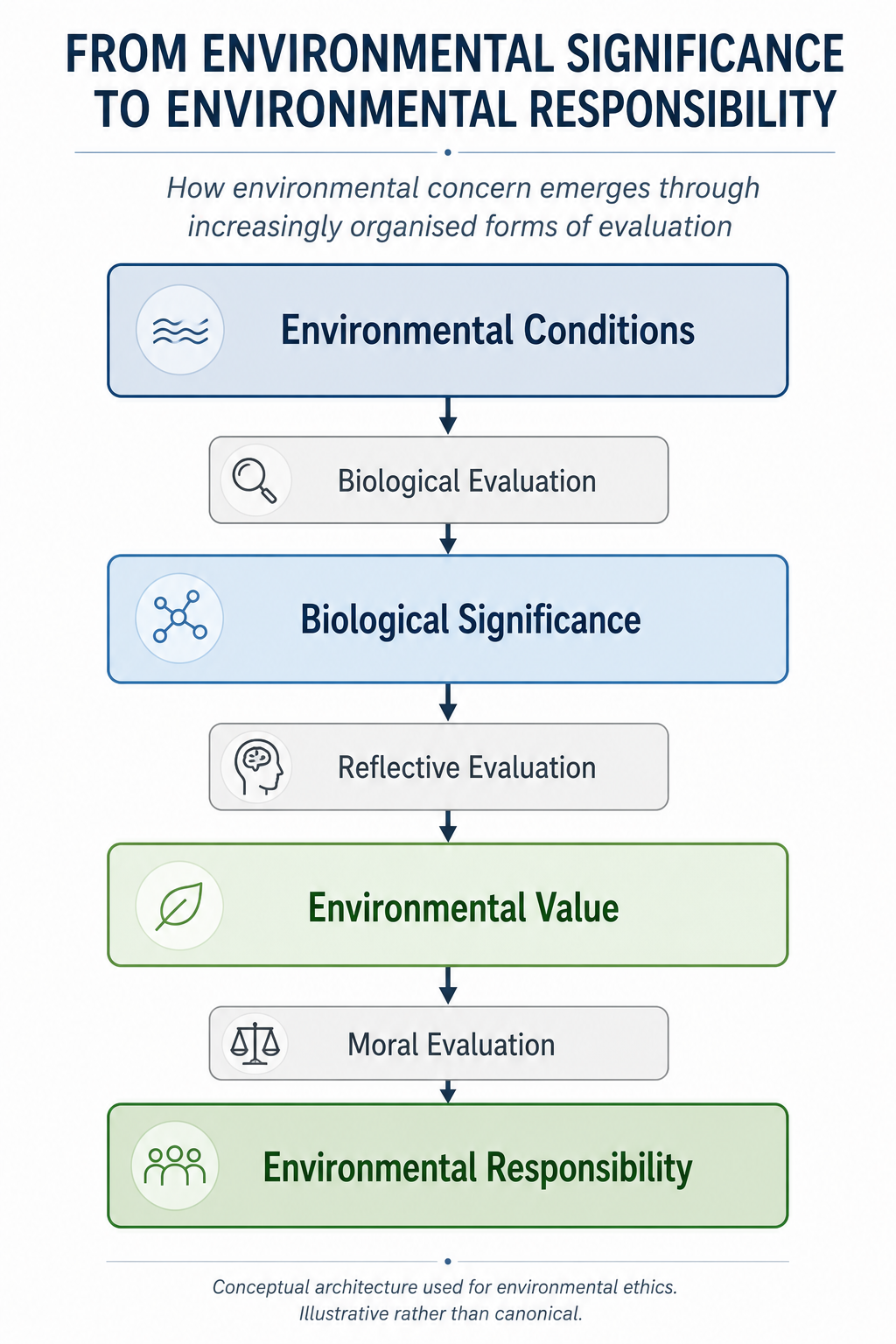
From Environmental Significance to Environmental Responsibility. Environmental obligation does not arise directly from environmental conditions. APS proposes that conditions first acquire biological significance through evaluation, after which reflective and moral forms of evaluation can transform significance into environmental value, responsibility, and ethical concern.
Must Something Be an Agent to Matter?
Environmental ethics frequently asks us to care about entities that do not obviously possess agency.
Organisms act. Species do not obviously act in the same sense. Ecosystems exhibit organisation but may not constitute unified agents. Rivers, glaciers, mountains, and climate systems are not ordinarily understood as biological agents at all.
Yet many environmental arguments maintain that such entities deserve protection.
This raises a fundamental question:
Must an entity be an agent in order to matter morally?
APS provides a relatively clear answer for living organisms. A living organism is a viability-oriented organisation. Conditions can genuinely support or undermine its continued functioning. An organism therefore possesses a good of its own in the minimal biological sense that some conditions contribute to its persistence while others threaten it. This provides a strong basis for biological significance.
Biological significance alone, however, does not settle the question of moral standing. To possess a good of one’s own is not necessarily the same thing as possessing moral standing, and possessing moral standing is not necessarily the same thing as possessing overriding moral priority.
The difficulty becomes clearer as increasingly challenging cases are considered.
Organisms are the most straightforward candidates for moral consideration. They are living agents. They generate significance through biological evaluation. Conditions can support or undermine their organised persistence. For this reason APS can explain why organisms matter independently of their usefulness to human beings.
Species present a more difficult case. A species persists through changing populations and individual organisms. It possesses evolutionary continuity and historical identity, yet it is not simply a larger version of an organism. Species do not ordinarily evaluate conditions or pursue persistence through coordinated present-tense activity. Nevertheless, extinction eliminates unique evolutionary histories, ecological possibilities, and future forms of life. A species may therefore possess value that cannot be reduced entirely to the interests of currently living individuals.
Ecosystems raise a deeper challenge. They exhibit organisation, feedback, resilience, transformation, and continuity. Organisms depend upon them, and ecological relations contribute to the conditions under which life persists. Yet ecosystems are not obviously unified evaluators possessing singular interests or integrated agency comparable to living organisms. Their significance may instead arise through the constitutive role they play within broader architectures of organised persistence.
Rivers, landscapes, glaciers, and climate systems extend the difficulty further. They are not biological agents. They do not evaluate conditions or possess viability-oriented organisation. Yet many people regard them as worthy of protection because they sustain ecological communities, preserve historical continuity, shape cultural identities, support future life, and embody possibilities that would be difficult or impossible to replace.
The progression from organisms to species, ecosystems, and environmental systems reveals an increasingly complex landscape of concern. The question is no longer simply whether something possesses biological significance. The question becomes whether significance alone is sufficient for standing, or whether other forms of value, relation, vulnerability, and possibility also deserve consideration.
[[Being a Valuer Is Not the Same as Being Valuable]]
Agents generate significance through evaluation. But an entity need not itself evaluate in order to become an object of justified moral concern. This distinction is essential when considering species, ecosystems, landscapes, rivers, climate systems, and future generations. The unresolved question is not whether such entities can matter, but what grounds their standing and how their claims should be weighed.
These examples reveal the importance of distinguishing four concepts that environmental discussions often treat as interchangeable.
Biological significance concerns the difference environmental conditions make to viability-oriented organisation.
Environmental value concerns the wider importance organisms, systems, relations, histories, and possibilities acquire through evaluative organisation.
Moral standing concerns whether an entity warrants direct moral consideration rather than merely instrumental treatment.
Obligation concerns what agents ought to do in response.
The four concepts are related, but they are not identical.
An organism may possess biological significance without automatically determining obligation. A species may possess environmental value without possessing agency. An ecosystem may warrant moral consideration without constituting a unified evaluator. A river may be valuable without possessing biological interests.
APS therefore proceeds cautiously. Agency provides one strong basis for biological significance and may also provide one basis for moral standing. It is unlikely, however, to be either a sufficient or necessary condition for every form of environmental concern. The framework should therefore remain open to the possibility that moral standing arises through multiple routes, including agency, vulnerability, ecological participation, historical continuity, irreplaceability, future generative possibility, and justified inclusion within moral community.
Exactly which of these grounds should ultimately be recognised remains an open question.
What can already be said is that environmental ethics cannot be reduced to the simple extension of biological viability across wider scales. The transition from organisms to species, ecosystems, rivers, and future generations introduces different forms of value, different kinds of standing, and different reasons for concern.
Environmental ethics therefore requires the evaluation and adjudication of multiple forms of significance rather than the automatic prioritisation of whichever system is largest, most persistent, or most extensive.
When Viability Interests Conflict
The preceding sections have established that organisms, species, ecosystems, and environmental systems can become objects of justified concern through different routes. They have also shown that biological significance, environmental value, moral standing, and obligation are not identical concepts.
These distinctions become most important when legitimate claims conflict.
Environmental ethics is not required because significance is absent.
It is required because significance is abundant.
Living systems generate significance continuously. Organisms pursue conditions that support their continued functioning. Ecological relations sustain some forms of life while constraining others. Human communities depend upon environmental conditions while simultaneously transforming them. Different forms of value emerge through biological, social, cultural, historical, and moral organisation.
The result is not a single environmental interest but a field of competing claims.
In many environmental situations, not every claim can be satisfied simultaneously.
This is where environmental ethics begins in earnest.
Consider again the problem of invasive-species control. A population of introduced animals threatens native organisms and contributes to ecological disruption. Conservation managers propose removing or killing the invasive animals in order to restore ecological relations and protect vulnerable species. The invasive animals are living agents engaged in viability-oriented activity. The native organisms being protected are also living agents. The ecological relations threatened by disruption possess environmental value, and future species persistence may be at stake. No solution preserves every interest. The ethical problem concerns how competing claims should be evaluated rather than whether significance exists.
A similar tension appears in predator restoration. Predators may be reintroduced to restore ecological processes, regulate prey populations, increase biodiversity, and strengthen ecological resilience. Such programmes often generate ecological benefits while increasing suffering and mortality among prey animals. The restoration may support ecological organisation while imposing costs upon particular organisms. Significance again exists on all sides of the conflict.
The same pattern appears when environmental protection affects human communities. A wetland may be protected because of its ecological importance. A forest may be preserved because it sustains biodiversity. A river system may be conserved because it supports ecological continuity and future environmental possibilities. Yet such protections may also impose costs through restrictions on access to land, resources, or economic opportunities. Human flourishing, ecological organisation, future environmental conditions, and cultural attachments may all become entangled.
These examples reveal why biological significance cannot itself determine which claims should prevail. Significance identifies conditions that matter. Environmental ethics concerns how different forms of significance should be related when they conflict.
[[Scale Does Not Decide Moral Priority]]
A wider scale does not automatically carry greater moral authority. Ecosystems do not override organisms merely because they are more extensive, and planetary continuity does not automatically justify sacrificing local communities or individual lives. Scale changes what becomes visible to explanation. It does not by itself determine what ought to prevail.
This point is especially important for APS. Because APS employs Agency, Process, and Scale as explanatory projections, readers may be tempted to assume that broader scales possess greater ethical authority. That inference would be mistaken.
Scale is an explanatory perspective, not a moral ranking principle.
A continental ecosystem is not morally superior to an organism simply because it encompasses more relations. A species is not automatically more important than its members because it persists across longer timescales. A global environmental concern does not automatically override local responsibilities because it occupies a broader domain.
Environmental ethics cannot be solved by moving to larger scales.
Nor can it be solved by privileging persistence, continuity, resilience, success, or systemic organisation. These considerations may matter, but none is self-justifying.
APS therefore requires moral evaluation precisely because different forms of significance may point toward different conclusions.
Why Irreversible Loss Matters
Environmental conflicts often involve another dimension that cannot be captured by present significance alone.
Some environmental changes are reversible.
Others are not.
A damaged habitat may recover. A polluted river may be restored. A population decline may be reversed. Ecological relations may reorganise and persist through transformation.
Living systems themselves are dynamic.
Organised persistence does not require stasis.
Development, adaptation, ecological succession, evolutionary change, migration, and environmental transformation are normal features of living organisation.
APS therefore rejects the idea that all environmental change is undesirable.
A living world is not a static world.
The more difficult question concerns irreversible loss.
Species extinction provides the clearest example. When a species disappears permanently, more is lost than the lives of its final members. An evolutionary lineage vanishes. Unique forms of biological organisation disappear. Future ecological relations become impossible. Potential evolutionary trajectories are closed. A distinctive history is terminated.
Extinction therefore alters not only the present but also the space of future possibilities.
The same concern appears in coral reef collapse, the destruction of ancient habitats, glacier loss, and irreversible climate transformation. In each case, something more than present organisation is at stake. Future relations, opportunities, trajectories, and possibilities may be foreclosed.
These examples do not matter merely because something persistent has ended. Persistence by itself is not morally decisive. Ecological and evolutionary history are filled with transformation, and many forms of organisation should change.
The ethical concern arises because certain forms of loss permanently reduce what remains possible.
From an APS perspective, this suggests a distinction between two forms of change.
The first is transformative change.
Transformative change alters organisation while preserving or generating future possibilities. Development, adaptation, ecological succession, and many forms of environmental reorganisation belong to this category.
The second is foreclosing change.
Foreclosing change removes possibilities that cannot realistically be recovered. Extinction, irreversible ecological collapse, destruction of unique habitats, and some forms of long-term environmental degradation may belong to this category.
The distinction is not absolute. Determining whether a loss is truly irreversible is often difficult.
Nevertheless, the contrast is ethically significant.
Environmental concern increasingly shifts from what presently exists to what remains possible. Species matter not only because they persist but because they embody future evolutionary possibilities. Ecosystems matter not only because they organise present relations but because they sustain future relations. Environmental systems matter not only because they influence current life but because they shape the conditions under which future life may emerge, adapt, and flourish.
Seen in this way, irreversibility and responsibility become inseparable. The more an action forecloses future possibilities, the more strongly it invites ethical scrutiny. Environmental responsibility is therefore not concerned only with present organisms, present systems, or present interests. It also concerns the landscape of possibilities inherited by future life.
Toward Environmental Responsibility
The discussion so far suggests a provisional understanding of environmental responsibility. Environmental responsibility does not arise because every environmental entity possesses identical standing. Nor does it arise because persistence itself is morally authoritative.
Instead, responsibility emerges where agents possess the capacity to affect conditions that matter to organisms, ecological relations, environmental systems, and future possibilities.
The more extensive the consequences of an action, the greater the need for evaluation. The more difficult a loss is to reverse, the greater the need for justification. The more vulnerable the affected organisms, communities, or systems, the greater the need for moral scrutiny.
Environmental responsibility therefore concerns the relationship between power and consequence.
Agents capable of transforming environmental conditions acquire reasons to consider how those transformations affect the forms of significance already present within the living world.
This responsibility may extend beyond immediate self-interest. It may extend beyond present communities. It may extend beyond currently existing organisms.
The significance of this extension becomes increasingly apparent when environmental actions alter not merely present conditions but the possibilities available to future life.
A conservation decision may influence which species persist decades from now. Habitat destruction may shape ecological relations long after current communities have disappeared. Climate decisions may determine environmental conditions inherited by future generations.
The deepest environmental questions therefore emerge when present agents possess the power to shape the conditions under which future organisms, communities, and persons will live.
Environmental responsibility concerns not only what presently persists, but also which forms of organised persistence, ecological relation, and future possibility remain available to life.
The next question follows naturally from this conclusion:
If present actions help determine the conditions under which future significance, agency, value, and responsibility become possible, what do we owe to future life?
What Do We Owe to Future Life?
The preceding sections have shown that environmental ethics cannot be reduced to the viability interests of particular organisms. Organisms, species, ecosystems, human communities, and environmental systems may all become objects of justified concern through different routes. Environmental responsibility emerges when agents possess the capacity to affect these forms of significance.
The strongest challenge arises when those affected do not yet exist.
-
Future persons cannot participate in present decisions.
-
Future communities cannot negotiate with current institutions.
-
Future organisms cannot resist present environmental transformations.
-
Future ecological relations cannot defend themselves against present actions.
Yet many of the most pressing environmental concerns appear to depend precisely upon responsibilities extending beyond currently existing life.
Climate change provides the clearest example. The most significant consequences of present environmental decisions may occur long after those making those decisions are gone. Future people will inherit atmospheric conditions, ecological transformations, altered coastlines, disrupted hydrological systems, species losses, and environmental constraints they did not create.
The same pattern appears in biodiversity loss, habitat destruction, resource depletion, pollution, and irreversible ecological change.
The ethical problem is not merely that future life may be affected.
The problem is that present agents often possess substantial power over future conditions while remaining insulated from many of the consequences.
APS helps clarify why this situation is distinctive.
Living systems exist within temporal organisation. Their activity is not confined to the immediate present. Organisms maintain continuity through time. Cognition allows significance to be integrated across changing circumstances. Reflective agency expands this capacity further by enabling agents to evaluate possible futures, anticipate consequences, compare alternative outcomes, and organise action in relation to conditions that do not yet exist.
This capacity introduces counterfactual depth.
Reflective agents can evaluate not only what is occurring but also what could occur under different conditions. A person may consider what a landscape might become if protected, what a species loss would mean decades from now, how environmental degradation could affect future communities, or what opportunities would remain available under alternative decisions.
The future therefore becomes part of the evaluative field.
This does not require future persons to be present evaluators. Nor does it require future organisms to possess current claims in the same way as existing organisms. Rather, reflective agents can recognise that present actions help determine the conditions under which future significance, agency, value, and responsibility will emerge.
-
Future life matters because it represents future centres of significance.
-
Future persons may not yet exist, but the conditions necessary for their agency can be affected now.
-
Future non-human organisms may not yet be alive, but the ecological possibilities supporting their existence can be expanded or foreclosed.
-
Future communities may not yet be organised, but the environmental inheritance they receive is already being shaped.
This perspective shifts attention away from persistence alone.
The concern is not simply that humanity, species, or ecosystems continue. The concern is how present actions shape the conditions under which future forms of life may flourish, struggle, adapt, or disappear.
The ethical significance of future life therefore arises not from a mysterious obligation to abstract future entities, but from the relationship between present power and future possibility. Reflective agents are uniquely capable of recognising that their decisions influence conditions extending far beyond their own lifetimes. Environmental responsibility becomes increasingly important wherever those decisions affect the opportunities, constraints, vulnerabilities, and possibilities inherited by future life.
Environmental responsibility emerges most sharply where present agents possess power over the conditions of future agency without reciprocal vulnerability to those affected.
Future generations cannot currently impose costs upon those who shape their inheritance.
-
Future ecosystems cannot negotiate with present institutions.
-
Future communities cannot participate in present political decisions.
This asymmetry does not automatically determine what obligations exist. It does, however, explain why environmental responsibility becomes ethically significant.
Environmental ethics therefore extends beyond concern for present organisms and present communities. It asks how current actions shape the conditions under which future significance, agency, value, and responsibility will become possible.
The challenge of future life reveals something fundamental about environmental ethics itself. The field is not concerned only with what exists now. It is also concerned with the conditions under which future forms of life, relation, meaning, and value may emerge. In this respect, environmental responsibility becomes inseparable from questions of inheritance, possibility, and the long-term consequences of present power.
What APS Can Explain—and What It Cannot Yet Explain
The purpose of this article has not been to present a completed APS environmental ethic. Its purpose has been to determine what APS already contributes to environmental ethics and where important questions remain open.
APS already possesses substantial explanatory resources.
What APS Can Explain
APS can explain why environmental conditions acquire significance.
Environmental significance arises because living systems are viability-oriented organisations whose continued functioning depends upon conditions beyond their boundaries. Environmental differences matter because they support or undermine organised persistence.
APS can explain biological normativity.
The asymmetry between conditions favourable and unfavourable to continued functioning provides a naturalistic foundation for significance without requiring conscious judgment, explicit representation, or moral reasoning.
APS can explain why non-human life matters.
Organisms are centres of biological significance independently of their usefulness to human beings. Conditions can genuinely support or undermine them whether humans recognise those conditions or not.
APS can explain how evaluation extends beyond immediate interests.
Through cognition, integration, reflective agency, meaning, value, and shared evaluation, significance can be organised across wider spatial, temporal, social, and counterfactual domains.
APS can explain how environmental value becomes possible.
Environmental value may be relationally constituted without being merely subjective or instrumental. Organisms, species, ecosystems, rivers, landscapes, and environmental systems may acquire significance through ecological participation, historical continuity, vulnerability, irreplaceability, and future possibility.
APS can explain environmental responsibility.
Agents capable of altering environmental conditions acquire reasons to evaluate how their actions affect organisms, ecological relations, environmental systems, and future possibilities.
Taken together, these contributions provide a substantial naturalistic foundation for environmental thought. APS explains how significance arises, how evaluation expands, and how responsibility emerges within a world already structured by viability-oriented organisation.
At the same time, important questions remain unresolved.
What APS Cannot Yet Fully Explain
APS does not yet possess a complete account of non-agential moral standing.
The framework can explain why organisms possess biological significance. It remains an open question how species, ecosystems, rivers, climate systems, and other non-agential entities acquire moral standing and how different grounds of standing should be compared.
APS does not yet possess a fully articulated account of adjudication.
Environmental conflicts often involve multiple legitimate claims. The framework does not yet provide a complete method for determining how competing organismic, ecological, social, and intergenerational interests should be weighed.
APS does not yet possess a complete theory of environmental justice. Questions concerning unequal vulnerability, historical responsibility, political power, and the distribution of environmental burdens require further development. APS does not yet provide a sufficiently detailed account of institutional and collective responsibility.
Many environmental decisions are made not by isolated individuals but by governments, corporations, scientific institutions, and social systems. The relationship between agency, responsibility, and collective action remains underdeveloped.
APS does not yet fully explain the transition from environmental value to binding obligation.
Environmental value and environmental responsibility are not identical to obligation. Additional work is required to determine how justified obligations arise and what gives them normative force.
Most importantly, APS does not yet possess a complete theory of environmental ethics.
The framework currently provides a naturalistic foundation and a developing conceptual architecture rather than a finished ethical system.
This is not a weakness unique to APS.
Environmental ethics itself remains characterised by enduring disagreement concerning value, standing, obligation, justice, and responsibility.
The contribution of APS is to clarify how these questions emerge from the organisation of life rather than appearing as disconnected philosophical problems.
Toward an APS Environmental Ethics
The discussion throughout this article suggests a provisional direction for future development.
APS may eventually require a dedicated environmental-ethics architecture capable of connecting biological significance with moral responsibility and obligation.
One possible research architecture is:
Environmental Conditions
→ Biological Significance
→ Environmental Value
→ Shared Environmental Evaluation
→ Moral Standing
→ Moral Evaluation
→ Environmental Responsibility
→ Environmental Ethics
This sequence should not be interpreted as a canonical dependency pathway. At present it functions only as a research architecture. Its purpose is to identify the principal explanatory transitions requiring further investigation.
Several of these transitions remain open.
-
How does environmental value become moral standing?
-
How should different forms of standing be compared?
-
How does moral evaluation generate justified obligation?
-
What role should vulnerability, power, irreversibility, and future possibility play?
-
How should environmental justice be incorporated?
-
How should collective institutions be understood within an environmental ethics of responsibility?
These questions define a future research programme rather than a completed theory.
Nevertheless, the architecture suggests an important conclusion.
Environmental ethics need not begin by searching for moral principles detached from the living world. Nor need it reduce all value to biological persistence.
Instead, environmental ethics may be understood as a progressively organised extension of significance through evaluation, meaning, value, shared judgment, responsibility, and ethical reflection.
From this perspective, environmental ethics remains continuous with the wider APS project of explaining how increasingly complex forms of significance emerge within organised life.
Conclusion — From What Matters to What Ought to Be Protected
The article began with a conservation conflict. A population of invasive animals threatened native organisms and ecological relations, and protecting one form of life appeared to require harming another. The situation exposed a problem that recurs throughout environmental ethics: what should be protected when multiple legitimate claims cannot all be satisfied?
The answer cannot be found simply by identifying which organisms persist. Nor can it be found by privileging the largest scale, the most extensive system, the greatest continuity, or the most successful form of organisation.
As the discussion expanded, the problem became progressively more demanding.
Organisms possess biological significance because conditions support or undermine their organised persistence.
Species introduce questions of evolutionary continuity, historical inheritance, and irreversibility.
Ecosystems raise questions concerning organised relations that may not constitute unified agents.
Rivers, landscapes, and climate systems challenge the assumption that only living agents can become objects of justified concern.
Environmental conflicts reveal that significance alone cannot determine priority.
Irreversible loss highlights the ethical importance of future possibilities.
Future generations reveal the asymmetry created when present agents possess power over conditions they will never personally experience.
Taken together, these considerations suggest that environmental ethics cannot be reduced to persistence, continuity, success, consensus, power, or scale. Each may matter. None is sufficient.
Environmental ethics emerges when significance becomes responsibility.
Living systems generate significance through their organisation. Reflective agents expand significance into value. Moral evaluation confronts conflicts among values. Environmental responsibility arises where agents possess the capacity to influence the conditions under which future significance becomes possible. Seen in this way, environmental ethics is neither detached from biology nor reducible to it. It is the continuing organisation of concern within a world already structured by significance.
APS can explain how environmental significance becomes possible and how concern expands beyond immediate organismic interests. The framework shows why environments matter before ethics begins, how value can emerge through biological and reflective organisation, and why responsibility becomes increasingly important as agents acquire the capacity to shape wider domains of life.
The remaining challenge is to determine how different forms of value, standing, vulnerability, and responsibility should be related when deciding what ought to be protected.
That challenge remains open.
The purpose of this article has not been to close it.
Rather, it has been to show how the problem becomes intelligible within a framework that begins with living organisation and follows the expansion of significance through evaluation, value, responsibility, and ethical reflection.
Environmental ethics therefore appears not as an external addition to biology but as one of the most demanding consequences of taking biological significance seriously.
The environmental question is therefore not simply what can persist, but what forms of organised persistence, relation, inheritance, and possibility ought to be protected—and why.
See Also
Related Articles
References
- (1989). In Defense of the Land Ethic. State University of New York Press.
- (2014). Two Kinds of Climate Justice: Avoiding Harm and Sharing Burdens. The Journal of Political Philosophy, 22(2), 125–149 . https://doi.org/10.1111/jopp.12030
- (2011). A Perfect Moral Storm. Oxford University Press.
- (2008). Ethics and the Environment. Cambridge University Press.
- (1949). A Sand County Almanac and Sketches Here and There. Oxford University Press.
- (1973). The Shallow and the Deep, Long-Range Ecology Movement. Inquiry, 16(1-4), 95–100 . https://doi.org/10.1080/00201747308601682
- (1984). Environmental Ethics and Weak Anthropocentrism. Environmental Ethics, 6(2), 131–148 .
- (2008). Environmental Values. Routledge.
- (1984). Reasons and Persons. Oxford University Press.
- (1988). Environmental Ethics: Duties to and Values in the Natural World. Temple University Press.
- (2007). Defining Environmental Justice. Oxford University Press.
- (1986). Respect for Nature. Princeton University Press.