What Is Ethics?
Ethics is the organised reflective investigation of morality through which communities examine, interpret, justify, criticise, and revise moral beliefs, practices, responsibilities, obligations, institutions, and forms of moral concern. It emerges from morality but is not identical with it. Understanding ethics explains how moral life remains open to reflection, disagreement, criticism, and revision, enabling communities to continually reassess the moral arrangements through which collective life is organised.
Key Points
- Ethics emerges when morality itself becomes the object of reflective investigation.
- Ethics is distinct from morality but depends upon morality for its subject matter.
- Ethics examines obligations, responsibilities, legitimacy, institutions, and forms of moral concern.
- Ethical disagreement is not a failure of ethics but one of the conditions that makes ethical inquiry necessary.
- Ethics contributes to the criticism, interpretation, justification, and revision of moral life.
- Ethics is not restricted to academic philosophy but is present wherever communities reflect upon moral questions.
- Ethics helps ensure that morality remains open to examination and change.
Introduction - The Puzzle of Ethical Reflection
Human communities do more than organise moral life. They also reflect upon it. People question whether existing obligations are justified, debate competing responsibilities, criticise institutions, challenge established moral beliefs, and argue about how communities ought to respond to new circumstances. These activities occur in everyday conversation, public debate, education, law, politics, religion, science, and personal relationships. Wherever moral questions become objects of reflection, ethical inquiry begins.
This raises an important question.
If morality already exists, why is ethics necessary?
The question arises because morality does not eliminate disagreement. Communities frequently disagree about fairness, responsibility, authority, vulnerability, rights, obligations, punishment, care, and the treatment of morally considerable beings. Such disagreements cannot always be resolved simply by appealing to existing moral expectations because those expectations may themselves become objects of criticism. Moral life therefore generates questions that require further investigation.
The answer lies in the emergence of ethics.
Ethics develops when morality itself becomes an object of organised reflection. Instead of asking only how people should behave, ethics asks how moral beliefs, practices, responsibilities, institutions, and forms of concern should be understood, interpreted, justified, criticised, and revised. Ethics therefore extends beyond participation in moral life and examines the organisation of moral life itself.
Understanding ethics is important because moral communities continually encounter uncertainty, conflict, disagreement, and change. New forms of knowledge emerge. Institutions evolve. Technologies create unfamiliar possibilities and risks. Relationships become more complex. Communities therefore require organised ways of investigating the moral questions that arise within collective life. Ethics provides those reflective practices.
Ethics should not be understood as something separate from ordinary moral experience. It emerges from the same concerns that animate moral life itself. Whenever individuals or communities begin critically examining their moral assumptions, responsibilities, obligations, and forms of concern, they participate in ethical inquiry.
What Is Ethics?
The previous article showed how morality emerges as an organised system of evaluative practices, responsibilities, obligations, justifications, and forms of concern through which communities regulate conduct in relation to morally considerable beings and forms of life. Morality provides the framework through which collective life becomes organised around questions of responsibility, legitimacy, accountability, and moral concern. Yet morality also generates further questions about itself.
Communities often disagree about how obligations should be interpreted, whether institutions remain legitimate, how responsibilities should be distributed, or which beings deserve moral consideration. These disagreements create a need for more explicit forms of reflection. Communities require ways of examining the assumptions, principles, practices, and justifications that shape moral life.
In APS, ethics is understood as:
Ethics is the organised reflective investigation of morality through which communities examine, interpret, justify, criticise, and revise moral beliefs, practices, responsibilities, obligations, institutions, and forms of moral concern.
This definition identifies ethics as a distinct form of organised activity. Morality concerns the organisation of collective life around moral questions. Ethics concerns the reflective investigation of that organisation. Ethics therefore does not replace morality. Instead, it examines morality, seeks to understand it, and contributes to its continuing development.
This distinction is essential. A community may possess a morality without engaging extensively in ethical reflection. Individuals may participate in moral practices without explicitly investigating the assumptions that support those practices. Ethics emerges when moral life itself becomes the object of sustained examination. It introduces a reflective dimension through which communities can analyse, criticise, justify, and revise their moral arrangements.
Ethics should not be reduced to academic philosophy. Philosophical traditions have developed sophisticated forms of ethical inquiry, but ethical reflection occurs wherever people critically examine moral questions. Parents discussing responsibilities toward children, communities debating institutional reform, professionals considering their obligations, and citizens questioning public policies all participate in forms of ethical activity. Ethics is therefore broader than any particular discipline or tradition.
Understanding ethics in this way helps explain why ethical inquiry remains an enduring feature of human life. Moral organisation creates responsibilities, obligations, and forms of concern. Ethics emerges because those arrangements remain open to reflection. Communities continually ask whether existing practices remain justified, whether responsibilities should be reassigned, whether institutions should be reformed, and whether moral concern should extend in new directions.
Why Ethics Emerges
Ethics emerges because morality does not provide final answers to every moral question. Moral life organises responsibilities, obligations, and forms of concern, but it also generates disagreement, uncertainty, ambiguity, and conflict. Communities therefore require ways of examining and reassessing the moral arrangements through which collective life is organised.
This need becomes especially visible when established expectations come under pressure. Social change, technological innovation, scientific discovery, environmental challenges, institutional failures, and encounters with unfamiliar perspectives can expose tensions within existing moral frameworks. Practices that once appeared self-evident may become controversial. Responsibilities that seemed straightforward may become contested. New forms of vulnerability may emerge that require attention. In such circumstances, communities cannot simply rely upon inherited moral expectations. They must investigate them.
Ethics provides the organised practices through which this investigation occurs. Ethical inquiry allows communities to examine competing interpretations of responsibility, assess conflicting obligations, evaluate institutional arrangements, and consider whether existing forms of moral concern remain adequate. Through these activities, ethics helps communities navigate situations in which moral life itself becomes uncertain or contested.
Disagreement plays a particularly important role in this process. Individuals and groups frequently differ in their understanding of fairness, authority, obligation, legitimacy, vulnerability, and responsibility. These disagreements do not indicate that morality has failed. Rather, they reveal the continuing need for ethical reflection. Ethics emerges because moral communities must continually interpret, defend, criticise, and revise the arrangements through which collective life is regulated.
Ethics therefore performs a distinctive function within the APS architecture. Moral evaluation assesses actions, practices, institutions, and norms. Morality organises collective life around obligations and moral concern. Ethics investigates that organisation itself. It asks how moral arrangements should be understood, whether they remain justified, and how they ought to respond to changing circumstances.
The emergence of ethics can therefore be understood as a further development within the broader pathway of social and moral organisation. Human values become shared through collective evaluation. Shared evaluation generates social norms. Social norms become objects of moral evaluation. Moral evaluation develops into morality. Ethics emerges when morality itself becomes the object of organised reflective investigation.
Ethics and Morality
Ethics and morality are closely related because ethics emerges from moral life itself. Nevertheless, they perform different functions within the organisation of collective life, and understanding this distinction is essential for understanding why ethics exists. Communities often treat morality and ethics as interchangeable terms, but doing so obscures the distinctive role that reflective inquiry plays within moral organisation.
Morality concerns the organised system of evaluative practices, responsibilities, obligations, justifications, and forms of concern through which communities regulate conduct in relation to morally considerable beings and forms of life. Through morality, communities develop relatively stable ways of recognising responsibilities, responding to harms, assigning obligations, evaluating conduct, and regulating relationships. Morality therefore provides the organisational framework through which collective life becomes structured around moral concern.
Ethics emerges from this framework but performs a different task. Rather than organising conduct directly, ethics investigates the organisation of conduct. It examines how moral arrangements operate, how responsibilities are interpreted, how obligations are justified, how institutions exercise authority, and how communities understand moral concern. Ethics therefore introduces a reflective dimension into moral life.
This distinction can be expressed simply:
Morality organises collective life; ethics investigates that organisation.
The distinction is important because communities can participate in morality without engaging extensively in ethical reflection. People fulfil responsibilities, honour commitments, respond to obligations, and evaluate conduct long before they begin systematically examining why these practices exist or whether they remain justified. Ethics emerges when communities direct attention toward the assumptions, interpretations, and justifications underlying moral life itself.
At the same time, ethics remains dependent upon morality. Ethics does not investigate an independent domain detached from social existence. It investigates responsibilities, obligations, institutions, practices, and forms of concern that already exist within moral life. Ethics therefore presupposes morality in the same way that moral evaluation presupposes social norms. Without morality there would be no organised moral arrangements to examine.
The relationship between morality and ethics is therefore developmental rather than oppositional. Morality creates the conditions that make ethical inquiry possible. Ethics, in turn, contributes to the continuing interpretation, criticism, justification, and revision of moral life. Neither replaces the other. Each performs a distinct organisational function within the broader architecture of collective evaluation.
This relationship can be situated within the APS pathway:
Human Values → Shared Evaluation → Social Norms → Moral Evaluation → Morality → Ethics
Understanding ethics requires understanding this progression because ethics emerges from the forms of organisation that precede it. Ethics is not an alternative to morality. It is morality becoming reflectively self-examining.
What Ethics Investigates
Once morality becomes an object of reflection, a wide range of questions become available for investigation. Ethics is often associated with questions concerning right and wrong conduct, but its scope is considerably broader. Ethical inquiry extends to the assumptions, practices, responsibilities, institutions, and forms of concern through which moral life is organised.
Obligations are among the most familiar objects of ethical investigation. Communities continually ask what individuals owe to one another, how obligations should be interpreted, whether obligations conflict, and how competing responsibilities should be balanced. Ethics examines not only particular obligations but also the reasons communities recognise them and the conditions under which they remain justified.
Responsibilities likewise become objects of inquiry. Moral life assigns responsibilities to individuals, groups, institutions, professions, and communities. Ethical reflection investigates how responsibilities are distributed, whether existing distributions are legitimate, and how responsibilities should respond to changing circumstances. Questions concerning accountability, authority, dependency, vulnerability, and collective action often emerge through this process.
Institutions constitute another major focus of ethical inquiry because institutions organise large portions of collective life. Educational systems, governments, legal structures, workplaces, professions, scientific organisations, and cultural institutions all influence how responsibilities are assigned and how obligations are interpreted. Ethics investigates whether these arrangements remain legitimate, whether they operate fairly, and whether they adequately address the concerns of those affected by them.
Ethics also examines moral standing and moral concern. Communities continually negotiate questions concerning who or what deserves consideration, which forms of vulnerability matter, how responsibilities extend across populations, and how obligations should be understood in relation to future generations, non-human organisms, ecological systems, and other morally considerable entities. Ethical inquiry therefore contributes to the ongoing clarification of the scope of moral concern.
Practices and traditions likewise become objects of ethical investigation. Communities inherit established ways of organising social life, many of which become so familiar that their underlying assumptions are rarely examined. Ethics creates opportunities to investigate these assumptions, assess their consequences, and determine whether inherited practices remain justified under current conditions.
What unifies these diverse areas of inquiry is that ethics investigates moral organisation itself. Rather than focusing solely upon conduct, ethics examines the frameworks through which conduct becomes morally meaningful. It investigates how communities understand responsibility, legitimacy, obligation, accountability, and concern, and how those understandings shape collective life.
Ethics therefore expands the scope of evaluation beyond immediate moral judgement. It examines the structures, assumptions, and interpretations through which moral judgement becomes possible in the first place.
Ethical Disagreement and Moral Revision
Ethical disagreement is often treated as evidence that moral questions cannot be resolved. Yet disagreement is not a failure of ethics. It is one of the principal reasons ethics exists. If communities never disagreed about obligations, responsibilities, legitimacy, authority, vulnerability, or moral concern, there would be far less need for organised ethical inquiry.
Disagreement persists because moral life involves complex and evolving forms of organisation. Communities must respond to changing circumstances, new forms of knowledge, emerging technologies, shifting institutions, competing priorities, and diverse experiences. These conditions frequently generate tensions between responsibilities, conflicts between values, and uncertainty regarding how obligations should be interpreted. Ethical disagreement therefore arises naturally from the complexity of collective life.
The significance of ethics lies not in eliminating disagreement but in providing organised ways of engaging with it. Ethical inquiry creates opportunities for criticism, interpretation, justification, clarification, and revision. Through ethical reflection, communities examine competing positions, identify underlying assumptions, assess consequences, and explore alternative ways of understanding moral problems. Disagreement therefore becomes a source of investigation rather than merely a source of conflict.
This process contributes directly to moral development. Communities often revise moral arrangements in response to ethical criticism. Practices that were once accepted may become contested. Responsibilities may be redistributed. New forms of moral concern may emerge. Institutions may be reformed. Ethical inquiry helps communities navigate these changes by providing reflective mechanisms through which moral life can adapt while remaining organised around questions of legitimacy, responsibility, obligation, and concern.
Historical change frequently illustrates this process. Expansions in the scope of moral concern, transformations in institutional responsibility, reassessments of authority, and revisions of accepted practices have often been preceded by periods of sustained ethical disagreement. Such disagreements do not indicate that morality has broken down. Rather, they demonstrate that moral communities remain capable of reflecting upon and revising their own arrangements.
Ethics therefore performs an essential function within the APS architecture. Moral evaluation assesses actions, practices, institutions, and norms. Morality organises collective life around obligations and concern. Ethics helps ensure that these arrangements remain open to criticism, interpretation, justification, and revision. Through ethics, communities retain the capacity to examine themselves.
For this reason, ethical disagreement should be understood as a feature of moral life rather than a defect within it. The persistence of disagreement reflects the continuing need for ethical reflection. Communities remain capable of questioning their assumptions, reassessing their responsibilities, and revising their moral arrangements because ethics provides organised practices through which such inquiry can occur.
Ethics therefore helps sustain the capacity of moral life to remain responsive to change without abandoning the organisational structures that make moral life possible.
Ethics as Reflective Investigation
The emergence of ethics represents an important development within the organisation of collective life. Human communities do not merely establish obligations, responsibilities, institutions, and forms of moral concern. They also examine them. Through ethical inquiry, moral life becomes capable of reflecting upon itself, investigating its own assumptions, and revising its own arrangements.
This reflective capacity distinguishes ethics from the forms of organisation that precede it. Social norms establish expectations. Moral evaluation assesses those expectations. Morality organises collective life around obligations, responsibilities, legitimacy, accountability, and moral concern. Ethics emerges when these arrangements themselves become objects of organised investigation. Communities begin asking not only whether conduct conforms to moral expectations but also whether those expectations remain justified, whether responsibilities are appropriately assigned, whether institutions remain legitimate, and whether forms of moral concern should be expanded, revised, or reinterpreted.
Ethics therefore occupies a distinctive position within the APS architecture. It does not replace morality, nor does it stand outside moral life. Rather, it introduces a new mode of organisation through which moral arrangements become open to sustained reflection. Ethical inquiry enables communities to interpret inherited practices, assess competing claims, examine assumptions, investigate disagreements, and respond to changing circumstances. Through these activities, moral life becomes capable of self-examination.
This role is especially important because morality remains incomplete without reflection. Moral communities continually encounter uncertainty, conflict, novelty, and disagreement. New technologies create unfamiliar possibilities. Scientific knowledge alters understanding. Social conditions change. Institutions evolve. Responsibilities expand or shift. Communities therefore require organised ways of examining whether existing moral arrangements remain adequate. Ethics provides the reflective practices through which such examination becomes possible.
The significance of ethics lies not in producing final answers that permanently resolve moral disagreement. Ethical inquiry rarely eliminates disagreement altogether. Instead, ethics helps communities engage disagreement in productive ways. It creates opportunities for criticism, interpretation, justification, clarification, and revision. Through these processes, moral life remains responsive rather than fixed.
Ethics can therefore be understood as the continuing investigation of moral organisation. It sustains the capacity of communities to question assumptions, reassess responsibilities, examine institutions, reconsider forms of concern, and revise moral arrangements in light of new circumstances. Through ethics, moral life remains capable of learning from its own experience.
The full APS pathway can now be represented as:
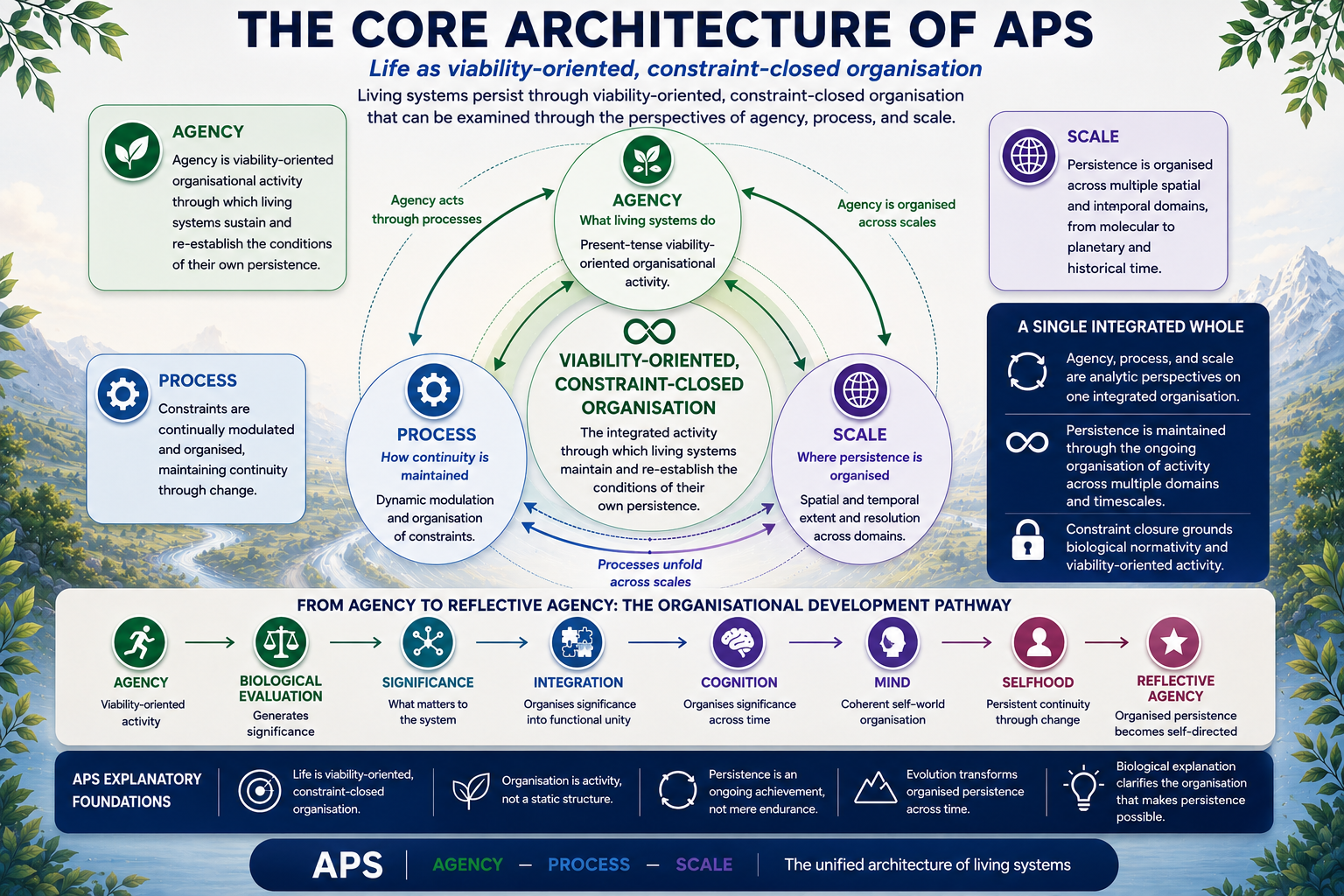
The Emergence of Ethics. Human values become socially organised through shared evaluation, generating social norms that structure collective expectations. Moral evaluation emerges when those expectations become objects of criticism, justification, and revision. Morality develops when evaluative practices become organised around obligations, responsibilities, legitimacy, and moral concern. Ethics emerges when morality itself becomes the object of organised reflective investigation.
Conclusion
Human communities do more than coordinate behaviour, establish expectations, evaluate norms, and organise moral life. They also investigate the moral arrangements through which collective life is structured. This capacity for reflection gives rise to ethics.
Understanding ethics requires recognising its place within a broader architecture of social and moral organisation. Human values become shared through collective evaluation. Shared evaluation generates social norms. Social norms become objects of moral evaluation. Moral evaluation develops into morality. Ethics emerges when morality itself becomes the object of organised reflective investigation. Ethics therefore represents neither a rejection of morality nor a departure from it. It is the reflective development of moral life itself.
This perspective helps explain why ethics cannot be reduced to personal opinion, professional philosophy, or abstract theorising. Ethical inquiry occurs wherever communities critically examine responsibilities, obligations, institutions, legitimacy, moral standing, and forms of concern. It is present whenever moral arrangements become objects of interpretation, criticism, justification, and revision.
Ethics also helps explain why disagreement remains a permanent feature of moral life. Communities continually encounter new circumstances, competing priorities, emerging vulnerabilities, and evolving forms of knowledge. Ethical inquiry provides organised ways of responding to these challenges without abandoning the moral frameworks that make collective life possible. Through ethics, moral communities remain capable of learning, adapting, and revising their own arrangements.
The significance of ethics therefore lies in its capacity to keep moral life open. It allows communities to investigate assumptions, challenge established practices, reconsider responsibilities, and expand forms of moral concern. Ethics does not stand above morality. It remains grounded within moral life while providing the reflective practices through which moral organisation can continue to develop.
Ethics sustains the capacity of moral life to remain open to criticism, justification, and revision, ensuring that morality remains a living and continually examinable form of social organisation.
See Also
Related Articles
References
- (2007). After Virtue. University of Notre Dame Press.
- (1985). Ethics and the Limits of Philosophy. Harvard University Press.
- (1999). A Theory of Justice. Harvard University Press.
- (1990). Moral Consciousness and Communicative Action. MIT Press.
- (2006). The Second-Person Standpoint. Harvard University Press.
- (1998). What We Owe to Each Other. Harvard University Press.