Architectural Dependency and Biological Explanation
APS explanatory pathways connect concepts by arrows. Architectural Dependency is the APS-specific interpretation of those pathway relations: each arrow is treated as a defeasible dependency hypothesis rather than as evidence, a causal assertion, or a universally fixed relation. The Dependency-Hypothesis Audit is designed for framework-neutral comparative assessment of such claims by requiring explicit relata, relation typing, material or argumentative specification, admissible variation, evidence and inferential limits, alternatives, scope, failure conditions, comparison with the strongest established explanation, and a comparative-gain or principled no-gain verdict. Architectural Dependency is neither a new dependency ontology nor a general theory of explanation.
Key Points
- Architectural Dependency is the APS-specific interpretation of pathway architecture; the Dependency-Hypothesis Audit is designed for framework-neutral comparative assessment.
- An APS arrow records a defeasible dependency hypothesis. The arrow itself is not evidence.
- Dependency relations may be causal, constitutive, enabling, constraint-based, structural, spatial, temporal, historical, conceptual, or mixed.
- Every dependency claim requires specified relata, an identified relation type, an appropriate material or argumentative basis, evidence with explicit inferential limits, alternatives, scope, and failure conditions.
- Dependency claims must be assessed against the strongest relevant established explanation for the same explanandum.
- The audit permits retention, qualification, retyping, rejection, redescription, redundancy, comparative gain, and principled no gain.
- Support for one arrow does not validate neighbouring arrows or the APS Dependency Map as a whole.
Where this article fits
This article explains how APS pathway arrows should be interpreted and assessed. Architectural Dependency is an APS-specific way of representing proposed relations among concepts. The Dependency-Hypothesis Audit provides a disciplined procedure for assessing those relations without treating the pathway itself as evidence.
1. Introduction
A pathway can appear more convincing than it is.
A sequence such as:
A → B → C
may suggest that A produces B, that B is necessary for C, or that the entire sequence has already been established by evidence. None of those conclusions follows from the diagram alone.
An arrow is not evidence. Visual coherence does not establish biological dependence, causal production, constitutive necessity, explanatory priority, or scientific support.
APS therefore treats this problem as a governing methodological constraint.
An APS pathway becomes scientifically assessable only when its arrows can be unpacked into explicit claims whose relation types, evidential bases, limits, alternatives, and failure conditions can be examined independently.
APS calls its interpretation of these pathway relations Architectural Dependency.
Architectural Dependency is specific to the APS pathway architecture. The procedure used to assess particular dependency hypotheses is designed for comparative application without presupposing that APS is correct.
The distinction is important:
- Architectural Dependency identifies how APS interprets the relations represented by its pathway arrows.
- The Dependency-Hypothesis Audit specifies how particular dependency claims can be assessed.
- Neither the arrow nor the pathway establishes the truth of the dependency represented.
2. Why APS Uses Explanatory Pathways
APS uses pathways because biological explanation often involves relations among concepts, activities, structures, conditions, and forms of organisation that cannot be displayed clearly in a single definition.
A pathway can serve several limited functions.
It can provide orientation by showing which concepts APS places in relation.
It can support decomposition by turning a broad framework into separately assessable connections.
It can provide research guidance by identifying relations that require evidence, clarification, comparison, or revision.
And it can support revision because individual arrows can be retained, qualified, retyped, or rejected without requiring the whole pathway to be defended intact.
For example, APS represents:
Biological Evaluation → Significance
and currently defines Biological Evaluation as the process through which agency generates significance.
That formulation identifies an APS relationship. The arrow does not by itself establish whether the relevant biological relation is causal, constitutive, enabling, constraint-based, conceptual, or mixed. Nor does it establish that the proposed relation is empirically supported.
Pathways therefore organise questions and expose connections to scrutiny. They do not settle those questions by their arrangement.
3. What Architectural Dependency Is
Architectural Dependency is the APS-specific interpretation of the relations represented by arrows in APS pathways.
It does not propose that all biological systems possess one universal dependency architecture.
It does not assume that every arrow expresses the same kind of relation.
It is not a general theory of biological explanation.
And it is not a fourth analytic projection alongside Agency, Process, and Scale.
Agency, Process, and Scale remain complementary, target-sensitive analytic projections of living organisation. Architectural Dependency instead concerns how proposed relations within APS conceptual pathways are specified and assessed.
A pathway arrow therefore records a dependency hypothesis.
The hypothesis may eventually receive strong support, remain provisional, require qualification or retyping, prove redundant or redescriptive, yield no additional explanatory gain, or be rejected.
Its placement within APS provides no evidential privilege.
The Dependency-Hypothesis Audit is designed as a framework-neutral assessment procedure: its verdict should depend upon the specified claim, evidence, alternatives, comparator, and failure conditions rather than upon the desirability of preserving APS architecture.
4. What an APS Arrow Claims
The most general interpretation of an APS arrow is:
APS proposes that specified relata associated with A and B stand in an explanatorily relevant dependency relation under stated conditions.
That formulation deliberately leaves the relation type open.
An arrow does not automatically mean:
- A causes B;
- A is necessary for B;
- B cannot exist without A;
- A is temporally prior to B;
- A is more fundamental than B;
- A occupies a lower biological level than B;
- A logically entails B;
- or A provides greater explanatory power than alternatives.
Those stronger claims require their own specification and evidence.
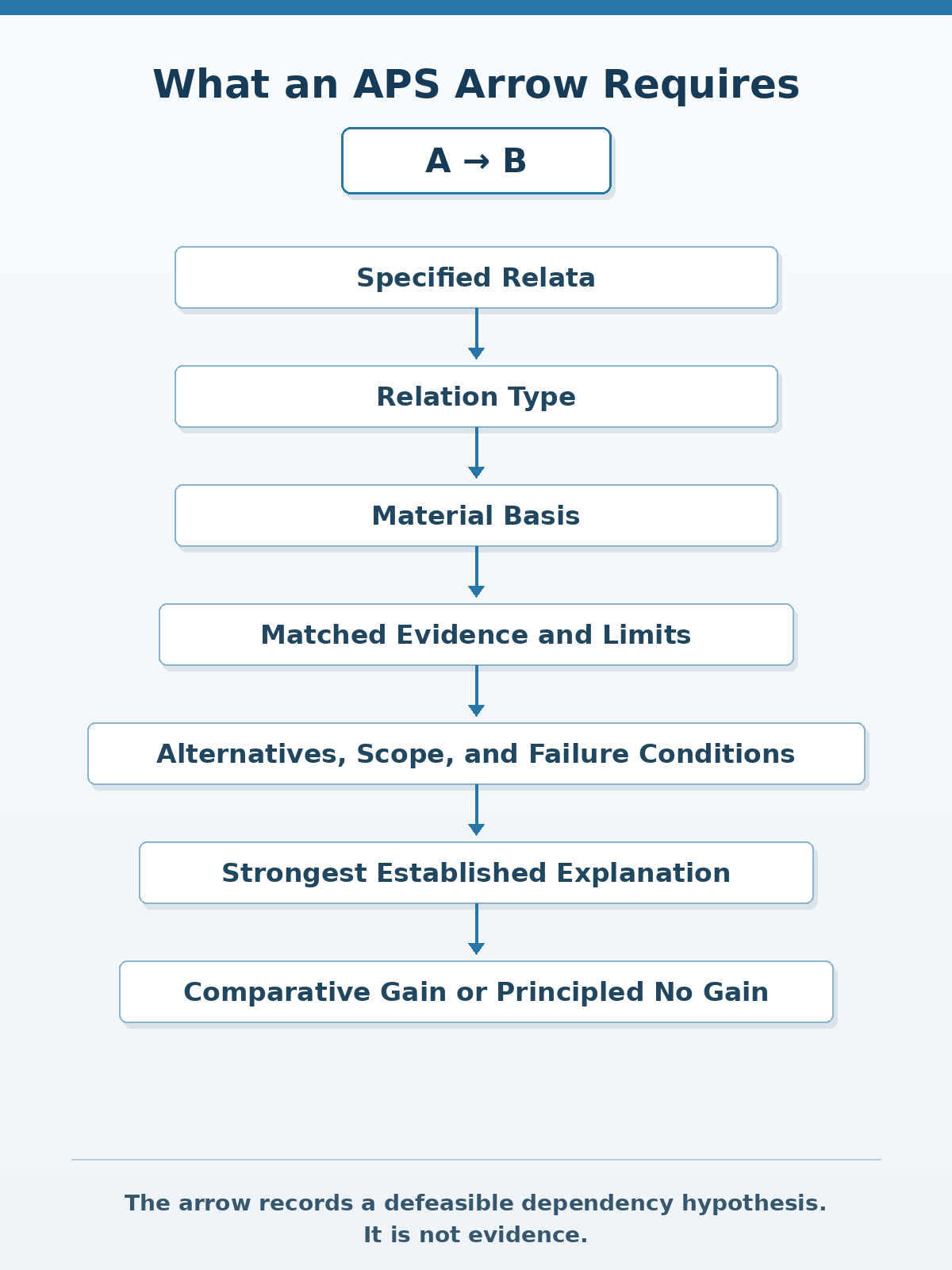
A dependency may be:
- causal;
- constitutive;
- enabling;
- constraint-based;
- structural;
- spatial;
- temporal;
- historical;
- conceptual;
- or mixed.
The relation must therefore be identified before the evidence is assessed.
Where a single arrow compresses more than one relation, the claim should be decomposed or explicitly represented as mixed.
Where no defensible relation survives assessment, the arrow should be rejected rather than protected by its place in the pathway.
5. Relation Types and Evidential Requirements
Different dependency relations require different forms of evidence and argument.
The relation types considered here form a provisional and non-exhaustive set. They are analytical distinctions for clarifying dependency claims, not a universal taxonomy imposed upon biological explanation.
Causal dependency
A causal dependency claims that variation in one specified factor makes a difference to another through materially realised processes or mechanisms.
Evidence may include intervention, perturbation, controlled comparison, mechanistic tracing, temporal ordering, or other forms of causal difference-making appropriate to the system.
Causal evidence does not automatically establish constitution, necessity, or conceptual priority.
Constitutive dependency
A constitutive claim concerns what participates in making a phenomenon or organisation the kind of thing it is.
Evidence must therefore establish more than causal influence.
A factor may causally affect a system without constituting it. Conversely, a constitutive relation need not be adequately represented as one event producing another.
Constitutive claims require careful specification of the explanandum and of what is being claimed to belong to its organisation.
Enabling dependency
An enabling relation identifies conditions under which an activity, organisation, or capacity can occur or continue.
Enabling conditions need not directly produce the phenomenon they enable.
The relevant question is whether the specified condition makes a defensible difference to the possibility, maintenance, range, or operation of the target under the conditions being considered.
Constraint-based dependency
A constraint-based relation concerns how one materially realised organisation restricts, channels, enables, or modulates possibilities available to another process or activity.
Such claims require identification of the constraint, the constrained process, the material implementation of the relation, and the contrast against which constraint is being assessed.
Structural dependency
A structural relation concerns dependence upon arrangement, topology, organisation, geometry, connectivity, or other materially realised relations among components.
Structural evidence does not automatically establish causal direction.
Spatial dependency
A spatial dependency concerns how a biological relation depends upon spatial organisation, localisation, distribution, proximity, compartmentalisation, or other spatial conditions.
Spatial association alone does not establish dependency. The relevant spatial relation must make a specified difference to the explanandum.
Temporal dependency
A temporal relation concerns dependence upon timing, duration, ordering, recurrence, rate, temporal integration, or other temporal organisation.
Temporal precedence alone does not establish causation.
Historical dependency
A historical dependency concerns cases in which the present explanandum depends upon developmental, evolutionary, ecological, or other historical trajectories.
Historical explanation should not be substituted automatically for present-tense mechanism, nor should present mechanism erase historically relevant dependencies.
Conceptual dependency
A conceptual dependency concerns relations among definitions, distinctions, explanatory commitments, or other elements of a conceptual architecture.
Conceptual indispensability within APS does not establish a material biological dependency.
A conceptual relation can therefore be valid within the framework while its proposed biological counterpart remains empirically unresolved.
Mixed dependency
Many biologically important relations combine several of these types.
A relation may, for example, be simultaneously enabling and constraint-based, or historical and constitutive.
Mixed relations should be stated explicitly rather than compressed into an ambiguous arrow.
6. How APS Assesses Dependency Claims
The Dependency-Hypothesis Audit is designed to prevent a pathway arrow from carrying more explanatory or evidential weight than its supporting argument warrants.
The procedure contains ten linked requirements.
1. Explanandum and foil
State exactly what is being explained and in contrast with what.
This prevents movement between explanatory targets during comparison.
2. Claim and relata
Specify what is proposed to depend upon what.
Broad labels should be replaced, where possible, by assessable activities, structures, conditions, organisations, or concepts.
3. Relation type
Identify the kind of dependency being claimed.
Do not infer causation, constitution, enabling, necessity, or conceptual priority merely from arrow direction.
4. Material or argumentative basis
For a biological dependency, identify how the relevant relation is materially realised.
For a conceptual dependency, specify the argumentative or definitional basis.
The appropriate level of material specification depends upon the explanatory target and should not be replaced by an arbitrary demand for reduction.
5. Admissible variation or contrast
Ask what intervention, counterfactual, comparison, perturbation, historical contrast, or conceptual variation would test or clarify the dependency.
The contrast must be appropriate to the relation type and biological system.
6. Evidence and inferential limits
Identify what supports the claim and what that evidence does not establish.
Correlation, precedence, perturbation, conceptual coherence, or mechanistic association should not license stronger conclusions than the evidence warrants.
7. Alternatives and scope
Identify plausible rival relations, alternative architectures, alternative realisations, and conditions under which the proposed dependency may or may not hold.
8. Failure conditions
State in advance what finding would qualify, retype, or defeat the claim.
A dependency hypothesis must remain open to revision.
9. Strongest established explanation
Compare the dependency claim with the strongest relevant established explanation for the same explanandum.
The comparator should be represented with its full mechanistic, organisational, historical, or other relevant explanatory resources rather than in a weakened form.
10. Comparative-gain or null verdict
Ask whether introducing the dependency claim changes a defensible explanatory assessment.
A comparative-gain verdict requires a specified explanatory contribution that survives comparison.
Where the strongest established explanation already performs the relevant explanatory work, a principled no-gain verdict is appropriate.
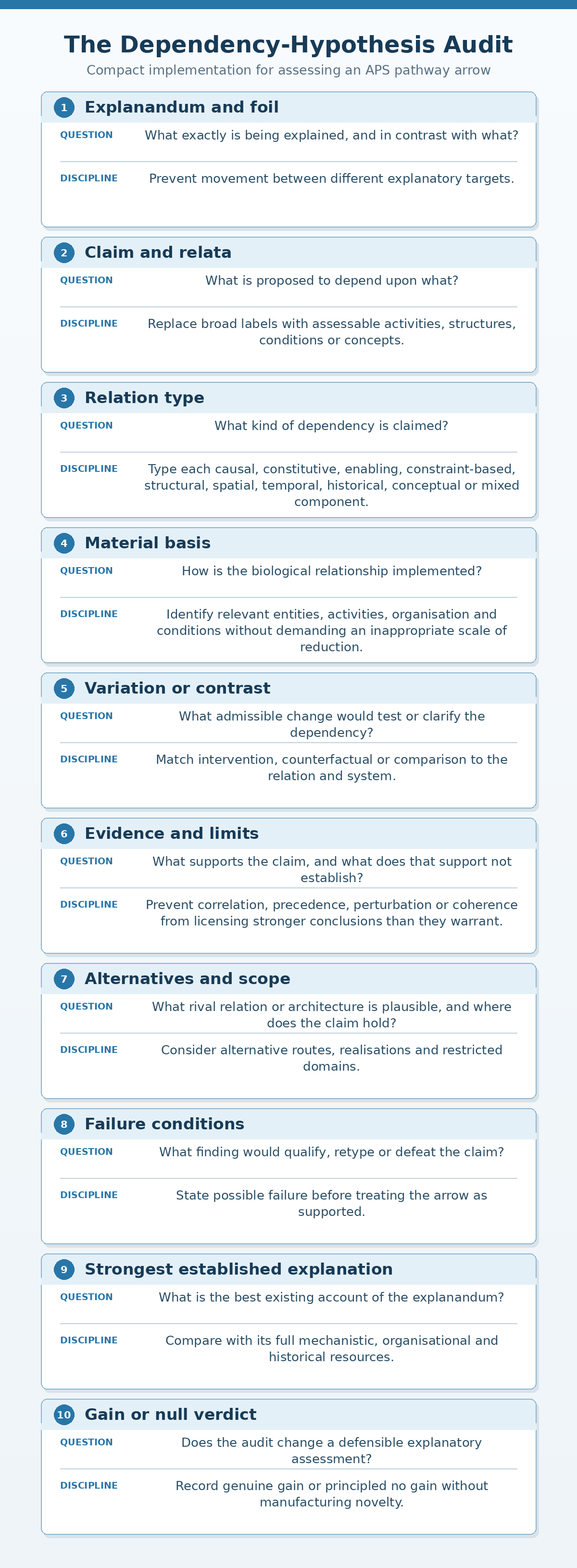
The audit is therefore designed for neutral comparative use. It does not require an APS dependency claim to survive.
A rejected, redundant, redescriptive, or no-gain result is a legitimate methodological outcome.
7. Feedback, Constraint Closure, Time, and Scale
Dependency relations in living systems frequently occur within reciprocal organisation.
Feedback does not automatically invalidate a directional dependency. Nor does it automatically confirm one.
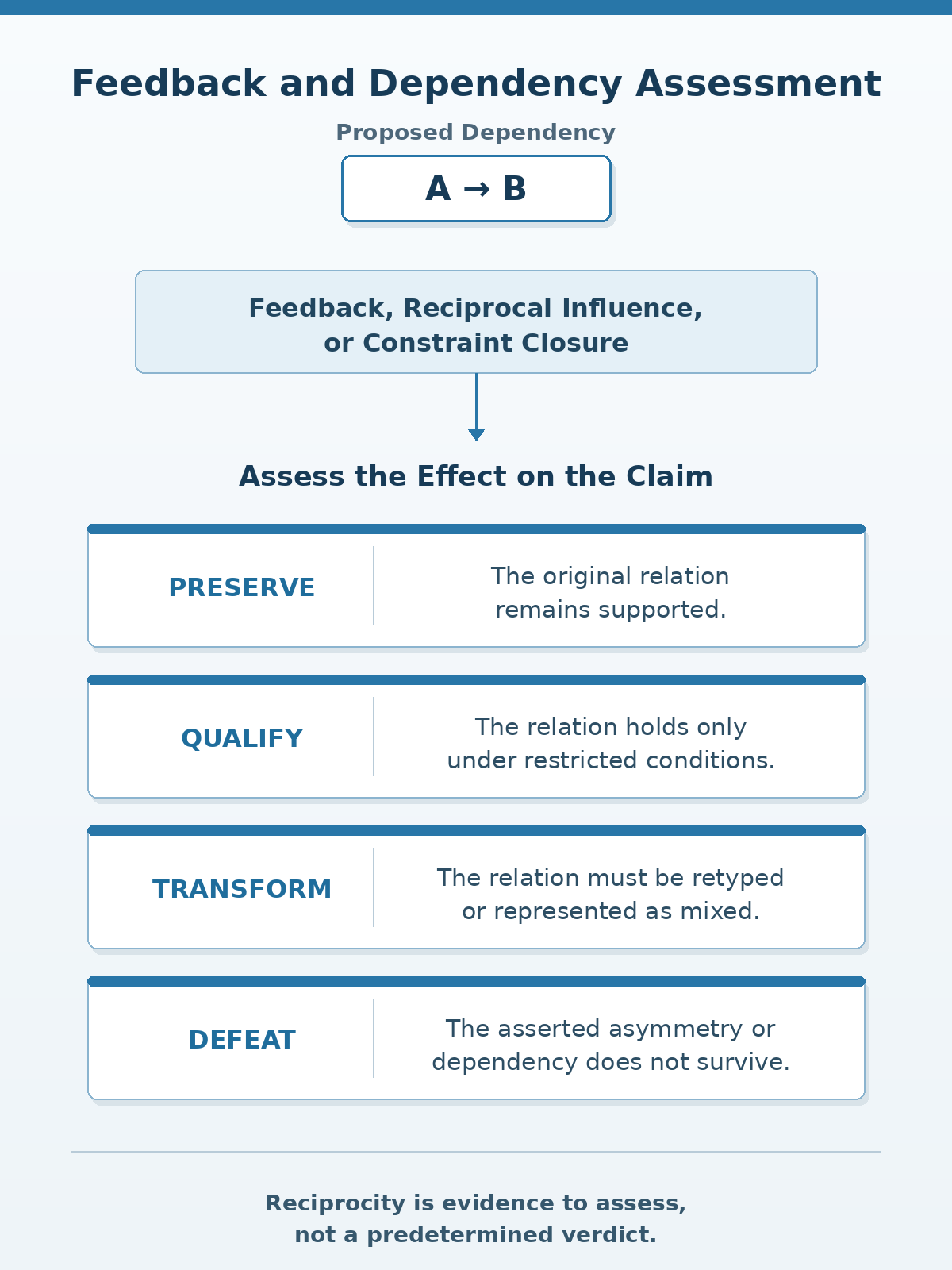
Suppose APS proposes:
A → B
and evidence also supports:
B → A
Several outcomes remain possible.
The original A → B relation may remain supported.
Its scope may need qualification.
The relation may need to be retyped as reciprocal or mixed.
Or the asserted asymmetry may fail.
The correct verdict depends upon the specified relata, relation type, evidence, explanatory target, and failure conditions.
Constraint closure is part of APS’s canonical account of Life as viability-oriented, constraint-closed organisation.
But constraint closure does not determine the verdict of an individual dependency claim.
Reciprocal organisation can therefore be relevant evidence without becoming a predetermined result.
Time
Dependency claims may extend across different temporal extents.
A relation may concern immediate physiological regulation, developmental transformation, recurrent activity, lifetime organisation, evolutionary history, or combinations of these.
Temporal extension does not itself determine relation type.
Historical dependence, present-tense causation, developmental constitution, and temporal enabling should therefore be distinguished where the explanatory target requires it.
Scale
Dependency claims may also extend across different spatial extents.
APS does not treat these extents as a hierarchy of causal levels.
Where activity organised across one spatial or temporal extent alters conditions relevant to activity elsewhere, the relation must be materially implemented through identifiable interactions, structures, constraints, environmental conditions, or other dependencies.
Scale difference alone does not establish causal influence or explanatory priority.
8. Confidence, Failure, and No-Gain Outcomes
Dependency claims can differ in evidential confidence.
APS distinguishes strongly supported, provisional, and speculative dependency claims.
A strongly supported claim has clearly specified relata and relation type, appropriate material or argumentative specification, substantial evidence, explicit limits and scope, stated failure conditions, and survival against the strongest relevant established explanation.
Strong support does not mean final proof, universality, or immunity to revision.
A provisional claim is sufficiently specified and supported to guide inquiry, but important questions remain unresolved.
A speculative claim identifies an intelligible possibility whose current support is insufficient for provisional acceptance.
Confidence status is distinct from audit verdict.
A dependency may be:
- retained;
- qualified;
- retyped;
- rejected;
- redescriptive;
- redundant;
- associated with comparative explanatory gain;
- or associated with principled no additional gain.
A dependency hypothesis remains scientifically assessable only if evidence and argument can alter its status.
Failure is therefore informative.
If evidence defeats a proposed arrow, APS should revise the arrow.
If the relation is better represented differently, it should be retyped.
If the claim merely redescribes what an established explanation already explains, that should be recorded.
If no additional explanatory gain survives comparison, the correct verdict is no gain.
The pathway is not protected from these outcomes.
9. Applying the Method
A compact dependency assessment can proceed as follows.
First, identify the precise explanandum.
Second, specify the relata.
Third, type the proposed dependency.
Fourth, identify its material or argumentative basis.
Fifth, specify an admissible contrast or variation.
Sixth, assess the evidence and its limits.
Seventh, examine alternatives and scope.
Eighth, state failure conditions.
Ninth, reconstruct the strongest established explanation.
Tenth, issue a gain or null verdict.
Consider again:
Biological Evaluation → Significance
Within APS, Biological Evaluation is defined as the process through which agency generates significance.
That establishes a conceptual relation inside the framework.
It does not by itself establish the corresponding biological dependency.
An empirical dependency claim would require specification of what biological activities count as evaluation, what outcomes count as significance, how the proposed relation is materially realised, what variation would discriminate the claim, what evidence supports it, and what alternatives could explain the same target.
The strongest established explanation would then need to be reconstructed.
Only after that comparison could the proposed dependency be retained, qualified, retyped, rejected, judged redescriptive or redundant, or found to provide comparative explanatory gain or principled no gain.
Conceptual coherence, biological evidence, and comparative explanatory assessment are therefore distinct achievements.
None should be substituted for another.
10. The APS Dependency Map
APS uses a Dependency Map to display proposed relations among concepts in its current pathway architecture.
For purposes of displaying that architecture, APS presently uses the following formulations. Their scientific status is not adjudicated by this article.
Life
Viability-oriented, constraint-closed organisation.
Agency
Viability-oriented organisational activity.
Biological Evaluation
The process through which agency generates significance.
Significance
Relationally real outcomes of biological evaluation that explain what matters to the living system.
Integration
The organisation of biological significance into functional unity.
Cognition
The organisation of biological significance across time.
Mind
Integrated evaluative cognitive processes maintaining a coherent self–world relation.
Selfhood
Continuity of self–world organisation through change.
Reflective Agency
The capacity to evaluate, prioritise, and direct one’s own agency.
Meaning
Significance integrated across experience, reflection, and value.
The sequence should not be read as a chronology, developmental timetable, causal chain, hierarchy of biological levels, or logical deduction.
Each arrow records a proposed dependency relation requiring separate assessment.
The Life → Agency relation, for example, may invite constitutive, enabling, or other interpretations within APS, but its relation type must not be assumed from the pathway or from the compact definitions alone.
Likewise, later arrows may involve different relations and different evidential burdens.
Support for one relation does not establish support for the next.
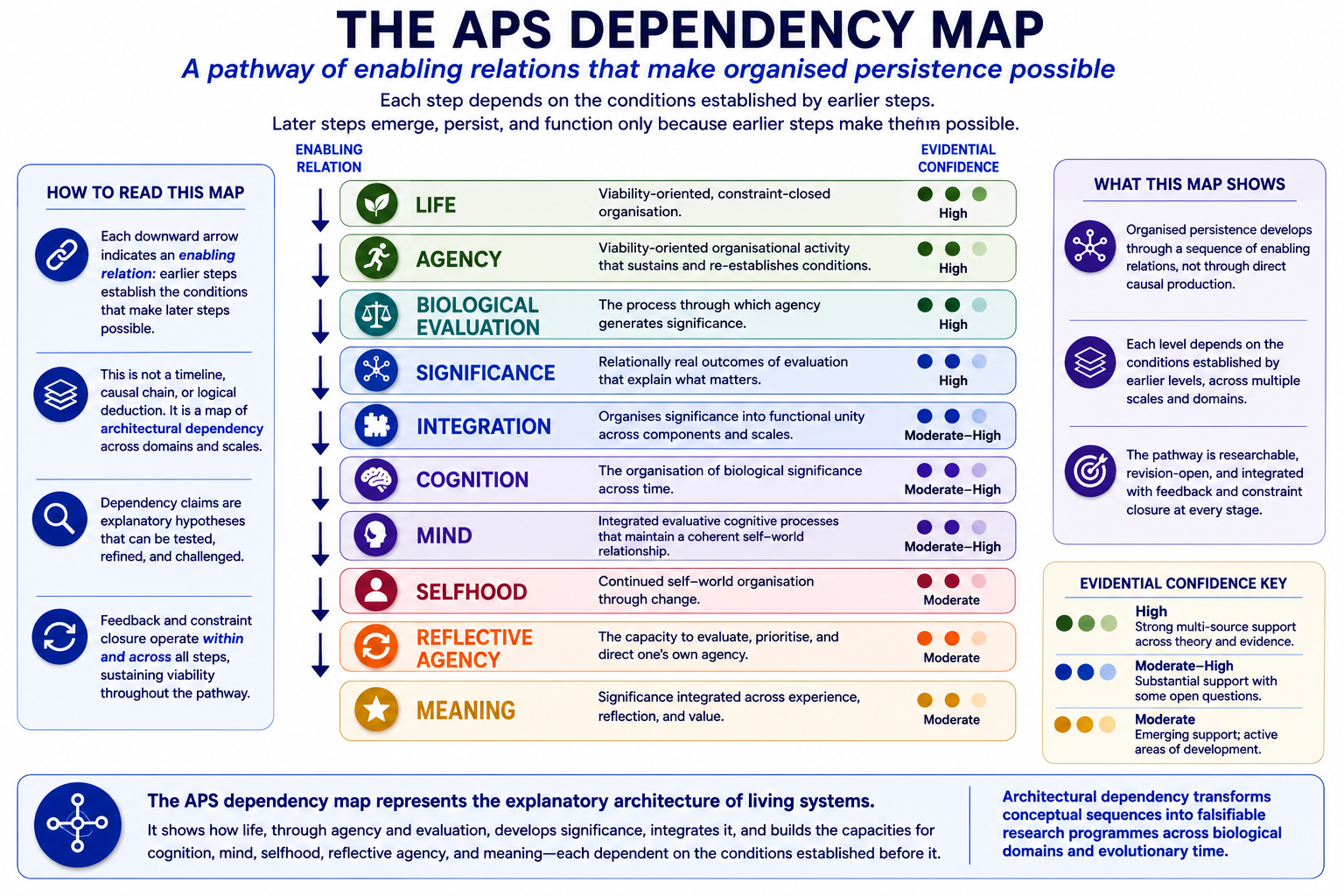
The Dependency Map is therefore neither an APS doctrine that must be defended intact nor an empirical result already established.
It is a structured representation of separately assessable hypotheses.
An arrow may survive assessment.
Another may require qualification.
Another may need to be retyped.
Another may prove redundant or redescriptive.
Another may provide no additional explanatory gain.
And another may fail.
Revision of one relation does not automatically invalidate neighbouring relations, just as support for one relation does not validate the map as a whole.
11. Architectural Dependency within APS Research
Architectural Dependency has both a public-facing and a research-facing role.
Publicly, it explains how APS pathway arrows should be read.
Research-facing, it converts those arrows into claims that can be specified, compared, criticised, revised, and, where appropriate, rejected.
The Dependency-Hypothesis Audit was developed to discipline this assessment.
Its purpose is not to manufacture support for APS but to make proposed dependency claims assessable under explicit burdens and failure conditions.
A completed APS dependency study has reported a disciplined three-case application of the procedure that produced differentiated positive, transfer, and null verdicts.
That application does not establish a universal methodology of biological explanation.
Nor does it establish that the Dependency-Hypothesis Audit is superior to existing comparative explanatory methods.
It provides a worked application of a procedure designed to distinguish cases in which a dependency formulation contributes to an explanatory assessment from cases in which it does not.
Nor does a successful application in one biological case validate the APS Dependency Map.
Each dependency claim retains its own evidential burden.
This separation is essential.
Architectural Dependency belongs to APS.
The Dependency-Hypothesis Audit is designed for comparative use without requiring an APS-positive verdict.
Whether it succeeds in that role must be assessed through its applications rather than inferred from its design.
12. Conclusion
APS pathways are useful only if their arrows remain open to scrutiny.
Architectural Dependency therefore treats each pathway arrow as a defeasible dependency hypothesis rather than as evidence, causal fact, logical implication, or guaranteed explanatory advance.
The resulting assessment requires:
- a specified explanandum and foil;
- explicit relata;
- relation typing;
- appropriate material or argumentative specification;
- admissible variation or contrast;
- evidence and inferential limits;
- alternatives and scope;
- failure conditions;
- comparison with the strongest established explanation;
- and a comparative-gain or principled no-gain verdict.
These requirements are not unique operations invented by APS. They draw upon familiar disciplines of scientific and philosophical analysis.
The specific contribution of Architectural Dependency within APS is narrower: it applies those disciplines consistently to the heterogeneous claims compressed within APS pathways.
The scientific credibility of APS pathway-based claims therefore depends heavily on how their arrows are specified and assessed.
An arrow should survive only to the extent warranted by its relation type, evidence, limits, alternatives, failure conditions, and comparative performance.
Some arrows may receive strong support.
Some may remain provisional or speculative.
Some may require qualification or retyping.
Some may prove redundant, redescriptive, or associated with no additional explanatory gain.
Some may fail.
That possibility is not a weakness of the method.
A pathway whose relations can be independently challenged and revised is methodologically stronger than one protected from criticism by the coherence of the diagram in which they appear.
Explanatory Architecture
Central Question
How should the arrows connecting APS concepts be interpreted and assessed without treating pathway structure itself as evidence?
Architectural Role
This Core article establishes Architectural Dependency as the APS-specific interpretation of pathway relations and specifies the Dependency-Hypothesis Audit used to assess individual dependency claims.
It does not establish a new dependency ontology or a general theory of biological explanation.
Preceding Conceptual Dependencies
This article presupposes the frozen APS distinction between:
- Life as viability-oriented, constraint-closed organisation;
- Biological Agency as viability-oriented organisational activity;
- Agency, Process, and Scale as complementary, target-sensitive analytic projections;
- and Organised Persistence as continuity of living organisation through change.
These are APS conceptual commitments. Their presence in the framework does not by itself validate any particular pathway arrow.
Methodological Commitments
Architectural Dependency requires that:
- arrows be treated as hypotheses rather than evidence;
- relation types be identified rather than inferred from diagram direction;
- biological dependencies be materially specified where appropriate;
- conceptual dependencies be distinguished from material biological dependencies;
- evidence be matched to the relation claimed;
- alternatives and failure conditions remain explicit;
- the strongest established explanation be reconstructed fairly;
- comparative gain not be presumed;
- and no-gain, redundancy, redescription, retyping, qualification, or rejection remain legitimate outcomes.
Subsequent Use
The method can be applied to individual APS pathway relations in later research.
Such applications must not infer the validity of an entire pathway from one successful dependency assessment.
Nor may a pathway definition substitute for empirical evidence where the proposed relation is biological rather than merely conceptual.
Position Within APS
Architectural Dependency provides a methodological control on APS pathway architecture.
It turns visual connections into separately assessable dependency hypotheses while preserving the possibility that particular relations may survive, change, or fail.
Its purpose is therefore not to secure the pathway but to make the pathway answerable to explicit explanatory and evidential assessment.