Constraint Closure — What It Does and What It Does Not Do
Constraint closure is a central concept in contemporary accounts of biological organisation. It identifies relations of mutual dependence through which constraints contribute to maintaining the organisation that sustains them. APS treats constraint closure as indispensable to explaining living organisation while distinguishing this contribution from a complete explanation of life. Closure considered abstractly does not by itself establish biological agency, normativity, viability orientation, or organised persistence. These are understood within APS as aspects of one viability-oriented, constraint-closed organisation enacted through time. This article explains what constraint closure contributes to biological explanation, what closure considered in abstraction leaves unexplained, and why its biological significance must be understood within the organisation through which living systems maintain and re-establish the conditions of their own persistence.
Key Points
- Constraint closure describes relations of mutual dependence through which constraints contribute to sustaining the organisation that maintains them.
- Constraint closure is indispensable to the APS account of living organisation.
- Closure considered abstractly does not constitute a complete explanation of life, agency, normativity, or organised persistence.
- Viability orientation is not an additional component attached to an independently constituted closure structure.
- Biological agency is viability-oriented organisational activity through which living organisation is enacted and sustained.
- Constraint closure must be understood dynamically and temporally rather than as a static configuration.
- Perturbation can reveal how living organisation maintains and re-establishes conditions of persistence.
- Closure alone does not warrant extending biological or agential concepts to every self-maintaining or mutually dependent system.
Constraint Closure — What It Does and What It Does Not Do
Where this article fits: This article clarifies the contribution and limits of constraint closure within APS. Constraint closure identifies an indispensable organisational relation in living systems, but closure considered abstractly does not exhaust the explanation of viability-oriented organisation, biological agency, or organised persistence. For the broader APS account of constraint as continuity-producing organisation, see Constraint — How Organisation Becomes Persistence.
Constraint closure has become an important concept in contemporary theoretical biology.
It identifies a distinctive form of organisation in which constraints are not merely imposed independently upon processes. Constraints participate in relations of mutual dependence through which they contribute to maintaining the organisation that sustains them.
This provides an important alternative to explanations that treat biological organisation simply as the aggregate result of independently specified parts or linear causal sequences.
APS therefore treats constraint closure as indispensable to explaining living organisation.
But its explanatory contribution must be stated carefully.
Closure considered abstractly does not by itself establish:
- life
- biological agency
- normativity
- viability orientation
- or organised persistence
This does not mean that these are additional components that must be attached to an independently constituted closure structure.
APS instead understands living organisation as viability-oriented, constraint-closed organisation.
Constraint closure identifies one indispensable feature of that organisation. Its biological significance becomes fully intelligible only in relation to the ongoing activity through which living systems maintain and re-establish the conditions of their own persistence.
What Constraint Closure Does
Constraint closure explains an important aspect of organisational coherence.
In a constraint-closed organisation:
- constraints participate in relations of mutual dependence
- constrained processes contribute to maintaining relevant organisational conditions
- those conditions contribute to the continued operation or regeneration of the constraints
- and organisational continuity depends upon these relations being sustained through ongoing activity
Closure therefore helps explain how biological processes can form a mutually dependent organisation rather than merely a collection of causally interacting processes.
It directs explanatory attention toward:
- reciprocal organisational dependence
- maintenance of enabling conditions
- regeneration of constraints
- coordination among processes
- and the organisation through which continued activity remains possible
This contribution is substantial.
But constraint closure should not be interpreted as an underlying structural layer upon which living organisation is subsequently constructed.
Within APS, closure is an analytic characterisation of relations operating within the living organisation whose persistence is being explained.
It therefore contributes to explaining organised persistence without independently constituting organised persistence as a whole.
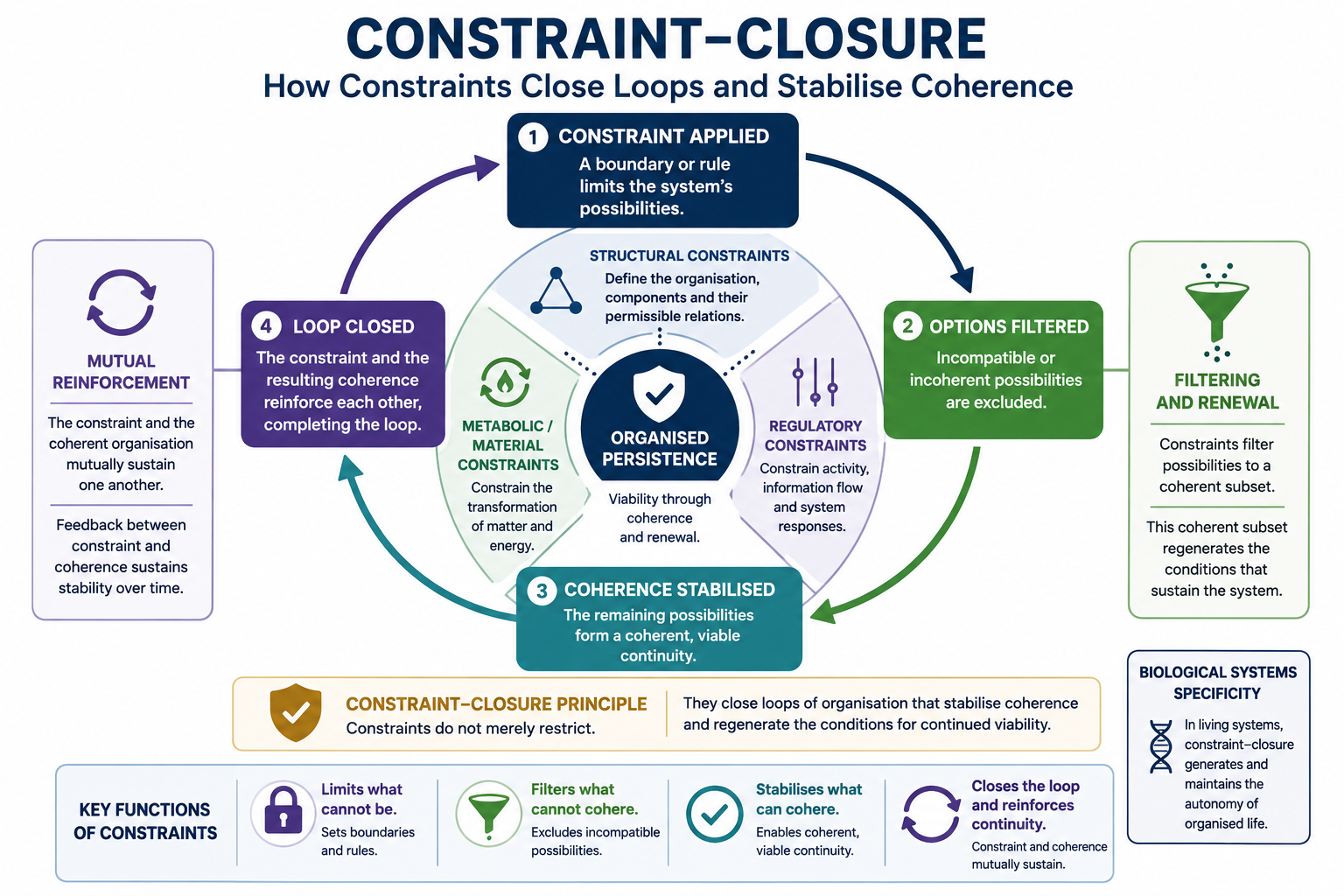
Constraint closure identifies relations of mutual dependence through which constraints contribute to maintaining the conditions for continued living organisation.
Closure and Temporal Organisation
Constraint closure cannot be adequately understood as a static arrangement.
Relations of mutual dependence persist only insofar as the activities through which they are realised continue through time.
Living systems undergo:
- material turnover
- environmental variation
- internal change
- perturbation
- degradation
- repair
- and reorganisation
Their organisation therefore cannot depend upon preserving an unchanged material configuration.
Constraints must be maintained, regenerated, modified, or re-established as conditions change.
The explanatory importance of closure is consequently temporal as well as relational.
A description of constraint relations at a single moment does not by itself explain how those relations continue to be realised across changing circumstances.
APS addresses this problem through organised persistence.
Living systems persist because organisation is continually enacted across material and temporal change. Constraint closure contributes to that persistence insofar as mutually dependent constraints remain organised through the processes that maintain and re-establish the conditions for continued activity.
Closure is therefore not adequately represented as a frozen configuration.
Its biological significance lies in dynamically maintained organisation through time.
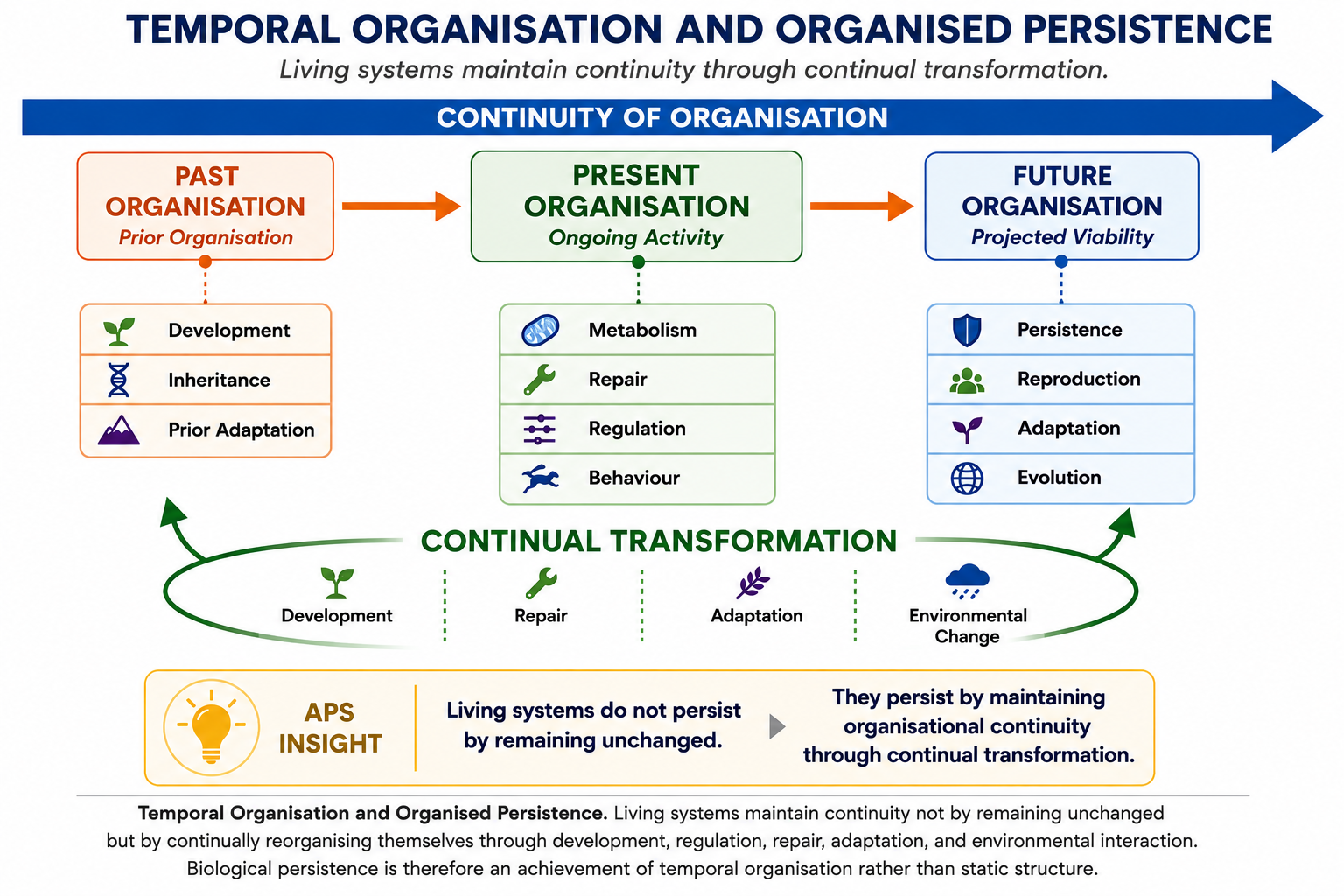
Living systems maintain continuity not by remaining materially or structurally unchanged, but through ongoing organisation across change. Biological persistence is therefore an achievement of temporal organisation rather than static structure.
What Constraint Closure Does Not Do
Constraint closure has explanatory limits.
Identifying reciprocal dependence among constraints does not, by itself, establish that every system exhibiting such dependence should be treated as living, agential, normative, or biologically organised.
The distinction is important because concepts such as:
- mutual dependence
- self-maintenance
- stability
- feedback
- persistence
- and organisational closure
can apply, in different senses, beyond living systems.
Closure therefore cannot serve as an unrestricted criterion from which biological status is inferred solely from the presence of reciprocal organisational dependence. Recent attempts to formalise autopoietic closure reinforce the importance of distinguishing an organisational relation from its formal representation. Ramírez-Tagle (2026), for example, proposes a categorical–thermodynamic calculus of closure while explicitly presenting it as a programmatic formalisation rather than a completed theory of living organisation.
APS does not resolve this problem by dividing reality into a generic closure structure and a second viability component that converts that structure into life.
Instead, the relevant explanatory object is the living organisation itself.
For APS, life is viability-oriented, constraint-closed organisation.
Closure considered in abstraction captures an indispensable relation within that organisation, but does not exhaust the organisation through which biological persistence is maintained.
This distinction preserves the explanatory importance of constraint closure without asking the concept to establish more than it can support.
Closure and Viability
Viability is not an additional ingredient attached to closure.
Nor does APS propose that a system first becomes constraint-closed and then acquires a separate viability orientation.
The distinction is analytic.
Constraint closure directs attention to relations of organisational dependence through which constraints participate in maintaining the conditions of their continued operation.
Viability directs attention to the asymmetry between conditions under which living organisation can continue and conditions under which that organisation degrades or ceases.
In living systems these are not two independently operating organisations.
They are aspects of one organisation.
Living activity occurs under conditions in which some changes are compatible with continued organisation while others threaten, impair, or terminate it. The organisation of activity relative to those conditions is what gives viability its explanatory significance.
APS therefore describes life as viability-oriented, constraint-closed organisation.
This formulation does not combine two independent mechanisms.
It characterises the organisation of living systems from complementary explanatory perspectives: the mutual dependence through which organisation is maintained and the viability conditions relative to which that maintenance matters for continued persistence.
Closure and Agency
Constraint closure and biological agency must also be distinguished without treating them as separate stages or components.
Biological agency is viability-oriented organisational activity.
Agency is therefore not something added to closure after a system has become sufficiently complex, nor does agency arise merely because closure becomes coupled to an additional regulatory mechanism.
Constraint closure characterises relations through which organisational conditions are mutually maintained.
Agency characterises what living organisation does: it modulates activity in relation to the conditions of its own continued functioning and persistence.
These descriptions concern the same living organisation under different explanatory projections.
This matters because closure alone should not be used as a synonym for agency.
A demonstration of reciprocal constraint dependence establishes an organisational relation. A claim of biological agency additionally concerns viability-oriented organisational activity.
APS therefore preserves the distinction while rejecting an architecture in which closure and agency are independent entities that must subsequently be joined.
Closure, Perturbation, and Reconstruction
Perturbation can make otherwise unobvious organisational dependencies visible.
When conditions change, investigators can examine:
- which processes are disrupted
- which constraints cease to be maintained
- which organisational relations are restored
- how activity is reorganised
- whether relevant conditions are re-established
- and whether continued functioning is preserved
Such cases can reveal how persistence depends upon organisation rather than upon the preservation of an unchanged state.
Living systems frequently maintain continuity through material replacement, regulation, repair, compensation, or reorganisation.
These responses should not be treated as evidence that every biological perturbation produces adaptive reconstruction, nor should passive physical processes be excluded from biological explanation.
Rather, perturbation provides an explanatory probe.
It can reveal dependencies that remain difficult to identify under relatively stable conditions and can show how materially implemented constraints alter the local conditions under which continued organisation is possible.
The relevant contrast is therefore not simply between passive non-living stability and active biological reconstruction.
It is between descriptions of persistence as unchanged state and explanations of the organisation through which living systems can maintain or re-establish conditions of continued functioning despite change.
Avoiding Overgeneralisation
Constraint closure is powerful partly because relations of mutual dependence occur across many forms of organised activity.
That generality also creates a risk.
If every instance of reciprocal dependence, self-maintenance, feedback, or organisational stability is treated as sufficient evidence of biological organisation or agency, the relevant concepts lose discriminatory value.
Chemical systems, engineered systems, ecological organisations, and social organisations may exhibit forms of:
- reciprocal dependence
- feedback
- persistence
- constraint
- or self-maintenance
without that fact alone establishing that they instantiate biological agency or living organisation.
APS therefore does not infer biological status merely from formal similarity.
The relevant question is what organisation is materially realised in the system under investigation and what explanatory claim the evidence supports.
This is especially important when concepts developed to explain organisms are extended to other domains.
Similarity in organisational description can justify comparison.
It does not by itself justify identity of biological status.
Constraint closure should therefore retain its explanatory generality without becoming an unrestricted licence for attributing life, agency, normativity, or cognition wherever mutually dependent processes can be identified.
Constraint Closure Reframed
Constraint closure remains indispensable to biological explanation.
It identifies relations of mutual dependence through which constraints contribute to maintaining the organisation that sustains them.
It helps explain how biological activity is coordinated, how enabling conditions are regenerated, and how organisation can continue despite ongoing material change.
But closure considered abstractly is not a complete explanation of:
- life
- biological agency
- normativity
- viability orientation
- or organised persistence
These explanatory limits do not require APS to supplement closure with a collection of independently constituted biological components.
The relevant explanatory object remains one living organisation.
APS describes that organisation as viability-oriented and constraint-closed, enacted through ongoing activity and maintained across spatial and temporal extents.
Agency, Process, and Scale provide analytic projections of this organisation rather than components of reality.
From the perspective of Agency, explanation concerns what living systems do through viability-oriented organisational activity.
From the perspective of Process, explanation concerns how continuity is maintained despite change.
From the perspective of Scale, explanation concerns where persistence is organised across spatial and temporal extents.
Constraint closure contributes to this explanatory architecture by identifying relations of mutual dependence through which the conditions of continued organisation are maintained and regenerated.
Its importance therefore lies neither in explaining life by itself nor in serving as a preliminary structure that becomes biological only when something else is added.
It is indispensable because living persistence is organised.
Explanatory Architecture
Central Question
What does constraint closure explain about living organisation, what does closure considered in abstraction leave unexplained, and how does it contribute to the APS account of organised persistence?
Architectural Role
This Core article establishes the explanatory role and limits of constraint closure within APS.
It treats constraint closure as an indispensable organisational relation within living systems while rejecting the interpretation that closure alone constitutes a complete explanation of life, biological agency, normativity, viability orientation, or organised persistence.
Within APS, life is viability-oriented, constraint-closed organisation. Constraint closure therefore does not constitute an independent structural component to which viability, agency, Process, or Scale are subsequently added. It identifies relations of mutual dependence within the living organisation whose persistence is being explained.
Preceding Explanatory Dependencies
These concepts and articles establish APS conceptual dependencies presupposed by this article:
-
Life — viability-oriented, constraint-closed organisation.
-
Biological Organisation — the living organisation within which constraint relations are materially realised and maintained.
-
Biological Agency — viability-oriented organisational activity.
-
Viability — conditions relevant to the continued functioning of living organisation.
-
Constraint — a materially realised organisational relation that selectively alters the possibilities available to ongoing activity without fully determining outcomes.
-
Process — the analytic projection concerned with how continuity is maintained despite change.
-
Scale — the analytic projection concerned with where persistence is organised across spatial and temporal extents.
-
Organised Persistence — continuity of living organisation through change.
These dependencies do not constitute a hierarchy, chronology, sequence of biological levels, set of independent causes, or assembly of components from which living organisation is constructed.
Subsequent Explanatory Developments
The account of constraint closure developed here supports subsequent APS investigations of:
-
biological regulation and function;
-
normativity and biological evaluation;
-
perturbation, repair, and organisational reconstruction;
-
development and developmental continuity;
-
adaptation and evolutionary transformation;
-
cognition and later organisational capacities;
-
biological explanation across different spatial and temporal extents.
These later developments do not follow automatically from constraint closure and require their own explanatory and evidential assessment.
Related Explanatory Questions
-
What relations of mutual dependence constitute constraint closure?
-
How does constraint closure contribute to self-maintaining biological organisation?
-
Why does closure considered abstractly not establish life, agency, or normativity?
-
How does viability orientation relate to constraint closure without functioning as an additional component?
-
How does constraint closure contribute to organised persistence across change?
-
What can perturbation reveal about otherwise unobvious organisational dependencies?
-
When does the identification of constraint closure provide explanatory gain beyond the strongest established explanation for the same target?
-
What warrants extending concepts of closure, organisation, or agency beyond paradigmatic living systems?
Position Within APS
Constraint Closure occupies a central position within the conceptual foundations of APS because it identifies relations of mutual dependence through which constraints contribute to maintaining the living organisation within which they operate.
Its position must nevertheless be stated precisely. APS does not treat constraint closure, viability, agency, Process, and Scale as independent components or explanatory levels. The explanatory object is one viability-oriented, constraint-closed living organisation.
Agency, Process, and Scale provide complementary, target-sensitive analytic projections of this organisation: what living systems do, how continuity is maintained despite change, and where persistence is organised across spatial and temporal extents.
Constraint closure therefore contributes to the APS explanation of organised persistence without constituting a complete explanation of life by itself. Its explanatory contribution in particular biological cases remains to be established relative to the explanandum, available evidence, and strongest established comparator.
Key Point
Constraint closure identifies indispensable relations of mutual dependence within living organisation, but closure considered abstractly does not exhaust the explanation of life. APS situates closure within one viability-oriented, constraint-closed organisation whose ongoing activity maintains and re-establishes the conditions of its own persistence.
See Also
Related Articles
References
- (2011). Incomplete Nature. W. W. Norton.
- (2015). Biological Autonomy: A Philosophical and Theoretical Enquiry. Springer.
- (2023). Organization in Biology. Springer.
- (2018). Everything Flows: Towards a Processual Philosophy of Biology. Oxford University Press.
- (2026). Formalizing autopoiesis: Toward a Categorical-Thermodynamic Calculus of Closure. BioSystems, 268 . https://doi.org/10.1016/j.biosystems.2026.105918