Representation — When and Whether It Arises in Biological Systems
Representation is often invoked to explain cognition, prediction, memory, planning, and intelligent behaviour. APS does not treat representation as a prerequisite of life, biological agency, biological evaluation, biological significance, or cognition. Biological Evaluation generates significance, while cognition organises biological significance across time and across viability-relevant possibilities. Representation becomes a further explanatory hypothesis when some materially implemented organisation appears to stand in for, model, or otherwise organise activity relative to absent, possible, or counterfactual conditions. Such an attribution requires evidence beyond differential responsiveness, information processing, biological significance, memory, anticipation, or cognition alone. APS therefore asks when representational description identifies an additional dependency and improves explanation of a specified biological explanandum.
Representation — When and Whether It Arises in Biological Systems
Introduction
Representation occupies a prominent place in cognitive science, neuroscience, artificial intelligence, and philosophy of mind. Organisms are frequently described as constructing internal models, encoding information about their environments, predicting future states, storing content, or representing conditions that are not immediately present. In some explanatory contexts, these descriptions may identify important features of biological organisation. Their usefulness, however, does not establish that representation is required wherever living systems regulate activity, process information, anticipate change, or behave cognitively.
APS therefore treats representation as a question rather than a starting assumption.
Living systems can respond differentially to conditions that bear upon their viability without thereby representing those conditions. Biological Evaluation is the process through which agency generates significance: differences become relationally real for living systems because they bear differently upon continued functioning. Such significance does not by itself establish meaning, cognition, or representation.
Cognition introduces a further organisational development. In compact form, APS treats cognition as the organisation of biological significance across time. More diagnostically, biological agency becomes cognitive when integrated biological significance modulates activity across a temporal field of viability-relevant possibilities in ways not exhausted by immediate or fixed regulation.
Even this does not establish representation automatically. A cognitive system may integrate memory, context, anticipation, and possible future conditions without the explanatory description of its organisation necessarily requiring states that stand in for or represent something else.
The central question of this article is therefore not whether representation exists, nor whether APS should accept or reject representational theories in general. It is when, and on what evidence, representational explanation becomes warranted in a biological system.
APS proposes that representation should be attributed where it identifies an additional materially implemented dependency and improves explanation of the specified explanandum beyond what can already be explained through biological significance, information, regulation, memory, anticipation, associative history, or cognition alone.
Where This Article Fits
This article clarifies the place of representation within the APS cognition–mind architecture without making representation either foundational or universally derivative.
Several preceding distinctions are essential. Information in Biology — An APS Clarification distinguishes statistical and other informational relations from biological significance. Meaning in Biology — An APS Clarification establishes the crucial boundary Biological Significance ≠ Meaning. Biological Evaluation generates significance; it does not thereby generate meaning. Cognition — Where Does It Belong in Biology? establishes the further boundary between biological agency and cognition by asking when integrated significance begins to modulate activity across a temporal field of viability-relevant possibilities in ways not exhausted by immediate or fixed regulation.
The present article asks a different question. Once cognitive organisation is established, what additional evidence warrants describing some of that organisation as representational?
Representation is therefore not inserted into a compulsory sequence between information, cognition, and meaning. Nor does APS assume that all cognition is representational, that all meaning requires representation, or that every representation constitutes meaning. These relations must be investigated rather than derived from APS architecture.
The broader positive APS account of meaning belongs to What Is Meaning?, where meaning is considered within the later development of cognition, mind, selfhood, and reflective agency. The present article has the narrower task of establishing when representational description earns explanatory work of its own.
Why Representation Became Explanatorily Important
Representation became influential because many organisms behave in ways that cannot be characterised adequately as immediate responses to present stimulation. They navigate through environments, remember absent conditions, alter behaviour in light of previous experience, anticipate consequences, pursue temporally extended activities, and sometimes act in relation to conditions that are merely possible.
Representational explanation offers one way of understanding such capacities. An internal state may be treated as standing in for an environmental condition, remembered event, goal, possible outcome, or relation that need not be immediately present. On this account, the system can use the state to organise activity beyond its current sensory circumstances.
Such explanations have played major roles in cognitive science and computational approaches to mind. They have also been challenged by embodied, enactive, dynamical, ecological, and other approaches that question whether apparently representational behaviour always requires internal content-bearing states.
APS does not settle this dispute by declaring representation either universal or illusory. Both positions would decide the explanatory issue too early.
Instead, APS asks what representational description contributes in a particular case. If behaviour can be explained adequately through ongoing sensorimotor organisation, regulation, learned dispositions, biological significance, or other materially identified dependencies, adding representation may provide only redescription. If, by contrast, the system depends upon states or organised relations that function in relation to absent, possible, or counterfactual conditions in ways not captured by those alternatives, representational explanation may add something important.
The problem is therefore diagnostic: what makes a representation a representation rather than merely another causally effective biological state?
Biological Evaluation Does Not Require Representation
APS begins from living organisation rather than representational content.
Biological agency is viability-oriented organisational activity. Because conditions differ in how they bear upon viability, living systems can modulate activity differently in relation to them. Biological Evaluation is the process through which agency generates significance.
This relation does not require a system to represent the conditions affecting it.
A bacterium can alter movement in relation to a nutrient gradient without the behavioural explanation necessarily requiring an internal representation of nutrients. A plant can reorganise growth under changing environmental conditions without that response alone establishing an internal model of its environment. Immune activity can discriminate among biologically consequential conditions without every such discrimination thereby constituting symbolic or representational content.
These examples do not establish that bacteria, plants, or immune systems can never possess representational organisation. They establish only the more limited point required here: differential viability-sensitive regulation is insufficient evidence for representation.
The distinction matters because otherwise representation becomes almost automatic. Whenever an internal state covaries with an external condition and influences activity, the state could be described as representing that condition. Such usage risks making representation indistinguishable from causal sensitivity or information-bearing correlation.
APS therefore requires additional explanatory work before moving from biological significance to representation.
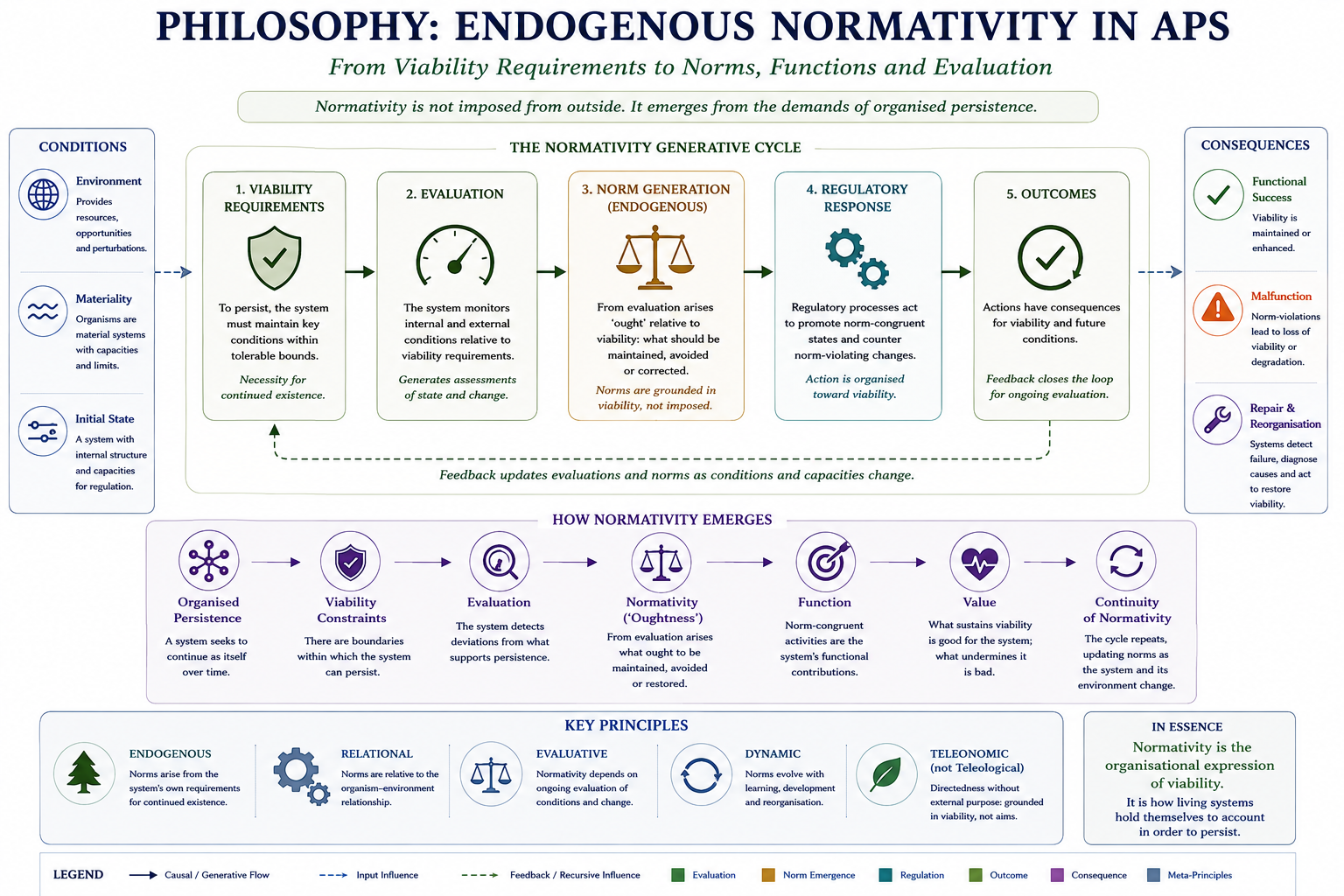
Evaluation Without Representational Commitment. Biological Evaluation generates significance because conditions differ in how they bear upon viability. This viability-sensitive organisation can guide activity without the additional claim that the system represents the conditions to which it responds.
Significance, Semiosis, and Representation
Biological significance must also be distinguished from semiosis and representation.
Significance concerns the relational reality generated through Biological Evaluation: some differences matter to a living system because they bear differently upon its viability. Semiosis concerns sign relations within biological organisation. Representation concerns the stronger possibility that some materially realised state or organisation functions as standing in for, modelling, or otherwise carrying content concerning something beyond its immediate causal occurrence.
These concepts can be related without being identified.
A biological sign may participate in regulation because one condition reliably indicates another. Such a relation may be important to the organism and therefore biologically significant. Whether it is also representational depends upon what explanatory work is performed by treating the sign-bearing state as standing in for something rather than simply participating in an organised causal relation.
Semiosis therefore does not automatically establish representation. Conversely, APS need not require every possible representation to be semiotic in exactly the same sense. The relevant dependencies must be specified for the system being investigated.
This distinction also prevents the language of biological meaning from doing premature work. A difference can be significant without thereby being meaningful in the richer interpretive sense, and a semiotic relation can be biologically consequential without the representational status of its components having already been established.
Significance ≠ Meaning ≠ Representation.
The symbols mark distinctions, not claims of complete independence. The concepts may become related within particular forms of organisation, but those relations require explanation.
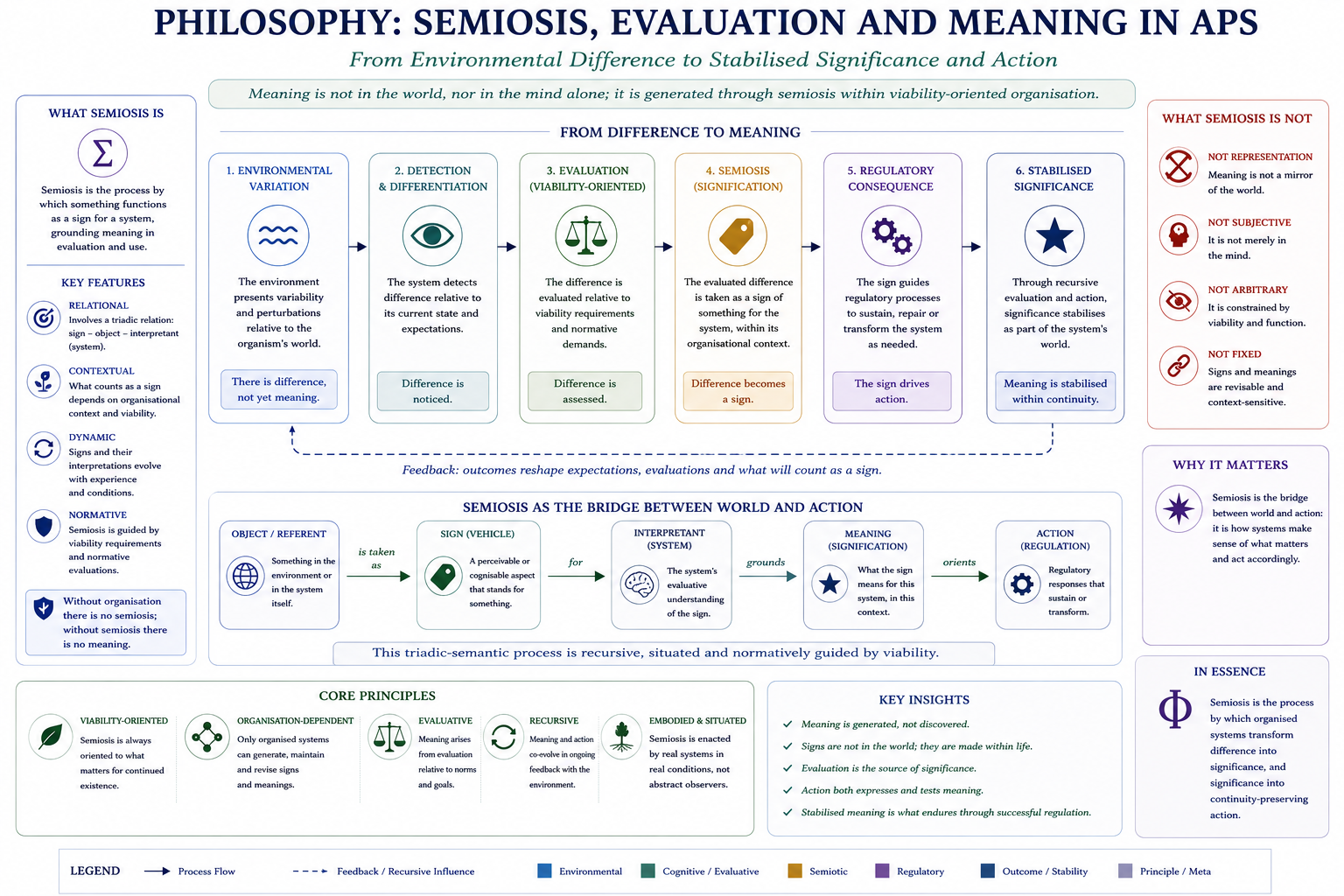
Semiosis Without Automatic Representation. Semiotic relations can organise biologically significant differences without every such relation constituting representation. Representational status requires additional evidence concerning what the relevant state or organisation does within the system.
Information Does Not Establish Representation
Information presents a similar problem.
A state can carry information about another state because the two covary statistically or causally. Biological signalling systems can therefore contain highly reliable information without the informational relation itself establishing representation.
The distinction becomes especially important where representational language is introduced through terms such as encoding, decoding, signal, message, or internal model. These terms can be useful scientific shorthand, but their presence does not settle whether the system itself contains representational organisation.
An internal state may correlate with an environmental condition because that condition causes it. The state may then alter downstream activity. This establishes a causal and potentially informational relation. To describe the state as representing the environmental condition requires a further reason for treating its role as content-bearing or stand-in rather than merely causally mediating.
APS therefore separates three questions. Does a relation carry information? Does that information have biological significance for the living system? Does some state or organisation function representationally?
The answers need not coincide.
This is why representation should not be placed automatically after information in an APS sequence. Some information-bearing relations may participate in representation; many need not. The detailed distinctions among forms of biological information are developed in Information in Biology — An APS Clarification.
Cognition Does Not Automatically Require Representation
The relation between cognition and representation is especially important because many theories identify cognition with representational processing.
APS does not build representation into its definition of cognition.
Cognition is the organisation of biological significance across time. More diagnostically:
Biological agency becomes cognitive when integrated biological significance modulates activity across a temporal field of viability-relevant possibilities in ways not exhausted by immediate or fixed regulation.
This criterion requires more than immediate viability-sensitive regulation. A cognitive system must organise significance across temporal and possible relations with sufficient flexibility that its activity cannot be exhausted by fixed or immediately triggered responses.
Memory, learning, anticipation, context sensitivity, flexible behavioural modulation, and counterfactual depth can all become relevant to this distinction. Yet none individually establishes representation.
A system might use past experience to alter present behaviour through modified dispositions without representing the remembered event. It might anticipate recurring conditions through temporally organised regulation without constructing a model of the future. It might respond flexibly to alternatives through dynamically organised sensorimotor relations without requiring internal content-bearing states.
Representation may nevertheless become explanatory in some cognitive systems. The important point is that cognition establishes a field within which the representation question becomes increasingly substantive; it does not answer that question automatically.
This gives APS a controlled progression of explanatory questions:
Is biological significance present?
Is that significance cognitively organised across time and viability-relevant possibilities?
Does explaining that cognitive organisation additionally require representational states or relations?
Each question requires its own evidence.
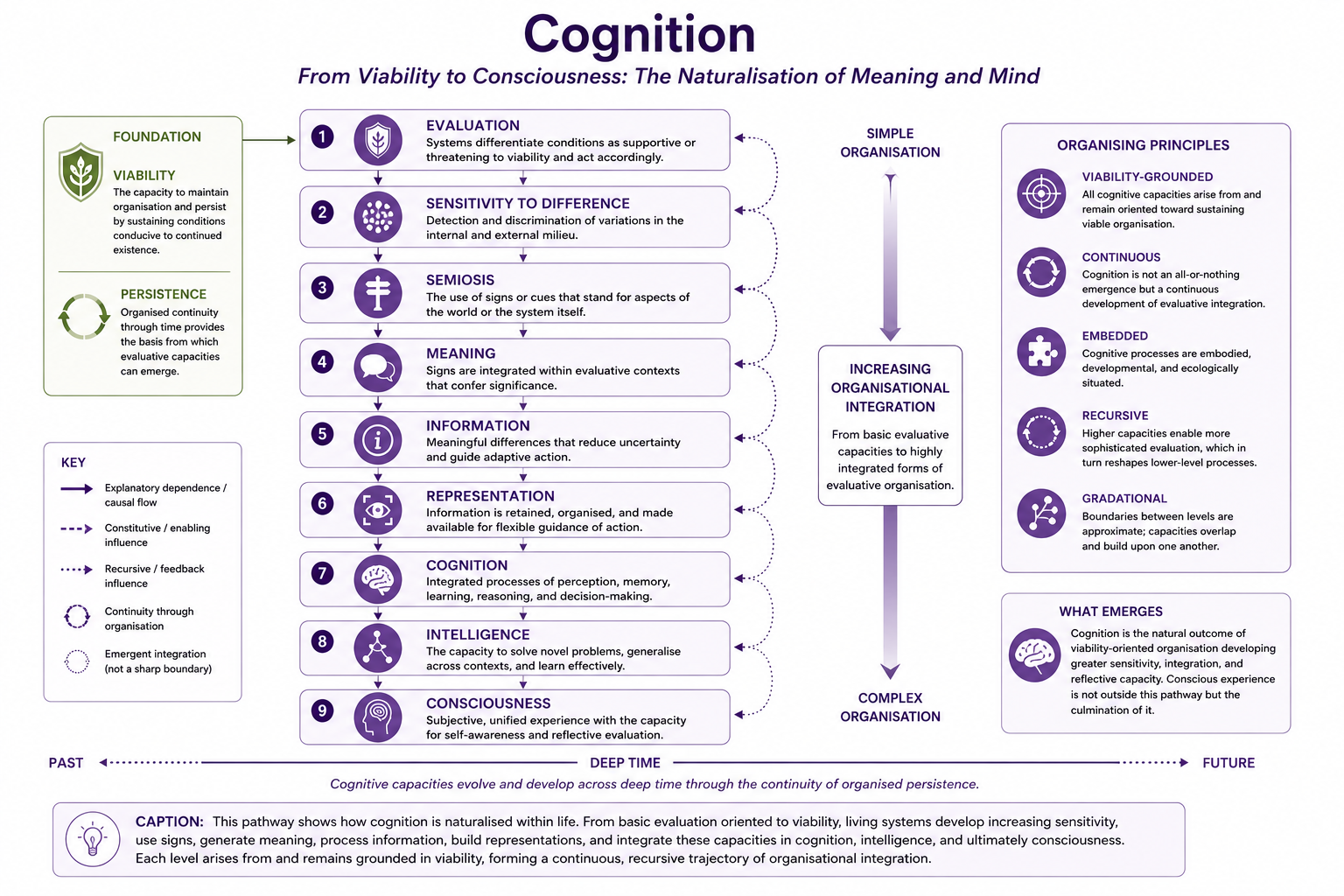
Cognition Before Representational Commitment. Cognition organises biological significance across time and across viability-relevant possibilities. Representation becomes an additional explanatory hypothesis where some of that organisation appears to stand in for, model, or carry content concerning conditions beyond the immediately present situation.
When Representation Becomes Plausible
Representational explanation becomes increasingly plausible when the activity of a cognitive system depends upon organised states or relations that concern more than their immediate causal circumstances.
Counterfactual depth is particularly important. A system capable of modulating activity across alternatives that are not presently realised raises a stronger representation question than a system responding only to current conditions. Temporal projection can likewise matter where activity is organised in relation to future possibilities rather than simply adjusted through fixed anticipatory regulation.
Memory provides another possible case. A persisting internal state may influence present activity because of previous experience. Yet memory alone does not establish representation. The relevant question is whether treating the state as carrying content about the previous event, condition, or relation explains something beyond its causal history and present regulatory effect.
Similar considerations apply to internal modelling, behavioural simulation, navigation, planning, symbolic manipulation, and hypothetical reasoning. These capacities can provide strong candidates for representational explanation, but the terminology should not decide the issue. Calling a process a model or a simulation is not evidence that the biological system itself represents what the scientific model attributes to it.
Representation should therefore be treated as an explanatory hypothesis whose plausibility increases when the organisation of activity cannot be accounted for adequately without reference to content concerning absent, possible, counterfactual, or otherwise non-immediate conditions.
The question then becomes how that hypothesis should be assessed.
A Diagnostic Test for Representational Explanation
APS does not presently propose a universal set of necessary and sufficient conditions for biological representation. The diversity of representational theories and biological cases makes such a claim premature.
It can, however, identify diagnostic considerations that strengthen or weaken a representational interpretation.
A representational explanation becomes more strongly warranted where:
-
A materially realised state or organisation can be identified.
The proposed representation must have some implementation within the biological system rather than existing only in the vocabulary of the observer or scientific model. -
The state functions in relation to something beyond its immediate causal occurrence.
Its explanatory role concerns an object, condition, relation, possibility, or state of affairs that need not be currently present. -
The state contributes to activity concerning absent, possible, or counterfactual conditions.
Behaviour or regulation depends upon more than direct response to the immediate environment or a fixed regulatory relation. -
A sufficiently determinate stand-in or content-bearing relation can be specified.
It should be possible to say what the proposed state represents and why that content attribution matters to the explanation. -
Appropriate and inappropriate use can be distinguished.
The organisation should permit some principled distinction between successful use and mismatch, error, or misrepresentation rather than every causal consequence counting equally as correct. -
The representational description adds explanatory work.
The explanandum should not already be adequately explained by biological significance, causal correlation, information transmission, associative history, regulatory organisation, memory, anticipation, or cognition without representational commitment.
These considerations are diagnostic rather than individually decisive. A candidate representation need not exhibit every feature in the same form, and their presence should not be converted mechanically into a score.
Their purpose is methodological. They require a representational claim to specify what is represented, what materially implements the relation, what difference that relation makes, and why representation explains more than a weaker non-representational description.
A failure to satisfy these questions does not prove that representation is absent. It indicates that the representational attribution has not yet earned explanatory priority.
Representation and Misrepresentation
The possibility of error provides one particularly useful diagnostic consideration.
If a state genuinely represents something, it should ordinarily be possible for the representational relation to fail in some relevant sense. A map can misrepresent terrain. A belief can be false. A perceptual state can concern something that is not present. A predictive representation can mismatch the condition toward which activity is organised.
Biological regulation also fails, but regulatory failure alone is not necessarily misrepresentation. A physiological response can be ineffective because a mechanism is damaged, a signal is too weak, or environmental conditions exceed the system’s regulatory capacity. Nothing in those cases requires the system to have represented the relevant condition incorrectly.
Misrepresentation therefore asks a stronger question: can the proposed content-bearing state continue to function as representing something while failing to correspond appropriately to what it represents?
Where such a distinction can be materially and functionally specified, the representational interpretation becomes stronger. Where every failure can be described fully as causal malfunction or ineffective regulation, representational terminology may add little.
This does not make misrepresentation an absolute criterion. It provides a powerful way of testing whether content attribution is doing explanatory work rather than redescribing causal sensitivity.
Representation, Memory, and Anticipation
Memory and anticipation are especially important because both concern activity extending beyond the immediately present condition.
A memory trace can modify current behaviour because previous activity changed the system. This temporal dependency does not automatically make the trace a representation. The relevant question is whether the system merely carries the causal consequences of its history or whether some persisting organisation functions in relation to the absent event or condition in a way for which content attribution adds explanation.
Anticipation requires similar discrimination. Many biological systems change activity before a recurrent condition occurs. Such anticipatory organisation may result from evolved regulation, entrainment, learned temporal relations, or cognitive processing. Prediction should not be inferred merely because behaviour occurs in advance of an event.
Representational anticipation becomes more plausible where the system organises activity flexibly across alternative possible futures and where identifiable internal states function differently according to what those futures are taken to involve.
The distinction is therefore not between present and future behaviour as such. It concerns the organisation through which absent or possible conditions make a difference to present activity.
This is where counterfactual depth becomes particularly informative. The richer the system’s capacity to organise significance across alternatives that are not currently realised, the more substantive the question becomes whether representational explanation identifies a dependency that simpler regulatory accounts omit.
Representation and Predictive Processing
Predictive-processing, generative-model, and Active-Inference approaches make the representation question especially visible because their formal descriptions frequently involve models, predictions, hidden states, expectations, and inference.
These terms do not by themselves establish biological representation.
A scientific model may represent a biological system without the biological system possessing a representation corresponding to the variables in the scientific model. Likewise, a formal generative model can provide an effective mathematical description of system dynamics without automatically establishing that the system literally constructs, stores, or consults an internal model in the representational sense.
The appropriate question is therefore not whether the mathematics can be expressed representationally. It is whether a representational interpretation identifies materially implemented organisation that contributes to the explanandum.
In some cognitive systems, internal states may plausibly satisfy strong representational diagnostics. In others, predictive or inferential terminology may function primarily at the level of formal description. These possibilities should not be settled merely by choosing either representational or anti-representational vocabulary.
APS’s comparative methodology therefore requires target matching. If APS and a predictive-processing account address the same explanandum, the comparison should identify the dependencies each proposes, determine their material implementation and evidential support, and ask whether representational interpretation contributes explanatory gain. Conceptual difference alone does not establish competition, complementarity, redundancy, or priority.
This comparison is developed more fully in APS and Contemporary Explanatory Approaches and APS and the Free Energy Principle: Organisation, Formalism, and Explanatory Comparison.
Representation Is Not Meaning
Representation and meaning should also remain distinct.
The APS account of biological significance begins before either concept. Biological Evaluation generates significance because conditions differ in how they bear upon viability. Significance therefore identifies what matters biologically without requiring the richer claim that the system interprets what matters.
Meaning concerns the interpretive organisation of significance. Representation concerns whether some state or organisation stands in for, models, or carries content concerning something else. These explanatory questions can intersect without becoming identical.
A representation may participate in meaningful interpretation. Symbolic language provides obvious cases in which representational and meaningful relations are closely integrated. Yet the existence of a representation does not by itself establish the full interpretive organisation associated with meaning, and meaning should not be made a prerequisite that every biological representation must already possess.
APS therefore rejects both simple equations:
Significance = Meaning
and
Meaning = Representation
It also rejects the reverse inference that representation necessarily generates meaning.
The relation among significance, meaning, and representation must instead be established in the organisation being investigated. This preserves the boundary established in Meaning in Biology — An APS Clarification while leaving open the possibility that representational capacities become increasingly important within richer forms of mind, selfhood, reflective agency, language, and human interpretation.
Representation and Artificial Systems
Artificial systems provide an important reminder that representational sophistication and biological agency are different explanatory questions.
Some artificial systems can manipulate symbols, maintain internal states, model complex relations, generate predictions, and organise outputs in relation to conditions not immediately present. Depending upon the representational criterion being used, such systems may provide strong candidates for representational description.
Nothing in APS requires representation to be exclusively biological.
What does not follow is that representational capacity by itself establishes biological agency. Biological agency is viability-oriented organisational activity, and the presence of sophisticated information processing or representational structure does not by itself establish the organisation APS identifies with life.
The comparison should therefore remain bounded. This article does not attempt to determine the complete status of artificial cognition, artificial meaning, or artificial agency. Its relevant conclusion is narrower:
Representation alone is insufficient to establish biological agency.
The broader comparison between artificial systems and biological organisation belongs to the dedicated APS treatment of artificial intelligence and biological agency.
Where Representation Is Materially Organised
If a biological system possesses representational organisation, its implementation may depend upon relations extending across different spatial and temporal extents.
Neural activity, memory systems, sensory organisation, bodily states, learned behavioural dispositions, environmental structures, and social or symbolic resources can all become relevant in particular cases. Their relevance cannot be inferred simply from the fact that they occur at different scales.
APS uses Scale to ask where the relevant organisation is materially implemented across spatial and temporal extents. The representational question is therefore not whether representation occurs at a particular biological level or whether cognition is inherently multiscale. It is which materially realised relations are necessary to the proposed representational capacity.
A neural state may be locally measurable while its representational role depends upon broader organism–environment relations. Conversely, a cognitive activity may depend upon widely distributed processes without representation itself being distributed across every contributing process.
Wider spatial extent does not imply richer representation, and distributed implementation does not automatically establish distributed representational content.
The same applies temporally. A representational capacity may depend upon developmental history, learning, memory, or repeated organism–environment interaction. Such temporal dependencies matter where they make a demonstrable difference to the organisation under investigation.
Scale-sensitive analysis therefore identifies where representational dependencies are implemented, not a hierarchy through which representation progressively emerges.
Representation Within APS Explanatory Methodology
APS does not derive representation from its conceptual architecture.
Agency, Process, and Scale can help organise questions about a candidate representational system. Agency asks what viability-oriented activity is being performed. Process asks how the relevant organisation is maintained and transformed through time. Scale asks where the dependencies supporting that organisation are materially realised across spatial and temporal extents.
None of these analytic projections establishes that representation is present.
Likewise, the presence of biological significance, semiosis, information, cognition, memory, anticipation, or organised persistence does not logically entail representation. These concepts identify different explanatory relations whose connections must be demonstrated.
A representational claim should therefore be treated as a dependency hypothesis. It proposes that some content-bearing or stand-in relation makes a material difference to the phenomenon being explained.
Testing that hypothesis requires a specified explanandum. It requires identification of the proposed representational state or organisation, the content or target attributed to it, the material basis through which the relation is implemented, and an appropriate contrast showing what representational description adds.
This makes null results possible. A detailed investigation may show that behaviour initially described as representational is explained adequately through non-representational regulation, learned dynamics, information-bearing correlations, or cognitive organisation without content-bearing states. In that case, APS should accept the null result.
Conversely, where representational description identifies dependencies required to explain flexible activity concerning absent, possible, or counterfactual conditions, the representational hypothesis gains support.
Representation is therefore neither assumed nor prohibited. It must earn its explanatory role.
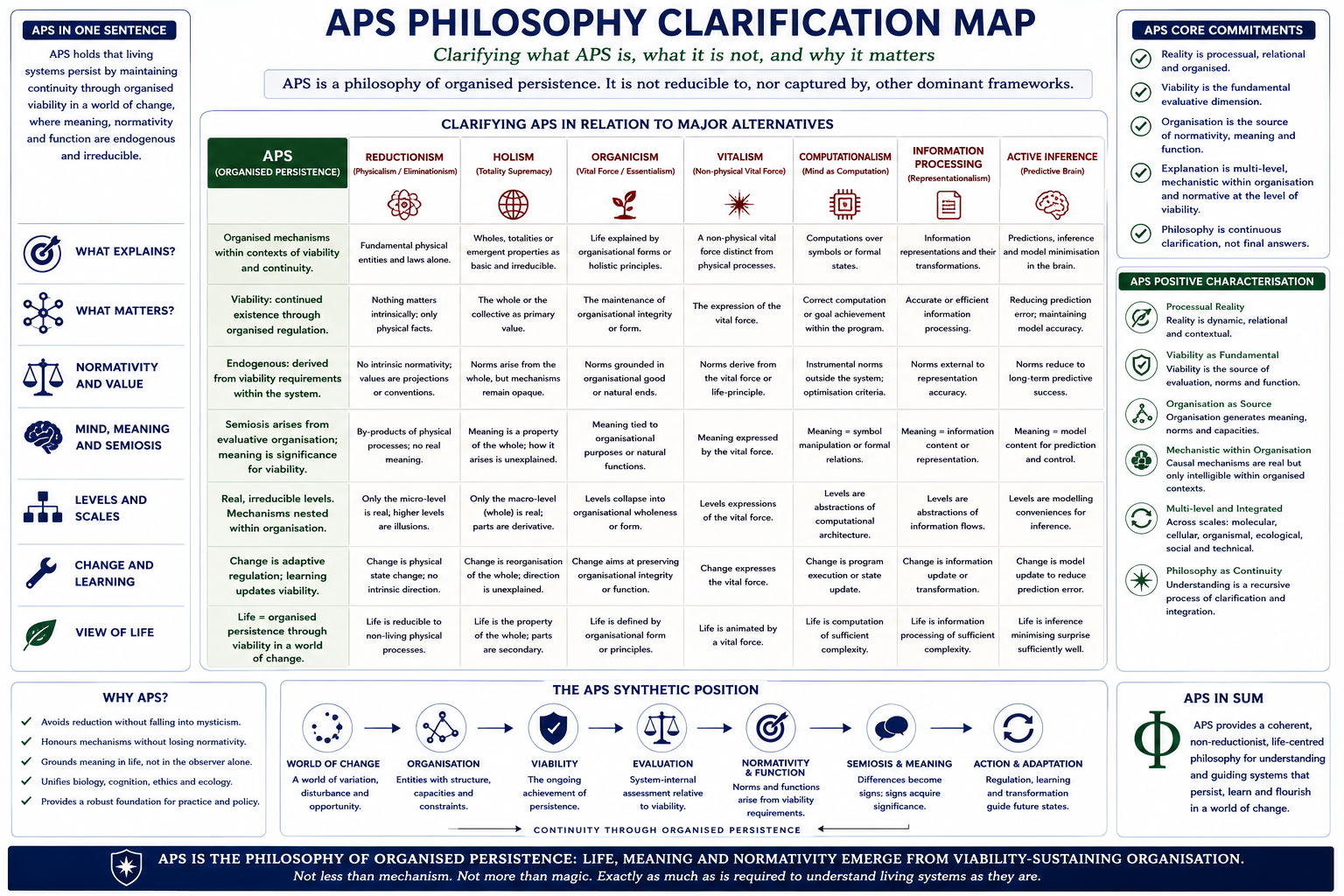
Representation Within APS. APS distinguishes biological significance, semiosis, information, cognition, meaning, and representation. Representational explanation is warranted where a materially implemented content-bearing or stand-in relation adds explanatory work for a specified explanandum rather than merely redescribing biological responsiveness or cognitive organisation.
Why Representation Matters
The representation question matters because representational vocabulary can either clarify biological organisation or conceal what still needs to be explained.
If every information-bearing state is a representation, representation adds little beyond information. If every viability-sensitive response represents the condition to which it responds, representation collapses into biological significance. If every memory or anticipation is representational by definition, the representation question is settled terminologically rather than empirically. If every cognitive process is assumed to manipulate representations, alternative explanations are excluded before comparison begins.
A more discriminating account allows representation to perform substantive explanatory work where the evidence warrants it.
This approach also protects APS from the opposite error. Rejecting representational foundationalism does not justify rejecting representation. Some biological systems may depend upon content-bearing states, internal models, symbolic relations, or other organisation for which representational explanation is indispensable.
The methodological requirement is symmetry. Representational explanations should neither receive automatic priority nor be excluded because APS begins from living organisation. They should be assessed against the explanandum, evidence, material implementation, available alternatives, and explanatory contribution.
This makes representation an empirical and explanatory question rather than a metaphysical commitment imposed in advance.
Conclusion
Representation is not required for life, biological agency, Biological Evaluation, or biological significance. APS also does not build representation into its definition of cognition.
Biological Evaluation generates significance because conditions differ in how they bear upon viability. Cognition develops when integrated biological significance modulates activity across a temporal field of viability-relevant possibilities in ways not exhausted by immediate or fixed regulation. These relations establish increasingly rich biological organisation without representation having to be assumed at either stage.
Representation becomes a further explanatory possibility where materially realised states or relations appear to stand in for, model, or carry content concerning conditions beyond their immediate causal occurrence. Absent conditions, possible futures, counterfactual alternatives, memory, simulation, and flexible planning can make this possibility increasingly plausible, but none establishes representation merely by being named.
A representational attribution therefore requires diagnostic scrutiny. What is represented? What materially implements the relation? How does the proposed representation guide activity concerning absent or possible conditions? Can appropriate use be distinguished from mismatch or misrepresentation? Most importantly, what does representational explanation add beyond biological significance, information, regulation, associative history, memory, anticipation, or cognition alone?
These questions preserve the distinctions required by the wider APS architecture:
Significance ≠ Meaning ≠ Representation.
They also prevent those distinctions from becoming an automatic sequence. Meaning and representation may interact within richer cognitive organisation, but their relation must be established rather than inferred from their position in a conceptual diagram.
The resulting APS position is deliberately conditional. Representation is neither the foundation of biological organisation nor an illusion to be eliminated. It is a substantive explanatory hypothesis whose warrant depends upon the organisation, evidence, and explanandum of the biological system under investigation.
Key Point
Representation should be attributed when a materially implemented state or organisation functions in relation to something beyond its immediate causal occurrence and when treating that relation as content-bearing or standing in for something adds explanatory work. Biological significance, information, memory, anticipation, semiosis, or cognition alone do not establish representation.
Explanatory Architecture
Central Question
When, and on what evidence, does representational description become warranted in explaining a biological system?
Architectural Role
This article provides the APS clarification and diagnostic framework for biological representation. It rejects representation as a prerequisite of life, biological agency, Biological Evaluation, significance, or cognition while leaving representation available as a substantive explanatory hypothesis for appropriate biological systems.
Its distinctive contribution is diagnostic. Rather than placing representation at a predetermined point in an organisational sequence, the article asks what materially implements a proposed representation, what the state or organisation represents, how it functions in relation to absent, possible, or counterfactual conditions, whether mismatch or misrepresentation can be specified, and what explanatory gain the representational description provides over weaker alternatives.
Preceding Explanatory Dependencies
These concepts and articles establish resources required to formulate the representation question. They identify explanatory dependencies within APS rather than chronological stages, hierarchical levels, or a compulsory developmental sequence.
- Biological Agency
- Viability
- Biological Evaluation
- Biological Significance
- Semiosis
- Information in Biology
- Cognition — Where Does It Belong in Biology?
- Meaning in Biology — An APS Clarification
- Persistence — Organised Continuity Through Time
Diagnostic Considerations for Representation
A representational interpretation becomes more strongly warranted where:
- a materially realised state or organisation can be identified;
- that state functions in relation to something beyond its immediate causal occurrence;
- it contributes to activity concerning absent, possible, or counterfactual conditions;
- a sufficiently determinate stand-in or content-bearing relation can be specified;
- appropriate use can be distinguished from mismatch, error, or misrepresentation;
- and representational description explains something not already adequately explained by biological significance, information, regulation, associative history, memory, anticipation, or cognition alone.
These are diagnostic considerations rather than a frozen set of necessary and sufficient conditions.
Subsequent Explanatory Developments
The distinctions established here are developed, tested, or extended in:
- Consciousness — An APS Clarification
- Mind
- Selfhood
- Reflective Agency
- What Is Meaning?
- Why Life Is Not Active Inference
- APS and Contemporary Explanatory Approaches
- APS and the Free Energy Principle: Organisation, Formalism, and Explanatory Comparison
Related Explanatory Questions
- Why does biological significance not establish representation?
- How does representation differ from information-bearing correlation?
- When does a semiotic relation become representational?
- Can cognition occur without representation?
- What additional evidence warrants moving from cognition to representational explanation?
- What distinguishes memory from representation of the past?
- When does anticipation warrant representation of the future?
- Why is counterfactual depth relevant to representational claims?
- What role does misrepresentation play in identifying genuine representational content?
- How can representational claims be materially implemented and empirically tested?
- When is an internal model a model possessed by the biological system rather than a model used by the scientist?
- Under what conditions does representational explanation provide explanatory gain?
Position Within APS
Representation is not a foundational component of APS and is not built into the definitions of life, agency, Biological Evaluation, significance, or cognition. It becomes relevant when the organisation of biological significance across time supports a substantive hypothesis that some materially realised state or relation functions as standing in for, modelling, or carrying content concerning something beyond its immediate occurrence.
The article therefore establishes a controlled boundary between cognition and representational explanation. Cognition makes the representation question increasingly substantive because cognitive systems organise significance across temporal and viability-relevant possibilities. It does not answer that question automatically.
Position Within the APS Corpus
This article is the principal APS treatment of when and whether representational explanation is warranted in biological systems. It follows the distinctions established in Information in Biology — An APS Clarification, Meaning in Biology — An APS Clarification, and Cognition — Where Does It Belong in Biology? while providing a diagnostic bridge toward later treatments of mind, selfhood, reflective agency, and meaning.
Within the Comparative Explanatory Approaches programme, it also provides the methodological basis for assessing representational interpretations of predictive processing, generative models, and Active Inference. APS does not assume that such approaches are representational, non-representational, complementary, competing, redundant, or explanatorily subordinate. Those relations must be determined through target-matched comparison of the dependencies and evidence relevant to the specified explanandum.
See Also
Related Articles
References
- (1997). Being There. MIT Press.
- (2016). Surfing Uncertainty. Oxford University Press.
- (2011). Incomplete Nature. W. W. Norton & Company.
- (1991). Consciousness Explained. Little, Brown and Company.
- (2013). The Predictive Mind. Oxford University Press.
- (1984). Language, Thought, and Other Biological Categories. MIT Press.
- (2026). Agency as the Defining Activity of Life. Biological Theory . https://doi.org/10.1007/s13752-026-00547-6
- (2007). Mind in Life. Harvard University Press.
- (1991). The Embodied Mind. MIT Press.