The Ecological Organisation of Life
Ecology is often presented as the study of interactions between organisms and their environments. APS accepts this insight while placing it within a broader account of viability-oriented organised persistence. Organisms do not merely exist within ecological environments; their continuity depends upon ongoing ecological organisation distributed across resources, niches, organism– environment coupling, ecological resilience, developmental conditions, evolutionary processes, and forms of ecological significance that shape agency and cognition. Ecology therefore becomes one of the major continuity architectures through which living systems sustain viability across changing conditions, scales, and timescales. This article presents the APS synthesis of ecological organisation and explains why ecology is indispensable to the persistence of life.
Introduction
No organism produces all of the conditions required for its own persistence.
A plant cannot generate sunlight, an animal cannot create the ecosystems upon which its food depends, and a developing organism cannot construct every environmental condition required for growth. Even the simplest microbial systems depend upon resources, chemical gradients, and ecological circumstances extending beyond their own boundaries. Yet despite this dependence, living systems persist.
Across the living world, organisms maintain continuity under conditions that are often uncertain, changing, and only partly under their control. Resources fluctuate, environments transform, ecological relationships emerge and disappear, and opportunities and constraints continually shift. Nevertheless, persistence remains possible. This observation reveals one of the deepest questions in biology: how does continuity remain possible when the conditions supporting continuity extend beyond the organism itself?
For APS, ecology provides a large part of the answer.
Ecology is often described as the study of interactions between organisms and environments. While valuable, this description captures only part of its significance. APS approaches ecology from the perspective of organised persistence. The central question is not simply how organisms interact with their surroundings, but how those interactions contribute to the maintenance of viability through time. Organisms remain viable because they participate in larger ecological organisations that continually contribute to the conditions required for continuity.
This perspective gives ecology a distinctive place within the APS framework. Development explains continuity through transformation across the life history of organisms. Evolution explains continuity through historical transformation across generations and lineages. Ecology explains continuity through organism–environment coupling. Together these domains address different dimensions of the same underlying problem: how viability-oriented organised persistence remains possible despite continual change. Each domain addresses a different dimension of the same underlying problem: how viability-oriented organised persistence remains possible despite continual change.
This changes the role of ecology within biological explanation. The environment is no longer treated as a backdrop against which life unfolds, nor is ecology merely an external influence acting upon otherwise self-contained organisms. Ecological organisation becomes part of the explanation of life itself. To understand persistence therefore requires understanding ecology—not because ecology surrounds living systems, but because continuity emerges through ecological organisation from the very beginning.
Where this article fits: Ecology as Organised Persistence Across Scales introduces the APS approach to ecological explanation. This article serves a broader purpose. It provides a synthesis of the ecological domain as a whole and explains why ecology occupies a central place within viability-oriented organised persistence.
Why Ecology Matters
One of the most remarkable features of living systems is their ability to maintain continuity despite continual uncertainty.
Organisms never exist under perfectly stable conditions. Resources become available and disappear, ecological opportunities emerge unexpectedly, competitors alter access to resources, predators introduce risks, habitats change, and environmental conditions fluctuate across timescales ranging from moments to millennia. Yet continuity often survives these disruptions. The traditional ecological question asks how organisms interact with changing environments. APS begins with a deeper question: why are these interactions so important to persistence in the first place?
The answer lies in the nature of viability itself.
No living system is entirely self-sufficient. Internal regulation, however sophisticated, cannot eliminate ecological dependence. Organisms require resources they do not produce, conditions they do not fully control, and relationships extending beyond their own organisation. Continuity therefore depends upon more than what occurs within the organism. It depends upon ecological organisation.
This insight transforms the explanatory role of ecology. Ecology is not simply the study of influences acting upon organisms from outside. It becomes the study of the relationships through which continuity is maintained beyond the organism itself. The ecological domain investigates how resources, environments, interactions, and larger ecological systems contribute to the preservation of viability across time.
The unifying principle behind these diverse ecological phenomena is organism–environment coupling. Resources matter because they participate in continuity-supporting relations between organisms and ecological conditions. Niches matter because they organise those relations. Constraints matter because they shape which forms of coupling remain viable. Resilience matters because it helps preserve coupling when disruption occurs. Ecology therefore possesses a deeper coherence than a simple catalogue of ecological concepts might suggest. Its central concern is the organisation of continuity-preserving relations linking living systems to the conditions required for persistence.
Seen from this perspective, ecology appears throughout biology. Development depends upon developmental environments, adaptation depends upon ecological circumstances, evolution depends upon ecological conditions, behaviour depends upon ecological opportunities and constraints, and cognition depends upon environments structured by differences that matter. Ecology therefore occupies a distinctive place within APS because it explains how continuity remains possible when the conditions supporting continuity extend beyond the organism itself.
The Ecological Problem
The importance of ecology becomes clearer once we recognise a tension at the heart of biological existence.
Living systems must maintain continuity, yet the conditions required for continuity are never entirely under their control.
This is not a temporary difficulty that organisms occasionally encounter. It is a permanent feature of life itself. Every living system depends upon conditions extending beyond its own organisation. Resources must be acquired, suitable environments must remain available, relationships with other organisms must be negotiated, and ecological uncertainties must continually be managed.
The challenge is therefore deeper than simple environmental interaction. The challenge is maintaining viable relations with a world that remains partly independent of the organism.
This is the ecological problem.
Organisms cannot preserve themselves through internal regulation alone. Continuity depends upon ongoing engagement with ecological conditions that are often changing, uncertain, and only partially predictable. Persistence therefore requires more than maintaining internal organisation. It requires maintaining viable organism–environment relationships.
Many familiar ecological concepts can be understood as responses to this problem. Predation concerns threats to continuity, resource acquisition concerns opportunities for continuity, mutualistic relationships concern shared contributions to continuity, niches concern the ecological conditions supporting continuity, and resilience concerns the recovery of continuity following disruption.
At first glance these topics may appear unrelated. Viewed through the lens of organised persistence, however, they reveal a common concern. Each addresses how continuity remains possible despite ecological uncertainty.
The ecological domain therefore possesses a deeper unity than is often recognised. It is organised around a single explanatory challenge: how living systems remain viable through ongoing ecological engagement with worlds they neither fully control nor entirely escape.
Organisms Do Not Persist Alone
The ecological problem reaches its clearest expression in a simple but far-reaching observation.
Organisms do not persist alone.
At first glance this claim may appear self-evident. Every organism depends upon food, water, habitats, and ecological conditions. Yet APS argues that its implications are much deeper than is usually appreciated.
Consider a forest tree.
It is tempting to regard the tree as an individual organism maintaining its own existence. The roots absorb water, the leaves capture energy, and the trunk provides structural stability. Viewed in isolation, the continuity of the tree appears to be produced primarily within the organism itself.
Closer examination reveals a different picture. The tree depends upon soil communities, nutrient cycles, microbial partnerships, climatic conditions, water systems, pollinators, and countless ecological relationships extending beyond its own boundaries. Remove enough of these relationships and continuity becomes impossible.
The persistence of the tree therefore emerges through a larger ecological organisation.
The same pattern appears throughout the living world. Animals depend upon food webs, microorganisms depend upon chemical environments, developing organisms depend upon developmental niches, populations depend upon ecosystems, and species depend upon ecological relationships accumulated across evolutionary time. In every case, continuity extends beyond the organism and becomes distributed across larger systems of organisation.
This observation captures one of the most important ecological insights of APS. The environment is not merely what surrounds life; it participates in the processes through which life persists. Ecological organisation contributes directly to the continuity-preserving activities through which viability is maintained. The persistence of living systems therefore cannot be fully explained by examining organisms in isolation. Continuity emerges through relationships distributed across larger ecological organisations.
Understanding ecology consequently requires moving beyond the image of organisms confronting external environments. Organism and environment must instead be understood as participants within larger continuity-preserving systems. Ecology exists as a distinct domain because viability is distributed beyond the organism itself and depends upon the organisation of those broader relations.
The question then becomes:
How are these organism–environment relations organised in ways that support persistence through time?
This question leads directly to the concept at the centre of the ecological domain.
Organism–Environment Coupling
If organisms do not persist alone, continuity must somehow emerge through relationships linking living systems to the ecological conditions upon which they depend.
The key issue is not merely interaction. APS describes this organisation through the concept of organism–environment coupling.
Coupling refers to the ongoing reciprocal relationships through which organisms and environments contribute to one another’s continuity. Persistence emerges not from the organism alone and not from the environment alone, but through their continuing organisation together. This perspective represents an important shift in biological explanation. Traditional descriptions often portray organisms as entities responding to external circumstances. APS instead emphasises the relational systems through which continuity is maintained. The focus moves from isolated organisms to continuity-preserving organism–environment organisations.
Organism–environment coupling occupies a central place within the ecological domain because it provides the organisational principle that unifies many otherwise disparate ecological concepts. Niches, resources, constraints, resilience, adaptation, and ecosystem organisation all concern different aspects of the ways organisms maintain viable relations with ecological conditions. Ecology therefore becomes intelligible as the study of coupling rather than simply the study of environments.
Examples appear throughout biology. A plant and its soil community are coupled through nutrient exchange, a pollinator and a flowering plant are coupled through mutually beneficial interaction, a grazing animal and its food resources are coupled through ongoing ecological dependence, and a developing organism and its developmental environment are coupled through conditions supporting growth and viability. In each case, continuity depends upon relationships extending beyond the boundaries of the organism itself.
The significance of coupling lies in what it reveals about persistence. Continuity is rarely produced entirely from within. It emerges through ecological organisations distributed across organism–environment systems whose ongoing interactions contribute to viability through time. Organisms influence the environments within which they live, while environments simultaneously influence the possibilities available to organisms. Persistence emerges through this continuing reciprocity rather than from either side alone.
Once continuity is understood in this way, the ecological world itself begins to appear differently. The environment is no longer simply a collection of external conditions. It becomes a structured world containing opportunities, constraints, resources, threats, and possibilities whose significance derives from their relationship to persistence.
It is this transformation that leads to the next major concept in the ecological synthesis: the ecological world as a world of biological significance.
The Ecological World Is Not Neutral
Understanding organism–environment coupling reveals something profound about the nature of ecological reality.
The environment is not simply a collection of physical objects and processes existing independently of life. From a biological perspective, ecological worlds possess structure because some features matter to persistence while others do not. Resources, opportunities, dangers, constraints, and possibilities acquire significance through their relationship to viability.
This insight marks an important departure from purely physical descriptions of the environment. A landscape may be described in terms of temperature, topography, chemistry, and material composition. Such descriptions remain valuable, but they do not by themselves explain why particular environmental features become biologically significant. The importance of a resource, a shelter, a predator, or a mating opportunity cannot be understood solely from its physical properties. Its significance derives from its role within the continuity-preserving organisation of living systems.
The ecological world is therefore structured by viability. Food matters because it contributes to persistence, danger matters because it threatens persistence, habitats matter because they support persistence, and opportunities matter because they enhance persistence. The environment encountered by an organism is consequently not a neutral physical space but a world organised around differences that matter to continuity.
Because organisms must continually act in ways that preserve viability, ecological significance is inseparable from agency. Opportunities, threats, resources, and constraints matter not simply because they exist, but because they shape the activities through which living systems maintain continuity. Ecological organisation therefore helps define the conditions within which biological agency becomes possible and effective.
This observation creates an important bridge to other areas of APS. The significance of ecological conditions provides the foundation for evaluation, meaning, information, and cognition. Organisms respond selectively to ecological circumstances because some features contribute differently to viability than others. The ecological world therefore becomes a world of biological relevance rather than merely physical existence.
Affordances provide one way in which ecological significance becomes operational. They identify possibilities for action that emerge within organism–environment relations. In APS, affordances are not merely environmental features but viability-relevant opportunities whose significance depends upon the organisation of the living system encountering them. What counts as an opportunity for one organism may be irrelevant, inaccessible, or threatening for another.
Ecology thus occupies a pivotal position within the APS framework because it explains how significance first emerges within the organisation of life. The environment is not merely where persistence occurs; it helps define what persistence requires.
Niches and the Organisation of Ecological Opportunity
Once ecological worlds are understood as structured by viability, the concept of the niche acquires a deeper significance.
Traditionally, niches are often described as the positions occupied by organisms within ecosystems or as the environmental conditions under which particular species can survive. While useful, these descriptions sometimes obscure the organisational role that niches play in biological persistence.
APS approaches niches from the perspective of continuity.
A niche is not merely a location, nor is it simply a set of environmental variables. A niche is a continuity-supporting ecological organisation through which viable persistence becomes possible.
This perspective helps explain why niches occupy such a central position in ecology. Organisms do not persist within arbitrary environments. They persist within ecological contexts containing the resources, relationships, opportunities, and constraints required for continuity. Niches therefore represent structured arrangements of ecological conditions that support viability across time.
Niches can be understood as one important expression of organism–environment coupling. They identify recurring ecological organisations through which continuity becomes possible. The niche therefore does not sit alongside coupling as a separate ecological principle. Rather, it reveals how coupling becomes organised in stable and continuity-supporting ways.
The relationship between organisms and niches is also dynamic rather than static. Organisms do not simply occupy niches; they participate in them. Many organisms modify the conditions contributing to their own persistence by altering habitats, influencing resource availability, reshaping ecological relationships, and contributing to the ongoing organisation of the niches within which they live.
The niche therefore becomes a relational organisation rather than a passive environmental container. This insight reveals why ecological explanation cannot be reduced to either organismal properties or environmental conditions alone. Persistence emerges through the organisation of viable relationships connecting organisms and ecological circumstances. Niches make those relationships visible by identifying the ecological structures through which continuity becomes possible.
Seen in this light, niches are not simply ecological positions. They are continuity architectures embedded within ecological systems.
Resources, Constraints, and Persistence
The niche concept naturally leads to a more general question: what exactly do ecological systems provide that allows continuity to persist?
APS answers this question in terms of resources and constraints.
Living systems require resources because continuity is never free. Energy must be acquired, materials must be obtained, developmental processes must be supported, and behavioural activities must be sustained. Every form of organised persistence therefore depends upon access to ecological conditions capable of supporting viability.
Resources, however, do not by themselves explain ecological continuity. The ecological world is also structured by constraints. Not every opportunity is available, and not every pathway remains viable. Organisms confront limitations imposed by resource availability, competition, predation, environmental conditions, developmental capacities, and ecological relationships. These constraints influence how persistence can be achieved and help shape the trajectories through which continuity unfolds.
Within APS, resources and constraints are best understood as complementary dimensions of organism–environment coupling. Resources contribute to continuity by opening viable pathways for activity, development, repair, and adaptation. Constraints contribute to continuity by shaping which pathways remain viable and which forms of activity can be sustained. Both therefore participate in the organisation of persistence.
This perspective highlights an important feature of ecological explanation. Persistence depends not upon unlimited possibility but upon structured possibility. Living systems survive because ecological organisations provide opportunities while simultaneously constraining those opportunities into forms compatible with continued viability.
The ecological world therefore becomes intelligible as an organised field of possibilities. Resources open pathways, constraints shape pathways, and continuity emerges through the ongoing navigation of both.
Ecological Resilience and the Recovery of Continuity
The organisation of resources and constraints helps explain how continuity is maintained under ordinary circumstances.
A further question remains: what happens when continuity is disrupted?
Ecological systems are continually exposed to disturbance. Climatic fluctuations, habitat modification, resource shortages, predation pressures, disease outbreaks, invasive species, and countless other influences can alter the conditions supporting persistence. Yet ecological systems often display a remarkable capacity to absorb disruption while preserving continuity.
This capacity is commonly described as resilience.
APS interprets resilience as a continuity-preserving property of ecological organisation. Resilience does not imply the absence of change, nor does it imply a return to some perfectly stable state. Rather, resilience concerns the capacity of ecological systems to preserve or recover viability despite disruption.
This distinction is important because a rigid system may resist change temporarily yet collapse when disturbances exceed its limits. Resilient systems operate differently. They accommodate change, reorganise relationships, and adapt to altered conditions while maintaining continuity.
From an APS perspective, resilience can be understood as the capacity of organism–environment coupling to survive disruption. Disturbances alter ecological relationships, modify resources, create new constraints, and transform opportunities for persistence. Resilient systems preserve continuity because the organisation of those relationships remains capable of supporting viability despite change.
The ecological significance of resilience therefore extends beyond recovery alone. Resilience reveals how continuity is maintained in a world where disruption is inevitable. Ecological systems persist not because disturbances never occur but because ecological organisation allows continuity to survive disturbances when they do occur.
This principle appears throughout biology. Organisms recover from injury, populations recover from decline, communities reorganise following disturbance, and ecosystems adapt to changing conditions. In each case, resilience reflects the capacity of ecological organisation to preserve continuity despite transformation.
The importance of resilience extends beyond ecology itself. It reveals a general principle that appears repeatedly throughout APS. Development preserves continuity through transformation, evolution preserves continuity through historical transformation, and social systems preserve continuity through coordinated transformation. Ecological resilience expresses the same underlying logic within the ecological domain.
Persistence is not the avoidance of change. It is the organised capacity to survive change through reorganisation while maintaining viability.
Understanding this principle prepares us to examine how ecological continuity connects to the broader continuity architectures of life, including development, evolution, cognition, and social organisation.
Ecology and Development
The ecological perspective developed throughout this article ultimately leads beyond ecology itself.
If continuity depends upon organism–environment coupling, then developmental organisation cannot be understood independently of ecological conditions. Development does not occur within a vacuum. Every developmental process unfolds within environments that contribute directly to the preservation of viability.
This relationship begins at the earliest stages of life. Developing organisms depend upon nutritional resources, physical conditions, ecological relationships, and continuity-supporting environments that make growth and differentiation possible. Yet ecological contributions to development do not end once adult form is achieved. Repair, learning, physiological regulation, behavioural adaptation, and ageing all continue to depend upon ecological circumstances throughout the lifespan.
Development therefore extends beyond the organism. The continuity-preserving processes explored in The Developmental Organisation of Life remain inseparable from the ecological organisations that support them. Developmental trajectories emerge through ongoing engagement with environments that provide opportunities, resources, constraints, and conditions required for viability.
The relationship is reciprocal. Development shapes how organisms engage with ecological worlds, while ecology shapes the developmental possibilities available to organisms. APS consequently treats both domains as complementary continuity architectures whose explanatory power increases when considered together rather than separately.
Development explains how continuity is maintained through transformation within organisms. Ecology contributes the organism–environment dimension through which those transformations remain viable. Together they reveal that persistence depends simultaneously upon developmental and ecological organisation.
Ecology and Evolution
The relationship between ecology and evolution is equally profound.
Evolution is often described as a historical process operating across generations, while ecology is frequently portrayed as a present-oriented study of organism–environment interactions. APS argues that this distinction, although useful, risks obscuring the deep continuity connecting the two domains.
Evolution unfolds within ecological worlds. The viability of inherited organisation always depends upon ecological conditions. Resources, competitors, predators, climatic circumstances, and ecological opportunities all influence which forms of organisation contribute successfully to future continuity. Evolutionary trajectories therefore emerge through continuing engagement with ecological realities.
At the same time, evolution transforms ecology. Novel forms of organisation alter ecological relationships, species modify habitats, new interactions emerge, and ecological opportunities are created, reshaped, and sometimes eliminated through evolutionary change. The ecological world observed at any particular moment is itself partly the product of previous evolutionary history.
The relationship is therefore one of mutual influence rather than simple causation in a single direction. Ecology shapes evolutionary possibilities, while evolution reshapes ecological organisation. This reciprocity helps explain why neither domain can be fully understood in isolation. Evolutionary continuity remains inseparable from the ecological circumstances through which viability is maintained across generations.
APS therefore treats ecology and evolution as interdependent continuity architectures operating at different timescales. Evolution explains continuity through historical transformation across generations and lineages. Ecology contributes the organism–environment dimension through which those historical processes remain viable. Together they reveal how persistence extends simultaneously across ecological and historical dimensions.
Ecology and Cognition
The ecological domain also provides an important bridge to cognition.
Earlier in this article we observed that ecological worlds are not neutral. Organisms encounter environments structured by differences that matter to persistence. Resources possess significance, threats possess significance, opportunities possess significance, and ecological conditions become biologically meaningful because they influence viability.
This observation leads directly toward the cognitive domain.
Evaluation begins when organisms distinguish among conditions according to their consequences for persistence. Meaning emerges because some ecological differences matter more than others. Information becomes biologically relevant because it concerns distinctions that contribute differently to continuity. Representation allows organisms to coordinate activity relative to ecologically significant conditions that may be distant, anticipated, or only indirectly encountered.
The roots of cognition therefore lie partly within ecological organisation. Without ecological significance there would be nothing to evaluate, without ecological opportunities and constraints there would be no basis for biological meaning, and without viability-relevant differences information would lack biological importance. Ecology thus provides the continuity conditions from which cognitive organisation emerges.
The relationship also operates in the opposite direction. Organisms do not merely respond passively to ecological conditions. Cognitive capacities increasingly shape how ecological worlds are encountered, interpreted, and modified. Learning, memory, communication, and planning alter organism–environment relationships in ways that influence future continuity.
Ecology and cognition therefore become increasingly integrated. The ecological world provides the significance to which organisms must respond, while cognition organises the capacities through which that response occurs. Cognition explains continuity through evaluation. Ecology contributes the organism–environment dimension that makes evaluation possible in the first place.
Ecology and Social Organisation
The ecological domain also connects directly to the social organisation of life.
For many organisms, and especially for humans, continuity increasingly depends upon ecological conditions that are mediated through social processes. Communication, cooperation, institutions, technologies, economic systems, and cultural practices reshape how resources are accessed, how risks are managed, and how opportunities for persistence are organised.
Social organisation therefore does not replace ecology. Rather, it transforms the ecological conditions through which continuity is pursued. The ecological worlds inhabited by socially organised organisms are partly constructed through collective activity, and human environments in particular are increasingly shaped by social continuity architectures that influence the conditions under which persistence occurs.
This relationship is reciprocal. Ecological constraints shape social possibilities, while social organisation modifies ecological realities. Understanding either domain therefore requires recognising its continuing dependence upon the other.
APS consequently treats ecological and social organisation as complementary dimensions of organised persistence. Social organisation explains how continuity can become coordinated, distributed, and maintained through collective forms of activity. Ecology contributes the organism–environment dimension within which those collective activities remain viable.
Together they reveal that continuity is often sustained through ecological and social organisation simultaneously.
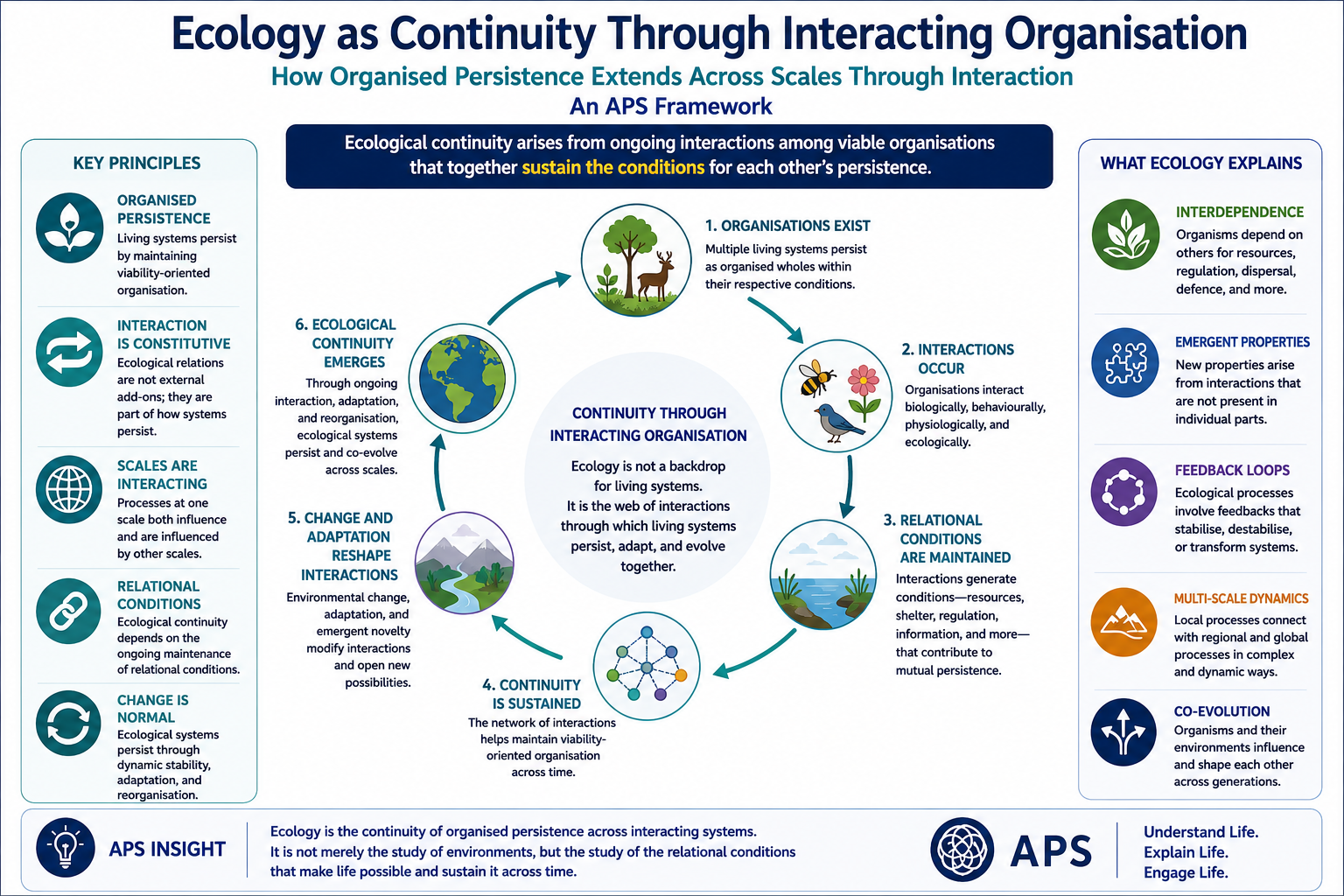
Ecological Continuity. Ecology explains how viability-oriented organised persistence emerges through organism–environment coupling. Resources, constraints, niches, and resilience contribute to continuity across developmental, evolutionary, cognitive, and social timescales.
Ecology reveals that persistence is never solely an internal achievement. Living systems remain viable through organised relations linking organisms to the ecological conditions upon which continuity depends. Ecology therefore explains one of the most fundamental dimensions of life: how continuity remains possible through ongoing organism–environment coupling across changing conditions and scales.
See Also
Related Articles
References
- (1973). Resilience and Stability of Ecological Systems. Annual Review of Ecology and Systematics, 4, 1–23 .
- (1957). Concluding Remarks. Cold Spring Harbor Symposia on Quantitative Biology, 22, 415–427 .
- (1998). Ecosystems and the Biosphere as Complex Adaptive Systems. Ecosystems, 1(5), 431–436 .
- (1968). Evolution in Changing Environments. Princeton University Press.
- (2023). Biological Functions: A Philosophical Study. Cambridge University Press.
- (2018). Everything Flows: Towards a Processual Philosophy of Biology. Oxford University Press.
- (2003). Niche Construction: The Neglected Process in Evolution. Princeton University Press.
- (1953). Fundamentals of Ecology. Saunders.
- (1983). Systems Ecology. Wiley.
- (2026). Agency as the Defining Activity of Life: A Viability-Oriented Framework Integrating Process and Scale. Biological Theory . https://doi.org/10.1007/s13752-026-00547-6
- (2003). Developmental Ecology. Oxford University Press.