Resilience, Ecology, and Continuity
APS approaches resilience as the continuity-preserving reorganisation of distributed ecological persistence systems under perturbation. Resilience is not the maintenance of stability through resistance to change, but the capacity of living systems to preserve viable continuity through adaptive reorganisation across changing conditions and interacting scales. Perturbation, adaptation, diagnosis, semiosis, temporal organisation, and ecological coupling all become intelligible through their relation to the preservation and reconstruction of continuity. APS therefore explains resilience as a central mechanism through which ecological persistence survives disruption across scale and time.
Introduction
Where this article fits: The Ecological Organisation of Life explains why ecology is indispensable to biological persistence. Organism–Environment Coupling explains how ecological persistence is generated through continuity-producing relations linking organisms and environments. This article explains how that continuity survives disruption. APS approaches resilience as the capacity of ecological persistence systems to reorganise viability under perturbation while preserving continuity across changing conditions. For a broader account of continuity across interacting ecological scales, see Ecology as Organised Persistence Across Scales.
Living systems persist under conditions of continual perturbation.
Organisms and ecological systems encounter changing climates, fluctuating resources, developmental instability, ecological disruption, disease, predation, environmental transformation, and countless other sources of uncertainty. Persistence therefore depends not upon the absence of disruption but upon the capacity of continuity systems to remain viable despite it.
This observation reveals why resilience occupies such an important place within biological explanation. Living systems survive because they continuously reorganise. Physiological regulation, behavioural flexibility, ecological redistribution, developmental plasticity, environmental modification, and adaptive transformation all contribute to the preservation of continuity under changing conditions.
APS therefore approaches resilience as:
the continuity-preserving reorganisation of distributed ecological persistence systems under perturbation.
This perspective differs significantly from conventional understandings of resilience. Resilience is often described as disturbance resistance, recovery after disruption, or return to equilibrium. APS instead treats resilience as an organisational property of persistence itself. Living systems remain resilient not because they avoid change, but because they preserve continuity through ongoing reorganisation across changing ecological conditions.
The central claim of this article is therefore:
resilience concerns the capacity of ecological continuity systems to preserve viable persistence through reorganisation under perturbation.
Why Resilience Matters
Resilience addresses one of the most fundamental questions in biology:
How does continuity survive instability?
Living systems exist within environments that are never perfectly stable. Resources fluctuate, conditions change, ecological relations reorganise, and developmental trajectories encounter disruption. If persistence depended upon static conditions, continuity would be impossible.
Yet continuity persists.
The explanation lies in the capacity of living systems to compensate for instability through ongoing reorganisation. Biological organisation continuously repairs damage, redistributes activity, modifies behaviour, reorganises ecological relations, and adjusts persistence strategies in response to changing circumstances.
Resilience therefore concerns far more than ecological recovery after disturbance. It concerns the preservation of continuity itself.
APS consequently treats resilience not as a secondary ecological property but as a central dimension of viability-oriented persistence. Continuity survives because living systems remain capable of reorganising the relations through which persistence is maintained.
Perturbation and Reorganisation
Perturbation is the condition that makes resilience necessary.
Every persistence system encounters disturbances capable of disrupting continuity. Some perturbations originate internally through developmental instability, physiological malfunction, or organisational failure. Others arise externally through environmental change, ecological disruption, predation, disease, or resource scarcity.
The significance of perturbation lies not simply in its capacity to disrupt. Perturbation reveals the organisational structure upon which continuity depends. Stable functioning often conceals ecological dependencies, coupling relations, constraint structures, and persistence vulnerabilities. Disturbance makes these continuity conditions visible.
For this reason APS treats perturbation as diagnostically informative rather than merely destructive. Perturbation exposes the organisational relations through which continuity is maintained and reveals the limits of resilience within persistence systems.
Resilience emerges through the response to perturbation.
Living systems preserve continuity by reorganising the relations that support viability. Behaviour changes, developmental pathways adjust, ecological interactions redistribute, resource use shifts, and environmental engagements are modified. Persistence is therefore preserved not by resisting change completely but by reorganising continuity-producing relations under changing conditions.
Resilience consequently depends upon reorganisation.
A rigid system may resist disruption temporarily while remaining vulnerable to collapse when conditions exceed its limits. A resilient system remains capable of modifying its organisation while preserving continuity. Resilience therefore concerns adaptive reorganisation rather than simple resistance.
Resilience and Continuity
Resilience concerns continuity preservation under perturbation.
The central resilience architecture developed by APS can be represented as:
viability
↓
perturbation
↓
adaptive reorganisation
↓
resilience
↓
continuity preservation
This structure captures the distinctive contribution of resilience to biological explanation.
Living systems remain viable not because perturbation is absent but because continuity can be reorganised when perturbation occurs. Ecological systems preserve persistence through compensation, redistribution, transformation, and reconstruction of continuity-producing relations.
Resilience therefore concerns:
the preservation of viable continuity through ecological reorganisation.
This perspective shifts attention away from static stability and toward continuity maintenance across changing conditions. Persistence becomes a dynamic achievement rather than a passive state.
Resilience consequently reveals that continuity is not preserved by remaining unchanged. Continuity is preserved by reorganising persistence-producing relations while maintaining viability.
Resilience Is Not Mere Stability
APS distinguishes resilience from stability.
The two concepts are related, but they are not identical. Stability concerns the tendency of a system to maintain particular states or patterns under specified conditions. Resilience concerns the capacity of a system to preserve continuity when those conditions change.
This distinction is especially important in ecology.
A highly rigid system may appear stable while environmental circumstances remain favourable. Yet the same rigidity may render it vulnerable when perturbations exceed its capacity for adjustment. Stability can therefore coexist with fragility.
Resilience operates differently. Resilient systems remain capable of reorganising activity, redistributing constraints, modifying ecological relations, and transforming persistence strategies in response to changing conditions. Change is not necessarily a threat to resilience. It is often the means through which continuity is preserved.
Ecological systems frequently remain resilient precisely because they can adapt, compensate, and reorganise. Forest succession, behavioural flexibility, trophic redistribution, developmental plasticity, and ecological recovery all involve forms of continuity preservation achieved through transformation rather than stasis.
APS therefore approaches resilience dynamically rather than equilibrium-centredly. Persistence is maintained not by preventing change but by reorganising continuity-producing relations as conditions evolve.
Resilience Is Ecological
Resilience cannot be understood solely at the level of isolated organisms.
Persistence depends continuously upon ecological conditions extending beyond individual biological boundaries. Organisms rely upon energetic flows, environmental resources, trophic relations, microbial communities, climatic conditions, developmental environments, and countless forms of ecological organisation that contribute to viability.
For this reason resilience is fundamentally ecological.
Living systems remain viable partly because they participate in distributed persistence systems extending across organisms, environments, and ecological relations. Continuity is therefore not produced by organisms alone but by wider continuity structures linking biological activity to ecological conditions.
Resilience emerges within these distributed systems.
The capacity of a population to survive environmental disruption, the ability of ecosystems to reorganise after disturbance, the persistence of developmental pathways under changing conditions, and the recovery of ecological interactions following perturbation all depend upon continuity relations extending across multiple levels of organisation.
APS consequently approaches resilience ecologically rather than individualistically. Resilience concerns the preservation of continuity within distributed persistence systems rather than within isolated biological entities.
Resilience and Environmental Coupling
The ecological character of resilience becomes clearer when viewed through organism–environment coupling.
Living systems remain continuously coupled to environmental conditions affecting persistence. Resources, climatic patterns, trophic relations, microbial ecologies, behavioural environments, and developmental conditions all contribute to the continuity of biological organisation.
These coupling relations are reciprocal.
Environmental change reorganises persistence conditions, while living systems simultaneously modify ecological organisation through their own activities. Organisms alter habitats, restructure ecological interactions, redistribute resources, modify environmental conditions, and influence the persistence opportunities available to themselves and other organisms.
Resilience therefore emerges through the reorganisation of coupling relations.
When perturbation occurs, continuity is preserved because organism–environment systems remain capable of reorganising the relations through which viability is sustained. Behaviour may change, ecological interactions may shift, developmental processes may adjust, and environmental engagement may be redistributed. These changes preserve continuity by reorganising the coupling systems upon which persistence depends.
APS consequently approaches resilience as:
continuity-preserving reorganisation within distributed organism–environment coupling systems.
Resilience Across Scale and Time
Resilience operates across interacting spatial and temporal scales.
Continuity may be preserved through physiological regulation occurring over seconds, behavioural adjustment unfolding over hours or days, developmental plasticity operating across lifetimes, ecological reorganisation occurring over decades, or evolutionary diversification extending across generations.
No single scale provides a complete explanation of resilience.
Persistence survives because continuity-producing relations connect multiple scales simultaneously. Physiological organisation contributes to behavioural flexibility. Behaviour influences ecological participation. Ecological conditions shape developmental trajectories. Development affects adaptive possibilities. Evolutionary history influences future resilience capacities.
Resilience therefore emerges through distributed continuity relations extending across interacting scales and timescales.
This perspective aligns resilience directly with the broader APS understanding of ecological organisation. Continuity is not localised at a single level of organisation but propagated through relations linking multiple levels together.
The resilience of ecological systems therefore depends not only upon what occurs at individual scales, but upon how continuity is coordinated across them.
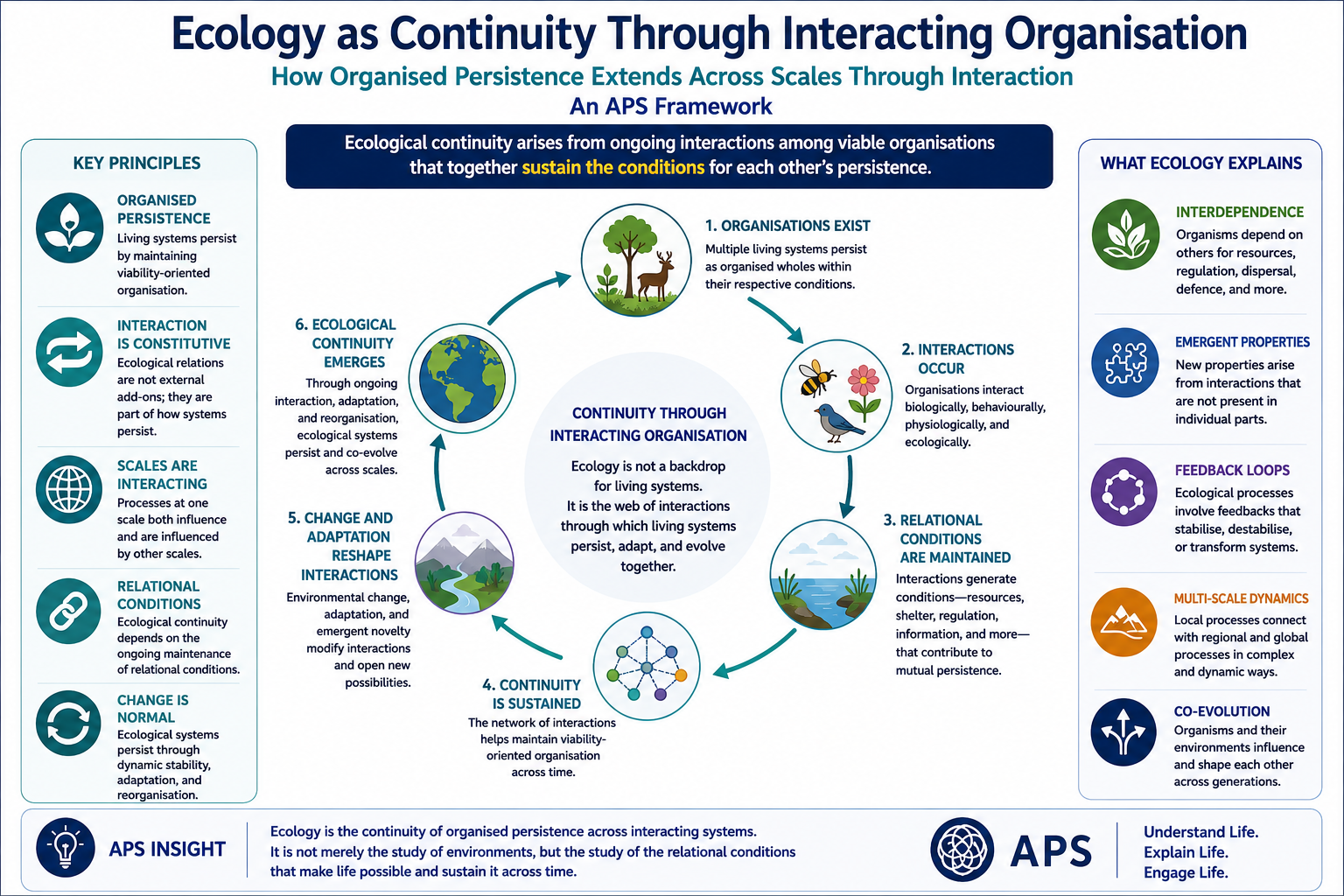
Ecological Continuity and Resilience. APS interprets resilience as continuity-preserving ecological reorganisation distributed across organisms, environments, trophic relations, perturbation dynamics, and adaptive persistence systems operating across interacting scales and temporal conditions.
Resilience and Adaptation
Resilience and adaptation are closely related but distinct dimensions of persistence.
Both concern the maintenance of viability under changing conditions, yet they operate in different ways and across different timescales.
Resilience concerns:
the preservation of continuity through reorganisation under perturbation.
Adaptation concerns:
the historical transformation of persistence organisation across changing conditions.
Resilience enables continuity to survive disruption in the present. Adaptation alters the organisational capacities through which future continuity becomes possible.
The two processes therefore interact continuously.
Perturbation may generate selective pressures that drive adaptive transformation. Adaptive changes may in turn increase the resilience of persistence systems by expanding their capacity for reorganisation under future conditions. Ecological systems therefore preserve continuity not only through immediate resilience but also through the longer-term adaptive transformation of persistence organisation.
APS consequently approaches resilience and adaptation as complementary dimensions of ecological continuity. Resilience preserves continuity through reorganisation, while adaptation transforms the organisation through which continuity can be preserved.
Resilience and Semiosis
Resilience also possesses an important semiosic dimension.
Living systems do not respond passively to perturbation. They continually evaluate ecological conditions relative to viability. Environmental cues, behavioural signals, gradients, affordances, and ecological indicators contribute to how organisms and persistence systems respond to changing circumstances.
For this reason resilience depends partly upon meaningful environmental differentiation.
Ecological continuity can be preserved only when relevant differences become available for persistence-oriented regulation. Organisms must distinguish opportunities from threats, resources from hazards, and favourable conditions from adverse ones. Resilience therefore depends not only upon material organisation but also upon the capacity to detect and respond to viability-relevant differences.
Semiosis contributes directly to resilience because continuity-preserving reorganisation requires information about changing conditions. Behavioural modification, ecological adjustment, developmental flexibility, and adaptive response all depend upon the interpretation of ecological significance.
APS consequently approaches resilience not merely materially but semiosically. Persistence survives perturbation partly because ecological systems remain capable of responding meaningfully to changing conditions.
Resilience and Diagnosis
Resilience occupies a central place within diagnosis.
Perturbation reveals the continuity structures upon which persistence depends. Disturbance exposes vulnerabilities, resilience limits, dependency relations, adaptive capacities, and organisational thresholds that often remain hidden during periods of stable functioning.
Diagnosis therefore concerns more than identifying isolated failures.
APS approaches diagnosis as the analysis of continuity under perturbation. Understanding resilience requires understanding how continuity responds when persistence conditions change, how reorganisation occurs, and where the limits of compensation and adaptation lie.
This perspective links diagnosis directly to resilience.
The resilience of a persistence system can often be evaluated by examining how continuity responds to disruption. The capacity for recovery, compensation, redistribution, and reorganisation reveals important features of underlying biological organisation.
Diagnosis therefore becomes:
continuity analysis under perturbation.
APS consequently integrates resilience directly with diagnosis, perturbation analysis, ecological organisation, and persistence theory.
Why APS Reframes Resilience
Many conventional approaches treat resilience primarily as disturbance resistance, ecosystem recovery, or return to equilibrium following disruption.
These approaches capture important aspects of resilience but often leave unexplained why continuity remains possible under changing conditions.
APS reframes resilience organisationally.
The central question is not whether a system returns to a previous state. The central question is how viable continuity is preserved when conditions change.
This shift changes the explanatory focus.
Resilience becomes a property of persistence systems rather than merely a measure of recovery. Ecological organisation, environmental coupling, adaptive redistribution, semiosis, temporal organisation, and multiscale continuity all contribute to the preservation of viable persistence under perturbation.
APS therefore integrates resilience directly into the broader explanatory architecture of biology. Resilience becomes a central mechanism through which continuity survives disruption across ecological systems.
Resilience and Biological Explanation
Resilience reveals how living systems persist under instability.
Biological explanation therefore requires understanding how perturbation propagates through persistence systems, how continuity reorganises under changing conditions, how ecological relations redistribute constraints, and how viability is preserved despite disruption.
This perspective extends beyond ecology alone.
Development, behaviour, adaptation, semiosis, diagnosis, and evolution all involve forms of continuity preservation under changing conditions. Resilience therefore functions as a bridge connecting multiple domains of biological explanation.
APS consequently approaches resilience as one of the principal explanatory interfaces through which ecological organisation becomes visible.
Resilience reveals continuity structure.
Understanding resilience therefore contributes directly to understanding how living systems preserve viability across scale and time.
Conclusion
APS approaches resilience as the continuity-preserving reorganisation of distributed ecological persistence systems under perturbation.
Living systems remain viable not because they avoid instability entirely, but because continuity can be preserved through compensation, redistribution, transformation, and reorganisation across changing ecological conditions.
Resilience therefore concerns the preservation of viable continuity through ecological reorganisation.
Perturbation reveals the dependencies upon which continuity relies, while reorganisation preserves viability under changing conditions. Across ecological systems, developmental processes, behavioural organisation, adaptation, and semiosis, persistence is maintained through the capacity of continuity systems to reorganise when continuity is threatened.
Resilience consequently reveals that continuity is not preserved by resisting change. It is preserved by reorganising persistence-producing relations while maintaining viability.
APS therefore explains resilience not as static resistance or equilibrium recovery but as the continuity-preserving organisation of distributed ecological persistence systems across scale and time.
Related Pathways
- The Ecological Organisation of Life
- Organism–Environment Coupling
- Ecology as Organised Persistence Across Scales
- Temporal Organisation and Organised Persistence
- Diagnosis as Continuity Analysis
- Adaptation — How Living Systems Sustain Themselves Through Change
Key Terms
resilience · ecology · continuity · perturbation · adaptation · viability · persistence · ecological coupling · semiosis · diagnosis · reorganisation · temporality
See Also
Related Articles
References
- (2011). Incomplete Nature. W. W. Norton.
- (1973). Resilience and Stability of Ecological Systems. Annual Review of Ecology and Systematics.
- (1998). Ecosystems and the Biosphere as Complex Adaptive Systems. Ecosystems.
- (2015). Biological Autonomy. Springer.
- (2019). Everything Flows. Oxford University Press.
- (2003). Niche Construction. Princeton University Press.
- (2026). Agency as the Defining Activity of Life: A Viability-Oriented Framework Integrating Process and Scale. Biological Theory . https://doi.org/10.1007/s13752-026-00547-6