The Social Organisation of Life
Social organisation is not an exception to life's organising principles but one of their most historically extended expressions. In APS, social systems emerge when coordinated interactions among organisms contribute to organised persistence across time and scale. Communication, social norms, symbolic coordination, culture, cultural inheritance, institutions, and technology form a continuity architecture through which social organisation becomes increasingly stabilised, transmissible, and historically extended. This article synthesises the APS social layer and explains how organised persistence becomes socially distributed through mechanisms that preserve, reproduce, stabilise, and extend continuity across generations.
Why Social Organisation Matters
Life does not exist solely as a collection of isolated organisms.
Across the living world, organisms continually interact with one another. They communicate, cooperate, compete, learn, coordinate activities, share resources, modify environments, and participate in relationships that influence their prospects for persistence. These interactions are not merely incidental features of biological existence. In many cases they become integral components of the processes through which continuity is maintained.
This observation reveals something important about life itself.
The persistence of living systems is often discussed at the level of individual organisms. Organisms regulate internal conditions, maintain viability, repair damage, adapt to changing circumstances, and preserve continuity through time. Yet many forms of continuity depend upon activities that extend beyond the boundaries of any individual organism. Persistence increasingly becomes a distributed achievement.
The living world provides countless examples of this phenomenon. Microbial communities coordinate activities across populations. Social insects organise collective forms of behaviour. Vertebrate groups engage in communication, cooperation, and social learning. Human societies preserve knowledge, coordinate activities across vast populations, and maintain institutions capable of surviving for centuries.
In each case, continuity is no longer confined to the individual.
It becomes organised across relationships.
APS begins with this insight.
Rather than treating society as a separate realm requiring fundamentally different explanatory principles, APS asks how organised persistence becomes distributed across interacting organisms. The central challenge is therefore not simply to explain why organisms form groups. It is to understand how continuity itself becomes socially organised.
This shift in perspective changes the question.
Instead of asking:
Why do organisms form groups?
APS asks:
How does organised persistence become socially distributed?
The answer unfolds through the continuity architectures explored throughout the social domain. Communication, norms, symbolic systems, culture, inheritance, institutions, and technology all contribute to forms of continuity that extend beyond individual organisms. Together they reveal how persistence becomes coordinated, stabilised, reproduced, and historically extended across populations and generations.
Social organisation therefore represents one of the most powerful expansions of continuity found anywhere in the living world.
Social Organisation as Organised Persistence
Many traditional approaches to social explanation begin with individuals and attempt to explain how larger social structures emerge from their interactions. Social systems are treated as collections of separate organisms whose activities somehow combine to generate collective outcomes.
APS approaches the problem from a different direction.
The starting point is not the individual or the collective. The starting point is organised persistence itself.
Living systems continually generate forms of organisation that contribute to viability across changing conditions. Organisms regulate activities, maintain ecological relationships, repair damage, coordinate internal processes, and preserve continuity despite ongoing transformation. Persistence is therefore not a passive state but an active organisational achievement.
The significance of social organisation becomes visible when this continuity-preserving activity begins to operate across multiple organisms simultaneously.
Interactions are no longer merely encounters among separate individuals. They begin contributing to forms of continuity that depend upon coordinated activity. Behaviour becomes mutually responsive. Organisational resources become shared. Information becomes distributed. Activities become aligned in ways that allow persistence to operate across broader scales than any single organism could achieve alone.
This is the point at which social organisation emerges.
The distinction is important because social organisation is not simply aggregation.
A crowd is not necessarily a social system. A collection of organisms does not automatically constitute social organisation. Mere proximity is insufficient. What matters is whether interactions become organised in ways that contribute to continuity through time.
Communication can contribute to this process.
Cooperation can contribute to this process.
Learning, collective defence, behavioural regulation, resource sharing, and shared expectations can all contribute to this process.
What unites these diverse phenomena is that they allow continuity to become distributed across interacting organisms whose activities increasingly support one another.
Social organisation therefore emerges when organised persistence itself becomes coordinated.
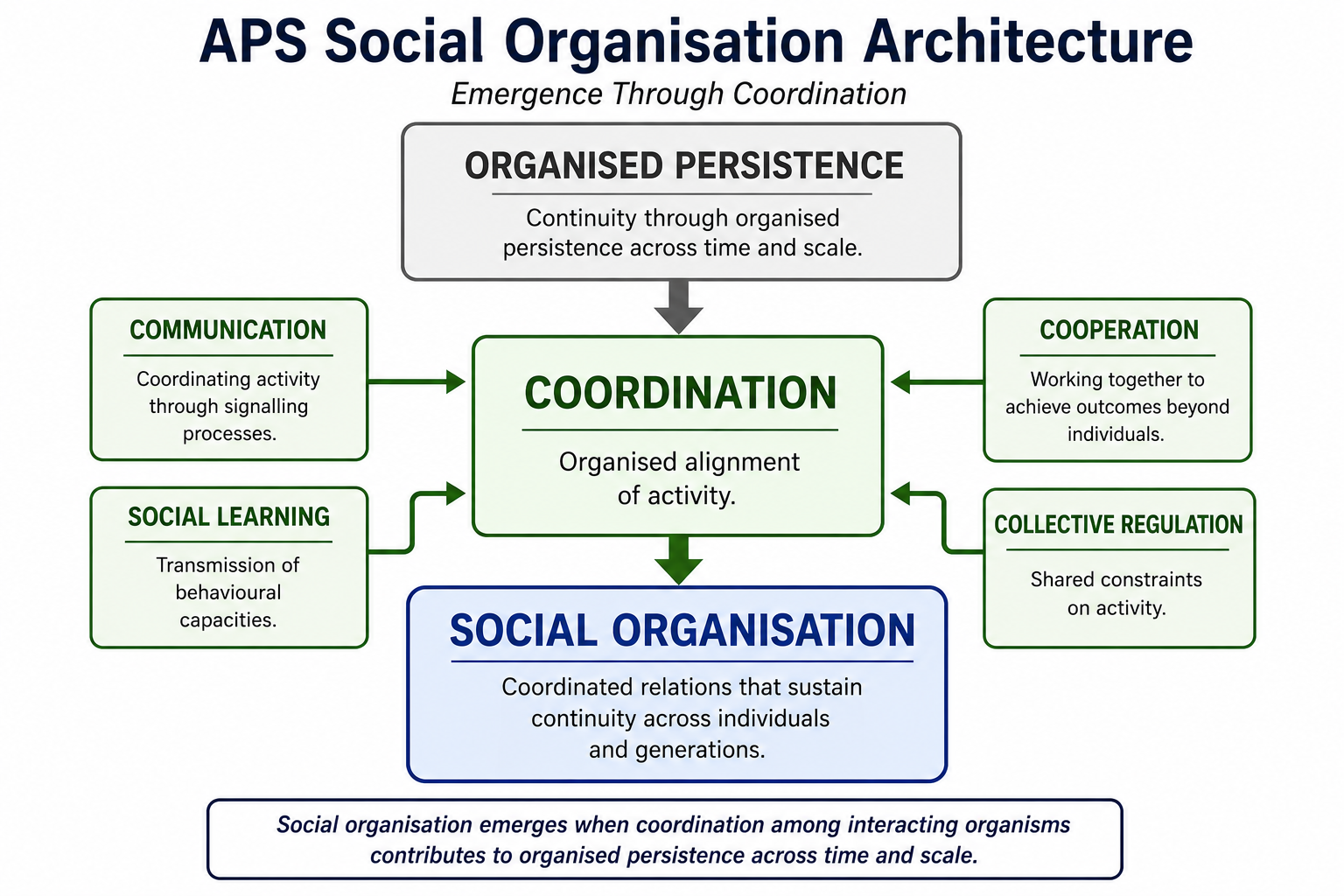
Social Organisation as Organised Persistence. Social organisation emerges when coordinated interactions among organisms contribute to continuity across populations and through time. Organised persistence provides the explanatory foundation, while coordination provides the central mechanism through which continuity becomes socially distributed.
This transition has profound consequences.
Once continuity becomes distributed across multiple organisms, entirely new organisational possibilities emerge. Activities can be coordinated across larger populations. Knowledge can accumulate. Behaviour can become increasingly structured. Organisational resources can persist beyond the lifespan of individual participants.
Importantly, this does not eliminate individual agency.
Nor does it require the existence of some independent collective entity existing above or apart from organisms. APS rejects both reductionist and reified accounts of social systems. Social organisation is neither reducible to isolated individuals nor separable from them.
Instead, continuity becomes distributed across networks of interacting agents whose coordinated activities generate forms of persistence extending beyond any single participant.
From Biological Organisation to Social Organisation
Understanding social organisation therefore requires understanding its biological foundations.
Social systems do not emerge from nowhere. They develop from capacities already present throughout the living world. Organisms communicate, respond to signals, regulate interactions, modify environments, learn from one another, and participate in forms of collective activity long before the appearance of complex human societies.
The roots of sociality therefore run deep within biology.
Cells coordinate activities within multicellular organisms. Organisms coordinate activities within ecological communities. Many species engage in signalling, cooperation, parental care, collective defence, social learning, and forms of behavioural regulation that contribute to continuity beyond the individual organism.
These activities do not yet constitute human society, but they reveal organisational capacities upon which more elaborate forms of social continuity can be built.
Human societies represent a remarkable extension of this process rather than an exception to it.
For this reason APS rejects sharp discontinuities between biological and social organisation. The social layer introduces new forms of continuity, but those forms remain grounded in the same general principles of organisation, coordination, constraint, and persistence that operate throughout life more broadly.
The relationship is therefore one of extension rather than replacement.
Social organisation does not abandon biological organisation.
It expands it.
Continuity becomes increasingly distributed, increasingly coordinated, and increasingly capable of operating across larger populations and longer timescales. The social world emerges as a historically extended expression of continuity-preserving processes already present within life itself.
The Challenge of Social Continuity
The expansion of continuity beyond the individual organism creates new possibilities.
It also creates new problems.
As continuity becomes distributed across larger populations, maintaining organisation becomes increasingly difficult. Small groups may coordinate activities through direct interaction alone. Participants can respond to one another, adjust behaviour, and preserve forms of local continuity without requiring elaborate organisational mechanisms.
Larger and more historically extended systems face a different challenge.
How can continuity be maintained across populations whose members continually change?
How can expectations remain reliable despite turnover among participants?
How can knowledge survive across generations?
How can coordinated activity remain stable despite changing ecological and social circumstances?
These questions define what APS calls the challenge of social continuity.
The problem is not simply interaction.
The problem is persistence.
Continuity must somehow survive despite demographic turnover, environmental change, historical transformation, and the continual arrival of new participants who did not contribute to the original organisation of the system.
Direct interaction alone is often insufficient.
As social systems become larger and more complex, continuity requires increasingly reliable mechanisms for preserving organisational resources. Communication must become more stable. Expectations must become more predictable. Shared meanings must become more durable. Organisational capacities must become reproducible through time.
The challenge of social continuity therefore leads directly to the central explanatory problem of the social domain:
the coordination problem.
How continuity becomes coordinated across multiple organisms, and how that coordination becomes increasingly stable, transmissible, and historically extended, forms the organising narrative of everything that follows.
Communication and the Coordination Problem
The challenge of social continuity immediately raises a practical question.
If continuity is to become distributed across multiple organisms, how are their activities coordinated in the first place?
No social system can persist if participants remain entirely independent of one another. Coordination requires organisms to become responsive to shared conditions, mutual expectations, collective opportunities, and common threats. Activities must be aligned sufficiently for continuity to emerge at scales larger than the individual organism.
Communication provides one of the most important solutions to this problem.
At its most basic level, communication allows the activities of one organism to influence the activities of another. Signals can convey information about resources, dangers, opportunities, intentions, or environmental conditions. Responses become increasingly coordinated because organisms no longer depend solely upon direct individual experience.
The significance of communication therefore extends far beyond information transfer.
Communication allows continuity-relevant information to become distributed across populations. Organisms can benefit from the experiences, perceptions, and activities of others. The social system begins to acquire capacities that exceed those available to isolated individuals.
This expansion has profound consequences.
Groups become capable of coordinating collective action. Individuals can respond to conditions they have not personally encountered. Social systems can react more rapidly to changing circumstances. Organisational resources become increasingly shared.
Communication thus represents a major expansion of continuity-preserving capacity.
Yet communication alone cannot fully solve the problem of social continuity.
Signals may be misunderstood.
Participants may behave unpredictably.
Coordination may break down.
As social systems become larger and more complex, continuity requires forms of organisation that extend beyond moment-to-moment interaction.
The need for greater stability leads naturally to the emergence of norms.
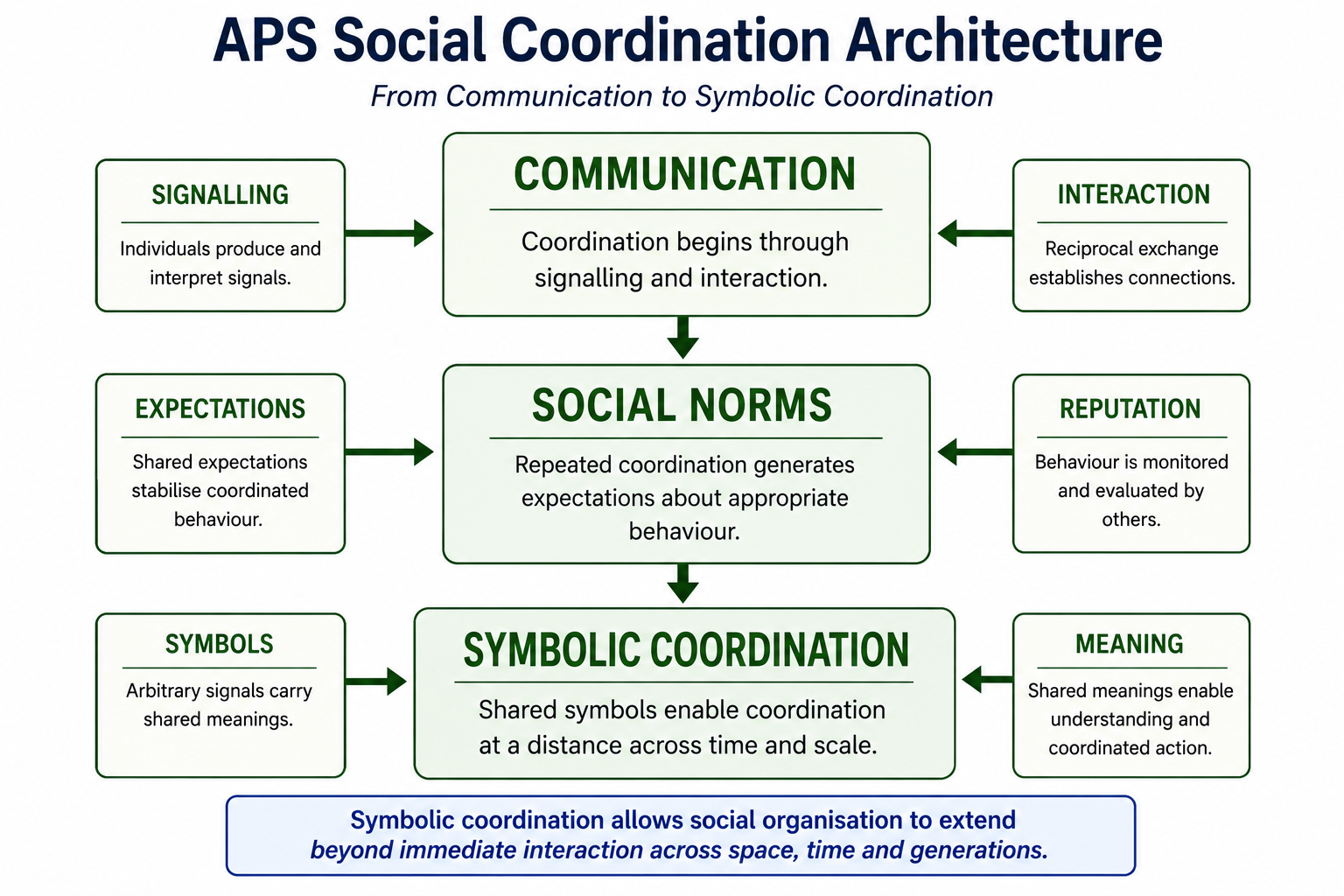
Communication and Coordination. Communication allows continuity-relevant information to become distributed across interacting organisms. Coordination emerges as activities become increasingly aligned through shared signals, expectations, and responses.
Norms and the Stabilisation of Expectations
Communication makes coordination possible.
Norms make coordination reliable.
This distinction is central to understanding the emergence of social organisation.
A social system based solely upon immediate communication would remain highly fragile. Participants would need continually to renegotiate expectations, reconstruct patterns of behaviour, and re-establish coordination each time circumstances changed. Continuity would remain possible, but it would be difficult to preserve across larger populations or longer periods of time.
Norms address this problem.
Norms stabilise expectations by establishing relatively durable patterns of behaviour that participants come to recognise, anticipate, and reproduce. They provide guidance about how members of a social system are likely to act under particular circumstances and therefore reduce the uncertainty that would otherwise accompany social interaction.
The importance of this achievement should not be underestimated.
Continuity becomes easier to maintain when expectations become predictable. Coordination no longer depends entirely upon continual negotiation because participants already possess shared understandings about appropriate behaviour. Social organisation acquires a degree of stability that moment-to-moment communication alone cannot provide.
Norms therefore function as continuity-preserving structures.
They reduce organisational friction.
They facilitate cooperation.
They stabilise social expectations.
They make larger and more enduring forms of social organisation possible.
Importantly, norms are not necessarily formal rules.
Many operate implicitly through repeated interaction and shared experience. Participants learn behavioural expectations through involvement in social life itself. Over time, these expectations become increasingly self-reinforcing because coordinated behaviour contributes directly to continuity.
The emergence of norms thus marks a significant developmental step within the social domain.
Communication coordinates activity.
Norms stabilise coordination.
The continuity architecture becomes more durable.
Yet even norms face limitations. If continuity is to extend across larger populations, longer timescales, and increasingly complex forms of organisation, social systems require ways of preserving and transmitting meaning itself.
This requirement leads to symbols.
Symbols and the Expansion of Social Continuity
Symbols transform the possibilities available to social organisation.
Communication and norms already allow continuity to become distributed across interacting organisms, but both remain constrained by immediate contexts. Symbolic systems extend continuity far beyond these limitations by allowing meanings to become preserved, reproduced, and transmitted independently of particular interactions.
This capacity dramatically expands the scale at which continuity can operate.
A symbol can preserve meaning across time.
It can preserve meaning across space.
It can preserve meaning across changing participants.
The continuity of social organisation therefore becomes increasingly independent of any particular interaction or individual organism.
Language provides the most familiar example.
Words allow meanings to remain available long after the original circumstances that produced them have disappeared. Knowledge can accumulate. Instructions can be preserved. Collective memories can be maintained. Future actions can be coordinated relative to shared symbolic frameworks.
The significance of symbols therefore lies not merely in representation.
Symbols preserve continuity.
They allow organisational resources to remain available across historical time and across changing social contexts. Meanings become durable components of social organisation rather than fleeting products of immediate interaction.
This transformation alters the nature of social systems themselves.
Continuity is no longer maintained solely through ongoing participation. It becomes embedded within symbolic structures capable of surviving changes in membership and circumstance. Social organisation acquires historical depth.
The social domain begins to develop memory.
Symbols therefore represent one of the most important continuity technologies ever produced by life.
They allow continuity to become increasingly transmissible, cumulative, and historically extended.
Culture and the Preservation of Organised Continuity
Once symbolic systems emerge, a further possibility becomes available.
Continuity can now accumulate.
Experiences, practices, meanings, skills, and organisational resources need no longer disappear with the individuals who first generated them. Instead, they can be preserved, shared, modified, and transmitted across populations and generations.
This accumulation gives rise to culture.
APS understands culture as a continuity-preserving organisation through which socially acquired resources are maintained and reproduced through time. Culture is not simply a collection of ideas or behaviours. It is an organised system that allows continuity to extend beyond the lifespan of individual participants.
The importance of culture follows directly from the challenge of social continuity.
Without mechanisms for preserving socially acquired knowledge, every generation would be forced to begin again. Organisational achievements would repeatedly disappear. Collective learning would remain shallow and fragile.
Culture solves this problem.
Through cultural processes, continuity becomes cumulative. Organisational resources generated in one historical context remain available within later contexts. Knowledge accumulates. Practices persist. Shared meanings become stabilised. Social systems acquire increasingly rich historical foundations upon which future developments can be built.
The consequences are transformative.
Social continuity is no longer limited to what individuals can remember or directly communicate. Entire populations become capable of preserving organisational resources across generations. Continuity acquires historical depth that far exceeds individual lifetimes.
Culture therefore represents one of the most powerful continuity architectures within the social domain.
Yet culture introduces a new challenge.
If cultural resources are to persist reliably through time, they must themselves be reproduced. Continuity requires mechanisms through which socially acquired organisation can be transmitted across generations and historical transitions.
This problem leads directly to cultural inheritance.
Cultural Inheritance and Historical Continuity
The emergence of culture transforms the scale at which continuity can operate.
Knowledge, practices, meanings, skills, and behavioural traditions can now persist beyond the individuals who first generated them. Yet the existence of cultural resources alone does not guarantee their survival. Continuity remains fragile unless mechanisms exist through which these resources can be reproduced across time.
This requirement gives rise to cultural inheritance.
Biological inheritance preserves continuity across generations through developmental and reproductive processes. Cultural inheritance performs an analogous function within the social domain. It allows socially acquired organisational resources to be transmitted, preserved, modified, and re-established across successive generations of participants.
The significance of this achievement is difficult to overstate.
Without cultural inheritance, continuity would remain confined largely to immediate interactions and personal experience. Organisational resources would continually disappear as individuals died or groups dissolved. The cumulative character of social organisation would be impossible to sustain.
Cultural inheritance changes this situation fundamentally.
Skills can be taught.
Knowledge can be preserved.
Practices can be reproduced.
Meanings can be transmitted.
Collective achievements can remain available long after their original creators have disappeared.
Continuity therefore acquires a new temporal depth.
The social domain becomes capable of preserving organisational resources across historical timescales far exceeding individual lifespans. Social systems increasingly depend not merely upon biological continuity but upon the continuity of inherited cultural organisation.
This development marks one of the most important transitions in the history of life.
Persistence becomes distributed across multiple inheritance systems. Biological inheritance remains essential, but it is joined by social processes capable of preserving and transmitting continuity in new ways.
The result is a social world that becomes progressively more historical.
Each generation inherits not only biological capacities but also accumulated organisational resources that shape future possibilities.
Culture therefore does not simply preserve continuity.
It allows continuity to accumulate.
Institutions and the Organisation of Social Stability
As cultural continuity expands, social systems confront a familiar challenge.
How can continuity remain stable despite ongoing change?
Participants enter and leave social systems. Circumstances evolve. Ecological conditions fluctuate. New problems emerge. Yet many forms of social organisation persist across decades, centuries, and sometimes even longer periods of time.
The answer lies partly in the emergence of institutions.
Institutions can be understood as organised structures that stabilise continuity across changing populations and circumstances. They preserve expectations, coordinate activities, regulate behaviour, and maintain organisational resources in ways that remain relatively independent of particular individuals.
This independence is crucial.
A social system that depends entirely upon the continued participation of specific individuals remains highly fragile. Institutions reduce this fragility by embedding continuity within durable organisational structures capable of surviving demographic turnover and historical change.
The continuity-preserving role of institutions appears in many forms.
Educational systems preserve knowledge.
Legal systems stabilise expectations.
Scientific institutions preserve methods of inquiry.
Economic institutions coordinate the distribution of resources.
Political institutions organise collective decision-making.
In each case, continuity becomes increasingly detached from particular individuals and increasingly embedded within enduring organisational arrangements.
Institutions therefore represent a major advance in the social architecture of persistence.
They do not eliminate change.
Rather, they provide frameworks through which change can occur without destroying continuity.
This is one of the reasons institutions occupy such a central position within the APS account of social organisation. They allow continuity to remain stable while accommodating transformation, much as developmental organisation allows organisms to preserve continuity through biological change.
The same continuity logic appears at both levels.
Persistence is not achieved by preventing change.
Persistence is achieved by organising change.
Technology and the Extension of Organised Persistence
The emergence of institutions creates the conditions for a further expansion of social continuity.
Organisational resources can now be preserved, coordinated, and reproduced with increasing reliability. Yet social systems continue to seek new ways of extending their continuity-preserving capacities beyond the limits imposed by direct interaction, memory, and existing organisational structures.
Technology emerges within this context.
APS interprets technology not merely as a collection of tools but as a continuity-extending organisation through which living systems modify the conditions under which persistence occurs. Technologies alter the ways information is stored, transmitted, coordinated, and utilised. They expand the capacity of social systems to preserve continuity across space, time, and scale.
The historical significance of this process is immense.
Writing extended memory beyond individual minds.
Printing extended the preservation and dissemination of knowledge.
Transportation technologies extended coordination across distance.
Communication technologies extended social responsiveness across entire populations.
Digital technologies have extended continuity-preserving capacities to scales previously unimaginable.
In every case, technology functions as an amplifier of social continuity.
It allows organisational resources to persist more reliably, circulate more widely, and remain accessible across increasingly complex social systems.
This does not mean that technology exists independently of culture or institutions.
On the contrary, technology emerges from and depends upon broader social organisation. It is best understood as one component within a larger continuity architecture through which social systems preserve and extend organisational capacities across historical time.
Technology therefore represents not a departure from the social domain but one of its most sophisticated expressions.
The social organisation of life becomes capable of preserving continuity through increasingly elaborate organisational infrastructures.
Social Organisation as a Continuity Architecture
At this point the broader significance of the social domain becomes visible.
Communication, norms, symbols, culture, inheritance, institutions, and technology are often studied as separate topics. APS instead interprets them as successive developments within a common continuity architecture.
The sequence is not arbitrary.
Communication allows coordination.
Norms stabilise coordination.
Symbols preserve and transmit meaning.
Culture accumulates continuity.
Inheritance reproduces continuity across generations.
Institutions stabilise continuity across populations.
Technology extends continuity across larger scales and longer timescales.
Each development addresses limitations encountered by the previous one. Together they explain how organised persistence becomes increasingly distributed across interacting organisms.
The social domain therefore possesses a coherent explanatory logic.
It is not merely a collection of social phenomena.
It is an architecture through which continuity becomes coordinated, stabilised, reproduced, accumulated, and historically extended.
This perspective helps explain why social organisation occupies such an important position within APS.
Development explains continuity through transformation.
Ecology explains continuity through coupling.
Evolution explains continuity through historical transformation.
Cognition explains continuity through evaluation.
Social organisation explains continuity through coordination.
Each continuity architecture addresses a different aspect of the same underlying phenomenon: the viability-oriented organised persistence of life.
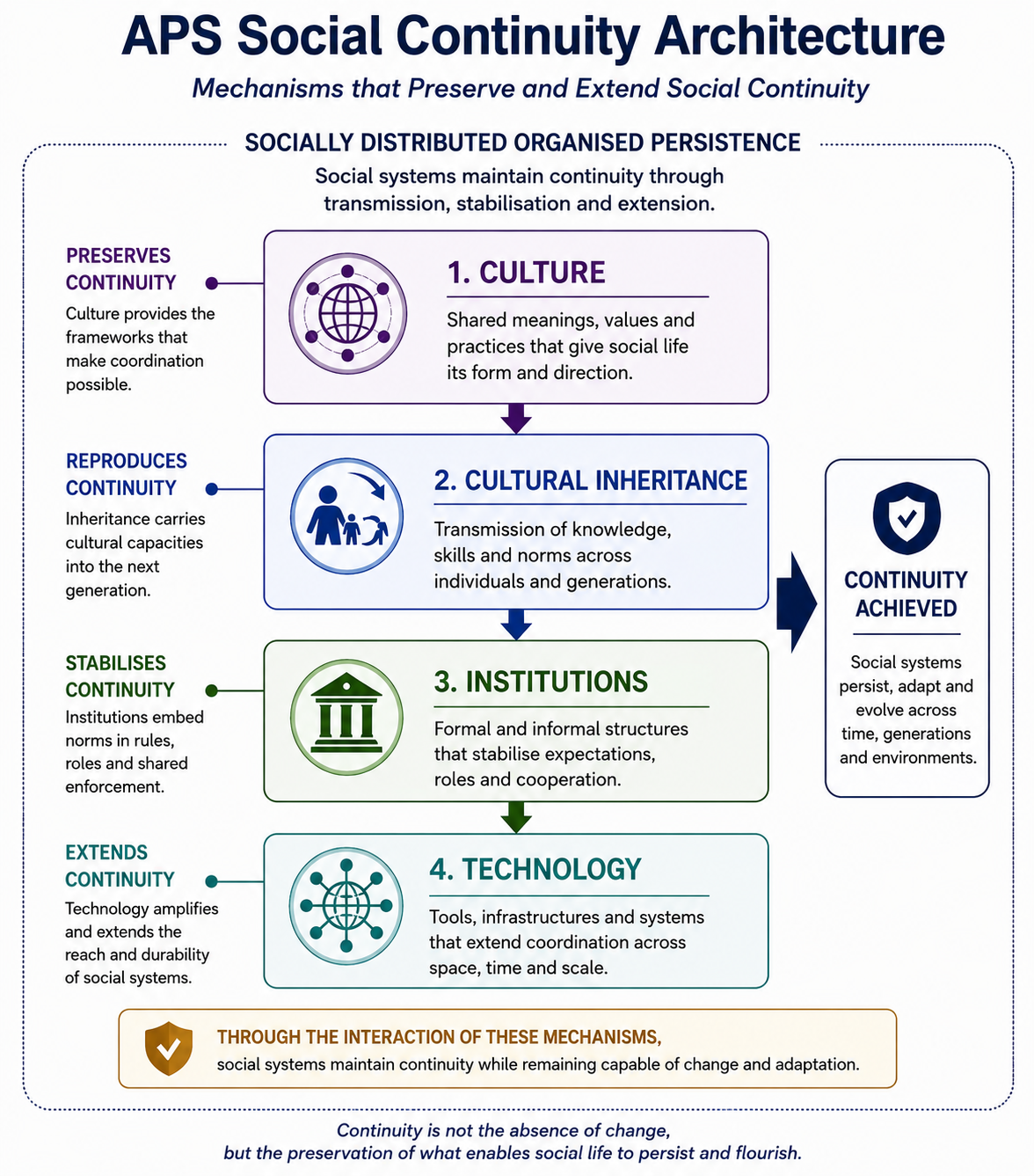
Social Continuity. Communication, norms, symbols, culture, inheritance, institutions, and technology progressively expand the capacity of social systems to preserve continuity across populations, generations, and historical timescales.
The Social Organisation of Life
The APS synthesis of social organisation begins with a simple observation.
Life does not persist solely through isolated organisms.
Across the living world, continuity increasingly depends upon relationships among organisms whose activities become coordinated in ways that support persistence. Social organisation emerges when organised continuity becomes distributed across these relationships and begins operating at scales larger than any individual participant.
This perspective changes how sociality is understood.
Social systems are not merely collections of organisms.
Nor are they independent entities existing apart from the organisms that compose them.
They are continuity-preserving organisations emerging through coordinated interactions among living agents.
Communication, norms, symbols, culture, inheritance, institutions, and technology all contribute to this process. Together they allow continuity to become increasingly stable, transmissible, cumulative, and historically extended.
The result is one of the most powerful continuity architectures found anywhere in the living world.
Social organisation enables forms of persistence that no isolated organism could achieve alone.
It allows knowledge to accumulate.
It allows cooperation to expand.
It allows continuity to survive across generations and historical transformations.
The social organisation of life therefore reveals how persistence can become a collective achievement.
Conclusion
The social domain exists because continuity becomes increasingly distributed across interacting organisms.
Communication allows activities to become coordinated. Norms stabilise expectations. Symbols preserve meaning. Culture accumulates organisational resources. Cultural inheritance reproduces continuity across generations. Institutions stabilise continuity across changing populations. Technology extends continuity across larger scales and longer timescales.
Together these developments reveal a common pattern.
Social organisation emerges whenever continuity becomes coordinated across relationships rather than remaining confined to isolated individuals.
APS therefore interprets sociality not as a separate realm standing apart from biology but as a further elaboration of continuity-preserving organisation. The same principles of viability, persistence, coordination, and organised continuity that operate throughout life remain visible within the social domain, although expressed through increasingly sophisticated forms.
The social organisation of life demonstrates that continuity can become collective.
Life persists not only through organisms.
It also persists through the relationships that connect them.
Where to Go Next
- The Developmental Organisation of Life
- The Ecological Organisation of Life
- The Evolutionary Organisation of Life
- The Cognitive Organisation of Life
- Communication
- Norms
- Symbols
- Culture
- Institutions
- Technology
Together these pathways explore how continuity becomes distributed, coordinated, and historically extended across the social world.
See Also
Related Articles
References
- (1995). The Major Transitions in Evolution. Oxford University Press.
- (2003). Niche Construction: The Neglected Process in Evolution. Princeton University Press.
- (2026). Agency as the Defining Activity of Life: Organised Persistence and the Continuity Principle. Biological Theory . https://doi.org/10.1007/s13752-026-00547-6
- (2012). The Evolved Apprentice. MIT Press.
- (2014). A Natural History of Human Thinking. Harvard University Press.
- (2019). This View of Life. Pantheon.