APS and Norms: How Social Systems Regulate Organised Persistence
APS interprets social norms as continuity-preserving coordination constraints that emerge from evaluative activity and contribute to the organised persistence of social systems. Rather than treating norms as merely subjective beliefs, conventions, or external rules, APS understands them as organisational structures that stabilise expectations, regulate interactions, and support coordinated activity across time. Norms extend biological normativity into the social domain, linking evaluation, communication, symbolic coordination, culture, institutions, and technology within a broader continuity architecture. APS therefore reframes norms as central mechanisms through which social organisation achieves persistence, adaptability, and historical continuity.
Introduction: Why Do Social Norms Exist?
Human societies depend upon remarkably stable forms of coordinated activity. People queue in orderly ways, conversations follow recognisable patterns, scientific communities maintain standards of evidence, and educational institutions reproduce expectations concerning learning and instruction. Across very different domains of social life, patterns of behaviour emerge that are sufficiently stable to be recognised, transmitted, and reproduced over time.
These forms of organisation are neither accidental nor automatic. They depend upon norms. Norms help make social life predictable enough for cooperation, learning, communication, and collective action to occur. They provide shared expectations concerning how people should behave, how interactions should unfold, and how social activities ought to be coordinated.
Norms are often described as rules, conventions, customs, obligations, or expectations. Such descriptions capture important aspects of normative organisation, but they leave a deeper explanatory question unanswered. Why do norms emerge in the first place? Why do some patterns of behaviour become stabilised and reproduced while others disappear? What role do norms play in the persistence of social systems?
APS approaches these questions through the concept of organised persistence. Rather than treating norms primarily as beliefs, prescriptions, or social conventions, APS interprets them as continuity-preserving coordination constraints. Norms help stabilise interactions among organisms engaged in collective activity. They reduce uncertainty, organise expectations, and support forms of coordination capable of persisting through time.
This perspective situates norms within the broader APS architecture of Agency, Process, and Scale. Norms do not exist independently of living activity. They emerge from evaluative interactions among organisms and become embedded within larger systems of communication, symbolic coordination, culture, institutions, and technology. Their significance therefore lies not merely in what they prescribe but in the organisational role they perform.
From an APS perspective, norms are among the principal mechanisms through which continuity becomes socially distributed. They help transform temporary interactions into durable forms of coordinated life capable of extending across populations, generations, and historical timescales.
Beyond Rules and Expectations
Many traditional accounts interpret norms in one of two ways. Some treat norms primarily as internal expectations concerning appropriate behaviour. Others treat them as external rules or obligations imposed by a social group. Both perspectives identify important features of normative organisation, yet neither fully explains why norms persist.
Rules do not reproduce themselves. Expectations do not stabilise automatically. The continuity of normative systems depends upon ongoing patterns of coordinated activity through which expectations, practices, and forms of interaction become reproducible across time. Understanding norms therefore requires more than identifying what people believe or what rules they follow. It requires understanding how social organisation is maintained.
APS consequently shifts attention from what norms represent to what norms do. Norms contribute to the organisation of collective activity in several important ways:
- stabilising expectations
- reducing uncertainty
- regulating interactions
- supporting cooperation
- preserving coordinated activity across time
Their significance lies in the organisational role they perform rather than in their symbolic content alone. Norms persist because they help organise activity in ways that become reproducible across populations and generations. In this respect they belong alongside other APS concepts such as constraints, communication, coordination, and organised persistence.
APS therefore rejects two common misunderstandings. The first treats norms as merely subjective beliefs held by individuals. The second treats norms as external prescriptions imposed upon otherwise passive participants. Neither captures the dynamic nature of normative organisation.
Norms emerge through coordinated activity while simultaneously shaping the conditions under which future activity occurs. Participants reproduce norms through their interactions, while norms help reproduce the organisational conditions that make those interactions possible. Normative organisation is therefore both reproduced and reproductive.
This reciprocal relationship lies at the heart of social continuity. Norms persist not because they exist independently of social activity, but because they continually participate in the organisation of that activity.
Norms as Coordination Constraints
APS interprets social norms as coordination constraints. A coordination constraint is an organisational structure that channels activity into relatively stable patterns while preserving the capacity for adaptive action. Constraints do not simply restrict behaviour. Rather, they make some forms of activity more likely and others less likely, thereby helping complex systems maintain coherence across time.
Norms perform precisely this function within social systems. They regulate expectations concerning behaviour and reduce uncertainty within interaction. Because participants share at least some understanding of how others are likely to act, they do not need continually to renegotiate every aspect of collective activity. Normative organisation provides a degree of stability that makes cooperation more reliable and coordination more efficient.
The continuity-preserving role of norms becomes particularly visible when they are absent. Without normative organisation, coordination becomes fragile, cooperation becomes more difficult, expectations become unstable, and collective activity becomes increasingly difficult to sustain. Social systems would be forced into continual renegotiation, reducing their capacity to maintain organised forms of life over time.
Norms help address these challenges by organising interactions into reproducible patterns. Their effects can be observed across a wide variety of social contexts, including:
- conversational conventions
- professional standards
- scientific practices
- legal expectations
- educational traditions
- ethical commitments
- cultural customs
Although these forms of normative organisation differ greatly in content and complexity, they perform a similar organisational function.
What unites them is not what they prescribe but what they enable. Each contributes to the stabilisation of coordinated activity among interacting organisms. Each helps transform transient interactions into repeatable social patterns capable of persisting through time.
Social Coordination Through Normative Organisation. Social norms function as coordination constraints that stabilise expectations, reduce uncertainty, and support reliable forms of collective activity. Through normative organisation, temporary interactions become reproducible patterns capable of contributing to socially distributed organised persistence.
Figure: Social norms stabilise patterns of coordination that contribute to socially distributed organised persistence.
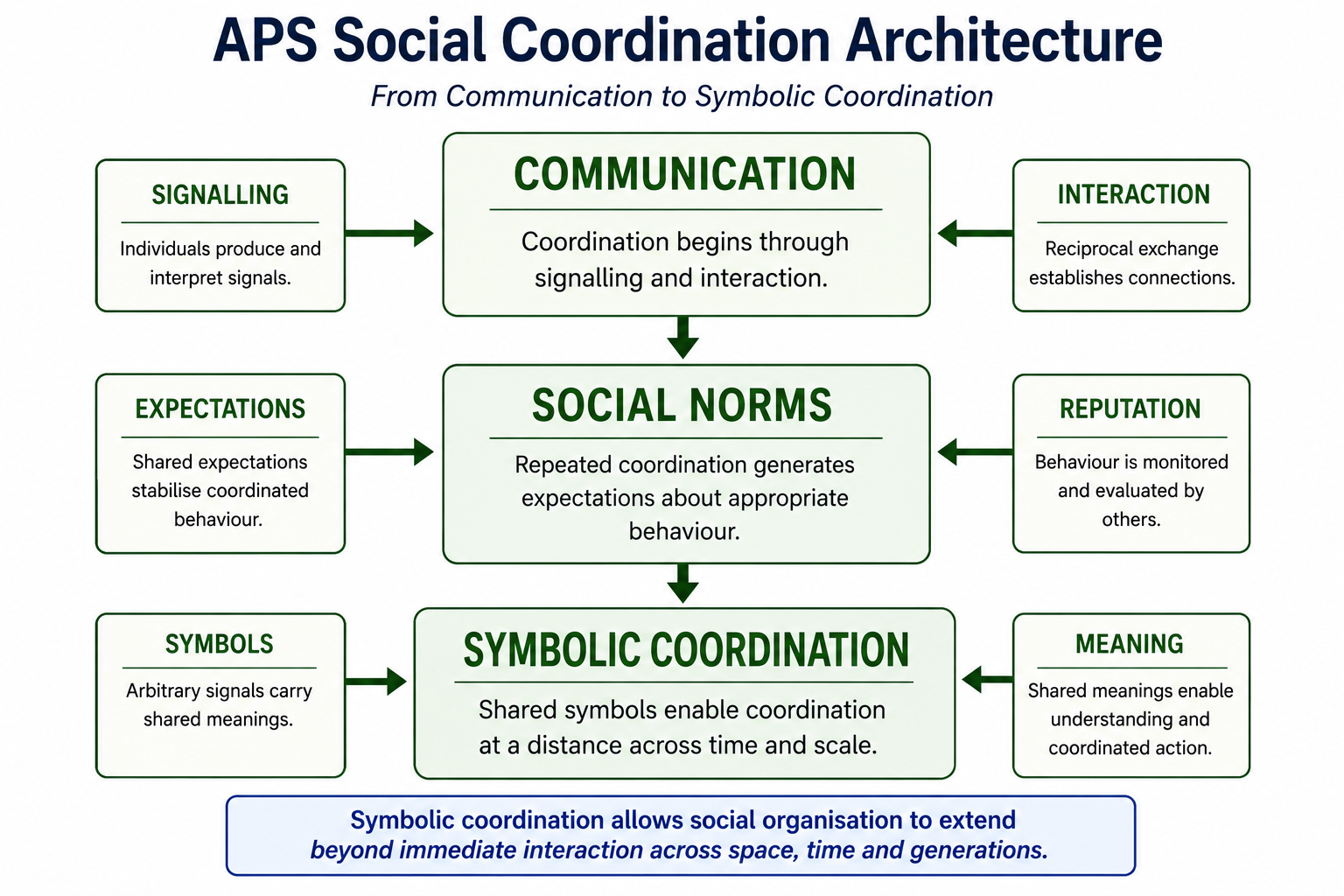
Communication makes coordination possible. Norms make coordination stable. Through normative organisation, social systems acquire the capacity to preserve coordinated activity despite continual change among the individuals who participate within them. For this reason APS treats norms not as secondary additions to social organisation but as one of its foundational continuity-preserving mechanisms.
Evaluation, Normativity, and Social Norms
To understand why norms emerge, APS begins with a more fundamental concept: evaluation.
All living systems are evaluative. Organisms continuously distinguish between conditions that support persistence and conditions that threaten it. Nutrients are distinguished from toxins, opportunities from dangers, and successful actions from unsuccessful ones. Evaluation is therefore not an optional cognitive achievement or a uniquely human capacity. It is a basic organisational requirement of viability-oriented systems.
This evaluative dimension gives rise to normativity. Normativity concerns the distinction between what supports persistence and what undermines it. In APS, normativity does not originate in abstract moral principles or externally imposed rules. Instead, it emerges from the organisational requirements of living systems themselves.
Biological normativity is therefore rooted in organised persistence. Some actions contribute to viability while others diminish it. Some forms of organisation stabilise persistence while others generate fragility or breakdown. Normative distinctions emerge because living systems face real consequences for success and failure.
Social norms extend this evaluative organisation into the social domain. When organisms engage in sustained collective activity, the success or failure of coordination itself becomes subject to evaluation. Certain patterns of interaction contribute to collective continuity, while others generate instability, conflict, inefficiency, or breakdown.
Norms emerge as mechanisms that help stabilise successful forms of coordination. Through repeated interaction, expectations become organised around behaviours that contribute to collective persistence. Over time these expectations become embedded within practices, traditions, institutions, and cultural forms that help reproduce coordinated activity.
In this sense, social norms are not arbitrary conventions. They are socially distributed expressions of evaluative organisation. Different societies may develop different normative systems and different historical circumstances may generate different forms of normative organisation. Yet beneath this diversity lies a common organisational logic. Norms persist because they help maintain forms of collective activity capable of enduring through time.
APS therefore situates social normativity within a broader continuity architecture. Evaluation generates normativity. Normativity stabilises coordination. Coordination supports organised persistence. Social norms represent one of the principal mechanisms through which this progression becomes embedded within collective life.
Norms and Organised Persistence
APS interprets norms as continuity-preserving organisational structures. Their significance lies not merely in what they prescribe but in what they enable. By reducing uncertainty and stabilising expectations, norms help make coordinated activity more reliable and more durable.
These effects become increasingly important as social systems grow in complexity. Small groups can often rely upon direct interaction and immediate feedback to maintain coordination. Larger and more historically extended forms of organisation require additional mechanisms capable of preserving expectations across time and across changing populations.
Without normative organisation, every interaction would require continual negotiation. Cooperation would become fragile, collective projects would become difficult to sustain, and knowledge transmission would become unreliable. Social systems would struggle to maintain continuity beyond the immediate circumstances in which activity occurs.
Norms help address these challenges by creating relatively stable frameworks within which interaction can occur. Participants can orient their behaviour toward predictable expectations, allowing coordination to become more efficient and collective activity more robust. Normative organisation therefore increases the capacity of social systems to maintain continuity despite continual change among their constituent members.
The continuity-preserving role of norms can be observed across many domains of social life:
- scientific communities maintain standards of evidence and inquiry
- professions preserve standards of practice and competence
- educational systems reproduce expectations concerning learning
- legal systems stabilise expectations concerning conduct
- communities maintain traditions across generations
These examples differ enormously in content, scope, and complexity. What unites them is their contribution to organised persistence. In each case, normative organisation helps reproduce patterns of coordinated activity across time.
APS therefore rejects the idea that norms are merely restrictions on behaviour. Norms do constrain activity, but constraints are not simply limitations. Throughout APS, constraints are understood as organisational structures that make particular forms of activity possible. The same principle applies to social norms.
Norms limit some possibilities while simultaneously enabling others. They reduce uncertainty in ways that make cooperation more reliable, communication more effective, and collective projects more sustainable. Social continuity depends upon this balance between constraint and possibility.

Social Continuity and Organised Persistence. Norms stabilise coordination, communication distributes coordination, culture preserves coordination, and institutions and technology extend coordination across larger scales and longer timescales. Together these processes allow organised social activity to persist despite continual turnover among individual participants.
Figure: Normative organisation allows patterns of coordinated activity to persist despite continual turnover among participants.
Viewed in this way, norms become central components of social continuity architecture. They help preserve organisational patterns beyond the individuals who currently enact them, allowing forms of collective life to maintain persistence across longer timescales. Normative organisation therefore represents one of the most important mechanisms through which organised persistence becomes socially distributed.
From Norms to Social Continuity
The organisational significance of norms becomes particularly apparent when viewed across longer timescales.
Social systems persist despite continual change. Individuals are born and die, membership changes, resources fluctuate, and environmental conditions shift. Yet many forms of social organisation continue across decades, centuries, and sometimes even millennia. APS explains this persistence through continuity architecture.
Norms are among the most important components of that architecture. By stabilising expectations, norms allow patterns of coordination to remain reproducible across generations. They help create forms of organisational memory within social systems, enabling coordinated activity to persist even when the individuals who originally established those patterns are no longer present.
This continuity is not necessarily stored in formal rules or written regulations. Much of it exists in practices, habits, traditions, expectations, and shared ways of acting. People often participate in normative systems long before they are capable of explicitly articulating them. Through participation itself, forms of coordination become reproduced and transmitted.
Normative organisation therefore contributes directly to historical continuity. Social systems do not persist solely through buildings, infrastructures, or material artefacts. They persist through the reproduction of coordinated relationships among participants. Norms play a central role in that process.
For this reason APS treats norms as one of the principal mechanisms through which organised persistence becomes socially distributed. Normative organisation allows continuity to extend beyond individual organisms into larger systems of coordinated activity capable of enduring through time.
Norms, Symbolic Coordination, and Culture
Norms do not operate in isolation. As social systems become more complex, normative organisation becomes increasingly intertwined with communication, symbolic coordination, and culture.
Communication allows expectations to be expressed, negotiated, reinforced, and transmitted. Without communication, norms would remain highly localised and difficult to sustain across larger populations. Through communicative interaction, normative expectations become shared, stabilised, and reproduced across generations.
This process becomes even more powerful with the emergence of symbolic systems. Symbols allow meanings, expectations, and forms of coordination to become detached from immediate circumstances and preserved across time. Language provides the most familiar example. Through language, social systems can articulate rules, describe practices, transmit obligations, and preserve collective memory.
Symbolic coordination therefore dramatically expands the continuity-preserving capacity of normative organisation. Norms help regulate how symbols are interpreted and used, while symbolic systems help preserve and reproduce normative expectations. The relationship is reciprocal and mutually reinforcing.
This reciprocal relationship forms a bridge between norms and culture. APS interprets culture as a socially distributed form of organised persistence through which practices, meanings, skills, expectations, and forms of knowledge are maintained across generations. Cultural continuity depends upon the reliable reproduction of coordinated activity, and norms play a central role in making such reproduction possible.
Without normative organisation, cultural practices would become increasingly difficult to reproduce. Skills would be transmitted inconsistently, shared expectations would fragment, and collective memory would become unstable. Norms help transform temporary coordination into historically persistent organisation.
Communication enables coordination. Norms stabilise coordination. Symbolic systems preserve coordination. Culture transmits coordination. Together these processes create increasingly durable forms of social continuity.
Norms, Institutions, and Technology
As continuity architectures become more complex, normative organisation becomes increasingly formalised. This process gives rise to institutions.
Institutions can be understood as stabilised systems of norms organised around particular domains of collective activity. Educational institutions stabilise learning, scientific institutions stabilise inquiry, legal institutions stabilise expectations concerning conduct, and economic institutions stabilise patterns of production, exchange, and resource allocation.
Institutions therefore do not replace norms. Rather, they formalise and reinforce them. Institutional organisation allows normative expectations to become more durable, more scalable, and more resistant to disruption. Through institutions, social systems acquire greater capacity to preserve continuity across larger populations and longer periods of time.
This increased stability contributes directly to organised persistence. Institutions make it possible for coordinated activity to continue despite continual turnover among individual participants. They preserve organisational continuity across decades, centuries, and sometimes even longer historical periods.
Technology further extends this process. APS interprets technology not merely as tools or artefacts but as organised structures that extend the capacity for continuity-preserving activity. Technologies preserve information, support communication, coordinate action across space and time, and help stabilise organisational practices.
Technological systems frequently embody normative assumptions concerning how activities should be performed, how information should be organised, and how coordination should occur. In this sense, technology often functions as a form of materialised normativity. Norms shape technologies, while technologies help reinforce and reproduce norms.
Together, norms, institutions, and technology form successive layers within a broader continuity architecture. Each extends the capacity of social systems to preserve coordinated activity through time. Each contributes to the emergence of increasingly sophisticated forms of socially distributed organised persistence.
Conclusion: Normativity and Socially Distributed Organised Persistence
Norms are often treated as rules, conventions, obligations, or shared expectations. APS accepts that norms frequently take these forms but argues that their deeper significance lies elsewhere.
Norms are continuity-preserving coordination constraints. They emerge from evaluative activity, stabilise expectations, reduce uncertainty, support coordinated behaviour, and contribute directly to organised persistence. Their primary importance lies not in what they represent but in what they do.
Viewed through APS, norms are neither arbitrary conventions nor merely external restrictions imposed upon behaviour. They are organisational structures through which social systems preserve continuity across time. They help transform transient interactions into reproducible forms of coordinated life.
This perspective reveals the deeper relationship connecting evaluation, normativity, communication, symbolic coordination, culture, institutions, and technology. Each represents a different component within a broader continuity architecture through which social organisation becomes increasingly durable and historically extended.
Evaluation generates normativity. Normativity stabilises coordination. Coordination supports continuity. Continuity enables culture. Culture supports institutions. Institutions and technology extend continuity across larger scales and longer timescales.
APS therefore reframes norms as one of the foundational mechanisms through which organised persistence becomes socially distributed. Social systems persist not simply because individuals act, but because coordination becomes organised, stabilised, reproduced, and transmitted across time.
Social norms stabilise patterns of coordination that contribute to socially distributed organised persistence.
See Also
Related Articles
References
- (1922). Human Nature and Conduct. Henry Holt.
- (2006). What Are Institutions?. Journal of Economic Issues, 40(1), 1–25 .
- (1934). Mind, Self, and Society. University of Chicago Press.
- (2026). Agency as the Defining Activity of Life: An Organisational Approach to Biological Agency. Biological Theory . https://doi.org/10.1007/s13752-026-00547-6
- (2019). Becoming Human: A Theory of Ontogeny. Harvard University Press.