What Is It About Life? — The Search for Life's Defining Principle
Throughout the history of biology and philosophy, researchers have repeatedly attempted to identify the defining principle of life. Some have emphasised form, purpose, energy, metabolism, self-production, autonomy, organisation, or information. This article examines these major traditions as competing explanatory grammars—different ways of making life intelligible. By comparing the explanatory problems each tradition sought to solve, it traces a long intellectual search for the essence of life and situates APS within that ongoing conversation.
Key Points
- The history of life theories can be understood as a history of competing explanatory grammars.
- Different traditions have attempted to explain life through form, purpose, energy, metabolism, organisation, self-production, autonomy, and persistence.
- Defining life requires distinguishing between definition, diagnosis, and evidence.
- APS interprets earlier traditions as illuminating different aspects of living organisation.
- Agency, process, and scale provide an explanatory grammar for understanding viability-oriented organised persistence.
Introduction
The question What is life? is one of the oldest and most persistent questions in biology. For more than two millennia, philosophers, naturalists, and scientists have attempted to identify what distinguishes living systems from everything else in the world. The remarkable diversity of proposed answers reveals not merely disagreement about life itself but disagreement about how life should be understood and explained.
Some traditions have sought the defining principle of life in form and organisation. Others have emphasised purpose, metabolism, energy flow, self-production, autonomy, information, or evolution. At first glance these approaches appear to offer competing definitions. Yet viewed more carefully, they often reflect something deeper: different ideas about what kind of phenomenon life is and therefore what kind of explanation it requires.
This article approaches the history of life theories from that perspective. Rather than asking which definition is correct, it asks what explanatory problem each tradition was attempting to solve. Why did Aristotle focus on organised activity? Why did Schrödinger turn to thermodynamics? Why did Jonas emphasise metabolism and self-concern? Why did Rosen, Maturana, Varela, Deacon, and Moreno increasingly shift attention toward organisation, closure, and autonomy? These questions reveal a long intellectual search not merely for a definition of life but for an explanatory framework capable of making life intelligible.
An explanatory grammar is the conceptual structure through which a phenomenon becomes understandable. It identifies what counts as an explanation, what kinds of causes are regarded as significant, what aspect of a phenomenon is considered most fundamental, and how the explanatory target is analysed and related to other explanatory concepts. Different explanatory grammars illuminate different features of life. Some make energy central. Others make organisation central. Others emphasise information, reproduction, adaptation, or self-maintenance. The history of life theories can therefore be understood as a history of competing explanatory grammars.
This perspective also helps clarify why debates about life have often proven so difficult to resolve. Discussions frequently move between three distinct questions without recognising the shift. One question concerns definition: what life fundamentally is. A second concerns diagnosis: how life is recognised. A third concerns evidence: the observations that support diagnostic judgments. Metabolism, reproduction, growth, responsiveness, and evolution may function as evidence of life, as diagnostic criteria, or as proposed definitions depending on the theoretical framework being employed. Confusion arises when these roles are conflated.
The distinction is important because many disagreements about life are not disagreements about evidence. They are disagreements about explanation. Most biologists agree that living systems metabolise, develop, regulate themselves, reproduce, and evolve. The deeper question is why these activities belong together as aspects of a single phenomenon. What unifies them? What makes them biologically meaningful? What organisational condition transforms them from isolated processes into expressions of life?
The search for answers to these questions has generated some of the most influential ideas in the history of biology. Across more than two thousand years, thinkers have repeatedly returned to a surprisingly similar challenge: identifying the principle that allows living systems to maintain themselves despite continual change. Different traditions have approached this challenge through different conceptual routes, yet many converge upon themes of organisation, continuity, self-maintenance, and persistence.
The account that follows is therefore not a simple progression from error to truth. Nor is it a competition in which one definition eventually defeats all others. Each major tradition captured something important about living systems while revealing limitations that inspired further inquiry. The history of life theories is best understood as a continuing conversation about what requires explanation and how biological explanation should proceed.
Viewed in this way, the search for the essence of life becomes a search for the explanatory grammar most capable of accounting for the distinctive organisation of living systems. It is this search that links Aristotle’s reflections on living form, Kant’s analysis of natural purpose, Schrödinger’s thermodynamic vision, Jonas’s philosophy of metabolism, Rosen’s relational biology, autopoiesis, autonomy theory, and contemporary organisational approaches. The question connecting them all remains remarkably simple:
What is it about life?
The sections that follow examine how some of the most influential answers to that question have been developed, what explanatory problems they sought to address, and how they continue to shape contemporary attempts to understand the living world.
Aristotle and the First Organisational Theory of Life
The search for a defining principle of life begins long before modern biology. More than two thousand years ago, Aristotle confronted a question that remains recognisable today:
What makes a living thing alive?
Although the scientific context has changed dramatically, Aristotle’s answer remains remarkable because it focused not on the material composition of organisms but on their organisation and activity. In many respects, he was among the first thinkers to approach life as an organisational problem.
For Aristotle, living beings could not be understood merely by examining the substances from which they were composed. The same physical materials could appear in both living and non-living forms. What distinguished an organism was not its matter alone but the way that matter was organised and the activities that organisation made possible. Living systems possessed capacities absent from inert objects: growth, self-maintenance, sensation, movement, and reproduction. These capacities revealed the presence of what Aristotle called psyche, commonly translated as soul.
Modern readers often misunderstand this concept because the word “soul” now carries strong religious and spiritual associations. Aristotle’s psyche was not a supernatural substance inhabiting the body. Rather, it functioned as an organisational principle. It referred to the form of a living thing—the arrangement and activity through which matter became a living organism rather than a collection of physical components. A plant, an animal, and a human being possessed different capacities, but all were alive because they exhibited organised activities directed toward sustaining their characteristic modes of existence.
Aristotle’s explanatory grammar therefore centred on form and activity. Life became intelligible through the organised capacities of a living whole rather than through the properties of its material parts. The fundamental explanatory question was not:
What is life made of?
but:
What kind of organised activity makes a thing alive?
This was a profound shift. Much of later biology would become preoccupied with identifying the mechanisms, molecules, and physical processes underlying life. Aristotle instead focused on the organisation within which such processes acquired meaning. Nutrition mattered because it contributed to the maintenance of the organism. Growth mattered because it expressed the developmental capacities of the organism. Reproduction mattered because it extended the continuity of a living form. Individual activities were interpreted through their contribution to the organised whole.
For Aristotle, the significance of biological processes derived from their place within an organised living system. Growth, nutrition, reproduction, and sensation were not definitions of life but manifestations of a deeper organisational reality. His concern was explanatory rather than classificatory. He sought a principle capable of explaining why these diverse activities belonged together as expressions of a single phenomenon.
The limitations of Aristotle’s framework become apparent when viewed from the perspective of modern science. His conception of form provided little account of the physical and energetic processes through which living systems sustain themselves. The dynamics of metabolism, the role of energy, the mechanisms of heredity, and the historical transformations produced by evolution all remained beyond the reach of his explanatory framework. The grammar of form and activity successfully identified life as an organisational phenomenon, but it could not yet explain how such organisation was physically realised.
Nevertheless, Aristotle established a theme that would reappear repeatedly throughout the history of biology. Again and again, thinkers would return to the intuition that life cannot be understood solely through matter, energy, or mechanism. Something about the organisation of living systems appears equally fundamental.
The significance of Aristotle’s contribution therefore lies less in the specific answers he provided than in the explanatory direction he established. Life was treated not as a substance but as a mode of organised activity. The challenge for later thinkers would be to determine whether this organisational perspective could be reconciled with increasingly powerful mechanistic and physical accounts of the natural world.
Kant and the Problem of Natural Purpose
If Aristotle established the idea that life must be understood through organisation and activity, Immanuel Kant confronted a different problem:
Why do living systems appear organised for themselves?
By the late eighteenth century, the mechanistic revolution had transformed natural philosophy. The success of physics encouraged many thinkers to believe that all natural phenomena could ultimately be explained through matter in motion governed by universal laws. Organisms, however, presented a persistent difficulty. Unlike machines, living systems seemed to exhibit a form of organisation in which the parts existed for the sake of the whole while the whole simultaneously depended upon the activities of its parts.
Kant regarded this as one of the deepest puzzles in nature.
A watch contains parts that contribute to the functioning of the whole, yet the watch does not produce or maintain its own components. The organisation originates externally in the intentions and activities of the watchmaker. Living systems appear fundamentally different. Their structures are generated through developmental processes internal to the organism itself. Organs contribute to the maintenance of the organism, while the organism simultaneously generates and maintains the organs. Cause and effect appear to operate in a reciprocal manner.
Kant described organisms as natural purposes (Naturzwecke). By this he did not mean that organisms were consciously designed or directed toward externally imposed goals. Rather, he argued that living systems display a distinctive form of organisation in which the parts exist through the whole and the whole exists through the parts. Organisms are both producers and products of their own organisation.
This insight introduced a new explanatory grammar into discussions of life.
Where Aristotle’s grammar centred on form and activity, Kant’s centred on reciprocity and purposiveness. Life became intelligible through the mutually supportive organisation of a self-maintaining whole. Biological organisation could not be understood merely by analysing isolated components because the significance of each component depended upon its role within the larger system.
The explanatory challenge was therefore not simply to identify the material causes of biological phenomena. It was to understand how living systems exhibit a form of organisation that appears directed toward maintaining and reproducing itself.
Kant did not claim that organisms literally violated physical law or required mysterious vital forces. Nor did he believe that science should abandon mechanistic explanation. Instead, he argued that living systems force us to employ a distinctive mode of judgment. Organisms appear organised in ways that are difficult to understand solely through linear chains of efficient causation. To study them, we are compelled to think in terms of wholes, functions, and reciprocal relations.
In modern terms, Kant recognised that biological explanation often differs from physical explanation. The behaviour of a molecule can frequently be understood without reference to larger organisational structures. The significance of a heart, a leaf, or an immune system cannot. Their biological meaning depends upon their contribution to the persistence of the organism of which they are a part.
For this reason, Kant occupies an important position in the history of organisational thinking. He identified a feature of living systems that would later reappear in theories of autonomy, closure, and self-maintenance. Organisms are not merely collections of interacting parts. They are systems whose components derive their significance from participation in a larger organisation that contributes to its own continuation.
The limitations of Kant’s framework are equally important. Although he recognised the distinctive character of biological organisation, he regarded the phenomenon as resistant to complete scientific explanation. The reciprocal organisation of living systems appeared so remarkable that he doubted whether a fully mechanistic account could ever be achieved. In effect, he identified the problem without providing a naturalistic solution.
Subsequent developments in biology would challenge this pessimism. Advances in physiology, development, evolution, molecular biology, and systems theory revealed many of the mechanisms through which living organisation is generated and maintained. Yet these advances did not eliminate the problem Kant identified. They transformed it. The question became not whether biological organisation exists, but how it emerges and persists within the physical world.
From the perspective of APS, Kant’s contribution is significant because he recognised that living systems cannot be understood solely as aggregates of parts. Biological explanation requires attention to organisational relationships that operate across the system as a whole. The concepts of viability, constraint closure, and organised persistence all depend upon this broader insight.
Kant therefore occupies a pivotal position in the search for life’s defining principle. He moved beyond Aristotle’s emphasis on organised activity and highlighted the reciprocal organisation through which living systems sustain themselves. Although he lacked the scientific tools needed to explain such organisation, he identified a conceptual problem that would shape biological thought for centuries.
Schrödinger and the Thermodynamic Problem
By the twentieth century, the search for life’s defining principle had entered a new intellectual landscape. Biology had become increasingly mechanistic, physics had emerged as the dominant explanatory science, and thermodynamics had revealed a universe governed by the relentless tendency toward increasing entropy. Against this backdrop, a new question emerged:
How can living systems maintain order in a world that continually tends toward disorder?
No thinker articulated this problem more influentially than Erwin Schrödinger in his celebrated 1944 book What Is Life?
Schrödinger did not begin with organisation, purpose, or self-maintenance. He began with physics. Living systems appeared to exhibit a remarkable property: they maintained highly ordered structures over long periods despite existing in a universe where organised states are generally unstable. Organisms grow, repair themselves, regulate internal conditions, and preserve their organisation across time. How is this possible?
His answer centred on energy and thermodynamics.
According to the second law of thermodynamics, isolated systems tend toward increasing entropy. Organised structures gradually break down, energy gradients dissipate, and order gives way to disorder. Living systems appear to resist this tendency. Schrödinger argued that they accomplish this by continually extracting order from their surroundings and exporting entropy back into the environment. Famously, he described organisms as feeding upon what he called “negative entropy”—a phrase intended to capture the idea that living systems maintain their internal organisation by drawing upon external sources of usable energy and order.
Whether or not the terminology itself remains scientifically precise, the underlying insight proved enormously influential. Life cannot be understood independently of energy flow. Organisms persist only because they continuously acquire, transform, and utilise energy. Metabolism, growth, development, repair, movement, and reproduction all depend upon sustained energetic processes. A living system cut off from energy sources rapidly loses the capacity to maintain its organisation.
Schrödinger’s explanatory grammar therefore centred on energy and order.
Life became intelligible through:
thermodynamic disequilibrium; energy flow; the maintenance of order against entropy.
The central explanatory challenge was persistence itself. Living systems appeared remarkable because they sustained organised states that would otherwise decay.
This represented a major advance over earlier approaches. Aristotle and Kant had identified distinctive forms of biological organisation, but neither possessed the conceptual tools necessary to explain how such organisation could be physically maintained. Schrödinger situated life firmly within the physical world while preserving its apparent uniqueness. Organisms were not exceptions to thermodynamic law. Rather, they were special kinds of systems whose persistence depended upon continuous exchanges of matter and energy with their surroundings.
The influence of this perspective extended far beyond Schrödinger’s own work. Subsequent developments in systems theory, non-equilibrium thermodynamics, origins-of-life research, and complex systems science repeatedly returned to the idea that life depends upon sustained energy flow through organised structures. The work of Ilya Prigogine on dissipative structures, investigations of self-organising chemical systems, and contemporary studies of biological complexity all owe something to the thermodynamic questions that Schrödinger helped place at the centre of biological inquiry.
Yet the thermodynamic grammar also revealed important limitations.
The maintenance of order is not unique to life.
Many non-living systems exhibit organised behaviour sustained by energy flow. Hurricanes maintain coherent structures while dissipating energy gradients. Flames persist through continuous energy consumption. Chemical oscillators display dynamic order. Dissipative systems can generate striking forms of self-organisation. These examples demonstrate that energy flow and thermodynamic disequilibrium are not sufficient to explain life.
The problem becomes clearer when we ask a deceptively simple question:
What kind of order matters?
A crystal possesses order. A hurricane possesses order. A flame possesses order. A living cell also possesses order. Yet these forms of order are not equivalent. Biological organisation appears distinctive not merely because it is ordered but because it contributes to the continued existence of the system itself. The significance of metabolism, regulation, repair, and adaptation derives from their contribution to persistence under changing conditions.
This observation points toward an important distinction that would become increasingly prominent in later theories. Energy may explain how organised systems remain physically active, but it does not by itself explain why particular forms of organisation are biologically significant. Energy enables persistence, but it does not fully explain the organisation being maintained.
From the perspective of APS, Schrödinger identified one of the indispensable conditions of life. Living systems cannot exist without continuous energy throughput. Viability, regulation, development, reproduction, and adaptation all depend upon energetic processes. However, APS treats energy as an enabling condition rather than a defining principle. Energy becomes biologically meaningful only when organised in ways that contribute to the maintenance of viability-oriented persistence.
This distinction helps clarify both the power and the limitation of the thermodynamic approach. Schrödinger successfully explained why life must remain open to its environment and why persistence requires continuous energetic exchange. What remained unresolved was the question of why some forms of organised activity contribute to persistence while others do not. Energy explained how life remains active. It did not yet explain why living activity exhibits the distinctive organisation that it does.
The thermodynamic perspective therefore brought biology closer to understanding life without fully resolving the problem. It demonstrated that life depends upon continuous energetic processes, but it left open the question of how those processes become organised into systems whose own continued existence is at stake.
The next major development in the search for life’s defining principle would address precisely this issue. Rather than asking how living systems maintain order, Hans Jonas asked a deeper question:
Why does life appear concerned with its own continued existence at all?
Hans Jonas and the Problem of Self-Concern
If Schrödinger asked how living systems maintain order, Hans Jonas asked a more radical question:
Why does life appear concerned with its own continued existence?
This question marked a significant shift in the search for life’s defining principle. Earlier traditions had focused primarily on organisation, purpose, or energy. Jonas directed attention toward something that seemed simultaneously obvious and deeply mysterious: living systems behave as if their continued existence matters.
A bacterium swims toward nutrients and away from harmful conditions. A plant adjusts its growth in response to changing environmental circumstances. Animals regulate temperature, acquire resources, avoid threats, and repair injuries. Across the living world, organisms engage in activities that contribute to their own persistence. These activities occur in enormously different forms and at vastly different scales, yet they appear united by a common feature. Living systems continually act in ways that sustain the conditions of their own existence.
For Jonas, this observation pointed toward a fundamental distinction between life and non-life.
A rock remains what it is regardless of whether it continues to exist. Its identity is inseparable from its material composition. Living systems are different. The molecules constituting an organism are continually replaced through metabolism, growth, repair, and development. Matter flows through the organism, yet the organism persists. Identity is therefore maintained not through material permanence but through organised continuity.
This led Jonas to one of his most influential insights.
Life exists in a condition of perpetual vulnerability.
Every organism depends upon continual exchanges with its environment. Nutrients must be acquired. Waste must be removed. Internal organisation must be maintained. The cessation of these processes threatens the existence of the organism itself. Living systems therefore occupy a precarious position that non-living objects do not. Their continued existence is never guaranteed but must be actively sustained.
Jonas’s explanatory grammar centred on metabolism, selfhood, and concern.
Unlike Aristotle’s grammar of form, Kant’s grammar of purposiveness, or Schrödinger’s grammar of energy, Jonas’s framework focused on the existential situation of living systems. Life became intelligible through the fact that an organism’s own continued existence was at stake.
This perspective transformed the significance of biological activity.
Metabolism was no longer merely a biochemical process. It became the means through which an organism continually reconstituted itself despite material turnover. Regulation became more than a mechanism. It became part of an ongoing effort to maintain viable conditions. Behaviour became significant because some actions contributed to persistence while others threatened it. Across every domain of life, biological activity acquired meaning through its relationship to continued existence.
The importance of this insight is difficult to overstate.
Many biological concepts already presuppose distinctions of this kind. Function implies that some outcomes are better than others. Adaptation implies that some traits contribute more effectively to persistence. Malfunction implies that a process has failed relative to what it should achieve. These distinctions are difficult to understand in purely physical terms because physics does not distinguish between successful and unsuccessful states in the same way. Jonas recognised that living systems introduce a form of asymmetry grounded in the fact that their own continued existence matters.
This does not mean that organisms possess conscious desires or explicit goals. Jonas’s argument applies even to the simplest forms of life. A bacterium need not possess awareness to exhibit activities directed toward maintaining conditions compatible with persistence. The significance arises from the organisation itself rather than from subjective experience.
In this respect, Jonas approached a theme that would become increasingly important in later theories of life. Biological organisation appears inseparable from normativity. Some states support continued existence. Others undermine it. Some activities succeed. Others fail. Living systems therefore generate distinctions that are absent from purely physical descriptions of matter and energy.
At the same time, Jonas did not provide a fully developed organisational theory capable of explaining how such normativity emerges. He identified the phenomenon with extraordinary clarity but left open many questions concerning the mechanisms and organisational structures through which persistence is achieved. His work was philosophical rather than biological in orientation. It illuminated the significance of life without fully specifying the organisational conditions that produce that significance.
From the perspective of APS, Jonas occupies a particularly important position in the history of life theories because he came remarkably close to the concept of viability before that language was explicitly developed. His central insight—that living systems exist in a condition where their continued existence matters—anticipates the APS claim that biological organisation is fundamentally viability-oriented.
The connection becomes especially clear when viewed through the lens of explanatory grammar. For Jonas, life becomes intelligible through self-concern. For APS, life becomes intelligible through viability-oriented organisation. These are not identical ideas, but they point toward a common recognition: biological activity derives its significance from the maintenance of conditions necessary for continued existence.
Jonas also helped reveal a limitation of purely energetic accounts of life. Energy explains how organisms remain active, but it does not explain why particular activities matter biologically. A hurricane dissipates energy. A living cell also dissipates energy. The difference is not simply energetic. The activities of the cell contribute to maintaining a system whose continued existence is at stake. The organisation possesses a normative dimension absent from the hurricane.
This insight would prove enormously influential. Subsequent traditions increasingly shifted attention away from energy alone and toward the organisational conditions that generate self-maintenance, autonomy, and persistence. The focus of inquiry moved from how life remains active to how living systems maintain themselves as coherent unities.
The next major step in this progression would come from a thinker who believed that biology had become overly focused on mechanisms and insufficiently attentive to organisation itself. Robert Rosen would argue that the central mystery of life lies not in its material components but in the relational organisation that makes those components part of a living system.
Robert Rosen and the Primacy of Organisation
By the second half of the twentieth century, biology had achieved extraordinary success through mechanistic explanation. Molecular biology, genetics, biochemistry, and physiology revealed the physical processes underlying many of life’s most important phenomena. Yet for Robert Rosen, a fundamental question remained unresolved:
Why do living systems seem different from even the most sophisticated machines?
Rosen believed that biology had become so focused on mechanisms that it risked overlooking the very phenomenon it sought to explain. Scientists had become increasingly adept at identifying components, tracing causal pathways, and describing biochemical processes. But identifying parts, he argued, was not the same as understanding life.
The central problem was organisational.
A machine can often be understood by decomposing it into components and analysing the function of each part. The explanatory strategy succeeds because the organisation of the machine is imposed externally by a designer. The parts perform roles within an arrangement whose origin lies outside the system itself.
Living systems appear different.
Organisms produce, maintain, repair, and reproduce the very organisation upon which their continued existence depends. Their activities are not merely organised; they contribute to sustaining the organisation that makes those activities possible. Life therefore seems to involve a form of causal organisation that cannot be fully captured by analysing individual components in isolation.
Rosen’s explanatory grammar centred on relational organisation.
For him, the primary explanatory unit was not the molecule, the gene, the organ, or even the individual process. It was the network of relationships through which biological organisation is maintained.
This represented a significant departure from both mechanistic biology and thermodynamic approaches.
Mechanistic explanations typically ask:
What components produce a given phenomenon?
Thermodynamic explanations ask:
How can organised systems remain far from equilibrium?
Rosen asked a different question:
What organisational relationships make a system alive?
This shift transformed the nature of biological explanation.
Life became intelligible not through the properties of individual components but through the way components participate in a larger organisational structure. A biological process derives its significance from its role within a network of relationships that collectively sustain the organism. The explanatory focus therefore moves from things to relations, from parts to organisation.
Rosen developed these ideas most famously through his relational biology and his analysis of what he called “(M,R)-systems.” Although technically demanding, the underlying motivation was straightforward. He sought a formal account of the organisational closure exhibited by living systems. Biological systems appeared capable of producing and maintaining the very conditions required for their continued operation. This recursive organisational structure seemed fundamentally different from the externally specified organisation characteristic of machines.
The importance of Rosen’s contribution lies not primarily in the mathematical details of his models but in the explanatory challenge he identified.
Throughout the history of biology, researchers had repeatedly encountered evidence that living systems could not be understood solely through reduction to constituent parts. Aristotle had emphasised organised activity. Kant had highlighted reciprocal organisation. Jonas had focused on self-maintenance and existential vulnerability. Rosen reformulated these concerns in a modern scientific context by arguing that organisation itself must become a central explanatory target.
In this respect, his work represented one of the strongest twentieth-century challenges to purely mechanistic conceptions of life.
Importantly, Rosen did not reject mechanisms.
Cells contain mechanisms. Organisms contain mechanisms. Biological systems depend upon countless mechanistic processes operating simultaneously across multiple scales.
His argument was subtler.
Mechanisms are necessary for understanding how biological systems operate, but they may not be sufficient for understanding what makes a system alive. Mechanistic descriptions explain processes occurring within an organisation. They do not necessarily explain the organisation itself.
This distinction proved enormously influential. Subsequent research programmes concerned with autopoiesis, autonomy, systems biology, and organisational closure all inherited aspects of the problem Rosen articulated. Even when researchers disagreed with his conclusions, they increasingly recognised that biological explanation required greater attention to organisational relationships.
From the perspective of APS, Rosen occupies a pivotal position in the search for life’s defining principle.
His central insight—that organisation itself requires explanation—aligns strongly with the APS view that biology ultimately seeks to understand organised persistence rather than merely catalogue mechanisms. APS similarly rejects the idea that life can be reduced to a collection of components or processes considered independently of the organisational context within which they operate.
At the same time, APS departs from Rosen in important respects.
Rosen’s work was primarily concerned with identifying forms of organisational closure that distinguish living systems from machines. APS instead begins with the problem of viability-oriented persistence. Organisational closure becomes important because it contributes to the maintenance of viability. Organisation is therefore understood not merely as a structural property but as part of an ongoing process through which living systems sustain the conditions of their own continued existence.
This difference reflects a broader shift in explanatory emphasis.
For Rosen, the central question was:
What organisational relationships make life possible?
For APS, the question becomes:
How do organisational relationships contribute to viability-oriented persistence?
The distinction is subtle but significant. Organisation remains central, but its significance derives from its role in sustaining continuity through time.
Rosen also helped expose an important limitation of both energetic and mechanistic explanations. Energy can explain how systems remain active. Mechanisms can explain how particular processes occur. Neither automatically explains why the resulting organisation contributes to the persistence of a living system. The organisational dimension remains indispensable.
By the end of the twentieth century, this recognition was becoming increasingly difficult to ignore. A growing number of researchers were beginning to ask whether life should be understood not simply through mechanisms or energy flows but through forms of organisational closure capable of producing and maintaining themselves.
This question would become the foundation of one of the most influential organisational theories of life ever proposed: the theory of autopoiesis developed by Humberto Maturana and Francisco Varela.
Autopoiesis and the Problem of Self-Production
If Rosen argued that life must be understood through organisation rather than mechanism alone, Humberto Maturana and Francisco Varela attempted to identify the specific organisational principle that distinguishes living systems from all other entities. Their central question was both ambitious and deceptively simple:
What kind of organisation makes a system a living system?
The answer they proposed became one of the most influential theories in the modern philosophy of biology: autopoiesis.
The term derives from Greek roots meaning “self-production.” According to Maturana and Varela, living systems are distinguished by a unique form of organisation in which the components of the system continuously generate and regenerate the network of processes that produces those same components. A living system is therefore not defined by a particular material composition, by a specific molecule, or by a particular physical structure. It is defined by an organisational pattern of self-production.
This represented a significant conceptual advance.
Many earlier definitions of life relied upon lists of properties such as metabolism, growth, reproduction, or adaptation. Autopoiesis sought something deeper. Rather than asking which characteristics living systems possess, Maturana and Varela asked what organisational process gives rise to those characteristics in the first place.
Their explanatory grammar centred on self-production.
Life became intelligible through a network of processes that continually produced and maintained the very organisation that constituted the system as a distinct unity. The organism existed because it continuously generated itself.
This perspective offered a powerful solution to several longstanding problems.
First, it explained why living systems remain identifiable despite continual material turnover. The molecules composing a cell are constantly replaced, yet the cell persists. The continuity resides not in the permanence of matter but in the persistence of the organisational process through which the system reproduces itself.
Second, autopoiesis provided a way of understanding biological individuality. Organisms appear as coherent unities despite being composed of countless interacting processes. According to autopoiesis, this coherence arises because the network of self-producing processes continually regenerates the boundaries and structures that distinguish the organism from its environment.
Third, the theory placed organisation firmly at the centre of biology. The defining feature of life was no longer energy, matter, information, or even metabolism considered in isolation. It was the self-producing organisation through which these processes became integrated into a living whole.
For these reasons, autopoiesis became enormously influential across biology, cognitive science, systems theory, and philosophy. It helped redirect attention away from static descriptions of organisms and toward dynamic organisational processes. Many later discussions of autonomy, closure, embodiment, and cognition developed in dialogue with ideas first articulated within the autopoietic tradition.
Yet the very elegance of autopoiesis also revealed important limitations.
One difficulty concerned the explanatory status of self-production itself.
A system may generate and maintain its own organisation, but why is that organisation biologically significant? Why should self-production matter? What makes one form of organisational closure relevant to life while another is not?
Autopoiesis identifies a distinctive organisational structure, but it says relatively little about the conditions under which that organisation succeeds or fails. Questions concerning viability, adaptation, environmental challenge, and persistence often remain secondary to the problem of self-production.
A second difficulty concerns normativity.
Living systems do not merely maintain themselves. They encounter circumstances that can threaten, support, or transform their continued existence. Organisms succeed or fail relative to conditions necessary for persistence. They regulate, repair, adapt, and respond to changing circumstances in ways that appear directed toward maintaining viability. While autopoiesis successfully explains organisational closure, it is less explicit about the normative dimension of biological activity.
A third challenge concerns evolutionary and ecological context.
The autopoietic framework was developed primarily as a theory of living organisation at a particular moment in time. As a result, questions concerning long-term persistence, historical transformation, evolutionary change, and multiscale continuity often remain less developed than the analysis of organisational unity itself.
These concerns do not invalidate autopoiesis. Rather, they reveal the explanatory problem left unresolved.
Autopoiesis successfully answers the question:
How does a living system constitute itself as a coherent organisational unity?
It answers less clearly the question:
Why is that unity maintained, and under what conditions does it persist?
From the perspective of APS, this distinction is crucial.
APS agrees with autopoiesis that life cannot be understood through components alone and that organisational closure is an essential feature of living systems. Indeed, autopoiesis represents one of the most important organisational theories ever developed. It helped establish closure, self-maintenance, and organisational continuity as central topics within theoretical biology.
Where APS differs is in the explanatory target.
Autopoiesis places self-production at the centre of explanation. APS places organised persistence at the centre of explanation.
The difference may appear subtle, but it has significant consequences. APS asks not only how a system produces and maintains itself but also how it sustains viability through time, adapts to changing circumstances, and preserves continuity across multiple organisational scales. Organisational closure becomes important because it contributes to persistence rather than because self-production itself is taken as the defining principle.
This distinction also helps clarify the relationship between autopoiesis and many later organisational theories. Once self-production is recognised as insufficient by itself, attention naturally shifts toward broader questions of self-maintenance, autonomy, viability, and persistence. The focus moves from how a system constitutes itself to how it continues to exist as a living system in a changing world.
This transition would become particularly explicit in the work of theorists who sought to extend and refine the autopoietic tradition. Their efforts would produce one of the closest contemporary relatives of APS: the theory of biological autonomy developed by Moreno, Mossio, and others. Before reaching that development, however, another influential tradition emerged that approached life’s defining principle from a different direction altogether. Rather than focusing on closure or self-production, it asked how complex organisation could arise spontaneously in the first place.
This was the challenge taken up by Stuart Kauffman and the theory of self-organisation.
Stuart Kauffman and the Problem of Self-Organisation
While autopoiesis focused on how living systems maintain and reproduce themselves as organisational unities, Stuart Kauffman approached the problem of life from a different direction. His central question was not primarily about closure, autonomy, or self-maintenance. Instead, he asked:
How does organised order arise in the first place?
This question emerged from a growing recognition that traditional explanations often appeared incomplete. Classical Darwinian theory provided a powerful account of how natural selection shapes biological traits, but selection operates on systems that already exist. It explains the differential persistence of variants. It does not by itself explain how organised biological systems capable of variation and selection emerge in the first place.
Kauffman believed that biology required a deeper understanding of the spontaneous emergence of order.
Throughout nature, complex patterns arise without external design. Snowflakes develop intricate structures. Chemical systems generate oscillations and spatial organisation. Ecosystems exhibit large-scale regularities. Biological systems display extraordinary forms of organisation that appear neither random nor externally imposed. These observations suggested that order itself might be a natural property of sufficiently complex systems.
Kauffman’s explanatory grammar therefore centred on self-organisation.
Life became intelligible through the spontaneous emergence of organised structure from the interactions of many components. Rather than viewing biological order solely as the product of selection acting upon randomness, Kauffman argued that complex systems possess intrinsic tendencies toward organisation. Under appropriate conditions, order can emerge naturally from the dynamics of the system itself.
One of his most influential contributions involved the concept of autocatalytic networks.
In an autocatalytic system, the components collectively contribute to the production of one another. No single element controls the process. Instead, organisation emerges from the mutual interactions of the network as a whole. Kauffman proposed that such networks may have played an important role in the origins of life by providing a route through which organised biochemical systems could arise before the evolution of modern genetic mechanisms.
This perspective offered a significant alternative to explanations focused exclusively on genes, information, or natural selection.
Life appeared not as an improbable exception to physical law but as a natural consequence of the organisational possibilities inherent in complex systems. The emphasis shifted from competition and selection to emergence and order generation. Biological organisation became something that could arise spontaneously under suitable conditions rather than something requiring continual external specification.
Kauffman’s work also represented an important extension of the thermodynamic tradition initiated by Schrödinger. Both thinkers recognised that life depends upon systems operating far from equilibrium. Both sought to understand how organised structures can arise and persist within the physical world. Yet where Schrödinger focused primarily on energy flow and thermodynamic order, Kauffman focused on the organisational consequences of complexity itself.
The explanatory problem therefore shifted.
Schrödinger asked: How can order persist?
Kauffman asked: How can order emerge?
This distinction proved enormously influential in origins-of-life research, systems biology, and complexity science. It encouraged researchers to investigate the conditions under which organisation can arise naturally from interacting components without requiring external design or detailed genetic control.
At the same time, the self-organisational grammar revealed important limitations. Order is not the same as life.
Many non-living systems exhibit impressive forms of spontaneous organisation. Crystal growth, convection cells, hurricanes, chemical oscillations, and countless other phenomena demonstrate that order can emerge naturally within physical systems. Self-organisation is therefore neither unique to life nor sufficient to define it.
The crucial question becomes:
What kind of organisation matters?
A hurricane is organised. An autocatalytic chemical network may be organised. A living cell is organised. Yet these forms of organisation are not equivalent.
The distinctive feature of biological organisation appears not merely to be its existence but its contribution to the continued persistence of the system itself. Biological organisation is organised for something—not necessarily in the teleological sense of external purpose, but in the sense that its activities contribute to maintaining the conditions under which the organisation can continue to exist.
This limitation reveals an important distinction between self-organisation and self-maintenance.
Self-organisation explains how complex patterns can arise.
Self-maintenance explains how those patterns continue to persist despite disturbance, change, and environmental challenge.
Kauffman’s framework was particularly powerful in addressing the former problem. It showed that organised complexity need not be imposed from outside and may emerge naturally from the dynamics of complex systems. What remained less clear was how such organisation becomes viability-relevant. The existence of order does not automatically imply persistence, adaptation, or biological significance.
From the perspective of APS, Kauffman’s contribution is both profound and incomplete.
APS strongly agrees that organisation cannot be understood solely as the outcome of external design or selective filtering. The spontaneous emergence of organisation is a genuine and important feature of the natural world. Any adequate account of life must recognise that biological systems arise within a broader landscape of self-organising processes.
However, APS also argues that self-organisation alone does not explain life.
The central biological question is not simply how organisation emerges but how organisation becomes organised persistence. Living systems differ from other self-organising systems because their organisation contributes to maintaining viability across time. The explanatory challenge therefore shifts from the generation of order to the maintenance of continuity.
This distinction helps clarify the relationship between Kauffman’s work and the broader history of life theories. Self-organisation provides a powerful account of how complexity can arise. It does not fully explain why living systems exhibit normativity, self-maintenance, regulation, adaptation, and persistence. These phenomena require additional organisational principles.
Nevertheless, Kauffman’s work performed an essential intellectual function. It helped free biological thought from the assumption that organisation must always be externally imposed. Life could now be viewed as emerging within a universe already capable of generating order through its own dynamics.
The next major development would address a question that self-organisation alone could not resolve. Even if complex organisation emerges naturally, how does it acquire meaning? How do certain conditions come to matter for a system? How can purpose, function, and significance arise within a purely natural world?
These questions would become central to the work of Terrence Deacon, whose theory of teleodynamics sought to explain how organisation gives rise to meaning, constraint, and biological purpose.
Terrence Deacon and the Problem of Meaning
If Kauffman sought to explain how organised order emerges, Terrence Deacon confronted a different and equally challenging question:
How can organisation acquire meaning?
This problem occupies a peculiar position in the history of biology. Living systems do not merely exhibit structure, energy flow, or organisational complexity. They also appear to distinguish between conditions that matter and conditions that do not. Nutrients matter. Toxins matter. Damage matters. Environmental opportunities matter. Organisms continually respond to circumstances in ways that suggest that some states are significant for their continued existence while others are not.
Such observations are commonplace in biology, yet they present a profound explanatory difficulty.
Physical systems, considered purely in physical terms, do not appear to recognise significance. A rock does not distinguish beneficial from harmful conditions. A river does not evaluate alternative possibilities. Physical laws describe what happens, but they do not seem to contain concepts such as function, purpose, value, success, or failure.
How, then, do such concepts arise in living systems?
Deacon’s answer centred on the idea of constraint.
Traditional scientific explanations often focus on what is present: objects, structures, forces, molecules, and interactions. Deacon argued that equally important are what is absent. Organised systems exhibit constraints that restrict the range of possible behaviours available to them. These constraints shape outcomes not through direct causal force but by limiting what can occur.
A simple example illustrates the idea. The walls of a river channel do not push the water downstream. Rather, they constrain the directions in which the water can move. Similarly, biological organisation depends upon networks of constraints that channel matter, energy, and activity into particular patterns.
Deacon’s explanatory grammar therefore centred on constraint and absence.
Life became intelligible not simply through components or processes but through the constraints that organise those processes into coherent patterns. Biological organisation derives much of its significance from what it prevents as well as from what it enables.
This insight allowed Deacon to address a longstanding problem in biology and philosophy.
Purpose appears difficult to explain within a purely physical world because purpose seems to refer to future states or desired outcomes. Biological systems often behave in ways that contribute to maintaining conditions that have not yet been realised. Organisms acquire resources before starvation occurs. They avoid threats before damage is sustained. They regulate internal conditions before critical limits are exceeded.
Rather than treating such behaviour as evidence of mysterious forces or hidden intentions, Deacon argued that organised systems can naturally acquire goal-directed characteristics through increasingly complex networks of constraints. The result is what he termed teleodynamics: systems whose organisation generates activities directed toward maintaining and reproducing that organisation.
The significance of this proposal lies in its attempt to naturalise concepts traditionally associated with purpose.
Function becomes intelligible because certain processes contribute to maintaining an organised system. Failure becomes intelligible because some processes cease to contribute effectively. Meaning emerges because certain environmental conditions become relevant to the continued existence of the system. Teleology is not imposed from outside but arises from the organisation itself.
In this respect, Deacon occupies a distinctive position within the history of life theories.
Aristotle identified organised activity.
Kant identified purposiveness.
Schrödinger identified energy and order.
Jonas identified self-concern.
Rosen identified organisation.
Maturana and Varela identified self-production.
Kauffman identified self-organisation.
Deacon attempted to explain how significance itself emerges within organised systems.
His work therefore forms an important bridge between biological organisation and biological meaning.
At the same time, important questions remain.
Constraint is not unique to life.
Many non-living systems exhibit organised constraints. Crystals constrain molecular arrangement. Rivers constrain water flow. Physical structures constrain movement. Constraint alone therefore cannot distinguish living systems from non-living systems.
The crucial issue becomes the nature of the organisation generated by those constraints.
Why do some constrained systems exhibit biological normativity while others do not?
Why do some organisations generate self-maintaining activity while others merely persist passively?
Why do some systems acquire significance relative to their own continued existence?
These questions point toward a limitation of the constraint-centred grammar. While Deacon provides a powerful account of how meaning can emerge from organised systems, the framework is less explicit about the conditions under which such organisation remains viable through time. The emergence of significance is explained more clearly than the organisational criteria that determine success or failure relative to persistence.
From the perspective of APS, Deacon’s work is exceptionally valuable because it helps explain how biological significance can arise naturally within the physical world. APS similarly rejects the view that normativity, function, or meaning require supernatural explanations or externally imposed purposes. Living systems generate these distinctions because some conditions contribute to persistence while others undermine it.
However, APS places viability rather than constraint at the centre of the explanatory framework.
Constraints matter because they contribute to maintaining viable organisation.
Functions matter because they contribute to viability.
Environmental conditions become significant because they affect viability.
Meaning therefore emerges not simply from organisation or constraint alone but from organisation oriented toward persistence.
This distinction helps clarify the relationship between Deacon’s work and the broader history of life theories. Deacon successfully illuminates how organised systems can acquire meaning and purpose-like characteristics without abandoning naturalism. APS extends this insight by locating the source of biological significance in viability-oriented organised persistence.
The trajectory of the historical discussion is becoming increasingly clear. The search for life’s defining principle has moved steadily away from matter, energy, and mechanism toward organisation, self-maintenance, closure, constraint, and persistence. Yet one major contemporary tradition remains to be examined.
Building upon themes already present in Rosen, autopoiesis, and Deacon, autonomy theorists sought to identify the organisational conditions that allow living systems to maintain themselves as coherent, self-determining entities. Their work would produce what is arguably the closest contemporary relative of the APS framework.
Autonomy Theory and the Problem of Self-Maintenance
By the early twenty-first century, many of the major themes in the history of life theories had begun to converge. Aristotle had emphasised organised activity. Kant had identified reciprocal organisation. Schrödinger had highlighted energy and persistence. Jonas had focused on self-concern. Rosen had argued for the primacy of organisation. Autopoiesis had developed the concept of self-production. Deacon had explored constraint and meaning.
Yet an important question remained:
What organisational conditions allow a living system to maintain itself as a coherent and persistent entity?
This question became the central focus of autonomy theory, particularly in the work of Álvaro Moreno, Matteo Mossio, and their collaborators.
Autonomy theory emerged partly from the autopoietic tradition but sought to extend and refine it. While autopoiesis had successfully identified the importance of organisational closure and self-production, many researchers felt that the framework did not fully capture the broader dynamics of biological self-maintenance. Organisms do more than reproduce their own organisation. They regulate, repair, adapt, and continually respond to changing environmental circumstances. The challenge was to develop an account capable of explaining these activities within a unified organisational framework.
The result was an explanatory grammar centred on autonomy and self-maintenance.
Life became intelligible through systems that actively generate and sustain the conditions necessary for their own continued existence. Organisms are not simply organised. They are organised in ways that maintain the organisation itself.
This shift may appear subtle, but it represents a significant development.
Autopoiesis asks: How does a system produce itself?
Autonomy theory asks: How does a system maintain itself?
The distinction broadens the explanatory focus from organisational unity alone to the ongoing processes through which living systems preserve viability in changing circumstances.
Central to this approach is the concept of constraint closure.
Living systems contain numerous constraints that regulate flows of matter and energy. Membranes channel molecular interactions. Enzymes regulate biochemical transformations. Physiological systems maintain internal conditions. Importantly, these constraints do not exist independently of one another. They are generated, maintained, and supported through the activities of the larger organisation.
A living system therefore exhibits a form of organisational closure in which the constraints responsible for sustaining the system are themselves sustained by the system.
This idea provided a powerful naturalistic account of biological individuality.
The organism is neither a static object nor a simple collection of mechanisms. It is an organised network of mutually supporting constraints whose activities collectively contribute to maintaining the conditions required for continued existence.
The explanatory significance of this framework extends beyond physiology.
Function becomes intelligible because structures and processes contribute to maintaining the organisation. Regulation becomes intelligible because viability depends upon preserving critical conditions. Adaptation becomes intelligible because living systems must continue operating under changing circumstances. Normativity becomes intelligible because some organisational states support self-maintenance while others undermine it.
In each case, biological explanation is grounded in the organisational requirements of continued existence.
For this reason, autonomy theory represents one of the most sophisticated organisational approaches developed in contemporary theoretical biology. It integrates insights from systems biology, thermodynamics, physiology, philosophy of biology, and organisational theory into a coherent framework centred on self-maintaining organisation.
The theory also addresses several limitations that remained within earlier traditions.
Unlike purely thermodynamic approaches, it explains why some forms of organisation matter biologically while others do not. Unlike purely mechanistic approaches, it treats organisation itself as an explanatory target. Unlike simple trait-list definitions, it identifies an underlying organisational principle capable of unifying diverse biological phenomena. Unlike many forms of self-organisation theory, it places self-maintenance rather than mere order generation at the centre of explanation.
As a result, autonomy theory occupies a particularly important position within the contemporary search for life’s defining principle.
From the perspective of APS, it is also the closest intellectual neighbour among existing theories.
The similarities are substantial.
Both frameworks reject trait-list definitions of life. Both emphasise organisation rather than components alone. Both regard closure as an important feature of living systems. Both treat self-maintenance as central to biological explanation. Both seek naturalistic accounts of function, normativity, and biological significance.
These commonalities are not accidental. APS emerges within a conceptual landscape that autonomy theory helped shape.
Nevertheless, important differences remain.
The most significant concerns the primary explanatory target. Autonomy theory centres its analysis on self-maintaining organisation and constraint closure. APS centres its analysis on viability-oriented organised persistence.
Constraint closure remains important within APS, but it is not treated as the final explanatory destination. Rather, closure contributes to the larger problem of maintaining viability through time. The emphasis shifts from the maintenance of organisational autonomy itself to the maintenance of persistence across multiple domains and scales of biological organisation.
This broader focus has several consequences.
First, APS places greater emphasis on persistence as the central explanatory challenge of biology.
Second, APS explicitly incorporates process and scale alongside organisation.
Third, APS treats agency as the activity through which viability-oriented persistence is achieved.
These additions expand the explanatory framework beyond closure alone.
A second difference concerns explanatory structure.
Autonomy theory provides a powerful account of living organisation, but it does not explicitly distinguish between definition, diagnosis, and evidence. APS treats this distinction as foundational. Organisational closure, metabolism, regulation, reproduction, and adaptation may all serve as evidence of life or as diagnostic indicators, but they do not automatically constitute a definition of life itself.
This distinction helps APS address many long-standing disputes concerning borderline cases, artificial systems, and alternative forms of living organisation.
Despite these differences, autonomy theory represents a major milestone in the history of life theories. It brings together themes that have been developing for centuries: organisation, closure, self-maintenance, energy flow, function, normativity, and persistence. In many respects, it represents the most mature contemporary expression of the organisational tradition.
The historical trajectory is now approaching its culmination. Across more than two thousand years, thinkers have proposed remarkably different answers to the question of life’s defining principle. Yet beneath these differences, recurring themes have emerged: organisation, activity, energy, self-maintenance, closure, and persistence.
The next task is therefore not to examine another individual theory but to step back and compare the explanatory grammars themselves. What was each tradition trying to explain? What defining principle did each identify? What insights remain valuable? And what does this long intellectual search reveal about the continuing question:
What is it about life?
Comparing the Explanatory Grammars of Life
The history of attempts to define life is often presented as a succession of competing theories, each proposing a different answer to the same question. Viewed in this way, the debate can appear confusing. Some thinkers emphasise form. Others emphasise purpose, energy, metabolism, organisation, self-production, autonomy, information, or evolution. The resulting diversity has sometimes been interpreted as evidence that no satisfactory definition of life exists.
The preceding discussion suggests a different interpretation.
The major traditions examined in this article were rarely addressing exactly the same problem. Although all were concerned with life, they often focused on different explanatory challenges. Aristotle sought to understand living activity. Kant examined organismic purposiveness. Schrödinger confronted the thermodynamic problem of order. Jonas explored the significance of self-concern. Rosen investigated organisation. Maturana and Varela analysed self-production. Kauffman studied the emergence of order. Deacon examined meaning and constraint. Autonomy theory focused on self-maintenance.
Their apparent disagreements therefore conceal a deeper continuity.
Each tradition attempted to identify a principle through which life becomes intelligible.
The history of life theories can thus be understood as a history of explanatory grammars rather than simply a history of definitions.
Different Questions, Different Grammars
The diversity of life theories becomes easier to understand when viewed through the explanatory problems they were attempting to solve.
| Tradition | Central Problem | Explanatory Grammar | Defining Principle |
|---|---|---|---|
| Aristotle | What makes a living thing alive? | Form and activity | Organised activity |
| Kant | Why do organisms appear organised for themselves? | Reciprocity and purposiveness | Natural purpose |
| Schrödinger | How does order persist? | Energy and thermodynamics | Thermodynamic persistence |
| Jonas | Why does life appear concerned with itself? | Selfhood and concern | Metabolic self-maintenance |
| Rosen | Why is mechanism insufficient? | Organisation and relations | Relational organisation |
| Autopoiesis | How does a living system constitute itself? | Self-production | Organisational closure |
| Kauffman | How does order emerge? | Self-organisation | Emergent complexity |
| Deacon | How does meaning arise? | Constraint and teleodynamics | Organised significance |
| Autonomy Theory | How does a system maintain itself? | Closure and self-maintenance | Constraint closure |
| APS | What makes biological explanation possible? | Agency, process, and scale | Viability-oriented organised persistence |
Seen in this way, the traditions do not simply contradict one another. Rather, they illuminate different dimensions of a complex phenomenon.
Aristotle recognised that life cannot be reduced to matter alone.
Kant recognised the reciprocal organisation of living systems.
Schrödinger showed that life depends upon continuous energetic exchange.
Jonas revealed the significance of self-maintenance and vulnerability.
Rosen highlighted the primacy of organisation.
Autopoiesis clarified the importance of self-production.
Kauffman demonstrated the natural emergence of order.
Deacon explained how significance can arise through constraint.
Autonomy theory integrated many of these insights into a sophisticated account of self-maintaining organisation.
Each contribution captured something important about life.
The Recurring Themes
Despite their differences, several themes recur with remarkable consistency across the history of life theories.
The first is organisation.
Again and again, thinkers have concluded that living systems cannot be understood solely through their material components. Aristotle, Kant, Rosen, autopoiesis, autonomy theory, and APS all place organisation at the centre of explanation, even though they conceptualise it in different ways.
The second is continuity.
Whether expressed through metabolism, self-production, self-maintenance, closure, or persistence, many theories recognise that living systems actively sustain themselves through time. Life is not merely organised; it is organised in ways that preserve organisation despite continual change.
The third is energy.
From Schrödinger onward, it became impossible to understand life without recognising the role of thermodynamic processes. Living systems remain active because they continuously acquire and transform energy. Yet the history of life theories also reveals that energy alone is insufficient. Organised persistence requires more than energy flow.
The fourth is normativity.
Jonas, Deacon, autonomy theory, and APS all recognise that living systems generate distinctions between success and failure, benefit and harm, maintenance and breakdown. Biological activity is not simply physical activity. Some states matter because the continued existence of the organism is at stake.
Taken together, these themes reveal a striking pattern. Over time, the search for life’s defining principle has progressively shifted away from static properties and toward dynamic organisation.
The question has evolved from:
What substances compose living systems?
to:
What organisational conditions allow living systems to persist?
Definition, Diagnosis, and Evidence Revisited
This historical comparison also helps clarify why disputes about life have often proven so difficult to resolve.
Many disagreements arise because different traditions employ the same concepts in different explanatory roles.
Consider metabolism.
For Jonas, metabolism occupies a central explanatory position because it reveals the ongoing self-production of living identity.
For many biologists, metabolism functions primarily as a diagnostic criterion.
For others, it serves as evidence supporting the classification of a system as living.
Similar ambiguities surround reproduction, evolution, information processing, adaptation, and self-maintenance.
APS addresses this problem by distinguishing three questions.
Definition asks what life fundamentally is.
Diagnosis asks how life is recognised.
Evidence consists of the observations supporting diagnostic judgments.
Many historical debates implicitly move between these categories without acknowledging the shift.
For example, reproduction is often treated as a defining property of life. Yet sterile organisms remain alive. Reproduction therefore functions more effectively as evidence or diagnosis than as definition. Similar observations apply to growth, responsiveness, metabolism, and evolutionary capacity.
This distinction does not invalidate traditional criteria. It clarifies their role.
A feature can be extremely important biologically without constituting the defining principle of life.
The Direction of the Historical Search
Viewed as a whole, the history examined in this article reveals neither simple convergence nor complete disagreement.
Instead, it reveals a gradual refinement of the explanatory challenge itself.
Early theories identified organisation.
Later theories identified energy, metabolism, self-maintenance, closure, emergence, and constraint.
Increasingly, attention shifted away from isolated traits and toward the organisational conditions that make those traits possible.
This progression does not imply that one tradition replaces all others. Each continues to illuminate aspects of life that remain scientifically and philosophically important.
Yet the overall trajectory is unmistakable.
The search for life’s defining principle has increasingly become a search for an account of organised persistence.
The remaining challenge is whether these diverse insights can be integrated within a single explanatory framework. If organisation, energy, self-maintenance, closure, normativity, and persistence all capture genuine aspects of life, how should they be related?
It is this question that brings the discussion to APS. Rather than proposing another item for the list of defining properties, APS attempts to provide an explanatory grammar capable of integrating many of the insights developed throughout this long intellectual history.
The final sections therefore turn from comparison to synthesis. What does APS contribute to this continuing search, and what does it suggest about the question that has animated biological thought for more than two thousand years?
What is it about life?
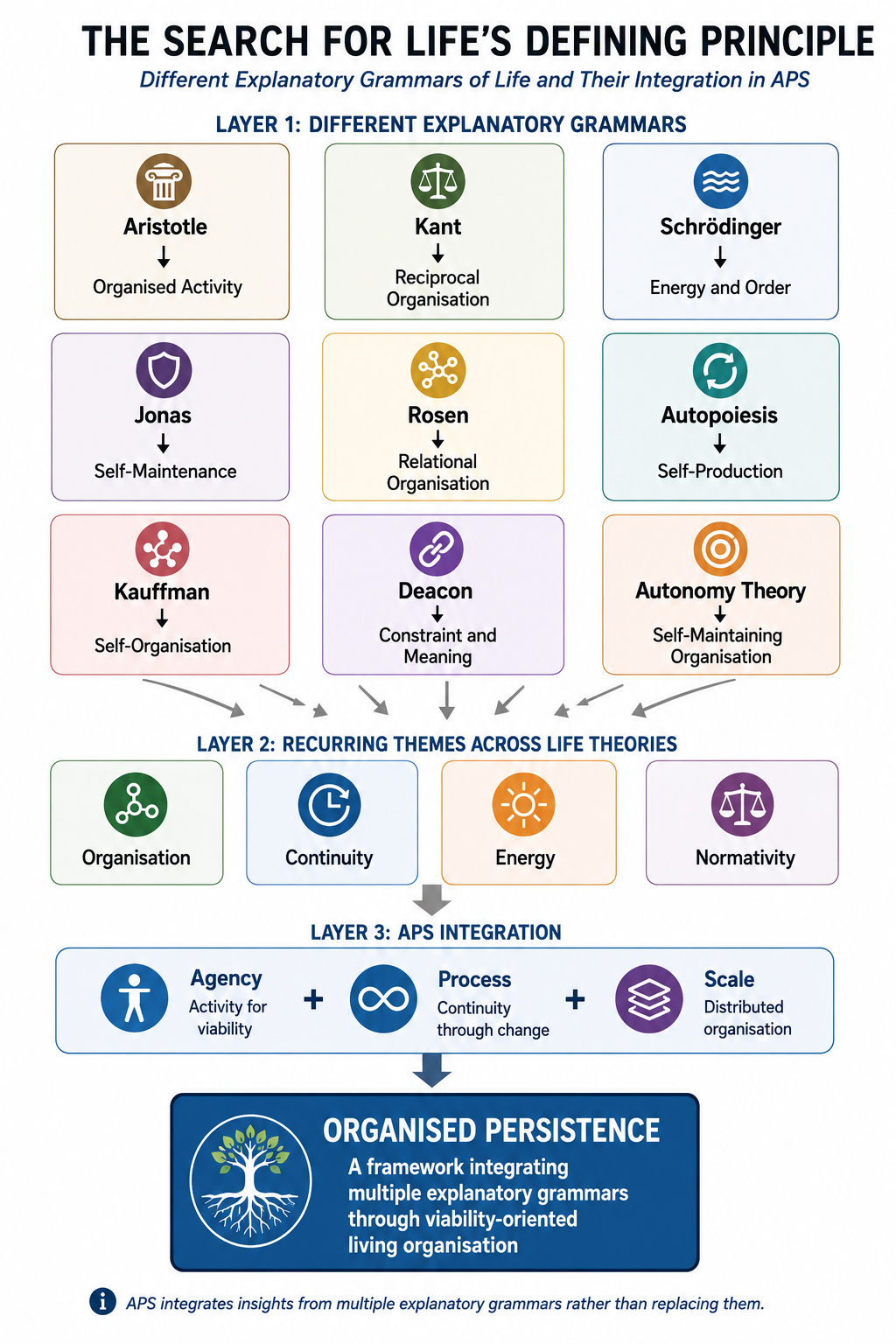
The Search for Life's Defining Principle. Major theories of life can be understood as alternative explanatory grammars that illuminate different dimensions of living organisation. Aristotle, Kant, Schrödinger, Jonas, Rosen, autopoiesis, Kauffman, Deacon, and autonomy theory each identify important aspects of life. APS integrates these insights through agency, process, and scale, providing an explanatory grammar for understanding organised persistence.
APS and the Grammar of Life
The preceding sections reveal an important pattern. Across more than two thousand years of inquiry, the search for life’s defining principle has repeatedly returned to a common set of themes: organisation, activity, purpose, energy, metabolism, self-maintenance, closure, emergence, constraint, and persistence.
Each tradition identified something important.
None appears wholly mistaken.
Yet none appears entirely sufficient.
The resulting challenge is not simply to choose between competing definitions. It is to understand how these insights relate to one another and whether they can be integrated within a broader explanatory framework.
APS approaches this challenge by asking a different question.
Rather than asking:
Which property defines life?
APS asks:
What kind of explanatory grammar is required to understand living systems?
This shift is significant because many historical debates have focused on identifying a defining feature while paying less attention to the structure of explanation itself. As a result, discussions often move between different explanatory levels without recognising the transition. A concept that functions as evidence in one context becomes a definition in another. A diagnostic criterion becomes an explanatory principle. A mechanism becomes an account of life itself.
APS begins by separating these roles.
Definition, Diagnosis, and Evidence
Throughout the history of life theories, many disagreements have arisen because three distinct questions have been conflated.
The first concerns definition.
A definition asks what life fundamentally is.
The second concerns diagnosis.
A diagnosis asks how life is recognised.
The third concerns evidence.
Evidence consists of the observations supporting diagnostic judgments.
The distinction may appear simple, but its implications are profound.
Consider reproduction.
Many traditional definitions identify reproduction as a defining property of life. Yet sterile organisms are alive. Individual organisms often remain alive long after reproductive activity has ceased. Reproduction therefore functions more effectively as evidence of life or as a useful diagnostic criterion than as a universal definition.
The same observation applies to growth, metabolism, responsiveness, information processing, and even evolutionary capacity. Each is biologically important. Each may provide evidence for life. Yet none automatically answers the question of what life fundamentally is.
APS therefore treats many familiar biological characteristics not as definitions but as manifestations of a deeper organisational condition.
This distinction clarifies a recurring theme throughout the history examined in this article.
Aristotle was not assembling diagnostic criteria.
Kant was not constructing a checklist.
Jonas was not primarily interested in classification.
Rosen was not attempting to identify observable traits.
Each sought an explanatory principle capable of accounting for why the familiar characteristics of life belong together.
APS inherits this ambition.
Life as Organised Persistence
The historical survey suggests that many traditions progressively moved away from static properties and toward dynamic organisation.
Organisation became more important than material composition.
Self-maintenance became more important than structure alone.
Closure became more important than isolated mechanisms.
Persistence became more important than momentary states.
APS builds upon this trajectory.
Its central claim is that life is best understood as viability-oriented, constraint-closed organisation.
This definition identifies the organisational condition that makes biological phenomena possible.
Living systems are organised in ways that sustain the conditions of their own continued existence. Their activities contribute to maintaining viability across time. Metabolism, regulation, development, repair, reproduction, adaptation, and evolution become intelligible because they participate in this larger organisational process.
Persistence therefore becomes the primary explanatory target.
Biology is not fundamentally concerned with molecules, genes, cells, organs, behaviours, or populations considered in isolation. It is concerned with understanding how organised systems maintain continuity despite continual material and environmental change.
The explanatory challenge is persistence.
From Defining Principle to Explanatory Grammar
APS differs from many earlier approaches because it does not stop at a definition.
A definition identifies the phenomenon requiring explanation.
An explanatory grammar provides the conceptual tools through which that phenomenon becomes intelligible.
This distinction mirrors the progression seen throughout the history of life theories.
Aristotle provided a grammar of form and activity.
Kant provided a grammar of reciprocity and purposiveness.
Schrödinger provided a grammar of energy and thermodynamic order.
Jonas provided a grammar of self-concern.
Rosen provided a grammar of organisation.
Autopoiesis provided a grammar of self-production.
Kauffman provided a grammar of emergence.
Deacon provided a grammar of constraint.
Autonomy theory provided a grammar of closure and self-maintenance.
APS proposes a different grammar.
Its explanatory grammar consists of three mutually complementary concepts:
- agency;
- process;
- scale.
Agency identifies the activity through which living systems sustain themselves.
Process identifies the temporal continuity through which organisation persists despite continual change.
Scale identifies the distributed organisation through which persistence is achieved across interacting domains of biological activity.
Together, these concepts provide a framework for understanding organised persistence.
Agency
Agency addresses a question that repeatedly surfaced throughout earlier traditions.
How do living systems actively contribute to their own continued existence?
Aristotle approached the issue through activity.
Jonas approached it through self-concern.
Autonomy theory approached it through self-maintenance.
APS unifies these insights through the concept of biological agency.
Agency is the viability-oriented activity through which living systems sustain, regulate, and recreate the conditions of their own persistence.
Agency therefore explains why biological processes matter.
Activities are not significant merely because they occur. They are significant because of their relationship to viability.
Process
Many historical theories struggled with the fact that living systems remain the same while continually changing.
Matter flows through organisms.
Structures develop.
Cells die and are replaced.
Populations evolve.
Yet continuity persists.
APS addresses this challenge through process.
Organisms are not static entities that occasionally undergo change. They are ongoing processes whose continuity consists precisely in organised change.
Process therefore explains how persistence occurs despite continual transformation.
Scale
A third challenge emerged repeatedly throughout the history of life theories.
Life is distributed across multiple organisational domains simultaneously.
Genes, cells, tissues, organs, organisms, populations, and ecosystems all contribute to biological phenomena. No single scale provides a complete explanation.
APS addresses this challenge through scale.
Biological persistence is achieved through coordinated activity distributed across multiple scales of organisation. Understanding life therefore requires analysing how these scales interact rather than reducing explanation to a single privileged level.
Integrating the Historical Traditions
Seen in this light, APS does not reject the major traditions examined in this article.
Instead, it seeks to integrate many of their most important insights.
From Aristotle it retains the importance of organised activity.
From Kant it retains the significance of reciprocal organisation.
From Schrödinger it retains the necessity of energy and thermodynamic openness.
From Jonas it retains the centrality of self-maintenance and vulnerability.
From Rosen it retains the primacy of organisation.
From autopoiesis it retains the importance of closure.
From Kauffman it retains the reality of self-organisation.
From Deacon it retains the importance of constraint and meaning.
From autonomy theory it retains the importance of self-maintaining organisation.
APS does not discard these insights.
It attempts to situate them within a common explanatory framework centred on viability-oriented organised persistence.
The result is not another entry in the catalogue of life definitions. It is a proposal concerning how biological explanation itself should be organised.
The question that remains is whether this framework helps illuminate the deeper issue that motivated the entire historical journey. If life is understood as viability-oriented organised persistence, and if agency, process, and scale provide the grammar through which that persistence becomes intelligible, what does this tell us about the enduring search for life’s defining principle?
The final section returns to the question posed at the beginning of the article and attempts to answer it directly:
What is it about life?
What Is It About Life?
The question that opened this article is among the oldest in biology and philosophy:
What is it about life?
Across more than two thousand years, the answers have changed repeatedly. Aristotle pointed to organised activity. Kant emphasised reciprocal organisation and natural purpose. Schrödinger focused on energy and thermodynamic order. Jonas highlighted self-concern and metabolism. Rosen argued for the primacy of organisation. Maturana and Varela identified self-production. Kauffman explored self-organisation. Deacon investigated constraint and meaning. Autonomy theory developed the concept of self-maintaining closure.
Each of these approaches captured something important.
Yet the history of life theories suggests that none of these principles alone fully resolves the problem.
Energy is necessary, but many non-living systems utilise energy.
Order is important, but order exists throughout the physical world.
Self-organisation is real, but not all self-organising systems are alive.
Closure is significant, but closure alone does not explain biological persistence.
Metabolism matters, but metabolism by itself does not define life.
Evolution is fundamental to biology, but evolution presupposes living systems rather than explaining what life is.
The recurring difficulty is that each principle illuminates one aspect of a larger phenomenon.
The deeper challenge is to identify the organisational condition that unifies them.
The historical trajectory examined throughout this article reveals a striking pattern. Over time, attention has progressively shifted away from static properties and toward dynamic organisation. Increasingly, the central question has become not what living systems are made of, but how they sustain themselves despite continual change.
Living systems are never finished.
Matter flows through them.
Energy passes through them.
Structures develop and transform.
Cells die and are replaced.
Environments change.
Populations evolve.
Yet continuity persists.
The remarkable feature of life is not permanence but organised persistence.
This observation helps explain why so many apparently different biological phenomena belong together.
Metabolism contributes to persistence.
Regulation contributes to persistence.
Development contributes to persistence.
Repair contributes to persistence.
Reproduction contributes to persistence.
Adaptation contributes to persistence.
Evolutionary transformation contributes to persistence across lineages and populations.
These activities differ enormously in their mechanisms and scales, yet all participate in maintaining continuity under changing conditions.
From the perspective of APS, this is the central insight emerging from the history of life theories.
Life is not best understood as a collection of traits.
Nor is it best understood through a single mechanism, energetic process, or organisational structure considered in isolation.
Life is best understood as viability-oriented, constraint-closed organisation.
Living systems are organised in ways that actively sustain the conditions necessary for their own continued existence. Their activities contribute to maintaining viability despite continual internal and external change. Persistence is therefore not a passive condition but an ongoing organisational achievement.
This perspective also clarifies the relationship between the many traditions examined in this article.
Aristotle recognised the importance of organised activity.
Kant recognised reciprocal organisation.
Schrödinger recognised the necessity of energy.
Jonas recognised the significance of self-maintenance.
Rosen recognised the primacy of organisation.
Autopoiesis recognised closure.
Kauffman recognised the emergence of order.
Deacon recognised the importance of constraint and meaning.
Autonomy theory recognised self-maintaining organisation.
APS seeks to integrate these insights rather than replace them.
The result is not another proposed trait list or another isolated defining principle. It is an explanatory framework centred on organised persistence.
Within that framework, agency identifies the activity through which persistence is achieved. Process identifies the continuity through which persistence unfolds. Scale identifies the distributed organisation through which persistence is maintained across multiple domains of biological activity.
Together, agency, process, and scale form an explanatory grammar for understanding life.
This grammar does not eliminate the need for mechanisms, thermodynamics, development, ecology, physiology, evolution, or molecular biology. Rather, it provides a framework within which these forms of explanation can be understood as contributing to a common explanatory target.
That target is organised persistence.
The search for life’s defining principle is therefore not merely a search for a better definition. It is a search for a way of understanding why living systems exhibit the distinctive forms of organisation observed throughout the biological world.
Different traditions have approached this challenge from different directions.
The continuing value of their work lies not only in the answers they proposed but in the explanatory questions they revealed.
Those questions remain as important today as they were in Aristotle’s time.
The continuing absence of a universally accepted definition of life may reflect more than simple disagreement about biological facts. A recent computational analysis of expert definitions (Bender et al. 2026) used large language models and semantic clustering techniques to examine how different definitions relate to one another conceptually. Rather than identifying sharply separated camps, the study revealed a continuous landscape of overlapping themes and perspectives, suggesting that competing definitions often emphasize different aspects of a shared phenomenon rather than describing entirely different things. This finding supports the view that life is difficult to capture through a single checklist of properties and may be better understood as a multidimensional, processual phenomenon. From an APS perspective, the diversity of definitions is therefore not necessarily evidence that life lacks coherence, but may instead reflect the challenge of describing a dynamic, multiscale form of organization from different explanatory standpoints.
The proliferation of definitions does not imply that life has no underlying unity.
Why do living systems maintain themselves?
Why do some conditions matter to them and others not?
How do they persist despite continual change?
How do organisation, energy, function, meaning, adaptation, and evolution fit together within a single biological reality?
The answers remain incomplete, and they will undoubtedly continue to evolve.
Yet the history of ideas examined in this article suggests that one conclusion has become increasingly difficult to avoid.
Life is not simply matter.
It is not simply energy.
It is not simply information.
It is not simply metabolism.
It is not simply reproduction.
It is not simply evolution.
Life is a distinctive form of organised persistence through which living systems continuously sustain, regulate, and recreate the conditions of their own existence.
That, perhaps, is what it is about life.
See Also
Related Articles
References
- (-350). De Anima (On the Soul).
- (2026). What Lives? A Meta-Analysis of Diverse Opinions on the Definition of Life. Biological Theory . https://doi.org/10.1007/s13752-026-00544-9
- (2011). Incomplete Nature: How Mind Emerged from Matter. W. W. Norton & Company.
- (1966). The Phenomenon of Life. Harper & Row.
- (1790). Critique of the Power of Judgment. Cambridge University Press.
- (1993). The Origins of Order: Self-Organization and Selection in Evolution. Oxford University Press.
- (1980). Autopoiesis and Cognition: The Realization of the Living. D. Reidel Publishing Company. https://doi.org/10.1007/978-94-009-8947-4
- (2015). Biological Autonomy. Springer. https://doi.org/10.1007/978-94-017-9837-2
- (2023). Determination, Explanation, and Organization in Biology. Springer. https://doi.org/10.1007/978-3-031-39541-3
- (2018). Everything Flows: Towards a Processual Philosophy of Biology. Oxford University Press. https://doi.org/10.1093/oso/9780198779636.001.0001
- (1991). Life Itself. Columbia University Press.
- (1944). What Is Life? The Physical Aspect of the Living Cell. Cambridge University Press.
- (2025). Biological Agency as the Context for Plant Cognition. Zenodo. https://doi.org/10.5281/zenodo.16938193
- (2026). Agency as the defining activity of life: A viability-oriented framework integrating process and scale. Biological Theory . https://doi.org/10.1007/s13752-026-00547-6