Why Is Biology Different From Physics?
Living systems are composed entirely of physical components and obey the same physical laws as every other system in nature. Yet biology remains a distinct science. Why? APS argues that biology differs from physics not because life violates physical law, but because living systems exhibit viability-oriented organisation. Physics explains the components and processes through which living systems operate. Biology explains how those components are organised to maintain persistence, regulate system–environment relations, and transform through evolutionary time.
Key Points
- Biology does not require forces or laws beyond physics.
- Physics explains matter, energy, forces, and interactions.
- Biology explains viability-oriented organisation and organised persistence.
- Living systems generate explanatory questions concerning function, agency, development, and evolution.
- Biology and physics are complementary rather than competing sciences.
Introduction
Where this article fits: Living systems are composed entirely of physical components and obey the same physical laws as every other system in nature. Yet biology remains a distinct science. APS explains why. Physics describes the components and processes through which living systems operate. Biology explains how those components are organised to maintain viability, persistence, and evolutionary continuity through time.
At first glance, biology might appear to be a branch of physics. Organisms are composed of atoms and molecules. Cells are built from chemical components. Biological processes depend upon physical interactions governed by the same laws that operate throughout the rest of the universe. Nothing in a living system escapes the domain of physics.
This observation raises a profound question. If living systems are entirely physical, why do we need a separate science of biology at all? Why are organisms studied differently from stars, rocks, rivers, or chemical reactions? Why do concepts such as function, adaptation, development, agency, and evolution occupy a central place in biology but not in physics?
These questions have accompanied biology since its emergence as a scientific discipline. Advances in chemistry and molecular biology have only sharpened them. The more successfully biological processes are explained in physical and chemical terms, the more pressing the question becomes. If life is made entirely of physical components, what remains for biology to explain?
APS approaches this issue by distinguishing between physical processes and biological organisation. Living systems do not violate physical laws. They depend upon them completely. Yet living systems exhibit a form of organisation that generates explanatory questions not typically addressed within physics itself. Biology exists because living systems are viability-oriented systems whose activities contribute to maintaining their own persistence through time.
Understanding this distinction helps explain not only why biology differs from physics, but also why concepts such as life, function, agency, development, and evolution are necessary components of biological explanation.
The Puzzle
The question of why biology differs from physics arises because both sciences investigate the same physical world. There are not two universes—one governed by physics and another governed by biology. Organisms, ecosystems, cells, and molecules all exist within a single natural order governed by physical processes.
From this perspective, the existence of biology can appear puzzling. If physics seeks to explain matter, energy, forces, and interactions, then one might expect increasingly complete physical explanations eventually to replace biological explanations altogether. The behaviour of organisms could seem destined to become nothing more than highly detailed descriptions of molecular and physical events.
This expectation has influenced scientific thinking for generations. The extraordinary success of physics has encouraged the view that all scientific explanations ultimately reduce to physical descriptions. According to this perspective, biology may be useful as a practical discipline, but its explanations are merely shorthand for more fundamental physical processes.
Yet biology has persistently resisted disappearance. Even as molecular understanding has advanced, biological concepts such as function, adaptation, regulation, development, fitness, and evolution have remained indispensable. Biologists continue to ask questions that cannot be replaced simply by listing molecules or describing physical interactions.
The persistence of these questions suggests that biology may be addressing something that is not captured by physical description alone. APS argues that what biology explains is not a special substance, force, or law absent from physics. Rather, biology explains a distinctive form of organisation that emerges within the physical world itself.
The puzzle is therefore not why biology differs from physics despite being physical. The puzzle is why certain forms of physical organisation generate explanatory questions that require biological concepts in the first place.
Biology Does Not Violate Physics
Any answer to this question must begin with an important clarification. APS does not propose that living systems operate according to special forces or laws that lie outside physics. Living systems are physical systems. Every biological process is realised through physical and chemical interactions.
Cells obey the laws of thermodynamics. Organisms exchange matter and energy with their environments. Development, metabolism, reproduction, and behaviour all depend upon physical processes. Nothing in biology requires the suspension or violation of physical law.
This point is essential because discussions of life’s distinctiveness have often been associated with forms of vitalism. Vitalist theories proposed that living systems possessed special life forces that distinguished them from non-living matter. Modern biology has overwhelmingly rejected such proposals because biological processes can be investigated successfully through ordinary physical and chemical explanations.
APS fully accepts this conclusion. Life is not mysterious because it transcends physics. Biological organisation is realised through physical processes and remains completely dependent upon them. The question is therefore not whether physics applies to life. It clearly does.
The real question is different. If living systems obey physical laws, why do they nevertheless require explanatory concepts such as viability, function, agency, development, and evolution? APS argues that answering this question requires attention not merely to physical processes themselves but to the ways those processes become organised within living systems.
The Same Molecules, Different Questions
One way to appreciate the distinction is to compare a living cell with a recently dead cell. In many cases the molecules present in both systems may be remarkably similar. The same proteins, nucleic acids, lipids, and other components may remain physically present for some time after death.
Yet something profoundly important has changed.
Biology is not satisfied by observing that the molecules remain. The biological question is why one system continues to maintain viability while the other does not. Why does one system continue to regulate itself, repair damage, exchange resources with its environment, and sustain organised activity, while the other gradually loses these capacities?
Notice that this question differs from asking which molecules are present. The components themselves may be largely unchanged. What has changed is the organisation through which those components contributed to maintaining persistence. The biological problem therefore concerns the maintenance and loss of viability rather than the mere existence of particular physical constituents.
This distinction reveals why biology remains necessary even when physical descriptions are highly detailed. Physical descriptions identify components and interactions. Biology asks how those interactions become organised into systems capable of maintaining themselves through time.
The difference is subtle but profound. Physics can describe the molecules involved. Biology seeks to explain how those molecules participate in the organised persistence characteristic of living systems.
Physics Explains Components
Physics provides extraordinarily powerful explanations of the natural world. It describes matter, energy, forces, fields, interactions, and the laws governing their behaviour. From subatomic particles to galaxies, physics explains how physical systems change through time and how those changes arise from underlying processes.
These explanations are indispensable to biology. Every biological process depends upon physical interactions. Molecular binding, energy transfer, diffusion, mechanical forces, electrical signalling, and countless other phenomena operate according to physical principles. Without physics there could be no scientific understanding of life.
APS therefore treats physics not as a rival to biology but as one of its foundations. Biological systems are composed of physical components whose behaviour must be understood through physical explanation. The success of modern biology depends heavily upon insights derived from physics and chemistry.
Yet physics typically explains what components do under particular conditions. It identifies the processes through which systems change and the mechanisms responsible for those changes. These explanations are powerful precisely because they reveal the physical regularities underlying natural phenomena.
The distinctive contribution of biology emerges when physical components become organised into systems whose activities contribute to maintaining their own persistence. At that point new explanatory questions arise—questions concerning viability, function, regulation, development, agency, and evolution. Understanding why those questions arise is the task to which we now turn.
Biology Explains Organised Persistence
If physics explains the components and processes through which living systems operate, what does biology explain?
APS argues that biology explains organised persistence. Living systems are not simply collections of molecules undergoing physical interactions. They are organised systems whose activities contribute to maintaining the conditions required for their own continued existence. Biology seeks to understand how this persistence is achieved, maintained, transformed, and reproduced through time.
This focus immediately distinguishes biological explanation from purely physical description. The biological question is not merely what physical processes occur. It is how those processes become organised into systems capable of sustaining viability. The central explanatory target is therefore not matter, energy, or molecular composition considered in isolation, but the organisation through which these components collectively contribute to persistence.
Organised persistence is evident throughout biology. Cells regulate internal conditions despite continual environmental fluctuations. Organisms acquire resources, repair damage, and maintain functional integrity across changing circumstances. Populations reproduce continuity across generations while remaining capable of evolutionary transformation. Across multiple scales, living systems exhibit organised activities that contribute to their own continued existence.
APS therefore proposes that biology possesses a distinctive explanatory target. Physics explains the processes through which living systems operate. Biology explains how those processes become organised into viability-oriented systems capable of persisting through time.
This distinction does not separate biology from physics. Rather, it identifies the specific organisational phenomenon that biology investigates within the physical world.
Why Organisation Matters
The importance of organisation becomes clear whenever biological systems lose the capacity for persistence. Death does not usually involve the immediate disappearance of molecules. The physical components often remain present. What disappears is the organisation through which those components contributed to maintaining viability.
This observation reveals a central feature of biological explanation. Knowing which components are present is not always sufficient to explain whether a system is alive, functional, developing normally, or capable of persistence. What matters is how those components are organised and how that organisation contributes to maintaining viability.
The significance of organisation extends far beyond the distinction between life and death. Throughout biology, explanatory questions concern relationships among components rather than components alone. Why does a heart pump blood? Why does an immune system respond to pathogens? Why does a plant grow toward light? These questions concern organised activities that contribute to persistence within larger systems.
Organisation therefore introduces explanatory patterns that cannot be captured simply by listing physical constituents. The same molecules can participate in very different forms of organisation. What matters biologically is not only what components exist but how those components contribute to maintaining the persistence of the system as a whole.
APS consequently places organisation at the centre of biological explanation. Biological systems are distinguished not by their components alone but by the viability-oriented organisation through which those components collectively sustain persistence.
Living Systems Create New Explanatory Questions
Once physical processes become organised into viability-oriented systems, new explanatory questions emerge. These questions are familiar throughout biology, yet they are strikingly different from the kinds of questions typically addressed in physics.
Consider a bacterium moving toward nutrients. Physics can describe the molecular interactions involved in movement, signalling, and energy transfer. Yet biology asks an additional question: why does the bacterium move toward nutrients in the first place? The answer concerns the relationship between nutrient acquisition and viability.
Similar patterns appear throughout the living world. Why does an organism repair damage? Why does a plant allocate resources to growth? Why does a developmental process produce a particular organisational outcome? Why does a population exhibit a particular adaptive characteristic? These questions concern the contribution of activities and structures to persistence.
Such explanations introduce concepts that are central to biology but uncommon in physics. Function concerns how activities contribute to viability. Development concerns how organised persistence is established and maintained across time. Adaptation concerns how forms of organisation become integrated into viable persistence. Evolution concerns the historical transformation of organised persistence across generations.
These explanatory domains arise because living systems exhibit organisational properties that generate questions about persistence itself. The biological challenge is not merely to identify physical processes but to understand how those processes collectively support the maintenance and transformation of viability-oriented organisation.
APS therefore interprets biological explanation as the investigation of organised persistence and the processes through which it is maintained, reproduced, and transformed.
Agency and Goal-Directedness
Among the most distinctive consequences of organised persistence is the emergence of agency. Living systems do not merely undergo change. They actively contribute to maintaining the conditions required for their own continued existence. This activity introduces a form of organisation that is central to biological explanation.
Agency does not imply conscious intention or deliberation. A bacterium moving toward nutrients, a plant regulating water use, and an immune system responding to pathogens all exhibit forms of viability-oriented activity. Their behaviour contributes to maintaining the conditions required for persistence. Agency therefore emerges wherever living systems actively regulate their relationship with the environment in ways that support continued viability.
This feature helps explain why biology frequently employs concepts that appear unfamiliar within physics. Biologists speak of functions, regulation, adaptation, goals, and strategies because living systems are organised around maintaining persistence. These concepts do not replace physical explanation. Rather, they describe organisational relationships that become significant once physical processes are integrated into viability-oriented systems.
Goal-directedness provides a particularly clear example. Organisms behave as though certain outcomes matter because those outcomes genuinely influence persistence. Acquiring resources, repairing damage, defending against threats, and reproducing all contribute to maintaining viability. The resulting appearance of purpose is not an illusion but a consequence of organised persistence.
APS therefore treats agency as a natural outcome of viability-oriented organisation. Living systems generate explanatory questions concerning regulation, function, and goal-directed activity because their organisation is structured around maintaining persistence. These questions arise naturally within biology even though every process involved remains entirely physical.
The emergence of agency thus marks an important point of divergence between biological and physical explanation. Physics explains the processes through which activity occurs. Biology explains how that activity contributes to maintaining organised persistence.
Evolution Adds a Historical Dimension
Biology differs from physics in another important respect. Living systems are not only organised in the present; they are also products of historical processes extending across generations. Understanding a living system therefore often requires explaining how its organisation emerged through time.
Physics certainly investigates history in some contexts. Cosmology, geology, and planetary science all examine historical processes. Yet historical explanation occupies a particularly central role within biology because living systems inherit organisational continuity from previous living systems. Organisms exist within lineages whose forms, functions, and capacities have been shaped by evolutionary processes.
This introduces explanatory questions that extend beyond present organisation. Why does an organism possess a particular structure? Why does a population exhibit a particular adaptation? Why are certain forms of organisation widespread while others are absent? These questions concern the historical emergence and transformation of organised persistence.
Evolution therefore complements agency within the APS framework. Agency explains how living systems maintain viability during their own lifetimes. Evolution explains how forms of viability-oriented organisation emerge, diversify, and transform across historical time. Together they provide a framework for understanding both the maintenance and the history of organised persistence.
Biology consequently differs from physics not only because it studies viability-oriented systems but also because those systems exist within lineages whose organisation has been shaped through evolutionary processes. Historical continuity is therefore a fundamental dimension of biological explanation.
Biology and Physics Are Complementary
The distinction between biology and physics should not be understood as a conflict between competing sciences. APS does not argue that biological explanations replace physical explanations, nor does it suggest that living systems operate outside physical law. Biology and physics address different aspects of the same natural world.
Physics explains the components and processes through which living systems operate. Biological organisation depends completely upon physical interactions. Every instance of metabolism, development, behaviour, and reproduction is realised through physical and chemical processes. Physics therefore remains indispensable to understanding life.
Biology contributes something different. It explains how physical processes become organised into systems capable of maintaining viability, regulating system–environment relations, exhibiting agency, developing through time, and evolving across generations. These explanatory questions arise because living systems exhibit forms of organisation whose significance depends upon persistence.
The relationship is therefore complementary rather than competitive. Physics explains how components behave. Biology explains how organised systems persist. Neither perspective eliminates the other because each addresses questions that the other does not specifically target.
APS consequently rejects both reductionism and anti-physicalism. Biological explanations are not rendered unnecessary by physical explanations, yet biological systems do not require forces or laws beyond physics. Biology occupies its own explanatory domain because living systems exhibit viability-oriented organisation within the physical world.
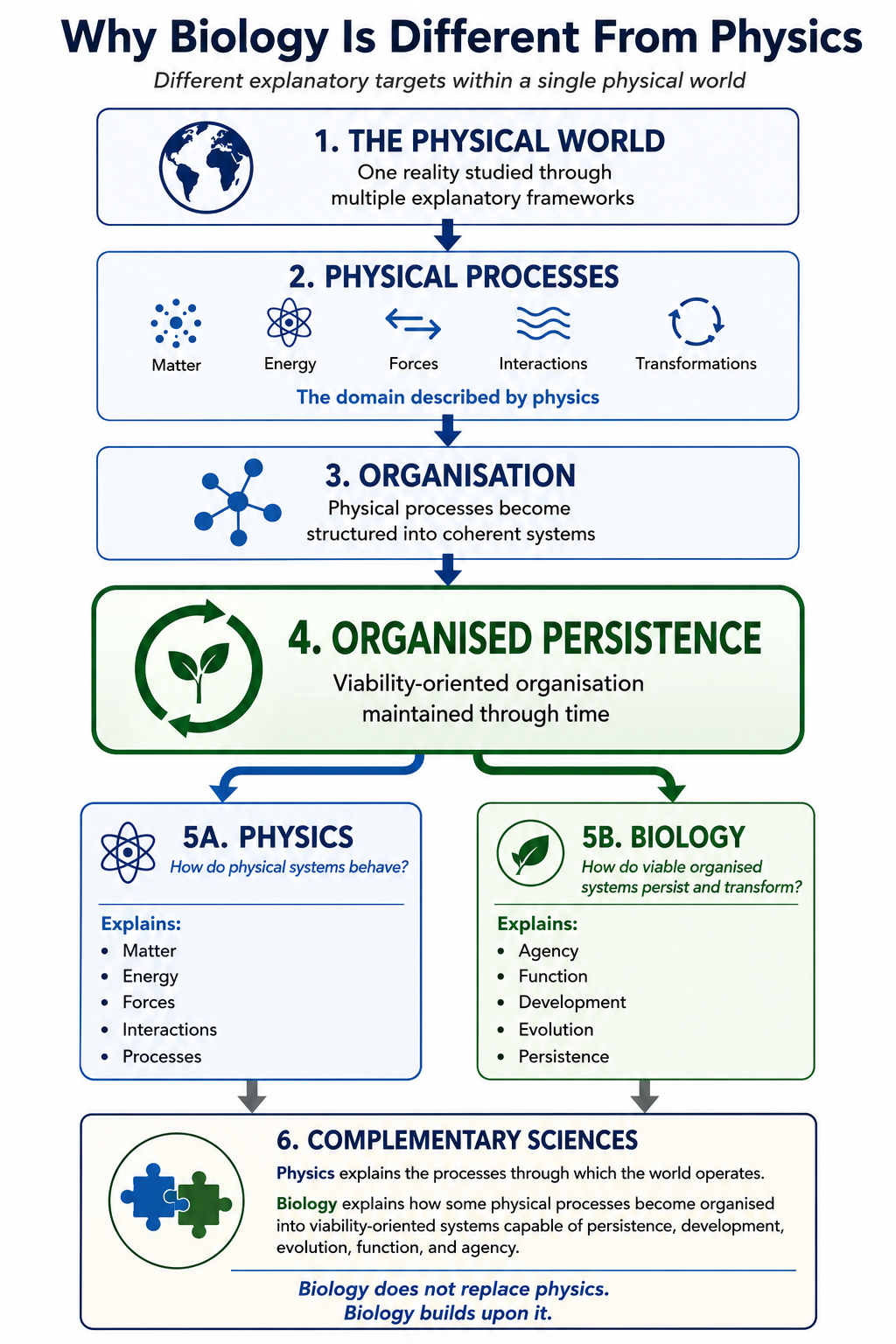
Why Biology Is Different From Physics. Physics explains matter, energy, forces, and interactions. Biology explains how physical processes become organised into viability-oriented systems capable of agency, function, development, evolution, and organised persistence. The sciences are therefore complementary rather than competing.
Why Is Biology Different From Physics?
The APS answer can now be stated directly.
Biology is different from physics not because living systems violate physical laws, but because living systems exhibit viability-oriented organisation. Physics explains the components and processes through which living systems operate. Biology explains how those processes become organised to maintain persistence through time.
This difference generates the central explanatory concepts of biology. Function becomes important because biological activities contribute to viability. Agency becomes important because living systems actively regulate the conditions required for persistence. Development becomes important because viable organisation must be established and maintained. Evolution becomes important because forms of organised persistence transform historically across generations.
These explanatory domains arise naturally once physical processes become organised into living systems. They do not replace physical explanations, nor can they be reduced to mere descriptions of physical components. They address questions concerning the maintenance, regulation, continuity, and transformation of organised persistence.
APS therefore identifies organised persistence as the defining explanatory target of biology. Biology exists because living systems are not merely physical objects. They are viability-oriented systems whose activities contribute to maintaining their own continued existence.
Understanding this point clarifies why biology remains a distinct science despite being entirely physical. The subject matter of biology is not a special substance called life. It is the organisation through which living systems persist.
Why This Matters
The question of why biology differs from physics is more than a philosophical curiosity. It influences how biological phenomena are interpreted, investigated, and explained. If biology is understood merely as applied physics, concepts such as function, agency, development, and evolution can appear secondary or provisional. Yet these concepts remain central to biological understanding because they address features of living organisation that physical descriptions alone do not specifically target.
Recognising organised persistence as the explanatory focus of biology helps unify diverse areas of biological research. Molecular biology, physiology, development, ecology, behaviour, and evolution all investigate different aspects of how living systems maintain, reproduce, and transform viability-oriented organisation. Their apparent diversity reflects different perspectives on a common explanatory target.
This perspective also clarifies why biological explanation often requires multiple complementary modes. Mechanistic explanations describe how organised persistence is produced. Functional explanations describe how activities contribute to viability. Evolutionary explanations describe how forms of organised persistence emerge and transform through time. These approaches are not competing alternatives but complementary dimensions of biological explanation.
APS therefore provides a framework for understanding both the distinctiveness and the unity of biology. The science of life is not unified by a particular substance, molecule, or level of organisation. It is unified by a common explanatory concern with organised persistence.
Key Point
Biology is different from physics not because living systems violate physical laws, but because living systems exhibit viability-oriented organisation. Physics explains the components and processes from which living systems are composed. Biology explains how those components become organised to maintain persistence, regulate system–environment relations, exhibit agency, develop through time, and evolve across generations. APS therefore identifies organised persistence as the defining explanatory target that makes biology a distinct science.
Explanatory Architecture
1. Central Question
Why is biology a distinct science if living systems are entirely physical?
APS argues that biology differs from physics not because life transcends physical law, but because living systems exhibit viability-oriented organisation. Physics explains the components and processes through which living systems operate. Biology explains how those components become organised to maintain organised persistence.
2. Architectural Role
This article establishes the explanatory distinction between physics and biology within the APS framework.
Rather than proposing additional biological forces or laws, it explains why living systems generate explanatory questions that cannot be answered by physical description alone. It therefore naturalises the autonomy of biology while remaining fully consistent with physical science.
The article identifies organised persistence as the defining explanatory target that distinguishes biology from physics.
3. Builds On
This article builds directly upon the APS concepts of:
- Life
- Biological Organisation
- Viability
- Organised Persistence
- Biological Agency
- Process
- Scale
- Function
It assumes these concepts in their canonical forms and explains why they become necessary once physical processes are organised into living systems.
4. Develops Into
The conceptual clarification provided here supports subsequent work on:
- Biological Explanation
- Function
- Development
- Evolution
- Ecology
- Biological Evaluation
- Cognition
- Mind
It establishes why these explanatory domains arise naturally from viability-oriented organisation rather than representing alternatives to physical explanation.
5. Related Explanatory Questions
This article contributes to the following broader biological questions:
- Why does biology remain a distinct science despite being entirely physical?
- What distinguishes biological explanation from physical description?
- Why do living systems generate concepts such as function, agency, and development?
- What is the explanatory target unique to biology?
- How are physics and biology complementary rather than competing sciences?
- Why is organised persistence central to biological explanation?
- How does viability-oriented organisation generate new explanatory questions?
6. Position within APS
This article occupies the Conceptual Foundations cluster as a major synthesis article.
Its role is to establish the explanatory relationship between physics and biology by identifying organised persistence as biology’s distinctive explanatory target. It rejects both reductionism and anti-physicalism, showing instead that biology and physics investigate different explanatory aspects of the same natural world.
The article complements the canonical articles on Life, Biological Organisation, Organised Persistence, Agency, Function, Development, and Evolution while providing an important conceptual foundation for the APS account of Biological Explanation.
Rather than treating biology as either reducible to physics or independent of it, APS presents biology as the science of viability-oriented organisation realised through entirely physical processes.
See Also
Related Articles
References
- (2018). A Manifesto for a Processual Philosophy of Biology. Oxford University Press.
- (1988). Toward a New Philosophy of Biology. Harvard University Press.
- (1944). What Is Life?. Cambridge University Press.
- (2026). Agency as the Defining Activity of Life: A Viability-Oriented Framework Integrating Process and Scale. Biological Theory . https://doi.org/https://doi.org/10.1007/s13752-026-00547-6