Gene-Centric Biology and APS — Why Genes Are Not “In Charge”
Gene-centred approaches have provided some of the most powerful explanations in modern evolutionary biology. APS does not dispute those achievements or treat genetic explanation as biologically secondary. It asks a different question: what follows from the explanatory importance of genes, and what does not? Genes make major causal contributions to inheritance, development, variation, and evolutionary change, but their importance for particular explananda does not by itself establish a universally privileged causal level or make genetic description sufficient for explaining living organisation. APS places genetic mechanisms within viability-oriented, constraint-closed organisation while leaving their particular causal importance, directionality, scale, and evolutionary consequences to biological evidence.
Key Points
- Gene-centred explanations can be scientifically sufficient for particular genetic and evolutionary explananda; APS does not replace them merely by supplying a broader organisational description.
- Genetic mechanisms make major causal contributions to inheritance, development, variation, and evolutionary change.
- The explanatory importance of genes does not by itself establish universal causal or explanatory priority.
- APS treats genes as operating within viability-oriented, constraint-closed living organisation, while the causal relations relevant to particular cases require independent biological evidence.
- Inheritance, variation, fitness, natural selection, and evolutionary transformation identify distinguishable explanatory relations; their ordering within APS does not establish a universal causal or temporal sequence.
- Multiscale organisation does not imply equal causal contribution or universal reciprocal causation across scales.
Where This Article Fits
This article is a clarification within the APS Evolutionary Dynamics corpus. It addresses the explanatory role of genes without denying their importance in inheritance, variation, development, and evolutionary change. Its purpose is to distinguish the biological importance of genetic mechanisms from the stronger claim that genes constitute a privileged causal level or the organisational basis of life.
APS therefore does not replace gene-centred explanations where they successfully address genetic transmission, population change, or molecular mechanisms. It places those explanations within the wider organisation through which genetic processes become biologically effective. Genes contribute to the continuity and transformation of living systems while operating within cellular, developmental, physiological, ecological, and evolutionary relations.
The article consequently clarifies a boundary of APS explanation: identifying an important or even indispensable component or mechanism for a specified process does not by itself establish general explanatory primacy. The causal contribution of genes must be understood relative to the particular biological organisation, evolutionary process, and explanandum concerned.
Explanatory Architecture
Central Question
What does the explanatory success of gene-centred biology establish about genetic causation, and what does it leave open about the organisation within which genetic processes operate?
Architectural Role
This article compares explanatory focus without assigning general causal priority in advance. Genetic mechanisms can provide sufficient explanations for particular genetic, molecular, population, or evolutionary explananda. Situating those mechanisms within wider living organisation does not by itself make the wider description explanatorily superior.
Causal and Explanatory Priority
Genes can make major causal contributions to inheritance, development, variation, and evolutionary change. Their importance for those processes does not establish that genes constitute a universally privileged causal level, nor does the organisational context in which genes operate establish universal downward or reciprocal causation.
The causal relations required for an explanation must therefore be identified for the particular biological target.
Scale and Explanatory Extent
APS Scale concerns the spatial, temporal, and organisational extent required to capture relations relevant to an explanandum. A genetic explanation need not be expanded merely because genetic activity occurs within wider biological organisation. Wider explanatory extent is warranted only where additional materially realised relations make an explanatory difference to the target.
Position within APS
APS therefore neither replaces gene-centred explanation with organised persistence nor treats genes as universally explanatory of living organisation. It asks what explanatory extent and which causal relations are required for the problem under investigation. Any claim of additional APS explanatory gain requires target-matched comparison rather than broader organisational description alone.
Introduction — What Exactly Is the Gene-Centric Question?
Are genes “in charge” of life?
Taken literally, this is not a useful biological question. Genes do not issue commands, organisms are not passive vehicles, and biological causation need not conform to a hierarchy in which one kind of component governs all others.
Yet the question points towards a genuine problem in biological explanation. Gene-centred approaches have been extraordinarily successful. Population genetics can explain changes in allele frequencies. Molecular genetics can identify mechanisms of inheritance and gene expression. Comparative genetics can reconstruct evolutionary relationships and reveal patterns of historical change. Genetic explanations can therefore be causally informative, quantitatively powerful, and sufficient for many specified explananda.
The relevant question is not whether those explanations work. It is:
What does the explanatory success of gene-centred biology establish about the role of genes—and what does it leave unexplained?
APS approaches this question without assuming that either genes or organisms must be assigned general explanatory priority. It distinguishes the success of a genetic explanation for a specified target from the stronger claim that genetic description therefore supplies a privileged explanation of living organisation as such.
That distinction is the subject of this article.
What Gene-Centred Biology Explains
Gene-centred biology has contributed to some of the central achievements of modern evolutionary science. Genetic models have provided powerful accounts of inheritance, population change, adaptation, and evolutionary relationships. Molecular biology has identified mechanisms through which DNA is replicated, expressed, regulated, and transmitted. Population genetics has made evolutionary change mathematically tractable across generations.
The gene’s-eye perspective developed by Dawkins provides a particularly clear version of this explanatory strategy. It asks how evolutionary processes appear when persistent replicating entities, especially genes, are treated as focal units of analysis. In The Extended Phenotype, this perspective extends beyond effects confined to an organism’s body and examines the wider phenotypic consequences through which genes can affect evolutionary outcomes.
Nothing in APS requires these explanations to be rejected merely because they focus on genes.
A genetic explanation may be entirely appropriate to a genetic explanandum. A population-genetic model need not include the full physiology, development, ecology, or organisational history of an organism if those factors are not required for the question being addressed. Explanatory adequacy is relative to a target.
The existence of wider biological organisation therefore does not automatically make a narrower genetic explanation inadequate.
The APS question begins only when a further inference is made: does explanatory success at the genetic level establish that genes have general causal or explanatory priority across living organisation?
That conclusion does not follow from explanatory success alone.
From Explanatory Success to Explanatory Privilege
Biological explanation often proceeds by isolating components or processes that make a difference to an outcome. Genes are particularly powerful explanatory objects because genetic differences can be tracked, inherited, experimentally manipulated, and incorporated into formal evolutionary models.
Several claims must, however, be kept distinct. At the methodological level, genes can be highly effective explanatory units for specified biological questions, while at the causal level genetic differences can make demonstrable contributions to biological outcomes. Neither proposition entails the stronger explanatory claim that, because genes are important for those outcomes, genetic explanation has priority over other forms of biological explanation. Still less do they establish the ontological claim that genes constitute the fundamental organisational basis from which the relevant properties of living systems can in principle be derived. The methodological and causal success of genetic explanation therefore provides no automatic warrant for either general explanatory priority or ontological primacy.
This distinction also prevents APS from replacing one hierarchy with another. To deny automatic genetic privilege is not to establish organismal, developmental, ecological, or organisational privilege instead.
Noble’s principle of biological relativity is relevant here: causal privilege should not be assigned to a biological level a priori. Processual and developmental approaches likewise emphasise that biological outcomes emerge through temporally extended relations among changing biological processes rather than through the autonomous operation of static components.
APS accepts this methodological consequence while retaining a further control: the absence of a priori privilege does not imply that every biological process is causally symmetrical or that every scale contributes equally to every explanandum. Real causal asymmetries may obtain, but their existence and explanatory importance must be established for the biological case concerned rather than assumed in advance. They must be established rather than assumed.
The APS Starting Point — Organisation Without Automatic Priority
APS begins from a constitutive account of living organisation.
Life is viability-oriented, constraint-closed organisation expressed through biological agency.
This claim specifies what APS means by living organisation. It does not, by itself, determine which component or process will provide the most informative explanation of every biological phenomenon occurring within that organisation.
Agency, Process, and Scale are complementary analytic projections of one living organisation. They are not competing causal levels.
Within Evolutionary Dynamics, APS distinguishes several explanatory relations. Inheritance concerns the reliable reconstitution of organised continuity across generations or developmental cycles; variation concerns differences generated within historical continuity; fitness concerns differential historical continuity; natural selection concerns differential historical stabilisation; and evolutionary transformation concerns historical change in organised biological persistence. Together these distinctions provide an explanatory architecture, but their arrangement within that architecture does not establish a universal sequence in which one process must always cause, precede, or explain another. The same control applies to genes. APS locates genetic processes within living organisation because genes are materially realised, replicated, expressed, and regulated there, while leaving the causal and explanatory importance of any particular genetic mechanism to be established for the evolutionary explanandum concerned.
Genes Within Biological Organisation
Genes make major causal contributions to biological continuity and transformation. Genetic systems participate in inheritance, contribute important sources of variation, influence development and physiology, and can make differences that persist through evolutionary time.
Their effects are nevertheless materially realised within biological systems.
Gene expression occurs through cellular machinery. DNA replication requires molecular and cellular processes capable of maintaining the conditions under which replication occurs. Development involves interactions among gene expression, cellular organisation, physiology, environmental conditions, and developmental history. Organisms can also alter environmental conditions that subsequently affect development, survival, reproduction, and selection.
These facts do not make genetic causation unreal or secondary. They specify the biological contexts in which genetic causation operates.
Lewontin’s treatment of gene, organism, and environment and West-Eberhard’s account of developmental plasticity both illustrate why biological outcomes cannot always be inferred from genetic state alone. Dupré and Nicholson’s processual approach similarly emphasises that living systems persist through organised processes rather than as collections of unchanging substances.
APS expresses this contextual point in its own terms: genetic processes occur within viability-oriented, constraint-closed organisation.
But APS does not infer from this that every genetic effect must be reciprocally caused by every other level of organisation. Nor does it infer that organisational description automatically explains more than a genetic mechanism does.
The relevant causal relations must be established in the biological case concerned.
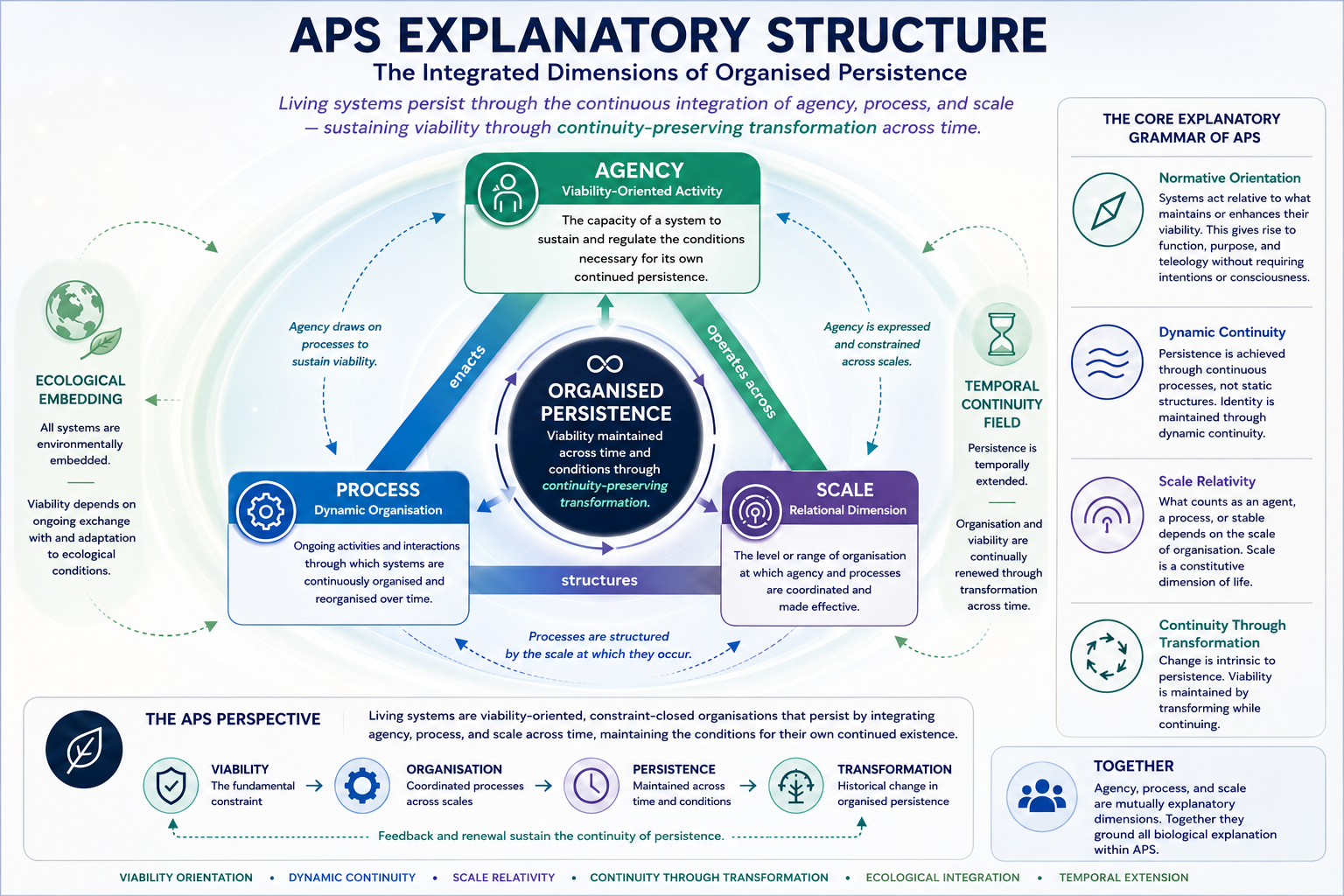
APS Explanatory Structure. Agency, Process, and Scale are complementary analytic projections of organised biological persistence. Genetic mechanisms can be investigated within this organisation at the scales and through the processes relevant to the explanandum concerned. The diagram represents APS explanatory organisation; it does not establish equal causal contribution, reciprocal causation, or explanatory priority among biological components or scales.
Scale, Causation, and Explanatory Priority
The phrase “genes are in charge” is misleading because it combines causal importance with the metaphor of control.
Biological systems contain many causal asymmetries. A particular mutation may be decisive for a phenotype. A regulatory process may constrain expression across many genes. A developmental transition may alter the effects of genetic variation. An environmental change may modify which variants contribute to differential continuity.
Nothing in APS requires these contributions to be equal. Scale has an explanatory rather than automatically hierarchical meaning: molecular, cellular, organismal, ecological, and evolutionary descriptions identify different spatial, temporal, and organisational extents over which biological relations can be investigated, and which of those extents matters depends on the explanatory target.
A gene may therefore provide the appropriate explanatory focus for one question, while a developmental process may be decisive for another and still other questions may require relations extending across several scales.
The APS principle is consequently narrower than the claim that “causation is multiscale and reciprocal.”
No component acquires explanatory priority merely from its identity or scale.
That principle leaves open the possibility that evidence will establish strong causal asymmetry, local explanatory sufficiency, or even practical explanatory priority for a particular biological problem.
APS therefore does not replace gene-centrism with organism-centrism.
It asks which biological relations actually explain the phenomenon concerned.
Genes in Evolutionary Explanation
Genes occupy an important place in evolutionary explanation because genetic processes can contribute both to historical continuity and to historical change. Different evolutionary questions should nevertheless not be collapsed into one another. Inheritance asks how biological organisation, or relevant components of it, is reliably reconstituted across generations; variation asks how differences arise within historically continuous living systems; fitness concerns differences in historical continuity under specified conditions; natural selection concerns differential historical stabilisation associated with such differences; and evolutionary transformation concerns historical change in living organisation across generations. Genetic processes may contribute to each of these relations in different ways. Mutations, recombination, segregation, gene regulation, and other genetic processes can generate or transmit differences, but their evolutionary consequences depend on the biological and historical relations through which those differences are expressed, inherited, maintained, eliminated, or transformed.
Developmental processes may contribute to the production and expression of variation. Ecological relations may alter the conditions under which differences matter. Selection may differentially stabilise some differences. Inheritance may reproduce organisational features through genetic and non-genetic processes.
Which relations are important, and how they depend upon one another, cannot be inferred merely from their positions within APS.
For the same reason, APS does not claim that organised persistence is “primary” in the sense of being a universal efficient cause of genetic inheritance or evolutionary change.
Organised persistence instead identifies the continuity whose maintenance and transformation APS seeks to explain.
Genes can be among the mechanisms contributing to that continuity and transformation.
What APS Adds — and What It Does Not Yet Establish
APS changes the framing of the gene-centred question. Instead of asking whether genes or organisms are ultimately in control, it asks what explanatory target is being addressed, which biological relations bear on that target, and what spatial, temporal, and organisational extent is required to explain it.
This framing can be useful where a biological problem extends beyond genetic transmission alone. It can make explicit relations among genetic mechanisms, development, physiology, organism–environment interaction, lineage continuity, and evolutionary history that a more narrowly targeted genetic explanation may not need to represent. Their inclusion, however, must be warranted by the explanandum rather than by a general preference for broader organisational description.
Broader framing is therefore not automatically better explanation. If a gene-centred model already explains a specified change in allele frequency, identifying the living organisation in which that change occurs does not by itself constitute explanatory gain. Likewise, if a molecular mechanism adequately explains a specified genetic effect, redescribing that mechanism as part of viability-oriented organisation does not automatically improve the explanation.
APS would establish additional explanatory gain only where its organisational framework identifies something consequential that the strongest relevant comparator does not—for example, a dependency, causal discrimination, intervention target, prediction, or other explanatory relation required by the explanandum. The relevant test is therefore not whether APS provides a more encompassing description, but whether the additional organisation it identifies makes an explanatory difference to the target.
This requirement preserves the distinction between integration and explanatory superiority. Bringing genetic, developmental, physiological, ecological, and evolutionary relations into a common framework may clarify how they are connected without demonstrating that the resulting explanation is superior to a narrower account. APS therefore makes no general claim that organisational explanation supersedes gene-centred biology. It provides a framework within which the explanatory extent and limits of genetic accounts can be examined relative to specified biological questions.
A Clarifying Analogy
Genes are sometimes compared with instructions or blueprints. Such metaphors can be useful if their limits are kept explicit.
A blueprint may contain information relevant to the construction of a building, but possession of the blueprint does not itself construct the building. Conversely, recognising that construction requires materials, workers, physical processes, and environmental conditions does not make the blueprint irrelevant.
The analogy should not be taken further than this: genes are not literally blueprints, organisms are not buildings, and development is not construction from a fixed plan. Its limited purpose is explanatory. The importance of one component of a process does not establish the sufficiency of its description for every question about the resulting organisation.
Genetic mechanisms can therefore make indispensable contributions to particular biological processes without genetic description becoming a complete theory of living organisation.
Conclusion
Gene-centred biology remains one of the most powerful explanatory traditions in modern science, and its achievements in genetics and evolutionary biology do not need to be diminished for APS to make its own organisational distinctions. Genes make real causal differences: genetic mechanisms contribute to inheritance, development, variation, and evolutionary change, and for many biological questions genetic explanation may be precisely the explanation required.
What does not follow from those successes is universal causal or explanatory privilege. APS treats genes as operating within viability-oriented, constraint-closed living organisation. This locates genetic processes within a wider biological context without determining their causal importance in advance or implying that causation must always be reciprocal, that all scales contribute equally, or that organisational description is automatically superior to genetic explanation.
The appropriate explanatory extent, process, or combination of relations depends on the biological question and the available evidence. The issue is therefore not whether genes are “in charge”, but what genes explain, what additional relations a particular explanandum requires, and what the evidence establishes about the relations among them.
Key Point
Genes are major causal participants in living systems, but causal importance for a specified process does not by itself establish universal explanatory primacy. APS places genetic mechanisms within living organisation while leaving their particular explanatory importance to the biological case concerned.
See Also
Related Articles
References
- (1982). The Extended Phenotype: The Gene as the Unit of Selection. W. H. Freeman.
- (2018). A Manifesto for a Processual Philosophy of Biology. Oxford University Press. https://doi.org/10.1093/oso/9780198779636.003.0001
- (2000). The Triple Helix: Gene, Organism, and Environment. Harvard University Press.
- (2012). A Theory of Biological Relativity: No Privileged Level of Causation. Interface Focus, 2(1), 55–64 . https://doi.org/10.1098/rsfs.2011.0067
- (2003). Developmental Plasticity and Evolution. Oxford University Press.