Function — How Living Systems Make Persistence Operational
This article explains function in APS as the operational expression of purpose within viability-oriented organised persistence. Functions are not externally assigned purposes, isolated mechanistic effects, or merely historical evolutionary outcomes. They are continuity-preserving organisational roles enacted through dynamically regulated biological processes operating across interacting scales and timescales. APS explains how living systems operationalise persistence through functional organisation, mechanistic realisation, adaptive reconstruction, perturbation-sensitive regulation, evaluation, and continuity-preserving organisation within organism–environment systems.
Key Points
- Function operationalises viability-oriented organised persistence.
- Biological functions are continuity-preserving organisational roles.
- Mechanisms realise functional organisation within continuity-maintaining systems.
- Functional organisation is temporally organised, adaptive, and reconstructive.
- Functional equivalence allows persistence through different organisational pathways.
- Malfunction reflects degraded contribution to organised continuity.
- Functions emerge within dynamically maintained organism–environment systems.
- Evaluation grounds functional significance relative to viability conditions.
Function — How Living Systems Make Persistence Operational
Biological systems are often described in terms of what their parts do.
Hearts circulate blood, leaves capture light, enzymes catalyse reactions, neural circuits coordinate activity, and immune systems regulate defence and repair.
These descriptions appear straightforward, but they conceal a deeper question:
What makes a process or structure count as having a biological function at all?
Traditional accounts often explain function either through causal contribution or evolutionary history.
APS preserves important insights from both approaches while situating function within a broader framework centred on organised persistence.
Function is not merely assigned from outside or inherited passively from the past.
It is enacted within already organised, viability-oriented systems that continuously maintain themselves across changing conditions.
In APS, function is the continuity-preserving organisational role through which viability-oriented persistence becomes operational within organised biological systems.
Beyond Mechanism and History
Many theories of biological function adopt one of two general approaches.
One approach defines function through causal contribution: a component has a function if it produces a particular effect within a larger system.
Another defines function historically: a trait has a function because it was selected for that effect during evolutionary history.
Both approaches capture important aspects of biology.
Causal accounts explain how processes contribute to system behaviour.
Historical accounts explain how functional organisation becomes stabilised across evolutionary time.
However, neither approach alone fully explains how function operates within living systems in the present.
Causal effects are not necessarily biologically meaningful.
Many processes produce effects without contributing to organised persistence.
Historical selection explains how functions emerge evolutionarily, but does not by itself explain how functions remain operational within living systems across changing conditions.
APS therefore grounds function in ongoing viability-oriented organisation.
Contemporary organisational approaches similarly argue that biological functions must be understood relative to the maintenance of organised systems rather than solely through isolated causal effects or historical selection accounts.
APS strongly converges with these perspectives while placing greater emphasis on:
- continuity-preserving organisation;
- temporally extended persistence;
- adaptive reconstruction;
- perturbation-sensitive regulation;
- evaluation;
- semiosis;
- and biological agency enacted across interacting scales and changing conditions.
Function as Viability-Oriented Organisational Role
In APS, function is the viability-oriented organisational role of a process or structure within an already organised continuity-maintaining system.
A process counts as functional only insofar as it contributes to preserving or restoring viable persistence.
Function is therefore not:
- an intrinsic property of isolated components;
- an externally assigned purpose;
- or merely a historically inherited effect.
It is a relational organisational role emerging within systems organised around continuity-preserving viability.
Function consequently depends upon organisational context.
The same process may be:
- functional in one system;
- non-functional in another;
- or actively disruptive under different organisational conditions.
Biological function therefore cannot be reduced to isolated mechanisms considered independently of organised persistence.
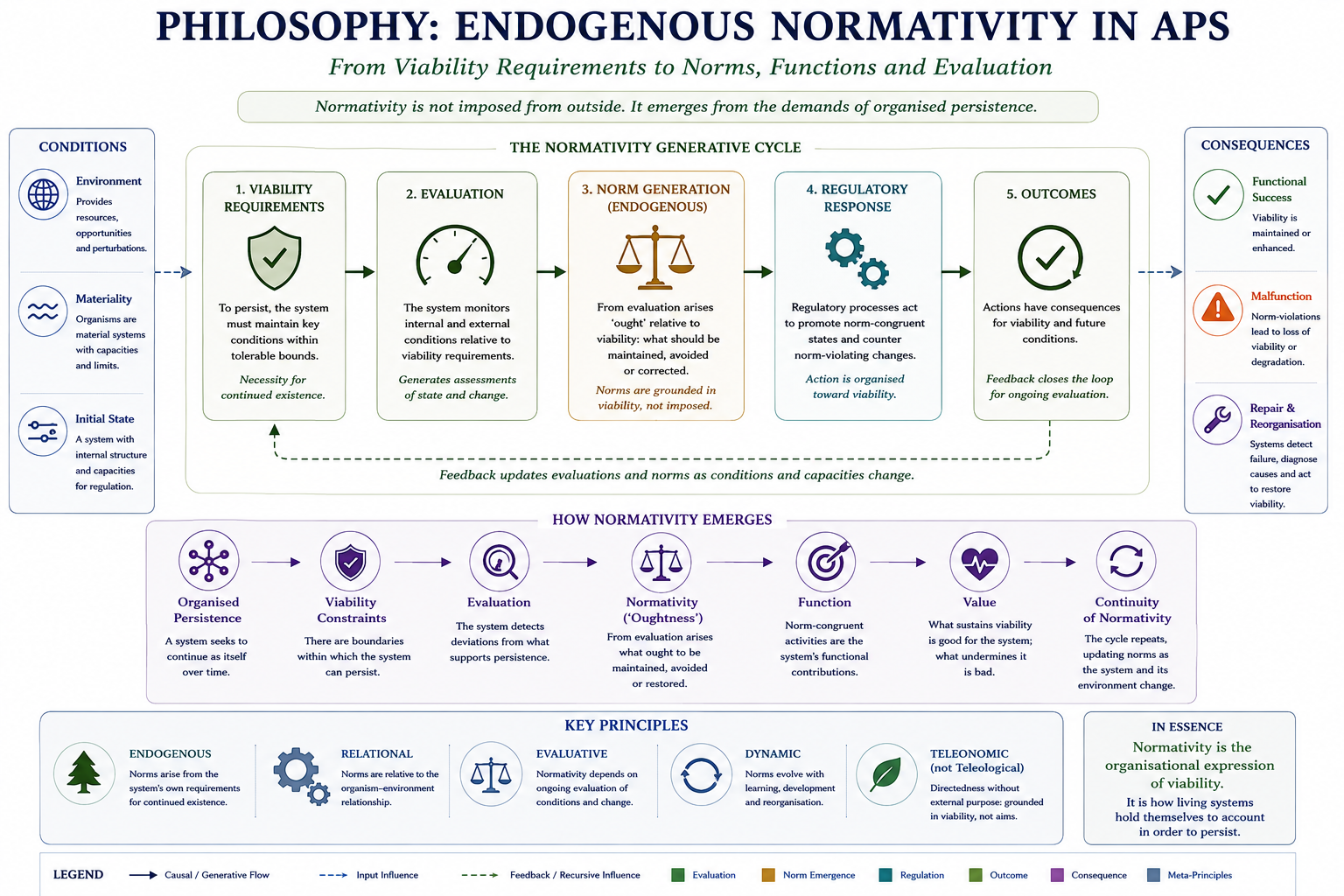
Function and Endogenous Normativity. Functional organisation emerges through viability-oriented organised persistence in which evaluation and regulation distinguish continuity-supporting from continuity-disrupting conditions.
Function, Purpose, and Organised Persistence
Function presupposes a purposive context in the APS sense.
Purpose names the viability-oriented organisation of the system as a whole.
Function names the operational processes through which that organisation is enacted and maintained across time.
Function is therefore the operational expression of purpose.
This relationship clarifies why function cannot be understood in isolation from organised persistence.
A process is functional only within a system whose activity is organised around preserving continuity under changing conditions.
Functions operationalise:
- regulation;
- repair;
- adaptation;
- environmental responsiveness;
- developmental continuity;
- evaluation;
- semiosis;
- and persistence-preserving organisation.
Living systems therefore maintain continuity not through static structure alone, but through ongoing functional activity continuously reconstructing viability-oriented organisation.
Function and Mechanistic Realisation
APS does not reject mechanistic explanation.
Mechanisms are indispensable for understanding how biological organisation operates.
Metabolic pathways, neural circuits, immune responses, developmental processes, and behavioural systems
all involve organised mechanistic relations.
However, APS rejects the idea that mechanisms are explanatorily self-sufficient.
Mechanisms become biologically meaningful because of the organisational roles they play within continuity-maintaining systems.
Mechanistic processes realise functional organisation.
A mechanism becomes biologically functional insofar as it contributes to:
- viability maintenance;
- continuity regulation;
- adaptive reconstruction;
- perturbation-sensitive compensation;
- evaluation;
- semiosis;
- and organised persistence across time.
Mechanistic explanation therefore remains scientifically indispensable, but its biological significance depends upon its integration within larger systems organised around viability-oriented continuity.
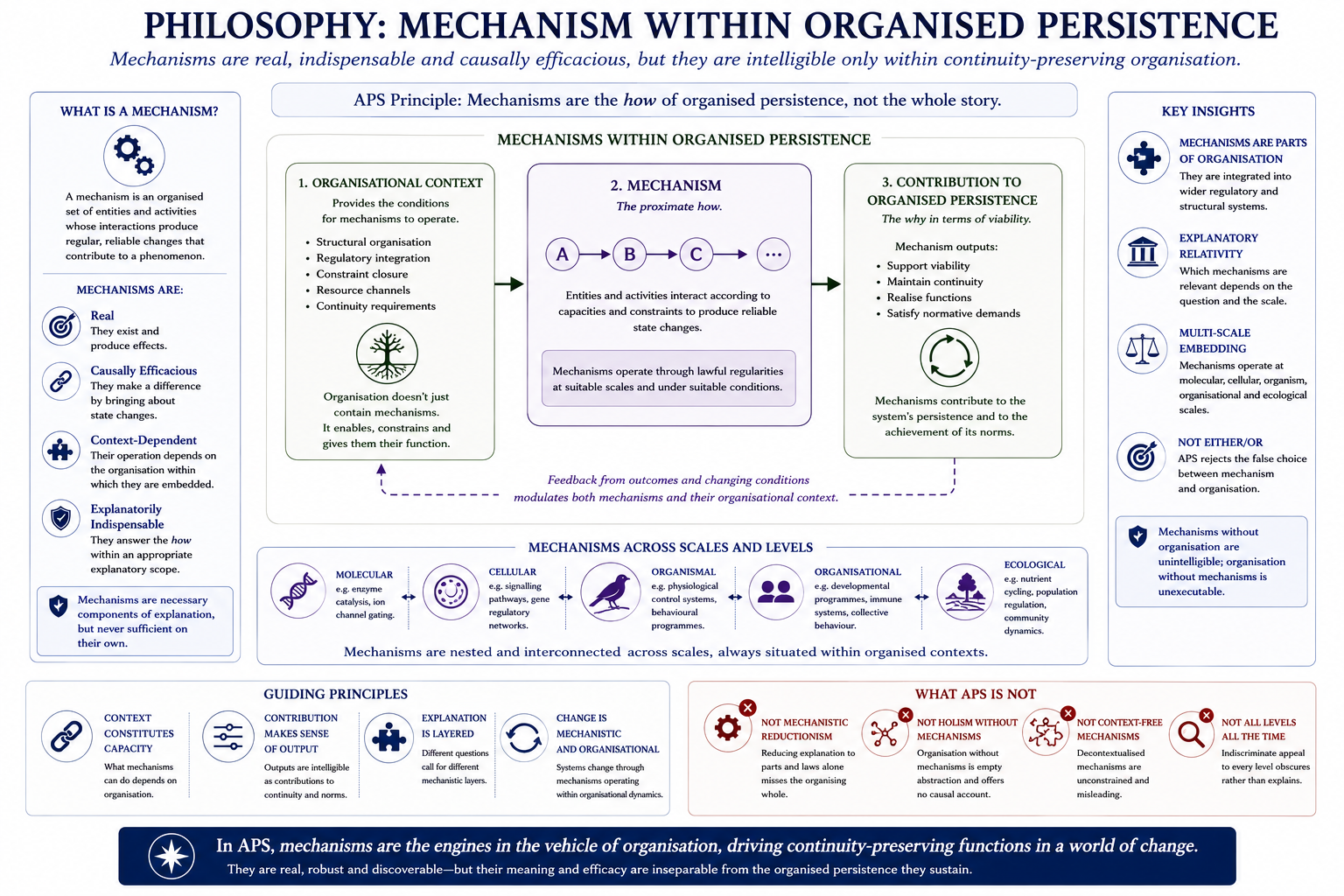
Mechanism Within Organised Persistence. Mechanisms realise functional organisation within systems organised around viability-oriented continuity and organised persistence.
Function and Biological Causation
Function is inseparable from biological causation.
Processes contribute to persistence only insofar as they participate in the viability-oriented modulation of organisational constraints within continuity-maintaining systems.
What counts as functional therefore depends upon how causal processes are organised relative to viability.
This clarifies why function cannot be reduced to causal effect alone.
Causal processes become functional only when integrated into systems that sustain their own organised persistence across changing conditions.
APS therefore gives explanatory priority to organised persistence while fully preserving the material and mechanistic constitution of biological systems.
Function and Temporal Organisation
Function is inherently temporal.
Functions do not exist at isolated moments.
They contribute to continuity across time.
A process becomes functional because it participates in maintaining viable persistence through ongoing transformation, reconstruction, and adaptive regulation.
Function therefore depends upon:
- temporal organisation;
- continuity maintenance;
- developmental reconstruction;
- ecological coordination;
- adaptive compensation;
- and persistence-preserving reorganisation
distributed across interacting timescales.
Living systems consequently preserve continuity through temporally organised functional relations rather than through static structural arrangements alone.

Functions contribute to organised persistence through temporally coordinated continuity-preserving organisation enacted across changing conditions.
Function and Constraint Closure
Function is grounded in continuity-maintaining organisational closure.
Within living systems, processes contribute to sustaining the organised relations that preserve viability across time.
Functions are realised when processes:
- maintain organisational constraints;
- restore degraded organisation;
- compensate for perturbation;
- reorganise continuity-preserving activity under changing conditions;
- and sustain evaluative organisation relative to viability.
Function therefore reflects the role of activity within dynamically self-maintaining systems rather than the properties of isolated components.
Functional Equivalence and Adaptive Reorganisation
Living systems exhibit remarkable capacities for organisational flexibility.
Distinct structures, processes, or behaviours may perform equivalent continuity-preserving roles under different conditions.
APS describes this capacity as functional equivalence.
Functional equivalence denotes the capacity of different mechanisms or organisational pathways to sustain viability-oriented persistence under comparable conditions.
What matters biologically is not necessarily the specific structure involved, but the continuity-preserving organisational contribution it realises.
Functional equivalence therefore helps explain:
- adaptive compensation;
- developmental plasticity;
- physiological substitution;
- behavioural flexibility;
- organisational resilience;
- and continuity-preserving reorganisation.
Living systems preserve continuity by reorganising functional relations across changing conditions while maintaining viable persistence.
Function, Adaptation, and Evolution
Evolutionary history helps explain how functional roles become stabilised, conserved, transformed, or diversified across time.
Evolution therefore explains how continuity-preserving functional organisation becomes historically shaped.
However, evolutionary history does not constitute function itself.
Functions are realised only through ongoing contribution to organised persistence within living systems operating in the present.
APS therefore integrates evolutionary explanation without reducing function to historical selection alone.
Functional organisation remains historically shaped, but operationally enacted through ongoing viability-oriented activity.
Function and Malfunction
Because function is normative, it can fail.
Malfunction occurs when organisational relations no longer contribute adequately to continuity-preserving viability.
Repair may fail.
Regulation may destabilise.
Coordination may degrade.
Adaptive compensation may become insufficient.
Malfunction therefore reflects disrupted contribution to organised persistence rather than merely altered causal behaviour.
This distinction clarifies why function cannot be reduced to causal effect alone.
A process may continue producing causal effects while no longer functioning relative to viability-oriented continuity.
Function and Organism–Environment Coupling
Functions emerge within coupled organism–environment systems.
Environmental relations contribute directly to:
- metabolic regulation;
- behavioural organisation;
- developmental continuity;
- ecological persistence;
- evaluative organisation;
- semiosis;
- and adaptive reconstruction.
Functions therefore cannot always be localised entirely within organisms themselves.
Persistence emerges through dynamically organised organism–environment relations extending across interacting ecological systems.
APS consequently situates function within distributed continuity-producing organisation rather than within isolated internal mechanisms alone.
Why Function Matters
Clarifying function helps resolve several persistent conceptual problems in biology.
It explains:
- why function cannot be reduced to causal effect alone;
- why historical selection does not exhaust present function;
- how biological normativity emerges naturally;
- how mechanisms contribute to organised persistence;
- how systems maintain coherence despite continual change;
- how evaluation grounds functional significance;
- how semiosis emerges from viability-oriented organisation;
- how adaptation reorganises continuity-preserving organisation;
- and how living systems operationalise persistence across changing conditions.
APS therefore explains biological function through viability-oriented organised persistence enacted across interacting temporal, developmental, ecological, and mechanistic scales.
Conclusion
Function is not defined by what parts are for in an abstract or externally imposed sense.
Nor is function reducible solely to historical evolutionary selection or isolated mechanistic effect.
In APS, function is the continuity-preserving organisational role through which viability-oriented persistence becomes operational within living systems.
Functions matter because they contribute to organised continuity across changing conditions.
Understanding function therefore requires understanding the continuity-maintaining organisation within which functional processes are enacted:
- systems that are already viability-oriented;
- dynamically organised;
- mechanistically realised;
- temporally structured;
- evaluative;
- semiotic;
- and actively engaged in preserving their own persistence.
Key Point
Function in APS is the operational expression of purpose: the continuity-preserving organisational role through which living systems maintain viability-oriented persistence across time.
See Also
Related Articles
References
- (2008). Mental Mechanisms. Routledge.
- (1975). Functional Analysis. The Journal of Philosophy, 72, 741–765 . https://doi.org/10.2307/2024640
- (2016). A Critical Overview of Biological Functions. Springer.
- (1984). Language, Thought, and Other Biological Categories. MIT Press.
- (2015). Biological Autonomy: A Philosophical and Theoretical Enquiry. Springer.
- (2023). Biological Functions and Functional Analysis. Cambridge University Press.
- (1991). Functions as Selected Effects: The Conceptual Analyst's Defense. Philosophy of Science, 58, 168–184 .
- (2026). Agency as the Defining Activity of Life. Biological Theory . https://doi.org/10.1007/s13752-026-00547-6
- (1973). Functions. The Philosophical Review, 82, 139–168 . https://doi.org/10.2307/2183766