What Is Meaning?
Meaning is the interpretive organisation of significance within broader patterns of relation, consequence, value, purpose, identity, and understanding. Within APS, meaning emerges from the progressive organisation of significance through integration, cognition, mind, selfhood, and reflective agency. Meaning explains how what matters becomes understood, interpreted, and situated within larger frameworks of understanding. It therefore functions as the interpretive culmination of the Cognition–Mind pathway and the current endpoint of the Matter-to-Mind programme.
Key Points
- Meaning is the interpretive organisation of significance.
- Significance explains what matters; meaning explains what what matters means.
- Meaning cannot be reduced to information, purpose, value, or reflective agency.
- Meaning emerges in progressively richer forms as biological organisation becomes more sophisticated.
- Meaning represents the interpretive culmination of the APS pathway.
Where this article fits: This article develops the APS account of meaning as a core concept within the Cognition–Mind architecture. It explains how meaning emerges from significance, integration, cognition, mind, selfhood, and reflective agency, and why meaning functions as the interpretive culmination of the pathway. Readers interested in the biological origins of meaning, including its relationship to evaluation, semiosis, information, representation, and viability-oriented organisation, should also see Meaning in Biology — An APS Clarification. That companion article examines how meaning emerges within living systems and why biological meaning cannot be reduced to information processing, representation, or symbolic interpretation alone. The two articles are complementary. What Is Meaning? explains what meaning is and why it occupies a distinct position within APS. Meaning in Biology — An APS Clarification explores how meaning emerges from biological organisation and how it relates to broader debates in theoretical biology, biosemiotics, and cognitive science.
Introduction
Meaning is among the most familiar concepts in human life and one of the most difficult to define. People seek meaning in relationships, work, creativity, community, belief, achievement, and personal growth. Philosophers have asked whether life itself possesses meaning. Psychologists investigate the role of meaning in well-being and identity. Religious traditions often place meaning at the centre of human existence. Yet despite its importance, the concept remains remarkably elusive.
Part of the difficulty arises because meaning appears in many different forms. We speak of the meaning of a word, the meaning of an event, the meaning of a relationship, the meaning of suffering, and the meaning of life itself. These uses are clearly related, but they do not refer to exactly the same phenomenon. Meaning therefore seems both familiar and conceptually unstable.
Within many discussions, meaning is treated as a uniquely human concern associated with language, symbolism, culture, or abstract thought. Other approaches identify meaning with purpose, value, belief, narrative, or personal identity. Each of these perspectives captures an important aspect of meaning, yet none fully explains what meaning itself is.
APS approaches the question differently. Rather than beginning with language, symbols, or existential reflection, it begins with the organisation of living systems. Throughout the APS pathway, organisms progressively distinguish what matters, organise significance, use significance adaptively, maintain coherent relationships with themselves and their environments, sustain continuity through change, and direct aspects of their own future organisation. Meaning emerges from this broader developmental context.
The central claim of this article is that meaning is neither an isolated human invention nor a mysterious property added to cognition. Meaning is the interpretive organisation of significance. It emerges when what matters becomes understood within broader patterns of relation, consequence, value, purpose, identity, and understanding.
In this sense, meaning represents the interpretive culmination of the APS pathway.
Why Meaning Is Difficult To Define
One reason meaning has proven so difficult to define is that it sits at the intersection of many different domains. Discussions of meaning frequently involve information, communication, purpose, value, identity, belief, understanding, and narrative. As a result, the concept often becomes absorbed into neighbouring ideas and loses its own explanatory identity.
For example, meaning is often equated with information. A message is said to have meaning because it conveys information. Yet information alone does not explain meaning. Signals, patterns, and differences may exist without being meaningful to any particular agent. Information describes structure and difference. Meaning concerns interpretation.
Meaning is also commonly equated with purpose. A person’s life may be described as meaningful because it serves a particular goal or direction. Purpose is undoubtedly important, but purpose and meaning are not identical. Purpose asks what something is for. Meaning asks what something means. A person may possess a clear purpose while still experiencing a lack of meaning, just as meaningful experiences may arise without any clearly defined long-term purpose.
Value presents a similar difficulty. People often regard meaningful things as valuable and valuable things as meaningful. Yet values concern what ought to matter, whereas meaning concerns how significance becomes interpreted. Values emerge within frameworks of meaning, but they do not exhaust meaning itself.
Identity, belief, and narrative create additional complications. Meaning frequently becomes woven into personal stories, systems of belief, and conceptions of self. Yet these are vehicles through which meaning is expressed rather than meaning itself. Meaning can shape identity without being identical to identity. It can influence beliefs without being reducible to belief. It can be communicated through narratives without being created by narrative alone.
These recurring confusions suggest that meaning occupies its own explanatory territory. It is related to many concepts but reducible to none of them. To understand meaning, APS therefore asks a different question: what organisational process allows significance to become interpreted?
Meaning In APS
APS defines meaning as:
Meaning is the interpretive organisation of significance within broader patterns of relation, consequence, value, purpose, identity, and understanding.
This definition builds upon a distinction developed throughout the Cognition–Mind programme.
Significance explains what matters.
Meaning explains what what matters means.
This distinction is fundamental. Living systems continually encounter conditions that affect their continued existence, functioning, and future prospects. Through biological evaluation, some conditions become significant. They matter because they influence the viability, organisation, or adaptive success of the organism.
Yet significance alone does not constitute meaning. A condition may matter without being interpreted. Nutrients matter. Threats matter. Opportunities matter. Significant conditions become meaningful when they are understood within a wider framework of relations and consequences.
Meaning therefore involves more than relevance. It involves interpretation.
Within APS, meaning is not identical with information, cognition, mind, selfhood, or reflective agency. Information concerns differences and patterns. Cognition concerns the adaptive use of significance. Mind concerns coherent self–world organisation. Selfhood concerns continuity through change. Reflective agency concerns self-directed organisation. Meaning concerns how significance becomes interpreted within larger frameworks that connect events, experiences, relationships, values, purposes, identities, and possibilities.
This interpretive role gives meaning its distinctive explanatory importance. Through meaning, significance becomes situated within broader contexts of understanding. What matters becomes connected to what it implies.
Meaning therefore occupies a unique position within APS. Rather than replacing earlier concepts, it depends upon them while performing explanatory work that none of them can perform alone.
From Significance To Meaning
Meaning does not emerge in isolation. It depends upon a sequence of organisational achievements that progressively transform the relationship between living systems and their worlds.
The pathway begins with agency. Living systems act in ways that contribute to their continued existence. Through biological evaluation, they distinguish conditions according to their consequences. Some conditions support persistence, while others threaten it. Through this process, significance emerges. Certain aspects of the world come to matter.
Significance alone, however, remains insufficient. What matters must be organised. Integration brings significant conditions into coherent relationships. Cognition enables organisms to use these organised patterns adaptively across time. Mind establishes coherent self–world organisation, allowing significance to be related within an ongoing perspective. Selfhood sustains that organisation through change, providing continuity across experience and development. Reflective agency enables a persistent self to evaluate, direct, and transform aspects of its own organisation.
Each stage extends the possibilities established by the previous stage. Yet even reflective agency leaves an important question unanswered.
A reflective agent can ask:
What should I do?
Meaning introduces a different question:
What does this mean?
This distinction marks a significant transition. Reflective agency concerns self-direction. Meaning concerns interpretation. Through meaning, significance becomes embedded within larger frameworks of relation, consequence, value, purpose, identity, and understanding. Events become connected to wider patterns. Experiences become situated within broader contexts. Possibilities become interpreted in relation to future directions and commitments.
Meaning therefore represents the interpretive culmination of the APS pathway—the point at which significance becomes understanding.
Agency acts.
Significance distinguishes what matters.
Integration organises what matters.
Cognition uses what matters.
Mind coheres what matters.
Selfhood persists what matters.
Reflective agency directs what matters.
Meaning interprets what matters.
Understanding this transition is essential because it reveals why meaning cannot be reduced to any of the concepts that precede it. Meaning emerges from their interaction while introducing a distinct form of organisation of its own. It is this interpretive organisation that allows living systems not merely to respond to significance, but to understand what significance implies for themselves, their worlds, and their futures.
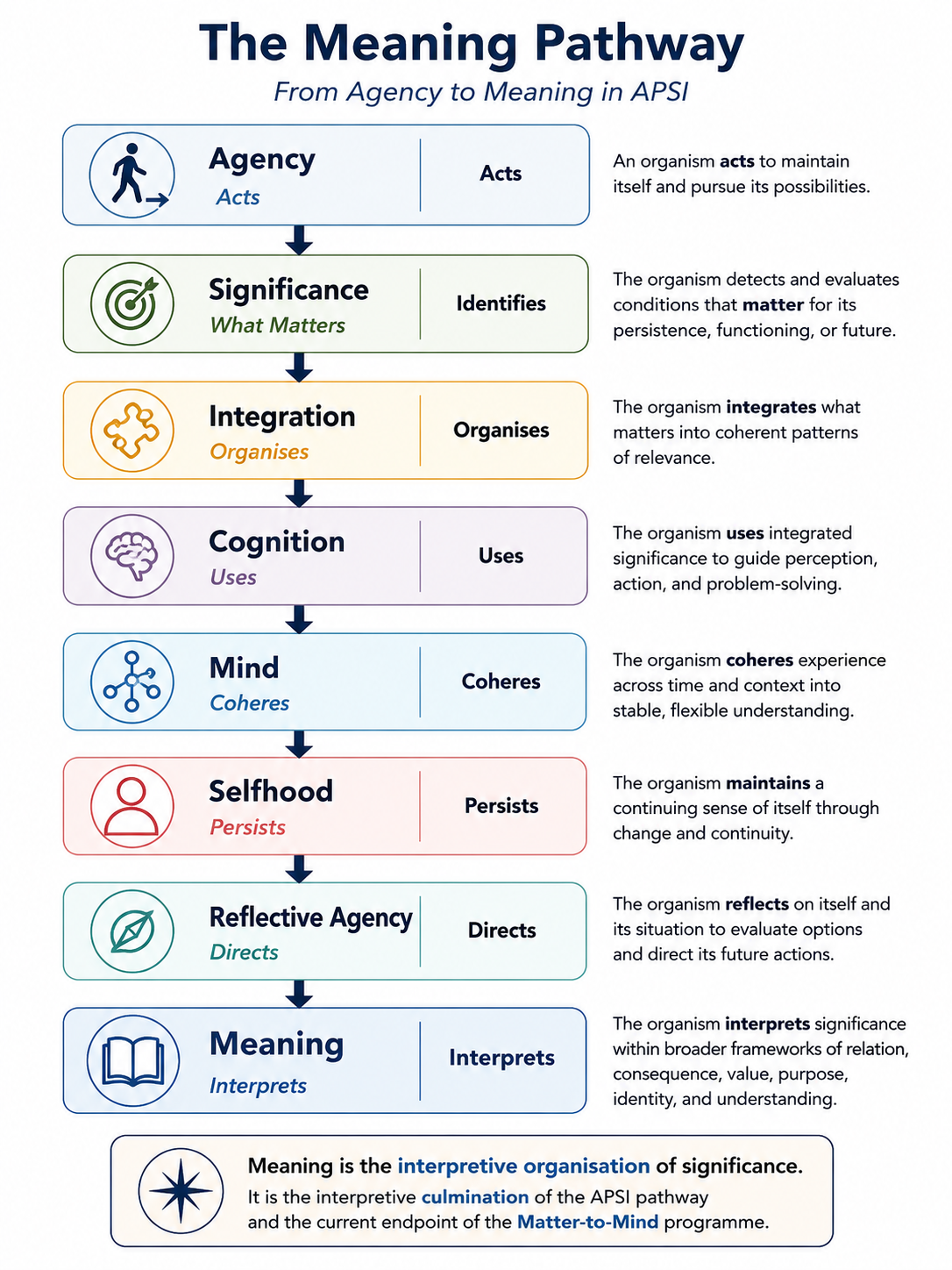
The Meaning Pathway. Within APSI, meaning emerges from a sequence of organisational achievements through which living systems distinguish, organise, use, cohere, persist, and direct significance. Meaning represents the interpretive culmination of this pathway, explaining how what matters becomes understood within broader frameworks of relation, consequence, value, purpose, identity, and understanding.
Meaning Is Not Information
Meaning is fequently treated as a form of information. In everyday language, messages are said to contain meaning because they convey information, and communication is frequently described as the transmission of meaningful content. This close association has encouraged the view that meaning can be explained entirely in informational terms.
APS rejects this reduction.
Information and meaning are related, but they are not identical. Information concerns differences, patterns, signals, or relationships capable of influencing the state of a system. Meaning concerns the interpretation of those differences, patterns, signals, or relationships within a broader framework of significance.
A pattern may contain information without possessing meaning for a particular agent. A written text in an unknown language contains information, yet much of its meaning remains inaccessible to a reader unable to interpret it. Similarly, countless environmental differences exist around living systems without becoming meaningful. Meaning arises only when differences become connected to what matters.
This distinction becomes clearer when viewed through the APS pathway. Biological evaluation distinguishes significant conditions according to their consequences for an organism. Integration organises those significant conditions into coherent patterns. Cognition enables their adaptive use. Meaning emerges only when significance becomes interpreted within wider contexts of relation, consequence, purpose, value, identity, and understanding.
Information therefore contributes to meaning, but it does not create meaning. Information describes structure and difference. Meaning explains what those structures and differences imply within the world of an agent.
This distinction is important because it prevents meaning from collapsing into abstract informational description. APS treats meaning as an organisational achievement rooted in significance and interpretation rather than as a property of information alone.
Meaning Is Not Purpose
Meaning is also frequently equated with purpose. People often describe meaningful lives as purposeful lives, and purposeful activities commonly contribute to experiences of meaning. The two concepts are deeply connected, yet they perform different explanatory functions.
Purpose concerns direction.
Meaning concerns interpretation.
Purpose addresses questions such as:
What is this for?
What should be pursued?
What goal is being served?
Meaning addresses a different question:
What does this mean?
A person may possess a clear purpose while still experiencing a lack of meaning. Individuals sometimes dedicate themselves to goals, careers, or projects that provide direction but fail to provide a sense of significance or fulfilment. Conversely, profoundly meaningful experiences may occur without being part of any long-term purpose or plan.
Within APS, purpose becomes increasingly important as living systems develop greater capacities for agency, cognition, selfhood, and reflective organisation. Reflective agents can evaluate possibilities, select directions, and commit themselves to particular futures. These capacities help explain purpose.
Meaning emerges when those directions become interpreted within broader frameworks of significance. Purpose may tell an organism or person where it is going. Meaning helps explain why that direction matters and how it should be understood.
The distinction therefore mirrors the broader APS relationship between direction and interpretation. Reflective agency allows a persistent self to direct what matters. Meaning allows a persistent self to interpret what matters.
Purpose and meaning often reinforce one another, but neither can be reduced to the other.
Meaning Is Not Value
The relationship between meaning and value is equally close. Meaningful experiences are often experienced as valuable, and values frequently shape what people find meaningful. Nevertheless, the two concepts remain distinct.
Values concern what ought to matter.
Meaning concerns how significance becomes interpreted.
Values express preferences, commitments, priorities, and orientations. They help determine what individuals, communities, and cultures regard as important, desirable, or worthy of protection. Values therefore influence how significance is evaluated and how decisions are made.
Yet values do not fully explain meaning.
A person may value honesty, loyalty, creativity, or justice, but the significance of those values depends upon broader frameworks of interpretation. Why these values matter, how they relate to one another, and what role they play within a life all involve questions of meaning.
Meaning therefore provides an interpretive context within which values become intelligible. Values help determine what should matter. Meaning helps explain how what matters is understood.
This distinction becomes particularly important when considering the broader APS pathway. Significance identifies what matters. Reflective agency enables the evaluation and direction of what matters. Meaning interprets what matters within larger patterns of relation, consequence, identity, purpose, and understanding. Values emerge within those interpretive frameworks, but they do not exhaust them.
Meaning therefore cannot be reduced to value any more than it can be reduced to information or purpose. Values participate in meaning, yet meaning remains the broader process through which significance becomes understood.
These distinctions reveal why meaning occupies a unique position within APS. Information provides differences and patterns. Purpose provides direction. Values provide orientation. Meaning explains how significance becomes interpreted within the larger contexts that make those differences, directions, and orientations intelligible.
Meaning Across The Living World
Meaning is often treated as a uniquely human phenomenon associated with language, culture, symbolism, and conscious reflection. Although these capacities undoubtedly contribute to some of the richest forms of meaning, APS argues that meaning itself cannot be restricted to human beings alone.
At the same time, APS rejects the opposite extreme. Meaning is not simply identical with life. Living systems exhibit significance from their earliest origins, but significance and meaning are not the same thing. Significance identifies what matters. Meaning concerns how what matters becomes interpreted.
Meaning is therefore best understood as a graded phenomenon that develops alongside increasingly sophisticated forms of biological organisation. As organisation deepens, meaning deepens.
At the most basic level, meaning appears in biological form. Living systems continuously distinguish conditions according to their consequences for persistence. Nutrients, toxins, environmental signals, and physiological states acquire significance because they affect viability. Such conditions do not merely differ from one another; they participate in organised patterns of biological interpretation. A chemical cue may indicate food, a stress signal may indicate danger, and a developmental signal may indicate a change in growth conditions. Meaning here remains minimal, yet significance already points beyond itself toward implications for the organism.
As cognition emerges, meaning acquires greater temporal depth. Organisms can increasingly relate present conditions to past experience and future possibilities. Signals become interpreted not only in relation to immediate consequences but also in relation to expectations, memories, and anticipated outcomes. Meaning therefore becomes more flexible and context-sensitive.
With the emergence of mind, meaning becomes integrated within coherent self–world organisation. Significant conditions are no longer interpreted in isolation but within an organised perspective linking the organism to its environment. Meaning now participates in a broader field of concern connecting perception, evaluation, memory, anticipation, and action.
Selfhood introduces another important development. Because selfhood maintains continuity through change, meaning can become organised around enduring patterns of experience. Events are no longer merely interpreted in the present moment. They become situated within an ongoing history. Meaning increasingly concerns what experiences imply for the continuing self.
Reflective agency allows meaning to deepen further. A persistent self can now evaluate not only conditions but its own evaluations. Questions emerge concerning values, commitments, goals, and future possibilities. Meaning becomes increasingly interpretive, extending beyond immediate circumstances toward broader questions of direction and significance.
At its most sophisticated expression, meaning becomes existential. Human beings can ask not merely what particular events mean, but what their lives mean. They can interpret experiences within comprehensive frameworks of value, purpose, identity, morality, and worldview. Meaning itself becomes an object of reflection.
These forms should not be understood as rigid stages or sharply separated categories. They represent progressively richer expressions of a common interpretive process. Meaning develops as living systems become capable of increasingly sophisticated forms of organisation, continuity, evaluation, and reflection.
APS therefore rejects both the claim that meaning exists fully formed throughout life and the claim that meaning appears suddenly in human beings alone. Meaning emerges gradually through the evolutionary and organisational development of living systems. It deepens as organisation deepens.
Meaning And Reflective Agency
The relationship between meaning and reflective agency is especially important because the two concepts occupy adjacent positions within the architecture.
Reflective agency concerns self-direction.
Meaning concerns interpretation.
The distinction can be expressed simply.
Reflective agency asks:
What should I do?
Meaning asks:
What does this mean?
These questions are closely related but not identical.
Reflective agency emerges when a persistent self becomes capable of evaluating, directing, and transforming aspects of its own organisation. Through reflective agency, living systems become active participants in shaping their own futures. They can deliberate, choose among alternatives, revise commitments, and pursue particular directions.
Yet self-direction alone does not explain meaning.
A person may possess substantial control over their actions while remaining uncertain about the significance of those actions. Conversely, experiences may be deeply meaningful even when they occur under circumstances largely beyond an individual’s control. Interpretation and direction therefore overlap without coinciding.
Meaning depends upon reflective agency for its most sophisticated forms because interpretation increasingly involves evaluating possibilities, commitments, values, and futures. Questions concerning the meaning of work, relationships, suffering, achievement, morality, or existence presuppose capacities associated with reflective organisation. Without reflective agency, existential meaning would be impossible.
At the same time, meaning cannot be reduced to reflective agency. Reflective agency explains how a self directs what matters. Meaning explains how a self interprets what matters. One concerns orientation toward action. The other concerns orientation toward understanding.
This distinction helps explain why meaning occupies a unique position within APS. Earlier concepts establish increasingly sophisticated forms of organisation. Selfhood provides continuity. Reflective agency provides self-direction. Meaning provides interpretation.
The resulting sequence is therefore:
Selfhood ↓ Reflective Agency ↓ Meaning
A persistent self becomes capable of directing itself, and through that self-direction becomes capable of interpreting itself and its world in increasingly sophisticated ways.
Meaning and reflective agency are thus mutually reinforcing. Interpretation influences direction, and direction influences interpretation. The ways individuals understand their lives shape the choices they make, while the choices they make reshape the meanings through which they understand themselves.
Nevertheless, the distinction remains essential. Reflective agency explains how living systems become active participants in shaping their futures. Meaning explains how those futures, and the experiences that contribute to them, become intelligible within broader frameworks of relation, consequence, value, purpose, identity, and understanding.
This interpretive role prepares the way for the final question addressed by APS: why meaning matters, and why it may represent the culmination of the Matter-to-Mind pathway itself.
Why Meaning Matters
Meaning occupies a unique position within APS because it explains something that no preceding concept fully explains. Agency, significance, integration, cognition, mind, selfhood, and reflective agency each illuminate an important dimension of biological and cognitive organisation. Together, they explain how living systems act, evaluate, organise significance, learn, maintain coherent relationships with their environments, persist through change, and direct aspects of their own futures.
Yet an important question remains.
What do these things mean?
A living system may distinguish what matters. It may organise significant information, use it adaptively, maintain coherent self–world relations, preserve continuity across time, and direct aspects of its own future organisation. None of these capacities, however, fully explain how significance becomes situated within broader frameworks of relation, consequence, value, purpose, identity, and understanding.
Meaning occupies this remaining explanatory territory.
This becomes particularly evident in the context of human experience. Values, commitments, life projects, moral concerns, identity narratives, and existential questions all involve more than adaptive regulation or self-direction. They involve interpretation. They depend upon how significant events, experiences, relationships, and possibilities are understood within larger contexts.
Consider the difference between merely enduring suffering and understanding suffering as worthwhile. Consider the difference between pursuing a goal and understanding why that goal matters. Consider the difference between possessing a history and interpreting that history as part of a meaningful life. In each case, meaning provides something that the preceding concepts alone cannot provide.
Meaning therefore survives the strongest reduction test available within APS. If meaning is removed from the architecture, a substantial explanatory gap remains. The framework can still explain action, evaluation, cognition, coherence, persistence, and self-direction, but it struggles to explain how significance becomes interpreted within larger patterns of understanding.
This is why meaning is not an optional addition to the Cognition–Mind pathway. It is a necessary concept. Meaning performs explanatory work that no neighbouring concept can absorb without losing an important distinction.
Significance identifies what matters.
Meaning explains what what matters means.
Meaning As The Culmination Of The Matter-to-Mind Pathway
The Meaning programme began with a question concerning interpretation, but its implications extend much further. The investigation ultimately returns to one of the deepest questions in APS.
How did matter become aware of itself?
APS-SYNTHESIS-001 approached this question by replacing the traditional gap between matter and mind with a sequence of organisational transitions. Rather than treating awareness as a sudden emergence from otherwise inert matter, APS traced the gradual development of increasingly sophisticated forms of biological organisation.
The pathway can be summarised as:
Matter
↓
Life
↓
Agency
↓
Significance
↓
Integration
↓
Cognition
↓
Mind
↓
Selfhood
↓
Reflective Agency
This sequence explains how organised matter becomes capable of acting, evaluating, learning, cohering, persisting, and directing itself. It reveals how increasingly sophisticated forms of organisation emerge through evolutionary and developmental processes without requiring a mysterious discontinuity between matter and mind.
Yet the Meaning investigation reveals that the pathway remains incomplete.
Reflective agency explains how a persistent self becomes capable of directing itself. It does not fully explain how that self becomes capable of interpreting itself. Questions concerning significance, purpose, value, identity, understanding, and existence itself point toward an additional organisational achievement.
Meaning.
Meaning extends the Matter-to-Mind pathway by explaining how significance becomes interpreted within broader frameworks of relation and consequence. Through meaning, living systems become capable not merely of responding to the world, but of understanding what aspects of the world imply for themselves and their futures.
The pathway therefore reaches its current culmination in the following form:
Matter
↓
Life
↓
Agency
↓
Significance
↓
Integration
↓
Cognition
↓
Mind
↓
Selfhood
↓
Reflective Agency
↓
Meaning
Meaning does not stand outside the pathway. It emerges from the organisational achievements that precede it while introducing a new form of interpretive organisation. Through meaning, awareness becomes progressively connected to understanding, while significance becomes progressively connected to interpretation.
In this sense, meaning represents the current interpretive culmination of the APS architecture.
Conclusion — The Interpretation Of What Matters
Meaning is among the most familiar concepts in human life, yet it becomes far more intelligible when viewed within the broader context of biological organisation. APS approaches meaning not as a mysterious property, a purely linguistic phenomenon, or an exclusively human concern, but as an interpretive achievement that emerges from the progressive organisation of significance.
The distinction at the centre of the Meaning programme is simple but profound.
Significance explains what matters.
Meaning explains what what matters means.
Throughout the APS pathway, living systems become capable of increasingly sophisticated forms of organisation. They distinguish significant conditions, organise significance into coherent patterns, use significance adaptively, maintain coherent self–world relations, preserve continuity through change, and direct aspects of their own future organisation. Meaning emerges when these organisational achievements allow significance to be interpreted within broader frameworks of relation, consequence, value, purpose, identity, and understanding.
Meaning therefore occupies a unique position within APS. It is neither reducible to information, purpose, value, cognition, selfhood, nor reflective agency. Instead, it explains how significance becomes intelligible.
Through meaning, living systems become capable not only of responding to what matters, but of understanding what what matters implies.
This interpretive capacity connects the Cognition–Mind programme to wider questions concerning values, morality, human nature, and existential understanding. Meaning therefore represents both the culmination of the current pathway and the beginning of new lines of inquiry.
The Matter-to-Mind pathway explains how organised matter becomes capable of awareness, cognition, selfhood, and reflection. The Meaning programme extends that story by explaining how organised matter becomes capable of interpretation.
Through meaning, living systems become capable of understanding the significance of their own existence.
See Also
Related Articles
References
- (2009). Defining Agency: Individuality, Normativity, Asymmetry, and Spatio-temporality in Action. Adaptive Behavior, 17(5), 367–386 . https://doi.org/10.1177/1059712309343819
- (2005). Autopoiesis, Adaptivity, Teleology, Agency. Phenomenology and the Cognitive Sciences, 4(4), 429–452 . https://doi.org/10.1007/s11097-005-9002-y
- (2018). A Manifesto for a Processual Philosophy of Biology. Oxford University Press.
- (2015). The Cognitive Cell. Frontiers in Microbiology, 6 . https://doi.org/10.3389/fmicb.2015.00264
- (2015). Biological Autonomy. Springer.
- (2026). Agency as the Defining Activity of Life: A Viability-Oriented Framework Integrating Process and Scale. Biological Theory . https://doi.org/10.1007/s13752-026-00547-6
- (2007). Mind in Life. Harvard University Press.
- (1991). The Embodied Mind. MIT Press.