Comparative Explanatory Methodology in Theoretical Biology
Comparative Explanatory Methodology in Theoretical Biology develops a method for comparing organisational research programmes through their explanatory architectures. Rather than adjudicating particular biological claims, the method examines explanatory targets, organising principles, explanatory priorities, conceptual organisation, characteristic strengths, and domains of application. It preserves differences among programmes rather than reducing them to a common theory or vocabulary. This comparative methodology provides the analytical foundation for the APS Comparative Explanatory Approaches programme and is distinct from methods for comparing claims and testing the evidential adequacy or explanatory gain of particular biological explanations.
Key Points
- Comparison of explanatory architectures examines research programmes rather than isolated concepts or competing truth claims.
- Research programmes can be compared through explanatory targets, organising principles, priorities, conceptual organisation, strengths, and scope.
- Comparative mapping preserves explanatory plurality and does not require programmes to share one explanatory framework.
- Explanatory-architecture comparison is distinct from evidential adjudication and dependency-hypothesis auditing of individual claims.
- The methodology provides the common analytical foundation for the APS Comparative Explanatory Approaches programme without requiring acceptance of APS biology.
Introduction
Contemporary theoretical biology has witnessed the emergence of a growing number of research programmes that seek to explain living systems through distinctive principles of biological organisation. Rather than treating life as the outcome of isolated mechanisms or reducible physical processes, these programmes investigate how living organisation itself should be understood and explained. Although they differ substantially in their conceptual commitments, they share the conviction that biology requires explanatory frameworks capable of accounting for the organised character of living systems.
Prominent examples include biosemiotics, enactivism, autopoiesis and biological autonomy, constraint-based approaches to organisation, the Free Energy Principle, and the Agency–Process–Scale (APS) framework. Each proposes a distinctive way of understanding the organisation of life and each has generated a substantial body of theoretical and philosophical literature. Together they have significantly broadened contemporary discussion of biological explanation by directing attention towards organisation, agency, meaning, autonomy, cognition, and the conditions under which living systems maintain themselves through continual change.
The increasing diversity of organisational research programmes represents an important development within theoretical biology. It demonstrates that many of biology’s most fundamental questions cannot be fully resolved through the description of mechanisms alone, but require explicit consideration of the organisation through which living systems persist, regulate themselves, and interact with their environments. At the same time, this diversity presents a methodological challenge. Although these programmes frequently investigate overlapping biological phenomena, they often do so by adopting different organising principles, explanatory priorities, conceptual vocabularies, and criteria for explanatory success. As a consequence, similarities and differences between programmes are often discussed in terms of terminology or philosophical affiliation rather than through systematic comparison of their explanatory architectures.
The emergence of multiple organisational research programmes reflects the expanding scope of inquiry within contemporary theoretical biology. Rather than indicating theoretical fragmentation, it reflects increasing attention to questions concerning the organisation of living systems that were previously addressed only indirectly. As organisational approaches have matured, the need has shifted from demonstrating their legitimacy to understanding how their explanatory contributions relate to one another.
This situation identifies a narrower methodological opportunity. Philosophy of science and theoretical biology already provide substantial resources for comparing explanations, research programmes, conceptual commitments, and forms of integration. What is less often made explicit in the APS Comparative Explanatory Approaches context is a stable protocol for comparing explanatory architectures for recording explanatory target, organising principle, explanatory priorities, conceptual organisation, characteristic strengths, and scope under the same comparative format. The present article develops that more limited instrument. Its purpose is not to fill a methodological vacuum, but to make research-programme comparison explicit, repeatable, and transparent.
The present article develops a comparative explanatory methodology for organisational research programmes in theoretical biology. Rather than asking which framework is correct, it asks what each programme is principally organised to explain, how its central concepts are related, where its explanatory priorities lie, and what domains it addresses most effectively. The objective is neither to reduce programmes to a common vocabulary nor to synthesise them into one theory. It is to provide a disciplined descriptive basis for identifying convergence, difference, scope, and possible complementarity before any stronger evaluative comparison is attempted.
The present protocol was developed within the APS research programme for use in its Comparative Explanatory Approaches studies, but its analytical operations are not constitutively APS-specific. Comparing research programmes by their problems, explanatory priorities, organising principles, conceptual relations, strengths, and scope has substantial precedent in philosophy of science and theoretical biology. APS therefore provides the research context in which this particular protocol was consolidated and applied, not the intellectual origin of programme comparison itself. The protocol must remain usable without accepting viability-oriented organisation, organised persistence, or Agency–Process–Scale.
The methodology compares organisational research programmes according to a common set of explanatory dimensions. These include the biological phenomena that constitute their principal explanatory targets, the organising principles around which their explanatory architectures are constructed, the relationships they establish between organisation and concepts such as agency, meaning, information, communication, cognition, and function, and the domains of biological inquiry to which they are most effectively applied. By examining programmes through these common dimensions, the methodology aims to clarify both genuine points of convergence and substantive explanatory differences without presupposing that all programmes are attempting to answer the same biological questions.
This article first develops the rationale for comparative explanatory methodology before establishing the principles that guide systematic comparison between organisational research programmes. It then introduces the principal comparative dimensions through which explanatory frameworks may be analysed and illustrates their application to several influential organisational traditions in contemporary theoretical biology. The article concludes by considering the implications of comparative explanatory methodology for biological explanation and for the continuing development of theoretical biology as a discipline.
The central thesis advanced throughout is that the growing plurality of organisational research programmes is not primarily a problem requiring theoretical resolution but an opportunity requiring methodological clarification. The question, therefore, is not whether contemporary theoretical biology possesses multiple organisational research programmes, but how those programmes should be compared. The following section argues that comparison itself requires an explicit methodology before meaningful evaluation of organisational frameworks can begin.
Why Compare Organisational Research Programmes?
The increasing prominence of organisational research programmes represents an important development in contemporary theoretical biology. Over recent decades, a wide range of approaches has sought to explain living systems by placing organisation at the centre of biological explanation. Although these programmes differ in their theoretical commitments, they share the conviction that understanding living systems requires attention not only to mechanisms, molecular interactions, and informational processes, but also to the organisation within which biological activity occurs. They therefore investigate the organisation through which living systems maintain themselves, regulate their activities, interact with their environments, and generate biologically significant relations.
Within the selected organisational traditions, this common orientation reflects one important strand of contemporary theoretical biology. Earlier debates often centred on whether biological phenomena could ultimately be reduced to physical and chemical processes. Contemporary organisational approaches generally accept the importance of mechanistic explanation while maintaining that understanding living systems also requires explicit attention to the organisation within which biological mechanisms operate. Increasing attention has therefore been directed towards questions concerning autonomy, agency, organisation, meaning, information, communication, cognition, development, and persistence. The growth of these organisational programmes contributes to an increasingly plural explanatory landscape rather than establishing a single contemporary identity for theoretical biology.
Despite their diversity, organisational research programmes frequently investigate overlapping biological phenomena. Questions concerning the organisation of living systems, the maintenance of biological continuity, the generation of meaning, the regulation of behaviour, the role of information, the emergence of cognition, and the coordination of biological activity recur throughout contemporary theoretical biology. Biosemiotics, enactivism, autopoiesis and biological autonomy, constraint-based approaches, the Free Energy Principle, and the Agency–Process–Scale framework all engage, in different ways, with these broad biological concerns. Consequently, comparisons based solely upon subject matter provide little insight into how these programmes actually differ.
Their principal differences lie elsewhere. Organisational research programmes distinguish themselves primarily through their explanatory priorities. Each identifies a particular organisational phenomenon as occupying a central explanatory role and develops its conceptual architecture around that organising principle. Biosemiotics places semiosis at the centre of biological explanation. Enactivism emphasises sense-making through embodied interaction. Autopoietic and autonomy theories explain living systems through self-producing organisational closure. Constraint-based approaches focus upon the organisation of constraints that maintain biological processes. The Free Energy Principle interprets biological organisation through adaptive self-evidencing under variational free energy. APS explains living systems through viability-oriented organised persistence. These programmes therefore investigate many of the same biological phenomena while differing principally in the explanatory priorities through which those phenomena are organised and explained.
Recognising this distinction has important methodological consequences. Comparisons between research programmes often proceed by asking which theory offers the better explanation of a particular biological phenomenon or by contrasting individual concepts such as agency, information, autonomy, or meaning. Although such comparisons may be valuable, they frequently overlook a more fundamental question. Evaluation of research programmes is improved when the architecture of the programmes being compared has first been made explicit. Apparent disagreements may arise because programmes answer different questions or assign different priorities, while other disagreements may concern genuinely incompatible claims. Mapping explanatory architectures therefore provides one useful preliminary discipline for distinguishing these possibilities; it is not a substitute for evidential adjudication where particular biological claims are at issue.
The task of comparison is therefore more demanding than evaluating isolated concepts or contrasting theoretical conclusions. Organisational research programmes are comprehensive explanatory frameworks whose concepts derive much of their significance from their relationships to one another. Agency, organisation, meaning, information, communication, cognition, function, and persistence do not occupy identical explanatory roles across different programmes. Understanding these relationships requires comparison of explanatory architectures rather than comparison of individual concepts in isolation. It also requires explicit criteria through which different organisational frameworks may be examined without presupposing that they are attempting to answer identical scientific questions.
Comparison thus becomes an explanatory problem in its own right. If organisational research programmes differ principally in the explanatory priorities around which they organise biological understanding, then meaningful comparison requires a methodology capable of identifying those priorities, clarifying their relationships, and distinguishing genuine theoretical disagreement from differences in explanatory organisation. The objective is not to determine a single correct framework, but to understand the distinctive explanatory contributions that different organisational programmes make to theoretical biology.
The following section therefore develops a comparative methodology for biological explanation by identifying the explanatory dimensions through which organisational research programmes may be analysed on common methodological grounds. It proposes that organisational research programmes should be compared through a common set of explanatory dimensions that make their organising principles, explanatory priorities, target phenomena, conceptual architectures, and domains of application explicitly comparable. Only once these comparative dimensions have been established can systematic comparison between organisational frameworks proceed on consistent methodological grounds.
A Comparative Methodology for Research Programmes
The preceding discussion has shown that meaningful comparison cannot be achieved simply by contrasting theories, isolated concepts, or theoretical conclusions. What is required is an explicit methodology for comparing explanatory architectures. The present section develops such a methodology by identifying the appropriate object, basis, and dimensions of comparison.
The methodology proposed here begins from a simple observation. Research programmes are not collections of independent concepts. Rather, they are organised explanatory systems within which concepts derive their significance from their relationships to one another. Agency, organisation, semiosis, autonomy, information, cognition, function, persistence, and meaning do not possess identical explanatory roles across different programmes. Their explanatory significance depends upon the wider organisation of the framework in which they occur. Consequently, meaningful comparison cannot proceed concept by concept in isolation. It must instead compare the explanatory organisation through which concepts collectively contribute to biological understanding.
This requires identifying the appropriate unit of comparison. The present methodology proposes that organisational research programmes should be compared as explanatory architectures. An explanatory architecture is the organised set of explanatory relations through which a research programme identifies its primary explanatory target, establishes its organising principle, integrates its principal concepts, determines its explanatory priorities, and defines the biological questions it is intended to address. Individual concepts acquire explanatory significance only through their place within this wider architecture. Comparison therefore seeks to understand explanatory systems rather than isolated theoretical claims.
An explanatory architecture is therefore not equivalent to a dependency hypothesis or an individual biological explanation. It represents how a research programme organises its explanatory work as a whole. Particular claims within that architecture may subsequently require independent evidential testing by methods appropriate to their relation type and explanandum.
Recognising explanatory architectures as the appropriate unit of comparison immediately changes the purpose of comparative analysis. Conventional comparisons often ask whether one theory is preferable to another or whether competing concepts provide incompatible explanations of the same biological phenomenon. The methodology developed here asks a different question. Before evaluating competing explanations, it first seeks to determine how each research programme organises biological explanation. Comparison therefore begins with explanatory organisation rather than with theoretical judgement. Only after the explanatory architecture of a programme has been understood can its explanatory contributions be meaningfully interpreted.
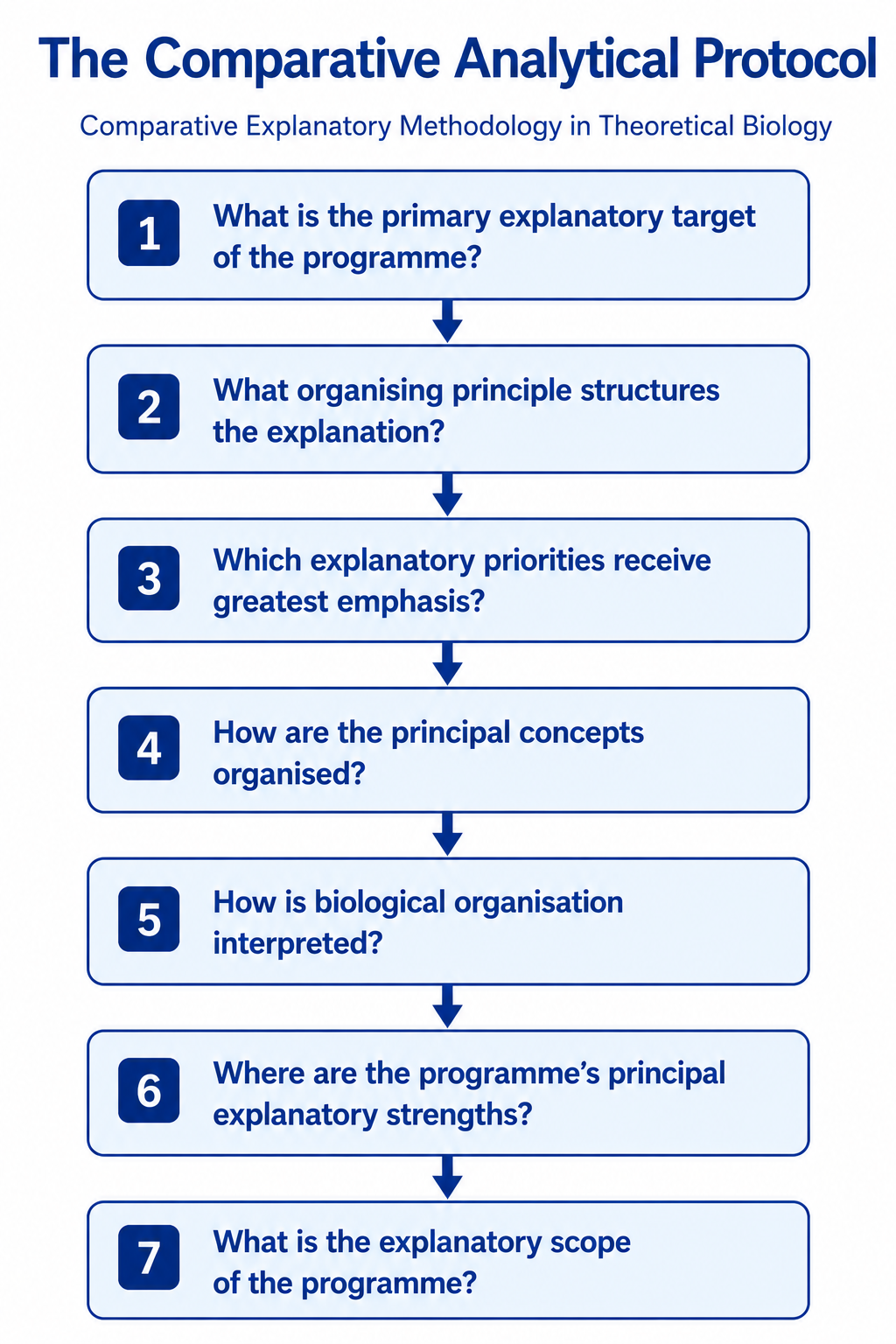
The methodology accordingly compares organisational research programmes through a common set of explanatory dimensions. These dimensions do not prescribe what a programme ought to explain. Rather, they provide a consistent basis for describing how different programmes organise biological explanation. The first dimension concerns the programme’s primary explanatory target: the biological phenomenon it principally seeks to render intelligible. The second identifies its organising principle: the concept or process around which explanation is systematically organised. The third concerns explanatory priorities, asking which biological questions are treated as foundational within the framework. The fourth examines conceptual organisation by considering how central concepts derive their explanatory significance through their relationships to one another. The fifth considers the interpretation of biological organisation itself, while the sixth identifies the domains of inquiry in which the programme is expected to provide its strongest explanatory contribution. Finally, the methodology recognises that every explanatory architecture possesses characteristic limits, reflecting the biological questions that lie beyond its principal explanatory scope.
These comparative dimensions provide a common methodological framework without requiring conceptual uniformity. Different research programmes may employ distinct terminologies, investigate different biological systems, or pursue different explanatory objectives while remaining directly comparable through the organisation of their explanatory architectures. The methodology therefore neither reduces organisational research programmes to a common vocabulary nor attempts to synthesise them into a unified theory. Instead, it establishes a principled basis upon which their distinctive explanatory contributions may be examined consistently and transparently.
Because these dimensions describe the explanatory organisation of research programmes rather than dictate a preferred biological theory, the protocol is framework-neutral in application. It does not rank programmes automatically, require convergence on one organising principle, or privilege APS categories. This neutrality is limited: selecting a unit of comparison, reconstructing a programme’s central commitments, and judging its characteristic strengths still require scholarly interpretation. Nor does this comparative neutrality settle whether particular biological claims are evidentially adequate. Those questions require separate assessment of the relevant explanatory claims.
The comparative methodology presented here has been developed within the Agency–Process–Scale (APS) research programme. This protocol was consolidated within APS for the practical purpose of comparing organisational research programmes. Its comparative fields are nevertheless independent of APS’s substantive biological commitments. A researcher need not accept organised persistence, viability-oriented organisation, or Agency–Process–Scale to ask what a programme principally explains, how it organises its concepts, what explanatory priorities it adopts, and where its scope lies.
The following section develops these comparative dimensions in greater detail. It shows how explanatory targets, organising principles, explanatory priorities, conceptual organisation, domains of application, and explanatory scope together provide a coherent methodological basis for analysing organisational research programmes across contemporary theoretical biology.
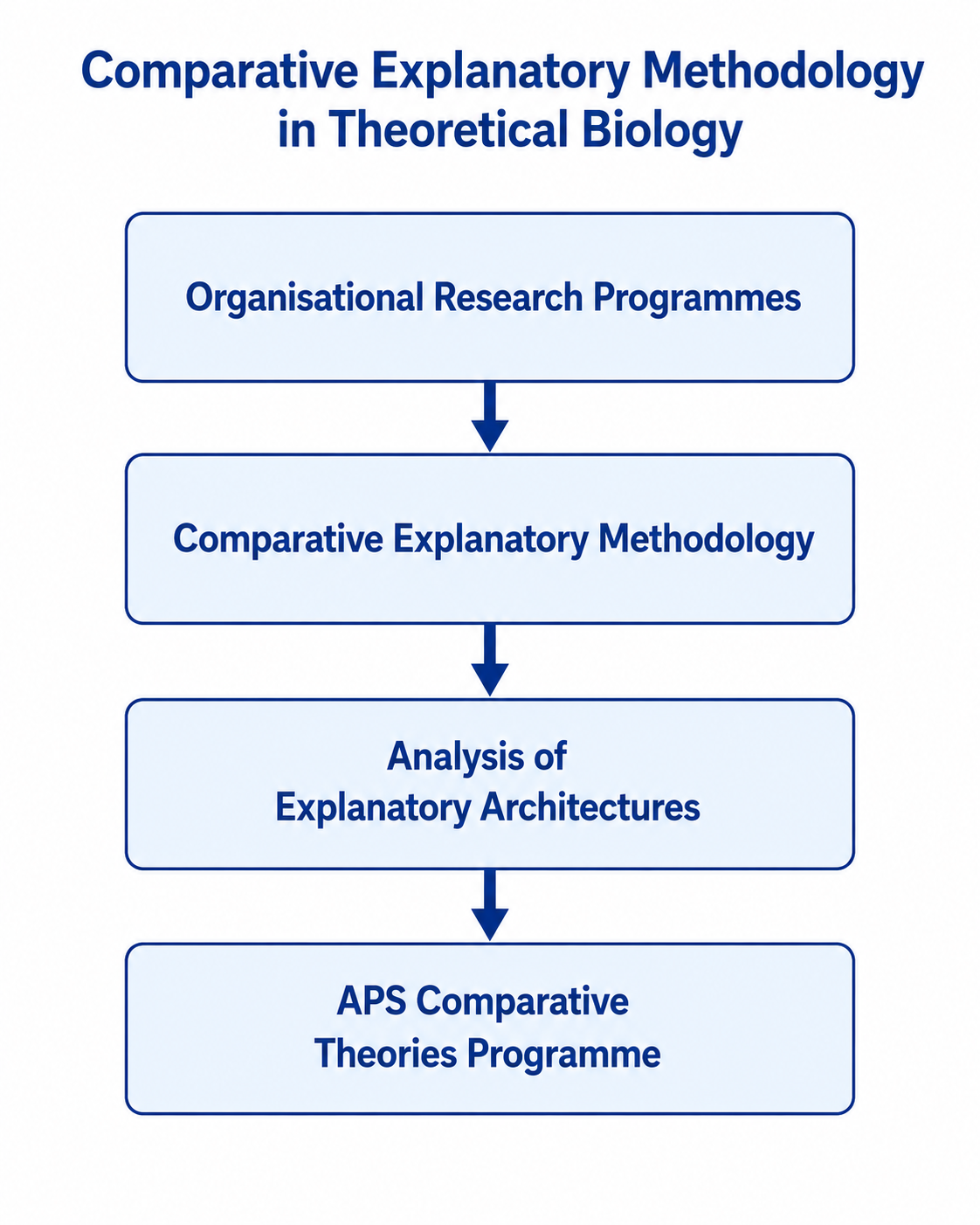
Comparative explanatory methodology provides a common analytical framework through which organisational research programmes may be examined according to their explanatory architectures. The resulting comparative analyses establish the methodological foundation for the APS Comparative Explanatory Approaches programme.
Comparative Analytical Protocol
The comparative methodology developed in the preceding section establishes the explanatory architecture of a research programme as the appropriate unit of comparison. The next task is to determine how that architecture should be analysed. A methodology becomes operational only when it provides a consistent procedure through which different explanatory frameworks may be examined according to common analytical principles. The present section therefore develops a comparative analytical protocol for organisational research programmes in theoretical biology.
The protocol is organised as a sequential series of analytical questions. The sequence is important because each stage provides the context within which the following stages acquire their explanatory significance. Comparison does not begin by contrasting individual concepts such as agency, meaning, information, or cognition. It begins by identifying the biological phenomenon that a research programme is principally organised to explain. Only after that explanatory target has been established can the organising principle, explanatory priorities, conceptual organisation, and broader explanatory architecture be interpreted consistently.
The sequence is descriptive-comparative rather than evidential-adjudicative. It does not determine whether a particular causal, constitutive, enabling, constraint, structural, spatial, temporal, or historical claim is supported; such questions require relation-appropriate evidence and comparison appropriate to the explanatory claim.
Comparative explanatory methodology analyses organisational research programmes through a common sequence of seven analytical questions. The protocol does not evaluate whether one programme is superior to another; rather, it provides a consistent procedure for describing and comparing how different programmes organise biological explanation. It maps the explanatory organisation of research programmes rather than auditing the evidential adequacy of individual biological claims.
The first analytical question concerns the programme’s primary explanatory target. Every organisational research programme seeks to render a particular aspect of living systems intelligible. Although many programmes investigate overlapping biological phenomena, they frequently differ in what they treat as the principal object of explanation. Identifying the explanatory target therefore establishes the biological problem around which the remainder of the explanatory architecture has been organised.
The second question identifies the programme’s organising principle. This is the central explanatory idea through which the primary explanatory target is interpreted. Different organisational research programmes organise explanation around different principles, including semiosis, sense-making, organisational closure, the closure of constraints, adaptive self-evidencing, or viability-oriented organised persistence. The organising principle is not merely an important concept within the framework. It provides the explanatory centre from which the broader conceptual organisation derives its coherence.
The third analytical question concerns explanatory priorities. Every explanatory architecture assigns greater importance to particular biological questions than to others. These priorities determine which phenomena are treated as fundamental, which concepts become explanatorily central, and which forms of biological organisation receive greatest analytical attention. Explanatory priorities therefore distinguish research programmes even when they investigate many of the same biological systems. Comparison of explanatory priorities seeks to clarify the organisational logic through which explanatory attention is distributed rather than to evaluate the correctness of competing explanations.
The fourth stage examines conceptual organisation. Concepts such as agency, organisation, information, communication, function, cognition, meaning, persistence, and development should not be compared as isolated theoretical entities. Their explanatory significance depends upon the relationships established between them within the explanatory architecture of the programme. Comparative analysis therefore asks how central concepts are organised into a coherent explanatory system rather than whether individual concepts possess identical meanings across different frameworks.
The fifth question concerns the programme’s interpretation of biological organisation itself. Although every organisational research programme regards organisation as explanatorily important, they differ in what organisation is understood to consist in. Some emphasise semiotic relations, others autonomous self-production, organisational constraints, adaptive prediction, or viability-oriented persistence. Comparison therefore examines not merely whether organisation is considered important, but how it is biologically interpreted and how that interpretation structures the explanatory architecture as a whole.
The sixth analytical stage identifies the programme’s domains of explanatory strength. Organisational research programmes frequently illuminate different classes of biological phenomena with particular effectiveness. Recognising these domains clarifies the kinds of biological questions for which each explanatory architecture has been principally developed. Comparative analysis therefore seeks to identify explanatory strengths without implying that all programmes should perform equally well across every domain of biological inquiry.
The final analytical question concerns explanatory scope. Every explanatory architecture possesses natural boundaries determined by its organising principle and explanatory priorities. No research programme is expected to explain every aspect of living systems equally well. Comparative methodology therefore treats explanatory scope as an intrinsic characteristic of explanatory organisation rather than as evidence of theoretical inadequacy. Identifying these boundaries provides a more balanced understanding of both the achievements and the intended purposes of different organisational research programmes.
Taken together, these analytical stages constitute a coherent comparative protocol. The sequence proceeds from explanatory target to organising principle, from organising principle to explanatory priorities, from explanatory priorities to conceptual organisation, and from conceptual organisation to broader questions concerning biological organisation, explanatory strength, and explanatory scope. The methodology therefore compares explanatory architectures as integrated organisational systems rather than as collections of isolated concepts or theoretical claims.
The protocol is intentionally neutral with respect to the research programmes under comparison. It does not determine which organising principle should ultimately be preferred, nor does it seek to reconcile different frameworks within a single theoretical synthesis. Instead, it provides a common analytical procedure through which diverse organisational research programmes may be examined consistently while preserving their distinctive explanatory identities.
The following section illustrates the application of this protocol through a concise comparative analysis of representative organisational research programmes. The objective is not to provide comprehensive reviews of those programmes, but to demonstrate how the comparative methodology clarifies both their shared biological concerns and their distinctive explanatory organisations.
Illustrative Application of the Comparative Analytical Protocol
The comparative analytical protocol developed in the preceding section provides a common methodological procedure through which organisational research programmes may be analysed consistently. Its value, however, depends upon more than methodological consistency. A comparative methodology should also generate explanatory insight by making relationships between research programmes more explicit than they would otherwise appear. The following illustration therefore demonstrates how the protocol clarifies both the shared concerns and the distinctive explanatory organisations of representative organisational research programmes.
The comparison presented here is intentionally illustrative rather than comprehensive. Its purpose is not to provide exhaustive analyses of individual research programmes, nor to evaluate their relative merits. Detailed comparative studies belong within the subsequent publications of the Comparative Explanatory Approaches programme. The present discussion instead demonstrates how the analytical protocol may be applied to a small number of representative frameworks in order to show the kinds of methodological understanding that it produces.
Three organisational research programmes have been selected for illustration. Biosemiotics, enactivism, and the Agency–Process–Scale (APS) framework each investigate important aspects of living organisation while organising biological explanation around distinct explanatory principles. Together they provide sufficient diversity to demonstrate the operation of the comparative methodology without obscuring its underlying structure through unnecessary complexity.
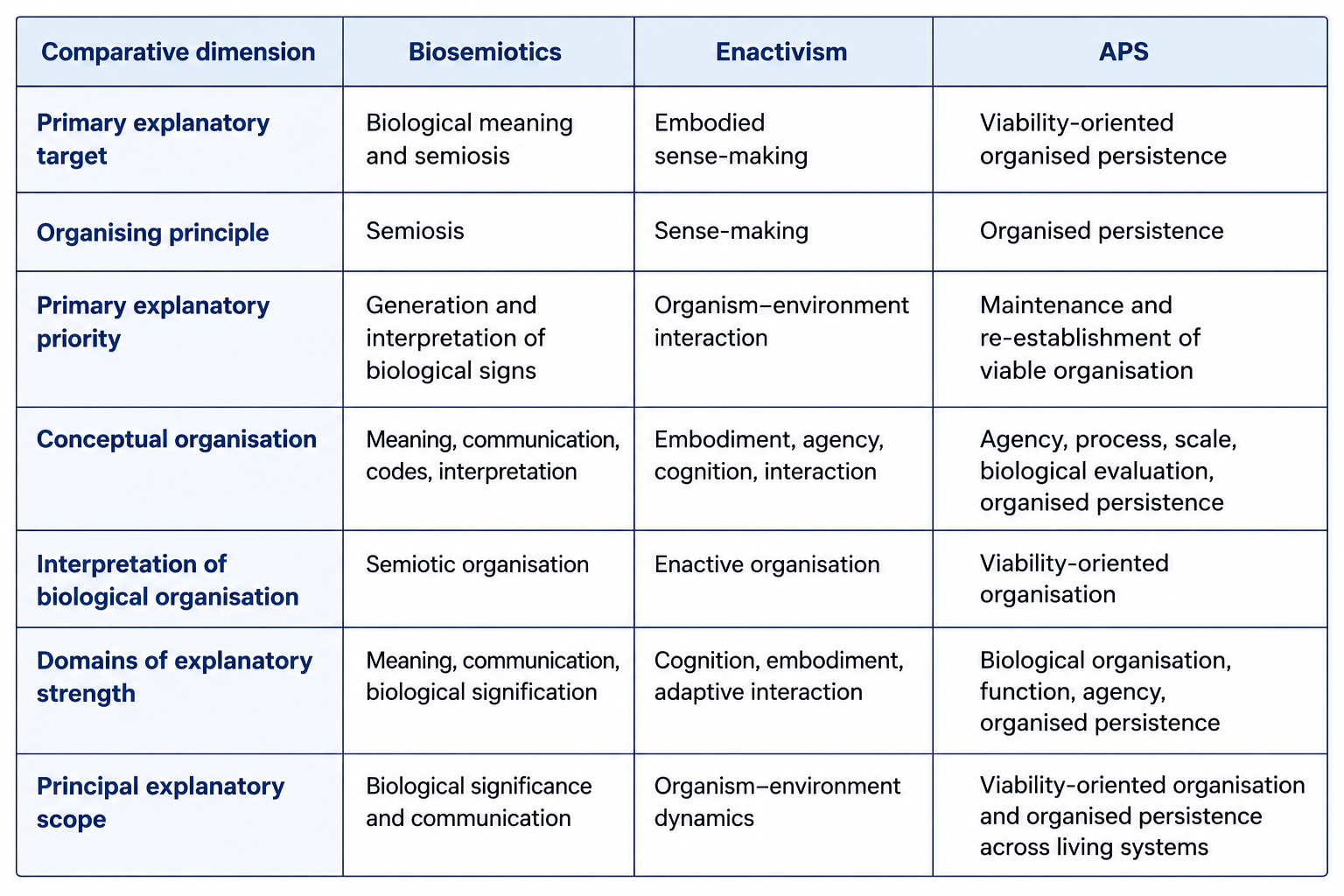
The table illustrates how the same comparative analytical protocol can be applied across organisational research programmes while preserving their distinctive explanatory architectures. The comparison is illustrative rather than exhaustive.
The comparison immediately reveals several important methodological observations. First, the programmes investigate many of the same biological phenomena. All are concerned with living organisation, biological activity, and the continuity of living systems. Conventional comparisons might therefore suggest that they are competing explanations of essentially the same scientific questions.
The analytical protocol, however, reveals a different pattern. Although the programmes investigate overlapping biological phenomena, they organise explanation around different explanatory priorities. Biosemiotics gives explanatory priority to semiosis and the generation of biological significance. Enactivism places explanatory priority upon embodied sense-making and organism–environment interaction. APS gives explanatory priority to viability-oriented organised persistence as the central target through which APS interprets living organisation. These differences do not necessarily represent incompatible theories. Rather, they identify different explanatory centres around which broader conceptual architectures have been organised.
The protocol also demonstrates why comparisons based upon isolated concepts frequently prove inconclusive. Terms such as agency, organisation, information, communication, cognition, and meaning appear across multiple research programmes, yet they occupy different explanatory roles within each architecture. Their significance derives not simply from their definitions but from their relationships to the organising principles and explanatory priorities of the programmes in which they occur. Comparative analysis therefore becomes considerably more informative when concepts are interpreted within their explanatory organisation rather than considered independently.
Perhaps the most significant insight generated by the protocol concerns the relationship between similarity and difference. Organisational research programmes frequently share substantial areas of biological interest while differing in the explanatory structures through which those interests are investigated. The methodology therefore distinguishes between shared biological phenomena and distinct explanatory organisation. This distinction allows apparent theoretical disagreements to be interpreted more precisely by asking whether programmes genuinely offer competing explanations of the same explanatory problem or whether they organise biological explanation around different primary concerns.
The purpose of the comparative protocol is therefore neither synthesis nor adjudication. Its value lies in clarifying the explanatory contributions of different research programmes by making their organising principles, explanatory priorities, conceptual organisations, and domains of application explicitly comparable. The methodology provides a common analytical framework while preserving the conceptual integrity of the programmes under examination.
The illustrative comparison demonstrates the operation of the protocol independently of any particular research programme. The remaining question is how APS itself should be understood when examined according to the same comparative procedure.
The Comparative Role of APS
The protocol developed here applies to APS in the same way that it applies to other organisational research programmes. APS possesses an explanatory target, characteristic explanatory priorities, an internal conceptual architecture, domains in which it seeks explanatory gain, and limits that should be made explicit. Applying the same descriptive fields to APS is therefore an important guard against constructing the comparison around APS as the presumed standard.
At programme level, APS is centred on viability-oriented organised persistence. Agency, Process, and Scale are analytic projections of the one viability-oriented, constraint-closed organisation APS investigates; they are not universal categories that competing programmes must adopt. Comparative analysis should therefore describe APS through its own architecture while describing biosemiotics, enactivism, autonomy theory, the Free Energy Principle, and other programmes through theirs.
APS also provides the institutional and research context in which the present comparative protocol has been consolidated for the Comparative Explanatory Approaches programme. That fact should not be confused with a claim that APS originated programme comparison or that this protocol exhausts comparative methodology in theoretical biology. Its contribution is narrower: it supplies a stable common format through which APS’s comparative studies can reconstruct and contrast explanatory architectures consistently.
Acceptance of this programme protocol does not require acceptance of APS biology. Conversely, successful use of the protocol does not establish the truth or superiority of APS. The method can expose APS’s explanatory priorities, limits, and differences from neighbouring programmes just as readily as it can clarify those of any comparator.
The methodology also has reflexive consequences for APS. Because APS is analysed according to the same comparative protocol that it applies to other research programmes, its own explanatory architecture becomes more explicit and therefore more open to critical examination. Questions concerning explanatory target, organising principle, explanatory priorities, conceptual organisation, domains of application, and explanatory scope are as relevant to APS as they are to biosemiotics, enactivism, autopoiesis, or the Free Energy Principle. In this respect, the comparative methodology does not privilege APS; it disciplines APS by requiring the same standards of analytical clarity that it expects of every organisational research programme.
This reflexive character strengthens rather than weakens the methodology. Comparative analysis becomes a common scholarly practice rather than a means of defending a preferred theoretical position. Organisational research programmes are understood first on their own explanatory terms before their relationships to other programmes are examined. The objective is therefore to improve the transparency of biological explanation by making explanatory architectures, explanatory priorities, and conceptual organisation more readily comparable across theoretical biology.
The broader significance of this approach extends beyond the present article. The comparative analytical protocol establishes a common methodological foundation for the Comparative Explanatory Approaches programme developed within APS. Subsequent studies of biosemiotics, enactivism, autopoiesis, the Free Energy Principle, ecological psychology, and other organisational research programmes employ the same analytical procedure while examining each framework in substantially greater detail. The present article therefore provides the methodological foundation for that wider programme of comparative investigation.
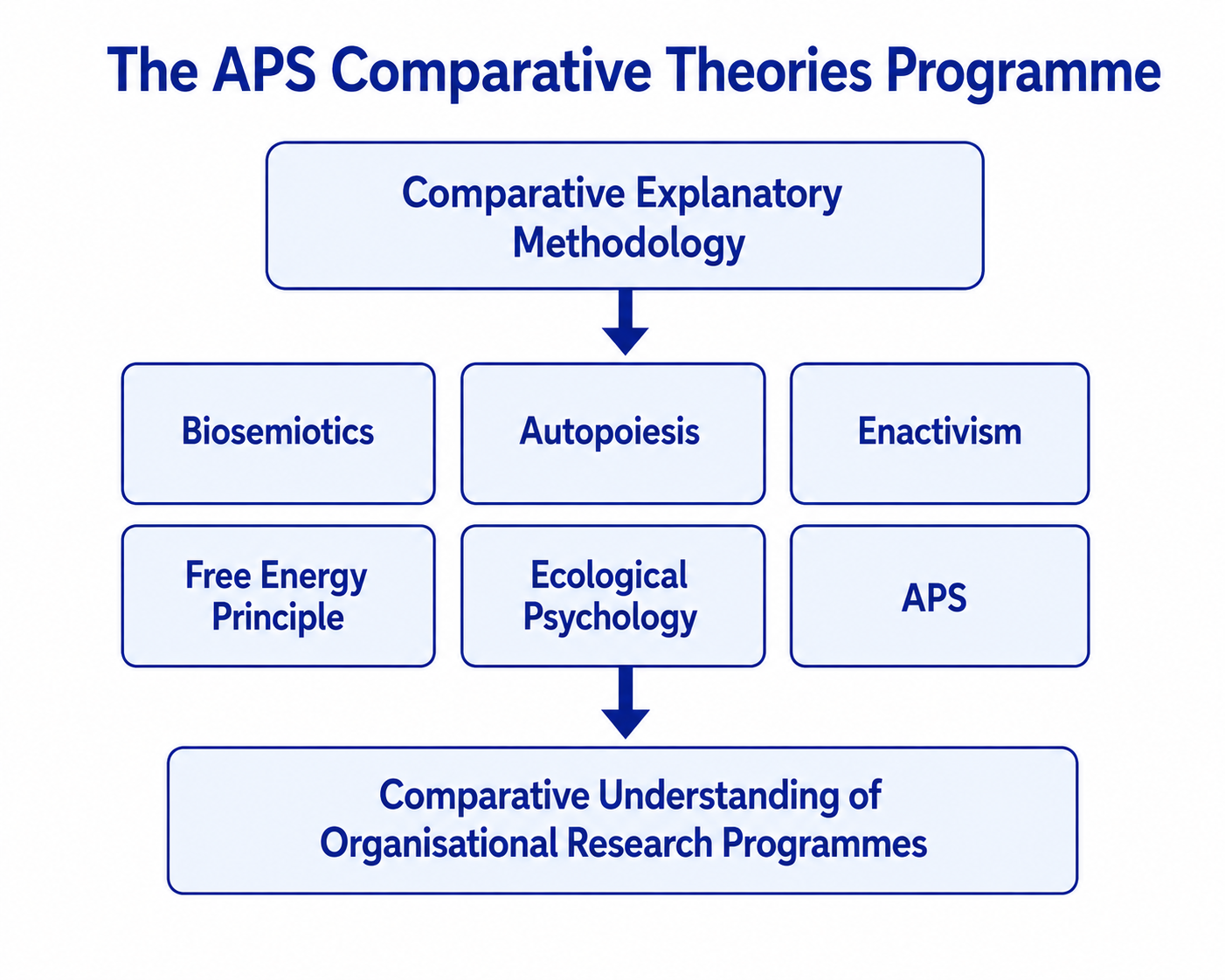
Comparative explanatory methodology provides a common analytical framework through which organisational research programmes can be examined according to their explanatory architectures. Individual comparative studies preserve the conceptual integrity of each programme while contributing to a cumulative comparative understanding of theoretical biology.
APS contributes two different kinds of work within the present corpus. First, it advances a substantive account of living organisation centred on viability-oriented organised persistence. Second, the APS Comparative Explanatory Approaches programme uses a programme protocol for reconstructing and comparing explanatory architectures. These functions should remain distinct. The first is an APS biological proposal; the second is a comparative research practice whose usefulness does not depend on acceptance of that proposal.
The following and final section considers the broader implications of comparative explanatory methodology for theoretical biology and the philosophy of biology. It argues that making explanatory architectures explicit provides a basis for greater conceptual clarity, more productive dialogue between organisational research programmes, and a more systematic understanding of the diverse ways in which contemporary biology seeks to explain living systems.
Implications for Theoretical Biology
The programme methodology developed here provides one systematic procedure for comparing organisational research programmes as explanatory architectures. It complements, rather than subsumes, other forms of comparison in theoretical biology and philosophy of science. Its distinctive practical function within the APS corpus is to separate questions about how a research programme is organised from questions about whether particular claims within that programme are evidentially warranted.
This perspective has important consequences for theoretical biology. Contemporary organisational research programmes have emerged from diverse intellectual traditions, employ different conceptual vocabularies, and organise explanation around different explanatory priorities. Such diversity need not imply theoretical incompatibility or constitute an obstacle to conceptual integration. It may instead reflect multiple legitimate explanatory architectures organised around different biological questions. Comparative analysis therefore provides a means of understanding conceptual diversity without requiring premature theoretical unification.
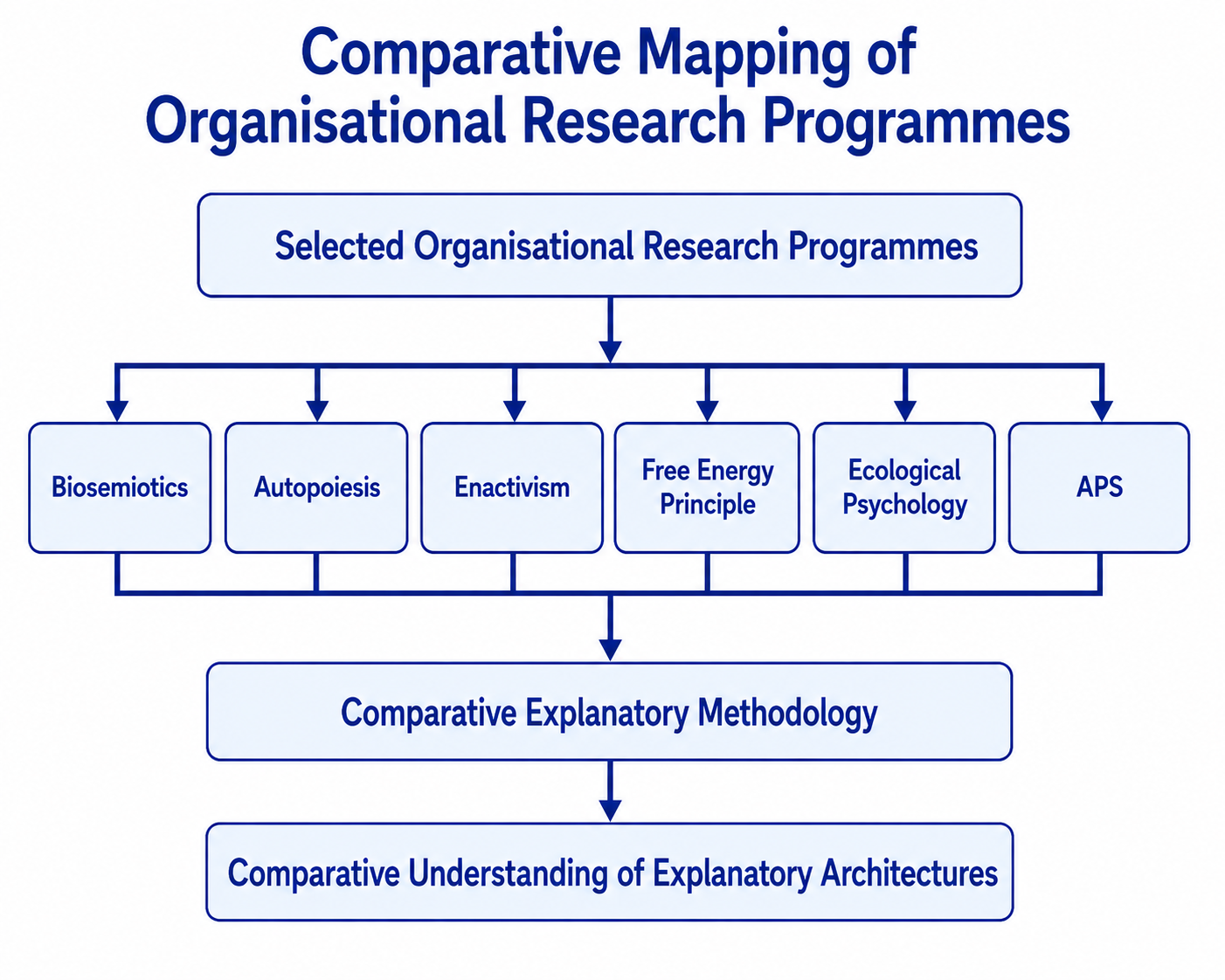
Comparative explanatory methodology enables selected organisational research programmes to be examined according to their explanatory architectures. Rather than reducing theoretical diversity, the methodology clarifies relationships among distinct explanatory programmes and supports comparative understanding of their explanatory architectures.
The methodology also contributes to the philosophy of biological explanation. Discussions concerning agency, organisation, autonomy, information, semiosis, cognition, function, and related concepts often focus upon individual concepts in isolation. The present study argues that these concepts acquire much of their explanatory significance through the architectures within which they are organised. Comparative analysis therefore shifts attention towards the explanatory organisation that gives those concepts their biological roles and encourages more systematic investigation of how explanatory frameworks contribute to biological understanding.
A further implication concerns scholarly communication. A stable protocol for comparing research programmes provides a common analytical language through which organisational research programmes may be examined without requiring conceptual uniformity or theoretical consensus. Rather than eliminating disagreement, it clarifies the explanatory questions being addressed, the organising principles employed, and the relationships between different explanatory architectures, thereby enabling more precise and constructive dialogue across theoretical traditions.
The methodology also establishes a practical foundation for future comparative research. Because the comparative analytical protocol specifies a reproducible sequence of analytical questions, it may be applied consistently across diverse organisational research programmes while preserving the conceptual integrity of each. The APS Comparative Explanatory Approaches programme adopts this protocol as its common methodological foundation, enabling detailed comparative studies to proceed within a shared analytical framework.
The present article therefore makes four restricted methodological contributions to the APS Comparative Explanatory Approaches programme: it treats the explanatory architecture of a research programme as the unit of comparison; makes explanatory organisation explicit as a basis for that comparison; provides a repeatable seven-question descriptive protocol; and separates clarification of explanatory architecture from subsequent evidential adjudication of particular claims.
Together, these contributions establish a coherent methodological foundation for comparative investigation within theoretical biology. Their significance, however, extends beyond the immediate methodology developed here. Treating explanatory architectures as legitimate objects of scholarly investigation suggests a wider perspective on the organisation of biological explanation itself. That broader perspective forms the subject of the final section.
Toward a Comparative Map of Explanatory Architectures
The comparative methodology developed in this article has been presented as a practical procedure for analysing organisational research programmes. Its immediate objective has been methodological: to establish a principled means of comparing explanatory architectures without reducing them to common terminology or evaluating them solely through claims of theoretical superiority. Yet the implications of this approach extend beyond the methodology itself. If explanatory architectures can be described systematically, compared consistently, and related coherently, then they become legitimate objects of scholarly investigation in their own right.
This possibility suggests a broader perspective on theoretical biology. Traditionally, biological research has concentrated upon understanding organisms, populations, ecosystems, evolutionary processes, and the mechanisms through which living systems function and change. Theoretical biology has likewise developed a rich diversity of explanatory traditions, each organised around distinctive concepts, questions, and investigative priorities. Comparative explanatory methodology does not replace these traditions. Instead, it invites systematic investigation of how their explanatory architectures are organised, how they relate to one another, and how together they contribute to biological understanding.
From this perspective, explanatory architectures become legitimate objects of methodological and philosophical investigation around theoretical biology. Studying how research programmes organise explanation can clarify theoretical practice without implying that every such meta-level analysis is itself theoretical biology. Whether a particular comparative product counts as philosophy of biology, theoretical biology, or mixed work depends on its intended product, evidential responsibilities, and consequences for biological inquiry.
This shift carries important methodological consequences. Organisational research programmes need no longer be viewed primarily as competing schools of thought seeking exclusive explanatory authority. They may instead be understood as distinctive explanatory architectures that illuminate different aspects of living systems through different organising principles and explanatory priorities. Comparative analysis therefore seeks to understand relationships among explanatory frameworks before asking whether they should be integrated, revised, or challenged. Clarifying explanatory architecture can improve subsequent theoretical evaluation by showing whether apparent disagreements concern the same explanandum, the same explanatory purpose, or genuinely competing claims. It is one useful preliminary operation, not a universal precondition for scientific adjudication.
The perspective developed here also encourages cumulative methodological development. As additional organisational research programmes are analysed through a common comparative protocol, a progressively richer understanding of the explanatory landscape of theoretical biology becomes possible. Similarities and differences between research programmes can be described more systematically, conceptual relationships become more explicit, and areas of complementarity or genuine disagreement become easier to identify. Comparative explanatory methodology therefore provides not simply a framework for individual comparisons, but the foundation for an expanding programme of methodological investigation.
This article does not claim that a comprehensive comparative explanatory architecture of theoretical biology has already been achieved. Rather, it argues that the methodology developed here establishes one possible route towards that objective. Whether this broader programme ultimately proves fruitful will depend upon its continued application across diverse organisational research programmes and upon its capacity to clarify explanatory relationships that would otherwise remain obscure. In this respect, the present study should be understood not as the completion of a methodological enterprise, but as its point of departure.
The broader aspiration is therefore modest but significant. Contemporary theoretical biology possesses a remarkable diversity of organisational research programmes, each contributing distinctive insights into the organisation of living systems. Comparative explanatory methodology seeks to make those contributions more intelligible by providing a common analytical procedure through which their explanatory architectures may be examined systematically and transparently. If successful, such work may contribute not to the replacement of theoretical diversity, but to a deeper understanding of how diverse explanatory traditions together enrich biological science.
The development of a comparative explanatory architecture of theoretical biology remains an open scholarly project. Its purpose is not to establish a final framework within which all biological explanation must be accommodated, but to improve our understanding of how explanatory frameworks themselves are organised, how they relate to one another, and how they collectively advance biological knowledge. The comparative methodology developed in this article is offered as one step towards that wider objective.
See Also
Related Articles
References
- (2025). The Organism. Cambridge University Press. https://doi.org/10.1017/9781009495035
- (2009). Defining Agency: Individuality, Normativity, Asymmetry, and Spatio-temporality in Action. Adaptive Behavior, 17(5), 367–386 . https://doi.org/10.1177/1059712309343819
- (2008). Life Is Semiosis. Cosmos and History: The Journal of Natural and Social Philosophy, 4(1–2), 29–52 . https://cosmosandhistory.org/index.php/journal/article/view/99
- (1993). Discovering Complexity: Decomposition and Localization as Strategies in Scientific Research. Princeton University Press.
- (2022). Organization Needs Organization: Understanding Integrated Control in Living Organisms. Studies in History and Philosophy of Science, 93, 96–106 . https://doi.org/10.1016/j.shpsa.2022.03.005
- (2016). Biological Regulation: Controlling the System from Within. Biology & Philosophy, 31(2), 237–265 . https://doi.org/10.1007/s10539-015-9497-8
- (2013). From Groups to Individuals: Evolution and Emerging Individuality. MIT Press.
- (2013). Explanation in Biology: Reduction, Pluralism, and Explanatory Aims. Science & Education, 22(1), 69–91 . https://doi.org/10.1007/s11191-011-9350-7
- (2007). Explaining the Brain: Mechanisms and the Mosaic Unity of Neuroscience. Oxford University Press. https://doi.org/10.1093/acprof:oso/9780199299317.001.0001
- (2011). Incomplete Nature: How Mind Emerged from Matter. W. W. Norton & Company.
- (2018). A Manifesto for a Processual Philosophy of Biology. Oxford University Press. https://doi.org/10.1093/oso/9780198779636.003.0001
- (2010). Essential Readings in Biosemiotics: Anthology and Commentary. Springer. https://doi.org/10.1007/978-1-4020-9650-1
- (1948). Studies in the Logic of Explanation. Philosophy of Science, 15(2), 135–175 . https://doi.org/10.1086/286983
- (2008). Biosemiotics: An Examination into the Signs of Life and the Life of Signs. University of Scranton Press.
- (2006). Scientific Pluralism. University of Minnesota Press.
- (1993). The Advancement of Science: Science without Legend, Objectivity without Illusions. Oxford University Press.
- (1977). Progress and Its Problems: Towards a Theory of Scientific Growth. University of California Press.
- (2016). Explanatory Pluralism. Cambridge University Press. https://doi.org/10.1017/CBO9781316409961
- (2003). Biological Complexity and Integrative Pluralism. Cambridge University Press. https://doi.org/10.1017/CBO9780511802683
- (2015). Biological Organisation as Closure of Constraints. Journal of Theoretical Biology, 372, 179–191 . https://doi.org/10.1016/j.jtbi.2015.02.029
- (2015). Biological Autonomy: A Philosophical and Theoretical Enquiry. Springer. https://doi.org/10.1007/978-94-017-9837-2
- (2014). The Return of the Organism as a Fundamental Explanatory Concept in Biology. Philosophy Compass, 9(5), 347–359 . https://doi.org/10.1111/phc3.12128
- (2019). Is the Cell Really a Machine?. Journal of Theoretical Biology, 477, 108–126 . https://doi.org/10.1016/j.jtbi.2019.06.002
- (2018). Everything Flows: Towards a Processual Philosophy of Biology. Oxford University Press. https://doi.org/10.1093/oso/9780198779636.001.0001
- (2018). Answering Schrödinger's Question: A Free-Energy Formulation. Physics of Life Reviews, 24, 1–16 . https://doi.org/10.1016/j.plrev.2017.09.001
- (2026). Agency as the Defining Activity of Life: A Viability-Oriented Framework Integrating Process and Scale. Biological Theory . https://doi.org/10.1007/s13752-026-00547-6
- (2007). Mind in Life: Biology, Phenomenology, and the Sciences of Mind. Harvard University Press.
- (2003). Making Things Happen: A Theory of Causal Explanation. Oxford University Press. https://doi.org/10.1093/0195155270.001.0001