How Does Scientific Explanation Reach Reality?
Scientific explanation is an epistemic achievement, but it is directed towards a reality that exists independently of any particular explanatory perspective. This article examines how explanatory practices can support ontological commitment without being treated as transparent representations of the world. It argues that explanation reaches reality through empirically constrained, perspectival, and revisable forms of understanding whose success provides defeasible grounds for ontological commitment. APS contributes to this problem by treating Agency, Process, and Scale as analytic projections rather than independent components of reality. Their integration does not reproduce the organisation of life without epistemic mediation, but progressively clarifies the viability-oriented, constraint-closed organisation that biological inquiry seeks to understand. APS therefore connects science's epistemological and ontological objectives without collapsing either into the other.
Key Points
- Scientific explanation is epistemic in form but ontological in orientation.
- Explanation does not reach reality through an unmediated correspondence between theory and world.
- Empirical constraint, intervention, explanatory integration, and resistance to failure provide defeasible grounds for ontological commitment.
- Perspectivism need not entail relativism because explanatory perspectives remain answerable to a reality they do not create.
- Explanatory pluralism can disclose different aspects of one organised reality without requiring either reduction or unrestricted equivalence.
- Agency, Process, and Scale are analytic projections of viability-oriented, constraint-closed organisation, not independent components of reality.
- Within APS, scientific explanation may contribute to metaphysics while remaining revisable, practice-constrained, and epistemically modest.
** Where This Article Fits:** Many scientists are understandably suspicious of metaphysics. The term can suggest speculative claims imposed upon science from outside, or attempts to determine the nature of reality independently of evidence. This article defends neither approach. It does not argue that science requires a prior metaphysical system, that explanatory success guarantees truth, or that philosophical reflection should override scientific practice.
The problem addressed here already arises within science. Scientific explanations make claims about what exists, what produces a phenomenon, which relations matter, and how a target is organised. These claims have ontological significance whether or not scientists describe them as metaphysical. The question is how such commitments are warranted when explanations are necessarily selective, model-mediated, idealised, and developed from particular investigative perspectives.
The article argues that explanation reaches reality through disciplined answerability rather than unmediated representation. Evidence, intervention, comparison, correction, and failure constrain which explanations can remain successful. Where commitments survive relevant changes in method, model, evidence, and question, they may warrant selective and revisable claims about reality. This is not metaphysical proof. It is an account of how scientific inquiry can support defeasible ontology without claiming certainty.
The question matters directly for APS. Agency, Process, and Scale are analytic projections through which living organisation is investigated; they are not proposed as three components of life. Their conceptual compatibility alone cannot establish that their integration discloses something real. The relevant test is whether each projection is independently grounded, whether their relation generates additional explanatory constraints, and whether evidence arising through one can force revision within another.
The ontological claim developed through APS is therefore conditional. Viability-oriented, constraint-closed organisation gains scientific and philosophical warrant only insofar as organisational analysis clarifies materially consequential dependencies, improves comparison among explanations, and remains vulnerable to empirical failure. The article asks how that warrant should be understood—and what this biological case may reveal about the relationship between scientific explanation, knowledge, and reality.
1. The Problem: Explanation Is Ours, Reality Is Not
Science is directed towards reality. Its theories, models, experiments, and classifications do not merely organise experience; they make claims about what exists, how phenomena are produced, and which relations structure the world. Scientific inquiry therefore has an ontological objective. It seeks knowledge of the way the world actually is, including aspects of reality that are not directly observable. Yet science pursues this objective through practices of representation, interpretation, abstraction, and explanation. These practices belong to inquiry. Reality does not arrive already divided into explanatory variables, model boundaries, causal contrasts, or scientifically relevant questions.
This creates a fundamental philosophical difficulty. Explanation is an epistemic achievement: it concerns what investigators can understand, justify, communicate, and use. Reality, by contrast, is not constituted by the particular explanatory perspective through which it is investigated. An explanation may be illuminating because it selects some relations and omits others, answers one question rather than another, or represents a phenomenon at a useful degree of abstraction. Its intelligibility therefore cannot by itself establish that its categories correspond directly to the organisation of the world. What makes sense to us need not, for that reason alone, disclose what exists.
The traditional debate over scientific realism brings this difficulty into sharp focus. Scientific realists argue that the success of mature science provides reason to believe that its claims, including claims about unobservable entities and relations, are at least approximately true (Psillos 1999). Constructive empiricists reply that science may achieve its proper aim through empirical adequacy without requiring belief in the literal truth of everything its theories describe (van Fraassen 1980). The dispute is not simply about whether science succeeds. It concerns what kind of commitment that success warrants. Does explanatory success reveal reality, or does it show only that a theory or model works within the conditions under which it has been tested?
The problem becomes more difficult once explanation is distinguished from prediction and description. An explanation does more than record that a phenomenon occurs. It identifies what is relevant to its occurrence and organises that relevance into an intelligible account. Scientific understanding consequently depends upon abilities, concepts, models, and standards of intelligibility that vary across investigative contexts (de Regt 2017; Khalifa 2017). Explanation is selective because understanding must be selective. No explanation includes every fact about its target, and the omission of detail is often a condition of explanatory success rather than a defect.
Selection, however, appears to introduce a gap between scientific understanding and reality. If explanatory relevance depends partly upon questions, purposes, methods, and representational choices, how can explanation support ontological commitment? Conversely, if explanation has no ontological significance, it becomes difficult to understand why its repeated empirical success should matter as more than practical usefulness. Scientific inquiry seems caught between two unsatisfactory conclusions: either explanations transparently reproduce reality, despite their evident selectivity, or they remain confined to human understanding and never warrant claims about the world beyond it.
Agency, Process, and Scale are analytic projections through which living organisation is investigated and explained. They are not proposed as three independent entities or components from which organisms are assembled. Agency asks what living systems do; Process asks how continuity is maintained despite change; Scale asks where persistence is organised across spatial and temporal extents. If these are analytic projections, however, what warrants the further claim that their integration clarifies something real about life? Why should an explanatory grammar developed for understanding biological phenomena be taken to disclose viability-oriented, constraint-closed organisation rather than merely redescribe those phenomena in APS terminology?
This article argues that epistemic mediation does not prevent explanation from reaching reality. It does, however, determine the kind of realism that explanation can support. Scientific explanations do not acquire ontological force by escaping perspective or reproducing the world without selection. Their warrant arises from the ways in which explanatory practices are constrained, corrected, and sometimes defeated by phenomena that inquiry does not create. The central question is therefore not whether explanation is epistemic. It necessarily is. The question is how epistemic practices can become answerable to reality strongly enough to justify claims about what exists and how it is organised.
2. Science’s Epistemological and Ontological Objectives
The difficulty identified in the opening section arises because science pursues two distinguishable objectives. Epistemologically, it seeks justified knowledge and understanding. Ontologically, it seeks to determine what exists and how reality is organised. Scientific explanation participates in both objectives. It is produced, assessed, and communicated through human practices of inquiry, yet it makes claims about phenomena whose existence and organisation are not ordinarily understood to depend upon those practices.
The epistemological objective concerns the conditions under which a scientific claim should be accepted. Evidence must be gathered, methods justified, alternatives compared, inferences evaluated, and uncertainty acknowledged. An explanation must do more than appear plausible: it must be supported by appropriate relations between evidence, theory, model, and phenomenon. This objective includes understanding because explanation should make intelligible why or how its target occurs. Such understanding may involve the ability to recognise relevant dependencies, draw counterfactual inferences, connect previously separate findings, or anticipate how a phenomenon would change under different conditions (de Regt 2017; Khalifa 2017).
The ontological objective concerns what these epistemically warranted explanations license scientists to say about reality. A causal explanation may support commitment to causal relations; a mechanistic explanation may identify organised activities through which a phenomenon is produced; a structural explanation may disclose relations that persist across different representations; and an intervention-based explanation may show that changing one factor alters another in systematic ways. Science consequently does not seek only reliable expectations. It also investigates the entities, processes, capacities, constraints, and forms of organisation through which phenomena become possible.
These objectives should not be collapsed. Understanding an explanation is not identical to establishing that everything it represents exists exactly as represented. An account may be intelligible but false, or useful while relying upon idealisations. Conversely, some well-supported scientific claims may remain difficult to understand intuitively. Epistemic accessibility therefore cannot serve as a simple measure of ontological truth. Nor can ontological commitment bypass epistemology. Science has no independent route from reality to warranted belief outside the evidential and explanatory practices through which its claims are tested.
The two objectives are nevertheless inseparable within scientific inquiry. Ontological claims can be warranted only through epistemic practices, while epistemic success is scientifically important because inquiry is constrained by phenomena that do not simply conform to investigators’ preferences. An explanation fails when the dependencies it proposes are absent, when interventions do not produce the expected differences, when a mechanism cannot generate the phenomenon, or when evidence resists the organisation imposed upon it. Reality enters explanation not as an unmediated copy but as a source of constraint, correction, and possible failure.
This relationship can be seen across influential accounts of scientific explanation. The deductive-nomological model associated explanation with the logical derivation of phenomena from laws and conditions (Hempel and Oppenheim 1948). Unificationist accounts located explanatory power in the capacity to derive many phenomena through a reduced set of argument patterns (Kitcher 1989). Causal and mechanistic accounts shifted attention towards the processes through which phenomena are produced (Salmon 1984; Craver 2007), while interventionist approaches connected explanatory relevance to counterfactual dependence under possible changes (Woodward 2003). Strevens’s account sought explanatory depth through the abstraction of difference-making information from fuller causal histories (Strevens 2008). These approaches disagree about what makes an explanation explanatory, but each links an epistemic achievement to some proposed feature of the world: laws, causal processes, mechanisms, dependencies, or patterns of relevance.
Explanation may therefore be defined provisionally as an organised account that makes a phenomenon intelligible by identifying relations treated as relevant to its occurrence, maintenance, transformation, or possibility. This definition is deliberately inclusive. It allows different sciences to explain through different resources without assuming that every adequate explanation must have the same form. At the same time, it prevents explanation from becoming equivalent to any narrative that produces understanding. Scientific explanation must remain answerable to evidence and to the phenomenon it claims to explain.
Ontology, in this context, refers to warranted claims about what exists and which relations or forms of organisation are real. Metaphysics extends the inquiry by asking what general account of reality is supported by those commitments. Scientific explanation contributes to metaphysics only indirectly: not by converting every explanatory posit into an element of reality, but by helping to determine which commitments remain necessary across successful, mutually correcting practices of inquiry.
The relevant relationship is therefore neither a progression from purely epistemological work to a separate ontological domain nor a choice between understanding and reality. Epistemological and ontological objectives operate within the same scientific enterprise. Explanation connects them by organising evidence into claims about the dependencies through which phenomena become intelligible. The philosophical problem is to determine when that organisation reflects more than the requirements of a particular explanatory perspective. Before answering that question, it is necessary to understand why explanation cannot be treated as a transparent mirror of the world.
3. Why Explanation Cannot Simply Mirror Reality
If scientific explanation connects epistemic and ontological objectives, the most direct account of that connection would treat a successful explanation as a representation of reality as it actually is. On this view, explanation reaches reality by correctly depicting the entities and relations responsible for a phenomenon. The better the explanation, the more faithfully its structure corresponds to the structure of the world. Although few sophisticated realists defend so simple a picture, some version of it remains tempting whenever explanatory success is taken to warrant acceptance of the ontology an explanation employs.
The attraction is understandable. Scientific explanations often appear successful precisely because they identify features of the world that had not previously been recognised. The detection of causal relations, the discovery of mechanisms, and the successful manipulation of previously unobservable entities seem difficult to explain if scientific theories are regarded merely as instruments for organising observations. The realist argues that the empirical and explanatory success of mature science would be surprising if its central claims did not track reality at least approximately (Psillos 1999). Explanation appears to work because the world contains the entities, structures, or dependencies that the explanation identifies.
Yet even highly successful explanations do not function as exhaustive representations. An explanation selects particular features as relevant while omitting innumerable others. It may describe a phenomenon through a causal relation while disregarding the underlying mechanism, represent a complex process through an idealised model, or abstract from variation in order to identify a stable pattern. The same phenomenon may be explained differently depending upon whether the question concerns its origin, present operation, persistence, distribution, or transformation. These explanations need not compete, because each may identify a different relation under which the phenomenon becomes intelligible.
Selection is not an accidental limitation that increasingly complete science will necessarily eliminate. It is constitutive of explanation. An account containing every fact about a phenomenon would not thereby explain it, because explanatory understanding depends upon distinguishing what matters to the question from what does not. Explanatory representations must therefore differ from their targets. They organise, simplify, contrast, and abstract. Even when their claims are true, the form in which those claims become explanatory reflects the requirements of inquiry as well as the organisation of reality.
The history of science adds a second difficulty. Theories once regarded as explanatorily successful have subsequently been rejected, and the entities or properties they invoked have sometimes disappeared from accepted ontology. Laudan’s criticism of convergent realism challenges the inference from historical success to approximate truth by documenting theories that were successful despite central commitments later judged false (Laudan 1981). Psillos’s response seeks to distinguish indispensable components of past success from idle or abandoned commitments, thereby defending a more selective realism (Psillos 1996). Whatever the outcome of that dispute, it establishes an important constraint: explanatory success cannot warrant indiscriminate acceptance of every feature of an explanation.
Structural realism addresses this problem by proposing that what survives theory change may be relational structure rather than a stable inventory of entities. Worrall argues that continuity across scientific revolutions can justify realism about preserved mathematical or structural relations even where interpretations of the entities involved change (Worrall 1989). French develops a stronger ontic structuralism in which structure is not merely what science can know but is central to what reality is (French 2014). These approaches weaken the demand that scientific representation mirror reality entity by entity. They nevertheless retain the realist conviction that successful science captures something objective and persistent.
Intervention provides another route. Hacking argues that confidence in otherwise unobservable entities is strengthened when scientists can use them to produce effects (Hacking 1983). Intervention does not require a complete representation of an entity’s intrinsic nature. It establishes a practically consequential relation between scientific activity and the causal capacities of the world. What can be reliably manipulated is difficult to regard as a merely convenient fiction. Even here, however, intervention warrants selective commitment. It may support belief that an entity or capacity is real without establishing that every theoretical description of it is correct.
These considerations suggest that explanation should not be assessed through a choice between literal mirroring and ontological silence. Constructive empiricism is right to resist the assumption that empirical success automatically licenses belief in the full truth of a theory (van Fraassen 1980). Realism is right to insist that the sustained success of explanation, prediction, and intervention calls for more than an account of observational convenience. The challenge is to identify which aspects of explanatory practice warrant commitment and how strong that commitment should be.
The metaphor of a mirror obscures this task. A mirror is valued for reproducing visible appearance, whereas an explanation is valued for selecting dependencies that make a phenomenon intelligible. A mirror does not distinguish relevance, test counterfactual relations, expose mechanisms, or integrate findings across different inquiries. Scientific explanation is therefore better understood as an achievement of constrained representation. It is constructed through particular concepts and methods, but its adequacy depends upon relations that inquiry cannot freely choose.
This conclusion also clarifies the problem confronting APS. Agency, Process, and Scale should not be expected to resemble three divisions already inscribed in biological reality. Their status as analytic projections means that they organise different questions about living systems. The relevant test is not whether each projection mirrors an independent portion of the world. It is whether the distinctions they introduce identify dependencies materially involved in biological organisation, whether the projections constrain one another, and whether their integration survives empirical and comparative scrutiny.
Explanation cannot reach reality by becoming independent of representation, abstraction, or perspective. Those are conditions under which scientific inquiry operates. The ontological force of explanation must instead arise from the way representations remain answerable to their targets: through evidence, intervention, comparative success, correction, and failure. To understand that answerability, the next step is to examine how models and idealisations mediate scientific knowledge without severing it from reality.
4. Models, Idealisation, and the Mediation of Knowledge
The rejection of simple mirroring does not leave scientific explanation without contact with reality. It redirects attention towards the practices through which that contact is achieved. Scientific knowledge is rarely produced by comparing an unmediated description with a phenomenon in its entirety. It is developed through experimental systems, mathematical structures, diagrams, simulations, classifications, and models that make selected features of a target available for investigation. These mediating resources are constructed, but their construction does not make their results arbitrary.
Models are especially important because they occupy an intermediate position between theory and phenomenon. They may instantiate a general theory under specified conditions, represent a target system selectively, explore the consequences of assumptions, or integrate information that cannot be handled within a single description. Morgan and Morrison describe models as mediators because they possess a degree of autonomy from both theory and data: scientists build, manipulate, and learn from them rather than merely deriving them from theory or copying them from observation (Morgan and Morrison 1999). This autonomy explains their epistemic productivity, but it also intensifies the ontological question. If models are constructed objects, what warrants the belief that the relations they reveal belong to the world rather than only to the model?
The answer cannot be that successful models resemble their targets in every respect. Models routinely omit features that are present, introduce assumptions that are false, and represent continuous processes through discrete variables or idealised boundaries. Their usefulness often depends upon these departures. A model containing every available detail may obscure the dependency under investigation, while a simpler representation can reveal how changing one factor alters another. The epistemic value of a model therefore lies not in comprehensive resemblance but in disciplined selectivity.
Idealisation makes this point explicit. Scientific explanations may assume frictionless surfaces, perfectly mixed populations, isolated systems, rational agents, uniform environments, or sharply bounded processes even when no real case satisfies those assumptions. Such departures from literal truth need not undermine explanation. Potochnik argues that idealisation is pervasive because science pursues multiple aims and must isolate patterns within complex causal circumstances (Potochnik 2017). An idealisation can be informative when investigators understand what has been omitted, why the omission is useful, and under which conditions the resulting explanation remains reliable.
The permissibility of idealisation is nevertheless limited. A false assumption cannot be defended merely because it simplifies analysis. It must contribute to identifying a dependency, pattern, or constraint that remains relevant to the target. Scientists may test this by relaxing assumptions, comparing idealised and less idealised models, examining performance across different conditions, or determining whether intervention upon a represented variable produces the expected effects. Idealisation becomes epistemically dangerous when its contribution cannot be separated from the result, when omitted features alter the dependency being claimed, or when the model succeeds only because it has been adjusted to reproduce known outcomes.
The use of multiple models further complicates the relationship between explanation and reality. Different models may represent the same target through incompatible assumptions or mathematical structures. Sometimes this plurality is complementary: each model isolates a different feature or answers a different question. In other cases, the models make conflicting claims that cannot all be true of the same target under the same conditions. Morrison warns that appeals to perspective do not automatically resolve such conflicts; genuine inconsistency may indicate incomplete understanding rather than harmless plurality (Morrison 2015). Model pluralism therefore requires comparative assessment, not automatic reconciliation.
Scientific practice supplies several forms of such assessment. Models may be judged by empirical fit, predictive reliability, explanatory reach, robustness under altered assumptions, compatibility with established findings, and capacity to guide successful intervention. Hacking’s emphasis on intervention is particularly important because manipulation can connect representation with causal consequence (Hacking 1983). If a model supports reliable changes in a target system, its variables and relations acquire a form of practical answerability. This does not establish that every representational feature is real, but it provides reason to believe that the model has captured something consequential about how the target behaves.
Historical investigation provides another test. Chang’s reconstruction of the scientific understanding of water shows that evidence, standards, and accepted interpretations develop together and that scientific consensus may close questions that remain philosophically or empirically contestable (Chang 2012). Scientific knowledge is not produced by a single decisive confrontation between theory and reality. It emerges through extended practices in which instruments, concepts, evidence, and alternatives are repeatedly reorganised. This historical complexity supports pluralism while also showing why pluralism must remain critical: discarded alternatives may expose assumptions hidden within the accepted account.
Cartwright’s image of a dappled world gives the argument ontological significance. If scientific laws and models succeed only within particular arrangements, their limited scope may reflect not merely the incompleteness of inquiry but the heterogeneous organisation of reality itself (Cartwright 1999). The world need not be governed everywhere by one uniform explanatory scheme. Domain-specific models may succeed because different configurations sustain different regularities. Yet this conclusion, too, must be earned. The limited application of a model could reflect the organisation of reality, the deficiencies of the model, or both.
Mediation therefore neither guarantees nor prevents access to reality. Models, idealisations, and simulations enable inquiry by selecting and reorganising features of phenomena. Their ontological significance depends upon how those selections are tested: whether results survive changes in representation, whether interventions produce the anticipated differences, whether alternative models expose hidden assumptions, and whether explanatory claims remain stable beyond the conditions in which they were first constructed.
The result is a more demanding account of scientific objectivity. A representation is not objective because it is perspective-free, and it is not ontologically informative merely because it is useful. Its warrant depends upon the disciplined relations connecting model, method, evidence, and target. Because those relations can be established in different ways, scientific inquiry may support more than one legitimate explanation of the same phenomenon. The next question is whether such perspectival plurality can remain objective without dissolving reality into whatever an explanatory perspective makes intelligible.
5. Perspectivism, Objectivity, and Explanatory Pluralism
Once scientific knowledge is understood as mediated by models, instruments, idealisations, and questions, perspective can no longer be treated as an accidental imperfection that more advanced inquiry will necessarily remove. Scientists investigate phenomena from particular theoretical, experimental, mathematical, and disciplinary standpoints. These standpoints determine which variables can be measured, which contrasts are salient, which interventions are possible, and which forms of representation make a target intelligible. The resulting explanations may be objective without being perspective-free.
Scientific perspectivism begins from this dependence of knowledge upon situated practices. Giere argues that scientific representations relate models to selected aspects of the world for particular purposes rather than reproducing reality in its entirety (Giere 2006). A model may represent one feature accurately while remaining silent or misleading about another. Its perspectival character lies not in the denial of reality but in the conditional and selective character of the relation through which reality is represented.
This position differs from relativism. Relativism would make the acceptability or truth of an explanation dependent only upon a standpoint, framework, or community. Perspectivism need not do so. A scientific perspective may determine how a target becomes accessible without determining how the target behaves. Instruments have ranges and limits; models make assumptions; questions select contrasts. None of these facts implies that every result is equally defensible. Perspectives remain answerable to evidence, experimental resistance, predictive failure, intervention, and comparison with alternatives.
Massimi’s perspectival realism develops this point by treating scientific knowledge as historically and contextually situated while retaining commitment to a mind-independent reality (Massimi 2022). Scientific claims are made from particular epistemic circumstances, but they concern phenomena that do not depend for their existence upon those circumstances. Objectivity is achieved through practices that allow claims to be assessed, extended, corrected, and sometimes transported across perspectives. It does not require investigators to occupy a standpoint outside all conceptual and experimental conditions.
Disagreement consequently has a productive role. Scientists may disagree because they employ different models, evidence, standards, background assumptions, or investigative aims. Such disagreement does not automatically show that there is no fact of the matter. It may instead reveal where a claim depends upon a limited perspective or where apparently competing explanations address different aspects of a phenomenon. Massimi argues that perspectival disagreement can contribute to realism when the relations among perspectives enable inquiry to identify what remains stable, what requires revision, and what cannot be reconciled without further evidence (Massimi 2021).
The social organisation of criticism is central to this process. Longino’s account of objectivity emphasises the importance of publicly accessible standards, critical interaction, responsiveness to objections, and the inclusion of diverse viewpoints within scientific communities (Longino 1990). Individual investigators cannot identify every assumption shaping their work. Critical exchange allows background commitments to become visible and contestable. Socially organised criticism does not replace empirical constraint; it helps scientific communities recognise where their interpretation of evidence has been narrowed by assumptions that the evidence alone does not expose.
Perspectivism also helps explain why scientific pluralism can be epistemically productive. Different explanations may identify different dependencies within the same phenomenon. A developmental explanation and an evolutionary explanation may both be relevant without being interchangeable. A mechanistic account may explain how a phenomenon is produced, while an organisational account explains how the contributing activities are coordinated and maintained. A model that isolates one causal relation may complement another that represents the behaviour of the larger system under changing conditions. Plurality can therefore increase understanding by preventing one explanatory achievement from being mistaken for an exhaustive account.
Pluralism nevertheless requires careful differentiation. Representational pluralism concerns the use of multiple models or descriptive systems. Explanatory pluralism concerns the availability of different legitimate answers to different explanatory questions. Ontological pluralism makes the stronger claim that reality itself contains irreducibly different kinds or forms of organisation. The first two do not automatically establish the third. The existence of several useful representations may reflect the complexity of the target, the limitations of inquiry, differences in purpose, or some combination of these. Ontological conclusions require additional argument.
Cartwright’s account of a dappled world gives one such argument by suggesting that the limited domains of scientific laws may reflect the heterogeneous organisation of reality rather than merely incomplete knowledge (Cartwright 1999). Chang’s complementary science similarly shows how maintaining alternative systems of inquiry can expose neglected phenomena and improve knowledge (Chang 2012). These positions make pluralism more than tolerance of different descriptions. They suggest that methodological diversity may be necessary to investigate a world whose regularities are not everywhere organised in the same way.
Yet plurality should not be insulated from conflict. Morrison’s analysis of scientific models shows that incompatible representations cannot always be redescribed as complementary perspectives (Morrison 2015). Two models may make genuinely inconsistent claims about the same target under the same conditions. In such cases, perspectivism does not dissolve the disagreement. Inquiry must determine whether one model is mistaken, whether both are limited, whether the target changes across contexts, or whether the conflict exposes a deeper unresolved problem. Objectivity requires the possibility that a perspective can fail.
Explanatory integration must therefore differ from both reduction and indiscriminate inclusion. It does not require all explanations to be translated into one privileged vocabulary. Nor does it treat every perspective as an equally valid contribution to a larger whole. Integration occurs when explanations can be related through their shared target, their evidential dependencies, and the constraints they impose upon one another. A mechanistic account may limit which organisational interpretations are viable; an organisational account may reveal why a locally adequate mechanism is insufficient to explain persistence under changing conditions. The explanations remain distinct, but their adequacy is no longer assessed in isolation.
This distinction will be essential for APS. Agency, Process, and Scale are not three scientific perspectives gathered together because plurality is intrinsically desirable. They are analytic projections defined by different questions about one viability-oriented, constraint-closed organisation. Their integration can support ontological commitment only if the projections remain empirically answerable, expose dependencies that are materially involved in biological organisation, and constrain one another’s explanatory claims. Conceptual compatibility alone would not be enough.
Perspectivism thus changes the standard of objectivity without abandoning it. Scientific knowledge need not escape every perspective to reach reality. It must instead demonstrate that its claims remain accountable across relevant changes in model, method, evidence, and question. Explanatory plurality becomes ontologically informative when different practices converge upon dependencies that cannot be removed without diminishing empirical or explanatory success. The central issue is now whether such success provides a defensible route from scientific explanation to ontological commitment.
6. From Explanatory Success to Defeasible Ontology
The preceding argument has rejected two conclusions. Scientific explanation cannot be treated as a transparent mirror of reality, because explanation is selective, model-mediated, idealised, and perspectival. It cannot, however, be confined to the organisation of human understanding, because explanatory practices are constrained, corrected, and sometimes defeated by phenomena that inquiry does not create. The task is to specify how these features can support ontological commitment without converting scientific success into a guarantee of truth.
Explanatory success alone is insufficient. A model may predict accurately because it has been fitted to a restricted dataset. A theory may organise observations while misidentifying the processes responsible for them. Different false assumptions may compensate for one another, and several empirically adequate accounts may remain underdetermined by the available evidence. The history of abandoned but successful theories prevents a direct inference from usefulness to truth (Laudan 1981). Any defensible realism must therefore discriminate among kinds of success and among the commitments involved in producing them.
The relevant distinction is between success considered as an outcome and success considered through the constraints that make it possible. Accurate prediction is an outcome. The capacity to retain predictive success when assumptions are altered, evidence expands, instruments change, and independently developed methods are compared reveals a more informative constraint profile. Likewise, an explanation that merely accommodates known results warrants less confidence than one that guides successful intervention, anticipates previously unrecognised phenomena, or identifies a dependency that recurs across representations designed for different purposes.
This suggests a six-step argument.
Scientific explanations are selective epistemic achievements. They organise phenomena through concepts, models, contrasts, and questions. Their form therefore reflects the conditions of inquiry as well as the character of their targets. Explanatory practices are constrained by more than internal coherence or intelligibility. They must accommodate evidence, support appropriate counterfactual reasoning, withstand comparison with alternatives, and remain vulnerable to empirical failure. Different forms of constraint provide different degrees of ontological warrant. Prediction, intervention, robustness, explanatory integration, and resistance to failure do not have identical implications. Their force depends upon how independently they are established and how specifically they bear upon the commitment being assessed. Commitments that survive relevant variation deserve greater confidence than commitments tied to one representation. When changing models, instruments, assumptions, or investigative purposes preserves a dependency, structure, capacity, or constraint, the case strengthens that inquiry is tracking something not created by any one perspective. What survives need not be a complete or final description of reality. Scientific change may preserve relations while revising the entities said to bear them, retain causal capacities while altering their theoretical interpretation, or maintain organisational dependencies while replacing the vocabulary through which they were first described. Ontological commitment should therefore be selective and defeasible. Science may warrant belief in entities, processes, relations, constraints, or forms of organisation without warranting acceptance of every feature of the explanation in which they appear.
This is an ampliative rather than a deductive inference. The survival of a commitment across relevant changes in evidence, method, and representation does not logically entail that the commitment is true. It makes target-independent constraint a better-supported explanation of that survival than convenience within any single representation. Alternative instrumental or constructivist interpretations remain possible, and the resulting ontological confidence must remain proportionate to the independence and severity of the tests involved.
The resulting position may be called constraint-sensitive realism. It is realist because explanatory success is interpreted as evidence of contact with a mind-independent world. It is constraint-sensitive because that evidence is assessed through the particular ways in which inquiry is disciplined by its targets. It is selective because warrant attaches more strongly to some commitments than to others. It is defeasible because no pattern of success renders future correction impossible.
Here, “constraint-sensitive” initially names a methodological relation between inquiry and its target. It refers to the evidential, experimental, comparative, and corrective conditions that restrict which explanations can remain successful. It does not imply that every science must adopt material constraints as part of its ontology. Where constraints are themselves proposed as features of the target—as they are in APS—their existence and organisational relevance require independent empirical and explanatory support.
Constraint-sensitive convergence is central to this account, but convergence must be understood carefully. It does not mean simple agreement among scientists, nor does it require every inquiry to adopt one representation. Consensus can reflect shared assumptions, institutional authority, restricted evidence, or premature closure. The relevant convergence occurs when independently motivated practices repeatedly require investigators to preserve, accommodate, or rediscover a relation despite changes in perspective. Such convergence is evidentially significant only to the extent that the practices are genuinely capable of correcting one another.
Intervention provides one route. When manipulating a putative entity or variable produces systematic differences, the claim that it has causal relevance gains support (Hacking 1983; Woodward 2003). Robustness across models provides another. When representations with different assumptions identify the same dependency, confidence may increase that the result is not an artefact of one model. Structural continuity across theory change may warrant commitment to relations that survive altered interpretations (Worrall 1989). Explanatory integration can also matter when findings from distinct inquiries constrain one another and disclose connections that no account could establish alone.
Explanatory integration contributes ontological warrant only under additional conditions. The explanations being integrated must possess support that is not derived solely from their mutual coherence; their relation must generate constraints, expectations, or discriminations that conceptual compatibility alone would not provide; and evidence arising within one line of inquiry must be capable of exposing inadequacy or forcing revision within another. Integration that cannot fail in these ways demonstrates conceptual organisation, not contact with reality.
None of these routes is decisive in isolation. Intervention is possible only in some domains and may establish causal efficacy without disclosing the nature of the entity involved. Robustness is weakened when models share hidden assumptions or draw upon the same evidence. Structural continuity may be described retrospectively in ways that conceal important discontinuities. Integration may impose coherence rather than discover it. Ontological warrant therefore depends not upon accumulating undifferentiated successes but upon evaluating what each practice tests, which alternatives it excludes, and where its limitations remain.
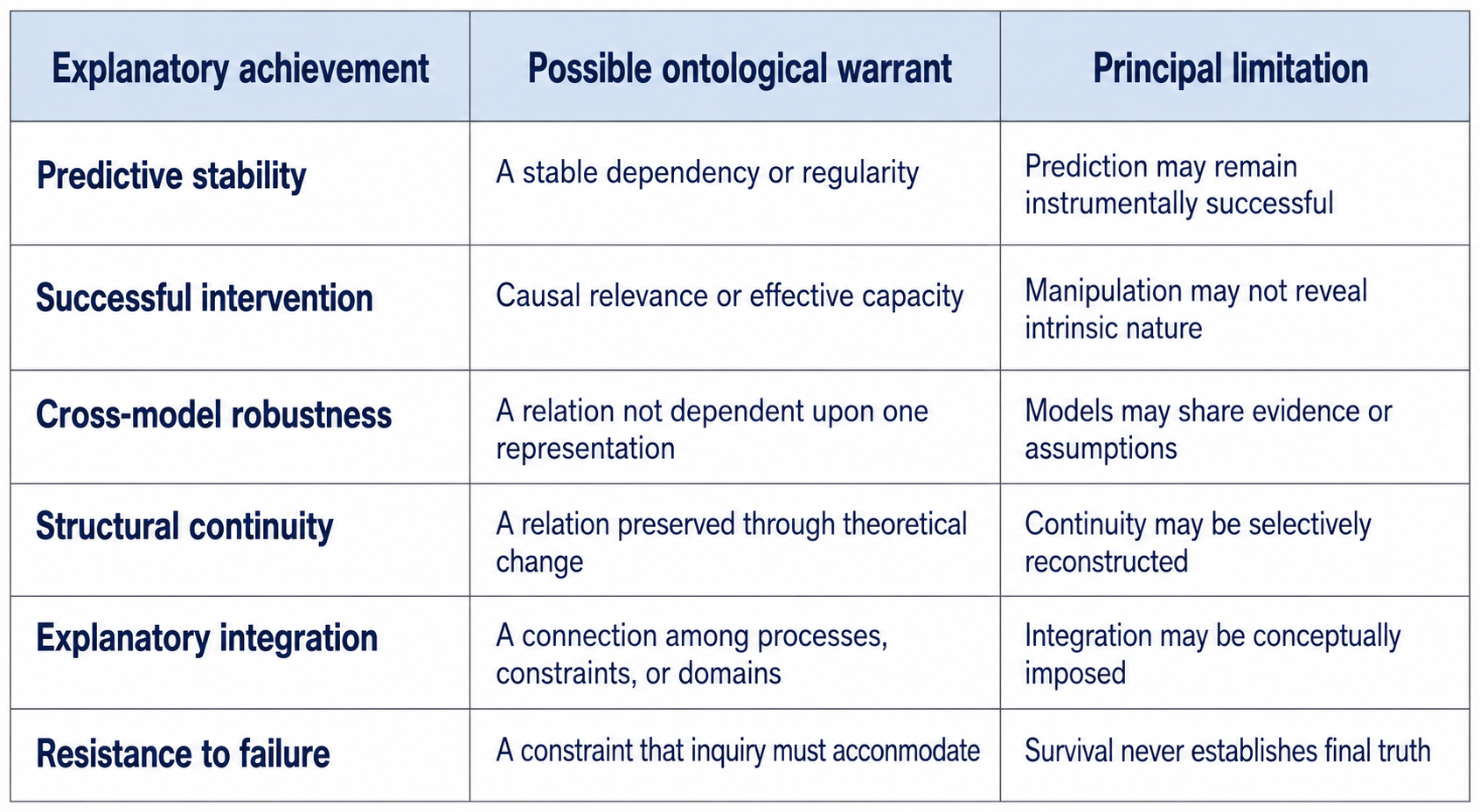
Table 1. Explanatory achievements provide different forms and degrees of ontological warrant. Each remains subject to a characteristic limitation, so no achievement alone establishes metaphysical truth.
The table shows why the argument is not a restatement of the claim that science would be miraculous if it were not approximately true. The no-miracles argument treats broad scientific success as evidence for realism (Psillos 1999). Constraint-sensitive realism asks a more discriminating question: which commitments contributed to which successes, through what relations to evidence and intervention, under which changes in method or representation, and with what capacity for correction? It shifts attention from success in general to the architecture of answerability through which success is achieved.
Chakravartty’s work on scientific realism and scientific ontology is important here because it exposes the distance between accepting science and specifying its metaphysical implications (Chakravartty 2007, 2017). Ontological commitment is not forced uniformly by evidence. It depends partly upon judgments about risk, explanatory value, and the degree of metaphysical detail that investigators are prepared to endorse. Constraint-sensitive realism does not eliminate those judgments. It disciplines them by requiring commitments to be proportionate to the practices that support them.
Structural realism provides a related lesson. Ladyman and colleagues argue that metaphysics should be continuous with successful science rather than guided primarily by intuitions detached from scientific practice (Ladyman et al. 2007). French similarly treats scientific representation as a route to the structure of the world while recognising that such representation requires philosophical interpretation (French 2014). The present argument accepts the demand for continuity but resists the inference that one form of scientific success must yield one privileged metaphysics. Different sciences may warrant different kinds and degrees of commitment.
Perspectival realism reinforces this restraint. A claim may remain situated within historically and methodologically specific practices while tracking a reality that exceeds those practices (Massimi 2022). The ontological force of a perspective depends upon its capacity to enter relations of criticism, extension, and correction with other perspectives. What becomes credible is not whatever every perspective happens to share, but what relevant inquiry repeatedly cannot discard without losing empirical or explanatory achievement.
Explanation therefore reaches reality through constraint-sensitive convergence upon what inquiry, within its current evidential reach, must preserve, accommodate, or repeatedly rediscover. This relation is weaker than an unmediated correspondence between explanation and world, but stronger than empirical usefulness alone. It licenses neither certainty nor unrestricted scepticism. It supports graded commitments whose strength reflects the independence, specificity, and corrective power of the practices from which they arise.
APS provides a demanding test of this position. Its ontology of viability-oriented, constraint-closed organisation cannot be warranted merely because Agency, Process, and Scale form a coherent conceptual scheme. The relevant question is whether these analytic projections identify dependencies that biological inquiry must preserve across different phenomena, methods, and explanatory purposes—and whether their integration reveals constraints that would otherwise remain unrecognised. The next section examines whether APS can meet that burden.
7. APS as a Test Case: Analytic Projections and Organised Reality
APS provides a demanding test of constraint-sensitive realism because it moves deliberately between explanatory methodology and biological ontology. It proposes Agency, Process, and Scale as a grammar for explaining living systems, while also claiming that their integration clarifies something real: life as viability-oriented, constraint-closed organisation. The philosophical question is whether this ontological claim is supported by biological inquiry or merely projected from the conceptual architecture of APS itself.
The question cannot be answered by treating Agency, Process, and Scale as three features discovered ready-made in the world. They are analytic projections rather than components of reality. Each begins from a different explanatory question. Agency asks what living systems do. Process asks how continuity is maintained despite change. Scale asks where persistence is organised across spatial and temporal extents. These questions direct attention differently, but they concern one living organisation rather than three independent causes, domains, or kinds of entity.
Agency identifies the present-tense activity through which living organisation is enacted and sustained. In its compact APS formulation, biological agency is viability-oriented organisational activity. This does not require consciousness, deliberation, representation, or intention. It concerns the capacity of living systems to modulate their activity in ways that maintain or re-establish the conditions under which they can continue functioning. Agency is therefore not an additional force acting upon biological processes. It is an explanatory projection of what living organisation does.
Process addresses the temporal problem created by continual material and organisational change. Organisms persist without remaining materially or structurally identical from moment to moment. Metabolism, repair, development, regulation, and reproduction all involve transformation. Process asks how continuity is achieved through this activity. It therefore directs explanation away from static inventories and towards the ongoing relations through which living organisation is maintained, reorganised, and re-established.
Scale addresses the spatial and temporal extents across which that persistence is organised. Biological activity is locally realised, but the conditions affecting it may extend across cells, tissues, organisms, ecological relations, developmental histories, and evolutionary time. Scale does not divide life into stacked tiers of causal authority. It asks which spatial and temporal relations are explanatorily relevant to the organisation of persistence. Wider relations modify local causal contexts through materially implemented constraints; they do not supersede local causation.
These projections converge upon APS’s proposed explanatory target: organised persistence. The canonical definition is concise:
Life is viability-oriented, constraint-closed organisation.
This organisation consists in the ongoing modulation of constraints through which a system actively maintains and re-establishes the conditions of its own persistence. “Viability-oriented” identifies an asymmetry between changes compatible with continued organisation and changes that impair or destroy it. “Constraint-closed” indicates that the constraints contributing to the maintenance of the system are themselves produced, sustained, repaired, or renewed through the organisation in which they participate. Neither term invokes foresight or external design.
Constraint now has a more specific biological referent than the methodological constraint discussed in the preceding section. Methodologically, inquiry is constrained when evidence, intervention, comparison, and failure restrict which explanations can remain successful. Ontologically, APS proposes that materially realised constraints modify the conditions under which biological processes occur and are themselves sustained through the organisation in which they participate. The first kind of constraint may provide evidence for the second, but it does not establish it without further biological support.
The coherence of these concepts is not sufficient to establish their ontology. A framework can organise familiar findings elegantly while adding no new knowledge about its target. Section 6 therefore specified three conditions under which explanatory integration may contribute ontological warrant: the explanations being integrated must possess support not derived solely from their mutual coherence; their relation must generate constraints, expectations, or discriminations that compatibility alone would not provide; and evidence within one line of inquiry must be capable of forcing revision within another. APS must be judged by these standards.
The first condition is partial independence of support. Agency, process, and scale are not invented solely to complete the APS framework. They draw upon established but incompletely integrated practices of biological inquiry. Research on self-maintenance, autonomy, regulation, and organismal activity supplies evidence relevant to agency. Metabolism, development, repair, and processual biology supply evidence concerning continuity through transformation. Physiology, ecology, developmental biology, and evolutionary inquiry show that biological persistence is organised across different spatial and temporal extents. APS does not treat the existence of these research traditions as proof of its framework. Their partly independent findings ensure, however, that integration begins from empirically grounded problems rather than from conceptual symmetry alone (Spencer 2026).
The second condition is the production of additional explanatory constraints. APS requires an adequate biological explanation to clarify how the phenomenon under investigation relates to the organisation of persistence. An agency account that identifies flexible activity but cannot show how that activity bears upon viability remains incomplete. A process account that describes change without explaining how continuity is maintained does not yet explain organised persistence. A scale account that invokes wider relations without identifying their material implementation leaves their local causal relevance unspecified. These requirements discriminate among explanations that might otherwise appear equally acceptable.
Integration also changes the questions asked of familiar mechanisms. Mechanistic explanation can identify the entities and activities through which a phenomenon is produced (Craver 2007), but APS asks how those activities are organised so that the conditions of continued functioning are maintained or restored. This does not compete with mechanism. It establishes a further explanatory burden where the target is living continuity. Conversely, organisational language that cannot be related to materially realised activities remains inadequate. Agency cannot float free of process, and organisational persistence cannot be invoked independently of the mechanisms and constraints through which it is enacted.
The third condition is reciprocal corrigibility. Each analytic projection must be capable of exposing inadequacy in the others. Claims about agency must be revised if no material process can implement the attributed activity. Process descriptions must be revised if they cannot distinguish continuity-maintaining organisation from dynamics that merely occur within a living system. Claims about scale must be revised if the wider relations invoked make no demonstrable difference to local causal conditions. Conversely, a locally adequate mechanism may prove explanatorily incomplete if it cannot account for how its operation is sustained, regulated, or reorganised under changing conditions.
This reciprocal constraint distinguishes integration from accumulation. APS does not simply place several descriptions beside one another. Nor does it seek unification by translating every biological explanation into one vocabulary. Mitchell’s integrative pluralism is relevant here because it allows explanations to retain domain-specific resources while becoming coordinated around complex targets (Mitchell 2003). Integration without unification is possible when distinct inquiries constrain one another without being reduced to a single explanatory form (Mitchell and Dietrich 2006). The edited volume Scientific Pluralism (Kellert, Longino, and Waters 2006b) and its introduction, “The Pluralist Stance” (Kellert, Longino, and Waters 2006a), similarly reject both fragmented isolation and compulsory theoretical unity. Mitchell’s later account of the landscape of integrative pluralism further emphasises that integration can take different forms according to the relations among problems, methods, and explanatory aims (Mitchell 2023).
APS adds a specific proposal to this pluralist architecture: biological explanations can be compared and related through their contribution to understanding viability-oriented organised persistence. This is not a claim that every biological question has the same answer. Evolutionary, developmental, ecological, mechanistic, and physiological explanations retain their characteristic evidential practices and explanatory achievements. Organised persistence supplies a shared biological target through which their relations can be investigated, not a master explanation that renders them dispensable.
The ontological claim arising from this integration is correspondingly selective. APS does not infer that Agency, Process, and Scale exist as three constituents of life. It proposes that living systems instantiate an organisation whose activity, temporal continuity, and spatial and temporal extent can be analysed through those projections. What is claimed to be real is the viability-oriented, constraint-closed organisation: the materially realised relations through which living systems maintain and re-establish the conditions of their persistence.
This position may be described as organisational realism. It does not treat organisation as an abstract pattern imposed upon components, a static arrangement, or an unexplained property of a whole. Organisation is the coordinated activity through which constraints are generated, maintained, and modulated. Its reality must be demonstrated through the differences it makes to biological explanation: the dependencies it identifies, the interventions it supports, the failures it exposes, and the connections it establishes among otherwise separated findings.
The resulting methodology can be represented as follows:
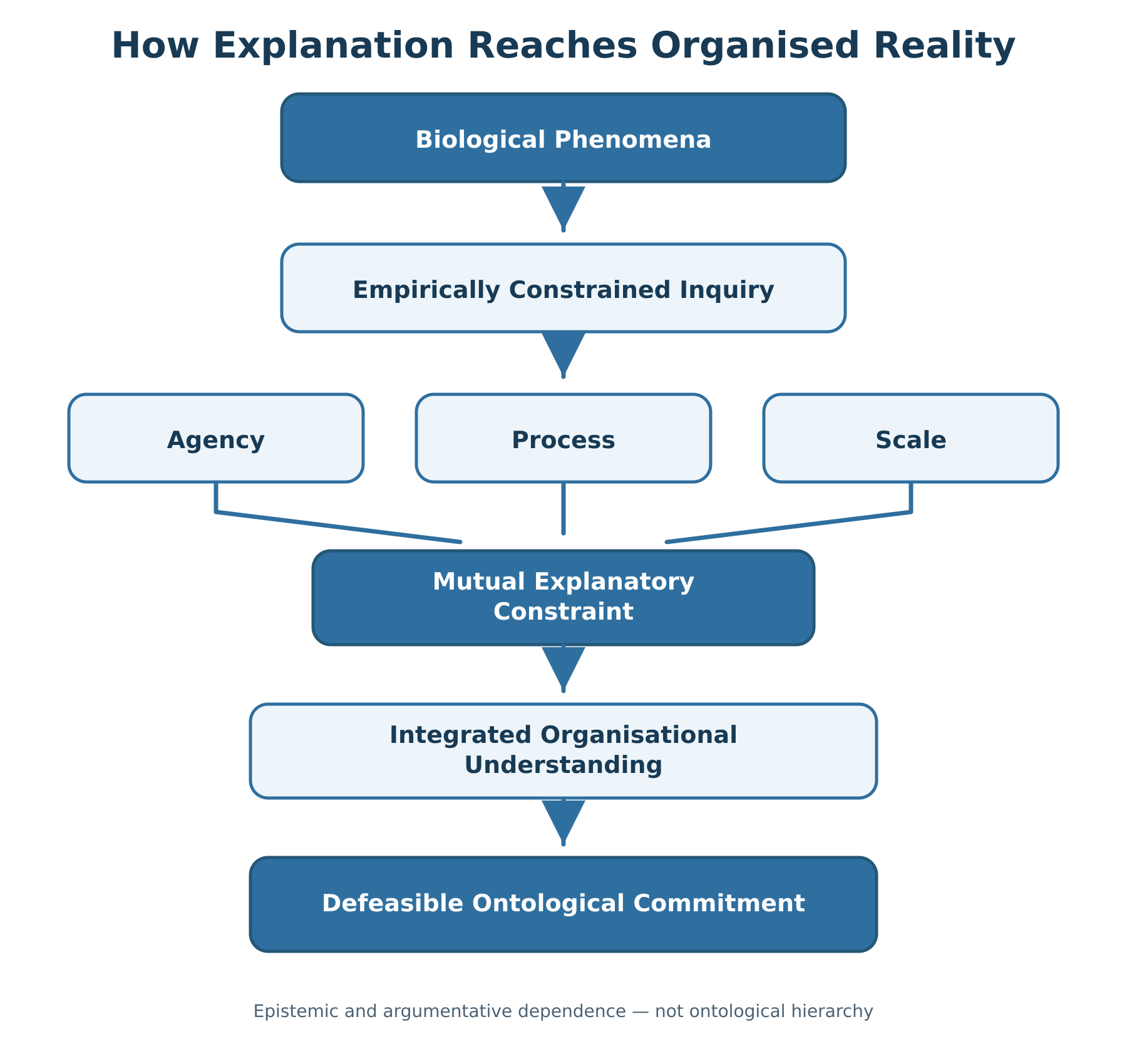
Figure 1. How explanation reaches organised reality in APS. The sequence represents epistemic and argumentative dependence, not ontological hierarchy. APS does not move directly from explanatory concepts to metaphysical conclusions. Agency, Process, and Scale organise distinct but mutually constraining questions whose empirical integration may support revisable commitment to viability-oriented, constraint-closed organisation.
This argument remains programmatic. APS has identified conditions under which its explanatory architecture could acquire ontological warrant, but it cannot declare those conditions satisfied across biology in advance. Its claim must be tested through concrete cases: whether the projections reveal dependencies that established explanations overlook, whether their integration improves discrimination among alternatives, and whether the framework can identify circumstances in which its own organisational interpretation would fail.
That limitation is philosophically productive. It prevents APS from converting conceptual coherence into metaphysical certainty and makes its ontology accountable to continuing biological inquiry. If the integration of Agency, Process, and Scale repeatedly identifies materially consequential relations that survive empirical correction and comparison across biological domains, commitment to organised persistence gains support. If the projections merely redescribe accepted findings without constraining explanation or exposing new inadequacies, the ontological claim weakens.
APS therefore contributes a testable methodological proposal rather than a completed metaphysical system. It suggests that analytic projections can support knowledge of organised reality when they are independently grounded, mutually corrective, and empirically consequential. The broader significance of that proposal is the subject of the next section: what, if anything, such explanatory integration allows science to contribute to metaphysics.
8. What Scientific Explanation Contributes to Metaphysics
The argument can now return to the broad question with which the article began. If explanation is an epistemic achievement, can it contribute to metaphysics—the inquiry into the most general character and organisation of reality? The answer is yes, but only if the contribution is understood as constrained, selective, and revisable. Scientific explanation does not deliver metaphysical conclusions independently of interpretation, nor does it render metaphysics unnecessary. It supplies evidence, commitments, relations, and limits that responsible metaphysics must accommodate.
The relationship is most direct at the level of ontology. Explanations identify entities, processes, structures, capacities, constraints, and forms of organisation as relevant to phenomena. Where those commitments survive appropriate empirical testing, intervention, comparison, and correction, they provide materials for an account of what exists. Metaphysics begins when inquiry asks how such commitments should be interpreted, related, and understood more generally. The move is not from empirical fact to metaphysical certainty. It is from scientifically warranted commitments to a disciplined account of the reality those commitments suggest.
Scientific explanation contributes to this task in at least four ways. First, it constrains metaphysical possibility. A metaphysical proposal that conflicts with well-supported scientific explanations requires either revision or a scientifically credible reason for rejecting those explanations. Metaphysics cannot remain insulated from discoveries about causation, matter, life, cognition, or the organisation of complex systems. This is the central motivation behind naturalised metaphysics: claims about reality should be continuous with successful scientific inquiry rather than derived primarily from intuitions independent of it (Ladyman et al. 2007; Ross, Ladyman, and Kincaid 2013).
Second, explanation supplies positive ontological commitments. Intervention may support commitment to causal capacities; structural continuity may support commitment to relations; mechanistic explanation may support commitment to organised activities; and successful integration may support commitment to dependencies connecting phenomena investigated through different methods. These commitments remain selective. Evidence for a causal relation does not establish a complete account of the entities involved, and evidence for structure does not automatically determine whether structure is ontologically fundamental. Explanation identifies what metaphysics has reason to take seriously without settling every question about its ultimate character.
Third, explanation reveals relations among commitments that isolated findings do not display. Scientific disciplines often investigate different aspects of the same phenomena through specialised methods. Metaphysical significance may arise when those findings are integrated and their dependencies clarified. The relation between physics and the special sciences, between mechanism and organisation, or between historical and present-tense explanation cannot be determined merely by listing the entities accepted in each domain. It requires an account of how their explanatory achievements constrain one another.
Fourth, explanation limits the scope of metaphysical generalisation. Scientific success is often local, conditional, and dependent upon particular arrangements. Cartwright’s dappled world cautions against treating the achievements of one explanatory form as evidence that reality everywhere has the same organisation (Cartwright 1999). Chang’s pluralism similarly shows that scientific development may be improved by sustaining alternative systems of investigation rather than closing inquiry around one accepted framework (Chang 2012). Metaphysics informed by science must therefore learn not only what to affirm but where affirmation should stop.
Naturalised metaphysics is itself contested because continuity with science can be interpreted in different ways. Ladyman and colleagues defend a strongly naturalistic approach in which legitimate metaphysics is motivated by the project of unifying hypotheses taken seriously by contemporary science (Ladyman et al. 2007). Maddy’s Second Philosophy rejects the need for an external philosophical standpoint from which scientific methods must first be justified; philosophical inquiry proceeds within the same broadly empirical enterprise (Maddy 2007). Chakravartty, by contrast, emphasises that scientific ontology involves epistemic choices concerning how much metaphysical detail to accept and what risks of error to tolerate (Chakravartty 2017). These differences show that science does not mechanically dictate one metaphysics.
French’s structural realism illustrates both the promise and the interpretive burden involved. Scientific representation can support commitment to objective modal structure, but moving from represented structure to an account of what fundamentally exists requires philosophical argument (French 2014). The science constrains the metaphysics without uniquely determining it. Similarly, Massimi’s perspectival realism permits commitment to a mind-independent world while treating scientific knowledge as historically and epistemically situated (Massimi 2022). Metaphysical warrant can therefore be real without becoming perspective-free or final.
The relationship between science and metaphysics is also reciprocal. Scientific inquiry begins with concepts and assumptions about objects, causation, possibility, identity, and evidence. These commitments may shape which questions are asked and which explanations appear acceptable. Scientific explanation does not emerge from a metaphysically empty starting point. The relevant safeguard is corrigibility: background commitments must remain open to revision when they obstruct inquiry, fail to accommodate evidence, or become unnecessary within more successful explanations. Metaphysics may guide science, but it cannot claim immunity from scientific correction.
APS enters this relationship through biological explanation. It does not propose that biology should supply a universal metaphysics for all sciences. It asks what ontological commitments become warranted when living systems are investigated through Agency, Process, and Scale and these analytic projections are integrated around organised persistence. The resulting commitment is not to three divisions of reality. It is to viability-oriented, constraint-closed organisation as a materially realised form of activity through which living systems maintain and re-establish the conditions of their persistence.
This is a metaphysical contribution because it concerns what living beings are and how their reality is organised. Yet its warrant remains scientific and methodological. APS must show that organisational interpretation clarifies dependencies that biological inquiry must preserve, improves comparison among explanations, and identifies failures that would otherwise remain concealed. Organisational realism gains support only insofar as organisation makes an empirically consequential explanatory difference.
APS also modifies the expected form of naturalised metaphysics. Metaphysical insight need not arise only from the ontology of a fundamental theory or from reduction of specialised sciences to physics. It may arise from the integration of complementary explanatory projections within a science whose phenomena require attention to activity, persistence, and spatial and temporal extent. Biology may warrant ontological commitments appropriate to living organisation without violating physical explanation or claiming independence from material causation.
This position avoids both reductionism and an unrestricted metaphysical pluralism. The existence of domain-specific explanatory commitments does not imply disconnected realities, but neither must every real pattern be translated into one privileged vocabulary before it can be taken seriously. What matters is whether the commitments are materially compatible, empirically supported, and capable of entering relations of mutual constraint. Metaphysical integration, like explanatory integration, must be earned rather than imposed.
Scientific explanation therefore contributes to metaphysics in a disciplined sequence. It identifies candidate commitments, tests them through practices answerable to phenomena, relates them across perspectives, and exposes the limits of their application. Metaphysics interprets and organises those commitments while remaining vulnerable to their revision. Neither enterprise can replace the other. Science without ontological reflection may leave its commitments unexamined; metaphysics without scientific constraint risks organising possibilities that reality gives us no reason to accept.
APS develops this relationship as a methodological hypothesis. It proposes that analytic projections can jointly support a revisable ontology when they are independently grounded, empirically consequential, and mutually corrective. That proposal is philosophically substantial, but it is not immune to objection. Its adequacy depends upon whether constraint-sensitive realism can avoid circularity, whether plural explanations can genuinely support shared commitments, and whether APS’s organisational ontology does more than redescribe the explanatory preferences built into its framework.
9. Objections and Replies
The argument developed here occupies an intentionally difficult middle position. It holds that scientific explanation can support claims about reality while denying that explanatory success guarantees truth, that one perspective can exhaust its target, or that integration by itself establishes ontology. This restraint does not remove the principal objections. It makes their force more precise.
Objection 1: Constraint-sensitive realism merely restates the no-miracles argument
The no-miracles argument infers that the success of science would be difficult to explain if mature theories were not at least approximately true. Constraint-sensitive realism may appear to repeat that inference in more elaborate language. Explanations succeed, their success is attributed to reality, and realism is then presented as the best explanation of the success. The argument may therefore inherit the familiar circularity of using inference to the best explanation to justify realism about inference to the best explanation.
The reply is not that constraint-sensitive realism escapes every form of circularity. No general defence of scientific reasoning can occupy a standpoint wholly outside the reasoning practices being assessed. Its more limited contribution is discriminatory. It does not move directly from the overall success of science to the approximate truth of scientific theories. It asks which commitments contributed to which achievements, how they were tested, whether alternative representations preserve them, and what forms of failure could have displaced them.
This difference matters because the argument can withhold commitment where success is narrow, heavily accommodated, or dependent upon shared assumptions. It can also distinguish confidence in an interventionally supported capacity from confidence in the full theory used to describe it. Laudan’s historical challenge remains effective against indiscriminate realism (Laudan 1981). Constraint-sensitive realism responds by grading commitment rather than immunising realism from historical correction.
This does not compel an anti-realist to accept the resulting ontology. A constructive empiricist may acknowledge prediction, intervention, robustness, and correction while declining commitment beyond empirical adequacy. Constraint-sensitive realism is therefore not offered as a non-circular proof that realism is mandatory. It is a comparative account of when selective ontological commitment possesses stronger evidential support than it does in cases where those constraints are absent.
Objection 2: Interest-relative explanation cannot support objective ontology
Explanations answer questions, and questions reflect interests. Investigators decide which contrasts matter, what counts as relevant, and how much detail an explanation should include. If explanatory form depends upon human purposes, moving from explanatory relevance to ontological relevance may confuse what matters to investigators with what exists in the world.
The objection succeeds against any direct inference from relevance to reality. A factor can be explanatorily useful without being ontologically fundamental, and different interests may legitimately select different aspects of the same target. The reply is that interests select the question but do not determine whether the proposed answer is adequate. A causal dependency does not arise because investigators find it useful, and a mechanism does not function only because it has been represented.
Objectivity therefore concerns answerability rather than absence of interests. Evidence may fail to support the selected contrast; interventions may not produce the anticipated difference; other investigators may expose background assumptions; and alternative questions may reveal dependencies omitted from the original explanation. Longino’s account of critical interaction is relevant because it shows how socially organised inquiry can expose the assumptions through which interests shape explanation (Longino 1990). Interest-relativity limits the scope of ontological inference without eliminating it.
Objection 3: Explanatory pluralism produces ontological underdetermination
If several explanations can account for the same phenomenon, their success may support incompatible ontologies. Perspectivism then appears to deepen rather than resolve underdetermination. The same evidence might sustain causal, structural, mechanistic, statistical, or organisational accounts without deciding which description identifies what is real.
In many cases, this objection is correct. Scientific evidence may not determine a unique ontology, and the appropriate result is suspended or limited commitment. Defeasible ontology is not a device for manufacturing agreement where inquiry leaves alternatives open.
Plural explanations do not, however, always remain ontologically isolated. They may share commitments, expose different consequences of the same dependency, or constrain one another’s scope. Intervention may support a causal relation represented differently by several models. Mechanistic and organisational accounts may agree about materially realised activities while differing in the explanatory questions they answer. What gains support is not necessarily one complete ontology but a selective commitment preserved across the alternatives.
Perspectival realism therefore permits ontological confidence without requiring uniqueness of representation (Massimi 2022). Where plural accounts remain empirically equivalent and ontologically incompatible, the argument requires restraint. Where they independently preserve a relation and remain capable of mutual correction, pluralism can strengthen rather than weaken warrant.
The next three objections concern different stages of the APS inference. The first challenges whether biological reality is sufficiently integrated to support the proposed shared target. The second challenges whether APS has built that target into its vocabulary. The third challenges whether even well-supported projections disclose one organisation rather than several compatible descriptions.
Objection 4: Integration may impose unity upon a disunified world
Integration is often treated as an intellectual virtue. Yet a coherent framework may reflect the preferences of investigators rather than the organisation of reality. If the world is dappled, as Cartwright argues, then attempts to relate diverse explanations through one target may conceal genuine heterogeneity (Cartwright 1999). APS’s appeal to organised persistence might impose unity upon biological phenomena whose explanatory relations are local, contingent, and irreducibly diverse.
This objection establishes why integration cannot be valued for coherence alone. The criterion developed in Section 6 requires the participating explanations to possess partly independent support, to generate additional constraints when related, and to remain capable of forcing revision in one another. A proposed integration that accommodates every outcome and cannot be empirically disrupted reveals the flexibility of the framework, not the unity of its target.
APS does not require all biological explanations to adopt one vocabulary or derive from one principle. Integrative pluralism allows domain-specific explanations to retain their distinctive methods and achievements (Mitchell 2003; Mitchell and Dietrich 2006). Organised persistence functions as a proposed shared target only where relations among those explanations can be demonstrated. If some biological phenomena do not acquire explanatory significance through that target, APS must restrict its claim rather than redefine the phenomena until they fit.
Objection 5: APS converts its preferred vocabulary into metaphysics
APS begins by describing life through viability, constraint closure, agency, process, scale, and organised persistence. It then concludes that living reality is viability-oriented and organisational. The result may seem circular: the framework finds in the world the organisation it has already built into its explanatory language.
This is the strongest objection to APS’s metaphysical contribution. Conceptual coherence cannot establish existence, and the repeated redescribing of biological findings in APS terminology would not provide independent warrant. The response must therefore be empirical and comparative rather than definitional.
APS gains ontological support only if its concepts expose dependencies that existing explanations leave unclear, discriminate among competing interpretations, guide investigation, or identify conditions under which an accepted explanation fails. Agency claims must be materially implemented; process accounts must explain continuity rather than change alone; scale claims must show how wider relations modify local causal contexts through materially implemented constraints. If these requirements produce no difference to explanation or inquiry, the organisational vocabulary remains a conceptual redescription.
The APS claim is therefore conditional. Organisational realism is warranted in proportion to the empirical and explanatory differences made by organisational analysis. The framework cannot determine the success criteria and then count conformity with its vocabulary as independent evidence.
Objection 6: Compatible projections need not disclose one organised reality
Agency, Process, and Scale may be mutually compatible because they have been defined to avoid conflict. Compatibility does not show that they investigate one organisation. They might remain separate descriptions connected only by the architecture of APS.
The reply begins by conceding the central point: compatibility is insufficient. Even mutual coherence does not establish a shared target. The claim of one organised reality requires demonstrable dependency. Accounts of agency must identify processes through which viability-oriented activity is enacted. Process accounts must show how continuity is maintained through materially organised activity. Scale accounts must establish the spatial and temporal relations through which those processes are conditioned and sustained.
The decisive test is reciprocal corrigibility. Evidence arising through one projection must be capable of exposing inadequacy within another. If no material process could implement an attributed form of agency, the agency claim would require revision. If a proposed wider relation made no difference to local causal conditions, the scale claim would lose explanatory force. If the projections can never conflict because the framework automatically reconciles them, their integration has no ontological significance.
APS therefore treats one organised reality as a hypothesis supported by converging dependencies, not as a conclusion guaranteed by the existence of three analytic projections.
Objection 7: A biological methodology cannot establish a general account of science
The article asks how scientific explanation reaches reality, but its principal constructive case concerns biology. Even if APS supports a defensible organisational ontology of life, it does not follow that physics, chemistry, geology, or the social sciences reach reality in the same way. The argument may generalise too quickly from the distinctive organisation of living systems.
This objection requires an explicit limitation. APS is a biological test case, not a universal template for scientific explanation. Its specific ontology—viability-oriented, constraint-closed organisation—does not apply to every scientific target. Nor does every science need analytic projections corresponding to Agency, Process, and Scale.
The broader proposal is methodological rather than biological: explanations gain ontological force through the ways in which they are empirically constrained, compared, corrected, and integrated. Different sciences may instantiate these relations differently and may warrant different kinds of ontological commitment. Whether constraint-sensitive realism extends beyond biology must be assessed through other scientific practices rather than assumed in advance.
The biological case is nevertheless philosophically significant. It demonstrates why the relation between explanation and reality cannot be modelled solely upon fundamental physical theory or reduced to an inventory of entities. Biology investigates organisation, activity, persistence, history, and contextual dependence. If those explanatory commitments are empirically warranted, an adequate philosophy of science must be able to interpret their ontological significance without either reducing them away or exempting them from material constraint.
These objections narrow but do not defeat the article’s central claim. Scientific explanation does not guarantee metaphysical truth, perspectival plurality does not always resolve underdetermination, and APS has not completed the empirical demonstration of its organisational ontology. What remains defensible is a conditional position: explanatory practices can support selective ontological commitment when they are independently grounded, mutually corrective, empirically consequential, and vulnerable to failure. APS matters because it makes those conditions explicit for an organisational approach to life—and thereby makes its own metaphysical claims answerable to scientific inquiry.
10. Reality Reached Through Revision
How does scientific explanation reach reality? Not by escaping epistemic mediation. Scientific explanations are produced through concepts, models, idealisations, instruments, questions, and perspectives. They select relations rather than reproduce phenomena in their entirety. Their intelligibility is achieved within practices of inquiry, and no explanatory success converts those practices into a view from nowhere.
This does not confine explanation to human understanding. Scientific representations remain answerable to phenomena that investigators do not create. Evidence can resist interpretation; interventions can fail; models can lose reliability when assumptions change; explanatory integration can reveal conflict rather than unity. Reality enters inquiry through the constraints it places upon what can continue to succeed.
The ontological force of explanation therefore depends upon the architecture of its answerability. Predictive stability, intervention, cross-model robustness, structural continuity, explanatory integration, and resistance to failure provide different forms and degrees of warrant. None guarantees truth. Together, where they arise through practices capable of correcting one another, they can justify selective commitment to entities, processes, relations, capacities, constraints, and forms of organisation that inquiry must preserve within its current evidential reach.
The resulting ontology is defeasible. Defeasibility is not a retreat from realism but a condition of scientifically responsible realism. It acknowledges that later inquiry may revise the interpretation of a commitment, restrict its scope, or remove it altogether. Science reaches reality through its capacity to discover and through its organised capacity to correct what it has claimed to discover.
Perspectivism and pluralism are therefore not obstacles to objectivity when perspectives remain empirically accountable. Different explanations may disclose different aspects of a phenomenon, answer different questions, or identify dependencies that cannot be represented adequately in one model. Their plurality becomes ontologically informative when their findings constrain one another. Where they remain incompatible and empirically underdetermined, commitment should be limited or suspended.
APS develops this methodology as a biological test case. Agency, Process, and Scale are analytic projections rather than components of reality. Agency asks what living systems do; Process asks how continuity is maintained despite change; Scale asks where persistence is organised across spatial and temporal extents. Their conceptual compatibility does not establish ontology. Their integration gains significance only if the projections are independently grounded, empirically consequential, mutually corrective, and capable of failure.
The ontological claim developed through APS is not that life has a tripartite structure, but that living systems exhibit viability-oriented, constraint-closed organisation. This claim must be assessed through concrete biological inquiry. APS must show that organisational analysis identifies dependencies that established explanations leave unclear, improves discrimination among alternatives, and explains how living systems maintain and re-establish the conditions of their persistence. If it merely redescribes accepted findings in APS terminology, its ontological claim weakens.
APS therefore contributes to metaphysics without claiming to complete it. It proposes that scientific explanation can disclose organised reality through the disciplined integration of analytically distinct questions. The proposal does not universalise biological ontology across science, and it does not make organisation immune to material or empirical constraint. It offers a methodological hypothesis about how explanation, understanding, and ontological commitment may become related.
The relationship between science’s epistemological and ontological objectives is consequently neither identity nor separation. Science knows through representations, but those representations are corrected by what they seek to explain. Metaphysics interprets the commitments that survive this correction, while remaining answerable to their continued revision.
Scientific explanation reaches reality, then, not at the point where inquiry becomes free of perspective, but where perspective becomes corrigible. Reality is reached provisionally, selectively, and repeatedly—through the explanations that survive our most disciplined attempts to make them fail.
See Also
Related Articles
References
- (1999). The Dappled World: A Study of the Boundaries of Science. Cambridge University Press. https://doi.org/10.1017/CBO9781139167093
- (2007). A Metaphysics for Scientific Realism: Knowing the Unobservable. Cambridge University Press. https://doi.org/10.1017/CBO9780511487354
- (2017). Scientific Ontology: Integrating Naturalized Metaphysics and Voluntarist Epistemology. Oxford University Press. https://doi.org/10.1093/oso/9780190651459.001.0001
- (2012). Is Water H2O?: Evidence, Realism and Pluralism. Springer. https://doi.org/10.1007/978-94-007-3932-1
- (2007). Explaining the Brain: Mechanisms and the Mosaic Unity of Neuroscience. Oxford University Press. https://doi.org/10.1093/acprof:oso/9780199299317.001.0001
- (2017). Understanding Scientific Understanding. Oxford University Press. https://doi.org/10.1093/oso/9780190652913.001.0001
- (2014). The Structure of the World: Metaphysics and Representation. Oxford University Press. https://doi.org/10.1093/acprof:oso/9780199684847.001.0001
- (2006). Scientific Perspectivism. University of Chicago Press.
- (1983). Representing and Intervening: Introductory Topics in the Philosophy of Natural Science. Cambridge University Press. https://doi.org/10.1017/CBO9780511814563
- (1948). Studies in the Logic of Explanation. Philosophy of Science, 15(2), 135–175 . https://doi.org/10.1086/286983
- (2006). Introduction: The Pluralist Stance. University of Minnesota Press.
- (2006). Scientific Pluralism. University of Minnesota Press.
- (2017). Understanding, Explanation, and Scientific Knowledge. Cambridge University Press. https://doi.org/10.1017/9781108164276
- (1989). Explanatory Unification and the Causal Structure of the World. University of Minnesota Press.
- (2007). Every Thing Must Go: Metaphysics Naturalized. Oxford University Press. https://doi.org/10.1093/acprof:oso/9780199276196.001.0001
- (1981). A Confutation of Convergent Realism. Philosophy of Science, 48(1), 19–49 . https://doi.org/10.1086/288975
- (1990). Science as Social Knowledge: Values and Objectivity in Scientific Inquiry. Princeton University Press.
- (2007). Second Philosophy: A Naturalistic Method. Oxford University Press. https://doi.org/10.1093/acprof:oso/9780199273669.001.0001
- (2021). Realism, perspectivism, and disagreement in science. Synthese, 198(Suppl 25), 6115–6141 . https://doi.org/10.1007/s11229-019-02500-6
- (2022). Perspectival Realism. Oxford University Press. https://doi.org/10.1093/oso/9780197555620.001.0001
- (2003). Biological Complexity and Integrative Pluralism. Cambridge University Press. https://doi.org/10.1017/CBO9780511802683
- (2023). The landscape of integrative pluralism. THEORIA. An International Journal for Theory, History and Foundations of Science, 38(3), 261–297 . https://doi.org/10.1387/theoria.25273
- (2006). Integration without Unification: An Argument for Pluralism in the Biological Sciences. The American Naturalist, 168(S6), S73–S79 . https://doi.org/10.1086/509050
- (1999). Models as Mediators: Perspectives on Natural and Social Science. Cambridge University Press. https://doi.org/10.1017/CBO9780511660108
- (2015). Reconstructing Reality: Models, Mathematics, and Simulations. Oxford University Press. https://doi.org/10.1093/acprof:oso/9780199380275.001.0001
- (2017). Idealization and the Aims of Science. University of Chicago Press. https://doi.org/10.7208/chicago/9780226507194.001.0001
- (1996). Scientific Realism and the ‘Pessimistic Induction’. Philosophy of Science, 63(S3), S306–S314 . https://doi.org/10.1086/289965
- (1999). Scientific Realism: How Science Tracks Truth. Routledge.
- (2013). Scientific Metaphysics. Oxford University Press. https://doi.org/10.1093/acprof:oso/9780199696499.001.0001
- (1984). Scientific Explanation and the Causal Structure of the World. Princeton University Press.
- (2026). Agency as the Defining Activity of Life: A Viability-Oriented Framework Integrating Process and Scale. Biological Theory . https://doi.org/10.1007/s13752-026-00547-6
- (2008). Depth: An Account of Scientific Explanation. Harvard University Press.
- (1980). The Scientific Image. Clarendon Press.
- (2003). Making Things Happen: A Theory of Causal Explanation. Oxford University Press. https://doi.org/10.1093/0195155270.001.0001
- (1989). Structural Realism: The Best of Both Worlds?. Dialectica, 43(1–2), 99–124 . https://doi.org/10.1111/j.1746-8361.1989.tb00933.x