APS as an Evolving Intellectual System
Large theoretical frameworks are usually encountered through their finished concepts, arguments, and conclusions. APS provides a documented case in which the practices of constructing, stabilising, comparing, testing, revising, bounding, documenting, and maintaining a theoretical system can themselves be examined. This article distinguishes four concurrent intellectual functions of the APS corpus—explanatory, philosophical, scholarly, and developmental—and asks how their different standards of warrant can remain connected without substituting for one another. It examines negative and limiting results, source authentication, corpus consolidation, maintenance, and public claim calibration without treating architectural breadth, conceptual coherence, methodological discipline, or corpus size as evidence of explanatory superiority.
Key Points
- APS can be examined as a developing intellectual system as well as a biological explanatory framework.
- Explanatory, philosophical, scholarly, and developmental functions are concurrent functions of one corpus, not levels or stages.
- Different intellectual functions require different forms of warrant; success in one does not automatically validate another.
- Development can include restriction, correction, consolidation, redescription, equivalence, non-gain, retirement, or termination as well as expansion.
- Research workbooks, reference library (APS-REF), canonical controls, and public Research perform different roles in maintaining provenance and evidential status.
- Negative or limiting results constrain APS claims but do not provide indirect evidence of framework-wide superiority.
- Selected APS practices may be worth considering in other theoretical projects, but their transferability or general effectiveness has not been demonstrated.
Where This Article Fits APS is presented across this website as a biological explanatory framework, a body of philosophical commitments, a scholarly corpus, and a continuing research programme. Those functions are closely connected, but they are not interchangeable. This article examines a different question from the articles that explain the framework itself: how does a large theoretical and scholarly system develop while remaining open to correction, restriction, and revision? The article therefore complements The Philosophical Foundations of APS, APS as an Organised Conceptual System — Why Definitions Form a System, and Comparative Explanatory Methodology in Theoretical Biology. It also draws on the evidential distinctions maintained by APS Research and on the worked outcomes described in What Happens When APS Is Tested Against Its Strongest Comparators?. APS is used here as a documented case, not as a model whose success is assumed in advance. The organisation of its corpus, the explicitness of its methodology, or its willingness to record limiting results cannot by themselves establish the explanatory adequacy of the framework.
1. Making Development Itself Visible
Theoretical frameworks are often presented synchronically. Readers encounter definitions, diagrams, explanatory claims, references, and applications as parts of a current intellectual structure. Yet such a presentation can conceal another object of interest: the process by which the structure came to have its present form. A framework that extends across many topics must do more than accumulate concepts and articles. It must decide which claims are foundational, which remain exploratory, how sources are authenticated, how apparent gaps are distinguished from genuine research problems, how competing explanations are compared, what counts as a limiting result, when revision is warranted, and when material should be consolidated or retired. These are not themselves evidence that the framework is scientifically successful. They are practices through which its development can be made inspectable.
APS now provides an extensive documentary record of such practices. Its public articles describe the framework and its philosophical and methodological commitments. Its Research programme distinguishes proposed architecture from investigated and supported claims. Research workbooks preserve the operational history of individual investigations. APS-REF provides a controlled reference infrastructure. Canonical controls preserve settled formulations against inadvertent drift, while research-responsive revision allows specific findings to alter the public corpus when the relevant evidential threshold has been met.
APS can be examined in two ways. The first asks whether particular APS propositions successfully explain specific biological phenomena. The second asks how the broader intellectual system containing those propositions is built, tested, revised, and maintained. This article addresses the second question.
It does not ask whether APS is correct as a whole, whether its architecture establishes general explanatory adequacy, or whether it supplies a completed philosophy of biology. The narrower question is how a large theoretical and scholarly system can remain coherent enough to preserve intellectual continuity while retaining explicit routes for correction, restriction, and termination. APS is examined here as one documented case.
2. One System, Four Intellectual Functions
APS can be used in several distinguishable ways. These are not levels, stages, or independent components of the framework. They are concurrent intellectual functions performed by one developing corpus, and each raises a different question.
Explanatory framework
As an explanatory framework for biology, APS provides an analytic architecture for investigating specified biological explananda and comparing explanations. Agency, Process, and Scale are not separate components or hierarchical levels of living organisation. They are analytic projections of one organisation, used to expose different explanatory relations without assuming that any one projection is independently sufficient.
The relevant question for this function is therefore not simply whether an APS vocabulary can be applied to a biological phenomenon. It is whether the framework identifies explanatory dependencies, distinctions, or consequences that are warranted for the specified target. Where competing accounts already exist, this may require comparison with the strongest relevant alternatives.
Architectural applicability is not equivalent to demonstrated explanatory contribution.
Philosophical commitments
APS also contains explicit philosophical commitments concerning life, organisation, biological reality, agency, explanation, and the relation between conceptual and material organisation.
These commitments are examined most directly in The Philosophical Foundations of APS. They do not constitute a prior philosophical system from which biological conclusions are derived. Claims about biological organisation remain answerable to specified explananda, material dependencies, empirical evidence, relevant comparators, and explicit limits.
This gives philosophical work within APS a distinctive function. It can clarify concepts, dependencies, ontological commitments, and explanatory boundaries. But conceptual coherence does not by itself establish that a proposed biological dependency exists.
Philosophical articulation and biological warrant must therefore remain connected without being conflated.
Scholarly knowledge system
APS is also a scholarly knowledge system. The website contains canonical articles, glossary entries, diagrams, research summaries, comparative analyses, historical material, references, and navigational relations. Behind the public corpus, research workbooks preserve more detailed records of investigations, while APS-REF provides a controlled reference infrastructure.
The function of this organisation is not merely archival. It allows claims to be located in relation to definitions, sources, prior decisions, research programmes, and later revisions. It also makes inconsistencies, redundancies, unresolved dependencies, and outdated formulations easier to detect. But scholarly organisation has its own standard of warrant. A correctly authenticated source does not establish that a claim citing it is correct. A well-organised corpus does not establish the explanatory adequacy of the framework it contains. Provenance, consistency, and accessibility are intellectual achievements, but they cannot substitute for proposition-specific evidence.
Documented development programme
Finally, APS functions as a documented programme of intellectual development. Research programmes record questions, candidate claims, source audits, comparison rules, admissible outcomes, decisions, revisions, closures, and unresolved problems. Developmental strategy determines when broader reconstruction is warranted and when consolidation, comparative investigation, or maintenance should take priority. Canonical controls distinguish settled public formulations from exploratory research without making canonical claims unrevisable in principle.
This documentary function makes the development of APS unusually inspectable. It allows later readers to recover not only what the framework currently says, but some of the reasons why particular formulations were retained, changed, restricted, or abandoned.
That record should not be mistaken for evidence of explanatory success. A carefully documented decision can still be mistaken. The significance of documentation is different: it makes the route to the decision available for examination. The four functions can therefore be represented together, provided that their different standards of warrant remain explicit.
*
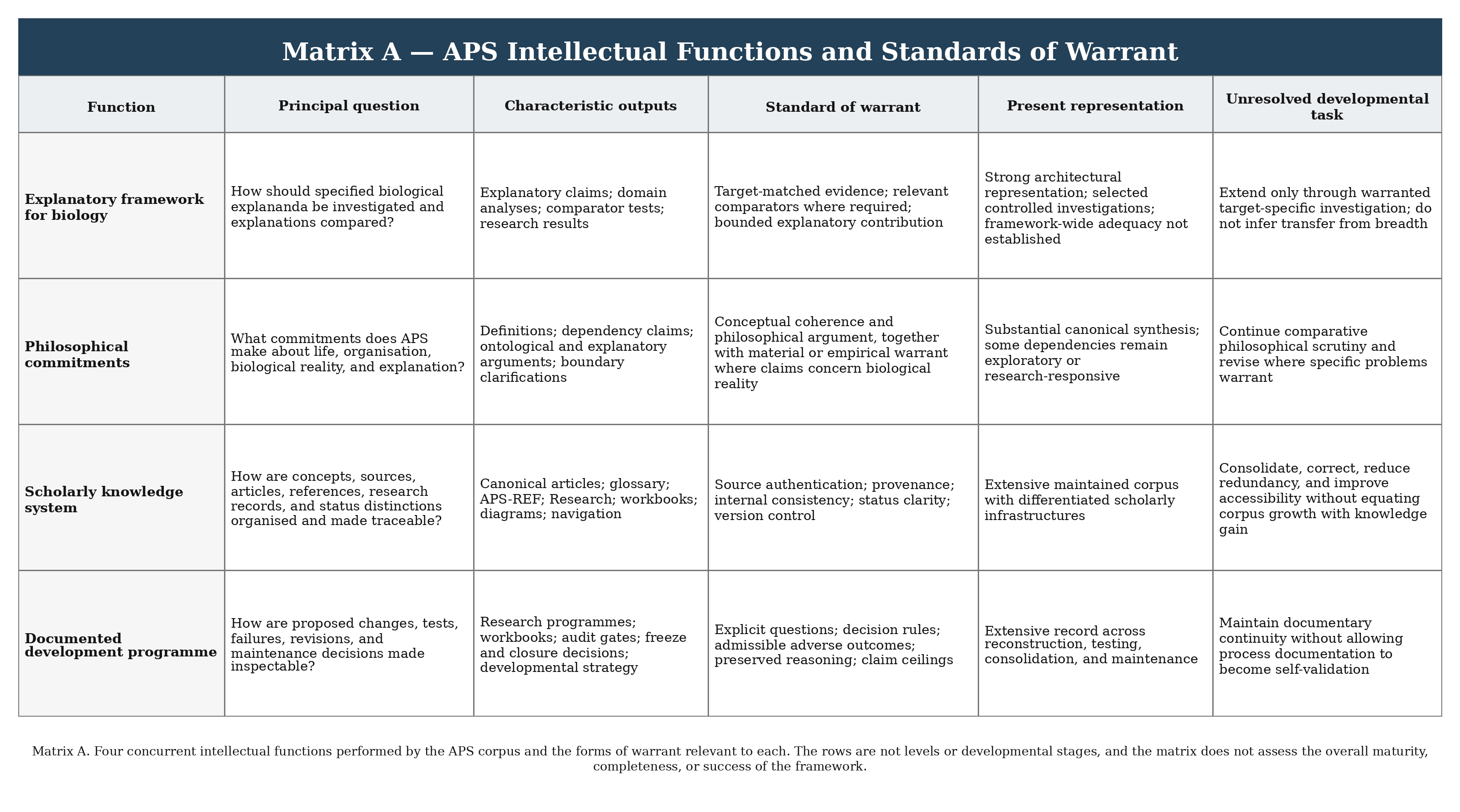
Matrix A — APS Intellectual Functions and Standards of Warrant. Four concurrent intellectual functions performed by the APS corpus and the forms of warrant relevant to each. The rows are not levels or developmental stages, and the matrix does not assess the overall maturity, completeness, or success of the framework.
Matrix A distinguishes concurrent intellectual functions of APS and the forms of warrant relevant to each. Its rows are not levels or developmental stages, and the matrix does not assess the overall maturity, completeness, or success of the framework.
3. Different Functions Require Different Warrants
The distinction among these functions matters because their evidential requirements are not interchangeable. APS’s philosophical foundations explicitly separate philosophical commitment from biological entitlement. Claims about biological organisation remain answerable to specified explananda, materially implemented dependencies, empirical evidence, relevant comparators, and explicit limits.
Likewise, bibliographic verification establishes that a source has been correctly identified; it does not establish that every claim associated with that source is supported. Source authentication is a condition of reliable scholarship, not a substitute for claim-to-source sufficiency.
A research workbook can preserve the reasoning behind a decision without making that decision correct. Its value lies in provenance, recoverability, and the possibility of later scrutiny. A canonical lock can protect a settled public formulation from accidental drift without making that formulation unrevisable. Canonical status records the governed state of the corpus; it does not confer truth.
Public research status can report what has been proposed, investigated, supported, left unresolved, or not yet established. The status classification does not create the evidence it reports.
The same distinction applies to conceptual integration. A framework may connect many biological concepts within a coherent architecture without thereby demonstrating that those connections supply additional explanatory gain for any particular explanandum.
This is especially important for APS because the framework deliberately connects conceptual, methodological, philosophical, and biological questions. The greater the degree of integration, the greater the need to prevent warrant obtained in one context from being silently transferred to another. The principle is therefore simple: connection does not erase evidential difference.
A philosophical argument can clarify what a biological claim means. A conceptual system can reveal dependencies that require investigation. A reference infrastructure can establish provenance. A comparative method can specify how alternatives should be tested. A research workbook can preserve the reasoning behind an outcome. A public status system can communicate the resulting evidential position.
None of these functions, taken alone, establishes the success of the others. Their value lies partly in making those distinctions visible while allowing the different forms of work to remain connected.
4. Development Is Not the Same as Expansion
The development of a theoretical system can easily be mistaken for its expansion. New concepts, articles, research programmes, diagrams, references, and applications make growth visible. But an increase in the size of a corpus does not by itself show that the underlying framework has improved. This distinction has become increasingly important in APS. During its earlier development, substantial reconstruction was necessary to establish a coherent conceptual architecture, stabilise terminology, reconcile older formulations, and make relationships among Agency, Process, and Scale explicit. As that work progressed, however, continued general reconstruction became less informative. The developmental problem changed.
Under the current APS developmental strategy, broad reconstruction has therefore given way to controlled scholarly maintenance, domain corpus consolidation, research-led development, comparative investigation, and research-responsive revision. The change is methodological rather than merely administrative. It reflects the recognition that once a sufficiently stable architecture exists, further development should increasingly depend on identifiable problems rather than on the availability of additional material. Development can consequently reduce a corpus as well as enlarge it.
A domain census may reveal duplicated or weakly differentiated objects. Comparative investigation may show that an apparent APS contribution is already supplied by another account. Source reconciliation may require correction rather than supplementation. A research result may justify narrowing a claim. Consolidation may merge, reposition, or retire material that no longer performs a distinct function.
Even maintenance can contribute to intellectual development when it includes correction, reconciliation, provenance control, dependency checking, and claim calibration. This does not mean that maintenance is inherently knowledge-producing. A clean and internally consistent corpus may still contain mistaken claims. The narrower point is that maintaining a large theoretical system can involve substantive decisions about what the system is entitled to retain, change, or cease claiming.
The distinction is therefore not between a creative phase in which a framework grows and a later administrative phase in which it is merely preserved. Construction, investigation, correction, consolidation, and maintenance can interact throughout development.
Nor does APS treat this as a universal sequence through which theoretical systems must pass. It is a description of the developmental practices that have become visible in this particular corpus. What matters is that development is not measured simply by what has been added. It can also be expressed by what has been clarified, tested, restricted, corrected, consolidated, deferred, or closed.
5. How APS Has Developed
The documentary record of APS makes several recurring developmental practices visible. They should not be interpreted as stages in a fixed sequence. Different parts of the framework may undergo different forms of work at different times, and the same object may return to an earlier kind of scrutiny when a new problem emerges.
Conceptual construction and stabilisation
Some developmental work establishes or repairs the conceptual relations required for later investigation. APS treats its definitions as an organised system of mutually constraining concepts, a principle developed in APS as an Organised Conceptual System — Why Definitions Form a System.
Within the developmental record considered here, the relevant point is narrower: conceptual relations sometimes have to be stabilised or repaired before a research question can be specified precisely enough to test. Recent work on the cognition corpus, for example, required the dependency among agency, evaluation, significance, integration, and cognition to be made explicit before subsequent claims could be assessed consistently.
Conceptual stabilisation is therefore one developmental practice within APS. It enables subsequent investigation; it does not establish the biological adequacy of the resulting conceptual architecture.
Source authentication and provenance
A large scholarly corpus also depends on knowing which sources support which claims. APS-REF was developed to separate reference identity and authentication from the looser citation practices that can accumulate during extended theoretical work. Source reconciliation checks the live reference library rather than assuming that references inherited from older articles or planning documents remain authoritative. This work can preserve an existing source, correct its record, insert an authenticated missing source, or leave a question unresolved when the evidence is insufficient.
Such operations improve provenance and make claim-to-source relations easier to inspect. They do not convert citation into evidence by themselves. A correctly identified publication may still fail to support the proposition for which it has been invoked.
Comparative investigation
APS increasingly tests specified claims against relevant alternatives rather than asking whether the framework can redescribe a phenomenon in its own terminology.
Comparative Explanatory Methodology in Theoretical Biology formalises this approach. A comparison should identify the explanandum, specify the APS claim, match the strongest relevant comparator to the same target, and admit outcomes in which APS does not provide additional explanatory gain. This changes the role of comparison. A comparator is not included merely to display a difference between vocabularies. It provides a control on what APS is entitled to claim.
The resulting outcome may support an APS contribution, reveal complementarity, show an advantage for the comparator, establish equivalence, identify redescription, or remain unresolved. Which outcomes are appropriate depends on the particular comparison.
The existence of a comparative procedure does not itself favour APS. Its purpose is to make an APS claim more vulnerable to a relevant alternative.
Revision and repair
Investigation can expose problems that require changes to the conceptual or public corpus.
These changes need not amount to wholesale reconstruction. A dependency may require clarification. A term may be used too broadly. An article may preserve an earlier formulation that no longer matches the canonical framework. A diagram may imply relations that the prose does not warrant. A distinction may need to be narrowed so that different explanatory questions are no longer conflated.
The cognition corpus has provided examples of such repair, including clarification of the dependency from agency through evaluation, significance, and integration to cognition. Work on plant cognition has required reconciliation between earlier formulations and the subsequent development of APS. Work on evolutionary dynamics has required more explicit separation of organismic agency, population adaptation, functional explanation, and developmental constraint.
Revision in these cases is not evidence that the revised claim is correct. It shows that the public system can be altered when a specific conceptual or evidential problem warrants alteration.
Consolidation and maintenance
As a corpus becomes larger, the existence of many individually plausible objects can itself create problems.
Concepts may be repeated in slightly different forms. Articles written at different times may preserve different terminologies. Domain boundaries may become unclear. Research questions may already have been answered elsewhere in the corpus. Older objects may continue to occupy public space after their function has been superseded.
Domain Corpus Consolidation addresses these problems by establishing the smallest evidence-based population of relevant objects before deciding whether anything requires preservation, merger, reconstruction, repositioning, retirement, or further investigation.
This reverses a common assumption about intellectual development. The first question is not necessarily, “What should be added?” It may instead be, “What is already here, what function does it perform, and is further intervention warranted?”
Controlled scholarly maintenance follows the same principle. Stability is valuable only when what is being stabilised remains warranted. Maintenance must therefore remain compatible with correction.
Public claim calibration
A theoretical system also needs a way to distinguish what it proposes from what it has investigated and what its investigations currently support. The APS Research page performs this function publicly. Its Research Coverage and Evidential Status matrix separates architectural coverage, controlled investigation, bounded results, supported local contribution, and broader transfer or scope.
Those categories are not developmental stages. Nor does movement across them imply inevitable progress. A topic can be architecturally represented without having been investigated. Investigation can produce a limiting or negative result. A supported local contribution does not automatically transfer to a wider domain. Public status therefore has a reporting function. It makes differences in evidential position visible without creating the evidence on which those differences depend.
Taken together, these practices show development occurring through more than accumulation. Conceptual construction can make a claim investigable; source authentication can establish provenance; comparison can test whether an apparent contribution survives a relevant alternative; limiting results can restrict or close a claim; revision can repair a specific defect; consolidation can reduce redundancy; and public calibration can prevent proposed reach from being presented as demonstrated achievement.
The relationship among these practices is summarised below.
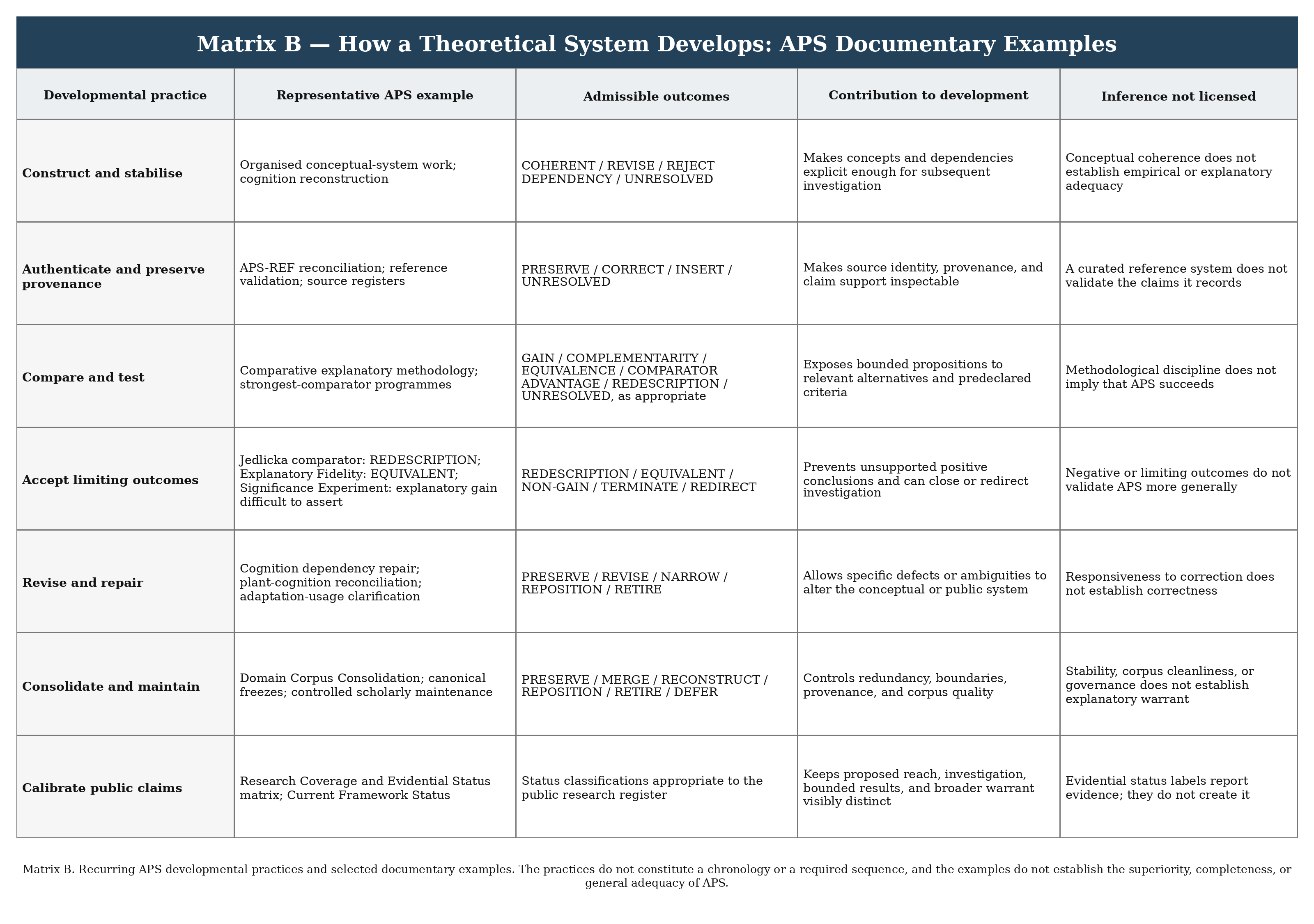
Matrix B — How a Theoretical System Develops: APS Documentary Examples. Recurring APS developmental practices and selected documentary examples. The practices do not constitute a chronology or a required sequence, and the examples do not establish the superiority, completeness, or general adequacy of APS.
Matrix B records recurring APS developmental practices and selected documentary examples. The practices do not constitute a chronology or a required sequence, and the examples do not establish the superiority, completeness, or general adequacy of APS.
6. What Negative and Limiting Results Contribute
A research programme can be distorted if development is recognised only when an investigation produces a positive result. For a theoretical framework, this problem is particularly acute. Because a sufficiently flexible vocabulary can often be applied retrospectively to many phenomena, the ability to redescribe an existing explanation can easily be mistaken for explanatory gain. Similarly, partial correspondence with another framework can be presented as confirmation even when the comparator already performs the relevant explanatory work.
APS comparative methodology therefore admits outcomes in which an APS claim is restricted, found equivalent to another account, judged redescriptive, left unresolved, or terminated. Several APS investigations have produced such outcomes.
The comparison with Jedlicka’s account of biological information and adaptation tested whether APS supplied an explanatory dependency not already available to the comparator. In the selected C. elegans case, the final result was REDESCRIPTION. APS could organise the phenomenon in its own terms, but the comparison did not establish the additional explanatory gain required for the stronger claim.
The Explanatory Fidelity programme investigated whether a proposed APS concept captured an explanatory property not adequately represented by the strongest comparators. Its equivalence test produced EQUIVALENT. The proposed concept was therefore terminated rather than retained merely because it fitted comfortably within the wider APS architecture.
The Significance Experiment similarly found that APS explanatory gain was difficult to assert under the specified comparison. That result redirected attention toward more precise distinctions among explanatory capacity, power, gain, and authority rather than licensing a stronger conclusion about significance.
These outcomes differ in detail and should not be collapsed into a single category of failure. Redescription, equivalence, non-gain, comparator advantage, insufficient evidence, and unresolved comparison identify different relations between a claim and the evidence or comparator against which it has been tested. Their developmental importance is correspondingly specific.
A redescription result can show that a new vocabulary has not yet earned an explanatory role beyond an existing account. An equivalence result can remove the rationale for maintaining a proposed distinction. A non-gain result can prevent architectural integration from being mistaken for explanatory improvement. An unresolved result can identify what further evidence or conceptual discrimination would be needed before a conclusion is warranted. Such outcomes can therefore close a programme, redirect a question, preserve a useful distinction while rejecting a stronger claim, or show that another framework already performs the explanatory operation under investigation. But a limiting result must itself remain limited.
The fact that APS records adverse outcomes does not provide indirect evidence that the framework is generally reliable. Methodological openness to failure is not a substitute for successful explanation. Nor does terminating an unsupported APS claim demonstrate the adequacy of the claims that remain.
This distinction is maintained in What Happens When APS Is Tested Against Its Strongest Comparators?. Comparative outcomes are local to the claims and explananda tested. They do not generate a framework-wide verdict.
Negative and limiting results nevertheless have an important place in intellectual development because they alter what the system is entitled to say. Development is therefore visible not only in successful extension but also in disciplined contraction.
7. What Can Be Learned from the APS Case
APS is one developing theoretical system. Its documentary practices do not establish a general science of framework construction, and this article does not propose that other projects should reproduce its organisation.
The case nevertheless makes several problems of large-scale theoretical development unusually visible.
Distinguish architecture from achievement
A framework may possess broad conceptual reach before that reach has been investigated.
APS can organise questions across multiple areas of biology because Agency, Process, and Scale provide a general analytic architecture. But architectural coverage establishes where questions can be posed within the framework, not whether APS has supplied a distinctive or adequate explanation in each domain.
Keeping those two claims separate prevents breadth from functioning as evidence of success.
Keep intellectual functions connected without exchanging their warrants
Philosophical analysis, explanatory investigation, scholarly organisation, and developmental documentation can support one another without becoming evidentially interchangeable.
A philosophical distinction may sharpen an empirical question. A source audit may reveal that a claim lacks adequate support. A comparative result may require conceptual revision. A workbook may preserve the reasoning behind that revision. A public article may then need to be changed. This is productive interaction among functions.
It becomes problematic only when success in one function is used to validate another without the appropriate intermediate warrant.
Specify limiting outcomes before they are needed
A comparison becomes less informative if every possible result can be interpreted as support for the framework being tested. APS has increasingly addressed this problem by specifying admissible null and adverse outcomes in advance. Depending on the investigation, these can include equivalence, redescription, comparator advantage, insufficient evidence, unresolved status, or termination. Predeclaring such outcomes does not guarantee methodological adequacy. It does, however, make it harder to preserve a preferred claim merely by redescribing an adverse result after the event.
Preserve the reasoning behind change
The current state of a theoretical system does not reveal all the decisions that produced it.
When a concept has been narrowed, an article reconstructed, a comparator programme closed, or a source replaced, the final public object may no longer display the problem that prompted the change. Research workbooks and related documentary records can preserve that reasoning. This makes later scrutiny possible and reduces dependence on retrospective reconstruction. Again, documentation does not validate the decision. It preserves the path by which the decision can be examined.
Treat consolidation and maintenance as possible intellectual work
Growth creates its own theoretical problems. As a corpus expands, duplication, conceptual drift, inconsistent terminology, obsolete formulations, and uncertain boundaries can make further accumulation counterproductive. Census, reconciliation, consolidation, and maintenance can therefore become necessary parts of continued intellectual work.
Their value depends on what they actually accomplish. Removing redundancy or repairing a dependency may improve the structure through which research proceeds. Merely making a corpus tidier does not establish new biological knowledge. The APS case therefore supports a bounded proposition: maintenance can have intellectual consequences when it changes the clarity, provenance, dependencies, or warranted claims of the system being maintained.
Separate public status from proposed reach
A developing framework needs language for saying both what it is designed to investigate and what has actually been established.
APS addresses this through its public Research architecture, which distinguishes framework status and evidential position without treating the categories as a progression toward success. This allows a domain to be visibly represented within APS without implying that its explanatory adequacy has already been demonstrated there.
The distinction is especially important for a framework with broad ambitions. The larger the proposed reach, the greater the need to make the limits of investigated reach equally visible.
Possible relevance beyond APS
These practices may be relevant to other theoretical projects that face similar problems of conceptual integration, evidential heterogeneity, corpus growth, comparative testing, and long-term revision. Their relevance should not be overstated. The APS case does not demonstrate that its procedures are generally effective, that they form a necessary method for theoretical development, or that projects organised differently are methodologically inferior.
Instead, the case identifies practices that readers or other projects may consider and, where appropriate, adapt: distinguishing architecture from achievement; separating intellectual functions from their standards of warrant; specifying limiting outcomes; preserving decision history; treating consolidation and maintenance as potentially substantive work; and distinguishing public statements of scope from evidentially supported reach.
These practices are potentially adaptable rather than demonstrated transferable methods. Whether they are useful elsewhere depends on the aims, evidence, scale, and organisation of the project concerned. That is the appropriate limit of the educational claim.
APS provides an example through which these problems can be examined. It does not establish a universal template for solving them.
8. An Open System Under Controlled Development
APS now exists simultaneously as a biological explanatory proposal, a set of philosophical commitments, a large scholarly corpus, and a documented research-and-maintenance programme.
These are concurrent functions of one intellectual system. They are connected by shared concepts, sources, research questions, and documentary infrastructure, but their standards of warrant remain distinct.
That distinction helps clarify what it means for APS to remain open. The conceptual basis for combining stability with controlled development is addressed in APS as an Organised Conceptual System — Why Definitions Form a System. At the wider developmental scale considered here, the question is how changes arising from research, comparison, source authentication, consolidation, and maintenance are incorporated without dissolving the continuity of the system being investigated.
Canonical status is therefore not immunity from revision. A specific research result, conceptual contradiction, authenticated source problem, comparator finding, or domain consolidation may establish a reason to reconsider an existing object. Research-responsive revision provides a controlled route through which such findings can alter the public corpus.
The system is therefore neither fixed nor indefinitely reconstructive.
Its foundational commitments provide continuity. Research and comparison expose specified claims to challenge. Workbooks preserve the reasoning behind developmental decisions. APS-REF controls source provenance. Domain consolidation examines whether the existing corpus remains appropriately organised. Public Research distinguishes proposed scope from investigated and supported contribution. Revision occurs when a sufficiently specific problem warrants it.
None of these practices establishes that APS is generally correct.
Their significance is architectural and methodological: they allow the framework to retain a recognisable identity while remaining capable of changing particular claims, dependencies, representations, and research priorities.
This is also why development cannot be reduced to the accumulation of successful results. A system capable only of adding compatible material would have no controlled means of learning from equivalence, redescription, non-gain, correction, redundancy, or conceptual failure.
The developmental problem is therefore one of controlled continuity through change.
APS approaches that problem by distinguishing what is canonical from what is exploratory, what is proposed from what is investigated, what is locally supported from what remains broader aspiration, and what belongs to the explanatory framework from what belongs to the scholarly machinery through which that framework is investigated and maintained.
Conclusion
Large theoretical frameworks are usually judged through the concepts and explanations they eventually present. Their development is less often available as an explicit object of examination.
The APS documentary corpus is now extensive enough for its development to be examined as an object of inquiry. The framework is represented simultaneously as a biological explanatory proposal, a set of philosophical commitments, a large scholarly corpus, and a documented research-and-maintenance programme. Those functions are connected, but their warrants remain distinct.
This distinction prevents several forms of inference that would otherwise be tempting. Conceptual coherence does not establish biological adequacy. Scholarly organisation does not establish explanatory success. Methodological discipline does not establish that APS outperforms its comparators. A large corpus does not demonstrate knowledge gain. Negative results do not indirectly validate the framework. Public evidential classifications report the state of inquiry rather than creating it.
At the same time, the documentary record shows that theoretical development can involve more than expansion. Construction, stabilisation, authentication, comparison, limiting results, revision, consolidation, maintenance, and public claim calibration can all alter the intellectual system without constituting a single developmental sequence.
APS therefore provides a case of a theoretical system attempting to preserve continuity without treating its current form as final, and to permit change without equating change—or expansion—with progress. Whether its biological explanations ultimately warrant the broader reach proposed for the framework remains a matter for continuing target-specific investigation. The additional point examined here is narrower.
When the construction, testing, correction, limitation, and maintenance of a theoretical framework are sufficiently documented, the development of the intellectual system can itself become an object of inquiry.