Why Use APS If Biology Already Has the Concepts?
Biology already possesses substantial concepts and explanatory resources concerning agency, organisation, process, function, information, cognition, regulation and multiscale biological activity. APS does not need to deny this overlap or claim that its terminology is intrinsically superior. This article explains APS as a comparative explanatory methodology: a controlled way of organising and distinguishing biological questions, testing whether those distinctions matter to a specified explanandum, and determining whether established explanations already perform the required work.
Key Points
- APS does not require every concept in its controlled vocabulary to be scientifically novel.
- Different terminology does not by itself establish different explanatory work.
- Conceptual clarification, methodological contribution and substantive explanatory gain must be distinguished.
- Agency, Process and Scale are analytic projections that organise diagnostic questions rather than compulsory components of every biological explanation.
- Explanatory gain must be demonstrated relative to a specified explanandum and the strongest relevant comparator.
- Sufficiency, complementarity, redundancy, no additional gain and unresolved assessment are legitimate comparative outcomes.
- APS must be capable of determining that an established explanation already does the required work.
1. Introduction - A reasonable question
Biology already has a rich explanatory vocabulary. Biologists investigate regulation, function, information, signalling, adaptation, development, cognition, ecological interaction and biological organisation. Mechanistic approaches explain how organised entities and activities produce changes. Organisational approaches examine autonomy, self-maintenance, constraint closure and biological function. Processual approaches emphasise turnover, transformation and continuity through change. Work on adaptivity and sense-making addresses the ways in which conditions can matter differently to living systems. APS does not need to deny any of this. These are substantial and established areas of biological and philosophical research (Di Paolo 2005; Mossio, Saborido, and Moreno 2009; Moreno and Mossio 2015; Nicholson and Dupré 2018).
That creates an obvious question. If biology already possesses many of the concepts and explanatory resources with which APS is concerned, what is APS for?
Simply introducing new terminology does not answer it. Calling something Agency, Process, Scale, Significance or organised persistence does not show that a new biological phenomenon has been discovered. Nor does placing familiar ideas within a new framework establish that existing explanations are incomplete.
APS therefore has to meet a more demanding standard. Its contribution cannot be inferred from the distinctiveness of its vocabulary. It must be established by asking what explanatory work its distinctions perform, whether that work matters for a specified biological question, and whether established approaches already perform the same work.
This changes the question from Are APS concepts different? to What difference does using APS make to biological explanation?
That is the question this article addresses.
2. Different words are not different explanations
Scientific concepts can overlap without being identical. The same term may also be used differently in different research traditions, while different terms may perform much the same explanatory work. Neither terminological similarity nor terminological difference therefore settles the relation between two explanations.
APS uses controlled terminology because distinctions can matter. Its purpose is to make explanatory commitments explicit, not to establish by definition that APS has identified biological mechanisms or dependencies absent from established science.
Several possibilities must therefore be kept separate.
APS and an established approach may use different words for substantially the same explanatory work. Alternatively, APS may draw a useful conceptual distinction while leaving the underlying biological explanation unchanged. A distinction can clarify what is being claimed, prevent categories from being conflated, or expose an assumption that would otherwise remain implicit. That is useful conceptual work, but it is not automatically additional biological explanation.
A distinction can have a stronger consequence if it changes how an investigation is organised. It might help specify what is being explained, which dependencies are relevant, which comparison is appropriate, or what evidence would discriminate between alternatives. That would be a methodological contribution.
Only then should a stronger question be asked: does APS provide substantive explanatory gain? Does it identify some warranted biological dependency, consequence, prediction, intervention or other explanatory capacity that the strongest relevant existing explanation does not already provide?
There is no legitimate shortcut from different terminology to that conclusion.
This control is especially important because conceptual integration can itself be attractive. A coherent framework may connect questions that are often investigated separately. But coherence, integration and explanatory gain are not the same achievement. APS methodology therefore requires competing explanations to be reconstructed fairly rather than making APS vocabulary the language in which all alternatives must be judged.
3. What Agency, Process and Scale are for
APS organises its central questions through Agency, Process and Scale. These are analytic projections rather than components of reality. They are not three substances, causal forces, biological modules or hierarchical levels.
They provide three complementary ways of asking questions about one living organisation.
Agency asks what the living system is doing in maintaining, reorganising or re-establishing viable organisation.
Process asks how organised continuity is maintained, reorganised or re-established despite change.
Scale asks across what spatial and temporal extents the dependencies relevant to that persistence are organised.
The distinction matters because biological explanations can have different targets. An explanation of a molecular mechanism may successfully answer how a particular interaction occurs without attempting to explain the longer-term persistence of the organisation in which that mechanism operates. A developmental explanation may be concerned with transformation through time. An ecological explanation may depend upon relations extending beyond the organism. None becomes deficient merely because it does not answer every question that APS can ask.
The A–P–S projections are therefore diagnostic, not compulsory boxes through which every biological explanation must pass.
Process provides a useful illustration. Living systems undergo material turnover, repair, development, physiological change and reorganisation. Processual biology has developed sophisticated accounts of such dynamic continuity, and APS does not claim to have discovered that living systems change while persisting (Nicholson and Dupré 2018).
APS uses Process more specifically as an analytic question: how is organised continuity maintained, reorganised or re-established despite change? That question may reveal something important about a particular explanatory target. In another investigation it may add little because the relevant temporal dependencies are already adequately represented.
The same discipline applies to Agency and Scale. The fact that an APS question can be asked does not demonstrate that another explanation has omitted something it needed to explain. An APS question becomes consequential only when the relation it identifies matters to the specified target.
4. Why controlled distinctions can still matter
If terminology does not establish explanatory novelty, why control it so carefully?
Because different biological questions can easily be run together.
Consider Agency and Cognition. APS defines biological agency as viability-oriented organisational activity. Agency therefore does not require cognition. Metabolism, repair, homeostatic regulation and other forms of active self-maintenance can be agential without thereby being cognitive. This prevents increasingly sophisticated biological activity from being called cognitive simply because it is adaptive, responsive or regulatory. The distinction marks a question that must be answered rather than an escalation that can be assumed. This treatment is continuous with established work on autonomy, adaptivity and biological normativity (Di Paolo 2005; Barandiaran, Di Paolo, and Rohde 2009).
The distinction between information and Significance performs related work. Information-bearing differences can be detected, transmitted or causally effective. APS uses Significance for what a difference amounts to in relation to the viability of a living organisation. The distinction does not propose an additional substance or signal. It asks whether being informationally available and mattering to a particular living organisation are being treated as the same explanatory relation. Functional and pragmatic approaches to biological information may already capture much of the relevant work; where they do, APS must acknowledge that overlap.
Other distinctions serve the same general purpose. Significance is not Cognition: something may matter to a living system without the system cognitively organising that significance. Function is not intention: a biological contribution to ongoing organisation need not be consciously intended, and organisational accounts of biological function long predate APS (Mossio, Saborido, and Moreno 2009). Organised persistence is not unchanged structure: living continuity may depend precisely upon turnover, repair and reorganisation.
The point is not that ordinary biological vocabulary is defective. Terms such as information, regulation, function, learning, memory, cognition, purpose and mechanism perform indispensable work. Controlled terminology is useful where meanings shift without notice, implications from one context are transferred into another without justification, or a change of vocabulary is mistaken for a change in biological explanation.
It can therefore protect explanatory boundaries and make a transition visible enough to ask what warrants it.
But that is still not the same as showing that APS explains the biology better.
5. Four different things APS might contribute
The question What does APS add? becomes clearer if four possibilities are distinguished.
Terminological equivalence occurs when APS and an established approach use different language but perform substantially the same explanatory work. APS terminology may provide consistency within the framework, but terminological consistency is not substantive explanatory gain.
Conceptual clarification occurs when APS separates questions or categories that might otherwise be conflated. Distinguishing Agency from Cognition, or information from Significance, may make the commitments of an explanation clearer even if no new mechanism or biological dependency is identified.
Methodological contribution is stronger. Here an APS distinction changes how an explanatory problem is formulated or tested. It may sharpen the explanandum—the phenomenon or question being explained—expose a relevant dependency, identify a boundary requiring empirical discrimination, clarify which comparison is appropriate, or specify what result would count against the proposed explanation.
Substantive explanatory gain requires an additional warranted explanatory capacity relative to an appropriate existing explanation of the same target. Novelty, breadth, integration or usefulness alone do not establish such gain. A target-relevant difference must make an explanatory difference. APS therefore treats explanatory gain as bounded by the specified target and comparator rather than as a framework-wide property.
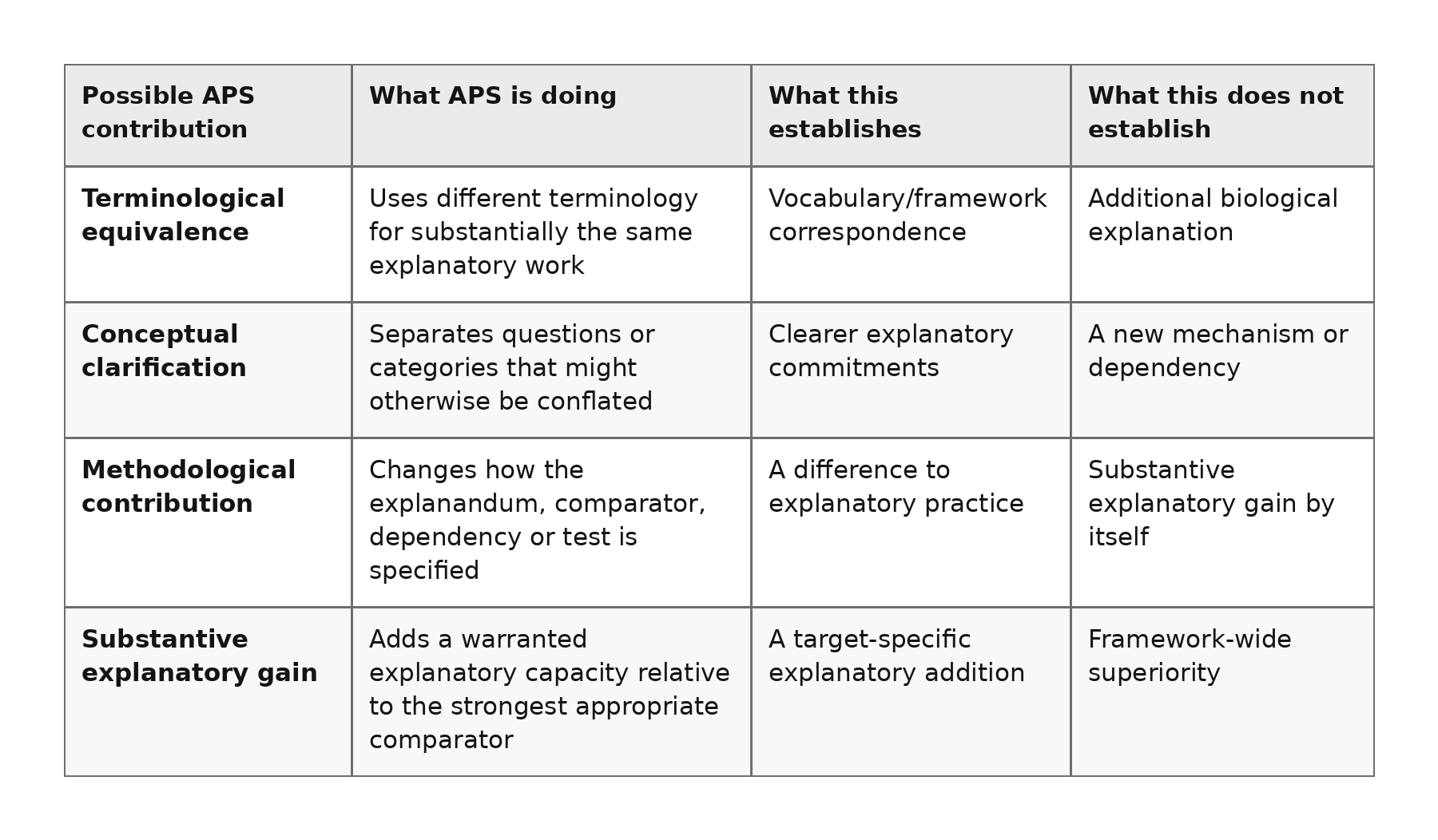
Four possible contributions of APS to biological explanation. Different terminology may correspond to existing explanatory work, while conceptual clarification and methodological contribution need not amount to substantive explanatory gain. Substantive gain requires an additional warranted explanatory capacity relative to the strongest appropriate comparator.
These four possibilities are not stages through which every APS analysis must progress. There is no ladder running from new terminology to conceptual clarification to methodology and finally to substantive gain.
Terminological equivalence may be the correct conclusion. So may conceptual clarification. A methodological contribution may remain useful even when no additional substantive explanation is demonstrated.
The purpose of the distinctions is to prevent APS from claiming more than comparison warrants.
6. How APS has to earn a stronger claim
Suppose APS appears to identify something missing from an existing explanation. What happens next?
The first requirement is to specify the explanandum: the phenomenon or question being explained. Two approaches cannot be compared fairly merely because they discuss the same organism, process or general subject. They need to address sufficiently matched explanatory targets.
The second requirement is an appropriate comparator. Testing APS against an oversimplified, outdated or deliberately narrow alternative would establish little. The relevant question is what the strongest appropriate established explanation already accomplishes.
That comparator should then be reconstructed in its own terms. APS cannot translate an alternative into APS vocabulary, identify what disappears in translation, and count that disappearance as a deficiency of the alternative. Comparison has to preserve relevant differences rather than assume that APS supplies the neutral language of biological explanation.
Only then can the central question be asked: what explanatory consequence remains after the strongest comparator has been taken seriously?
Perhaps APS identifies a dependency that was not represented. Perhaps it changes the interpretation of an experiment, exposes a contrast requiring discrimination, supports a different prediction, or identifies a materially implemented relation whose significance was missed. Such a result could support a substantive claim if the evidence warrants it.
But APS may instead reorganise relations that the comparator already explains. It may make a distinction explicit without changing what can be explained. Or the two approaches may address partly different questions and therefore be complementary rather than rivals.
APS comparative methodology keeps all of these possibilities open. It requires a specified target, fair reconstruction, an appropriate strong comparator, a test against mere redescription, and a conclusion restricted to what the comparison actually establishes.
For substantive biological claims, conceptual organisation is therefore insufficient. Relevant dependencies must be materially realised, and empirical claims require empirical warrant.
APS does not earn explanatory gain by asking more questions. It earns a stronger claim only when answering an APS question makes a warranted difference to the explanation of the specified biological target.
7. Sometimes APS should add nothing
A successful APS comparison does not have to end by showing that APS is better.
Sometimes the established explanation already does the work required. The appropriate conclusion is then sufficiency.
Sometimes APS and another approach illuminate different but relevant aspects of the target without one displacing the other. The result is complementarity.
Sometimes APS terminology or organisation reproduces work already available from the comparator. For that target, the proposed contribution may be redundant.
Sometimes no additional explanatory gain can be demonstrated.
And sometimes the evidence is insufficient to decide. The correct result is then unresolved, together with a clearer statement of what further discrimination would be required.
These are not escape clauses added to protect APS from criticism. They follow from comparative methodology itself. A procedure that could recognise explanatory gain but could never conclude that the comparator was already sufficient would not provide a serious test. APS methodology therefore explicitly permits complementarity, redundancy, no additional gain and unresolved outcomes alongside positive gain.
APS may consequently help formulate a comparison, sharpen a boundary or identify what evidence would matter, while the comparison itself shows that established science already provides the substantive explanation.
That does not convert a null result into hidden evidence of APS superiority. It means only that the methodological and substantive questions have been kept separate.
APS must be able to determine that APS adds nothing further.
8. So why use APS?
We can now return to the opening question.
If biology already has many of the concepts, what is APS for?
APS does not need to claim that biology lacked agency, process, organisation, function, normativity, information, cognition or multiscale explanation. Nor does it need to claim that established biological language is defective.
What APS proposes is a controlled way of organising certain explanatory questions.
Agency asks what living systems do in maintaining, reorganising and re-establishing viable organisation. Process asks how organised continuity is maintained, reorganised or re-established despite change. Scale asks where the relevant dependencies are organised across spatial and temporal extents. These are analytic projections of one living organisation, not separate components of it.
Controlled terminology helps prevent explanatory transitions from being taken for granted: information is not automatically Significance; Significance is not automatically Cognition; Agency need not be Cognition; function need not imply intention; organised persistence need not mean unchanged structure.
But these distinctions remain proposals for explanatory organisation until their consequences are established.
That is why comparison matters. APS asks whether a distinction merely renames existing work, clarifies a concept, changes the organisation of inquiry, or produces substantive explanatory gain. It requires the strongest relevant comparator to be taken seriously, and it permits the answer to be that the established explanation is sufficient.
The usefulness of APS therefore cannot finally be established by the elegance or coherence of APS itself.
APS need not introduce a new scientific concept wherever it introduces controlled terminology. Its contribution must instead be assessed by asking what explanatory distinctions its architecture makes explicit, whether those distinctions matter to a specified biological explanandum, and whether established approaches already perform the same work.
The reason to use APS is not that biology lacked concepts before APS. It is that APS provides a controlled framework for organising, distinguishing and comparing certain questions about living organisation—and for testing whether doing so makes an explanatory difference.
Whether APS adds substantive biological explanation remains something to be demonstrated, not something the framework is entitled to assume.
See Also
Related Articles
References
- (2009). Defining Agency: Individuality, Normativity, Asymmetry, and Spatio-temporality in Action. Adaptive Behavior, 17(5), 367–386 . https://doi.org/10.1177/1059712309343819
- (2005). Autopoiesis, Adaptivity, Teleology, Agency. Phenomenology and the Cognitive Sciences, 4(4), 429–452 . https://doi.org/10.1007/s11097-005-9002-y
- (2015). Biological Autonomy: A Philosophical and Theoretical Enquiry. Springer. https://doi.org/10.1007/978-94-017-9837-2
- (2009). An Organizational Account of Biological Functions. The British Journal for the Philosophy of Science, 60(4), 813–841 . https://doi.org/10.1093/bjps/axp036
- (2018). Everything Flows: Towards a Processual Philosophy of Biology. Oxford University Press. https://doi.org/10.1093/oso/9780198779636.001.0001