What Counts as Explanatory Gain?
Explanatory gain is not established merely because an explanation is novel, different, broader, more integrated or more useful. It is a bounded conclusion about additional explanatory capacity relative to a sufficiently strong explanation of the same target. This article examines how such gain can be demonstrated, why no additional gain and unresolved assessment are legitimate outcomes, and why local explanatory gain does not establish framework-wide superiority.
Key Points
- Explanatory gain is relative to a specified explanatory target and a sufficiently strong relevant comparator.
- A target-relevant difference is necessary for positive gain but does not by itself establish additional explanatory capacity.
- Prediction, integration, unification, novelty, formalisation and usefulness may contribute to explanation without automatically constituting explanatory gain.
- Positive gain, no additional gain and unresolved assessment are all legitimate bounded outcomes.
- Local explanatory gain does not by itself establish the overall superiority of a theory or framework.
Where This Article Fits
The previous article established how scientific explanations should be compared. It required sufficiently matched explanatory targets, reconstruction of the strongest serious alternatives, relation classification before ranking, evidential symmetry, and explicit scope and stopping controls.
This article begins only after that comparative work has been done. A controlled comparison may reveal a target-relevant difference, but difference is not yet explanatory gain. The further question is whether the candidate explanation provides additional explanatory capacity relative to a sufficiently strong comparator.
That is the question addressed here. The article does not reopen the comparative procedure, and it does not survey or rank contemporary biological frameworks. The next article will examine how such frameworks actually explain. The present task is narrower: to determine what must be shown before a difference can count as explanatory gain.
Introduction
A new explanation earns credit for what it adds relative to a strong account of the same target—not simply for being newer, broader or more integrated.
Gain Is Relational
Explanatory gain is not an intrinsic property that an explanation possesses in isolation. It is a relation among at least four things:
- a candidate explanation;
- a specified explanatory target;
- a sufficiently strong relevant comparator; and
- the evidence available for assessing their difference.
This matters because a proposal may appear powerful when considered alone but add little once the strongest relevant explanation of the same target has been reconstructed. Conversely, an account that is narrow in scope may still add something important if it explains, discriminates, constrains or supports an inference that the comparator does not already provide.
The relevant question is therefore not simply whether the candidate is informative, coherent or scientifically interesting. It is whether some target-relevant explanatory capacity remains after the comparator has received full credit for what it already explains.
Ross (2025) emphasises the plurality of explanatory aims and forms found in biology. That plurality is compatible with disciplined comparative assessment, but it makes a relational conception of gain especially important. Different explanations may succeed in different respects, and no single property automatically determines whether one has gained over another.
Difference Is Not Gain
A fair comparison may reveal a genuine difference between candidate explanations. That difference is necessary for positive explanatory gain: if the candidate adds nothing distinguishable, there is nothing further to credit. But difference alone is not sufficient.
A difference may consist in terminology, conceptual organisation, descriptive grain, formal representation, emphasis, scope, or explanatory aim. It may clarify a problem without solving an additional part of it. It may re-express dependencies already captured by the comparator. It may connect previously separate bodies of work without establishing a new explanatory consequence.
The anti-redescription control is therefore straightforward:
A candidate explanation does not gain merely by describing the same explanatory work in a new vocabulary.
A target-relevant difference becomes evidence of gain only when the difference supports additional explanatory capacity that survives comparison with the strongest relevant alternative.
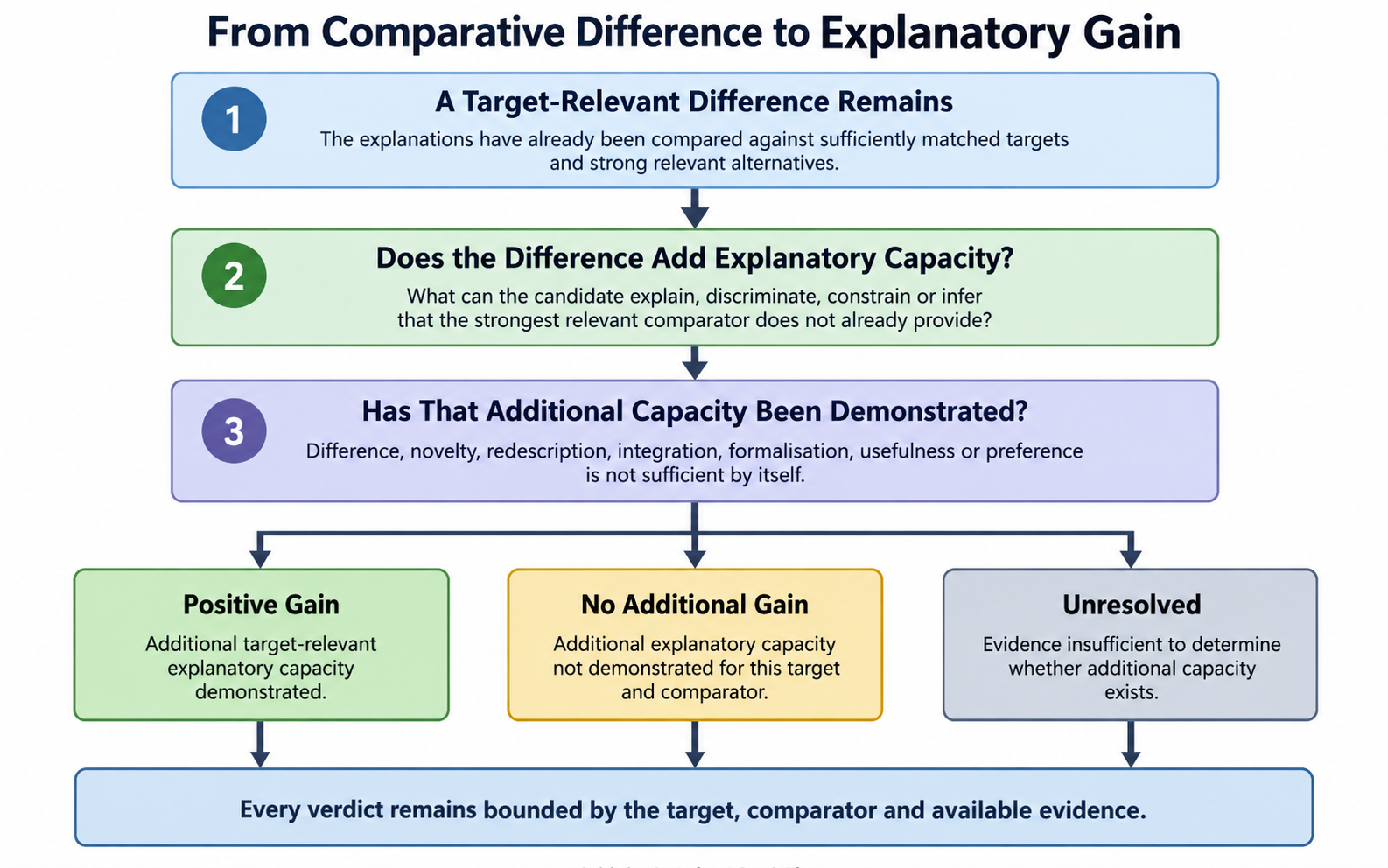
From Comparative Difference to Explanatory Gain. A target-relevant difference becomes evidence of explanatory gain only when additional explanatory capacity is demonstrated relative to a sufficiently strong comparator. Positive gain, no additional gain and unresolved assessment remain bounded outcomes rather than framework-wide rankings.
There Is More Than One Form of Explanatory Gain
There is no reason to expect all explanatory gain to take the same form. What counts as additional explanatory capacity depends on the target and on what the strongest comparator already supplies.
For one problem, gain may consist in identifying a mechanism. For another, it may consist in revealing a developmental route, specifying a mathematical constraint, discriminating between rival dependencies, explaining robustness, identifying a dynamical regime, or supporting a new target-relevant inference.
This plurality does not imply that anything useful counts as gain. It means that the form of gain must be matched to the explanatory question. A proposed mechanism cannot be credited merely because mechanisms are often valuable. A mathematical result cannot be credited merely because it is formally exact. A broader synthesis cannot be credited merely because it connects more phenomena.
The form of the contribution must be assessed against the explanatory capacity of the comparator.
Prediction Can Demonstrate Gain, but Prediction Is Not the Definition of Gain
New prediction can provide particularly strong evidence of explanatory gain when it is target-relevant and genuinely discriminates between candidate accounts. If one explanation supports a successful expectation that the strongest comparator does not support, the result may reveal additional explanatory structure.
But prediction is not the definition of explanatory gain.
Some explanations concern why a known pattern holds, how a system is organised, which constraints make a behaviour possible, or why a phenomenon is robust across perturbations. In such cases the relevant gain may be retrospective, mechanistic, structural, developmental or inferential rather than a novel forecast.
Prediction therefore has an evidential role rather than a privileged constitutive role. The question remains whether the candidate provides explanatory capacity not already supplied by the comparator.
Complementarity Can Contain Real Gain
Explanatory gain does not require that one explanation replace another. Complementary explanations can each contribute something that the other does not.
The evolution of pelvic reduction in threespine sticklebacks provides a useful example. Population and evolutionary evidence establishes the historical and selective context in which reduced pelvic structures evolved. Genetic and developmental work then identified recurrent changes involving regulation of Pitx1, including deletion of a pelvic-specific enhancer, thereby adding a route connecting regulatory change to the developmental production of the phenotype (Shapiro et al., 2004; Chan et al., 2010).
The developmental account does not make the evolutionary account redundant. Selection, population history and recurrence remain explanatory questions in their own right. Nor does the evolutionary account make the developmental route dispensable when the target concerns how pelvic reduction is generated through altered regulation.
The gain is therefore bounded and complementary. One account adds explanatory capacity relative to a specified question without licensing a conclusion that an entire framework has defeated or superseded another.
Complementarity can also be asymmetric. One explanation may add a substantial new dependency or route while the other contributes little to the target under examination. In other cases the additional contributions may run in both directions. What matters is not whether the accounts are labelled complementary, but whether each claimed contribution survives the residual-capacity test.
Integration Must Earn Its Gain
Integration is scientifically valuable. It can connect evidence from different domains, reveal common structure, reduce fragmentation, and make a research problem easier to investigate.
But integration is not automatically explanatory gain.
Suppose a framework places several established mechanisms, models or observations into one conceptual scheme. That may improve organisation and understanding. Yet if every target-relevant dependency, contrast and inference was already supplied by the strongest relevant explanations, the integration has not thereby demonstrated additional explanatory capacity.
Integration earns explanatory gain when the act of integration produces a new explanatory consequence—for example, by revealing a dependency that could not previously be seen, constraining possible mechanisms, discriminating between alternatives, or supporting a target-relevant inference unavailable to the comparator.
The distinction is important because scientific synthesis can be valuable even when no additional gain is demonstrated. Explanatory gain is one form of scientific achievement, not the only one.
Usefulness Is Not the Same as Explanatory Gain
Scientific ideas can be useful in many ways. They can organise research programmes, identify neglected variables, introduce productive distinctions, generate new experimental questions, provide tractable models, or improve communication across specialties.
Niche construction theory illustrates why usefulness and gain should be separated. Niche construction emphasises how organisms modify environmental conditions that in turn affect selection and development, and it has been scientifically productive as an organising perspective (Laland, Matthews, & Feldman, 2016). That usefulness, however, does not by itself establish that every niche-construction description adds explanatory capacity beyond the strongest relevant evolutionary, ecological or gene–culture account of a matched target.
The correct comparative question remains local. What does the niche-construction account add for this explanandum that the comparator does not already supply? Without a demonstrated residual contribution, scientific usefulness should not be converted into a positive gain verdict.
| Useful is not the same as explanatory gain |
| A concept, model or framework may organise research, integrate findings, expose new questions or improve representation without thereby demonstrating additional explanatory capacity relative to the strongest relevant explanation of the same target. Usefulness matters scientifically, but explanatory gain requires a further result: the candidate must enable something target-relevant to be explained, discriminated, constrained or inferred that the comparator does not already provide. |
Novelty and Formalisation Do Not Settle the Question
Novelty can be scientifically important, but newness is not a comparator. A recently proposed explanation may simply redescribe established work, while an old explanation may continue to supply explanatory capacity that newer accounts do not replace.
Formalisation raises a related issue. Mathematical precision can expose structure that verbal reasoning obscures, make assumptions explicit, generate quantitative predictions, or unify a range of phenomena. These are significant achievements. But formal scope alone does not establish comparative explanatory superiority.
Formal specification should also be distinguished from material implementation. A model may specify how an explanatory dependency could be organised without establishing that the corresponding dependency is instantiated in the biological system under investigation. Where biological explanatory gain is claimed, the evidential burden therefore extends beyond formal coherence or modelling success to evidence that the proposed dependency is materially realised and performs the claimed explanatory role.
The Free Energy Principle and active inference provide a useful example of the distinction. Active-inference models have been developed to connect perception, action, homeostatic regulation and adaptive control within a common formal framework (Pezzulo, Rigoli, & Friston, 2015). At the same time, questions remain about the scope of the Free Energy Principle and about what follows empirically from its formal architecture (Raja et al., 2021).
For PA-06 the appropriate conclusion is deliberately narrow. Formal integration and modelling success do not themselves establish that the framework provides greater explanatory capacity than the strongest relevant alternatives for a matched biological target. A positive comparative-gain verdict requires that the residual capacity itself be demonstrated.
No Additional Gain Is a Legitimate Result
A controlled comparison need not end with a positive verdict.
Sometimes the strongest relevant comparator already supplies the explanatory work at issue. The candidate may restate it, organise it differently, extend its vocabulary, or connect it to a broader programme without demonstrating an additional target-relevant consequence.
In that situation the appropriate conclusion is:
No additional gain has been demonstrated for this target relative to this comparator on the available evidence.
This is a local conclusion. It does not mean that the candidate explanation is false. It does not mean that the associated framework is useless. It does not mean that no gain could be demonstrated on another target, against another comparator, or with further evidence.
A legitimate null result protects comparative inquiry from a built-in preference for novelty. If every new proposal had to be credited with gain merely because it was scientifically interesting or differently organised, the assessment would cease to discriminate between genuine addition and conceptual redescription.
Unresolved Is Different from No Additional Gain
No additional gain and unresolved are not interchangeable.
A null-gain verdict says that the controlled comparison did not establish additional explanatory capacity. An unresolved verdict says that the available evidence is insufficient to determine whether such additional capacity exists.
The distinction matters whenever the comparator is strong but the candidate makes a plausible further claim that has not yet been adequately tested.
Mammalian glycaemia provides such a case. Organisational approaches have proposed that glucose regulation should be understood not only through local feedback loops but through the organisation of interacting regulatory constraints (Bich, Mossio, & Soto, 2020). That proposal can be scientifically meaningful without automatically establishing a positive comparative-gain result. The relevant question is whether the organisational framing yields a residual explanatory consequence—such as a dependency, discrimination or constraint—that the strongest physiological comparator does not already provide.
Where that residual consequence has not yet been demonstrated, the appropriate outcome is unresolved rather than a declaration that organisational explanation has no value.
The same restraint applies at theory level to the Free Energy Principle and active inference. Formal and modelling achievements may be substantial while the comparative empirical burden remains open (Pezzulo, Rigoli, & Friston, 2015; Raja et al., 2021). Lack of a demonstrated superiority claim is not equivalent to theoretical failure.
| Three outcomes of an explanatory-gain assessment |
| Positive gain — Additional target-relevant explanatory capacity has been demonstrated relative to the sufficiently strong comparator. |
| No additional gain — The comparison does not establish additional explanatory capacity for the specified target relative to the comparator. |
| Unresolved — The available evidence is insufficient to determine whether additional explanatory capacity exists. |
| These are bounded comparative outcomes, not scores or framework rankings. None by itself establishes the overall superiority or inferiority of a theory or framework. |
Explanatory Gain Is Bounded
Every gain verdict is bounded by the comparison that produced it.
At minimum, the conclusion should identify:
- the candidate explanation;
- the explanatory target;
- the comparator;
- the evidence used to assess the difference; and
- the respect in which additional capacity was or was not demonstrated.
A positive verdict therefore has the form: this account provides additional explanatory capacity for this target relative to this sufficiently strong comparator on this evidence.
That statement does not imply that the account is superior on every target. It does not imply that the comparator should be abandoned. It does not imply that all explanations associated with one framework are better than all explanations associated with another.
The same boundedness applies to null and unresolved outcomes. Failure to demonstrate gain on one target does not establish general equivalence or inferiority, while unresolved evidence does not become a permanent verdict about the framework as a whole.
This local character is essential if explanatory gain is to remain an evidential conclusion rather than a rhetorical label.
A Practical Test for Explanatory Gain
After fair comparison, the practical question is:
What does the candidate explanation enable us to explain, discriminate, constrain or infer that the strongest relevant comparator does not already enable us to do?
The wording is deliberately plural. Additional explanatory capacity may appear in different forms depending on the target.
A disciplined assessment should therefore ask whether the candidate provides a residual contribution that survives reconstruction of the strongest comparator. If the answer is yes and the contribution is supported by evidence, a bounded positive-gain verdict is warranted. If no additional capacity is established, the appropriate result is no additional gain. If the evidence cannot yet decide the matter, the result is unresolved.
The test does not replace specialist scientific judgment. It organises that judgment around the specific comparative burden that must be met before a difference is credited as gain.
What This Article Establishes
This article establishes that explanatory gain is:
- relational: it is assessed against a sufficiently strong relevant comparator;
- target-relative: it concerns a specified explanatory question rather than a theory in the abstract;
- evidence-dependent: additional capacity must be demonstrated rather than presumed;
- plural in form: gain may concern mechanism, development, constraint, dynamics, discrimination, robustness, prediction or other target-relevant explanatory capacities;
- compatible with complementarity: gain need not imply replacement;
- distinct from usefulness: scientific value may exist without demonstrated gain;
- distinct from novelty and formalisation: newness or mathematical sophistication does not settle the comparative question; and
- bounded in outcome: positive gain, no additional gain and unresolved assessment are all legitimate local conclusions.
The central requirement is residual explanatory capacity. A difference becomes gain only when something target-relevant remains that the strongest comparator does not already provide.
What This Article Does Not Establish
The account does not provide a universal numerical measure of explanatory quality. It does not require every explanatory gain to be mechanistic, predictive or formally expressible. It does not convert integration, unification, novelty, usefulness or formalisation into automatic evidence of superiority.
It also does not infer framework-wide victory from local explanatory success. A candidate may gain on one target while remaining complementary, weaker or simply different on another. No result established here determines in advance which contemporary biological framework is best.
The article therefore stops where the next question begins. Once explanatory gain has been defined and bounded, contemporary frameworks can be examined for the kinds of explanatory work they actually perform without assuming beforehand that one form of explanation must dominate the others.
Related Terms and Next Step
Related terms: Biological Explanation, Explanation, Explanandum and Explanatory Target.
Related articles: What Makes an Explanation Successful? and How Should Scientific Explanations Be Compared?.
For the APS research programme in which explanatory claims are investigated, compared, and reported with their evidential qualifications, see APS Research. The methodological criteria established here do not themselves demonstrate explanatory gain in any particular investigation.
The next article asks how contemporary biological frameworks actually explain, using the distinction between fair comparison and bounded explanatory gain without converting either into a pre-decided ranking.
See Also
Related Articles
References
- (2020). Glycemia Regulation: From Feedback Loops to Organizational Closure. Frontiers in Physiology, 11 . https://doi.org/10.3389/fphys.2020.00069
- (2010). Adaptive Evolution of Pelvic Reduction in Sticklebacks by Recurrent Deletion of a Pitx1 Enhancer. Science, 327(5963), 302–305 . https://doi.org/10.1126/science.1182213
- (2016). An Introduction to Niche Construction Theory. Evolutionary Ecology, 30, 191–202 . https://doi.org/10.1007/s10682-016-9821-z
- (2015). Active Inference, Homeostatic Regulation and Adaptive Behavioural Control. Progress in Neurobiology, 134, 17–35 . https://doi.org/10.1016/j.pneurobio.2015.09.001
- (2021). The Markov Blanket Trick: On the Scope of the Free Energy Principle and Active Inference. Physics of Life Reviews, 39, 49–72 . https://doi.org/10.1016/j.plrev.2021.09.001
- (2025). Explanation in Biology. Cambridge University Press. https://doi.org/10.1017/9781009300940
- (2004). Genetic and Developmental Basis of Evolutionary Pelvic Reduction in Threespine Sticklebacks. Nature, 428, 717–723 . https://doi.org/10.1038/nature02415