How Do Contemporary Biological Frameworks Explain?
Contemporary biology uses multiple explanatory approaches, including mechanistic, evolutionary, developmental, systems, organisational and formal frameworks. These approaches do not all address the same explanatory targets or carry the same explanatory burdens. This article reconstructs a representative landscape of contemporary biological explanation and shows why frameworks should be understood by what they explain and how they explain it before their relative merits are compared.
Where This Article Fits
The previous article established that explanatory gain is bounded, target-relative and comparator-relative. A difference between explanations does not by itself establish gain, and a local gain does not establish the overall superiority of a framework.
This article takes a different step. Before contemporary biological frameworks can be compared, we need to know how they actually explain: what kinds of questions they address, what explanatory resources they characteristically employ, and where their explanatory commitments overlap or differ.
The task here is therefore reconstructive rather than adjudicative. The article does not ask which framework is best. That question belongs to the next stage. Here the aim is to establish the explanatory landscape that makes controlled comparison possible.
Mechanistic explanation
Mechanistic explanation asks how organised entities and activities produce, sustain or regulate a phenomenon. Rather than treating a mechanism simply as a linear chain of causes, contemporary mechanistic explanation can accommodate feedback, cyclic organisation, stochastic processes and dynamically organised interactions (Machamer, Darden, & Craver, 2000; Ross, 2025).
The characteristic explanatory burden is to identify the organised causal production relevant to the explanandum. Depending on the target, this may involve components, activities, spatial organisation, temporal organisation and the relations through which their operation generates or maintains the phenomenon.
Mechanistic detail is therefore not valuable simply because it is more detailed. The appropriate degree of decomposition depends on what is being explained. A biological question concerning historical change, population dynamics, developmental organisation or system-level dynamics may require explanatory resources that are not supplied merely by adding finer component detail.
Mechanistic explanation is consequently one important form of biological explanation rather than a universal template to which every biological explanation must conform.
Evolutionary explanation
Evolutionary explanation characteristically addresses change in populations and lineages through time. Selection, drift, mutation, migration, inheritance, recombination, population structure and phylogenetic history can all enter evolutionary explanations depending on the explanandum (Ross, 2025).
Such explanations can answer questions about adaptation, diversification, trait-frequency change, common ancestry and historical transformation. Their explanatory resources therefore include both population processes and historical relations.
An evolutionary explanation need not answer every question about how a trait is developmentally produced or physiologically maintained. Conversely, identifying a developmental or physiological mechanism does not by itself explain the population and historical processes through which a trait changed.
The distinction is not a division into isolated explanatory domains. It shows instead that different explanatory questions can be directed toward the same biological phenomenon.
Evolutionary developmental biology
Evolutionary developmental biology brings developmental organisation into the explanation of evolutionary change. It examines how developmental mechanisms, regulatory relations, genotype–phenotype mappings, plasticity, developmental bias and constraint participate in the production and transformation of phenotypic variation (Gilbert, 2000; Love, 2014).
Its explanatory relevance depends on the question being asked. When the explanandum concerns how a phenotype is generated, how developmental organisation structures possible variation, or how developmental processes contribute to evolutionary change, developmental evidence may supply explanatory resources not captured by a population-level description alone.
This does not require developmental explanation to replace evolutionary explanation. Population history, selection and developmental production can address distinguishable aspects of a common biological problem.
Evolutionary developmental biology therefore illustrates a recurring feature of the contemporary landscape: explanatory approaches may intersect without becoming interchangeable.
Niche construction
Niche construction focuses attention on the ways organisms modify environmental conditions and thereby alter circumstances relevant to their own lives and those of other organisms. These modifications can persist and contribute to ecological inheritance, creating feedback between organismal activity, environmental change and evolutionary processes (Laland, Matthews, & Feldman, 2016).
As an explanatory approach, niche construction can foreground dependencies that become less visible when environments are treated only as externally given selective conditions. Its characteristic contribution lies in making organism–environment modification and inherited environmental effects explicit within the explanatory target.
That does not establish in advance that every niche-construction account adds explanatory capacity beyond contemporary evolutionary or ecological explanations. Whether it does so is a comparative question requiring a specified explanandum and sufficiently strong comparator.
For present purposes the important point is descriptive: niche construction organises some evolutionary explanations around reciprocal organism–environment relations and ecological inheritance.
The Extended Evolutionary Synthesis
The Extended Evolutionary Synthesis brings together a set of proposals emphasising processes and explanatory resources including developmental bias, phenotypic plasticity, niche construction, inclusive inheritance and reciprocal causation (Laland et al., 2015).
These proposals do not constitute an entirely separate biology. Many of the processes they emphasise can also be studied within established evolutionary, developmental and ecological research. The relevant explanatory question is therefore not settled by attaching a synthesis-level label to them.
The Extended Evolutionary Synthesis is useful here because it illustrates the difference between identifying scientifically important processes and establishing the explanatory distinctiveness of an encompassing framework.
Component-level importance does not automatically establish synthesis-level explanatory gain. That stronger conclusion would require controlled comparison and therefore lies beyond the task of this article.
Systems biology
Systems biology encompasses a heterogeneous family of mathematical, computational, network, dynamical and mechanistically informed approaches to biological organisation. It is especially concerned with cases in which interactions among multiple components generate behaviours that cannot be understood adequately by considering those components independently (Kitano, 2002, 2004).
Depending on the target, systems approaches may investigate network architecture, dynamical regimes, robustness, feedback, synchronisation, control or responses to perturbation. Mathematical and computational representations can make relationships among these features explicit and permit consequences of a model to be explored.
A network representation by itself, however, is not automatically an explanation. The explanatory contribution depends on what the representation establishes about the phenomenon and how its variables and relations connect to the biological system under investigation.
Systems biology therefore often intersects with mechanistic explanation rather than simply competing with it. A mechanistic account may identify organised causal components while a systems model characterises dynamical properties of their interaction. Whether either adds something beyond the other depends on the target.
Organisational autonomy
Organisational-autonomy approaches characteristically explain living systems through the organisation that enables them to maintain themselves. Their explanatory resources include self-maintenance, constraints, closure of constraints, biological function, regulation and the relations through which organised activity contributes to continuing biological organisation (Moreno & Mossio, 2015).
This shifts explanatory attention from isolated component activities toward dependencies among processes and constraints involved in biological self-maintenance. Work on regulation, for example, has investigated how organisational relations can be brought to bear on concrete physiological problems such as glycaemic control (Bich, Mossio, & Soto, 2020).
The explanatory burden remains empirical as well as conceptual. Identifying an organisational vocabulary does not by itself demonstrate that an organisational account explains something unavailable to a sufficiently strong mechanistic or physiological comparator.
Organisational autonomy is therefore best reconstructed by specifying the organisational dependencies it claims are explanatorily relevant, rather than by assuming either its superiority or its reducibility to another framework.
Free Energy Principle and active inference
The Free Energy Principle provides a formal framework in which adaptive systems are described using variational free energy, generative models and relations among internal, external and boundary states. Active inference develops related process models of perception and action in which organisms act and update in relation to generative models and expected states (Pezzulo, Rigoli, & Friston, 2015).
These approaches bring distinctive formal resources to questions concerning adaptive dynamics, perception, action, regulation and control. Formalisation can expose assumptions, specify mathematical dependencies and generate models whose consequences can be investigated.
Formal scope and biological explanatory scope are nevertheless different matters. Critical analysis of Markov-blanket formulations and broad interpretations of the Free Energy Principle illustrates the need to distinguish mathematical results from stronger biological explanatory claims (Raja et al., 2021).
The appropriate reconstruction therefore asks what a particular Free Energy Principle or active-inference model explains for a specified biological target. Formal sophistication alone does not determine its comparative explanatory standing.
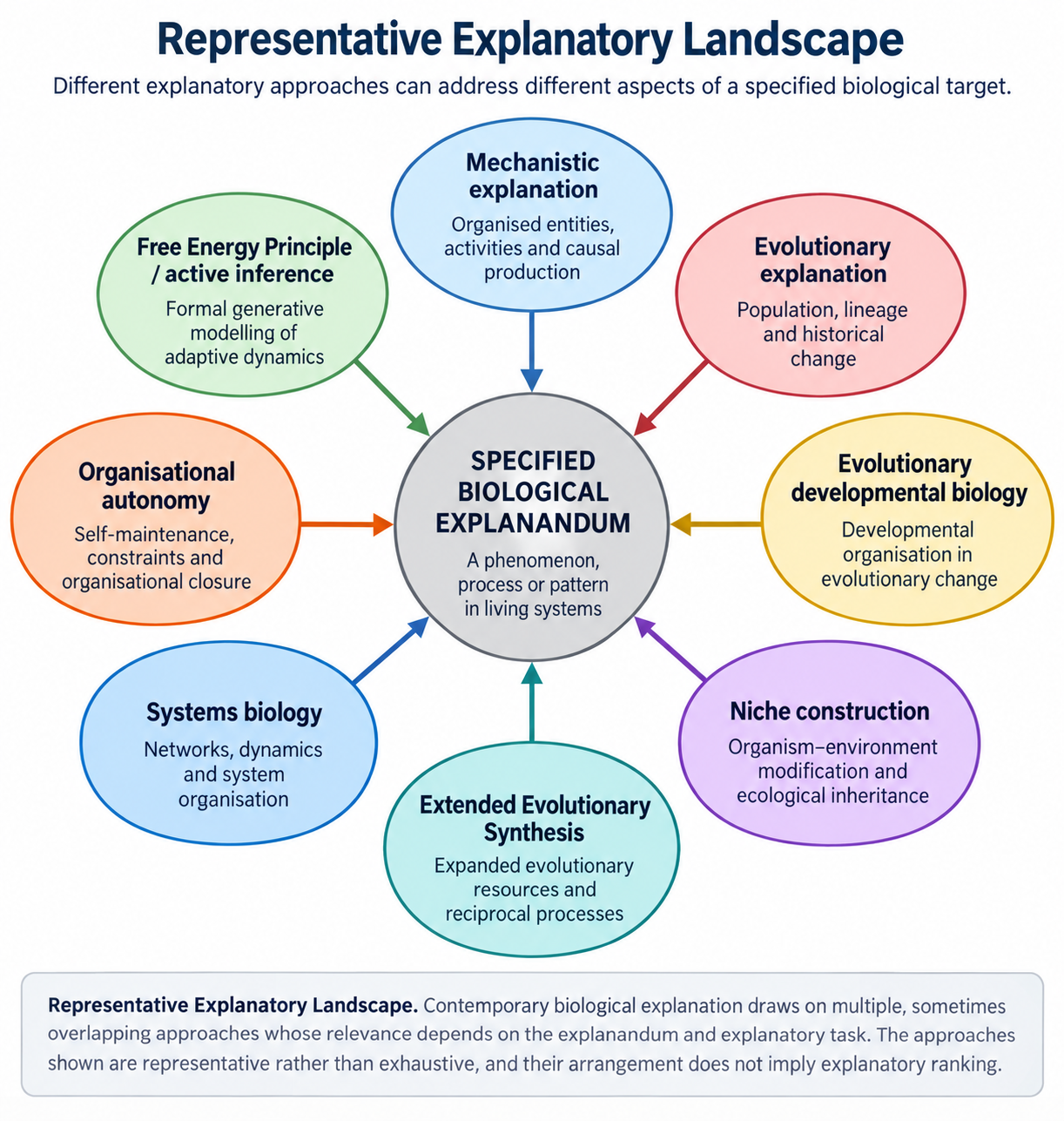
Representative Explanatory Landscape. Contemporary biological explanation draws on multiple, sometimes overlapping approaches whose relevance depends on the explanandum and explanatory task. The approaches shown are representative rather than exhaustive, and their arrangement does not imply explanatory ranking.
A landscape, not a league table
Taken together, these approaches form an explanatory landscape rather than a league table.
Their differences do not place them automatically on a common scale. A mechanistic explanation of causal production, an evolutionary explanation of lineage change, a developmental explanation of phenotypic generation and a dynamical model of system behaviour may be addressing distinguishable questions even when they concern the same biological phenomenon.
Plurality therefore does not imply either equivalence or relativism. Some explanations are better supported than others, and competing accounts can sometimes be compared directly. But comparison becomes meaningful only after the explanatory target and the actual commitments of the candidate accounts have been specified.
The existence of multiple frameworks is consequently not evidence that biology lacks explanatory discipline. It reflects, in part, the diversity of questions that biological phenomena permit us to ask.
A framework is not a discipline
A scientific discipline and an explanatory framework are not the same thing.
Evolutionary biology, developmental biology, physiology and neuroscience can each contain several explanatory approaches. Conversely, mechanistic, systems or formal approaches may be used across several biological disciplines.
Framework labels should therefore not substitute for reconstruction of the explanation itself.
Saying that an explanation is “mechanistic,†“systems,†“evolutionary†or “organisational†provides useful orientation, but it does not yet tell us precisely what the explanandum is, which dependencies are being claimed, what evidence supports them, or what explanatory burden the account carries.
The unit that ultimately matters for assessment is the explanatory claim directed toward a specified target, not the framework label considered in isolation.
Frameworks can overlap without being the same
Contemporary explanatory approaches frequently share evidence, concepts, models and methods.
Mechanistic explanations can incorporate feedback and dynamics. Systems models can be mechanistically anchored. Evolutionary developmental explanations combine developmental and evolutionary resources. Niche-construction analyses can be represented within population and ecological models. Organisational accounts can depend on detailed physiological mechanisms. Active-inference models can address processes also investigated through control theory, neuroscience and physiology.
Such overlap does not make the frameworks identical.
What matters is the explanatory work assigned to the shared resource. Two accounts may use the same experimental result while drawing different explanatory consequences from it. Conversely, apparently different vocabularies may sometimes identify dependencies already represented by another account.
Framework boundaries are therefore less informative than the explanatory commitments that become visible when a specific target is reconstructed.
Explanatory vocabularies are not automatically separate frameworks
Biology also contains recurring explanatory vocabularies that cut across framework boundaries.
Terms such as function, information, control, regulation, constraint, ecology and teleology can be important to biological explanation without each defining an independent peer framework.
A vocabulary becomes explanatorily significant through the work it performs in a particular account. “Information,†for example, may refer to sequence relations, signalling, representation or statistical dependence in different contexts. “Control†may identify physiological regulation, engineering-style feedback, dynamical intervention or organisational constraint.
Treating every recurring vocabulary as a separate framework would therefore multiply framework labels without necessarily clarifying explanatory structure.
The relevant question is not whether a distinctive term appears, but what explanatory commitment the term carries in the account being examined.
Reconstruct before comparing
The central methodological lesson of this landscape is straightforward:
Reconstruct the explanation before comparing the framework.
For a specified biological explanandum, this means asking:
- What exactly is being explained?
- Which entities, processes, histories, relations, constraints or formal dependencies are claimed to matter?
- What explanatory question is the account answering?
- What evidence supports those claims?
- Which part of the explanatory burden is carried by the framework-specific resources?
- Which explanatory work is already supplied by other established accounts?
Only after those questions have been answered does comparison become controlled.
This prevents framework labels from doing evidential work they have not earned. It also allows genuine differences to become clearer. Two frameworks may turn out to address different targets, to overlap substantially, to provide complementary explanatory resources, or to make genuinely competing claims.
Those possibilities cannot be determined from framework identity alone.
What this article establishes
This article establishes a representative, target-sensitive landscape of contemporary biological explanation.
Mechanistic explanation characteristically concerns organised causal production. Evolutionary explanation addresses population and historical change. Evolutionary developmental biology brings developmental organisation into evolutionary explanation. Niche construction foregrounds organism–environment modification and ecological inheritance. The Extended Evolutionary Synthesis assembles an expanded set of evolutionary processes and explanatory emphases. Systems biology investigates networks, dynamics and system organisation. Organisational autonomy focuses on self-maintenance, constraints and organisational closure. The Free Energy Principle and active inference bring formal generative modelling to adaptive dynamics.
These characterisations do not make the approaches mutually exclusive. Frameworks can share evidence, concepts and methods while assigning them different explanatory roles.
The more general conclusion is methodological: framework identity alone does not determine explanatory content. Explanatory targets, commitments, resources and evidential burdens must be reconstructed before frameworks can be compared.
What this article does not establish
This article does not provide an exhaustive census of contemporary biological explanation.
It does not establish that the approaches represented here are equally strong, equally mature, equally well supported or equally useful. Nor does it establish that they form eight completely independent or internally homogeneous frameworks.
Most importantly, the article does not rank them.
Difference in explanatory target, vocabulary, formalism, scope or organisation does not by itself establish explanatory gain or superiority. Those conclusions require controlled comparison under the criteria established in the preceding methodology articles.
The question of relative explanatory standing therefore remains open at this stage.
Related terms and next step
Relevant glossary entries include Biological Explanation, Explanation, Explanandum and Explanatory Target.
The preceding article, What Counts as Explanatory Gain?, established what must be shown before a controlled explanatory difference can count as bounded gain.
The next methodological question is Which Explanatory Framework Is Best? That question requires comparative adjudication rather than further landscape reconstruction and is therefore reserved for the next article.
See Also
Related Articles
References
- (2020). Glycemia Regulation: From Feedback Loops to Organizational Closure. Frontiers in Physiology, 11 . https://doi.org/10.3389/fphys.2020.00069
- (2000). Diachronic Biology Meets Evo-Devo: C. H. Waddington's Approach to Evolutionary Developmental Biology. American Zoologist, 40(5), 729–737 . https://doi.org/10.1093/icb/40.5.729
- (2002). Computational Systems Biology. Nature, 420(6912), 206–210 . https://doi.org/10.1038/nature01254
- (2004). Biological Robustness. Nature Reviews Genetics, 5(11), 826–837 . https://doi.org/10.1038/nrg1471
- (2016). An Introduction to Niche Construction Theory. Evolutionary Ecology, 30, 191–202 . https://doi.org/10.1007/s10682-016-9821-z
- (2015). The Extended Evolutionary Synthesis: Its Structure, Assumptions and Predictions. Proceedings of the Royal Society B, 282(1813) . https://doi.org/10.1098/rspb.2015.1019
- (2014). The Erotetic Organization of Developmental Biology. Oxford University Press. https://doi.org/10.1093/acprof:oso/9780199671427.003.0003
- (2000). Thinking About Mechanisms. Philosophy of Science, 67(1), 1–25 . https://doi.org/10.1086/392759
- (2015). Biological Autonomy: A Philosophical and Theoretical Enquiry. Springer. https://doi.org/10.1007/978-94-017-9837-2
- (2015). Active Inference, Homeostatic Regulation and Adaptive Behavioural Control. Progress in Neurobiology, 134, 17–35 . https://doi.org/10.1016/j.pneurobio.2015.09.001
- (2021). The Markov Blanket Trick: On the Scope of the Free Energy Principle and Active Inference. Physics of Life Reviews, 39, 49–72 . https://doi.org/10.1016/j.plrev.2021.09.001
- (2025). Explanation in Biology. Cambridge University Press. https://doi.org/10.1017/9781009300940