Which Explanatory Framework Is Best?
Biological explanatory frameworks cannot be ranked globally without first specifying what is being explained and what the relevant alternatives are. This article shows how controlled, target-relative comparison can support bounded explanatory gain, complementarity, no additional gain, unresolved assessment or non-comparability without turning local results into a universal league table.
Key Points
- Frameworks should be compared for specified explanatory targets, not ranked globally.
- A local explanatory advantage does not establish framework-wide superiority.
- Explanatory difference, usefulness, integration or formal sophistication does not by itself establish explanatory gain.
- Controlled comparison can support bounded positive gain, complementarity, no additional gain, unresolved assessment or non-comparability.
- The strongest relevant comparator must receive full explanatory credit before additional explanatory capacity is claimed.
Where This Article Fits
The preceding article, How Do Contemporary Biological Frameworks Explain?, reconstructed representative explanatory frameworks by asking what they explain, what resources they use and what explanatory burdens they carry. It deliberately did not rank them.
Before that, What Counts as Explanatory Gain? established a stricter criterion: explanatory gain is a bounded, target-relative and comparator-relative conclusion requiring evidence of additional explanatory capacity relative to a sufficiently strong alternative.
This article brings those two results together.
Its question is not which framework is best in biology as a whole. It asks what comparative judgement is warranted when sufficiently matched explanatory accounts are placed under controlled comparison.
The result remains local to the explanandum, comparator and evidence.
The next article will turn the completed methodological sequence into a practical guide for constructing and assessing biological explanations. That practical procedure is not attempted here.
Introduction
Asked globally, “Which explanatory framework is best?†is usually an ill-posed question.
Biology does not present a single explanatory task, and an explanatory framework is not itself a single explanation. Mechanistic, evolutionary, developmental, systems, organisational and formal approaches can address different questions, employ different explanatory resources and carry different evidential burdens.
That does not make comparison impossible. It changes what a legitimate comparison must establish.
For a specified explanandum, against a sufficiently strong relevant comparator, it can be reasonable to ask whether one account explains something the other does not, whether each supplies a non-redundant contribution, whether no additional explanatory gain is demonstrated, or whether the available evidence leaves the comparison unresolved.
The appropriate outcome is therefore not always victory. It may be bounded positive gain, complementarity, no additional gain, unresolved assessment or, where the explanatory targets are insufficiently matched, non-comparability.
Why Global Rankings Mislead
A global ranking would require frameworks with heterogeneous explanatory aims, domains, evidential bases and forms of representation to be placed on a common scale.
The preceding analysis gives us no warrant for doing that.
Mechanistic explanation can be especially informative where the explanandum concerns organised causal production. Evolutionary explanation can address population and historical change. Systems approaches can characterise dynamical and robustness properties. Evolutionary developmental biology can make developmental routes and constraints explanatorily explicit. Organisational and formal approaches can foreground still other dependencies.
These are not fixed jurisdictions, and the approaches can overlap.
Their characteristic explanatory resources therefore cannot be converted directly into a framework-wide ranking.
This does not imply that every framework is equally strong. It means that claims of strength must identify the target, comparator and evidential burden to which they apply.
A framework can perform better on one explanatory task without thereby becoming the best framework overall (Ross 2025).
What a Comparative Verdict Must Establish
A controlled framework comparison begins only after the candidate accounts have been reconstructed in their strongest relevant forms.
The comparison must establish what the specified explanandum is, whether the candidate accounts genuinely address that explanandum or sufficiently linked aspects of it, what explanatory work each account performs, and what evidence supports that work.
It must then ask whether one account contributes something not already supplied by the strongest relevant comparator.
If both contribute, the question becomes whether those contributions are genuinely non-redundant.
And if a difference is identified, the final question remains whether that difference amounts to explanatory gain rather than merely a different vocabulary, representation, emphasis, formalisation or way of organising the problem.
These controls allow comparative adjudication without assuming that all biological explanation belongs on a single scale.
|
No League Table A local explanatory success does not rank a framework globally. Framework breadth, maturity, popularity, formal sophistication and explanatory gain are different properties. |
Bounded Asymmetric Gain
One possible comparative result is bounded positive gain in which one account contributes explanatory capacity that the strongest relevant comparator does not supply.
The evolution of pelvic reduction in threespine sticklebacks provides a useful illustration.
Shapiro and colleagues identified the genetic and developmental basis associated with repeated pelvic reduction in natural stickleback populations (Shapiro et al. 2004). Subsequent work by Chan and colleagues identified recurrent deletion of a tissue-specific enhancer of Pitx1, connecting repeated evolutionary change to a particular regulatory route (Chan et al. 2010).
The developmental-genetic account contributes explanatory detail concerning how pelvic reduction is produced. Evolutionary and population-level explanation remains necessary for understanding selection, recurrence and historical change.
The appropriate conclusion is therefore bounded.
The developmental-genetic account contributes something additional to the specified explanatory problem without displacing the evolutionary account or establishing the general superiority of evolutionary developmental biology.
Local explanatory gain is not framework-wide victory.
Bounded Contribution Without Exclusive Ownership
Niche construction provides a different comparative problem.
Organisms modify environments, and those modifications can alter the conditions under which selection subsequently operates. Human dairying and lactase persistence provide a familiar illustration of this reciprocal organism–environment relationship (Laland, Matthews, and Feldman 2016).
Making such feedback explicit can reorganise an explanatory problem in scientifically useful ways.
But usefulness, emphasis and integration are not automatically explanatory gain.
Contemporary evolutionary explanation is not restricted to environments that remain unchanged by organisms. The relevant comparative question is therefore not whether niche construction occurs, but whether a niche-construction account supplies target-relevant explanatory capacity beyond what the strongest relevant evolutionary comparator already provides.
The controlled source base does not establish a positive gain verdict for this comparison.
The case instead illustrates why a useful conceptual emphasis must not be converted automatically into a claim of explanatory superiority.
Unresolved Means Unresolved
Controlled comparison must allow the evidence to remain insufficient.
This is not an embarrassment. It is one of the results a serious comparative methodology must be capable of returning.
Mammalian glycaemia provides one example.
Organisational approaches describe glycaemic regulation in terms extending beyond isolated feedback loops toward relations among regulation, function and organisational closure (Bich, Mossio, and Soto 2020).
Those relations may be scientifically significant. But a richer organisational description does not by itself demonstrate residual explanatory capacity relative to the strongest physiological or regulatory comparator.
The bounded comparative verdict is therefore unresolved.
That conclusion does not establish that organisational explanation lacks explanatory gain. It establishes only that the controlled comparison does not yet warrant the stronger positive conclusion.
The Free Energy Principle and active inference raise a differently structured version of the same methodological problem.
Active-inference approaches provide formal accounts connecting homeostatic regulation, adaptive behaviour and prediction (Pezzulo, Rigoli, and Friston 2015). Their scope and interpretation have also generated substantial debate about what the formalism establishes and how broadly its explanatory claims should extend (Raja et al. 2021).
Formal sophistication, mathematical coherence and modelling usefulness can all be scientifically important.
None alone establishes comparative explanatory superiority.
Where the residual explanatory contribution relative to the strongest alternative has not been demonstrated, the appropriate verdict remains unresolved rather than positive or negative by default.
No Additional Gain Can Coexist With Important Science
A no-additional-gain verdict is also legitimate.
It means that, for the specified explanandum and comparator, the comparison has not established additional explanatory capacity.
It does not mean that the candidate framework is false.
It does not mean that its models, concepts, experiments or associated discoveries are scientifically unimportant.
And it does not establish global inferiority.
This distinction matters because biological frameworks often draw attention to processes that are unquestionably real and scientifically significant. The existence or importance of those processes does not by itself establish that a framework-level explanation adds something beyond what the strongest relevant comparator already explains.
A controlled comparison must therefore be able to conclude that no additional explanatory gain has been demonstrated without turning that local result into a rejection of the science associated with the candidate account.
The present cases do not need to manufacture a biological example merely to populate this category.
The legitimacy of the verdict follows from the comparative method itself.
Non-Comparability Is Also a Result
Not every pair of explanatory accounts should be forced into direct competition.
Two accounts may address different explananda, different contrasts, different explanatory questions or different aspects of a biological phenomenon.
Where the targets are insufficiently matched, asking which account is better can manufacture a competition that the explanatory situation does not contain.
In such cases, non-comparability is not a failure of analysis.
It records that the conditions required for controlled adjudication have not been met.
This prevents explanatory plurality from being converted artificially into explanatory rivalry.
Controlled Outcomes of Framework Comparison
Once the explanandum has been specified, the strongest relevant comparator reconstructed and the explanatory contributions compared under common controls, several bounded outcomes become possible.
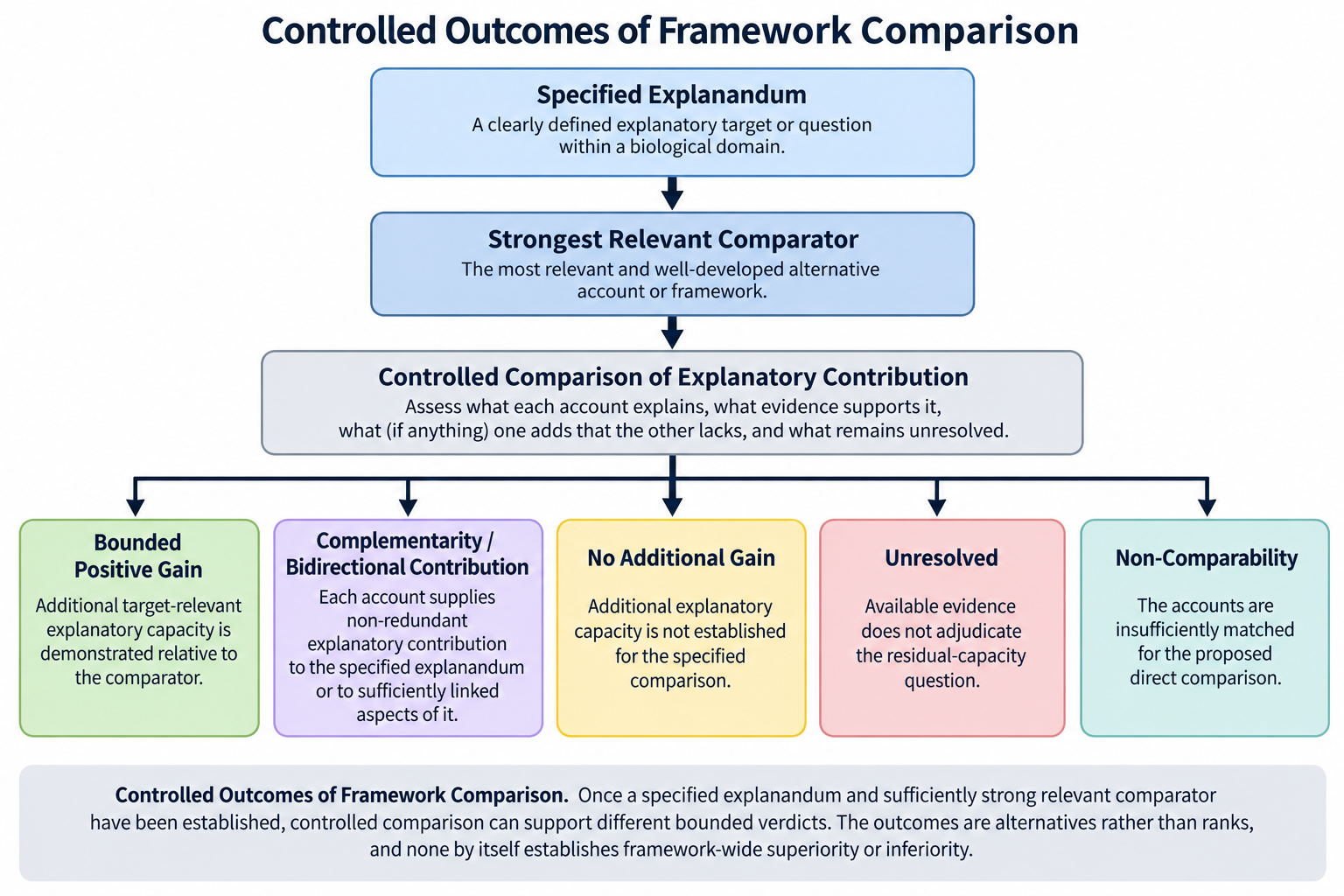
Controlled Outcomes of Framework Comparison. Once a specified explanandum and sufficiently strong relevant comparator have been established, controlled comparison can support different bounded verdicts. The outcomes are alternatives rather than ranks, and none by itself establishes framework-wide superiority or inferiority.
The diagram is an outcome map, not a ranking scale.
The procedural sequence has an order because a legitimate comparison requires a specified target, a sufficiently strong comparator and controlled assessment. The resulting verdicts do not form a progression from weaker to stronger frameworks.
Nor does the diagram imply that each outcome must be represented by one of the biological cases discussed here.
It specifies the legitimate comparative outcome space.
A Better Comparative Question
Instead of asking:
Which explanatory framework is best?
ask:
For this explanandum, against this strongest relevant comparator, what does each account explain, what evidence supports it, what does either account add that the other lacks, and what remains unresolved?
That formulation permits genuine comparative judgement without requiring a universal winner.
It also preserves a crucial distinction:
local explanatory success does not establish global framework priority.
Breadth, maturity, popularity, conceptual richness, formal sophistication and explanatory gain are different properties.
None should substitute for the others.
|
Complementarity Is Not Compromise Two explanatory accounts are complementary only when each makes a non-redundant contribution to the specified explanandum or to sufficiently linked aspects of it. Compatibility, coexistence or usefulness alone is not enough. |
Complementarity Is Not Compromise
Complementarity is sometimes invoked too easily.
Two accounts do not become complementary merely because they can coexist, use different vocabularies or appear useful for different purposes.
A substantive complementarity verdict carries an evidential burden.
Each account must contribute explanatory capacity relevant to the specified explanandum, or to sufficiently linked aspects of it, that the other does not supply.
Where that condition is demonstrated in both directions, the appropriate comparative result may be complementarity or bidirectional contribution.
That is not a diplomatic refusal to choose a winner.
It is an evidence-based comparative conclusion.
But complementarity must be earned in the same way as any other claim of explanatory contribution. It should never become the automatic outcome whenever frameworks differ.
What This Article Establishes
Contemporary biological frameworks can be compared, but only under controlled conditions.
The explanandum must be specified. Candidate accounts must be reconstructed in sufficiently strong forms. The relevant comparator must receive full explanatory credit. Differences must then be tested for residual explanatory capacity rather than assumed to constitute gain.
Under those conditions, comparative adjudication can support different bounded outcomes: positive explanatory gain, substantive complementarity or bidirectional contribution, no additional gain, unresolved assessment, or non-comparability.
These outcomes are not positions on a universal scale.
A local comparative advantage remains local to the explanatory target, comparator and evidence that establish it.
What This Article Does Not Establish
This article does not establish a universal ranking of contemporary biological frameworks.
It does not claim that all frameworks are equally strong, nor that explanatory plurality makes comparative judgement impossible.
It does not infer explanatory gain from novelty, breadth, popularity, maturity, integration, conceptual richness, formal sophistication or usefulness.
It does not establish an empirical circadian-clock verdict of bidirectional gain.
It does not establish positive explanatory gain for niche construction from the lactase-persistence discussion.
It does not resolve the organisational comparison concerning mammalian glycaemia or the comparative explanatory status of the Free Energy Principle and active inference.
And it does not require every legitimate comparative outcome to be represented by one biological example.
The bounded conclusion is methodological: frameworks can be adjudicated where sufficiently matched explanatory claims exist, but the resulting verdict must remain proportionate to the target, comparator and evidence.
Related Terms and Next Step
Relevant glossary terms include Biological Explanation, Explanation, Explanandum and Explanatory Target.
The immediate methodological predecessors are What Counts as Explanatory Gain? and How Do Contemporary Biological Frameworks Explain?.
The next article turns the completed methodology into a practical guide for constructing and assessing scientific explanations.
See Also
Related Articles
References
- (2020). Glycemia Regulation: From Feedback Loops to Organizational Closure. Frontiers in Physiology, 11 . https://doi.org/10.3389/fphys.2020.00069
- (2010). Adaptive Evolution of Pelvic Reduction in Sticklebacks by Recurrent Deletion of a Pitx1 Enhancer. Science, 327(5963), 302–305 . https://doi.org/10.1126/science.1182213
- (2016). An Introduction to Niche Construction Theory. Evolutionary Ecology, 30, 191–202 . https://doi.org/10.1007/s10682-016-9821-z
- (2015). Active Inference, Homeostatic Regulation and Adaptive Behavioural Control. Progress in Neurobiology, 134, 17–35 . https://doi.org/10.1016/j.pneurobio.2015.09.001
- (2021). The Markov Blanket Trick: On the Scope of the Free Energy Principle and Active Inference. Physics of Life Reviews, 39, 49–72 . https://doi.org/10.1016/j.plrev.2021.09.001
- (2025). Explanation in Biology. Cambridge University Press. https://doi.org/10.1017/9781009300940
- (2004). Genetic and Developmental Basis of Evolutionary Pelvic Reduction in Threespine Sticklebacks. Nature, 428, 717–723 . https://doi.org/10.1038/nature02415