A Practical Guide to Building Better Scientific Explanations
Scientific explanations are easier to assess when their explananda, explanatory claims, explanatory resources, evidence, strongest relevant alternatives, claimed additional contributions and warranted scope remain explicitly aligned. This article converts the preceding Methodology and Explanation sequence into a practical, non-algorithmic guide for constructing and assessing explanations while permitting bounded positive, null, unresolved and non-comparable outcomes.
Key Points
- A scientific explanation should begin from a specified explanandum rather than a preferred explanatory framework.
- Explanatory claims must remain aligned with the explanatory resources and evidence that actually support them.
- Serious comparison requires reconstruction of the strongest relevant comparator rather than a weak rival.
- Claims of explanatory advance require demonstrated additional explanatory capacity, not merely novelty, integration, formal sophistication or usefulness.
- A rigorous assessment may legitimately end in bounded gain, complementarity, no additional gain, unresolved status or non-comparability.
Where This Article Fits
Earlier articles in this sequence established the conditions under which scientific explanations can be assessed and compared. They distinguished explanatory success from scientific usefulness, examined characteristic forms of explanatory overclaim, established fair-comparison requirements, defined explanatory gain relative to a sufficiently strong comparator, reconstructed how contemporary biological frameworks explain, and showed why framework comparison must remain bounded and target-sensitive.
This article does something different. It operationalises those controls as a reader-usable method for working with an individual explanatory claim.
It does not introduce a new theory of scientific explanation. It does not replace the earlier comparative methodology, redefine explanatory gain or require one preferred explanatory form. Nor does it test the scientific standing of a whole framework. That framework task belongs to the next article.
Introduction
Scientific explanations are not improved simply by adding detail, expanding vocabulary, increasing formal sophistication or placing more phenomena under one conceptual umbrella. Improvement depends on whether an explanation is clear about what it is explaining, what explanatory contribution it claims, what resources do the explanatory work, what evidence supports that contribution, what alternatives remain relevant, and how far the resulting conclusion is warranted.
This article turns the preceding Methodology and Explanation sequence into a practical guide. It is intended for constructing explanations, assessing them, and identifying where a claim should be revised, narrowed or left unresolved.
Better Explanation Requires Alignment
A scientific explanation is easier to assess when its principal commitments remain aligned.
The explanandum identifies what is to be explained. The explanatory claim states what kind of contribution is being offered. The explanatory resources identify what is supposed to do the explanatory work. The evidence must support that claimed relation rather than merely confirm that the phenomenon exists. Where comparison is warranted, the relevant alternative must be reconstructed strongly enough to receive full explanatory credit. Any claim of additional explanatory capacity must then be judged relative to that comparator, and the resulting conclusion must remain within the scope actually supported.
This is particularly important in biology, where explanatory work may involve mechanisms, histories, dependencies, models, constraints, developmental routes, organisational relations or combinations of these. Contemporary biology therefore rewards clarity about explanatory targets and resources rather than assuming that one explanatory form is sufficient for every question (Ross, 2025).
Three Kinds of Explanatory Improvement
Scientific explanations can be improved in at least three distinct ways:
-
Explanatory improvement — An account establishes an additional, adequately warranted explanatory dependency or capacity relative to the strongest relevant alternative.
-
Organisational or integrative improvement — Existing explanatory relationships are made more explicit, better distinguished, or more coherently connected, without necessarily adding a biological explanation.
-
Communicative improvement — An explanation becomes easier for its intended audience to understand, remember, or use correctly. Claims of improved reader understanding require appropriate evidence.
These improvements are valuable but not interchangeable. Greater integration or clarity does not by itself establish explanatory gain, and a scientifically stronger explanation is not necessarily easier to communicate. What counts as improvement depends on the explanatory question, the achievement being claimed, and the evidence supporting it. There is no single measure of the “best” explanation independently of these considerations.
Specify the Explanandum
Begin by stating what is to be explained.
That sounds elementary, but many explanatory disagreements become confused because the phenomenon, contrast, domain or grain shifts while the discussion continues. A claim about why a trait evolved is not automatically the same explanatory task as a claim about how the trait develops. A model may explain variation within one regime without explaining why that regime exists. A mechanism may account for a local dependency without answering a historical question about its origin.
A useful specification asks:
- What phenomenon, outcome, dependency, pattern or contrast requires explanation?
- In what population, system, domain or regime?
- At what spatial or temporal grain?
- What kind of explanatory question is being asked?
The target need not remain immutable. Scientific inquiry may legitimately revise its explanandum as evidence accumulates. The requirement is that the change be explicit. If the target changes, the explanatory claim must be reassessed against the revised target rather than treated as though the original question had remained unchanged.
State the Explanatory Claim
Next ask what the proposed account is claiming to achieve.
Scientific achievements are related but not interchangeable. Description can be accurate without explaining why a pattern occurs. Prediction can succeed without identifying the dependency responsible for the predicted outcome. A model can fit observations without establishing that its internal structure uniquely represents the causal structure of the target. Integration can organise established findings without adding new explanatory capacity.
The practical question is therefore:
What exactly is this explanation claiming to contribute?
This should be stated before stronger conclusions are drawn. If the achievement is prediction, say prediction. If it is a useful representation, say representation. If it identifies a causal dependency, mechanistic organisation, historical route or mathematical constraint, make that claim explicit.
The aim is not to demote non-explanatory scientific achievements. It is to prevent one kind of success from silently being redescribed as another.
Identify the Explanatory Resources
An explanatory claim should make clear what is doing the explanatory work.
In some cases the relevant resource is a mechanism: organised entities and activities produce or maintain the phenomenon. In others it may be a causal or counterfactual dependency, a developmental history, an evolutionary history, a mathematical relation, a model structure, a constraint, an organisational dependency or some combination of these.
No single list is exhaustive, and no one resource is required in every successful explanation.
The task is instead to identify the resources actually being used and ask whether they are relevant to the specified explanandum. This prevents an explanation from gaining apparent strength merely by accumulating heterogeneous forms of scientific information without showing how they bear on the question.
Match the Evidence to the Claim
Evidence should support the explanatory relation claimed, not merely the existence of the phenomenon.
A causal claim normally requires evidence capable of distinguishing causal dependence from association, with interventionist or structural reasoning providing important tools for doing so (Woodward, 2003; Pearl, 2009). A modelling claim requires clarity about what successful fit, validation or calibration establishes; numerical agreement does not by itself prove that a model is uniquely correct or literally true in all respects (Oreskes, Shrader-Frechette, & Belitz, 1994).
Evidence also has a history. Exploratory analysis and post-hoc hypothesis generation are legitimate parts of research. Problems arise when a result discovered after inspecting the data is presented as though it had survived a prior independent test. HARKing and related forms of hidden flexibility can therefore inflate evidential appearance without making the exploratory work itself illegitimate (Kerr, 1998). Reproducibility practices, transparent reporting and preregistration can help where they are appropriate to the design, but they are means of evidential control rather than universal rituals (Munafò et al., 2017).
The operative rule is simple:
Calibrate the strength of the explanatory claim to the strength and kind of evidence that bears on it.
Reconstruct the Strongest Relevant Comparator
Not every explanation needs to defeat a rival. But when comparative advantage is claimed, a weak foil is not enough.
The relevant comparator should address a sufficiently matched explanatory target and should be reconstructed in a form its proponents could recognise. This means giving it credit for the explanatory resources and evidence it actually possesses rather than comparing the candidate account with a simplified caricature.
Explanatory alternatives may compete, overlap, complement one another, or prove to be directed at different questions. Comparison should therefore begin by asking whether the accounts are genuinely comparable rather than assuming competition from shared subject matter alone.
Inference to the best explanation provides one influential way of thinking about explanatory alternatives, but PA-09 does not reduce comparison to a single philosophical theory of inference (Lipton, 2004). The practical requirement is narrower: compare the candidate with the strongest relevant alternative, not the weakest available rival.
Compare Explanatory Contribution
Once the target and comparator are sufficiently matched, compare what each account contributes.
Ask what each explanation enables us to understand about the specified explanandum. Does one identify a dependency that the other omits? Does one discriminate between possibilities that remain undifferentiated in the comparator? Do they make different counterfactual commitments? Does each contribute something non-redundant to different but sufficiently connected aspects of the target?
Difference alone is not enough.
Two accounts may use different vocabulary while making the same explanatory commitments. They may emphasise different features without altering what can be explained. They may also be complementary, but complementarity should be reserved for cases in which each account contributes something genuinely non-redundant rather than merely coexisting without contradiction.
At this point the comparison should remain descriptive and symmetrical. The next question is whether any claimed explanatory advance has actually been demonstrated.
Test Any Claimed Additional Capacity
When explanatory advance is claimed, apply a stricter test:
What does the candidate explanation enable us to explain, discriminate, constrain or infer that the strongest relevant comparator does not already enable us to do?
This is the residual-capacity burden established earlier in the sequence.
The residual might consist in a newly identified dependency, a mechanistic step, a developmental route, a discriminating counterfactual, a mathematical constraint or another target-relevant capacity. But the mere presence of new terminology, a wider conceptual vocabulary, additional integration, formal elegance or broader scientific usefulness does not establish explanatory gain.
An explanation can be valuable without demonstrating additional explanatory capacity relative to a strong comparator. Keeping those achievements distinct prevents the conclusion from outrunning the evidence.
|
Before You Judge an Explanation Can you state the explanandum clearly? Is the explanatory claim distinct from description, prediction, model fit or integration alone? What explanatory resources are doing the work, and does the evidence support the relation claimed? Where comparison is warranted, has the strongest relevant comparator been reconstructed fairly? What additional explanatory capacity, if any, has been demonstrated? What scope does the evidence support, and what result would require the claim to be narrowed, left unresolved or judged non-comparable? |
Bound the Verdict and Its Scope
A controlled assessment does not have to end with one account declared the winner.
For a specified explanandum and sufficiently strong comparator, several bounded outcomes are legitimate:
- Bounded positive gain — additional target-relevant explanatory capacity is demonstrated.
- Comparator advantage — the strongest relevant comparator provides greater explanatory capacity for the specified target than the candidate account.
- Complementarity — each account contributes something non-redundant to the specified explanandum or to sufficiently linked aspects of it.
- No additional gain — the candidate account does not establish additional explanatory capacity in the controlled comparison.
- Redescription — the candidate reorganises or reformulates explanatory content already available from the strongest relevant comparator without demonstrating additional explanatory capacity.
- Unresolved — the available evidence does not yet settle the residual-capacity question.
- Non-comparability — the accounts are not sufficiently matched for the proposed direct comparison.
These are alternatives, not positions on a single scale.
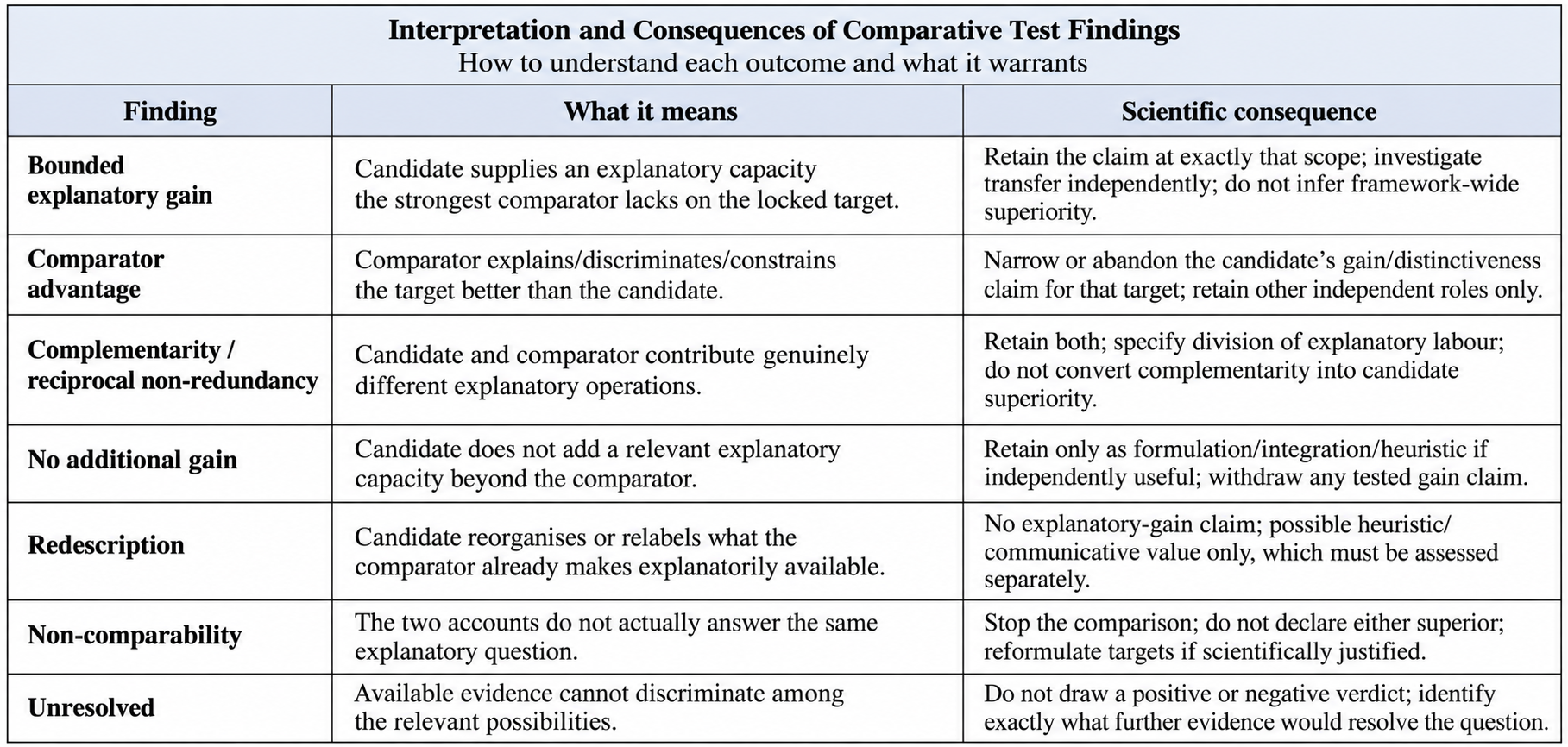
Interpreting Comparative Findings. Different comparative outcomes warrant different scientific conclusions. A bounded explanatory gain supports a correspondingly bounded claim, whereas comparator advantage, complementarity, no additional gain, redescription, non-comparability and unresolved evidence impose different constraints on what may legitimately be concluded.
Scope must then be controlled. Evidence from one population, model system, species or regime does not automatically warrant a general biological conclusion. Generalisation requires bridge evidence or other justification appropriate to the domain (Yarkoni, 2022).
The same principle applies to framework claims. A local explanatory success does not establish framework-wide superiority, and a local null result does not establish framework-wide failure.
Record What Remains Unresolved
A rigorous explanation should make its unresolved burdens visible.
This may include uncertainty about the target, incomplete evidence for a proposed dependency, ambiguity about the strongest relevant comparator, uncertain scope, or a residual question that current data cannot adjudicate.
“Unresolved†should not be treated as an embarrassment to be removed by stronger rhetoric. It is often the correct scientific result.
A useful unresolved statement identifies what remains open and what kind of further evidence or analysis could change the assessment. This makes the explanation more assessable because later work can be directed toward a specific burden rather than toward an indefinitely expanding research programme.
The Workflow Is Iterative, Not Algorithmic
The numbered sequence in this article is a presentation order, not a claim that scientific reasoning always proceeds linearly.
New evidence may force revision of the explanandum. A strong comparator may reveal that the candidate claim was mis-specified. Scope analysis may show that a conclusion must be narrowed. An unresolved verdict may motivate a targeted experiment or a different comparison.
The crucial distinction is between explicit revision and silent drift.
A scientific explanation can change during inquiry. What matters is that changes in target, claim, comparator or scope are made visible so that the explanatory burden can be reassessed rather than retrospectively rewritten.
Practical Workflow for Building and Assessing an Explanation
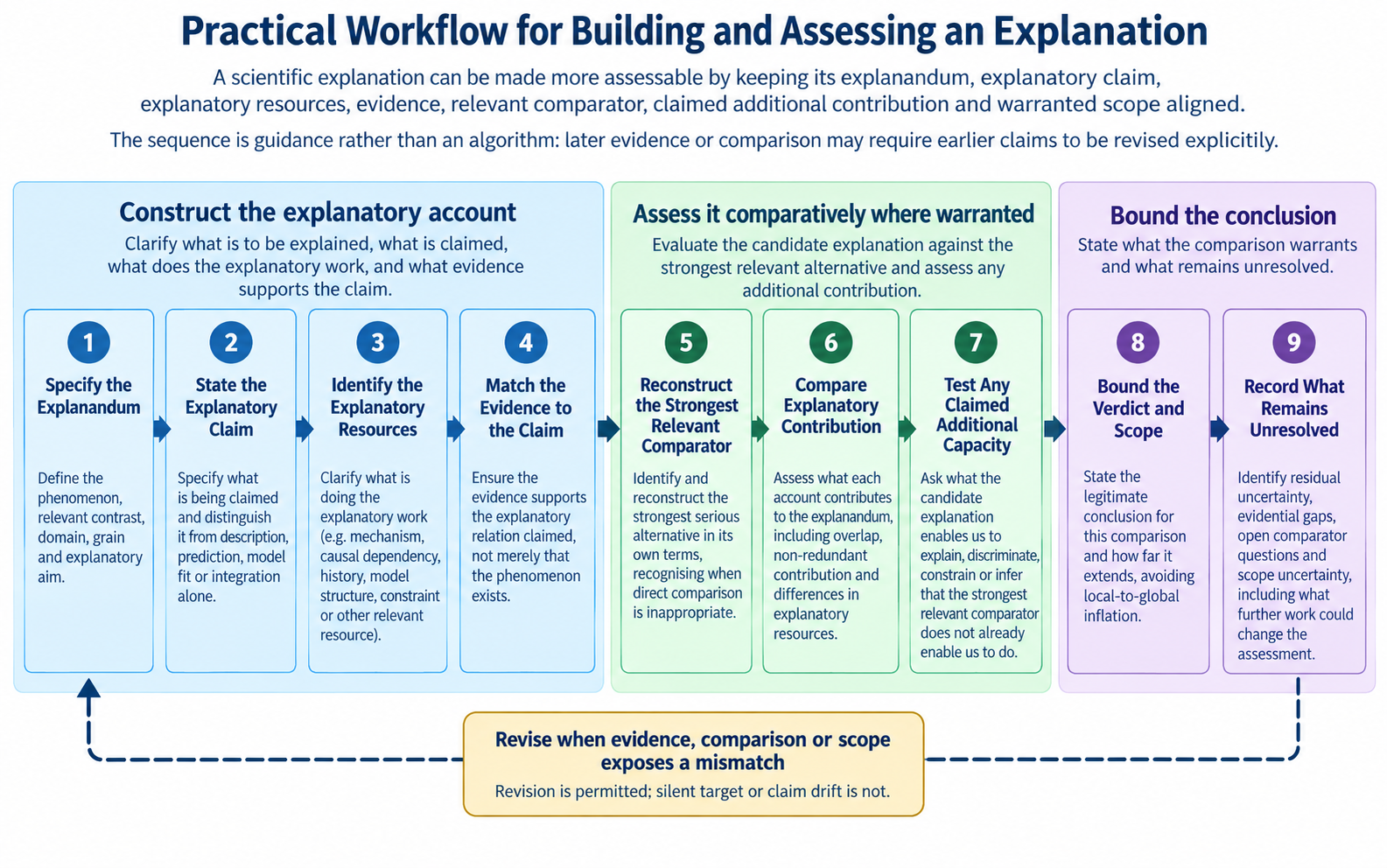
Practical Workflow for Building and Assessing an Explanation. A scientific explanation can be made more assessable by keeping its explanandum, explanatory claim, explanatory resources, evidence, relevant comparator, claimed additional contribution and warranted scope aligned. The sequence is guidance rather than an algorithm: later evidence or comparison may require earlier claims to be revised explicitly.
Knowing When Further Work Is Needed
More literature, more variables and more explanatory layers are not automatically improvements.
Further work is warranted when it could plausibly change the explanandum, evidential assessment, strongest relevant comparator, judgement of additional capacity, warranted scope or unresolved status. A specific uncertainty may therefore justify targeted source verification, new evidence, a new experiment or a revised comparison.
Broadening should stop when additional material merely increases volume without changing one of those burdens.
This is not a universal stopping rule. Different sciences have different evidential practices and different costs of uncertainty. The point is narrower: further work should have an identified explanatory purpose.
What This Article Establishes
Scientific explanations become more rigorous and more assessable when their explananda, explanatory claims, explanatory resources, evidential support, strongest relevant comparators, additional contributions, scope and unresolved limitations are kept explicitly aligned.
The procedure developed here helps expose where an explanatory claim is well supported, where comparison is warranted, where additional capacity has been demonstrated, and where the correct conclusion is narrower, null, unresolved or non-comparable.
It does not guarantee explanatory success. It makes the basis and limits of explanatory judgement more visible.
What This Article Does Not Establish
This article does not provide a universal algorithm for scientific explanation.
It does not prescribe one evidential method for every science, require every explanation to be mechanistic, require comparison where no genuine comparator exists, or assume that a successful assessment must demonstrate explanatory gain.
It also does not establish the scientific standing of an entire explanatory framework. A framework may contain multiple conceptual, methodological, modelling and substantive claims whose joint evaluation requires a different level of testing.
Finally, nothing in this workflow depends on Agency–Process–Scale or any other APS-specific biological proposition. The methodology is intended to remain independently applicable.
Related Terms and Next Step
Related glossary terms include Biological Explanation, Explanation, Explanandum, and Explanatory Target.
For the diagnostic background, see How Do Scientific Explanations Go Wrong?. For controlled comparison, see How Should Scientific Explanations Be Compared?. For the residual-capacity criterion, see What Counts as Explanatory Gain?. For bounded framework comparison, see Which Explanatory Framework Is Best?.
PA-09 provides a practical method for constructing and assessing individual scientific explanations. The next article, How Should a New Scientific Framework Be Tested?, asks a different question: when a proposed scientific framework makes multiple explanatory, methodological, conceptual or substantive claims, how should the framework as a whole be tested fairly and allowed to fail?
See Also
Related Articles
References
- (1998). HARKing: Hypothesizing After the Results Are Known. Personality and Social Psychology Review, 2(3), 196–217 . https://doi.org/10.1207/S15327957PSPR0203_4
- (2004). Inference to the Best Explanation. Routledge.
- (2017). A Manifesto for Reproducible Science. Nature Human Behaviour, 1, 0021 . https://doi.org/10.1038/s41562-016-0021
- (1994). Verification, Validation, and Confirmation of Numerical Models in the Earth Sciences. Science, 263(5147), 641–646 . https://doi.org/10.1126/science.263.5147.641
- (2009). Causality: Models, Reasoning, and Inference. Cambridge University Press. https://doi.org/10.1017/CBO9780511803161
- (2025). Explanation in Biology. Cambridge University Press. https://doi.org/10.1017/9781009300940
- (2003). Making Things Happen: A Theory of Causal Explanation. Oxford University Press. https://doi.org/10.1093/0195155270.001.0001
- (2022). The Generalizability Crisis. Behavioral and Brain Sciences, 45, e1 . https://doi.org/10.1017/S0140525X20001685