How Should Scientific Explanations Be Compared?
Scientific explanations can be compared fairly only when their explanatory targets are sufficiently matched, their strongest serious alternatives are reconstructed, and their relationship is classified before any judgment of preference or explanatory gain.
Key Points
- Comparing explanations is not identical to choosing between entire theories or frameworks.
- A fair comparison must lock the explanandum, contrast, grain and explanatory aim.
- Candidate accounts may be rival, complementary, partially overlapping, target-different, non-comparable or unresolved.
- Comparative difference does not by itself establish explanatory gain.
Where This Article Fits
The previous article examined how explanatory claims can fail, overreach or be misapplied. This article turns from diagnosis to procedure: how should candidate explanations be placed into a fair comparison?
That question comes before deciding which explanation is preferable or whether one provides additional explanatory capacity. Candidate accounts must first be matched by explanatory target, reconstructed in their strongest serious forms and classified as rival, complementary, partially overlapping, target-different or non-comparable.
This article establishes those comparison controls. It does not provide a universal ranking algorithm or treat comparative difference as explanatory gain. The next article asks what must be demonstrated before additional explanatory capacity can legitimately be claimed.
Introduction
A fair comparison begins before anyone asks which explanation is better. The first question is whether the explanations address sufficiently matched explanatory targets to permit comparison at all.
Comparison Is Not the Same as Theory Choice
Scientists and philosophers have long compared theories using considerations such as accuracy, consistency, scope, simplicity, fruitfulness and problem-solving effectiveness (Kuhn, 1977; Laudan, 1977). Work on inference to the best explanation has likewise examined the considerations governing preference among explanatory alternatives (Lipton, 2004). These traditions remain important, but theory choice and target-specific explanatory comparison are not identical tasks.
A framework may be broad, coherent and scientifically productive without improving the explanation of every target to which it is applied. Conversely, a comparatively narrow account may answer one question particularly well without becoming the preferable framework overall. General theoretical virtues cannot therefore determine, by themselves, whether one account should be preferred for a particular explanatory task.
Comparative assessment requires a more controlled question: what exactly are the candidate accounts explaining, how do they relate to one another, and on what matched basis can their differences be assessed?
Fix the Comparative Question
The first step is to specify the comparison before evaluating its outcome. Scientific explanations are responsive not only to a broad phenomenon but also to the particular question and contrast through which that phenomenon becomes an explanandum (van Fraassen, 1980). This requires identification of:
- the phenomenon under investigation;
- the explanandum;
- the contrast, where the question is contrastive;
- the relevant spatial, temporal and organisational grain;
- the explanatory aim; and
- the respects in which the candidate accounts are being compared.
Reference to the same organism, process or broad phenomenon is not sufficient. Different accounts can concern the same biological system while answering different questions about it.
Hardy–Weinberg equilibrium presents a related problem. The equilibrium specifies the expected stability of Mendelian proportions under stated conditions (Hardy, 1908). Selection, drift, mutation and migration concern processes through which actual populations may depart from that baseline. Treating the equilibrium and explanations of departure as straightforward rivals would collapse distinct explanatory functions into one undifferentiated question.
A comparison is therefore properly formed only when the candidate accounts are sufficiently aligned in what they seek to explain. If target matching cannot be established, the appropriate result is not a ranking but a finding of target difference, complementarity or non-comparability.
| Compare sufficiently matched explanatory targets |
| Two accounts concerning the same organism or phenomenon can still answer different questions. Match the explanandum, contrast, grain and explanatory aim before deciding whether comparison is warranted. |
Reconstruct the Strongest Serious Alternatives
Once the comparative question has been fixed, each candidate account must be reconstructed in its strongest serious form. A new proposal should not be compared with a simplified textbook summary, an obsolete formulation or an account stripped of resources that its informed advocates would ordinarily recognise.
The strongest relevant comparator may not be contained in a single publication. Scientific explanations are often distributed across models, experiments, mechanisms, measurements and background assumptions. Where scientific practice genuinely integrates these resources, a fair comparison may require a composite reconstruction rather than an artificially isolated statement.
The same discipline applies to the proposed alternative. Novel terminology, ambitious framing or association with a broader research programme should not be treated as evidence of explanatory strength. The account must be reconstructed through the claims, evidence and dependencies that bear on the locked target.
This requirement is symmetrical. New accounts receive no novelty bonus, while established accounts receive no incumbency bonus. Both must be represented charitably, subjected to comparable evidential standards and assessed only in relation to the question that has been fixed.
This principle also answers a familiar concern about inference to the best explanation: the best account in an inadequately constructed comparison set may remain a poor choice (Lipton, 2004). Comparative inquiry must therefore search actively for serious alternatives rather than testing a favoured proposal against a convenient foil.
Classify the Relationship Before Ranking
Candidate explanations need not be straightforward rivals. They may be complementary, partially overlapping or resistant to combination, depending on their targets and counterfactual commitments (Marchionni, 2008; Gijsbers, 2016).
Candidate explanations can stand in several different relationships:
- rival: they offer incompatible or competing answers to a sufficiently matched target;
- complementary: they answer connected questions whose contributions can be combined;
- partially overlapping: they address some of the same explanatory work but also retain distinct targets or functions;
- target-different: they concern the same broad phenomenon while answering materially different questions;
- non-comparable: no sufficiently controlled basis for comparison has been established; or
- unresolved: the available evidence or reconstruction is insufficient to determine the relationship.
This classification should precede any judgment of preference. Without it, productive explanatory plurality can be mistaken for competition, while genuine disagreement can be obscured by describing all accounts as complementary.
The KaiABC circadian system illustrates the problem. Its core phosphorylation oscillation can be reconstituted in vitro using KaiA, KaiB, KaiC and ATP (Nakajima et al., 2005). Accounts may nevertheless be directed toward different properties of the wider clock system, just as models more generally are constructed in relation to particular targets and purposes (Weisberg, 2013). Accounts directed toward different clock properties should not be globally ranked as though they necessarily supplied rival answers to one question.
Evolutionary and proximate explanations can likewise answer different why-questions. The Trivers–Willard model gives a selection-based account of condition-dependent variation in offspring sex allocation (Trivers & Willard, 1973). A physiological account of how such allocation is produced would address a different explanatory question. The two should not be classified as rivals merely because they concern the same trait.
Relation classification is not a preliminary formality. It determines what kind of conclusion the comparison can legitimately support.
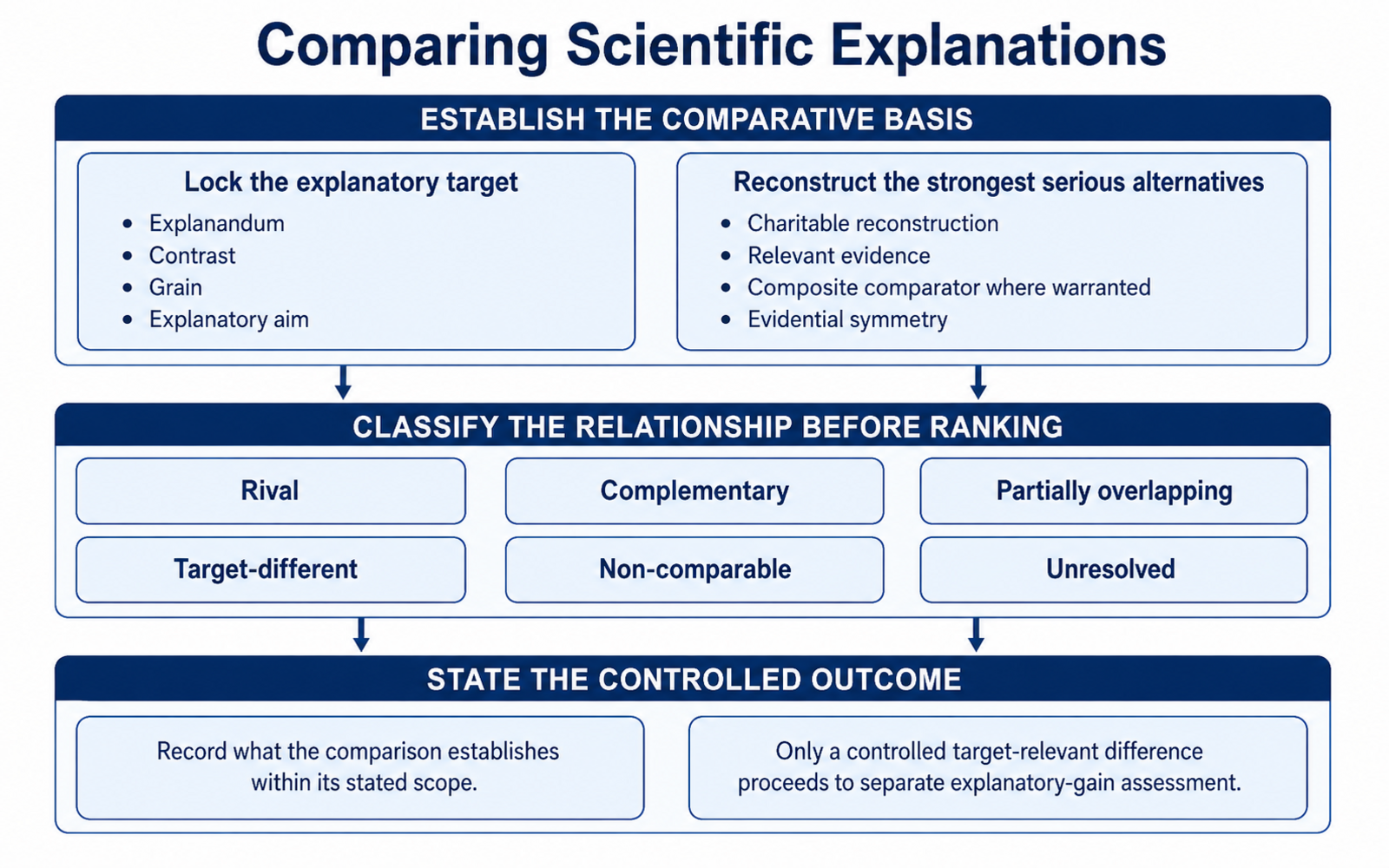
Comparing Scientific Explanations. Fair comparison requires a locked explanatory target, strongest-alternative reconstruction and relation classification before ranking. Rivalry is only one possible outcome, and comparative difference does not by itself establish explanatory gain.
Construct a Symmetrical Comparison
When candidate accounts are sufficiently target-matched, their comparison should be constructed around common questions rather than framework-specific standards. Relevant questions may include:
- What claim does each account make about the locked target?
- What evidence supports that claim?
- Which dependencies, mechanisms, models or assumptions does the account invoke?
- What contrasts or alternatives can it discriminate?
- At what grain and within what domain does the account apply?
- Which uncertainties or limitations remain?
- Does the apparent difference survive reconstruction of the strongest comparator?
At this stage, the aim is to identify and document target-relevant similarities and differences. The existence of a difference does not yet show that one account possesses additional explanatory capacity. A difference may reflect alternative terminology, a change of grain, a broader framing, a distinct explanatory aim or a genuinely unresolved disagreement.
This article therefore stops short of declaring explanatory gain. Its task is to produce a comparison sufficiently disciplined for the next question to be asked without prejudging the answer.
A properly constructed comparison may conclude that:
- the accounts are insufficiently target-matched;
- they are complementary or partially overlapping;
- they are genuine rivals;
- one or both have been inadequately reconstructed;
- the evidence does not yet permit adjudication; or
- a target-relevant difference remains for assessment under the explanatory-gain burden.
None of these outcomes, including the final one, independently establishes explanatory gain.
Control Scope and Stopping
Every comparative conclusion must be limited to the target, contrast, grain, evidence and alternatives actually examined. A local preference does not establish framework-wide superiority, just as non-comparability on one target does not establish general equivalence.
Comparison should also be bounded by an explicit stopping rule. Further reconstruction or evidence gathering is warranted while it continues to alter:
- the specification of the target;
- the strongest serious comparator;
- the classification of the relationship;
- the evidential symmetry of the comparison; or
- the target-relevant difference passed forward for assessment.
Search can stop when additional material no longer changes these elements and the remaining uncertainty has been stated explicitly. This is not a claim that inquiry has been completed permanently. It is a control on the scope and documentary adequacy of the particular comparison.
The resulting procedure does not replace specialist scientific evidence or domain-specific comparison methods. It clarifies the conditions under which their results can be placed into a fair comparative structure.
Comparison Without Manufactured Victory
A comparative method should not assume that every pair of explanations contains a winner. Some accounts are complementary. Some address different targets. Some comparisons remain unresolved. Others identify genuine rivalry but lack adequate evidence for adjudication.
Allowing these outcomes is essential. A procedure that converts every difference into competition, or every comparison into victory, cannot distinguish explanatory advance from the structure imposed by the comparison itself.
The proper endpoint of the comparison is therefore not a declaration that one explanation is better. It is a controlled statement of:
- what was compared;
- why the targets were or were not sufficiently matched;
- how the strongest alternatives were reconstructed;
- what relationship holds between them;
- what the evidence permits;
- where the conclusion applies; and
- whether any target-relevant difference remains for separate explanatory-gain assessment.
What This Article Establishes
Fair explanatory comparison requires:
- a locked explanatory target;
- strongest-alternative reconstruction;
- evidential symmetry;
- relation classification before ranking;
- matched comparative questions;
- permission for complementary, target-different, non-comparable and unresolved outcomes;
- explicit scope control; and
- a stopping rule appropriate to the bounded inquiry.
Together, these controls determine whether candidate explanations can be compared fairly and whether any target-relevant difference is ready for a separate explanatory-gain assessment.
What This Article Does Not Establish
The procedure is not a novel general theory of scientific explanation, a universal ranking algorithm or a substitute for specialist scientific evidence. Its principal controls are substantially anticipated within existing traditions of theory comparison, inference, model pluralism and explanatory analysis (Kuhn, 1977; Lipton, 2004; Marchionni, 2008; Gijsbers, 2016).
The article does not establish that every explanatory difference constitutes improvement. It does not define explanatory gain, perform the anti-redescription test or specify the residual contribution required to demonstrate additional explanatory capacity. Those questions belong to the next article.
Related Terms and Next Step
Related terms: Biological Explanation, Explanation, Explanandum and Explanatory Target.
Related articles: What Makes an Explanation Successful? and How Do Scientific Explanations Go Wrong?.
The next article asks what must be demonstrated before a target-relevant comparative difference can count as explanatory gain.
See Also
Related Articles
References
- (2016). Explanatory Pluralism and the (Dis)Unity of Science: The Argument from Incompatible Counterfactual Consequences. Frontiers in Psychiatry, 7 . https://doi.org/10.3389/fpsyt.2016.00032
- (1908). Mendelian Proportions in a Mixed Population. Science, 28(706), 49–50 . https://doi.org/10.1126/science.28.706.49
- (1977). The Essential Tension: Selected Studies in Scientific Tradition and Change. University of Chicago Press.
- (1977). Progress and Its Problems: Towards a Theory of Scientific Growth. University of California Press.
- (2004). Inference to the Best Explanation. Routledge.
- (2008). Explanatory Pluralism and Complementarity: From Autonomy to Integration. Philosophy of the Social Sciences, 38(3), 314–333 . https://doi.org/10.1177/0048393108319399
- (2005). Reconstitution of Circadian Oscillation of Cyanobacterial KaiC Phosphorylation in Vitro. Science, 308(5720), 414–415 . https://doi.org/10.1126/science.1108451
- (1973). Natural Selection of Parental Ability to Vary the Sex Ratio of Offspring. Science, 179(4068), 90–92 . https://doi.org/10.1126/science.179.4068.90
- (1980). The Scientific Image. Clarendon Press.
- (2013). Simulation and Similarity: Using Models to Understand the World. Oxford University Press. https://doi.org/10.1093/acprof:oso/9780199933662.001.0001