What Makes an Explanation Successful?
Scientific explanations can succeed in different ways because they answer different questions and identify different kinds of explanatory dependence. This article develops a disciplined, target-sensitive account of explanatory success based on adequacy to the target, appropriate evidential support, explanatory relevance, discrimination, and the conditional contributions of mechanism, idealisation, mathematical structure, scope, robustness, and scientific understanding.
Key Points
- Explanatory success must be assessed relative to the question, target, and claim an explanation addresses.
- Evidence must support the cause, mechanism, dependency, structure, history, or other relation doing the explanatory work.
- Explanatory relevance matters because additional true information does not necessarily improve an explanation.
- Discrimination is required when alternatives compete over the same or a sufficiently matched explanatory target.
- Mechanism, idealisation, scope, robustness, and understanding contribute differently in different explanatory contexts.
- Explanatory quality cannot be reduced to a universal score, checklist, or ranking algorithm.
Where This Article Fits
This article is the third in the Methodology and Explanation sequence. First, What Is a Scientific Explanation? showed that different questions about the same phenomenon can require different explanatory answers. Second, How Did Scientists Learn to Think About Explanation? explained how contemporary explanatory plurality emerged through historically differentiated responses to problems of relevance, causation, unification, contrast, mechanism, intervention, non-causal dependence, and understanding.
This article asks what makes an explanation successful once that plurality is acknowledged. It develops the positive considerations by which explanatory quality can be assessed without imposing one universal explanatory form or reducing success to a numerical score.
The next article examines the complementary question of how explanatory projects fail, overreach, or go wrong. The sequence is therefore:
1 — What is scientific explanation?
2 — How did explanatory plurality arise?
3 — What makes an explanation successful?
4 — How do scientific explanations go wrong?
What Makes an Explanation Successful?
Scientific explanations can succeed in different ways. Some identify causes, some describe mechanisms, some isolate mathematical or structural relations, and others show how a phenomenon arises through development or history. This plurality does not mean that explanatory quality is merely a matter of preference. It means that an explanation must be assessed in relation to the question it answers, the claim it makes, and the evidence appropriate to that claim.
Explanatory success is therefore multidimensional, evidence-dependent, and target-sensitive. No single measure determines which explanation is best in every scientific context, but disciplined assessment remains possible.
Success Relative to an Explanatory Target
The first question to ask of an explanation is whether it answers the question that has actually been posed. An account may be detailed, accurate, and scientifically important while remaining inadequate to a particular explanatory target.
A molecular description, for example, may identify the components involved in a biological process. That description becomes explanatory only when it shows how those components bear on the phenomenon under investigation. Conversely, an abstract mathematical model may omit most of the physical details of a system while successfully isolating the relation on which the phenomenon depends.
Explanatory adequacy consequently depends on more than the amount of information supplied. It depends on the explanandum, the relevant contrast, the grain at which the question is posed, and the dependency or structure the explanation is intended to identify (Ross, 2025).
This is why explanations answering materially different questions cannot be ranked simply by comparing their detail, scope, or vocabulary. A mechanistic account of how a process operates and an evolutionary account of why a trait was retained may both be successful while explaining different aspects of the same phenomenon. Before their quality can be compared, their explanatory targets must be made sufficiently clear.
Target adequacy is not a complete measure of explanatory success. It is a governing control: an account cannot succeed as an answer to one question merely by providing an excellent answer to another.
Evidence Must Support the Explanatory Claim
A successful explanation requires evidence appropriate to the claim it makes. The relevant evidence is not always evidence that the phenomenon occurs. It must bear on the cause, mechanism, dependency, structure, history, or other relation that is supposed to explain the phenomenon.
This distinction matters because descriptive accuracy does not by itself establish explanatory adequacy. A model may reproduce observed data without correctly identifying why the pattern occurs. A proposed mechanism may contain plausible components without showing that their organisation produces the phenomenon. A historical narrative may be consistent with present evidence without establishing that the proposed sequence was responsible for the outcome.
Different explanatory claims therefore require different forms of support. Causal explanations may be strengthened by interventions, controlled contrasts, or evidence of invariance under relevant changes (Woodward, 2003). Mechanistic explanations require evidence connecting organised components and activities to the production or maintenance of the phenomenon. Mathematical and structural explanations require support for the applicability of the relevant relations and for their bearing on the stated target.
Evidence need not take one universal form. Its adequacy depends on what the explanation claims and what would have to be true for that claim to do its explanatory work.
Relevance and Discrimination
Evidence supports an explanation only when it bears on the relation that is explanatorily relevant. Merely adding true information does not necessarily improve an explanation. Additional detail helps when it clarifies the dependency, mechanism, contrast, or structure at issue. It can hinder understanding when it obscures that relation beneath information that does not answer the question.
A strong explanation should also distinguish its account from serious alternatives when those alternatives make materially different claims. Evidence that is equally compatible with several rival explanations may support the existence of a phenomenon without determining which proposed explanation is responsible for it.
Discrimination does not require that every successful explanation defeat every possible alternative. Some explanations are complementary because they address different targets. The demand for discrimination arises when accounts compete over the same or sufficiently matched target and attribute the explanatory result to different dependencies.
Explanatory flexibility can be useful during inquiry. Scientists may initially explore several models, mechanisms, or interpretations before the available evidence permits sharper conclusions. As an explanatory claim becomes more definite, however, it should also become clearer what evidence supports it, what alternatives it excludes, and what observations would require its scope or strength to be reconsidered.
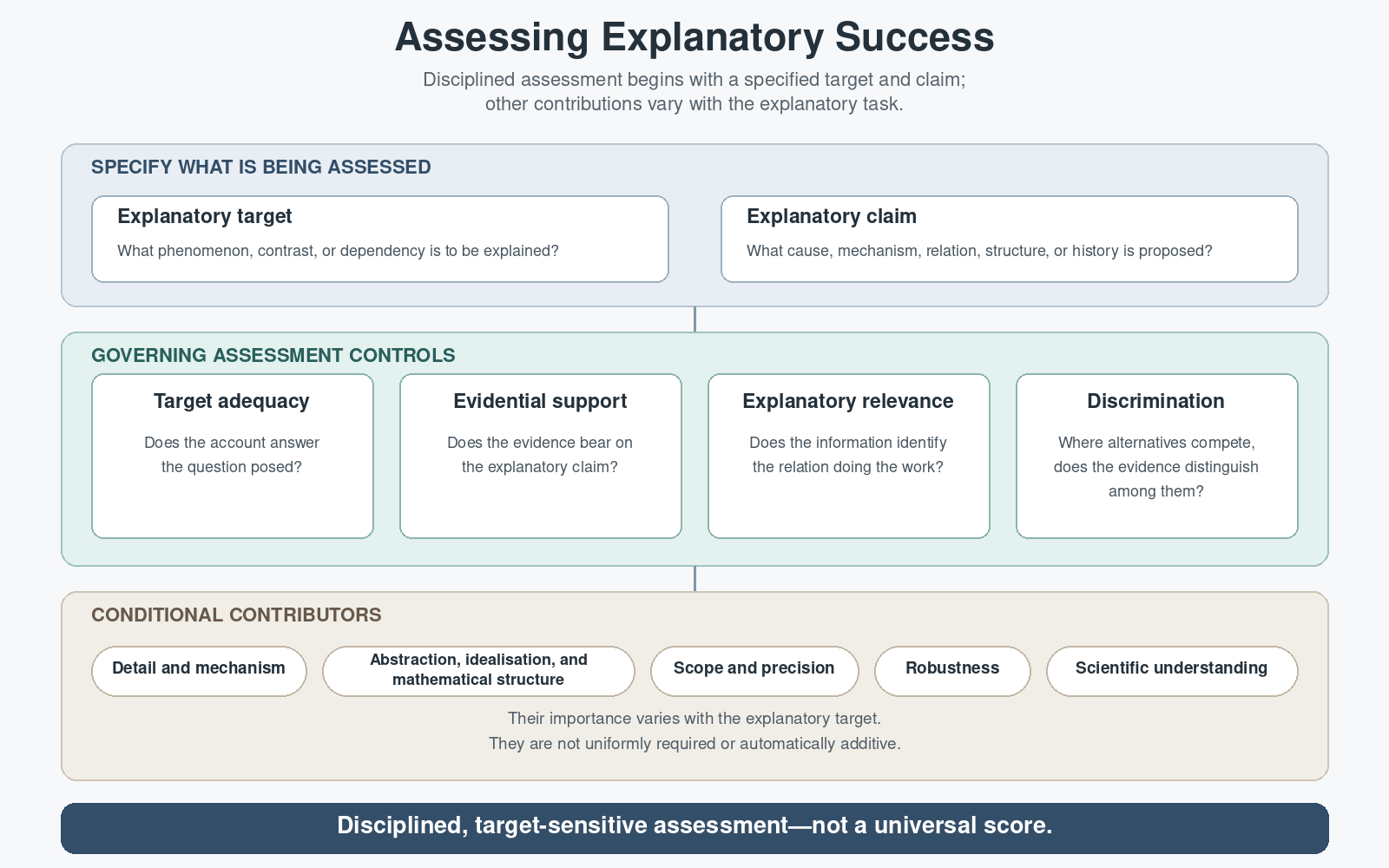
Assessing Explanatory Success. Explanations remain answerable to their targets, claims, evidence, relevance, and serious alternatives. Other contributions can strengthen an explanation, but their importance varies with the explanatory task and cannot be combined into a universal score.
Detail and Mechanism
Mechanistic detail is often explanatory because it shows how organised entities and activities produce, maintain, or regulate a phenomenon. It can connect components to operations, operations to organisation, and organisation to the outcome being explained.
But greater detail is not a universal measure of explanatory quality. A list of molecular participants does not automatically explain their coordinated activity. Nor must every successful explanation descend to the smallest available physical scale. The appropriate degree of detail depends on which dependencies are relevant to the target.
The biochemical reconstitution of the cyanobacterial KaiABC oscillator, for example, showed that a circadian phosphorylation rhythm could be generated in vitro from a small set of components (Nakajima et al., 2005). That achievement provided powerful evidence about the oscillator’s biochemical basis. Yet reconstitution does not make every other explanatory question disappear. Questions about cellular integration, environmental entrainment, functional organisation, and evolutionary history may require additional evidence and different explanatory resources.
Mechanistic models succeed when their selected components, activities, and organisation illuminate the phenomenon at issue. Their value lies not in detail alone, but in the explanatory relevance of the detail they provide (Darden, 2007).
Abstraction, Idealisation, and Mathematical Structure
Scientific explanations frequently succeed by omitting detail. Abstraction can reveal patterns shared across otherwise different systems. Idealisation can isolate a dependency by deliberately setting aside influences that would obscure it. Mathematical representation can show that an outcome follows from a structural relation rather than from a fully specified sequence of causal events.
Hardy–Weinberg equilibrium illustrates the explanatory value of an idealised baseline. Its simplifying assumptions exclude several forces that affect actual populations. Those assumptions do not make the model scientifically useless. They establish a reference condition against which departures can be identified and investigated (Hardy, 1908).
The Trivers–Willard model similarly derives a conditional evolutionary prediction from simplified assumptions about parental condition and expected reproductive returns (Trivers & Willard, 1973). Its explanatory contribution lies in isolating a relation that can guide empirical investigation. Its success does not require it to reproduce every feature of every biological population.
An idealisation is therefore not justified merely because simplification is convenient. Its explanatory value depends on what the simplification makes visible, which inferences it supports, and whether those inferences remain appropriate to the target. Realism and detail matter, but they matter in relation to explanatory function rather than as context-free measures of quality.
Scope and Precision
Explanatory scope concerns the range of phenomena or conditions to which an account applies. Broad scope can be valuable when the same explanatory relation genuinely holds across multiple cases. It can reveal common structure, connect previously separate findings, and support generalisation.
Broader is not automatically better. A narrowly specified explanation supported by strong evidence may be more successful than a sweeping account whose claims extend beyond the cases it can explain. Explanatory success requires an appropriate relation between scope, precision, and evidential support.
The scope of an explanation should therefore be stated rather than assumed. Scientists should be able to identify the systems, conditions, contrasts, or domains to which the claim applies. Boundaries are not necessarily weaknesses. They can be evidence that an explanation has been formulated with sufficient precision to show where its explanatory commitments begin and end.
Robustness
An explanatory result is robust when it persists across relevant changes in assumptions, models, measurements, methods, or experimental conditions. Robustness can increase confidence that a result does not depend entirely on one fragile representation or procedure.
Its significance nevertheless requires interpretation. Agreement among several models may be informative when the models reach the same result through genuinely different assumptions or methods. Agreement is less decisive when the models inherit the same simplifying assumptions, data limitations, or background commitments.
Robustness is therefore not an automatic guarantee of truth or explanatory success. Its value depends on what varies, what remains stable, and why that stability bears on the explanatory claim.
Explanation and Scientific Understanding
Explanations often produce scientific understanding. They can make a phenomenon intelligible by showing how it depends on a cause, mechanism, mathematical relation, organised process, or historical sequence. They can also enable scientists to reason about what would happen under relevant changes.
Understanding is an important scientific achievement, but its relationship to explanation remains contested. An account can feel intelligible because it fits familiar expectations while lacking adequate evidential support. Conversely, a mathematically demanding explanation may be difficult for many readers to grasp while remaining scientifically well supported.
Intelligibility to an audience should therefore not be treated as an unqualified measure of explanatory success. The stronger consideration is whether an explanation provides warranted understanding: whether it enables competent reasoners to grasp the relevant dependency on the basis of evidence and appropriate inferential practices (de Regt, 2017).
Disciplined Pluralism
The success of a scientific explanation cannot be calculated by adding fixed quantities of mechanism, prediction, simplicity, scope, robustness, or intelligibility. These considerations do not contribute equally to every explanatory task.
A mechanistic explanation may succeed through experimentally supported organisation of components and activities. A causal explanation may succeed through evidence that relevant interventions change the outcome. A mathematical explanation may succeed by demonstrating a structural dependency. An idealised model may succeed by establishing a baseline or isolating a relation that would otherwise remain hidden.
This is explanatory pluralism, but it is not the view that every proposed account is equally adequate. Explanations remain answerable to their targets, evidence, relevance, discriminative capacity, inferential commitments, and stated scope.
The appropriate conclusion is therefore plural but disciplined. Scientific explanations can succeed in different ways, but each must show why its explanatory resources are appropriate to the question being asked and how the available evidence supports the relation claimed to explain the phenomenon.
What This Article Establishes
Explanatory success is multidimensional, evidence-dependent, and target-sensitive. Adequacy to the explanatory target, relevant evidential support, and discrimination among serious alternatives provide central controls. Mechanism, abstraction, idealisation, mathematical structure, scope, robustness, and understanding can also contribute, but their importance depends on the explanatory task.
No universal scalar measure of explanatory strength is warranted. The absence of such a measure does not prevent disciplined assessment.
What This Article Does Not Establish
The considerations identified here are not jointly necessary and sufficient conditions for every scientific explanation. They do not form a mechanical checklist, additive score, or universal ranking algorithm.
This article also does not determine how explanations answering different targets should be compared, what constitutes additional explanatory gain, or which explanatory framework is best. Those questions require further methodological controls developed later in the sequence.
Next: How Explanations Go Wrong
Positive standards of explanatory success also reveal points at which explanatory projects can become inadequate. The next article examines how explanations lose contact with their targets, evidence, alternatives, or legitimate scope—and how explanatory ambition can become explanatory overreach.
See Also
Related Articles
References
- (2007). Mechanisms and Models. Cambridge University Press. https://doi.org/10.1017/CCOL9780521851282.008
- (2017). Understanding Scientific Understanding. Oxford University Press. https://doi.org/10.1093/oso/9780190652913.001.0001
- (1908). Mendelian Proportions in a Mixed Population. Science, 28(706), 49–50 . https://doi.org/10.1126/science.28.706.49
- (2005). Reconstitution of Circadian Oscillation of Cyanobacterial KaiC Phosphorylation in Vitro. Science, 308(5720), 414–415 . https://doi.org/10.1126/science.1108451
- (2025). Explanation in Biology. Cambridge University Press. https://doi.org/10.1017/9781009300940
- (1973). Natural Selection of Parental Ability to Vary the Sex Ratio of Offspring. Science, 179(4068), 90–92 . https://doi.org/10.1126/science.179.4068.90
- (2003). Making Things Happen: A Theory of Causal Explanation. Oxford University Press. https://doi.org/10.1093/0195155270.001.0001