What Is a Scientific Explanation?
Scientific explanation is target-sensitive and plural in practice. This article introduces the explanandum and explanatory target, distinguishes explanation from description, prediction, model fit, and mere intelligibility, and examines several major forms of scientific explanation without reducing them to a single universal model.
Key Points
- Scientific explanation begins by specifying what is to be explained.
- An explanation can be successful for one explanatory target while failing to answer another.
- Description, prediction, modelling, and understanding are important scientific achievements but are not automatically identical to explanation.
- Scientific explanations may be causal, mechanistic, unificatory, contrastive, mathematical, structural, or otherwise non-causal.
- Explanatory plurality does not imply that all explanations are equally adequate.
- Explanatory adequacy must be assessed relative to the explanandum, evidence, and explanatory work being claimed.
Where This Article Fits
This article is the first in a ten-part Methodology and Explanation series examining how scientific explanations are constructed, assessed, compared, and tested. The sequence begins with the nature of scientific explanation, then moves through its historical development, standards of explanatory success and failure, comparison and explanatory gain, the assessment of contemporary explanatory frameworks, and practical methods for constructing and testing explanations.
The series is developed independently of APS. Its purpose is not to derive standards of scientific explanation from the APS framework, but to establish a broader methodological basis from which APS and other explanatory approaches can subsequently be examined. This separation is important: a framework should not establish its own adequacy merely by defining the standards against which it is assessed.
As the opening article, What Is a Scientific Explanation? establishes the starting point for the sequence. It introduces the explanandum and explanatory target, distinguishes explanation from neighbouring scientific achievements such as description, prediction, and model fit, and shows why scientific explanation can legitimately take more than one form. Its central principle is that explanatory adequacy cannot be assessed until we know what is being explained and what explanatory work an account is intended to perform.
The next article, How Did Scientists Learn to Think About Explanation?, asks how the major approaches to scientific explanation developed historically and why contemporary science inherited a plural rather than a single model of explanation.
What Is a Scientific Explanation?
Explanation begins with a question:
What, exactly, are we trying to understand, and what would count as answering it?
Scientists do more than observe, classify, measure, model, and predict. They also ask why a pattern occurs, how a process is produced, what makes one outcome occur rather than another, or what relations are responsible for a phenomenon.
These are explanatory questions.
Yet there is no single uncontested philosophical definition that captures every successful scientific explanation. Scientific disciplines explain in different ways, and even within one field different explanatory questions can require different kinds of answers.
A useful starting point is therefore not to ask for one universal formula for explanation, but to ask:
What is the explanatory target, and what kind of answer would address it?
Why Explanation Needs a Target
The phenomenon, pattern, event, or relation to be explained is traditionally called the explanandum. The information offered in explanation of it is sometimes called the explanans.
In simpler terms:
- the explanandum is what we are trying to explain;
- the explanans is what we offer as the relevant explanatory answer.
This distinction matters because a scientific explanation is not simply a collection of true statements. It must bear appropriately on the problem being explained (Hempel & Oppenheim, 1948; Ross, 2025).
The same biological system can support several legitimate explanatory targets.
Consider the action potential. One question asks how changes in membrane voltage depend quantitatively on ionic conductances. Another asks what physical structures produce those conductance changes. The questions are connected, but they are not identical.
The Hodgkin–Huxley model provided a powerful quantitative explanation of electrical excitation before the later molecular characterisation of individual ion-channel structures. Subsequent molecular work did not simply make the earlier explanation obsolete. It addressed a more specific mechanistic target and thereby added a different kind of explanatory detail (Hodgkin & Huxley, 1952; Darden, 2008).
This illustrates a general principle:
An explanation can be highly successful for one explanatory target while failing to answer another.
More detail is therefore not automatically better explanation. What matters is whether the information supplied is relevant to the question being asked.
Explanation Is Not Description
Description is indispensable to science.
Scientists describe structures, regularities, distributions, behaviours, sequences, and changes. Accurate description may be a prerequisite for explanation because one must usually establish what happens before asking why or how it happens.
But description and explanation are not identical.
A description may tell us that a regularity occurs, how frequently it occurs, or what its characteristic pattern looks like. An explanation goes further by identifying a dependency, causal structure, mechanism, mathematical relation, contrast, history, or other scientifically relevant relation that answers the explanatory question.
The distinction is not always sharp in practice. A sufficiently structured description can itself reveal explanatory relations, while an explanatory model will normally contain substantial descriptive content.
The important point is narrower:
The amount or accuracy of description alone does not determine whether the explanatory question has been answered.
The same applies to definition. Defining a phenomenon can clarify what is being investigated, but a definition does not by itself explain why the phenomenon occurs or how it is produced.
Explanation Is Not the Same as Prediction
Prediction and explanation often support one another, but they are not interchangeable.
A successful prediction tells us what is expected to occur under specified conditions. An explanation addresses why or how the relevant phenomenon occurs.
Sometimes the same scientific account does both. A causal model may explain a dependency and generate accurate predictions about interventions. A mechanistic account may explain how a process works and support predictions about what will happen when one of its components is disrupted.
But the two achievements can also come apart.
A model may predict accurately without identifying the dependency, mechanism, contrast, structure, or history relevant to the explanatory question. Conversely, an explanation may identify an important causal or structural relation even when precise prediction remains difficult.
Examples drawn from Hodgkin–Huxley physiology, circadian systems, population genetics, and evolutionary modelling illustrate different relationships among prediction, model adequacy, mechanism, and explanation (Ross, 2025; Darden, 2008).
Prediction can nevertheless play a crucial explanatory role. Predictions may test candidate explanations, expose their limits, distinguish alternatives, and guide interventions.
The appropriate conclusion is therefore not that explanation is superior to prediction.
It is that:
Predictive success is one important scientific achievement, but predictive accuracy is not a universal substitute for explanation.
Explanation Is Not the Same as Model Fit
Models are among the most important tools of scientific explanation.
A model can isolate a dependency, represent causal organisation, display a mathematical constraint, explore counterfactual possibilities, or show how complex behaviour can arise from relatively simple relations.
But a good fit between a model and observed data does not automatically establish an explanation.
Different models can sometimes reproduce the same pattern for different reasons. A model may fit observations while leaving unresolved which represented features are responsible for the phenomenon. Conversely, an idealised model may deliberately depart from many details of a real system while exposing the relation that matters to the explanatory target.
The explanatory question is therefore not simply:
How well does the model reproduce the data?
It is also:
What does the model allow us to understand about the phenomenon, and which features of the model perform that explanatory work?
More Than One Form of Scientific Explanation
Modern philosophy of science has developed several influential accounts of explanation.
One major tradition is the covering-law approach, associated especially with Hempel and Oppenheim, in which explanation involves deriving the phenomenon to be explained from general laws together with relevant conditions (Hempel & Oppenheim, 1948).
Causal explanations instead emphasise causal dependence or difference-making. Interventionist approaches, for example, ask how changes in one factor would make a difference to another under suitable interventions (Woodward, 2003).
Mechanistic explanations investigate the organised entities and activities responsible for producing or maintaining a phenomenon. They have become especially important in philosophy of biology and the biomedical sciences (Machamer, Darden, & Craver, 2000; Darden, 2007).
Unificationist explanations emphasise the capacity to derive or understand many apparently different phenomena through a comparatively small set of explanatory patterns (Kitcher, 1981).
Pragmatic and contrastive approaches emphasise the explanatory question itself. Asking why one outcome occurred rather than another can require different information from asking simply why the outcome occurred at all (van Fraassen, 1980).
Not all scientific explanation is straightforwardly causal. Mathematical and structural explanations can sometimes explain by showing that an outcome follows from a constraint, topology, symmetry, mathematical relation, or other non-causal structure (Lange, 2016).
Scientific explanation is also closely connected with understanding. Good explanations often make phenomena intelligible by revealing previously obscure relations. But intelligibility alone should not be equated automatically with explanation. A story can feel satisfying without being scientifically adequate, while a technically demanding explanation may be well supported even before it becomes intuitively transparent. The relationship between explanation and understanding therefore remains an important but distinct issue (Ross, 2025).
These approaches need not be treated as mutually exclusive boxes. An actual scientific explanation may be simultaneously mechanistic and causal, use mathematical representation, support prediction, and contribute to broader unification.
Nor does the existence of several explanatory forms mean that anything can count as an explanation.
Plurality is not relativism.
An explanatory claim remains answerable to evidence, relevance, the question posed, and the specific scientific relations it asserts.
Biology Makes Explanatory Plurality Especially Clear
Biology provides strong reasons not to collapse explanation into one form.
A molecular mechanism, a developmental trajectory, a physiological dependency, an evolutionary history, a population-genetic model, and a mathematical baseline can all contribute genuine scientific understanding while answering different questions.
Hardy–Weinberg equilibrium provides a simple illustration.
The Hardy–Weinberg relation is idealised. It specifies what happens to allele and genotype frequencies under a defined set of assumptions. Its usefulness does not depend upon reproducing every causal detail of an actual population.
By establishing a mathematical baseline, it helps investigators determine what departures from that baseline require further explanation. Its explanatory role therefore differs from an account that reconstructs a biochemical or molecular mechanism (Hardy, 1908; Ross, 2025).
Recognising such differences prevents a common mistake: treating distinct explanatory products as though they were defective versions of one another.
A mechanistic explanation is not automatically superior because it contains more component detail. A mathematical explanation is not automatically superior because it is more general. A predictive model is not automatically explanatory because it forecasts accurately. An evolutionary account is not automatically competing with a physiological one merely because both concern the same organism.
The explanatory target must come first.
A Practical Starting Rule
Before asking whether an explanation is good, first state what it is supposed to explain.
Where relevant, specify:
- the phenomenon or pattern;
- the contrast — why this rather than that;
- the spatial and temporal grain;
- the explanatory aim;
- and the kind of dependency, mechanism, relation, structure, or history being sought.
This does not provide a universal algorithm for explanation.
It provides a discipline for avoiding a basic error: judging an answer without first fixing the question.
Once the target has been made explicit, more demanding questions become possible.
Does the evidence support the proposed relation? Does the explanation discriminate among alternatives? Is the mechanism relevant? Is an idealisation legitimate? Does the explanation work only within a narrow scope? Does it provide understanding without overclaiming what has been demonstrated?
Those questions concern explanatory success and belong to the next stages of the Methodology and Explanation series.
For the present, the essential principle is:
Before asking whether an explanation is good, ask what it is an explanation of.
Explanation Is Not Prediction
A prediction tells us what is expected to occur. An explanation identifies the dependency, mechanism, relation, contrast, structure, or history relevant to why or how it occurs.
The two often overlap, but neither guarantees the other.
One Phenomenon, Different Explanatory Targets
A single biological system may support mechanistic, mathematical, developmental, physiological, evolutionary, or system-dynamical questions.
An answer can therefore be excellent for one target and irrelevant to another. Comparison becomes informative only when the explanatory targets are sufficiently matched.
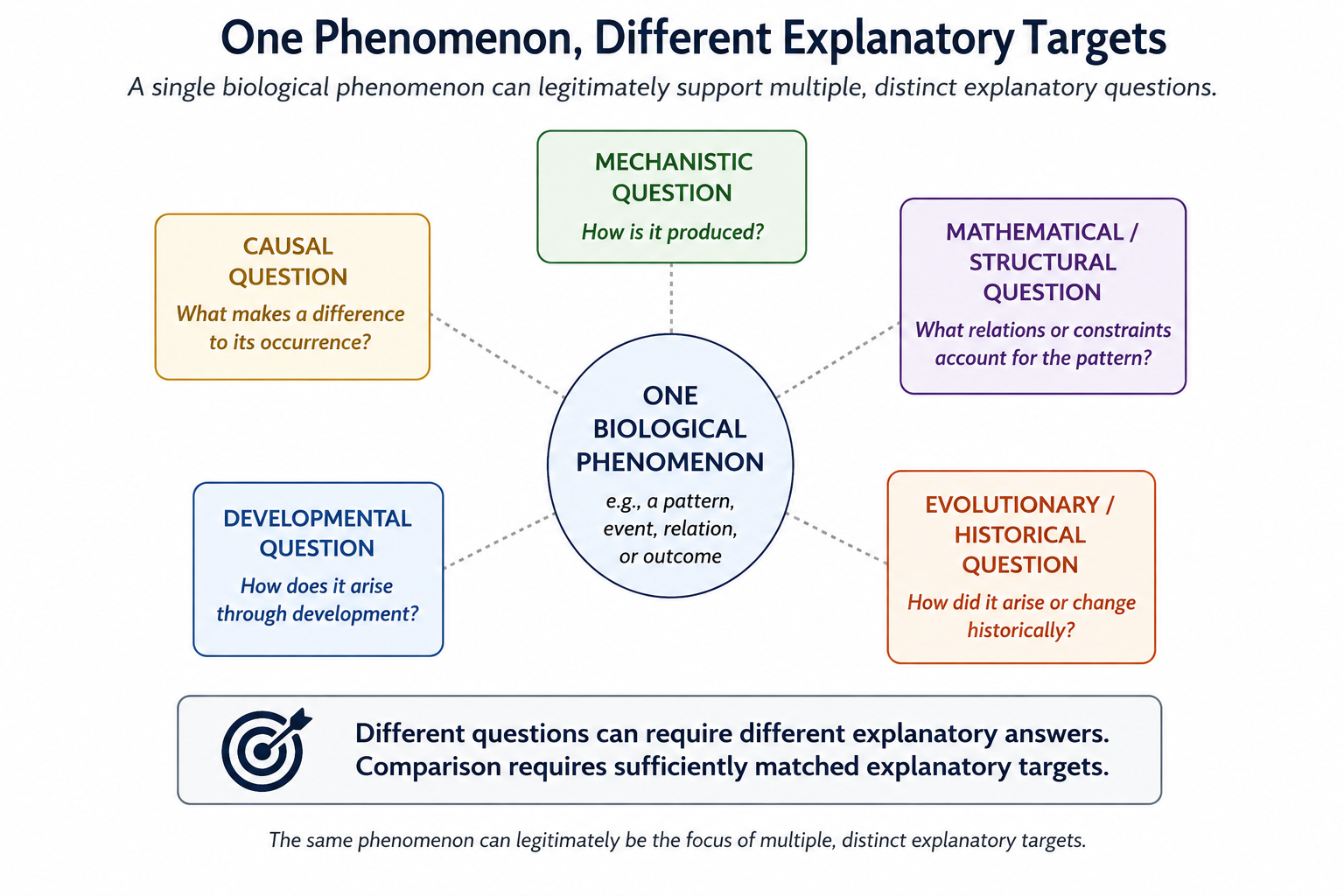
One Phenomenon, Different Explanatory Targets. A single biological phenomenon can support several legitimate explanatory questions. Different questions can require different explanatory answers, so comparison is informative only when explanatory targets are sufficiently matched.
What This Article Establishes
Scientific explanation is target-sensitive and plural in practice.
Description, prediction, modelling, causal analysis, mechanistic reconstruction, mathematical representation, unification, and scientific understanding can all contribute importantly to inquiry, but they should not be assumed to be interchangeable achievements.
Explanatory adequacy must be assessed in relation to what is being explained and what explanatory work the account claims to perform.
What This Article Does Not Establish
This article does not provide a final necessary-and-sufficient definition of scientific explanation.
-
It does not claim that every explanation is causal.
-
It does not claim that every explanation is mechanistic.
-
It does not claim that mathematical, unificatory, contrastive, or understanding-oriented explanations can all be assessed by one universal criterion.
-
And explanatory plurality does not imply that all purported explanations are equally adequate.
The next task is to understand why these different conceptions of explanation arose and how the modern debate acquired its present plural form.
Related Terms and Next Step
Glossary: scientific explanation; explanandum; explanatory target; prediction; model; understanding.
Next: 2 — How Did Scientists Learn to Think About Explanation? examines how the modern debate about scientific explanation developed historically.
See Also
Related Articles
References
- (2007). Mechanisms and Models. Cambridge University Press. https://doi.org/10.1017/CCOL9780521851282.008
- (1908). Mendelian Proportions in a Mixed Population. Science, 28(706), 49–50 . https://doi.org/10.1126/science.28.706.49
- (1948). Studies in the Logic of Explanation. Philosophy of Science, 15(2), 135–175 . https://doi.org/10.1086/286983
- (1952). A Quantitative Description of Membrane Current and Its Application to Conduction and Excitation in Nerve. The Journal of Physiology, 117(4), 500–544 . https://doi.org/10.1113/jphysiol.1952.sp004764
- (1981). Explanatory Unification. Philosophy of Science, 48(4), 507–531 . https://doi.org/10.1086/289019
- (2016). Because Without Cause: Non-Causal Explanations in Science and Mathematics. Oxford University Press. https://doi.org/10.1093/acprof:oso/9780190269487.001.0001
- (2000). Thinking About Mechanisms. Philosophy of Science, 67(1), 1–25 . https://doi.org/10.1086/392759
- (2025). Explanation in Biology. Cambridge University Press. https://doi.org/10.1017/9781009300940
- (1980). The Scientific Image. Clarendon Press.
- (2003). Making Things Happen: A Theory of Causal Explanation. Oxford University Press. https://doi.org/10.1093/0195155270.001.0001