How Did Scientists Learn to Think About Explanation?
The study of scientific explanation did not develop through a simple sequence in which one theory replaced another. This article traces a selective history from earlier concerns with cause, law, unification, and representation through the covering-law model and the branching development of causal, unificationist, contrastive, interventionist, mechanistic, non-causal, and understanding-oriented approaches.
Key Points
- Questions about cause, law, unification, and representation predate the modern philosophical debate about scientific explanation.
- Hempel and Oppenheim's 1948 covering-law account was a major crystallisation point, not the beginning of thinking about explanation.
- Problems of asymmetry and explanatory relevance showed why derivability alone could not settle what makes an explanation successful.
- Later approaches branched around different explanatory concerns rather than forming a simple sequence of replacements.
- Biology makes explanatory plurality concrete because different approaches may address different explanatory targets.
- The resulting plurality leads to the further question of what makes an explanation successful.
Where This Article Fits
This article is the second in the Methodology and Explanation sequence. First, was What Is a Scientific Explanation? which introduced scientific explanation as target-sensitive and plural in practice. It distinguished different explanatory questions and showed why explanations cannot be compared fairly without first specifying what is being explained.
This article asks a different question: How did this plurality of explanatory approaches arise?
It provides a selective intellectual history of the modern debate about scientific explanation, showing how concerns with law, causation, unification, contrast, intervention, mechanism, non-causal dependence, and scientific understanding became increasingly explicit. The article does not attempt to decide which explanatory approach is best, nor does it establish general criteria of explanatory success.
That question belongs to the next article: What Makes an Explanation Successful? The sequence is therefore:
1 — What is scientific explanation?
2 — How did explanatory plurality arise?
3 — What makes an explanation successful?
How Did Scientists Learn to Think About Explanation?
The modern study of scientific explanation has a history, but not a simple march from one victorious theory to the next.
Scientists have long asked why phenomena occur, what makes one account more illuminating than another, and whether explanation depends on laws, causes, mechanisms, mathematical relations or some other form of intelligible dependence. During the twentieth century these questions became increasingly explicit within philosophy of science. Proposed answers generated new objections, distinctions and alternatives rather than converging on a single uncontested theory.
The history of scientific explanation is therefore best understood as a history of increasingly explicit disagreement about what an explanation must accomplish.
That history matters because contemporary science inherits several legitimate explanatory traditions. Understanding how they arose helps explain why different scientific questions can require different kinds of answers.
Before the Modern Debate
Questions about explanation long predate twentieth-century philosophy of science.
Aristotle distinguished different senses in which causes answer why-questions. In the nineteenth century, John Stuart Mill treated explanation in close relation to laws and their subsumption under more general laws, while William Whewell emphasised the power of consilience: bringing apparently separate classes of facts under common principles. Pierre Duhem later sharpened questions about whether physical theory should be understood as revealing underlying reality or as representing experimental laws economically.
These thinkers should not be treated as interchangeable ancestors of later theories of scientific explanation. Their projects, assumptions and intellectual settings differed substantially. What they nevertheless show is that concerns about cause, law, unification and representation were already distinguishable before the modern philosophical debate took its recognisable form.
The early twentieth century brought further attention to logical structure, probability and the language of science. Logical empiricism made relations among observation, theoretical statements and scientific laws central philosophical concerns.
Against that background, Carl Hempel and Paul Oppenheim’s 1948 paper became a major crystallisation point for the modern debate. It did not begin philosophical reflection on explanation, but it gave the problem a particularly explicit formal structure.
The Covering-Law Moment
Hempel and Oppenheim proposed that scientific explanation could be analysed through a logical relation in which the event or regularity to be explained is derived from general laws together with relevant conditions (Hempel & Oppenheim, 1948).
This approach became associated with the covering-law conception of explanation. To explain a phenomenon was, on this model, to show how it fell under appropriate general laws and conditions.
The proposal was powerful partly because it made explanatory structure unusually explicit. It also made possible unusually precise criticism.
If a conclusion can be validly derived from laws and conditions, is that enough for explanation? Must the premises be true? Must explanation always involve laws? What distinguishes genuinely explanatory information from information that happens to be sufficient for a derivation?
These questions exposed a problem that would recur throughout subsequent work:
logical derivability and explanatory relevance are not obviously the same thing.
Why Derivation Was Not Enough
Objections to covering-law approaches showed that formally adequate derivations can appear explanatorily unsatisfactory.
Cases involving explanatory asymmetry suggested that being able to derive one fact from another does not necessarily show that the latter explains the former. Other examples suggested that irrelevant information could occur within an apparently adequate derivation without contributing to the explanation.
The debate therefore moved beyond the question:
Can the phenomenon be derived?
toward a more demanding question:
What makes the information doing the explanatory work relevant to the phenomenon being explained?
Wesley Salmon’s work helped redirect attention toward statistical relevance and causal structure (Salmon, 1984, 1990). Causal approaches sought to explain phenomena through the processes, interactions or dependencies responsible for them rather than through derivation alone.
But causation did not become an uncontested replacement for covering laws. Other approaches were developing in parallel, often because they identified different features of explanatory practice that also seemed important.
Explanation Branches
One response focused on unification.
Philip Kitcher developed an account in which explanatory power is associated with deriving many phenomena from a comparatively small set of argument patterns (Kitcher, 1981). From this perspective, explanation can contribute to understanding by reducing the number of independent assumptions or patterns required to organise what we know.
Another response emphasised the structure of the question itself.
Bas van Fraassen drew attention to the pragmatic and contrastive character of why-questions (van Fraassen, 1980). Asking why one event occurred rather than another is not necessarily the same explanatory problem as asking simply why the event occurred. Which answer is relevant can depend partly on the contrast being posed and the context of inquiry.
Causal explanation was also developed in more explicitly interventionist terms. James Woodward proposed an account centred on relationships that remain informative under possible interventions (Woodward, 2003). This connects explanatory relevance to questions about how changes in one factor would be associated with changes in another.
Meanwhile, work in the life sciences made mechanistic explanation increasingly explicit.
Rather than treating explanation primarily as deduction from general laws, mechanistic accounts ask how organised entities and activities produce, maintain or otherwise contribute to a phenomenon (Machamer, Darden, & Craver, 2000). Such explanations are particularly familiar in biology, where researchers frequently investigate how components, activities and their organisation generate or sustain a phenomenon of interest.
Yet causal and mechanistic explanation do not exhaust scientific explanation either.
Philosophers have defended forms of non-causal explanation, particularly mathematical and structural explanations in which the explanatory relation does not consist straightforwardly in identifying a cause (Lange, 2016). Scientific understanding has also become an important subject of investigation: an explanation may contribute to understanding, but explaining and understanding need not simply be identical achievements (de Regt, 2017).
The result was not an orderly series in which one theory disappeared whenever another emerged.
It was a branching debate in which different accounts made different explanatory demands explicit.
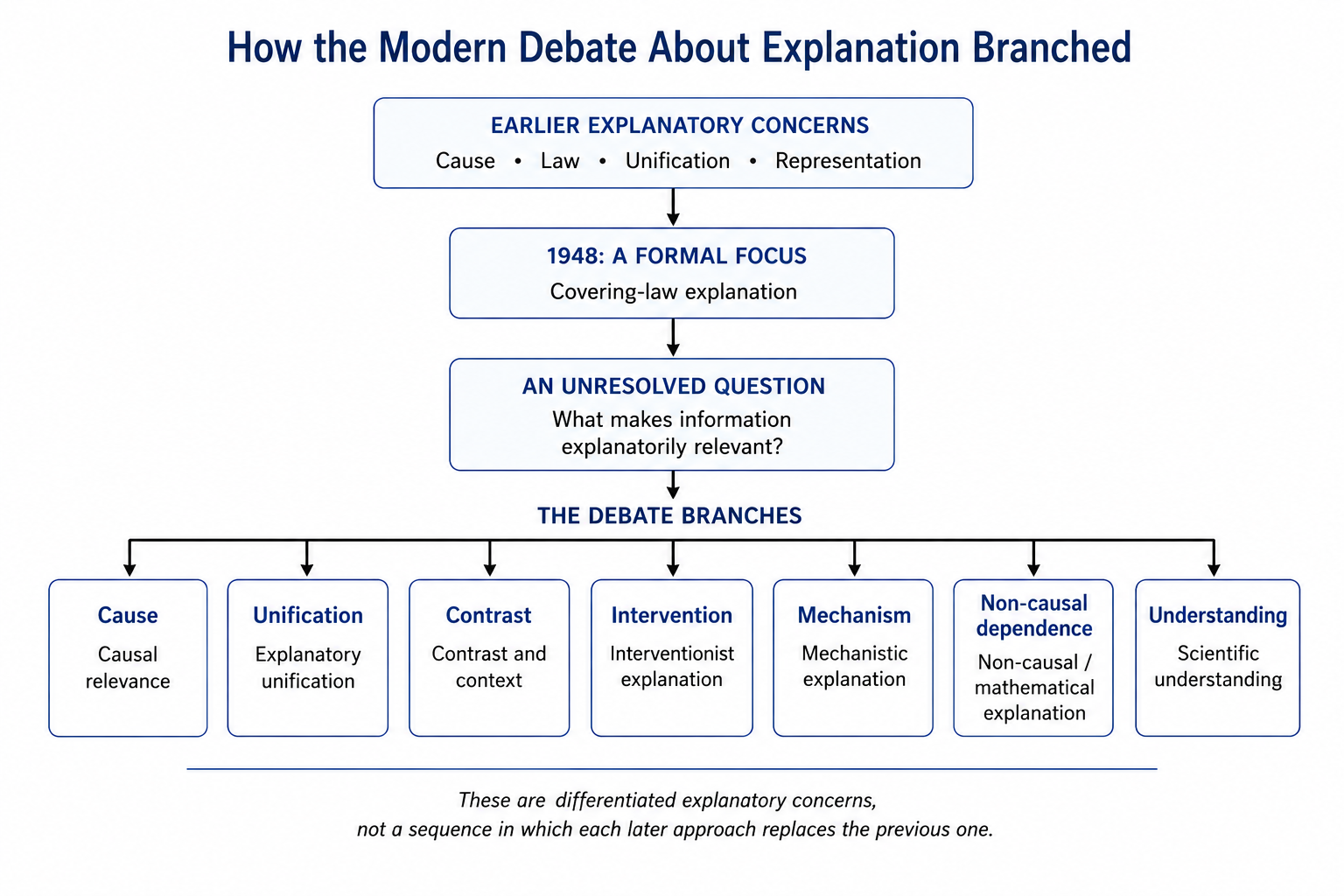
How the modern debate about explanation branched. Different explanatory concerns became increasingly explicit without forming a simple sequence in which each later approach replaced the previous one.
Biology Makes the Plurality Concrete
The life sciences make this plurality especially visible.
A biological phenomenon may be investigated through a molecular mechanism, a developmental history, an evolutionary history, a mathematical relationship, a physiological model or a dynamical system. These need not be failed versions of one another.
They may be answering different questions.
A molecular explanation may ask how particular entities and activities generate a phenomenon. An evolutionary explanation may ask how a trait or organisation arose or was transformed historically. A mathematical model may identify a dependency or constraint without reproducing a detailed causal mechanism. A dynamical account may characterise how a system’s behaviour changes over time.
The important point is not that every biological phenomenon requires all of these explanations. Nor does explanatory plurality imply that every explanation is equally successful.
Rather, it means that different explanatory approaches can be directed at different explanatory targets.
This creates a further methodological problem. If two explanations answer different questions, their difference alone cannot show that one is better than the other. Before explanations can be compared fairly, we need to know sufficiently clearly what each is trying to explain.
What History Teaches
The historical lesson is not that one account of scientific explanation finally replaced all the others.
Nor does the history establish that every proposed theory is equally adequate.
Instead, successive debates made different explanatory requirements increasingly visible: lawful dependence, causal relevance, mechanism, unification, contrast, intervention, mathematical or structural dependence, and scientific understanding.
These concerns overlap. Sometimes they compete. Sometimes they concern different explanatory targets. Sometimes more than one may be relevant to the same scientific problem.
Their relations remain debated because scientific inquiry does not ask only one kind of question or use only one kind of evidence (Salmon, 1990; Ross, 2025).
For biology this matters immediately.
A mathematical baseline, an evolutionary history, a molecular mechanism and a dynamical system model need not be failed versions of one another. Before asking which explanation is better, we must first determine what each explanation is attempting to explain and what would count as success for that explanatory task.
That is where the historical question leads.
The next problem is no longer simply:
What kinds of scientific explanation have been proposed?
It is:
If explanation can take several forms, what makes an explanation successful?
What This Article Establishes
The modern debate about scientific explanation did not converge on a single uncontested account of what all successful explanations must be.
Covering-law, causal, unificationist, pragmatic and contrastive, interventionist, mechanistic, non-causal and understanding-oriented approaches made different explanatory requirements explicit.
The resulting history is plural and branching rather than a sequence in which each new account simply superseded its predecessor.
For contemporary science, that history helps explain why different explanatory questions may require different kinds of answers.
What This Article Does Not Establish
This article is a selective intellectual map, not an exhaustive history of scientific explanation or philosophy of science.
-
It does not claim direct continuity between earlier thinkers and modern positions.
-
It does not establish that the traditions surveyed are exhaustive, mutually exclusive or equally successful.
-
It does not establish that explanatory plurality makes comparison impossible.
-
And it does not assume that historical persistence, philosophical influence or widespread use is sufficient evidence that an explanatory approach succeeds on a particular scientific target.
Related Terms and Next Step
Related glossary terms include biological explanation, explanation, explanandum, explanatory target, and mechanism.
-
Established that scientific explanation can take different forms and that explanatory comparison requires attention to what is being explained.
-
Has shown how that plurality emerged historically.
3. Next — investigates What Makes an Explanation Successful? - it turns from the history of explanatory theories to the criteria by which explanations can be assessed in scientific practice.
See Also
Related Articles
References
- (2017). Understanding Scientific Understanding. Oxford University Press. https://doi.org/10.1093/oso/9780190652913.001.0001
- (1948). Studies in the Logic of Explanation. Philosophy of Science, 15(2), 135–175 . https://doi.org/10.1086/286983
- (1981). Explanatory Unification. Philosophy of Science, 48(4), 507–531 . https://doi.org/10.1086/289019
- (2016). Because Without Cause: Non-Causal Explanations in Science and Mathematics. Oxford University Press. https://doi.org/10.1093/acprof:oso/9780190269487.001.0001
- (2000). Thinking About Mechanisms. Philosophy of Science, 67(1), 1–25 . https://doi.org/10.1086/392759
- (2025). Explanation in Biology. Cambridge University Press. https://doi.org/10.1017/9781009300940
- (1984). Scientific Explanation and the Causal Structure of the World. Princeton University Press.
- (1990). Four Decades of Scientific Explanation. University of Pittsburgh Press. https://doi.org/10.2307/j.ctt5vkdm7
- (1980). The Scientific Image. Clarendon Press.
- (2003). Making Things Happen: A Theory of Causal Explanation. Oxford University Press. https://doi.org/10.1093/0195155270.001.0001