What Happens When APS Is Tested Against Its Strongest Comparators?
A worked application of comparative explanatory methodology tests three APS propositions against their strongest relevant comparators. The results differ by proposition and target: minimal cognition retains a non-redundant boundary-classificatory role without demonstrated additional substantive biological gain; the APS function proposition encounters comparator advantage; and the A–P–S analytic interface provides coherent redescription without demonstrated additional methodological gain. The comparison supports proposition-specific, comparator-relative assessment rather than a framework-wide verdict.
Key Points
- Scientific frameworks should be tested proposition by proposition against the strongest relevant comparator on a specified explanatory target.
- Minimal cognition in Caenorhabditis elegans yields complementarity: APS retains a boundary-classificatory role, but additional substantive biological explanatory gain is not demonstrated.
- Coronary-artery malfunction yields comparator advantage: contemporary organisational accounts already perform the relevant present-tense viability-relative discrimination.
- The APS interface applied to the KaiABC oscillator yields redescription with possible heuristic utility, not demonstrated additional methodological gain.
- The three local results do not warrant a framework-wide APS success or failure verdict or reopening of the prior scientific-status determination.
Where This Article Fits
The preceding articles in this series developed the comparative methodology required for fair framework assessment. In particular, How Should the Strongest Comparator Be Chosen? established that comparator selection should proceed from a specified explanandum, contrast, and explanatory operation rather than from the identity or terminology of the candidate framework.
The present article takes the next step.
The comparator article established how the strongest relevant comparator should be chosen. PA-12 asks what happens when that controlled procedure is actually applied to selected APS propositions.
The purpose is not to defend APS, confirm APS, compare APS with one rival framework, restate APS theory, or reopen the prior scientific-status adjudication. It is a worked application in which selected APS propositions are exposed to target-matched strongest-comparator tests under conditions that permit positive, null, adverse, complementary, and unresolved results.
The unit of assessment is therefore not APS as a whole. It is a bounded proposition applied to a specified explanatory target.
Introduction
A scientific framework should not be assessed by asking whether it sounds plausible, whether its concepts fit together, or whether it can redescribe familiar phenomena in its own terms. Nor should it be judged by comparing it with a conveniently weak rival. A stronger test asks what a specific framework claim enables us to explain, discriminate, constrain, or infer that the strongest relevant alternative does not already enable us to do.
That requirement creates a difficulty for frameworks such as Agency–Process–Scale (APS). APS contains different kinds of propositions. Some concern biological boundaries, some concern function or organisation, and some concern how explanatory problems should be analysed. It would therefore be misleading to ask whether APS as a whole simply “passes” or “fails.”
This article applies a controlled comparative method to three deliberately different APS propositions. The cases were chosen before comparative outcomes were known, and the strongest relevant comparators were specified before APS was adjudicated against them. Positive, null, adverse, complementary, and unresolved outcomes were all permitted.
The three tests do not produce the same result.
A minimal-cognition proposition retains a non-redundant boundary-classificatory role but does not demonstrate additional substantive biological explanatory capacity. A present-tense function proposition encounters a stronger target-matched organisational comparator. The APS analytic interface provides a coherent reorganisation of an established explanatory problem but does not demonstrate additional methodological gain.
These different outcomes are not a defect in the test. They are what propositional testing is designed to reveal.
What Is Being Tested?
A fair comparative test must identify exactly what is at stake before asking which explanation performs better.
For each worked test, six elements are fixed: an APS proposition, a specified explanandum, a claimed explanatory operation, a bounded biological or analytic case, a strongest relevant comparator or comparator configuration, and an evidential record against which the comparison is made.
The general form is:
APS proposition × explanatory target × claimed explanatory operation × case × strongest comparator × evidence.
This matters because a framework can contain propositions with very different evidential burdens.
A claim about the boundary of cognition is not tested in the same way as a claim about biological function. An analytic interface is not assessed in the same way as a substantive biological hypothesis. A framework-wide conclusion cannot therefore be inferred simply by counting favourable and unfavourable local results.
The controlling comparative question is:
What does the candidate explanation enable us to explain, discriminate, constrain, or infer that the strongest relevant comparator does not already enable us to do?
A difference in terminology is not enough. Neither are conceptual elegance, integration, compatibility, broader vocabulary, novelty of presentation, or the fact that the candidate asks a question the comparator does not formulate in the same language.
Explanatory gain requires additional capacity relative to the specified target.
Why These Three Tests?
The portfolio was deliberately kept small.
The aim was not to test every APS proposition, nor to maximise conceptual coverage. It was to select the minimum heterogeneous set capable of exposing APS to materially different kinds of comparative pressure.
The first proposition concerns minimal cognition. APS proposes a boundary discriminator intended to distinguish minimal cognition from sophisticated but non-cognitive regulation. The selected case is food–odour associative learning in Caenorhabditis elegans.
The second concerns biological function. APS proposes a present-tense viability-relative criterion for distinguishing functional contribution from mere causal effect and malfunction. The selected case is coronary-artery stress-response malfunction.
The third concerns the APS analytic interface itself. The question is whether Agency, Process, and Scale improve explanatory problem decomposition when transferred to a complex case not used to construct the framework. The selected problem is explanation of the KaiABC cyanobacterial circadian oscillator.
The three cases therefore test different things.
The first tests boundary discrimination.
The second tests substantive explanatory distinctiveness under unusually close comparator pressure.
The third tests analytic transfer.
Previously examined APS cases were not reopened simply to search for a more favourable outcome. Earlier null results remained untouched.
How the Comparisons Were Controlled
Four controls govern all three tests.
First, the target was fixed before comparator selection. The comparator field was constructed from the explanandum outward rather than from APS outward.
Second, the strongest relevant comparator was reconstructed. Where explanatory resources were genuinely distributed across several established approaches, those resources were credited together rather than forcing the comparison into an artificial one-theory-versus-one-theory form.
Third, the comparator configuration was specified before outcome adjudication. It could not later be weakened or replaced because APS performed poorly.
Fourth, adverse outcomes were treated as legitimate results. Complementarity, comparator advantage, redescription, no additional gain, non-comparability, and unresolved status were all permissible.
A Fair Test Must Permit Different Outcomes
A fair test must allow the candidate framework to succeed, but it must also permit the strongest comparator to succeed, permit both to contribute differently, or permit no additional gain to be found.
A method that cannot return those outcomes is not a genuine test.
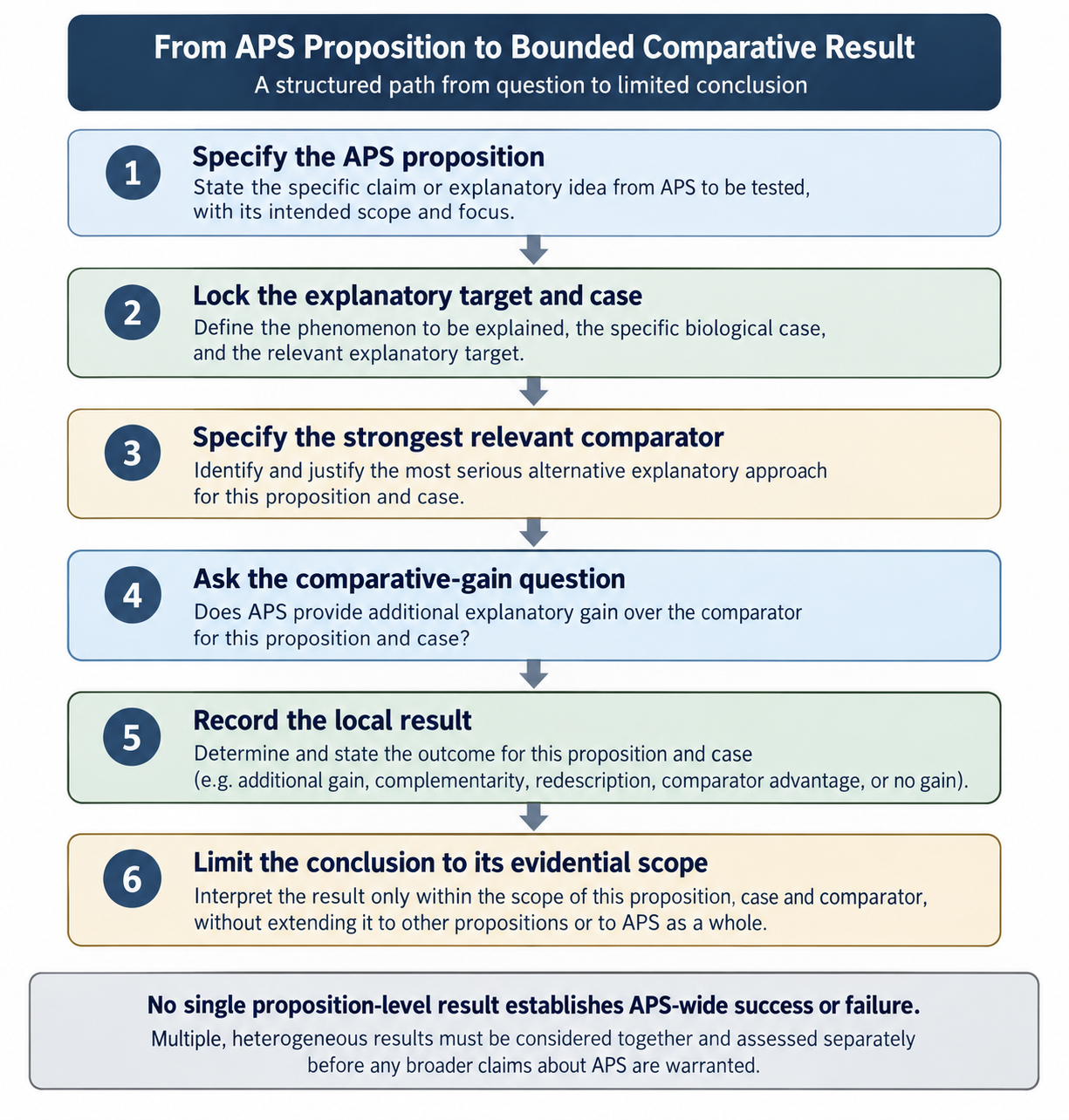
From APS Proposition to Bounded Comparative Result. A proposition-level test begins with a specified APS claim and locked explanatory target, identifies the strongest relevant comparator before outcome adjudication, asks whether APS adds explanatory capacity, and limits the resulting conclusion to the evidence actually obtained. No single local result establishes APS-wide success or failure.
Test One — Minimal Cognition in C. elegans
The APS proposition
APS distinguishes biological agency from cognition.
Its minimal-cognition proposal is intended to identify when biological regulation becomes cognitive without treating every form of responsiveness, learning, memory, or adaptive control as cognition.
The operative proposition is that cognition begins when temporally integrated biological significance modulates activity among materially available viability-relevant possibilities in ways not exhausted by immediate or fixed regulation.
For the present test, the key burden is discriminatory.
It is not enough to show that an organism learns.
It must be shown that the proposed APS criterion performs boundary work that cannot simply be recovered from established accounts of learning, memory, regulation, and behavioural control.
The case and target
The selected case is food–odour associative learning in C. elegans.
This is a useful boundary case because the behaviour is clearly more than an immediate stimulus–response relation.
Food availability can alter subsequent attraction to odours. Different nutritional experiences can produce different later behavioural responses. Learning can persist across time, and later navigation reflects previous experience rather than only the organism’s current sensory state.
Nuttley, Atkinson-Leadbeater, and van der Kooy (2002) showed that food–odour associative learning in C. elegans depends on the relation between odour and food rather than exposure alone, with serotonergic involvement. Torayama, Ishihara, and Katsura (2007) demonstrated integration of butanone and food signals and subsequent enhancement of chemotaxis to butanone.
Subsequent work extended the explanatory picture. Kauffman et al. (2010) investigated learning and memory across age and dietary conditions and connected long-term memory with molecular mechanisms. Cho et al. (2016) showed that sensory history and behavioural preference can be encoded through distinguishable neural processes. Chen et al. (2025) demonstrated that learning differentially alters identifiable whole-animal navigation strategies.
The locked target is therefore:
How does prior food-related experience reorganise later odour-guided behaviour in C. elegans, and does the organisation of that behaviour warrant crossing the boundary from sophisticated regulation to minimal cognition?
The strongest comparator
The strongest comparator is not one named theory of learning.
It is the distributed contemporary explanatory repertoire comprising associative learning, memory and retention, sensory plasticity, neural-circuit modulation, molecular implementation, and learned sensorimotor navigation.
These resources collectively explain why previous nutritional conditions alter later behavioural organisation.
They therefore constitute a much stronger comparator than a thin description such as “stimulus–response learning.”
What APS would need to add
APS would have to do more than redescribe learned valence, retained association, or altered action selection as biological significance.
It would need to show that its boundary criterion yields an additional discrimination.
The strongest version of the APS question is therefore:
Does temporally integrated biological significance across viability-relevant possibilities distinguish something biologically important that the established learning–memory–circuit account leaves unresolved?
Comparative result
The evidence supports two conclusions that must remain separate.
First, the empirical pattern to which the APS discriminator applies is present: the behaviour is temporally extended and context-sensitive, previous consequences alter later activity, and the organism does not simply react in a fixed way to the same cue.
Second, however, the strongest comparator already explains the production, retention, and behavioural expression of those changes.
The established learning literature explains why the cue is treated differently after different histories. Neural and molecular work explains how that change is implemented. Navigation work explains how learning reorganises whole-animal behaviour.
APS therefore does not presently establish an additional mechanism, dependency, intervention consequence, or prediction.
What it does retain is an explicit classificatory question:
At what point should such temporally extended, consequence-sensitive regulation count as cognition rather than sophisticated non-cognitive control?
The distributed mechanistic comparator does not itself supply one general answer to that boundary question.
What survives
Complementarity: APS retains a non-redundant boundary-classificatory role, but additional substantive biological explanatory gain is not demonstrated.
The comparator explains how the learned organisation is produced.
APS supplies a criterion for asking whether that organisation should count as minimal cognition.
That is genuine non-redundancy, but it is narrower than substantive biological explanatory superiority.
The result also means that C. elegans should not be presented simply as a positive demonstration of APS-specific explanatory gain.
Test Two — Function and Coronary Malfunction
The APS proposition
APS treats biological function as a present-tense viability-relative organisational contribution.
The proposition is designed to distinguish what a component merely does from what it contributes to the continued organisation of the living system.
This distinction should be especially important in malfunction.
A component may continue operating while no longer contributing adequately to the conditions under which the system persists.
The case and target
The selected case is coronary-artery stress-response malfunction.
The artery remains causally active. It is not inert. Yet under increased physiological demand it fails to dilate sufficiently to provide the blood flow required by the changed conditions of the system.
The target is therefore not simply:
What is the function of a coronary artery?
The target is:
How should we characterise a case in which causal operation continues but adequate functional contribution does not?
This is a strong test because activity and function can come apart.
The strongest comparators
The comparator environment is unusually close to APS.
Mossio, Saborido, and Moreno (2009) already developed an organisational account in which biological function is grounded in present contribution to the maintenance of an organised system.
Moreno and Mossio (2015) developed this organisational framework further within a general theory of biological autonomy.
More recently, Barandiaran (2026) reconstructs both a dual-order approach to organisational malfunction and a viability-based normative-field alternative. The coronary example is addressed directly within this literature.
The strongest comparator therefore does not merely say that functions are historically selected effects or that components play causal roles.
It already possesses resources for distinguishing continued operation, required contribution, insufficient contribution, physiological regime, viability, and graded malfunction.
What APS would need to add
APS would need to discriminate the case in a way that those organisational accounts do not.
The key question is therefore:
Does present-tense viability-relative organisational contribution identify an additional functional or malfunction distinction, prediction, dependency, or intervention consequence beyond what the strongest organisational comparator already provides?
Comparative result
On this target, the answer is no.
The central APS distinction is substantially anticipated.
The strongest contemporary organisational comparator already distinguishes operation from adequate contribution and locates malfunction relative to the requirements of the living system.
The normative-field formulation goes further by offering a more developed account of degrees and regimes of malfunction in relation to viability.
APS can describe the coronary case clearly:
the artery remains active, but its activity no longer contributes adequately to viable organisation under increased demand.
But that description does not add a new classification.
Nor does the frozen APS proposition presently provide a more developed threshold, intervention criterion, dependency structure, or graded account than the strongest comparator.
The result is therefore stronger than simple no-additional-gain.
The comparative asymmetry favours the comparator.
What survives
Comparator advantage: the strongest organisational comparator already performs the relevant explanatory discrimination and presently has the target-specific advantage.
This does not establish that APS accounts of function are generally false.
It establishes something much narrower and more important:
the coronary-malfunction case cannot presently be used as evidence that APS provides a distinctive explanatory account of function beyond the strongest contemporary organisational alternatives.
The result should not be softened into a claim of convergence.
Convergence may describe similarity.
It does not establish explanatory gain.
Test Three — APS and the KaiABC Oscillator
The APS proposition
The third test differs from the first two.
It does not concern a substantive biological claim.
It tests the APS interface as an analytic device.
Agency, Process, and Scale are complementary analytic projections of one living organisation rather than independent components or biological levels.
The methodological claim is that separating questions about activity, continuity through change, and spatial or temporal extent may improve the decomposition of complex biological explanatory problems.
The burden is therefore practical and analytic.
A–P–S must do more than provide alternative labels for distinctions that competent scientific practice already makes.
The case and target
The selected problem is explanation of the KaiABC cyanobacterial circadian oscillator.
Nakajima et al. (2005) demonstrated that the core KaiC phosphorylation rhythm can be reconstituted in vitro using KaiA, KaiB, KaiC, and ATP.
The system subsequently became a major target for biochemical, structural, dynamical, and modelling research.
Qin et al. (2010) connected intermolecular associations with oscillator dynamics and linked experimental measurements with modelling. Johnson, Stewart, and Egli (2011) reviewed the system across structural, biochemical, biophysical, and modelling perspectives.
KaiABC is therefore an appropriate transfer case because its explanatory structure is already rich.
Researchers distinguish questions concerning molecular interaction, phosphorylation and dephosphorylation, biochemical mechanism, oscillator dynamics, synchronisation, robustness, model-specific targets, and the relation between the minimal in-vitro oscillator and broader cellular organisation.
The target is not:
Can KaiABC be described in APS language?
It is:
Does the A–P–S interface improve the organisation of this established explanatory problem relative to competent existing practice?
The strongest comparator
The strongest comparator is the distributed explanatory-analysis repertoire already used in KaiABC research: mechanistic decomposition, dynamical and mathematical modelling, target-sensitive model plurality, and cross-extent systems analysis.
This matters because KaiABC researchers do not generally treat “the explanation” as one undifferentiated object.
Different models and experiments answer different questions.
Changing the explanandum changes what counts as sufficient explanation.
What APS would need to add
APS could plausibly organise the case.
Agency can direct attention to relevant living-system activity where an agent-level activity is genuinely part of the target.
Process can direct attention to the maintenance and temporal organisation of rhythmic continuity.
Scale can direct attention to the spatial and temporal extents across which molecular interactions, ensemble synchronisation, and wider cellular coupling matter.
The framework does not require all three projections to receive equal explanatory priority.
The comparative question, however, is stricter:
Does the tripartite interface separate explanatory questions that established KaiABC practice otherwise conflates or fails to identify?
Comparative result
The present evidence does not demonstrate that it does.
Established KaiABC practice already distinguishes mechanism from dynamics, model-specific targets from system-level questions, and microscopic processes from broader temporal and ensemble behaviour.
APS can reorganise these distinctions coherently.
It can provide a compact way of asking what activity matters, how continuity is maintained, and over what extent the relevant organisation must be analysed.
But the underlying distinctions are already recoverable from established scientific practice.
No independent-user comparison has shown that A–P–S reduces conflation, improves transfer, increases inter-analyst consistency, exposes a dependency otherwise missed, or increases analytic reliability.
What survives
Redescription with possible heuristic utility: APS provides coherent analytic reorganisation, but the relevant distinctions are already recoverable from established explanatory practice.
This does not mean the interface is useless.
It means that usefulness has not crossed the threshold into demonstrated additional methodological explanatory capacity.
That result must also remain separate from substantive biological evidence for APS.
A successful analytic interface would not by itself show that an APS biological proposition is true.
What the Three Tests Show
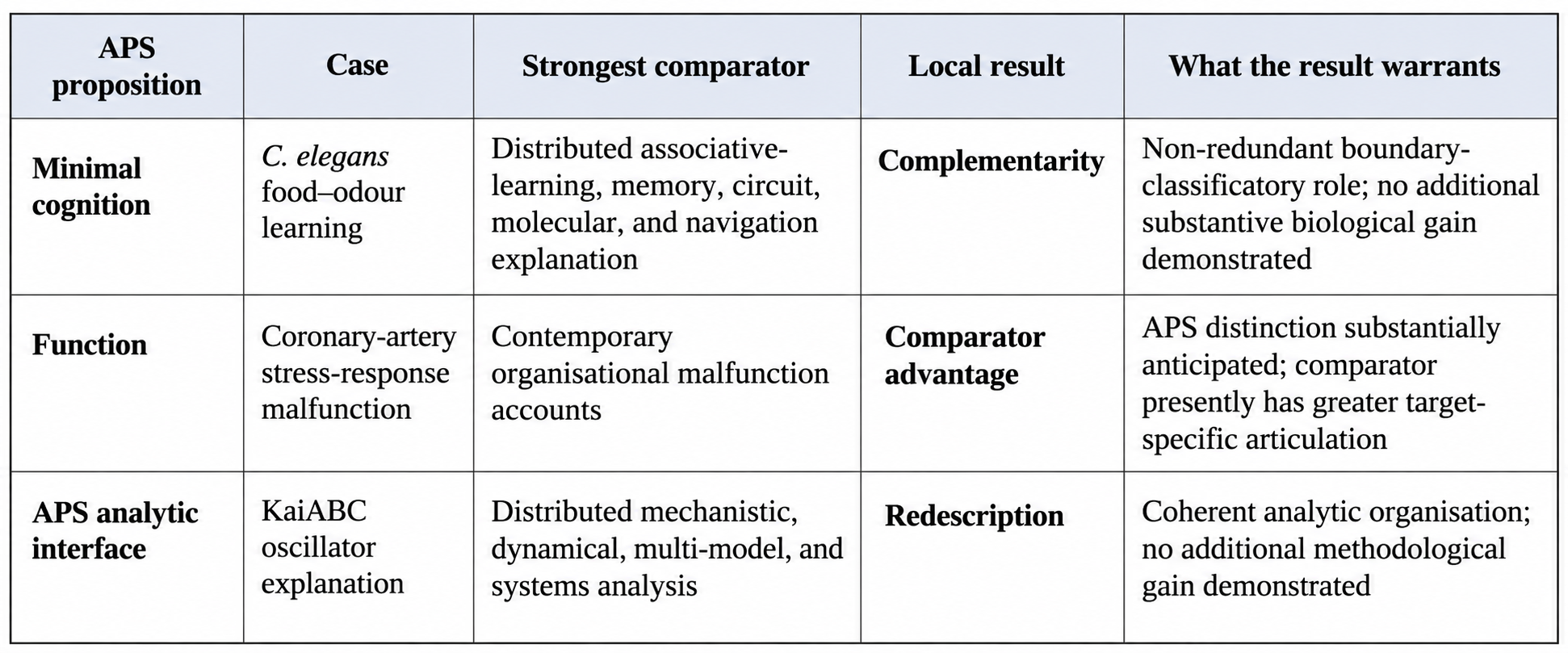
The table should not be read as a scorecard.
There is no meaningful arithmetic in which complementarity receives one point, comparator advantage subtracts one, and redescription receives half a point.
The propositions make different kinds of claims.
Their outcomes therefore have different scientific meanings.
Why the Results Differ
A framework need not succeed or fail uniformly because its propositions need not carry the same explanatory burden.
The minimal-cognition proposition is primarily a boundary claim.
It asks where cognition begins.
The strongest learning and neural comparator can explain the C. elegans behaviour without thereby supplying one general account of the cognition boundary. APS therefore retains a classificatory role even though it does not demonstrate an additional biological mechanism.
The function proposition is different.
It makes a stronger claim about how function and malfunction should be explained in present organisational terms.
Here the comparator operates on almost exactly the same conceptual territory. Once its strongest contemporary form is credited, the scope for APS-specific residual explanatory work becomes much smaller.
The APS interface is different again.
It is an analytic resource.
Its success would concern problem decomposition, explanatory navigation, or transfer—not biological mechanism or constitutive dependency. The KaiABC test therefore cannot be placed on the same evidential scale as the cognition and function tests.
This is why framework testing must remain claim-sensitive.
A global question such as “Is APS better?” collapses important distinctions before the comparison has even begun.
What This Worked Test Establishes
The strongest result of this investigationis not that APS succeeds or fails. It is that strongest-comparator testing produces meaningful discrimination among APS propositions. The method did not automatically confirm the framework.
-
It did not force every result into a binary win–loss relation.
-
It retained complementarity where different explanatory functions survived.
-
It retained comparator advantage where the strongest alternative already carried more of the relevant burden.
-
It retained redescription where a framework resource remained coherent and potentially useful but did not establish additional comparative capacity.
This is important because framework testing is often discussed abstractly. It is relatively easy to say that a scientific framework should be testable or compared with alternatives. It is much harder to preserve that discipline when the candidate framework is one whose concepts are already familiar and whose broader intellectual programme is internally coherent.
The worked tests show what a genuine opportunity to fail or narrow looks like in practice.
A null or adverse result does not make the methodology fail.
It makes the methodology informative.
What It Does Not Establish
The investigation does not establish a framework-wide verdict.
-
It does not show that APS “passes.”
-
It does not show that APS “fails.”
-
It does not establish that minimal cognition has achieved substantive explanatory superiority.
-
It does not establish that APS’s account of biological function is generally false.
-
It does not establish that the A–P–S interface lacks heuristic value.
-
It does not identify one rival framework that defeats APS across all targets.
-
It does not reopen the prior scientific-status adjudication.
The scientific-status reconsideration threshold was examined after the three local verdicts were fixed.
That gate remained closed.
This is not because adverse results automatically preserve a previous status. It is because the present worked tests did not generate the kind of new substantive result required to justify a separate scientific-status reconsideration.
Minimal cognition retained a non-redundant classificatory role but did not demonstrate an APS-specific biological consequence beyond the strongest comparator.
Function yielded comparator advantage.
The APS interface yielded methodological redescription rather than demonstrated additional gain. Methodological usefulness cannot substitute for a substantive biological success. Accordingly, the existing scientific-status determination remains outside PA-12 and unchanged.
The investigation neither confirms nor reassigns it.
Conclusion — What Happens When APS Is Actually Tested?
A framework does not have to receive one global verdict for a test to be scientifically informative.
When selected APS propositions are compared with their strongest relevant alternatives, different things happen.
The minimal-cognition proposition survives as a non-redundant way of organising the boundary question, but it does not yet demonstrate an additional biological explanatory dependency.
The function proposition encounters a comparator that already performs the relevant present-tense viability-relative discrimination and currently provides greater target-specific articulation.
The APS interface reorganises an established explanatory problem coherently, but the relevant distinctions are already recoverable without it.
The resulting picture is therefore neither vindication nor rejection. It is differentiation.
That is precisely what comparative explanatory methodology should make possible.
Framework testing is most informative when it reveals where a claim remains distinctive, where it becomes complementary, where its explanatory work is already available elsewhere, and where usefulness does not amount to explanatory gain.
For APS, the implication is correspondingly bounded.
Some propositions may remain scientifically interesting without yet demonstrating distinctive explanatory capacity. Others may require narrowing under comparator pressure. Analytic resources may remain useful even when they do not outperform competent existing practice.
Those are not failures to reach the “real” verdict. They are the verdicts appropriate to the propositions actually tested.
The broader lesson is methodological.
A new framework deserves its strongest fair test and a genuine opportunity to succeed. But the same test must leave open the possibility that the strongest comparator already does the work, that the candidate contributes only something different rather than something better, or that the claimed gain is not demonstrated.
Only under those conditions can a framework genuinely learn from comparison.
See Also
Related Articles
References
- (2026). Organizational Accounts of Malfunction: The Dual-Order Approach and the Normative Field Alternative. Biological Theory, 21(1), 51–69 . https://doi.org/10.1007/s13752-025-00500-z
- (2016). Parallel Encoding of Sensory History and Behavioral Preference during Caenorhabditis elegans Olfactory Learning. eLife, 5 . https://doi.org/10.7554/eLife.14000
- (2011). The Cyanobacterial Circadian System: From Biophysics to Bioevolution. Annual Review of Biophysics, 40, 143–167 . https://doi.org/10.1146/annurev-biophys-042910-155317
- (2010). Insulin Signaling and Dietary Restriction Differentially Influence the Decline of Learning and Memory with Age. PLOS Biology, 8(5) . https://doi.org/10.1371/journal.pbio.1000372
- (2015). Biological Autonomy: A Philosophical and Theoretical Enquiry. Springer. https://doi.org/10.1007/978-94-017-9837-2
- (2009). An Organizational Account of Biological Functions. The British Journal for the Philosophy of Science, 60(4), 813–841 . https://doi.org/10.1093/bjps/axp036
- (2005). Reconstitution of Circadian Oscillation of Cyanobacterial KaiC Phosphorylation in Vitro. Science, 308(5720), 414–415 . https://doi.org/10.1126/science.1108451
- (2002). Serotonin Mediates Food-Odor Associative Learning in the Nematode Caenorhabditis elegans. Proceedings of the National Academy of Sciences, 99(19), 12449–12454 . https://doi.org/10.1073/pnas.192101699
- (2010). Intermolecular Associations Determine the Dynamics of the Circadian KaiABC Oscillator. Proceedings of the National Academy of Sciences of the United States of America, 107(33), 14805–14810 . https://doi.org/10.1073/pnas.1002119107
- (2007). Caenorhabditis elegans Integrates the Signals of Butanone and Food to Enhance Chemotaxis to Butanone. Journal of Neuroscience, 27(4), 741–750 . https://doi.org/10.1523/JNEUROSCI.4312-06.2007