How Should the Strongest Comparator Be Chosen?
Fair explanatory comparison requires a prior decision about what the candidate explanation should be compared against. This article develops an explicit target-first procedure for selecting the strongest relevant comparator by distinguishing eligibility, adequacy and priority, reconstructing serious alternatives in their strongest defensible contemporary forms, recognising legitimate distributed explanatory resources, controlling independently motivated extensions, and recording the comparator specification before explanatory-gain adjudication.
Key Points
- Comparator selection begins with the explanatory target, not with the identity or reputation of the candidate framework.
- Eligibility, adequacy and priority are distinct stages in determining the strongest relevant comparator.
- The appropriate comparator may be a single account, multiple independent accounts or a minimum distributed set of established explanatory resources.
- Fair reconstruction must avoid both resource stripping and retrospective comparator inflation.
- Comparator selection establishes the strongest fair test environment; it does not determine explanatory gain.
Where This Article Fits
The preceding article, How Should a New Scientific Framework Be Tested?, established that a scientific framework should face sufficiently strong relevant alternatives under conditions that leave genuine possibilities of failure, limitation and null result.
That requirement raises another question:
How are those alternatives to be identified?
This article addresses that prior methodological problem.
Framework testing establishes why serious alternatives matter. Comparator selection establishes which alternatives should enter a particular explanatory comparison and in what form. Only after that work has been completed should the comparison proceed to questions of redundancy, discrimination or explanatory gain.
The sequence is therefore:
framework-testing requirement → comparator selection → comparative adjudication
Comparator selection is an input control on comparison. It does not determine its outcome.
Introduction
Scientific explanations are often evaluated comparatively. A new explanation may be said to clarify what an earlier account leaves obscure, distinguish possibilities that another account cannot distinguish, or explain a phenomenon that an established framework does not adequately capture. Such claims depend on comparison.
But comparison contains a prior methodological problem.
Before asking whether one explanation performs better than another, we need to know what it should fairly be compared against.
The answer is not always obvious. The most familiar theory may address a different explanatory problem. A historically important alternative may no longer represent the strongest contemporary account. Relevant explanatory resources may be spread across several models rather than contained in one named framework. And if the comparator changes after the outcome of the comparison becomes visible, apparent explanatory gain can be manufactured or protected retrospectively.
Comparator selection is therefore part of the design of explanatory assessment.
This article develops an explicit procedure for controlling that stage. Its constituent principles are not wholly new. Contrastive accounts of explanation have long emphasised the importance of specifying what is being explained and relative to what contrast; work on theory comparison, model pluralism and inference to the best explanation has likewise shown that scientific alternatives cannot always be ordered by one simple criterion (van Fraassen, 1980; Kuhn, 1977; Laudan, 1977; Lipton, 2004; Marchionni, 2008; Gijsbers, 2016; Weisberg, 2013).
The contribution proposed here is more modest. It is an operational synthesis: a way of making comparator selection explicit, auditable and prior to the assessment of explanatory gain.
The Hidden Problem in Explanatory Comparison
A comparison can be formally careful and still be misleading if the comparator was poorly chosen.
Several distortions are possible.
A candidate explanation may be compared with the most familiar alternative rather than the one most relevant to the explanatory target. A contemporary proposal may be compared against an obsolete or simplified version of an established account. Two frameworks may be treated as rivals because they concern the same biological system even though they address different explanatory questions. Explanatory resources distributed across several models may be ignored because no single framework contains terminology matching the candidate proposal.
The reverse problem can also occur. A comparator may be expanded after the result becomes visible, acquiring new resources until any apparent difference disappears. Or the candidate itself may be strengthened, narrowed or redefined once an unfavourable comparison emerges.
These are not merely rhetorical problems. They affect what the comparison is capable of showing.
The comparator is part of the test design.
A fair assessment requires some account of why this alternative, in this form, is the appropriate standard against which this particular explanatory claim should be examined.
Start with the Explanatory Target
Comparator selection should begin with the explanatory task rather than the identity of the candidate framework.
Scientific phenomena support multiple questions. To explain why a system exhibits a particular behaviour is not necessarily the same task as explaining the mechanism that produces it, the conditions under which it persists, its evolutionary history, or its biological function.
Contrastive approaches to explanation make this dependence especially clear. What counts as explanatorily relevant can depend on what is being explained and on the contrast against which the question is posed (van Fraassen, 1980). A question of the form “Why X?” may therefore differ importantly from “Why X rather than Y?”
Before searching for a comparator, four things should consequently be specified.
First, the explanandum: what exactly requires explanation?
Second, the relevant contrast, where one materially structures the explanatory question.
Third, the candidate claim itself. Broad framework claims often need to be decomposed into narrower propositions before useful comparison is possible.
Fourth, the claimed explanatory operation. Is the candidate offering a causal explanation, identifying a mechanism, establishing a dependency, distinguishing possible cases, supporting a counterfactual inference, predicting an outcome, defining a boundary, explaining a function, or performing some other explanatory task?
These distinctions matter because a candidate can appear superior simply by being compared with an account doing something different.
Comparator selection therefore proceeds from:
explanandum → contrast → candidate claim → explanatory operation
Only then should the comparator field be constructed.
Relevance Comes Before Strength
The phrase strongest comparator can be misleading if strength is treated as a general property of a theory.
There need be no scientifically strongest theory in the abstract. Theory evaluation is sensitive to problems, purposes and explanatory tasks, and different explanatory approaches may remain legitimate where they illuminate different aspects of a phenomenon (Kuhn, 1977; Laudan, 1977; Marchionni, 2008; Gijsbers, 2016).
Comparator selection therefore requires two questions to be separated.
The first is:
Is this account relevant to the explanatory task?
Only after that question has been answered should we ask:
How strong a comparator is it for this task?
An influential or comprehensive framework may be a poor comparator if it does not substantially address the locked explanandum. Conversely, a narrower model may provide the strongest challenge to a specific explanatory claim because it already performs much of the relevant explanatory work.
|
The Strongest Comparator Is Not Necessarily the Most Famous Theory Scientific prominence and comparator relevance are different questions. A theory does not become the correct comparator simply because it is widely known, historically influential or dominant within a field. The relevant comparator is determined by the explanatory task, not by reputation or superficial similarity to the candidate framework. |
Construct the Comparator Field
Once the explanatory target has been specified, comparator search should proceed outward from that target.
The governing question is:
Which established accounts already address this explanandum or perform materially overlapping explanatory work?
This differs from asking which theories are usually portrayed as competitors.
Historical disagreement can be informative, but historical rivalry is not sufficient for comparator relevance. Neither is terminological similarity. Two theories may use very different vocabulary while supporting substantially the same explanatory discrimination. Two frameworks using similar vocabulary may nevertheless be answering different questions.
Candidate comparators should therefore be screened for eligibility.
An account is eligible where its established resources materially address the same explanatory task: the explanandum, a relevant dependency, a classificatory distinction, a counterfactual relation, an intervention question, or another consequence central to the candidate claim.
Where an account concerns a materially different target, the appropriate disposition is not “weaker comparator.”
It is:
target-different — not a comparator for this claim
This distinction matters because the same organism, process or data set can support several legitimate explanations.
Same system does not mean same explanandum.
Comparator-field construction should also have a stopping condition. It is not necessary to identify every conceivable alternative. The field is sufficiently constructed when the major established approaches materially relevant to the locked task have been represented and additional candidates add no materially distinct explanatory resources likely to change comparator selection.
The aim is sufficient coverage for a fair comparison, not exhaustive literature accumulation.
Reconstruct the Strongest Defensible Version
Eligibility is not enough.
An eligible comparator must next be reconstructed adequately.
A comparison against a weak, outdated or strategically simplified version of an alternative is not a serious test. The comparator should therefore be represented in its strongest defensible contemporary form.
This involves crediting resources that genuinely belong to the established account: relevant conceptual distinctions, mechanisms, models, empirical findings, formal resources, recognised elaborations and established replies.
Where possible, reconstruction should rely on primary or authoritative sources rather than allowing a rival framework to define what its comparator can explain.
But strongest reconstruction has a limit.
Fairness does not require charitable inflation.
A comparator should not be granted explanatory resources it does not actually possess, nor should speculative additions be treated as though they were already part of the established account. “Strongest defensible” means strongest supported version, not strongest imaginable version.
The methodological task is therefore to avoid both resource stripping and comparator rescue.
What If the Alternative Is Distributed?
Scientific explanation does not always come packaged in one theory.
This creates an important difficulty for comparative assessment.
Suppose a candidate framework introduces one compact concept that brings together several explanatory relations. Existing science may contain no single concept with the same name or scope. It does not follow that the underlying explanatory capacity is absent.
Relevant resources may be distributed across several models, mechanisms or explanatory approaches.
Work on model pluralism and robustness already demonstrates that multiple models may legitimately contribute to understanding one scientific problem without being reducible to a single representation (Weisberg, 2013). Explanatory pluralism likewise allows distinct explanations to stand in complementary, partially overlapping or non-integrative relations rather than fitting one universal ordering (Marchionni, 2008; Gijsbers, 2016).
Comparator selection should therefore permit three forms.
A single comparator is appropriate where one established account supplies the relevant strongest challenge.
Multiple comparators are appropriate where materially different established accounts independently address the same locked explanatory claim and should remain separately assessable.
A distributed comparator is appropriate where the relevant explanatory capacity is genuinely spread across a minimum coherent set of established resources.
But distributed comparison introduces its own danger.
One cannot combine every useful scientific result into an artificial super-comparator. That would make explanatory addition almost impossible by construction.
The resources must independently bear on the locked target, be scientifically capable of functioning together for that problem, and form only the minimum set needed to represent the relevant established explanatory capacity.
A distributed comparator should reveal explanatory resources already present in scientific practice, not create a new synthetic theory for the purpose of defeating the candidate.
When Does an Extension Still Count as the Same Comparator?
Scientific accounts change.
A comparator that cannot evolve would be artificially weak. A comparator that can absorb any new resource without restriction would be artificially invulnerable.
Comparator selection therefore needs a controlled distinction between legitimate development and ad hoc rescue.
An extension should normally be credited when it is independently motivated within the comparator’s own scientific programme, supported by evidence or problems that do not depend solely on defeating the candidate, consistent with its established explanatory commitments, and not so substantial that it effectively creates a different framework.
The question is:
Could the comparator recover the relevant consequence through a development independently warranted by its own explanatory programme?
If yes, the extension may remain part of the comparator.
If it can do so only by importing the candidate’s resources after the candidate appears to possess an advantage, the extension is much harder to justify as part of the original comparison.
The same rule applies to the candidate explanation.
A candidate cannot expand its claim, import auxiliary resources or change its target once the outcome becomes inconvenient and still treat the amended proposal as though it were the original one.
Comparator control must be symmetrical.
From Eligibility to Adequacy to Priority
The method can now be expressed through three successive questions.
Eligibility: Does the account genuinely address the explanatory task?
Adequacy: Has it been reconstructed fairly, with its strongest defensible contemporary resources?
Priority: Among the adequate alternatives, which account—or minimum set—places the strongest relevant pressure on the candidate’s claim to explanatory addition?
This progression prevents the phrase strongest comparator from functioning as an unexplained judgement.
Priority should be assessed through considerations such as target coverage, match to the claimed explanatory operation, evidential support, recovery of the candidate’s claimed explanatory consequences, and the extent to which any remaining difference could be absorbed through independently motivated extension.
These considerations should not be converted into a numerical score.
They organise judgement rather than replace it.
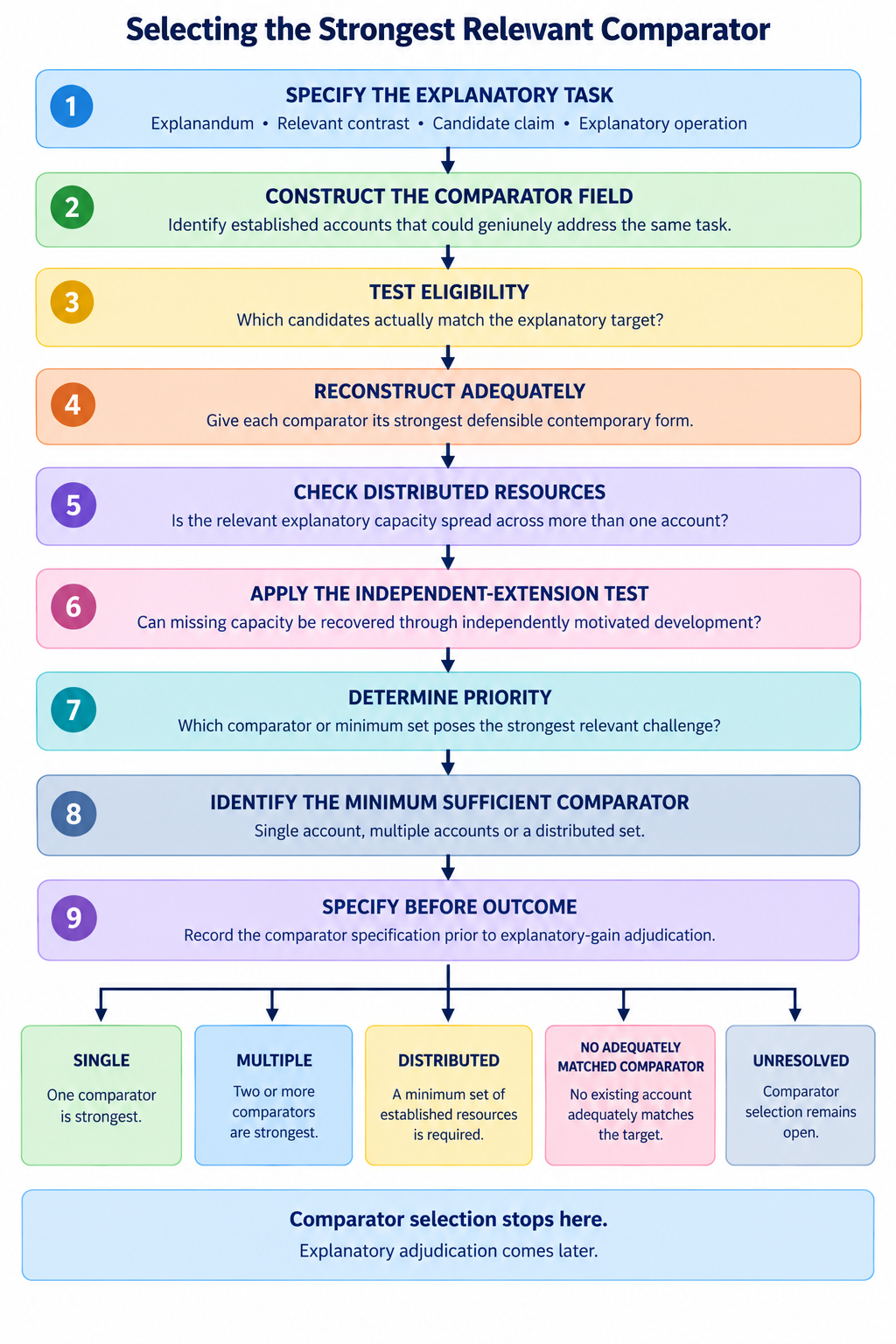
Selecting the Strongest Relevant Comparator. Comparator selection begins by specifying the explanatory task, then moves through eligibility, adequate reconstruction, distributed-resource and extension controls before comparator priority is determined. The result may be a single, multiple or distributed comparator, no adequately matched comparator, or an unresolved selection. None of these outcomes itself establishes explanatory gain.
A Compact Comparator Selection Record
The selection rationale can be recorded compactly. This is an audit record, not a scoring system.
| Question | What must be established? |
|---|---|
| Target | What exactly is being explained? |
| Candidate claim | What explanatory work is claimed? |
| Comparator field | Which established accounts genuinely address that task? |
| Eligibility | Which candidates actually match the target? |
| Adequacy | Have their strongest defensible resources been credited? |
| Distributed resources | Is the relevant capacity spread across more than one account? |
| Extension | Can missing capacity be recovered through independently motivated development? |
| Priority | Which comparator or minimum set poses the strongest relevant challenge? |
| Specification | Single, multiple, distributed, no adequate comparator, or unresolved? |
| Amendment | Has any later change been explicitly justified and recorded? |
Specify Before Judging the Outcome
Comparator selection becomes most informative when the selection rationale is recorded before explanatory-gain adjudication.
The point is not bureaucratic preregistration of every philosophical comparison. Nor should comparator specification be treated as irreversible.
The purpose is simpler.
Before deciding whether the candidate succeeds, the analysis should make clear which alternatives were considered, why some were eligible, why others were excluded, what legitimate resources were credited, whether a single, multiple or distributed comparator was selected, and what uncertainty remained.
This limits outcome-conditioned comparator selection.
Later amendment remains legitimate. Relevant scholarship may have been missed. A comparator resource may have been overlooked. New evidence may change the scientific field.
But material amendments should be visible. The reason for the change should be recorded, and the comparison should be reconsidered where the amendment affects its basis.
Correction is compatible with methodological discipline.
Invisible substitution is not.
How Comparator Selection Can Go Wrong
The procedure is easiest to understand by considering its failure modes.
One failure is the same-system fallacy: assuming that explanations concerning the same organism or process must be rivals.
Another is target drift, in which the explanandum changes during comparison.
A third is weak-foil selection: choosing an obsolete or underdeveloped alternative.
A fourth is vocabulary matching: treating absence of an equivalent term as evidence that an explanatory capacity is absent.
A fifth is resource stripping, in which legitimate mechanisms, models or distinctions belonging to the comparator are ignored.
The opposite mistake is synthetic-comparator inflation, where unrelated resources are assembled into an artificial super-account no actual scientific practice employs.
Outcome-conditioned comparator rescue and candidate rescue create a further asymmetry.
Finally, evidential success should not automatically be treated as explanatory completion. A striking experiment can strongly establish that a system is sufficient for producing a phenomenon while leaving open further questions about how the phenomenon is generated.
The purpose of comparator-selection control is not to eliminate judgement. It is to make these choices visible enough to be criticised.
Worked Example: The KaiABC Circadian Oscillator
The cyanobacterial KaiABC system can generate a self-sustained biochemical oscillation in a minimal in-vitro preparation containing KaiA, KaiB, KaiC and ATP (Nakajima et al., 2005). That result is scientifically important because it demonstrates that core clock-like oscillatory behaviour can be produced by a comparatively small biochemical system under specified conditions.
Suppose a candidate explanatory claim is framed as follows:
The minimal KaiABC biochemical system explains how the core in-vitro circadian oscillation is generated.
Comparator selection begins by restricting the target.
The explanandum is not:
How does the entire cyanobacterial circadian system work?
It is:
How is the self-sustained biochemical oscillation generated in the minimal KaiA–KaiB–KaiC–ATP system?
That immediately changes the comparator field.
Whole-cell transcriptional regulation, environmental input, downstream clock output and organism-level circadian function concern important aspects of the same biological system. But they are not automatically comparators for this particular claim.
Same system does not mean same explanandum.
The relevant comparator field instead includes dynamic and kinetic models of the core oscillation, models concerned with synchronisation and timing, and biochemical or structural accounts of the molecular processes through which the oscillation is implemented.
No single named theory necessarily contains all these resources.
Forcing the comparison into a one-theory-against-one-theory format would therefore misrepresent the scientific situation.
At the same time, simply combining every result from circadian biology would create an illegitimate super-comparator.
The appropriate comparator is narrower: the minimum scientifically coherent set of established dynamical, synchronisation and biochemical-mechanistic resources that materially addresses generation of the locked in-vitro oscillation.
The comparator-selection result is therefore:
SPECIFIED — DISTRIBUTED
That result does not show that biochemical reconstitution lacks explanatory value.
It does not show that the distributed comparator is superior.
It does not establish redundancy.
And it does not establish explanatory gain for the candidate.
Experimental reconstitution may provide exceptionally powerful evidence for bounded sufficiency without by itself settling every question about the explanatory organisation of the oscillation.
Comparator selection has answered only the prior question:
Against what established explanatory resources should the claim now be tested?
The actual comparison remains to be performed.
Selection Is Not Adjudication
This stopping point is essential.
Comparator selection asks:
What should the candidate fairly be compared against?
Comparative adjudication asks:
What happens when that comparison is made?
Those are different methodological tasks.
The sequence is:
comparator selection
→ controlled comparison
→ redundancy and discrimination analysis
→ explanatory-gain assessment
Selection establishes the test environment.
It does not supply the verdict.
A candidate may ultimately show bounded explanatory gain. The comparison may instead reveal complementarity, reciprocal strengths, redescription, no additional gain, or unresolved evidence.
None of those outcomes should be built into comparator selection itself.
Why This Matters for Framework Testing
The problem becomes especially important when a scientific framework contains several kinds of claim.
Different claims may address different explanatory targets and therefore require different comparators.
There may be no single meaningful answer to:
What is the strongest rival to this framework?
The better question is:
What is the strongest relevant comparator for this particular claim on this particular explanatory target?
A framework can then be tested claim by claim without assuming either that all its propositions face the same opponent or that local success establishes framework-wide superiority.
The method developed here is intended to make that selection process explicit before such testing begins.
What This Article Establishes
This article establishes comparator selection as a distinct methodological stage in explanatory assessment.
It provides a target-first procedure for constructing the comparator field, distinguishing eligibility from adequacy and priority, reconstructing alternatives in their strongest defensible contemporary forms, recognising legitimate distributed explanatory resources, controlling extensions, and recording the resulting comparator specification before outcome adjudication.
It also establishes that legitimate results include more than selection of one rival.
The appropriate result may be:
SPECIFIED — SINGLE
SPECIFIED — MULTIPLE
SPECIFIED — DISTRIBUTED
NO ADEQUATELY MATCHED COMPARATOR IDENTIFIED
or
UNRESOLVED
No-comparator and unresolved outcomes are not evidence for the candidate.
What This Article Does Not Establish
The procedure does not identify one universally correct comparator for every scientific claim.
It does not imply that scientific frameworks naturally form rival pairs.
It does not treat the most prominent theory as automatically strongest.
It does not infer explanatory absence from absence of matching terminology.
It does not provide a numerical ranking algorithm.
It does not determine explanatory gain.
It does not establish that the procedure is uniquely correct, generally validated or universally applicable.
Nor does its successful use in one worked case demonstrate reproducibility or general reliability.
The underlying principles have substantial precedents in work on explanatory relevance, theory comparison, explanatory pluralism, robustness and alternative explanation. The proposed contribution lies in organising those controls into an explicit pre-adjudication comparator-selection procedure rather than claiming novelty for the constituent ideas themselves.
Conclusion
Claims of explanatory advance depend on what they are compared against.
That makes comparator selection more than a preliminary convenience. It is part of the methodological structure of the comparison itself.
A defensible comparator should therefore be selected from the explanatory target outward. It should genuinely address the candidate’s explanatory task, be reconstructed in its strongest defensible contemporary form, receive legitimate distributed resources where appropriate, and remain protected against both resource stripping and retrospective inflation.
The result need not be one rival. It may be a single comparator, several independent comparators, a distributed comparator, no adequately matched comparator, or an unresolved selection problem.
Only after that result has been specified should explanatory adjudication begin.
A fair comparison therefore starts not by asking which explanation wins, but by establishing what would constitute the strongest fair test.
Related Terms and Next Step
Relevant glossary terms include Biological Explanation, Explanation, Explanandum and Explanatory Target.
The immediate methodological predecessors are How Should Scientific Explanations Be Compared?, What Counts as Explanatory Gain? and How Should a New Scientific Framework Be Tested?.
A subsequent worked application can use this procedure to identify the appropriate comparator for individual framework claims before explanatory gain is assessed.
See Also
Related Articles
References
- (2016). Explanatory Pluralism and the (Dis)Unity of Science: The Argument from Incompatible Counterfactual Consequences. Frontiers in Psychiatry, 7 . https://doi.org/10.3389/fpsyt.2016.00032
- (1977). The Essential Tension: Selected Studies in Scientific Tradition and Change. University of Chicago Press.
- (1977). Progress and Its Problems: Towards a Theory of Scientific Growth. University of California Press.
- (2004). Inference to the Best Explanation. Routledge.
- (2008). Explanatory Pluralism and Complementarity: From Autonomy to Integration. Philosophy of the Social Sciences, 38(3), 314–333 . https://doi.org/10.1177/0048393108319399
- (2005). Reconstitution of Circadian Oscillation of Cyanobacterial KaiC Phosphorylation in Vitro. Science, 308(5720), 414–415 . https://doi.org/10.1126/science.1108451
- (1980). The Scientific Image. Clarendon Press.
- (2013). Simulation and Similarity: Using Models to Understand the World. Oxford University Press. https://doi.org/10.1093/acprof:oso/9780199933662.001.0001