The Philosophical Foundations of APS
APS is a comparative explanatory methodology for biology with explicit philosophical commitments concerning life, organisation, biological reality, and explanation. This article examines those commitments without treating them as a prior philosophical system from which biological conclusions follow. It distinguishes the canonical APS account of life from organised persistence as an explanatory problem, treats Agency, Process, and Scale as analytic projections of one living organisation, and clarifies how philosophical claims about organisation and explanatory practice must remain answerable to specified explananda, materially implemented dependencies, empirical evidence, relevant comparators, and explicit limits. It also distinguishes these established foundations from the more exploratory APS research architecture extending from life toward cognition, Mind, Selfhood, Reflective Agency, and Meaning.
Key Points
- APS is a comparative explanatory methodology for biology with philosophical commitments, not a philosophical system from which biology is derived.
- Life is viability-oriented, constraint-closed organisation.
- Organised persistence concerns the continuity of living organisation through change; it is not a second definition of Life or the universal target of every biological explanation.
- Agency, Process, and Scale are analytic projections of one living organisation rather than independent causes, components, dimensions, domains, or levels.
- Explanatory claims are relative to specified explananda and relevant comparators.
- Organisational or dependency claims require appropriate material and empirical warrant when presented as claims about biological reality.
- Different explanatory approaches may answer different biological questions; plurality alone does not establish integration, complementarity, competition, or explanatory superiority.
- The pathway from Life toward Meaning is a research architecture whose individual relations require independent specification and support.
- APS's philosophical commitments remain open to comparative, empirical, and philosophical assessment.
Where this article fits: APS is a comparative explanatory methodology for biology. It is not derived from a prior philosophical system, but its biological and methodological commitments raise philosophical questions that must be made explicit. This article examines those commitments: what APS assumes about living organisation, what kind of reality it attributes to biological organisation, how it understands normativity, function and purpose, and what follows philosophically from its treatment of biological explanation. Readers seeking an introduction to APS should begin with What Is APS?, Naturalising Life, How APS Explains Life, and The Core Structure of APS. Why Philosophy of Biology Matters explains why philosophical clarification remains relevant to biological inquiry. Organisational Realism in Biology develops one specific ontological commitment associated with APS. APS as Philosophy considers the broader philosophical implications of the framework. The present article has a narrower task: to make explicit the philosophical foundations implicated by APS without treating philosophical coherence as evidence for biological explanatory success.
Introduction — Why a Biological Methodology Has Philosophical Commitments
Biology is extraordinarily successful at explaining the living world. It identifies mechanisms, reconstructs evolutionary histories, analyses developmental processes, investigates ecological relations, and increasingly reveals the regulatory organisation through which organisms maintain themselves under changing conditions.
Yet biological explanation also employs concepts whose meaning cannot always be settled by empirical description alone. Biologists speak of function, regulation, organisation, adaptation, agency, information, cognition and purpose. Such concepts raise questions about what biological explanations are explaining, which relations count as biologically significant, and how different explanatory approaches should be compared.
These are philosophical questions, but their presence does not make biology an application of philosophy. Nor does it mean that a philosophical account can determine in advance which biological explanation is correct.
APS approaches this relationship from the biological side. It begins with living organisation and asks how biological phenomena can be specified, compared and explained. Its philosophical commitments arise from that explanatory programme rather than functioning as premises from which the biology is deduced.
This distinction is fundamental because philosophical analysis can clarify concepts, identify assumptions, distinguish kinds of dependency, and expose cases in which apparently competing explanations address different explananda. It can ask what must be true if organisational relations are to have explanatory significance, or what is implied by treating function and normativity as features of living organisation.
Such clarification nevertheless has limits. Philosophical coherence does not establish biological warrant. A proposed biological dependency still requires appropriate material and empirical support, and a conceptually integrated framework is not thereby a better biological explanation. Explanatory gain must be assessed relative to a specified explanandum and relevant comparator.
The philosophical foundations of APS should therefore be understood as the commitments and questions implicated by its biological and methodological programme—not as an independent philosophical system standing behind that programme.
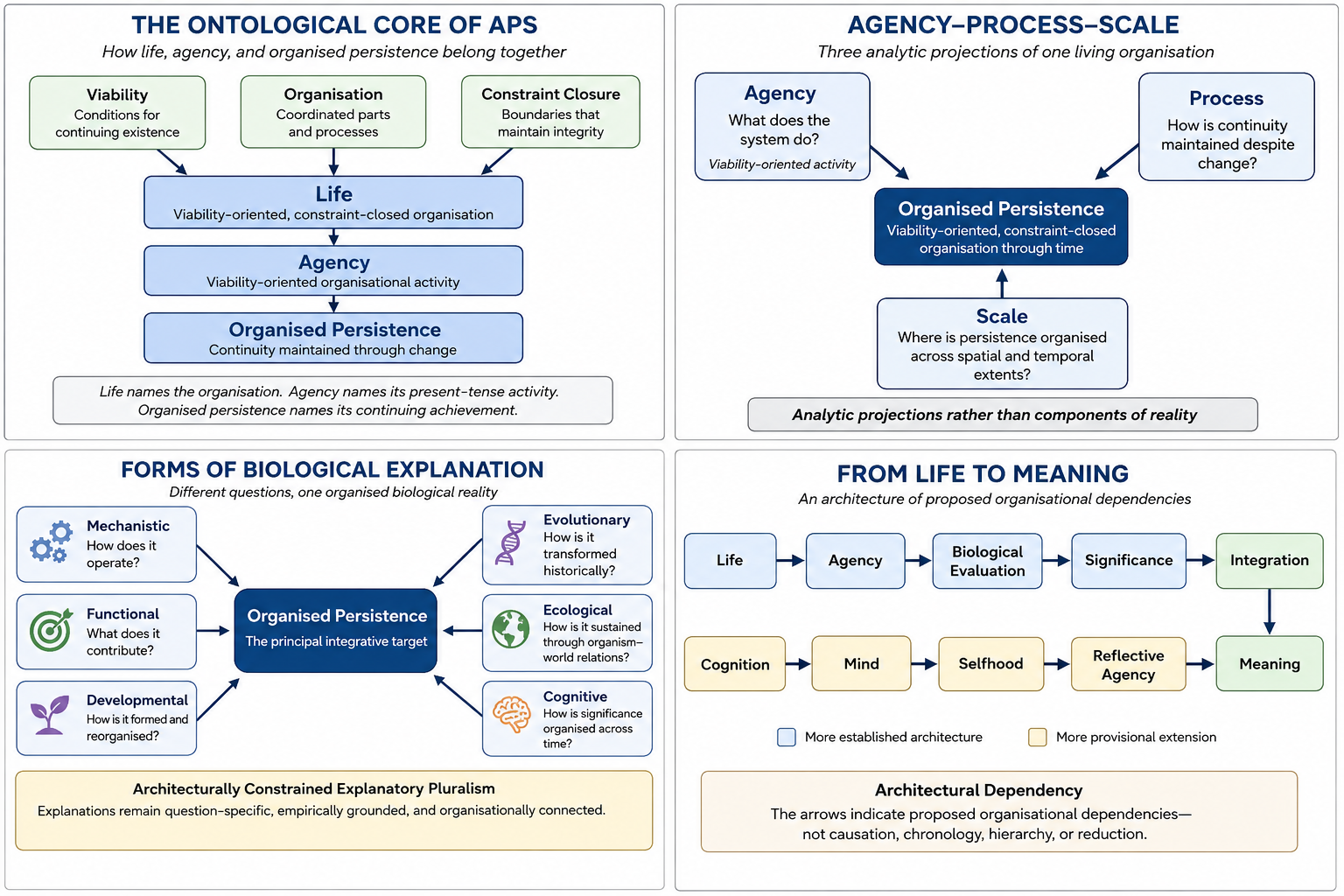
Philosophical Foundations of APS. APS begins as a comparative explanatory methodology for biology. Its treatment of living organisation and biological explanation raises philosophical questions concerning organisation, reality, normativity, function, purpose, and explanatory practice. Philosophical clarification can make these commitments explicit, but biological dependencies and claims of explanatory gain remain answerable to appropriate material, empirical, and comparative warrant.
Living Organisation and Organised Persistence
APS begins with a biological claim about Life:
Life is viability-oriented, constraint-closed organisation.
This definition brings together three ideas: viability, organisation and constraint closure.
Viability concerns the conditions within which a living system can continue functioning as the kind of organisation it is. Those conditions vary among organisms and across circumstances, but living activity is not indifferent to them. Some changes sustain or restore functioning; others impair or destroy it.
Organisation concerns the relations and activities through which those conditions are maintained. A living system is not simply an arrangement of components observed at a particular moment. Its organisation is continuously enacted through metabolism, regulation, repair, development, environmental interaction and other activities through which its continued functioning is maintained.
Constraint closure identifies a further feature of this organisation. Biological constraints channel processes while themselves being maintained, regenerated or enabled through other processes within the organisation. The point is not that living systems are materially closed. They remain dependent upon continuing exchanges of matter and energy and upon environmental conditions. Closure concerns the organisation of mutually dependent constraints through which living activity is maintained.
This conception makes biological organisation inherently dynamic. Life does not persist by remaining materially unchanged.
Cells continually replace components. Organisms develop, repair damage, alter behaviour and respond to changing environments. Biological continuity is therefore compatible with—and often dependent upon—material and organisational transformation.
APS calls this organised persistence.
Organised persistence is not a second definition of Life. Nor is persistence itself the ontological foundation from which Life is derived. Life is viability-oriented, constraint-closed organisation; organised persistence identifies the explanatory problem of how that living organisation maintains and re-establishes continuity through change.
The distinction matters. A non-living object can persist merely by remaining relatively unchanged. Living systems persist through activity. Their continuity depends upon continuing modulation of the constraints and relations through which the conditions of functioning are maintained or restored.
This makes organised persistence an important explanatory target within APS. It does not follow, however, that every biological explanandum can be reduced to persistence or that every biological explanation must explicitly invoke it. A question about a molecular mechanism, a developmental transition, a population change or an ecological interaction may require its own appropriately specified explanandum and evidence.
Organised persistence instead identifies a recurrent problem that connects many biological questions: how living organisation continues while the material, structural and environmental conditions through which it is realised continually change.
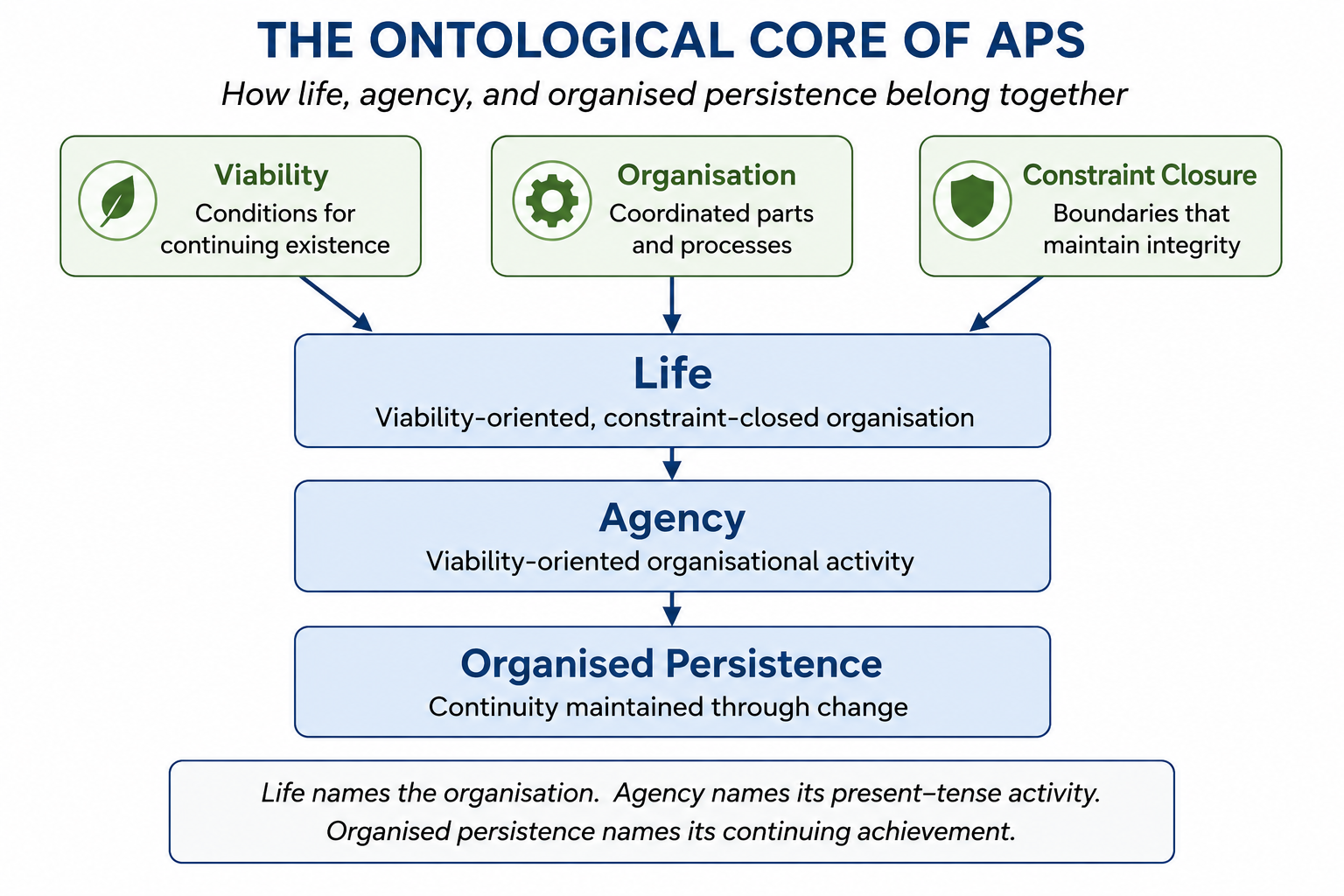
Life, Agency, and Organised Persistence. APS defines Life as viability-oriented, constraint-closed organisation. Biological agency is the viability-oriented organisational activity through which living organisation is enacted and sustained. Organised persistence concerns the continuity of that organisation through material, structural, developmental, ecological, and temporal change.
Organisation, Reality, and Material Implementation
Treating organisation as biologically important raises an ontological question.
Is organisation simply a useful way for investigators to describe complicated collections of physical events, or can organisational relations themselves be treated as real features of living systems?
APS adopts a bounded form of organisational realism.
The organisation relevant to APS is materially implemented. Membranes, metabolic processes, regulatory networks, signalling relations, physiological structures, organism–environment interactions and other biological arrangements constrain what can occur and alter the conditions under which further activity becomes possible. Their organisation is not an additional substance or force operating independently of their material realisation.
At the same time, identifying the material components alone does not necessarily specify all of the relations relevant to the biological explanandum. The organisation of those components can matter because changing a relation, constraint or pattern of coordination may change what the system can do even when many of its components remain present.
This is the limited ontological commitment APS requires: materially realised organisational relations can be genuine features of biological systems and therefore legitimate candidates for explanation.
It does not follow that organisational descriptions are always explanatorily superior to mechanistic, causal, developmental, evolutionary or other explanations. Organisational realism is an ontological commitment, not a rule assigning explanatory priority.
Whether an organisational relation contributes explanatory gain must be established for the particular explanandum and comparator under consideration.
Normativity, Function, and Purpose
Living organisation also raises a group of closely related philosophical problems concerning normativity, function and purpose.
These concepts have often proved difficult because they appear to describe biological phenomena in terms that go beyond the occurrence of physical events. A physiological process can succeed or fail. A structure can function well or malfunction. An organism can act in ways that improve or diminish its prospects of continued functioning.
APS interprets these asymmetries in relation to viability.
Normativity
Biological normativity does not require conscious evaluation, moral judgment or an external standard imposed upon an organism.
A change can matter biologically because of its consequences for the viability of the organisation concerned. Conditions that maintain or restore functioning differ from conditions that disrupt it. The resulting asymmetry is relational: the same environmental condition may have very different consequences for differently organised systems.
APS therefore treats biological normativity as viability-relative asymmetry.
This does not make viability an abstract value or a goal consciously represented by the organism. It identifies a feature of living organisation: because the organisation can continue only under some conditions and not others, changes can have different consequences relative to its continued functioning.
Function
Function concerns contribution within that organisation.
APS treats biological function in present-tense organisational terms: a structure, activity or process has a function insofar as it makes a viability-relative contribution to the organisation in which it operates.
This does not deny the importance of evolutionary history. Historical explanations can show how a trait arose, was retained, or acquired its present organisation. Such explanations may be indispensable to answering evolutionary questions.
But evolutionary history and present organisational contribution answer different questions. History can explain how a function came to be instantiated without being constitutive of the present-tense contribution by which APS identifies that function.
Purpose
Purpose raises a related problem because purposive language is often associated with intention, foresight or design.
APS does not require those implications.
Living systems exhibit viability-oriented organisation because their activities continually contribute to maintaining or re-establishing conditions under which the organisation can continue functioning. In this restricted biological sense, purpose does not require a conscious goal represented in advance.
Purpose is therefore compatible with naturalistic explanation when it refers to viability-oriented organisation rather than intention.
This does not license indiscriminate purposive description. Whether a particular activity genuinely contributes to viability, and how it does so, remains a biological question requiring evidence.
Normativity, function and purpose are therefore neither eliminable metaphors nor autonomous philosophical principles. In APS they are ways of describing different relations within materially implemented living organisation.
Agency, Process, and Scale
APS examines living organisation through Agency, Process and Scale.
These are analytic projections rather than components of reality.
They are not independent causes, ontological domains, biological levels, or separate parts from which living systems are assembled. Each brings a different explanatory question to the same organised phenomenon.
Agency — What do living systems do?
Biological agency is viability-oriented organisational activity.
Living systems regulate, repair, develop, interact with their environments and modify their activity under changing conditions. Agency directs explanatory attention to what the system does through the organisation by which viability is maintained or restored.
Agency does not by itself imply cognition, consciousness, intention or deliberation.
Its organising question is:
What does a living system do?
Process — How is continuity maintained despite change?
Living organisation is continually changing.
Development, metabolism, regulation, repair, behavioural adjustment and evolutionary transformation all involve change across time. Process directs attention to how continuity is maintained and re-established through such transformations.
Its organising question is:
How is continuity maintained despite change?
Process therefore does not identify a second biological entity alongside Agency. It is an analytic projection concerned with the temporal organisation through which living continuity is achieved.
Scale — Where is persistence organised?
Biological phenomena extend across different spatial and temporal extents.
The appropriate extent depends upon the explanandum. A physiological question may concern interactions over seconds or days; a developmental question may concern changes across an organism’s lifetime; an evolutionary question may concern transformations across generations.
Scale asks:
Where is persistence organised across spatial and temporal extents?
Scale does not imply an ontology of higher and lower levels. Nor does a wider spatial or temporal extent supersede local causation. Cross-scale influence must itself be materially implemented through constraints and interactions that alter the conditions under which local processes occur.
Agency, Process and Scale therefore provide complementary analytic perspectives upon one organised biological reality. Their value lies in helping specify what is being explained, how continuity is organised, and which spatial and temporal extents are relevant to the question.
They do not determine the answer in advance.
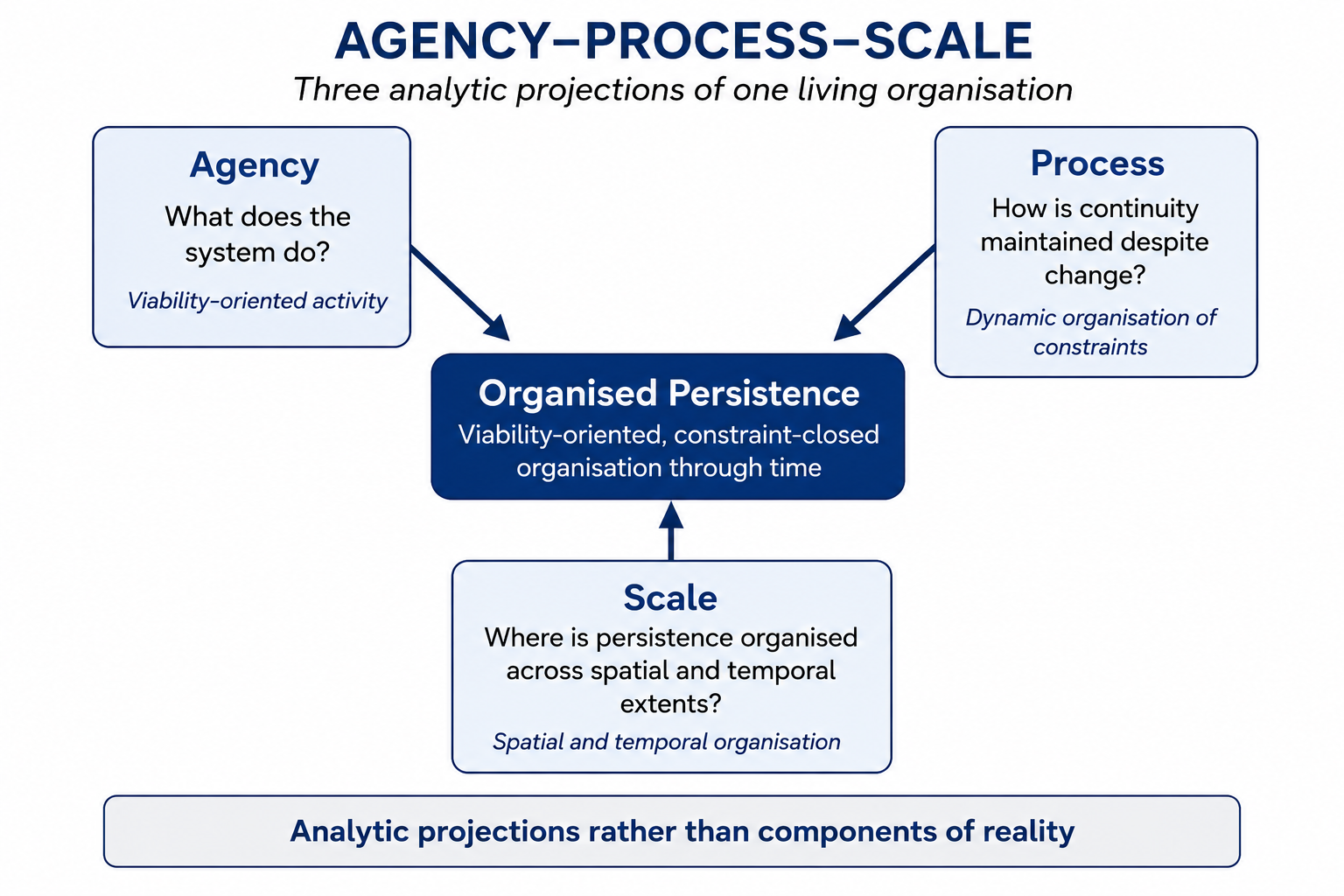
Agency–Process–Scale as Analytic Projections. Agency, Process, and Scale are complementary analytic projections of one viability-oriented, constraint-closed living organisation. Agency asks what living systems do; Process asks how continuity is maintained despite change; Scale asks where persistence is organised across relevant spatial and temporal extents. They are not independent causes, components, dimensions, domains, or hierarchical levels.
Biological Explanation and Explanatory Pluralism
Biology employs many forms of explanation.
Mechanistic explanations may specify organised components and activities through which a phenomenon occurs. Causal explanations may identify difference-making dependencies. Developmental explanations may account for the formation and transformation of biological organisation across an individual history. Evolutionary explanations may reconstruct changes across populations and generations. Ecological explanations may specify organism–environment dependencies. Functional explanations may identify present contributions to living organisation.
This diversity does not imply that biological explanation lacks discipline. Nor does it establish that every explanatory approach is equally appropriate.
Different explanations can address different explananda. A mechanistic explanation of how a process operates need not compete with an evolutionary explanation of how the relevant organisation arose, while a developmental explanation and a functional explanation may concern the same biological feature while answering different questions about it.
For this reason, APS rejects comparisons based merely upon explanatory vocabulary. Two approaches cannot be ranked simply because one speaks of mechanisms and another of organisation, or because one invokes history and another present activity. Meaningful comparison first requires a sufficiently matched explanatory target.
APS therefore adopts a constrained explanatory pluralism. The constraint does not come from requiring every explanation to instantiate a predetermined APS grammar. It comes from specifying what is being explained, which dependencies are proposed, how those dependencies are materially realised, what evidence supports them, and what relevant alternative explanations already achieve.
Organised persistence can provide a productive comparative target where continuity of living organisation through change is genuinely the explanandum. It should not be imposed upon biological questions for which another target is more appropriate.
This changes the philosophical significance of explanatory pluralism.
The question is not simply how the many explanatory forms of biology can be made conceptually harmonious. It is how their explanatory roles can be distinguished and, where appropriate, compared without confusing differences of vocabulary, target, evidence or dependency.
Philosophical analysis helps make those distinctions explicit.
Biological warrant must still come from the relevant science.
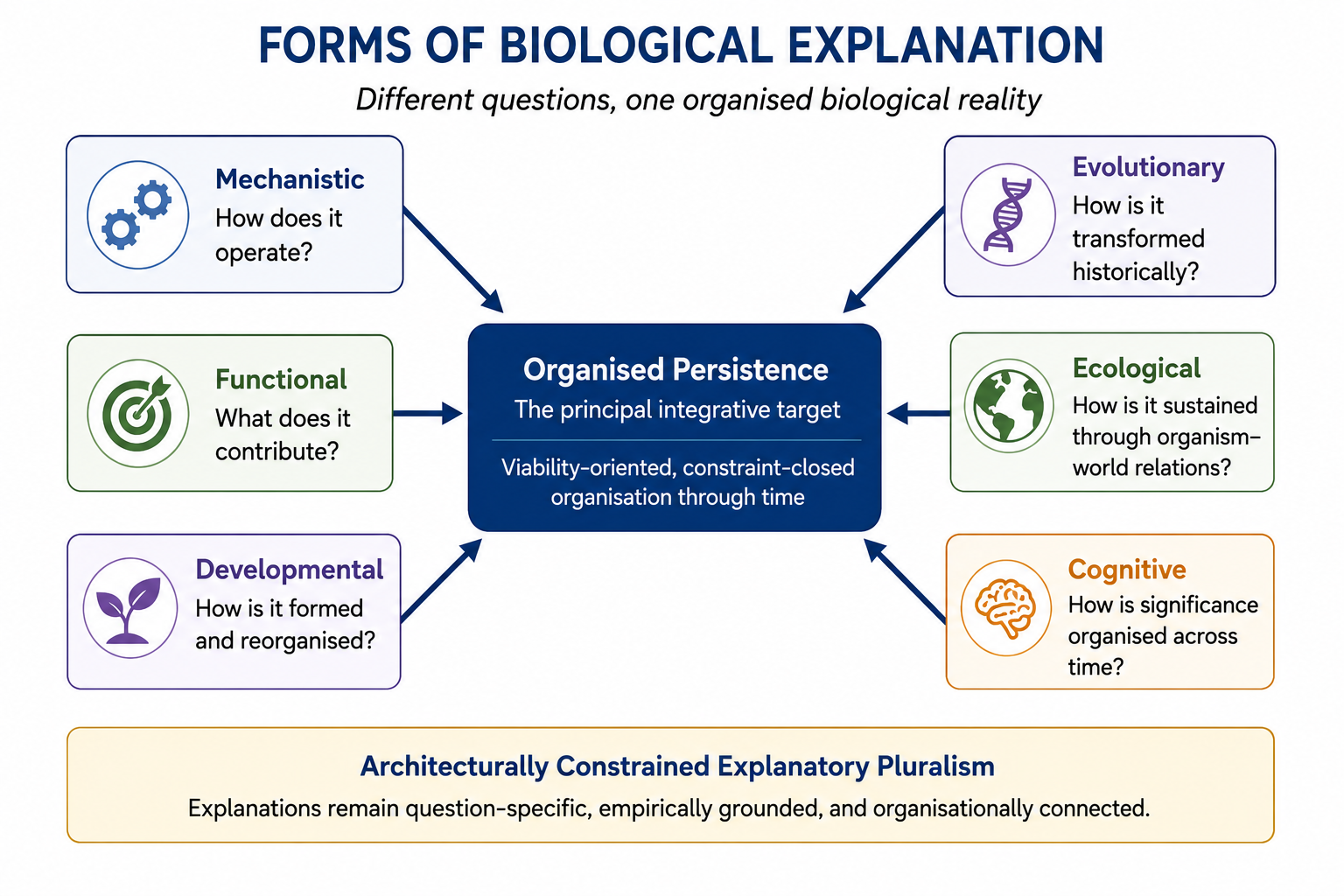
Comparing Biological Explanations. APS compares explanations only relative to sufficiently specified explananda and relevant comparators. Mechanistic, causal, developmental, evolutionary, ecological, functional, and organisational approaches may answer different questions. Claims of explanatory gain require identification of the relevant dependency, its material implementation and evidential support, and what an appropriate comparator already explains. Organised persistence is a useful target where continuity through change is the explanandum; it is not the universal target of biological explanation.
From Biological Organisation Toward Cognition and Meaning
APS also investigates a more ambitious question:
How might biological organisation support increasingly complex forms of evaluation, significance, cognition, Mind, Selfhood, Reflective Agency, and Meaning?
This question links biological organisation to problems traditionally distributed across biology, cognitive science, psychology and philosophy.
APS represents the research architecture as:
Life → Agency → Biological Evaluation → Significance → Integration → Cognition → Mind → Selfhood → Reflective Agency → Meaning
The sequence is not a hierarchy, chronology, universal developmental trajectory or simple causal chain.
The sequence is not a hierarchy, chronology, universal developmental trajectory or simple causal chain. Nor do the arrows establish the dependencies they represent; rather, they organise a research programme.
Different relations within the architecture may involve different kinds of dependency, and those relations must be distinguished rather than subsumed under a single architectural notion. A conceptual dependency is not automatically a causal dependency. An explanatory dependency is not automatically an evolutionary sequence. A developmental prerequisite is not established merely because one concept appears earlier in the diagram.
The standing of each proposed dependency therefore depends upon the relation being asserted and the evidence appropriate to it.
Biological Evaluation and Significance
APS uses Biological Evaluation to identify the process through which biological agency generates significance.
Living systems encounter conditions that differ in their consequences for viability. Their activity can discriminate among such conditions without requiring conscious judgment or representation.
Biological Evaluation is the process through which agency generates significance.
Significance is the relational consequence of that evaluation:
Significance is a relationally real product of biological evaluation.
It is neither an intrinsic property of an environmental object nor merely a projection by an external observer. A condition is significant in relation to the organisation for which it makes a viability-relevant difference.
Integration and Cognition
Significance relations do not necessarily remain isolated. Living activity can organise multiple viability-relevant differences into coordinated patterns.
APS calls this Integration: the organisation of what matters into functional unity.
Cognition introduces a further requirement.
APS defines cognition as the organisation of biological significance across time. The current minimal-cognition programme sharpens this by requiring more than immediate or fixed regulation: integrated biological significance must modulate activity across a temporal field of viability-relevant possibilities.
This distinction prevents cognition from becoming synonymous with life or regulation.
Life does not require cognition; cognition presupposes life.
Mind, Selfhood, and Reflective Agency
APS uses Mind for integrated evaluative cognitive processes that maintain a coherent self–world relation.
Selfhood concerns continuity across change. It should not be equated with consciousness, personal identity or Reflective Agency.
Reflective Agency introduces capacities through which possibilities, commitments and alternatives can themselves become objects of evaluation and deliberation.
These concepts identify increasingly demanding organisational claims. Their inclusion within a common research architecture does not establish that every transition has already been biologically demonstrated.
Meaning and the boundary of the programme
APS distinguishes biological Significance from Meaning.
Meaning requires forms of organisation not exhausted by immediate viability-relative significance. Its precise relation to Mind, Selfhood, reflection, communication and social organisation remains an open research problem.
APS can therefore investigate an organisational pathway from living matter toward increasingly sophisticated forms of awareness without claiming to have solved subjective experience.
That boundary is important.
The philosophical attractiveness of a continuous architecture from Life toward Meaning does not establish that nature implements every proposed transition in the way APS represents it. The architecture identifies questions and candidate dependencies for investigation. Individual claims must stand or fall by their own conceptual, comparative and empirical warrant.
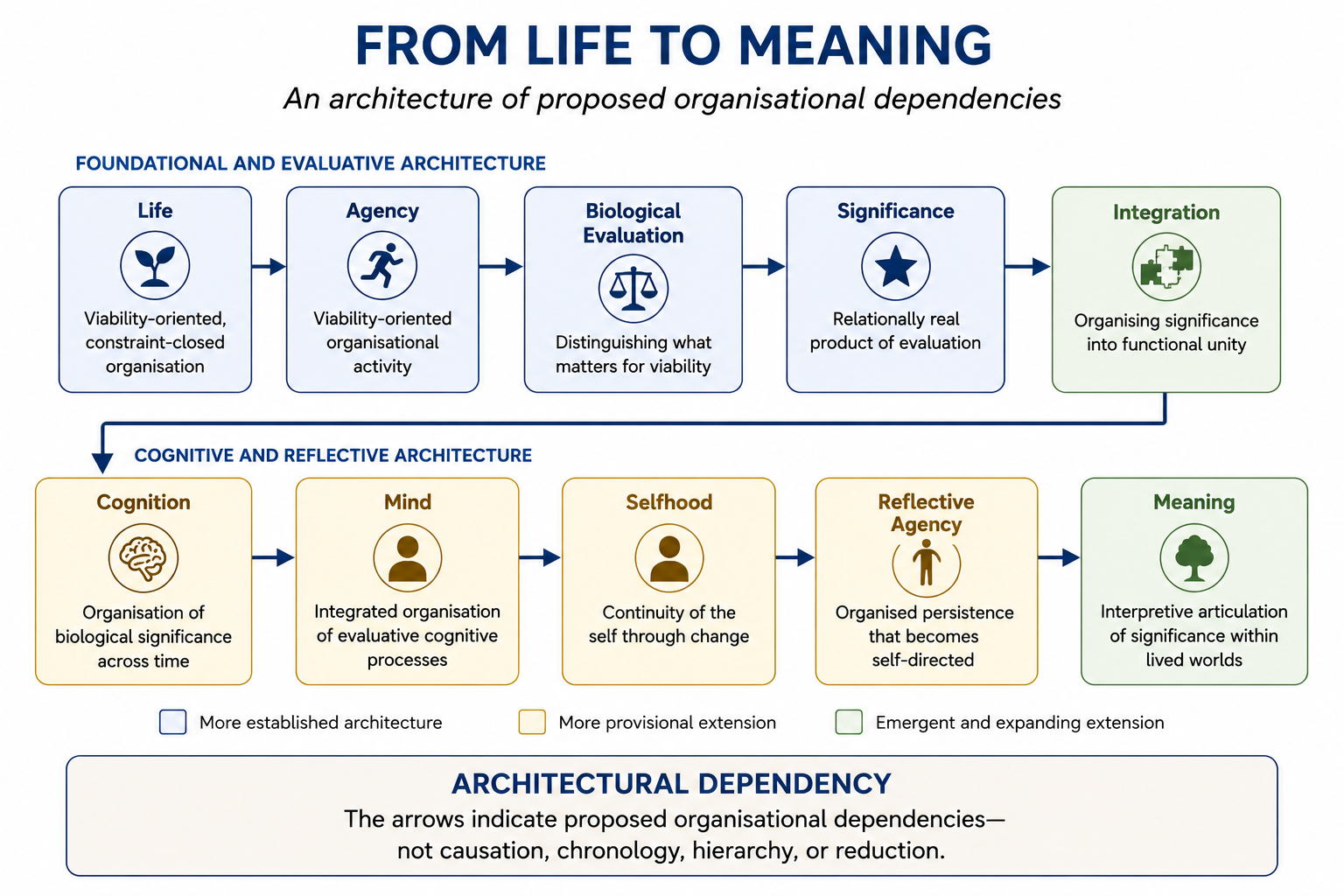
From Life Toward Meaning — An APS Research Architecture. APS investigates proposed relations among Life, Agency, Biological Evaluation, Significance, Integration, Cognition, Mind, Selfhood, Reflective Agency, and Meaning. The sequence organises research questions; it is not a hierarchy, universal developmental trajectory, evolutionary chronology, or simple causal chain. Individual relations may involve different kinds of dependency and require independent conceptual, material, comparative, and empirical warrant. Life does not require cognition; cognition presupposes life.
APS in Relation to Contemporary Philosophy of Biology
APS has developed in conversation with several established traditions in philosophy and theoretical biology.
These relationships should not be represented as a progression in which earlier approaches supply incomplete stages that APS subsequently completes. Nor should similarities of vocabulary be treated as evidence that the approaches share a theory.
The relevant question is what each approach seeks to explain and which explanatory resources it provides.
Mechanistic explanation
Mechanistic approaches have supplied powerful accounts of how organised components and activities produce biological phenomena.
APS does not oppose mechanism. Where a mechanistic account adequately explains a specified phenomenon, APS gains nothing merely by redescribing the same phenomenon in organisational language.
An APS analysis becomes explanatorily relevant only if it identifies an additional dependency or explanatory target not already captured by the comparator and if that contribution is materially and empirically warranted.
Process approaches
Process-oriented biology and philosophy emphasise activity, transformation and the temporally extended character of organisms.
APS shares the rejection of a purely static conception of living organisation. Its specific concern, however, is organised persistence: how continuity is maintained and re-established through transformation.
That difference identifies a possible comparative question. It does not by itself establish explanatory superiority.
Organisational autonomy
Work on biological autonomy, constraint closure, regulation and organisational function provides some of the closest scholarly antecedents to APS’s account of living organisation.
APS adopts and develops several concerns found in this literature, particularly self-maintaining organisation, constraint closure and biological normativity.
Its own Agency–Process–Scale architecture and emphasis on organised persistence should nevertheless be treated as APS proposals rather than as consequences already established by autonomy theory.
Enactivism
Enactive approaches have emphasised embodied activity, autonomy, sense-making and organism–environment relations.
APS shares important questions with this tradition, particularly concerning agency and significance.
But shared questions do not establish theoretical identity. APS distinguishes biological agency from cognition and places stronger conditions upon the transition to cognition. Comparative assessment therefore requires attention to the particular explanandum rather than broad claims that one framework encompasses another.
Biosemiotics
Biosemiotics investigates signs, semiosis and meaning across living systems.
APS likewise treats significance and meaning as legitimate natural phenomena, but it does not assume that every viability-relevant relation is therefore semiotic.
Its own research sequence distinguishes Biological Evaluation, Significance, Integration, Cognition and Meaning. Whether and where semiosis should enter that architecture is a substantive question rather than something settled by terminology.
Explanatory pluralism
APS shares with explanatory pluralism the recognition that biological inquiry requires more than one explanatory form.
Its methodological contribution is not simply the assertion that explanations should be integrated. Integration itself requires justification.
APS instead asks whether approaches address the same explanandum, what dependencies each identifies, what evidence supports those dependencies, and whether one approach contributes explanatory gain relative to another.
This places explanatory pluralism within a comparative methodology rather than turning conceptual unity into an explanatory objective in its own right.
Philosophical Coherence, Biological Warrant, and Open Questions
The philosophical foundations of APS can now be stated more precisely.
APS is committed to the reality of materially implemented biological organisation. It treats Life as viability-oriented, constraint-closed organisation and Biological Agency as viability-oriented organisational activity. It interprets normativity, function and purpose in relation to the conditions under which living organisation is maintained. It treats Agency, Process and Scale as analytic projections through which one organisation can be investigated from complementary explanatory perspectives.
These commitments have philosophical significance.
But several different standards of assessment must remain distinct.
Conceptual coherence asks whether APS’s concepts and distinctions can be formulated without contradiction or equivocation.
Philosophical defensibility asks whether its ontological and explanatory commitments can withstand relevant philosophical objections and alternatives.
Methodological usefulness asks whether its distinctions improve the specification, comparison or assessment of biological explanations.
Biological warrant asks whether proposed biological relations are materially implemented and empirically supported.
Comparative explanatory gain asks whether an APS analysis contributes something beyond an appropriate existing explanation for a specified explanandum.
Success at one of these tasks does not automatically establish success at the next.
A coherent concept may fail to identify a real biological dependency. A philosophically defensible ontology may add nothing to an already sufficient scientific explanation. A useful methodological distinction may help compare explanations without itself constituting a biological explanation. Conversely, empirical results may force revision of an otherwise attractive conceptual architecture.
This separation is particularly important for the more ambitious APS research programme extending toward cognition, Mind, Selfhood, Meaning, morality and social organisation.
Those extensions should not be treated as consequences that follow from the definition of Life. They are research programmes whose individual claims require their own forms of warrant.
APS is therefore assessable at multiple points.
Its definition of Life can be challenged. Proposed organisational dependencies can fail. Agency–Process–Scale may prove useful for some explanatory problems and redundant for others. Organised persistence may illuminate some comparisons while contributing little to others. Claims about cognition and Mind may require revision as empirical and conceptual work develops.
That capacity for discrimination is methodologically important. APS should not be protected from failure by redescribing every outcome as consistent with its architecture.
Conclusion
APS begins with biology. Its central concern is living organisation: how systems actively maintain and re-establish the conditions of their own persistence, how that organisation changes through time, and how biological explanations can be compared in relation to the phenomena and dependencies they seek to explain.
Those concerns have philosophical consequences. They raise questions about what kind of reality organisation possesses, how biological normativity can be naturalised, what function and purpose mean in living systems, how continuity can coexist with transformation, and how increasingly complex forms of cognition and meaning might relate to more basic forms of biological organisation.
The philosophical foundations of APS clarify those commitments and questions. They do not supply an independent philosophical system from which biological conclusions follow, nor does their coherence establish the explanatory superiority of APS. Agency, Process and Scale remain analytic projections of one viability-oriented, constraint-closed organisation. Organised persistence identifies the problem of continuity through change rather than a second definition of Life. The wider architecture from Life toward Meaning organises research questions and proposed dependencies whose standing must be established individually.
The resulting relationship between biology and philosophy is therefore neither reduction nor philosophical governance. Biological inquiry supplies the phenomena, material organisation and empirical constraints; methodological analysis clarifies explananda, dependencies, comparators and standards of explanatory gain; and philosophical analysis makes explicit the conceptual and ontological commitments involved and tests their coherence and implications. Each contributes something different, and APS brings those tasks into relation while keeping their evidential responsibilities distinct.
Its philosophical significance will therefore depend not on presenting an all-encompassing philosophy of biology, but on whether its commitments help biological explanations become more precise, comparable and empirically assessable.
Life persists, evolution transforms that persistence, and biological explanation clarifies the organisation that makes both possible.
See Also
Related Articles
References
- (2006). On What Makes Certain Dynamical Systems Cognitive: A Minimally Cognitive Organization Program. Adaptive Behavior, 14(2), 171–185 . https://doi.org/10.1177/105971230601400208
- (2008). Mental Mechanisms: Philosophical Perspectives on Cognitive Neuroscience. Psychology Press.
- (2007). Explaining the Brain: Mechanisms and the Mosaic Unity of Neuroscience. Oxford University Press. https://doi.org/10.1093/acprof:oso/9780199299317.001.0001
- (2005). Autopoiesis, Adaptivity, Teleology, Agency. Phenomenology and the Cognitive Sciences, 4(4), 429–452 . https://doi.org/10.1007/s11097-005-9002-y
- (2017). Sensorimotor Life: An Enactive Proposal. Oxford University Press. https://doi.org/10.1093/acprof:oso/9780198786849.001.0001
- (2008). Biosemiotics: An Examination into the Signs of Life and the Life of Signs. University of Scranton Press.
- (2006). The Biogenic Approach to Cognition. Cognitive Processing, 7(1), 11–29 . https://doi.org/10.1007/s10339-005-0016-8
- (2015). Biological Organisation as Closure of Constraints. Journal of Theoretical Biology, 372, 179–191 . https://doi.org/10.1016/j.jtbi.2015.02.029
- (2015). Biological Autonomy: A Philosophical and Theoretical Enquiry. Springer. https://doi.org/10.1007/978-94-017-9837-2
- (2009). An Organizational Account of Biological Functions. The British Journal for the Philosophy of Science, 60(4), 813–841 . https://doi.org/10.1093/bjps/axp036
- (2019). Is the Cell Really a Machine?. Journal of Theoretical Biology, 477, 108–126 . https://doi.org/10.1016/j.jtbi.2019.06.002
- (2018). Everything Flows: Towards a Processual Philosophy of Biology. Oxford University Press. https://doi.org/10.1093/oso/9780198779636.001.0001
- (2026). Agency as the Defining Activity of Life: A Viability-Oriented Framework Integrating Process and Scale. Biological Theory . https://doi.org/10.1007/s13752-026-00547-6
- (2007). Mind in Life: Biology, Phenomenology, and the Sciences of Mind. Harvard University Press.
- (2006). Principles of Minimal Cognition: Casting Cognition as Sensorimotor Coordination. Adaptive Behavior, 14(2), 157–170 . https://doi.org/10.1177/105971230601400207
- (2003). Making Things Happen: A Theory of Causal Explanation. Oxford University Press. https://doi.org/10.1093/0195155270.001.0001