Why Organisms Cannot Be Understood Apart from Their Environments
APS rejects the idea that organisms are independently constituted entities that subsequently interact with external environments. Although organisms can be distinguished physically from their surroundings, their viability depends upon ecological continuity extending beyond organismal boundaries. Organisms and environments are therefore reciprocally organised through coupling, semiosis, adaptation, resilience, and distributed continuity. APS concludes that biological organisation cannot be fully understood apart from the ecological relations through which persistence becomes possible.
Why Organisms Cannot Be Understood Apart from Their Environments
Where this article fits: The Ecological Organisation of Life explains why ecology is indispensable to biological persistence. Organism–Environment Coupling explains how organisms and environments become linked through continuity-producing relations. This article explains why those relations prevent organisms from being understood in isolation. Although organisms can often be distinguished physically from their surroundings, their persistence depends upon ecological continuity extending beyond organismal boundaries. For a broader account of resilience and distributed ecological organisation, see Resilience, Ecology, and Continuity and Ecology as Organised Persistence Across Scales.
Organisms appear to be self-contained biological entities.
They possess identifiable boundaries, internal organisation, and distinctive structures that seem to separate them from the environments in which they live. Biology has therefore often begun by defining organisms first and then describing ecological interaction as something that occurs between already constituted systems.
APS argues that this appearance is explanatorily misleading.
Although organisms can usually be distinguished physically from their surroundings, they cannot be understood independently of the ecological relations through which they remain viable. Persistence depends continuously upon energetic exchange, environmental resources, developmental conditions, ecological interactions, and countless other continuity-producing relations extending beyond organismal boundaries.
The consequence is significant. Ecology is not simply the external context within which organisms exist. It contributes directly to the organisation through which living systems persist.
The central claim of this article is therefore:
organisms cannot be fully understood apart from their environments because biological persistence depends upon ecological continuity extending beyond organismal boundaries.
Why Organism–Environment Separation Is Misleading
The distinction between organism and environment remains descriptively useful.
Organisms possess physical organisation that allows them to be recognised as distinct biological systems. Cells possess membranes, multicellular organisms possess bodies, and populations occupy identifiable ecological locations. These distinctions are indispensable for biological description.
Description, however, is not explanation.
The fact that organisms can be distinguished from their surroundings does not imply that they persist independently of them. Every living system depends continuously upon environmental conditions that sustain viability. Nutrient availability, atmospheric composition, microbial communities, ecological interactions, climatic stability, developmental environments, and behavioural contexts all contribute directly to biological persistence.
The organism–environment distinction therefore identifies physical organisation but does not capture the organisation through which persistence is achieved.
APS consequently treats organism–environment separation as analytically useful but explanatorily incomplete. Organisms remain identifiable biological systems, yet the conditions supporting their continued viability extend beyond their physical boundaries into wider ecological continuity systems.
Organisms Persist Through Environmental Coupling
The relationship between organisms and environments is therefore one of ongoing ecological coupling rather than external interaction.
Living systems remain continuously coupled to environmental conditions that contribute to persistence. Organisms exchange energy and materials with their surroundings, participate in ecological flows, depend upon microbial communities, exploit environmental resources, and respond to changing ecological circumstances throughout their lives.
These relations are reciprocal rather than one-directional.
Environmental conditions constrain development, behaviour, adaptation, and viability, while organisms simultaneously modify ecological conditions through metabolism, niche construction, migration, behaviour, reproduction, and ecosystem engineering. Organisms therefore influence the environments that influence them.
APS consequently approaches organism–environment coupling as a continuity-producing relation through which biological organisation is sustained rather than as an external interaction between independently constituted systems.
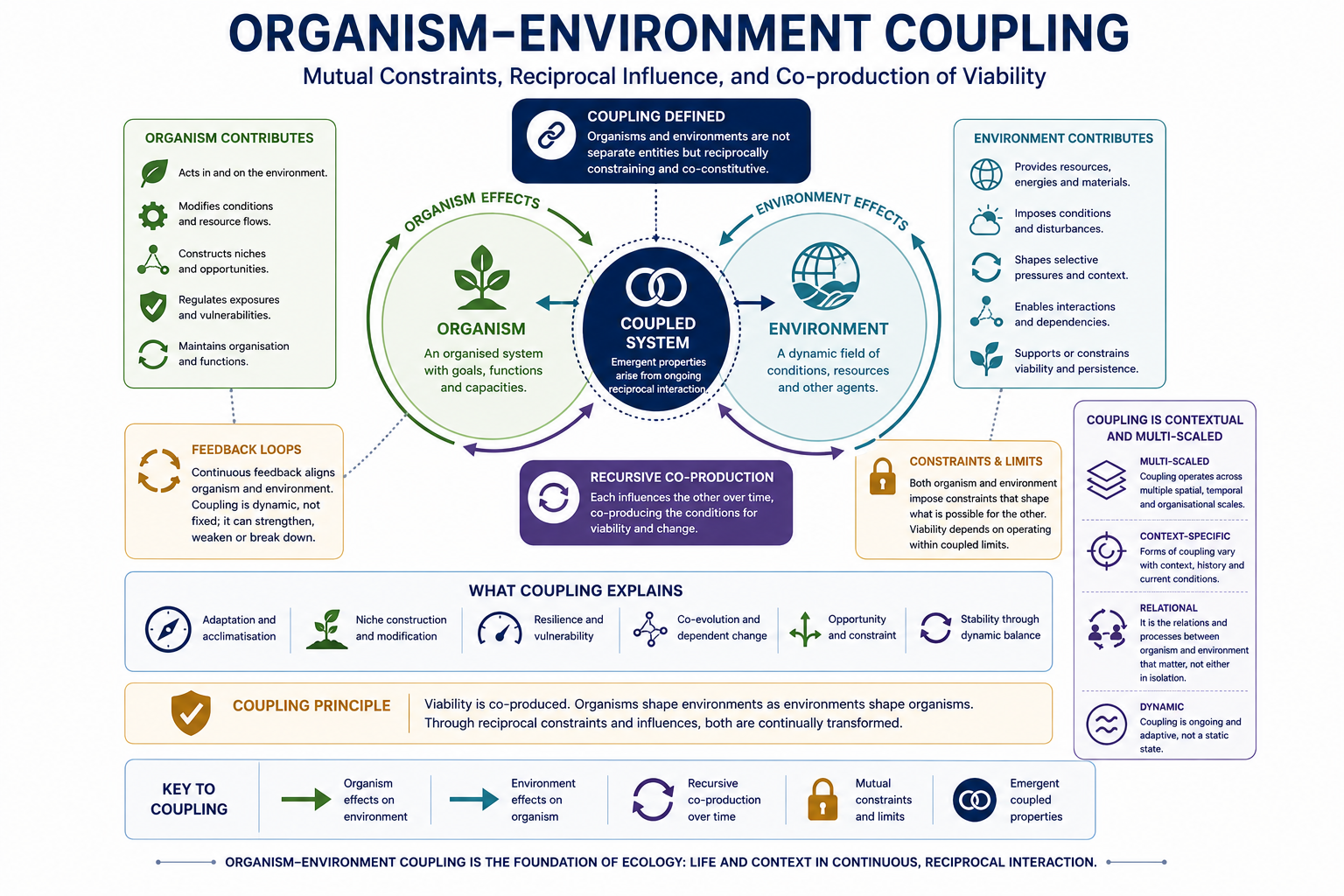
Organism–Environment Coupling. Organisms and environments are reciprocally organised through continuous ecological coupling. Environmental conditions shape biological activity while organisms simultaneously modify the ecological conditions upon which persistence depends. APS therefore treats organism–environment coupling as a continuity-producing relation rather than an external interaction between independently constituted systems.
Organism and Environment Co-Determine One Another
Environmental coupling has an important consequence.
Organisms and environments do not simply influence one another from opposite sides of an ecological boundary. They participate in the continual organisation of the conditions through which persistence becomes possible. Environmental conditions shape biological activity, while biological activity simultaneously reshapes ecological organisation.
This reciprocal organisation extends far beyond obvious ecological interactions. Organisms modify habitats, redistribute resources, alter nutrient cycles, construct ecological niches, transform microbial communities, and influence the persistence opportunities available to themselves and countless other living systems. At the same time, ecological conditions continuously constrain developmental pathways, behavioural possibilities, adaptive strategies, and viability itself.
Organism and environment therefore become reciprocally organised dimensions of a common persistence system.
APS consequently rejects both environmental determinism and organismal isolation. Neither organisms nor environments possess complete explanatory priority. Biological organisation emerges through the continuity relations linking them together.
Environmental Conditions Become Biologically Meaningful
Environmental conditions do not become biologically significant merely because they exist physically.
They become significant because they contribute to, or threaten, viable persistence.
Food, water, shelter, predators, toxins, competitors, mates, climatic conditions, and ecological signals matter biologically because living systems evaluate them relative to their own continuity. The same environmental feature may therefore possess radically different biological significance for different organisms depending upon their persistence requirements.
This observation introduces the semiosic dimension of ecology.
Organisms do not simply encounter physical environments. They encounter environments structured by viability-relevant differences. Ecological organisation therefore depends not only upon material interaction but also upon the capacity of living systems to distinguish opportunities from threats, resources from hazards, and favourable conditions from adverse ones.
APS consequently approaches organism–environment relations as both material and semiosic. Ecological continuity depends upon meaningful environmental differentiation through which biological organisation remains responsive to changing persistence conditions.
Ecology and Distributed Continuity
The ecological organisation supporting persistence extends well beyond individual organisms.
Viability emerges through continuity relations distributed across physiology, behaviour, populations, ecological communities, climatic systems, developmental processes, and evolutionary history. No organism contains all the conditions necessary for its own persistence within its physical boundaries.
This distributed organisation explains why ecological relations are constitutive rather than merely supportive. Persistence depends upon interactions extending across multiple levels of biological organisation, each contributing conditions that no individual component can generate independently.
APS therefore approaches ecology as distributed continuity organisation rather than external environmental context.
This perspective changes how biological individuality is understood. Individual organisms remain identifiable living systems, yet their persistence depends upon ecological organisation extending beyond the organism itself. Biological explanation must therefore include the wider continuity relations through which viability is sustained.
Perturbation Reveals Ecological Organisation
The dependence of organisms upon ecological continuity becomes especially visible when continuity is disrupted.
Perturbations such as climatic instability, habitat transformation, disease, resource scarcity, predation, ecological collapse, or developmental disruption expose organisational relations that often remain hidden during periods of stable functioning.
Disturbance reveals ecological dependency structures, resilience capacities, adaptive flexibility, continuity vulnerabilities, and the distributed coupling relations supporting persistence. Conditions that appear merely environmental during ordinary functioning become visible as integral components of biological organisation when they are altered or removed.
APS therefore treats perturbation as diagnostically informative rather than merely destructive. Perturbation reveals how deeply organismal persistence depends upon ecological continuity extending beyond organismal boundaries.
Resilience Depends Upon Ecological Organisation
Resilience further demonstrates why organisms cannot be understood in isolation.
Living systems remain viable because ecological continuity systems can reorganise under changing conditions. Behaviour adapts, ecological interactions redistribute, developmental pathways adjust, and persistence strategies transform in response to perturbation. Continuity is preserved through ecological reorganisation rather than through resistance to change alone.
Resilience therefore cannot be understood solely at the level of individual organisms.
The persistence of organisms depends partly upon ecosystem organisation, biodiversity, ecological redundancy, environmental stability, trophic relations, and distributed continuity across interacting scales. Ecological resilience is consequently a property of persistence systems rather than of isolated biological entities.
APS therefore approaches resilience ecologically from the outset. The capacity of organisms to remain viable reflects the resilience of the wider ecological continuity structures through which persistence is maintained.
Adaptation Is Ecological
Adaptation likewise emerges through organism–environment continuity rather than within organisms alone.
Selection pressures arise through ecological relations. Behaviour develops through environmental engagement. Developmental trajectories respond to ecological conditions, while organisms continually modify those same conditions through their own activities.
Adaptation therefore reflects the reciprocal organisation of organisms and environments across time.
Evolutionary change transforms persistence organisation partly because ecological conditions continually reshape adaptive possibilities, while organisms simultaneously reshape the ecological conditions experienced by future generations.
APS consequently approaches adaptation as an ecological process embedded within distributed continuity systems rather than as a property confined to individual organisms.
Cognition Is Ecologically Embedded
Cognition provides another reason why organisms cannot be understood independently of their environments.
Living systems do not generate cognition within isolated internal worlds before applying it to external reality. Perception, evaluation, semiosis, and behavioural regulation emerge through ongoing engagement with ecological conditions relevant to viability.
Organisms therefore become cognitively organised through continuous interaction with their environments. Environmental opportunities, constraints, signals, gradients, and affordances acquire biological significance because they contribute to the maintenance of persistence. Cognition is consequently organised around ecological continuity rather than detached internal representation.
APS rejects strongly internalist accounts of cognition for this reason. Cognitive organisation develops through organism–environment coupling, meaningful environmental differentiation, and viability-oriented behavioural engagement. The environment is therefore not simply the object of cognition but an indispensable participant in the continuity relations through which cognition itself becomes possible.
Ecological continuity thus contributes directly to cognitive continuity. Understanding cognition therefore requires understanding the ecological organisation within which cognition emerges and functions.
Why APS Reframes Ecology
Many biological approaches acknowledge that organisms interact with their environments while still treating organisms as fundamentally self-contained entities.
Ecology then becomes an external context within which biological processes occur.
APS proposes a different explanatory architecture.
Organisms remain identifiable biological systems, but the continuity supporting their persistence extends beyond organismal boundaries into wider ecological relations. Coupling, semiosis, adaptation, resilience, and distributed continuity are therefore not secondary additions to already complete organisms. They help constitute the organisation through which organisms remain viable.
This shift changes the explanatory role of ecology.
Ecology is no longer understood as the study of external surroundings alone. It becomes the study of the continuity relations through which biological organisation is sustained across organisms, environments, and the multiple scales linking them together.
APS therefore reframes ecology as a constitutive dimension of biological organisation rather than as a contextual domain surrounding living systems.
Ecology and Biological Explanation
This perspective has important consequences for biological explanation.
If persistence depends upon ecological continuity extending beyond organismal boundaries, then biological explanation cannot terminate at the organism itself. Explanations must also account for the ecological relations through which viability is maintained.
Mechanisms occurring within organisms remain indispensable, but they are not sufficient on their own. Biological explanation must also address organism–environment coupling, ecological continuity, resilience, adaptive transformation, and the distributed organisation supporting persistence across interacting scales.
APS consequently approaches biological explanation ecologically from the outset.
This perspective does not dissolve organisms into their environments, nor does it diminish the importance of organismal organisation. Instead, it situates organisms within the wider persistence systems through which biological organisation becomes intelligible.
Understanding organisms therefore requires understanding the ecological continuity that makes their persistence possible.
Conclusion
APS rejects the idea that organisms can be fully understood independently of their environments.
Although organisms possess identifiable physical boundaries, the continuity supporting their viability extends beyond those boundaries into distributed ecological relations. Organism–environment coupling, resilience, adaptation, cognition, and distributed ecological continuity all demonstrate that persistence depends upon ecological systems rather than isolated biological entities.
The apparent separation between organism and environment therefore proves to be descriptively useful but explanatorily incomplete. Organisms remain distinguishable as biological systems, yet the persistence that defines them emerges only through the ecological continuity relations in which they participate.
APS consequently concludes that organisms cannot be understood apart from their environments because biological organisation is constituted through the ecological continuity systems that make viable persistence possible across scale and time.
Related Pathways
- The Ecological Organisation of Life
- Organism–Environment Coupling
- Resilience, Ecology, and Continuity
- Ecology as Organised Persistence Across Scales
- Why Cognition Cannot Be Separated from Organised Persistence
- Diagnosis as Continuity Analysis
Key Terms
organism–environment coupling · ecology · persistence · continuity · viability · resilience · adaptation · semiosis · cognition · distributed continuity · biological organisation
See Also
Related Articles
References
- (2011). Incomplete Nature. W. W. Norton.
- (1980). Autopoiesis and Cognition. D. Reidel Publishing Company.
- (2015). Biological Autonomy. Springer.
- (2019). Everything Flows. Oxford University Press.
- (2003). Niche Construction. Princeton University Press.
- (2026). Agency as the Defining Activity of Life: A Viability-Oriented Framework Integrating Process and Scale. Biological Theory . https://doi.org/10.1007/s13752-026-00547-6
- (1991). The Embodied Mind. MIT Press.
- (1926). Theoretical Biology. Harcourt Brace.