Living Reality and Biological Explanation — What Does APS Mean by an Analytic Projection?
APS treats Agency, Process, and Scale as complementary analytic projections of materially realised living organisation rather than as independent components, causes, levels, or domains of biological reality. This article explains how that analytic differentiation can remain scientifically constrained rather than merely subjective or arbitrary, clarifies the relationship between biological realism and explanatory representation, and shows why complementarity among Agency, Process, and Scale does not require them to possess identical logical or biological status.
Key Points
- Living organisation is materially real; Agency, Process, and Scale are analytic differentiations of explanatory inquiry into that organisation.
- Analytic does not mean subjective, and projection does not mean invention.
- An analytic projection is explanandum-relative but remains constrained by material implementation, empirical evidence, explanatory relevance, and dependency.
- Agency, Process, and Scale are complementary without being logically equivalent.
- Process is not time, and Scale is not space, size, hierarchy, or an independently acting causal level.
- Organised persistence is an explanatory target rather than a fourth APS projection.
- APS does not assume that the A–P–S triad is universally necessary, universally sufficient, uniquely minimal, or guaranteed to provide explanatory gain.
Introduction — Living Reality and Biological Explanation
Living systems are not created by the concepts through which scientists describe them. Cells regulate exchange, organisms repair damage, developmental systems transform, and biological organisation persists or fails whether or not those phenomena are described through a particular explanatory framework. Yet biological explanation is necessarily selective. Scientists decide what requires explanation, which distinctions matter, what measurements are relevant, and which relations should be investigated. An explanation is therefore not a duplicate of the biological system itself, but a disciplined representation of selected features and relations that bear upon a particular question.
This creates an important problem for APS. APS treats Agency, Process, and Scale as complementary analytic projections of one viability-oriented, constraint-closed organisation. If they are analytic projections, however, it may seem that they are merely ways in which an observer chooses to see a living system. Conversely, if the organisation they disclose is biologically real, it may seem that Agency, Process, and Scale should themselves be treated as three real divisions of biological reality. Neither conclusion follows, because APS distinguishes the living organisation being investigated from the explanatory differentiation through which that organisation is investigated.
Living organisation is materially realised. Agency, Process, and Scale provide different ways of asking explanatory questions about it, and although those questions are selected by investigators, the answers are not free inventions. They remain answerable to the organisation, activities, constraints, dependencies, and material relations actually present in the biological system. In this sense:
The biology is real; the distinction is analytic; the explanation must remain answerable to the biology.
That is what APS means by an analytic projection.
Where This Article Fits: APS already distinguishes Agency, Process, and Scale as complementary analytic projections of one living organisation, and its account of organisational realism explains why materially implemented biological organisation need not be treated as merely observer-imposed. The present article addresses the philosophical relation between those commitments. It explains how APS can be realist about living organisation without turning Agency, Process, and Scale into independent components, causes, levels, or domains of biological reality, and how an investigator-selected explanatory distinction can remain scientifically constrained rather than arbitrary.
1. Living Things Are Real; Explanations Are Representations
A useful starting point is to distinguish three things that can easily be conflated: material reality, biological organisation, and explanatory differentiation.
The first is material reality. Biological entities, activities, interactions, transformations, spatial arrangements, and temporal relations occur independently of APS terminology. A membrane has material structure; metabolic reactions occur; regulatory dependencies can be disrupted; development unfolds; and organisms interact with their environments. These phenomena do not depend upon the vocabulary through which investigators subsequently describe or explain them.
The second is biological organisation. Living activity does not consist merely in a list of independently occurring components, because components participate in relations through which activities are constrained, coordinated, maintained, restored, or transformed. Organisational approaches to biology have analysed such relations through ideas including autonomy, constraint closure, regulation, functional dependence, and integrated control (Mossio, Saborido, and Moreno 2009; Montévil and Mossio 2015; Moreno and Mossio 2015; Bich and Bechtel 2022). APS treats this organisation as materially realised rather than as an additional substance standing over the components of a living system. Organisational relations can therefore be real where they are implemented through material dependencies among components, constraints, processes, and environmental conditions.
The third is explanatory differentiation. Scientific inquiry separates questions that the biological system itself does not present as labelled categories. An investigator may ask what a system is doing, how it maintains continuity despite change, which spatial and temporal extents matter, what mechanism produces an effect, or how a historical condition contributes to a present state. Making such distinctions does not divide the biological system into corresponding independent pieces; rather, it separates explanatory questions directed toward a common referent.
Explanatory differentiation separates questions without necessarily separating their referents.
The same living system can therefore support more than one legitimate explanatory analysis without implying either that explanation is arbitrary or that several distinct realities have been created by description. Scientific models and explanatory concepts are selective, and often idealised, while still being constrained by the world they seek to explain (Morgan and Morrison 1999; Potochnik 2017). The relevant asymmetry is consequently important:
The representation depends for its warrant upon the reality represented; the reality does not depend for its existence upon the representation.
APS therefore rejects both naïve reification and unrestricted constructivism. Explanatory categories need not reproduce the architecture of reality point for point, but neither are they insulated from empirical failure.
2. What Does APS Mean by an Analytic Projection?
An analytic projection is an explanandum-relative explanatory differentiation through which selected features or relations of materially realised organisation are brought into focus. Each element of this formulation matters because the term is intended to identify a disciplined explanatory operation without converting that operation into a claim about independently existing divisions of biological reality.
Analytic means that the distinction is made for investigation and explanation; it does not mean imaginary, merely verbal, or subjective. Projection means that a particular explanatory question brings certain relations into focus while leaving others in the background. Nothing is literally projected out of the organism, and the living system need not contain a corresponding independent component. For that reason, projection is a methodological label, not a geometric model of biological reality. APS does not assume that Agency, Process, and Scale are latent axes or dimensions already built into the world and merely waiting to be projected.
The analogy with a projection is useful only within these limits. Different projections of one object can disclose different relations without producing additional objects, and in the same way Agency, Process, and Scale can disclose different explanatory relations within one materially realised living organisation without implying that three separate things exist inside it. The analogy itself, however, does not guarantee scientific adequacy. A representation can be unhelpful, misleading, badly specified, or empirically unsupported.
APS also does not use analytic projection merely as another term for an observer’s perspective. A perspective can be understood loosely as a standpoint or way of looking, whereas an analytic projection is intended more narrowly as an explanandum-relative explanatory differentiation whose biological application remains materially and empirically constrained. A scientifically warranted analytic projection must therefore remain connected to the material organisation being investigated. Its claims must be open to empirical support, qualification, or rejection; the relations it identifies must bear on the specified explanandum; and where a projection is claimed to provide additional explanatory capacity, that claim must also survive comparison with the strongest relevant alternative.
Thus:
Projection does not mean invention.
And:
Analytic does not mean subjective.
The distinction between the projection and what it helps an investigator identify is therefore crucial. Agency, Process, and Scale organise inquiry, while the biological explanatory work is performed by the materially realised activities, dependencies, constraints, transformations, and relations disclosed through that inquiry. An analytic projection structures a question; it is not an additional biological cause.
3. One Living Organisation, Three Explanatory Projections
APS begins from a materially realised living organisation rather than from three independent explanatory objects. Its canonical definition is:
Life is viability-oriented, constraint-closed organisation.
Agency, Process, and Scale provide complementary analytic projections through which different questions can be directed toward that organisation. Agency asks what living systems do and, more specifically, brings into focus the APS claim that biological agency is viability-oriented organisational activity. Process asks how continuity is maintained despite change, directing attention to the ways living systems maintain, reorganise, or re-establish organisation through continual material turnover, repair, physiological adjustment, development, environmental interaction, and transformation. Scale asks where persistence is organised across spatial and temporal extents, identifying which extents and which materially implemented relations among them matter to the explanandum.
These projections should therefore not be understood as three causes operating upon one another, three hierarchical levels, three independently existing domains, or three components into which living systems can be decomposed. They are distinct explanatory questions directed toward the same organised biological system. Organised persistence is correspondingly not a fourth projection, but an explanatory target: the continuity of living organisation through change. This distinction allows APS to examine how Agency, Process, and Scale bear upon a persistence problem without turning persistence itself into another ingredient of living systems.
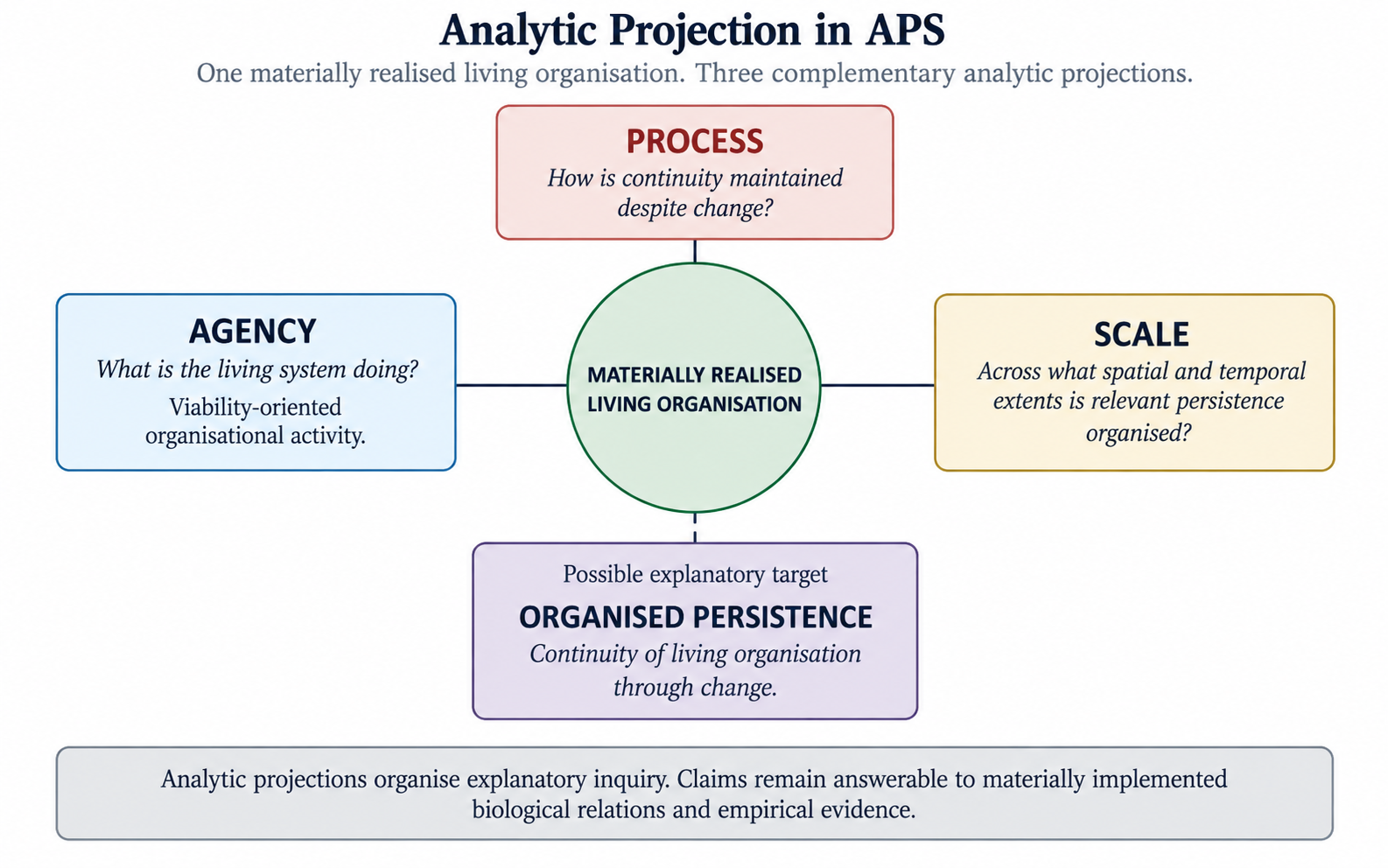
Analytic Projection in APS. Agency, Process, and Scale are distinct explanatory projections directed toward one materially realised living organisation. They are not independent components, causes, levels, or domains. Organised persistence may be an explanatory target without becoming a fourth projection.
4. Observer Dependence Without Arbitrariness
Every scientific inquiry begins with selection. Investigators decide what phenomenon requires explanation and select experimental systems, variables, measurements, models, and comparisons. APS adds another form of selection by asking whether Agency, Process, Scale, or some combination of them is relevant to the problem being investigated. That dependence on investigators does not, however, make explanation arbitrary.
Three forms of dependence need to be distinguished. Question dependence concerns the explanandum, because investigators decide what they want to explain. Representational dependence concerns the conceptual and methodological resources through which that problem is investigated. Biological dependence, by contrast, concerns whether the relations identified by the analysis actually occur and whether they matter to the biological phenomenon. The first two are selected by the investigator in the relevant sense; the third is constrained by the system.
The investigator may choose the question; the biological system constrains which answers can survive.
This is why scientific perspectivism need not collapse into relativism. Different models or perspectives may select different features of a system while remaining empirically answerable to something they do not create (Giere 2006; Massimi 2022). The same principle applies to APS. Choosing to analyse a phenomenon under Agency does not make the candidate system an agent; choosing a Process question does not establish that an identified temporal relation explains continuity; and widening a Scale analysis does not make every wider spatial or temporal extent explanatorily relevant.
Scientific warrant therefore increases as an analytic proposal becomes materially grounded, empirically supported, explanatorily relevant, and connected to identifiable biological dependencies. Where additional explanatory gain is claimed, a further question arises:
What does this analysis explain that the strongest relevant comparator does not already explain?
A projection can consequently be legitimate yet contribute no additional explanatory gain, and APS must allow that result.
5. Ontology and Methodology
The distinction between ontology and methodology is especially important because APS makes genuine claims about biology while also describing itself as a comparative explanatory methodology. Those positions are compatible, but only if the status of the respective claims is kept clear.
APS is not ontologically neutral. Its definition of Life is a substantive biological claim, as is its definition of biological agency, and claims about viability, constraint closure, regulation, material dependence, and biological organisation are not merely instructions about how investigators should talk. At the same time, APS does not require a complete inventory of everything that ultimately exists. It need not settle whether reality is fundamentally composed of substances, processes, relations, structures, or some combination of them, nor does it need to settle the general philosophical dispute over scientific realism. Its commitment is narrower: APS is realist about materially organised biological activity and the empirically supportable relations through which it is realised.
Organisational biology provides an important basis for this position. Constraint closure, biological autonomy, organisational function, and integrated control describe materially implemented dependencies rather than an immaterial organising force (Mossio, Saborido, and Moreno 2009; Montévil and Mossio 2015; Moreno and Mossio 2015; Bich and Bechtel 2022). Recognising such relations does not require treating an organismal whole as an additional causal entity standing above its components. Scientific realism likewise need not be restricted to belief in isolated objects, because scientific inquiry commonly concerns structures and relations as well as entities, even though disagreement remains about what kinds of empirical and explanatory success justify realist commitment (Worrall 1989; Chakravartty 2017).
APS therefore adopts a bounded organisational realism. Where an organisational relation is materially implemented, empirically supportable, and explanatorily relevant, APS permits that relation to be treated as a feature of the biological system rather than merely an artefact of explanatory language. This inference remains defeasible: useful vocabulary is not enough, successful modelling does not guarantee simple one-to-one correspondence, and a relation may be real while remaining irrelevant to the particular explanandum under investigation.
The boundary can therefore be stated simply:
Ontology concerns what the biological claim says is there. Methodology concerns how the claim is formulated, investigated, and assessed.
This distinction is especially important for Agency, Process, and Scale. Biological agency can be real without Agency becoming an independent ontological division; biological processes can be real without Process committing APS to process ontology; and spatial and temporal extents can be materially real without Scale becoming a causal level or entity. APS must therefore distinguish realism about the biological referent from reification of the analytic projection.
6. Agency, Process, and Scale Are Not Identical Kinds of Question
Calling Agency, Process, and Scale complementary analytic projections can suggest a stronger symmetry than APS requires, because the three do not have exactly the same logical or biological status. Their complementarity must therefore be understood in terms of the distinct explanatory work they perform rather than an assumption that they instantiate one identical kind of category.
Agency has the clearest attribution condition. To attribute biological agency is to claim that the candidate itself instantiates viability-oriented organisational activity, which means that not every component participating in an organism’s agency is thereby an independent agent. Process works differently: it does not usually ask whether a candidate is a Process, but how continuity is maintained, reorganised, or re-established through change. Scale differs again, because it does not ask whether an entity possesses Scale, but across which spatial and temporal extents the materially relevant organisation and dependencies must be traced.
This asymmetry is real, but it does not follow that the architecture is incoherent. A useful explanatory framework does not require all of its questions to belong to one identical logical class; what matters is whether they perform distinct, non-redundant, and mutually compatible explanatory functions. Agency, Process, and Scale satisfy that condition provisionally. Agency cannot simply be replaced by Process without losing the viability-oriented attribution; Process cannot simply be replaced by Scale without losing the question of continuity and transformation through change; and Scale cannot simply be replaced by Agency without losing the question of explanatory extent.
Their complementarity is therefore functional rather than symmetrical.
Complementary does not mean equivalent.
Nor does complementarity mean that all three projections must contribute equally to every biological explanation. Agency may be decisive for one explanandum, Process may carry most of the explanatory burden for another, while Scale may reveal a dependency that a more local analysis misses in a third. In still other cases, one or more projections may add little or nothing. Such variation is compatible with APS’s target-sensitive methodology, provided that target sensitivity affects whether and how a projection is relevant rather than permitting Agency, Process, or Scale to be redefined from case to case. Their meanings must remain stable even when their explanatory importance differs among biological problems.
7. Space, Time, Process, and Scale
A simple intuition helps introduce Process and Scale:
Biological phenomena happen somewhere, over some duration, while something is happening.
This observation is useful, but it should not be mistaken for a derivation of APS. Biological phenomena are materially spatial and temporal: cells have positions and boundaries, organisms occupy environments, development has duration, regulatory events occur in sequence, and evolutionary histories extend across generations. The explanatory projections of Process and Scale nevertheless cannot be reduced to those physical facts.
Process is not time.
Temporal passage by itself does not explain how a living system maintains continuity, because events can follow one another without sustaining, restoring, or reorganising the organisation of the system. Process asks instead how materially realised activity contributes to continuity through change. Not every temporally extended biological explanation is therefore a Process analysis in the APS sense. Process becomes relevant when continuity, reorganisation, or re-establishment through change is itself part of the explanandum.
Similarly:
Scale is not space.
Scale does not simply identify where something is located or how large it is. It asks which spatial and temporal extents, and which materially implemented relations across those extents, matter to the explanatory problem. Scale is therefore itself spatiotemporal. A developmental dependency may extend across hours, months, tissues, environments, or generations; a physiological dependency may operate rapidly and locally; and an evolutionary explanation may require a much longer temporal extent.
Time consequently does not belong exclusively to Process, just as space does not belong exclusively to Scale. Process and Scale can interrogate the same temporal reality differently: Process asks how organisation continues or changes through time, whereas Scale asks how far the relevant explanatory dependency extends, including temporally. Spatial organisation can likewise matter to Agency or Process when it materially implements viability-oriented activity or continuity. The projections therefore distinguish explanatory questions rather than exclusive physical properties.
Human investigators necessarily describe space and time through concepts and measurement conventions, but this does not make the spatial and temporal organisation of biological systems merely psychological. Nor does APS claim that Agency, Process, and Scale follow from the structure of human perception. Material spatiotemporality helps make Process and Scale intelligible, but it does not establish that A–P–S is the uniquely necessary or sufficient architecture for biology.
8. Explanatory Economy: What APS Has and Has Not Established
APS is compact, but compactness alone does not establish parsimony merely because the framework contains three named projections. A meaningful account of explanatory economy must instead ask what the distinctions actually accomplish.
A framework may be conceptually economical if a relatively small number of stable distinctions prevent recurrent confusion, clarify explananda, identify dependencies, and travel across different biological domains without repeated redefinition. APS has a bounded claim of this kind. The distinction among Agency, Process, and Scale helps separate questions concerning viability-oriented activity, continuity through change, and explanatory extent, while their analytic status avoids treating the three as additional biological substances or levels.
Stronger claims remain open. APS has not demonstrated that Agency, Process, and Scale are universally sufficient for biological explanation, that every biological explanation requires all three, that three is the uniquely minimal number of projections, or that APS has general explanatory superiority over other frameworks. The appropriate test is therefore comparative:
For a specified explanandum, does using A–P–S clarify the explanatory problem with less unnecessary conceptual burden and without sacrificing explanatory adequacy?
Possible outcomes include genuine explanatory gain, complementarity with another account, null gain, or advantage to the comparator. This matters because economy without adequacy is merely omission: a shorter description is not automatically a better explanation, just as additional conceptual machinery is not automatically more powerful.
APS should therefore treat its broader explanatory economy as a testable methodological hypothesis. Systematic redundancy among the projections, failure to distinguish relevant explananda, repeated need for an additional independent projection, unstable meanings across domains, increased explanatory burden without compensating gain, or repeated cases in which simpler alternatives perform as well or better would all count against the architecture. A framework that cannot lose cannot be meaningfully assessed, and APS should therefore be judged by what its distinctions enable investigators to discover, discriminate, and explain rather than by their numerical elegance.
9. Why APS Adopted Analytic Projection
The language of analytic projection reflects a development in APS’s own architecture. Earlier formulations gave Agency, Process, and Scale greater constitutive and generally necessary weight, which made it easier for explanatory distinctions to appear as though they were corresponding divisions of biological reality. Subsequent development clarified that the biological commitment and the explanatory architecture should be distinguished.
This development was not a retreat from realism, but a more precise location of that realism. APS continues to treat living organisation, viability-oriented activity, material constraints, biological dependencies, transformation, and relevant spatial and temporal relations as potentially real features of biological systems. What changed was the status assigned to the A–P–S differentiation itself. Agency, Process, and Scale are now treated as analytic projections directed toward one materially realised living organisation rather than as three constitutive dimensions or universally necessary components of biological reality.
The change can therefore be described as controlled de-reification and methodological narrowing.
Analytic projection did not enter APS because the framework became less realist. It entered because APS needed to become more precise about where its realism belongs.
The biology is organised; the explanatory differentiation is ours.
10. What Analytic Projection Clarifies — and What It Does Not
The concept of analytic projection resolves several potential confusions at once. It clarifies how APS can distinguish Agency, Process, and Scale without treating them as independent components; how an investigator-selected explanatory question can remain sufficiently objective to be empirically tested; and how realism about living organisation can be maintained without converting an explanatory architecture into an ontology. It also allows Agency, Process, and Scale to remain complementary despite their different logical functions, explains why Process is not another word for time and Scale is not another word for space, and keeps APS answerable to the biological relations its explanations claim to identify.
These clarifications should not, however, be mistaken for a solution to every philosophical problem raised by biological organisation. Analytic projection does not provide a complete metaphysics of organisation, establish that Agency, Process, and Scale are universally necessary or sufficient for every biological explanandum, prove that exactly three projections form the uniquely minimal architecture, or derive APS from human cognition or perception. Nor does it require process ontology, settle the general scientific-realism debate, or establish that an APS explanation is superior simply because it is formulated through A–P–S.
The concept is therefore deliberately limited. Its purpose is to state clearly the relationship between a materially organised biological reality and the explanatory distinctions APS uses to investigate it. That relationship can be realist without being reifying, analytic without being arbitrary, and methodologically structured without claiming universal explanatory priority.
Conclusion
APS is committed to the reality of living organisation, but it does not treat Agency, Process, and Scale as three independent pieces of that reality. They are analytic projections: distinct explanatory questions directed toward one materially realised, viability-oriented, constraint-closed organisation.
Their analytic status does not make them merely subjective. Investigators select questions and representations, but biological organisation constrains which interpretations, dependencies, and explanatory claims can be sustained. Nor does biological realism require APS to convert its explanatory categories into an ontology, because real agency, real processes, and real spatial and temporal relations can be investigated without treating Agency, Process, and Scale as independent ontological divisions.
The resulting position is deliberately bounded. A–P–S provides a compact way of distinguishing important explanatory questions, but whether those questions add explanatory value in a particular case remains something to be demonstrated. The central distinction is therefore simple:
Living organisation is real. The explanatory differentiation is ours.
And its methodological consequence is equally important:
The biology is real; the distinction is analytic; the explanation must remain answerable to the biology.
Explanatory Architecture
Central Question
How can APS treat living organisation as materially real while treating Agency, Process, and Scale as analytic projections rather than as independent divisions of biological reality?
Architectural Role
This article is a philosophical clarification of the relation between APS organisational realism and the A–P–S analytic architecture. Its role is to explain how investigator-selected explanatory differentiation can remain materially and empirically constrained without reifying Agency, Process, and Scale as components, causes, levels, or domains of living organisation.
Builds On
This article builds on Life as viability-oriented, constraint-closed organisation; Biological Agency as viability-oriented organisational activity; Process; Scale; organised persistence; constraint closure; organisational realism; and the APS methodology of target-sensitive explanatory comparison.
These dependencies do not imply that every biological explanation requires all three APS projections or that use of A–P–S guarantees explanatory gain.
Develops Into
This clarification supports more precise use of Agency, Process, and Scale across APS by distinguishing the reality of the biological relations under investigation from the analytic form through which those relations are made explanatorily explicit. It also supports later comparative testing of whether particular projections clarify a specified explanandum, contribute additional explanatory capacity, or yield no additional gain.
Related Explanatory Questions
Relevant questions include
- how explanatory representations can track materially real biological relations without reproducing the structure of reality point for point
- how investigator selection can remain scientifically constrained
- whether Agency, Process, and Scale must have identical logical status to be complementary
- how Process differs from time and Scale from space
- whether the three projections are non-redundant across biological domains
- and whether A–P–S provides genuine explanatory economy relative to relevant alternatives.
Position within APS
Life is viability-oriented, constraint-closed organisation. Agency, Process, and Scale are complementary analytic projections of that living organisation rather than components of reality. Agency concerns what living systems do; Process concerns how continuity is maintained despite change; Scale concerns where persistence relevant to an explanandum is organised across spatial and temporal extents.
Organised persistence may be an explanatory target without becoming a fourth projection. The A–P–S differentiation belongs to explanatory analysis, while claims made through it remain answerable to materially implemented biological relations, empirical evidence, explanatory relevance, and, where explanatory gain is claimed, comparison with the strongest relevant alternative.
Material grounding: Explanatory claims made under these projections must identify materially implemented biological activities, constraints, relations, or dependencies where such claims require them.
Epistemic constraint: Investigator selection of an explanandum or projection does not establish the truth or adequacy of the resulting explanation. Claims remain open to empirical support, qualification, rejection, and—in claims of additional explanatory capacity—comparison with the strongest relevant alternative.
Ontological boundary: Agency, Process, and Scale are analytic projections rather than components of reality. Realism concerns the materially realised living organisation and the biological relations that successful analysis identifies, not an independent ontological status for the projections themselves.
Explanatory limitation: APS does not assume that every explanandum requires all three projections, that the triad is universally sufficient, or that use of A–P–S guarantees explanatory gain.
See Also
Related Articles
References
- (2022). Organization Needs Organization: Understanding Integrated Control in Living Organisms. Studies in History and Philosophy of Science, 93, 96–106 . https://doi.org/10.1016/j.shpsa.2022.03.005
- (2017). Scientific Ontology: Integrating Naturalized Metaphysics and Voluntarist Epistemology. Oxford University Press. https://doi.org/10.1093/oso/9780190651459.001.0001
- (2006). Scientific Perspectivism. University of Chicago Press.
- (2022). Perspectival Realism. Oxford University Press. https://doi.org/10.1093/oso/9780197555620.001.0001
- (2015). Biological Organisation as Closure of Constraints. Journal of Theoretical Biology, 372, 179–191 . https://doi.org/10.1016/j.jtbi.2015.02.029
- (2015). Biological Autonomy: A Philosophical and Theoretical Enquiry. Springer. https://doi.org/10.1007/978-94-017-9837-2
- (1999). Models as Mediators: Perspectives on Natural and Social Science. Cambridge University Press. https://doi.org/10.1017/CBO9780511660108
- (2009). An Organizational Account of Biological Functions. The British Journal for the Philosophy of Science, 60(4), 813–841 . https://doi.org/10.1093/bjps/axp036
- (2017). Idealization and the Aims of Science. University of Chicago Press. https://doi.org/10.7208/chicago/9780226507194.001.0001
- (1989). Structural Realism: The Best of Both Worlds?. Dialectica, 43(1–2), 99–124 . https://doi.org/10.1111/j.1746-8361.1989.tb00933.x