Scale — How Life Is Coordinated Across Space and Time
This article explains Scale in APS as the analytic projection concerned with where persistence is organised across spatial and temporal extents. It distinguishes Scale from physical size, explanatory hierarchy, and materially realised spatial structure while showing why biological explanation must identify the extents across which living organisation is maintained.
Key Points
- Scale is the APS analytic projection concerned with where persistence is organised across spatial and temporal extents.
- Scale is not physical size, an explanatory level, or an independently acting causal domain.
- Material spatial structure can be constitutive of biological organisation without being identical to Scale as an APS explanatory projection.
- Biological organisation is materially realised across spatial and temporal extents, and explanatory claims must be warranted at the extents to which they apply.
- Agency, Process, and Scale are analytic projections of one viability-oriented, constraint-closed organisation rather than independent causes, levels, or components.
Scale — How Life Is Coordinated Across Space and Time
Where this article fits: This Core article establishes the meaning and explanatory role of Scale within APS. Scale asks where persistence is organised across spatial and temporal extents. It does not introduce an additional biological mechanism, causal level, or component of living organisation. Material spatial relations can themselves contribute constitutively to biological organisation; Material spatial relations can themselves contribute constitutively to biological organisation; Scale provides the analytic projection through which the spatial and temporal extent of that organisation becomes the target of analysis.
Introduction
Biological organisation is materially realised across space and time. Molecules interact within cells; cellular structures occupy particular positions and orientations; cells form tissues whose organisation depends upon boundaries, geometries, local environments, and material relations. Organisms, in turn, maintain their activity through processes distributed across different spatial extents and temporal durations. Biology often describes such differences using terms such as level, hierarchy, size, resolution, or scale. These descriptions can be useful, but they do not by themselves explain how living organisation persists.
APS uses Scale in a more specific explanatory sense:
Scale is the analytic projection concerned with where persistence is organised across spatial and temporal extents.
Scale therefore does not designate a separate entity or causal domain within a living system, nor is it simply another name for spatial structure. The explanatory object remains one viability-oriented, constraint-closed organisation. Scale makes explicit the spatial and temporal extents across which the organisation relevant to a particular biological explanandum is materially realised and maintained.
Scale Beyond Levels
Biology frequently organises phenomena into familiar domains such as molecular, cellular, tissue, organismal, population, ecological, and evolutionary, and nothing in APS requires abandoning those descriptions. The difficulty arises when descriptive divisions are treated as though they were independently acting causal levels, or when assigning a phenomenon to a level is taken to explain it. A molecule does not act because it belongs to a molecular level, a cell does not regulate because it occupies a cellular level, and an organism does not persist because organismal organisation occupies a higher position in a hierarchy. In each case, the relevant causal interactions are materially realised interactions among processes, structures, constraints, and environmental conditions.
These relations can extend across spatial and temporal extents that do not correspond neatly to a single conventional level. APS therefore does not replace one hierarchy with another hierarchy called Scale. Instead, Scale asks:
Across what spatial and temporal extents is the organisation relevant to this explanandum actually realised?
This shifts explanatory attention from a presumed ordering of levels toward the organisation that must be identified in the biological case itself.
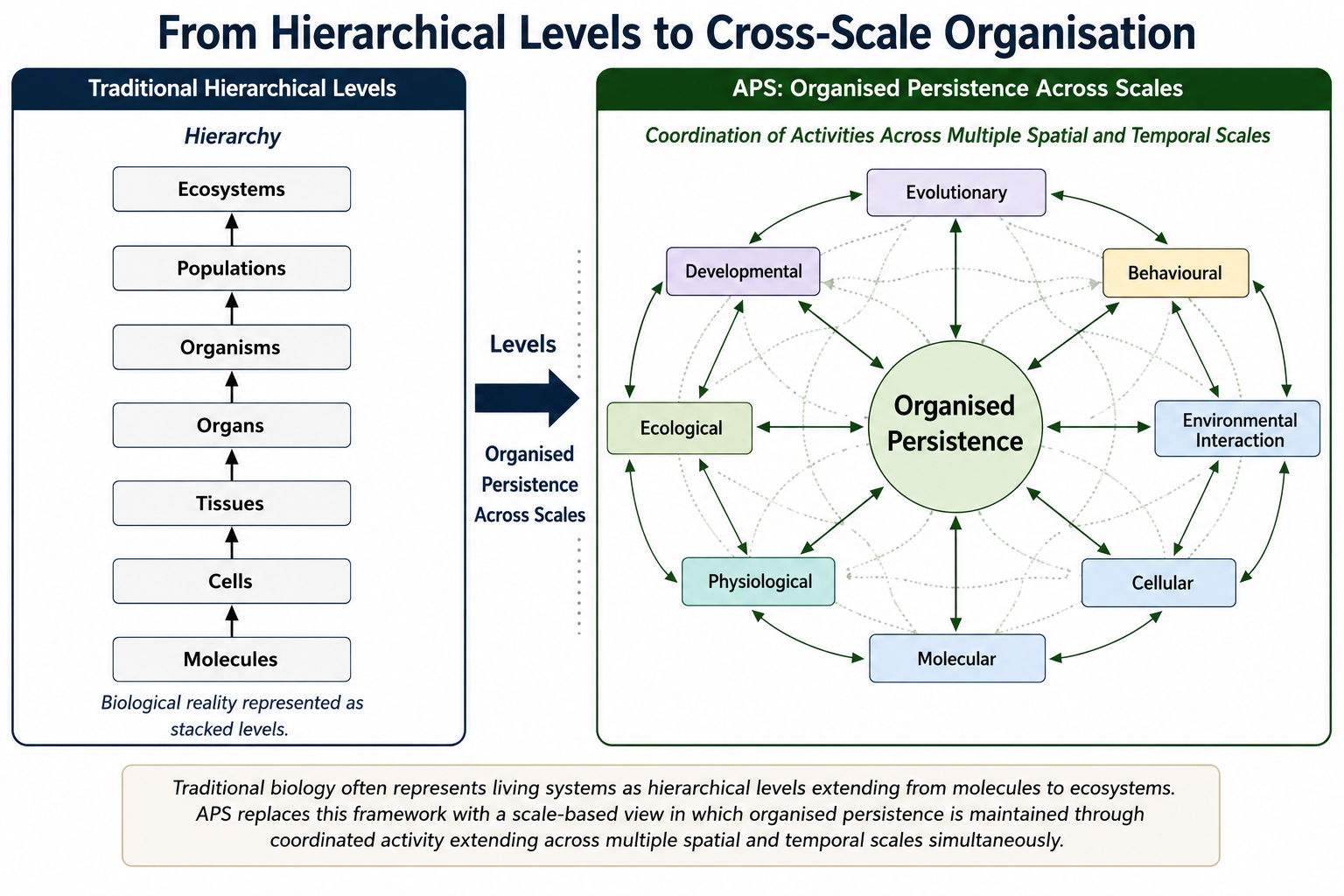
From Hierarchical Levels to Scale Analysis.
Conventional level descriptions can distinguish molecular, cellular, organismal, ecological, and evolutionary domains, but these labels do not themselves identify causal organisation. APS Scale asks where the organisation relevant to a biological explanandum is materially realised across spatial and temporal extents. Scale is therefore an analytic projection of living organisation rather than an additional causal layer; organised persistence may be one explanatory target of Scale analysis.
Scale as an Analytic Projection
Scale does not itself organise biological activity; living systems do. Their organisation is materially realised through processes, structures, boundaries, constraints, interactions, and environmental relations extending through space and time. Scale identifies the analytic projection through which the extent of that organisation is investigated. This distinction matters because statements such as “Scale coordinates activity” or “causation operates between scales” can inadvertently turn an analytic distinction into a causal entity. The philosophical status of this distinction is developed in Living Reality and Biological Explanation — What Does APS Mean by an Analytic Projection?. That article explains how Scale can direct an investigator-selected explanatory question toward materially real spatial and temporal organisation without turning Scale itself into a biological level, causal domain, or division of reality.
APS instead asks what materially implemented relations alter the conditions under which local activity occurs, how those relations are maintained, and across what spatial and temporal extents the resulting organisation must be analysed. A physiological process, for example, may depend upon molecular reactions, cellular organisation, tissue architecture, vascular relations, neural regulation, and organism–environment interaction. The explanatory task is not completed by saying that these processes occur at different scales; it requires identifying the organisation through which those materially realised relations contribute to continued functioning.
Scale tells us where that organisation must be sought and delimited.
Spatial Structure and Scale
The distinction between spatial structure and Scale is especially important. Hermida and Ladyman (2026) argue that biological organisation often consists in, or depends upon, spatial structure together with physical interactions among the parts of biological systems. Spatial features such as position, configuration, shape, directionality, orientation, boundaries, and location can therefore matter directly to biological organisation. APS does not redescribe these material spatial relations as Scale. A membrane boundary, the orientation of a cellular structure, the position of a signalling component, or the geometry of a tissue can contribute materially to what a biological system does; those relations belong to the organisation being explained.
Scale is the analytic projection under which we ask where that organisation is realised across spatial and temporal extents.
The distinction can therefore be stated simply:
Spatial organisation concerns materially realised biological relations. Scale concerns the explanatory identification of the extents across which organised persistence is realised.
The two are closely related, but they are not interchangeable. Recognising the constitutive importance of spatial structure also does not require APS to make a general claim against physical or part–whole explanation. Hermida and Ladyman explicitly distinguish their criticism of genetic and molecular reductionism from physical and suitably spatially informed part–whole explanation, and APS is compatible with that methodological caution. Its concern is not to establish Scale as a rival to physical, mechanistic, spatial, or compositional explanation, but to clarify what must be specified when the organisation relevant to persistence extends beyond the boundaries assumed by a more local description.
Coordination Across Spatial and Temporal Extents
Living organisation often depends upon relations realised across more than one spatial or temporal extent. Molecular processes operate within cellular structures, cellular activity occurs within tissue organisation, and physiological regulation depends upon materially realised relations distributed through an organism. Organismal activity likewise modifies and is modified by environmental conditions. None of these statements requires scales themselves to interact: the causal work is performed by the materially realised processes and constraints.
A wider organisational arrangement can alter local conditions because that arrangement is implemented through material relations that constrain the possibilities available to local activity. Conversely, local processes can modify the material organisation within which other processes occur. APS therefore avoids treating cross-scale influence as causation exercised by one level over another. The explanatory question is instead:
Which materially realised relations connect the relevant activities, and across what spatial and temporal extents must those relations be followed to explain continued organisation?
Persistence may depend upon such distributed coordination, but the coordination belongs to the living organisation. Scale identifies where that organisation is distributed.
Homeorhesis and Organised Persistence
Living organisation is not maintained by preserving an unchanged state. Material components turn over, structures change, development alters form, environmental conditions vary, and regulatory relations are repeatedly maintained, modified, and re-established. Homeorhesis can describe this persistence through an organised trajectory rather than through static constancy.
Scale does not provide the continuity of such a trajectory. Rather, it asks across what spatial and temporal extents the materially realised organisation underlying that continuity must be tracked. A trajectory may therefore require explanation over seconds or years, within a cell or across an organism, depending upon the explanandum. What persists is the organisation; Scale identifies the extent over which that persistence is organised.
Scale and the APS Triad
Scale is one of three analytic projections through which APS organises biological explanation:
- Agency concerns what living systems do.
- Process concerns how continuity is maintained despite change.
- Scale concerns where persistence is organised across spatial and temporal extents.
These are analytic projections rather than components of reality. They are not three independent mechanisms, three stages through which living systems pass, or biological levels, and persistence does not arise from their interaction. The explanatory object is one viability-oriented, constraint-closed organisation: Agency makes its activity explicit, Process makes its continuity through change explicit, and Scale makes the spatial and temporal extent of its organised persistence explicit.
The three projections can therefore place different explanatory questions before the same biological case without dividing the living organisation into separate ontological dimensions.
Scale-Indexed Organisation
Biological properties cannot automatically be transferred from one spatial or temporal extent to another. Evidence that a local process contributes to regulation does not establish that a larger aggregate is itself an agent; evidence that components exchange information does not establish cognition at every encompassing domain; and the persistence of an ecological or evolutionary pattern does not automatically establish that the ecological system, species, or lineage possesses the same organisational properties as a living organism.
Scale therefore performs an important discriminatory role in explanation. Claims must be warranted for the organisation to which they are attributed and for the spatial and temporal extent over which that organisation is materially realised. This is particularly important for concepts such as:
- biological agency
- normativity
- cognition
- semiosis
- individuality
- and organised persistence
Similarity across domains can justify comparison, but it does not by itself establish identity of biological organisation. Scale analysis therefore helps prevent the uncritical projection of explanatory concepts from one domain or extent to another.
Why Scale Matters
Scale matters because biological explananda frequently depend upon organisation whose relevant boundaries cannot be assumed in advance. A local mechanism may be sufficient for one question, while another may require relations extending across cells, tissues, an organism, or organism–environment coupling. Still other questions concern developmental, ecological, or evolutionary phenomena whose spatial and temporal extents differ from those of organismal self-maintenance.
APS does not assume that every biological explanation must encompass the widest available extent, nor does it presume that a broader description is intrinsically more explanatory than a local one. The relevant extent is determined by the explanandum and by the materially realised dependencies required to explain it. Scale therefore helps clarify:
- why conventional level labels do not by themselves supply explanations;
- where the organisation relevant to an explanandum is materially realised;
- when a more local or more extended explanatory domain is required;
- how spatial and temporal organisation contribute to biological persistence;
- and why biological properties must be attributed only where the relevant organisation is established.
Scale is therefore target-sensitive. More Scale is not more explanation; the relevant Scale is the spatial and temporal extent required by the explanatory target.
Explanatory Architecture
Central Question
Where is the organisation relevant to biological persistence realised across spatial and temporal extents, and what explanatory difference does identifying those extents make?
Architectural Role
This Core article establishes the APS meaning of Scale:
Scale is the analytic projection concerned with where persistence is organised across spatial and temporal extents.
It does not constitute a biological mechanism, causal level, spatial structure, or independent organisational dimension. The material organisation identified under a Scale analysis may include boundaries, configurations, spatial relations, constraints, interactions, trajectories, and environmental couplings. Those relations belong to the biological system or explanandum under investigation; Scale identifies their relevant explanatory extent.
Spatial-Organisation Comparator
Hermida and Ladyman (2026) provide an important contemporary comparator because they defend the constitutive explanatory importance of spatial structure in biology, but their account and APS Scale are not identical proposals. Hermida and Ladyman address how material spatial organisation contributes to biological phenomena; APS Scale asks where persistence-relevant organisation is realised across spatial and temporal extents.
Where these approaches address the same explanatory target, APS does not assume an additional explanatory contribution merely by redescribing the phenomenon in Scale terminology. Any claimed explanatory gain requires target-matched comparison with the strongest established account of that target.
Position Within APS
Scale must be understood together with Agency and Process without being converted into an independently acting component of living organisation.
Life is viability-oriented, constraint-closed organisation.
Agency concerns what that organisation does, Process concerns how its continuity is maintained despite change, and Scale concerns where that persistence is organised across spatial and temporal extents. These projections can be distinguished analytically because different biological questions give different explanatory priority to activity, continuity, or extent; they nevertheless concern the same materially realised organisation.
Conclusion
Scale is not size, hierarchy, or an independently acting biological level, nor is it identical to spatial structure. Material spatial relations can contribute constitutively to biological organisation: boundaries, positions, configurations, orientations, shapes, constraints, and physical interactions can all matter to how living systems function and persist. APS Scale asks a different but complementary explanatory question:
Where is the organisation through which persistence is maintained realised across spatial and temporal extents?
The answer must be established from the biological case rather than imposed by a predetermined hierarchy. Living organisation performs the causal and coordinative work; Scale makes its relevant extent explicit. Within APS, Scale therefore remains an analytic projection of one viability-oriented, constraint-closed organisation: the projection concerned with where persistence is organised across spatial and temporal extents.
See Also
Related Articles
References
- (2026). The Importance of Spatial Structure in Biology. European Journal for Philosophy of Science, 16(3) . https://doi.org/10.1007/s13194-026-00760-x