How Did Cognition Become a Biological Problem?
Cognition was not always a biological problem. It was successively approached through questions about knowledge and intellect, mind, experimental psychology, behaviour, representation, computation, and neural implementation. Ecological, embodied, dynamical, distributed, enactive, comparative, and biological approaches subsequently widened the problem by asking whether cognition could occur beyond familiar neural cases. This article traces that reorganisation of the explanatory landscape and shows why it produces a contemporary biological boundary problem: how to distinguish cognition from sophisticated regulation without either restricting cognition to nervous systems or extending it indiscriminately throughout life.
Key Points
- Cognition has not named one unchanged explanatory problem throughout its history.
- Experimental psychology, computation, and neuroscience made cognition scientifically tractable without settling its lower biological boundary.
- Ecological, embodied, dynamical, distributed, enactive, and biological approaches widened the possible domain of cognition.
- Complex regulation, plasticity, memory-like effects, anticipation, and adaptive success do not by themselves establish cognition.
- APS treats the cognition–regulation boundary as a comparative explanatory problem requiring empirical discrimination rather than terminological stipulation.
Where This Article Fits
This article asks how cognition became a biological problem. It does not attempt to settle where cognition begins. That question belongs to the APS treatment of minimal cognition, where the boundary between cognitive and non-cognitive biological organisation is examined comparatively. The article therefore provides historical and conceptual orientation for the cognition-and-mind corpus: it explains how questions once centred on knowledge and mind became questions about biological organisation, and why contemporary biology now requires a principled way of distinguishing cognition from sophisticated regulation.
For the broader APS account of the biological pathway toward awareness, see How Did Matter Become Aware of Itself?. For the systematic placement of cognition within biological organisation, see Cognition — Where Does It Belong in Biology?.
Introduction
Cognition has not always meant the same thing. Across its long history, the term and its conceptual relatives have been used to address knowledge, perception, reasoning, mental representation, information processing, neural computation, adaptive behaviour, embodied activity, and, more recently, the organisation of living systems. These are not simply different answers to one unchanged question. They reflect changing assumptions about what requires explanation, where cognition occurs, and what a scientific explanation of cognition must account for.
For much of Western intellectual history, the problems later gathered under cognition belonged principally to philosophy and the study of mind. During the nineteenth and twentieth centuries they became experimental problems for psychology and physiology, computational problems for cognitive science, and increasingly mechanistic problems for neuroscience. More recent ecological, embodied, dynamical, distributed, enactive, comparative, and biological approaches have widened the field again (Mandler 2006; Gibson 1979; Thelen and Smith 1994; Hutchins 1995; Thompson 2007).
That widening creates both an opportunity and a problem for biology. Organisms without familiar cognitive architectures can sense conditions, retain effects of previous states, modify activity, anticipate recurrent circumstances, and regulate themselves in ways that matter for continued functioning. Once consciousness, language, explicit representation, and possession of a brain cease to function as automatic boundaries, the possible biological distribution of cognition becomes much wider.
But widening the concept also creates a discrimination problem:
Which forms of biological organisation warrant a cognitive explanation, and which are sophisticated forms of non-cognitive regulation?
The history of cognition matters because it explains how biology arrived at this boundary problem. The history is therefore best understood not as a succession of answers but as an expansion and reorganisation of the questions that cognition research has learned to ask.
Cognition as Knowledge, Perception and Intellect
The earliest systematic Western discussions relevant to cognition were concerned with knowledge, perception, reason, memory, judgement, and the capacities of living beings.
Greek philosophy developed distinctions among sensation, imagination, memory, knowledge, and intellect that remained influential for centuries. Later Greek, Roman, medieval, and scholastic traditions transformed those distinctions within different philosophical and theological settings. What later came to be called cognition was not yet a unified scientific category. It belonged to a family of questions concerning knowing beings and their relations to the world (Knuuttila and Sihvola 2014).
This matters because the historical starting point was not a search for the minimal biological conditions of cognition. The central explananda concerned knowledge, perception, judgement, and intellect. The question of whether a bacterium, plant, or unicellular organism might be cognitive would therefore have been foreign to much of this conceptual landscape.
Cognition Becomes a Problem of Mind
Early modern philosophy reorganised these inherited questions around the relation between mind and world.
Rationalist and empiricist traditions disagreed profoundly about the sources and organisation of knowledge, but cognition increasingly became associated with processes occurring within a subject: thought, sensation, association, memory, judgement, imagination, and abstraction. The relation between internal mental activity and an external world became a central explanatory problem (Knuuttila and Sihvola 2014).
A durable conceptual pattern followed. Cognition was something performed by a minded subject, and the principal explanatory task was to understand the operations through which such a subject knew, represented, or responded to its world.
That pattern would later be transformed by experimental science, but it would not disappear.
Cognition Becomes an Experimental Object
During the nineteenth century, physiology and experimental psychology began turning philosophical questions about mind into experimentally tractable problems.
Sensory physiology, psychophysics, reaction-time studies, and experimental investigation of perception and attention connected mental capacities with measurable bodily processes. Early experimental psychology established laboratories, methods, and controlled phenomena through which questions about mental activity could be investigated empirically (Mandler 2006).
This transformation changed the status of cognition. Questions about perception, memory, attention, and judgement could increasingly be approached through experimental evidence rather than philosophical reflection alone.
Yet experimental tractability did not settle what cognition fundamentally was. Psychology could measure increasingly precise phenomena while continuing to disagree about the kinds of processes required to explain them.
Behaviourism and the Problem of the Unobservable Mind
Behaviourism sharpened that disagreement.
Rather than explaining behaviour through introspectively identified mental states, behaviourist programmes emphasised observable relations among stimuli, responses, learning histories, and environmental contingencies. The methodological issue was not simply whether organisms behaved adaptively, but what kinds of unobserved processes could legitimately enter scientific explanation (Mandler 2006).
This question survived behaviourism itself.
The later return of internal cognitive processes did not restore the earlier concept of mind unchanged. Instead, internal organisation became scientifically acceptable when supported by experimental evidence, formal models, and explanatory structures capable of generating testable consequences.
The problem had changed from whether mind could be studied scientifically to how internal organisation could be scientifically specified.
Representation, Information and Computation
By the middle of the twentieth century, developments in computation, cybernetics, information theory, linguistics, psychology, and artificial intelligence substantially reorganised the study of cognition.
Cognitive systems were increasingly described as processing information. Perception, memory, language, reasoning, decision-making, and problem-solving could be analysed through representations, transformations, rules, computational operations, or functional architectures. Cybernetics also demonstrated how control, communication, feedback, and goal-directed behaviour could be studied formally across animals and machines (Wiener 1948).
The computational approach did not produce one unified theory. Symbolic computation and connectionist approaches, for example, proposed importantly different forms of internal organisation. Parallel distributed processing showed how cognitive capacities might arise through distributed networks rather than explicit symbolic rules (Rumelhart, McClelland, and PDP Research Group 1986).
Nevertheless, a powerful association was established:
To explain cognition was increasingly to explain organised information processing.
This association transformed psychology and cognitive science, but it also encouraged a further question. If cognition is a form of information processing, what kinds of physical or biological systems can realise it?
Cognition and the Nervous System
Modern neuroscience supplied increasingly detailed answers for familiar cognitive capacities.
Perception, memory, learning, attention, decision-making, language, and other capacities were connected with neural structures, circuits, physiological processes, and molecular mechanisms. Cognitive neuroscience consequently became one of the dominant scientific approaches to cognition (Bechtel 2008).
This success produced a strong practical association between cognition and nervous systems. Many experimentally established examples of cognition were neural; many mechanisms supporting recognised cognitive capacities were investigated in brains; and much of the technical vocabulary of cognition developed around nervous-system function.
But explanatory success in neural cases does not itself establish a universal boundary.
Showing how nervous systems implement recognised cognitive capacities answers an important question:
How are these cognitive capacities biologically realised?
It does not automatically answer another:
Is a nervous system necessary for every form of organisation that should count as cognitive?
The distinction becomes important once cognition is investigated beyond familiar neural cases.
Ecological, Embodied, Dynamical and Distributed Alternatives
Several twentieth-century approaches challenged the assumption that cognition should be explained primarily as internal representation and computation.
Gibson’s ecological psychology emphasised structured organism–environment relations and affordances rather than treating perception solely as reconstruction of an external world inside the organism (Gibson 1979). Dynamical approaches emphasised temporally evolving organism–environment systems and challenged explanations built exclusively from internal symbolic structures (Thelen and Smith 1994). Distributed cognition extended analysis beyond the isolated individual to organised systems of people, artefacts, practices, and environments (Hutchins 1995).
These approaches are not interchangeable and should not be collapsed into a single alternative theory. Their explanatory targets, commitments, and methods differ.
Their collective historical importance is narrower but substantial: they weakened the assumption that cognition must always be located entirely inside an individual representational mechanism.
The explanatory unit itself had become open to reconsideration.
Autopoiesis, Enactivism and Organismic Cognition
Autopoietic and enactive traditions pushed the biological question further.
Rather than beginning with cognition as representation of a pregiven external world, these approaches emphasised autonomous living organisation, organism–environment coupling, sensorimotor activity, adaptivity, and sense-making. Cognition became increasingly connected with the organisation through which conditions acquire relevance for a living system (Di Paolo 2005; Thompson 2007; Di Paolo, Buhrmann, and Barandiaran 2017).
Again, these approaches do not form one homogeneous theory. Nor does their rejection or qualification of traditional representational assumptions by itself establish how far cognition extends through life.
Their significance for the present history is that they make a more general biological question difficult to avoid.
If cognition is fundamentally connected with the activity of living organisation rather than exclusively with neural representation, where within living organisation does cognition begin?
From the Biology of Cognition to Biological Cognition
There is an important difference between studying the biological implementation of recognised cognition and asking whether cognition itself has a more general biological basis.
The first question is familiar from neuroscience:
How do biological mechanisms produce recognised cognitive capacities?
The second asks:
What kind of biological organisation, if any, is sufficient for cognition?
This second question has encouraged investigation of organisms and systems far removed from traditional cognitive models. Research programmes concerned with bacteria, unicellular eukaryotes, slime moulds, plants, simple animals, cells, and other biological systems have examined phenomena described through sensing, learning, memory, decision-making, anticipation, problem-solving, and adaptive flexibility.
Such investigations do not establish merely by their existence that these systems are cognitive.
That is precisely the issue in dispute.
The shift from the biology of recognised cognition to the possibility of biological cognition more generally therefore creates a new explanatory burden. Once familiar human or neural markers no longer decide the matter in advance, some principled basis is required for distinguishing cognitive organisation from other forms of biological organisation.
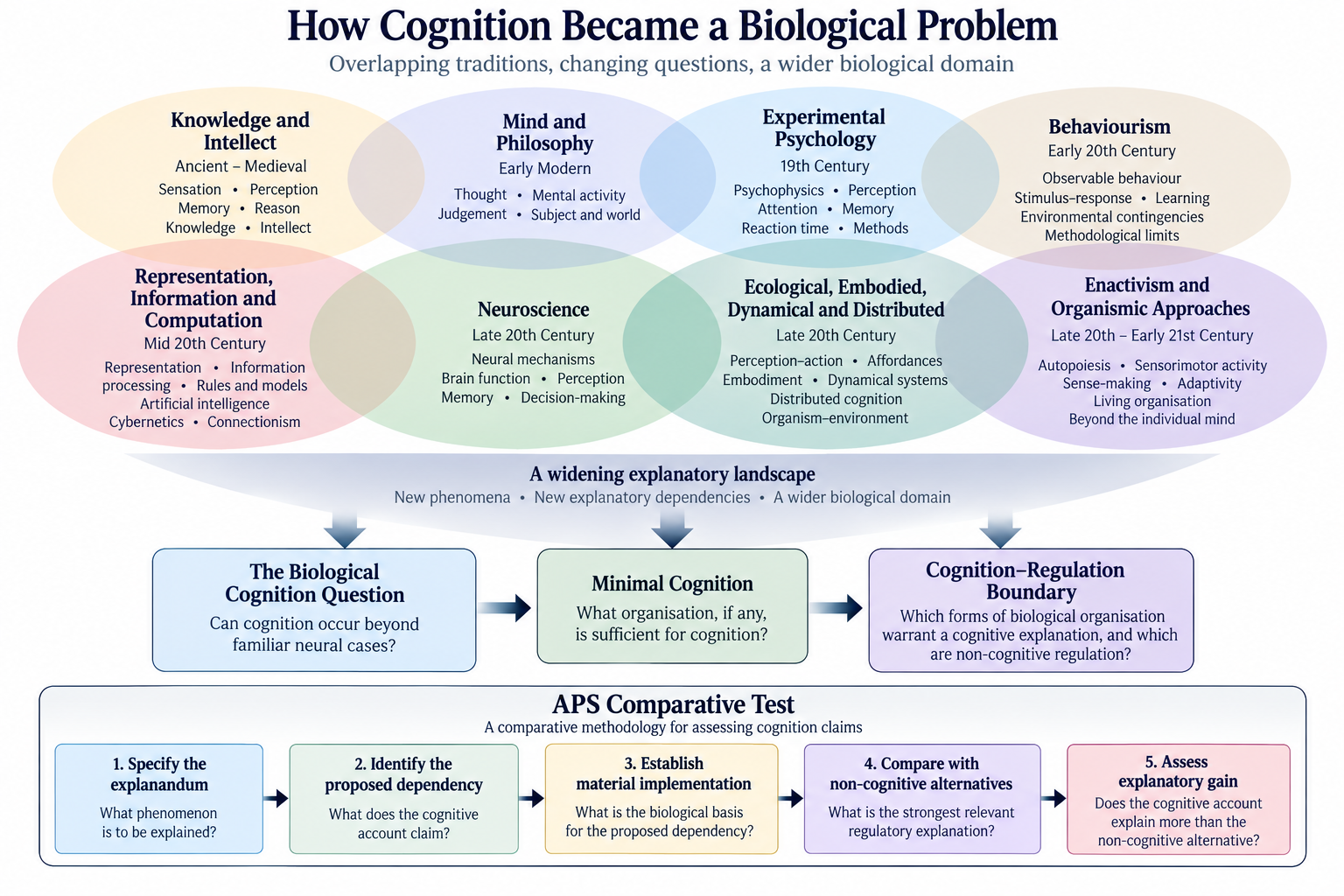
How Cognition Became a Biological Problem. The history of cognition is not a simple progression from one theory to another. Different explanatory traditions changed both the phenomena under investigation and the dependencies invoked to explain them. Their partial overlap and expansion eventually made the lower biological boundary of cognition itself an explicit scientific problem.
Minimal Cognition
The problem of minimal cognition asks what organisation is sufficient to warrant describing a living system or process as cognitive.
Proposed indicators have included learning, memory, flexible behaviour, anticipation, context sensitivity, problem-solving, representation, decision-making, adaptive plasticity, and forms of sense-making. Different research traditions give these indicators different theoretical significance (van Duijn, Keijzer, and Franken 2006; Lyon 2006; Barandiaran and Moreno 2006; Adams and Garrison 2013; Godfrey-Smith 2016; Allen 2017; Adams 2018).
None is automatically decisive.
A regulatory system can retain effects of previous conditions. A developmental system can respond differently according to context. A physiological system can anticipate recurrent demands. Evolution can produce highly adaptive organisation without requiring the organism itself to organise alternatives cognitively.
-
Complexity is therefore insufficient.
-
Adaptive success is insufficient.
-
Viability relevance is insufficient.
The central problem becomes one of discrimination:
What distinguishes genuinely cognitive organisation from non-cognitive biological organisation capable of producing superficially similar outcomes?
This is where the history of cognition becomes a contemporary problem of biological explanation.
Why Regulation Is Not Automatically Cognition
Every living system depends upon regulation. Biological systems coordinate metabolism, development, physiology, repair, behaviour, and interaction with changing environments in ways that preserve viable organisation. Regulation is therefore central to living organisation (Bich et al. 2016).
But centrality to life is precisely why regulation cannot automatically establish cognition.
If every viability-relevant regulatory process were classified as cognitive, cognition would approach coextensiveness with life. The distinction between being alive and being cognitive would lose much of its discriminatory content.
The opposite solution is equally unsatisfactory. Requiring neurons, brains, consciousness, explicit representation, or human-like behaviour would settle the boundary by prior stipulation rather than biological explanation.
The scientific task is therefore to determine whether cognitive organisation exhibits dependencies not exhausted by plausible non-cognitive regulatory explanations.
The boundary is consequently not merely terminological.
It is an explanatory problem.
What the History Changes
The history of cognition has produced multiple explanatory traditions, but those traditions do not necessarily address identical targets.
A cognitive neuroscientist explaining working memory, an ecological psychologist explaining perception–action coordination, an enactivist explaining sense-making, and a biologist investigating apparently anticipatory activity in a unicellular organism may all use cognitive language while asking importantly different questions.
Those explanations cannot be ranked merely because their theoretical vocabularies differ.
Comparison requires a specified explanandum and an appropriate comparator. Explanatory gain is relative to the target being explained and to the alternative explanation against which a proposal is assessed. Conceptual coherence, integrative scope, redescription, or philosophical attractiveness do not by themselves demonstrate superior biological explanation.
This is the methodological consequence of the history.
The expanding use of cognitive concepts does not require biology either to reject the expansion or to accept every proposed cognitive attribution. It requires increasingly careful discrimination among the explanatory problems being addressed.
The APS Approach to the Cognition–Regulation Boundary
APS—Agency, Process, Scale—approaches biological phenomena through complementary analytic projections of one viability-oriented, constraint-closed living organisation.
-
Agency asks what living systems do.
-
Process asks how continuity is maintained despite change.
-
Scale asks where persistence is organised across spatial and temporal extents.
These are analytic projections rather than components of reality. They are not independent causes, entities, domains, hierarchical levels, or successive stages.
Within this framework, cognition is approached through a more specific dependency architecture:
Life → Agency → Biological Evaluation → Significance → Integration → Cognition
This is not what APS stands for. Nor is it a chronology or hierarchy. It identifies conceptual dependencies within the APS account of cognition.
Life is viability-oriented, constraint-closed organisation. Biological agency is viability-oriented organisational activity (Spencer 2026). Biological Evaluation is the process through which agency generates significance. Significance is a relationally real product of biological evaluation. Integration organises what matters into functional unity. Cognition concerns the organisation of biological significance across time.
But neither significance nor adaptive regulation is sufficient for cognition.
The proposed APS discriminator is therefore more demanding:
Biological agency becomes cognitive when integrated biological significance modulates activity across a temporal field of viability-relevant possibilities in ways not exhausted by immediate or fixed regulation.
The phrase temporal field of viability-relevant possibilities does not require conscious imagination, explicit simulation, symbolic representation, or deliberate choice. It instead marks a proposed explanatory dependence extending beyond immediate coupling or a fixed regulatory response.
This criterion is not entailed merely by accepting APS architecture.
It is an empirically vulnerable proposal about where a useful biological cognition boundary might be drawn.
Testing the Boundary Comparatively
A useful boundary must be capable of excluding as well as including cases.
The appropriate question is therefore not:
Does this organism look intelligent?
Nor is it:
Can its behaviour be described using cognitive vocabulary?
The stronger question is:
Does a cognitive explanation identify a biologically implemented organisational dependency that plausible non-cognitive explanations of the same phenomenon do not adequately capture?
That question changes the evidential burden.
A cognition claim should specify the phenomenon to be explained, identify the proposed cognitive dependency, establish its material implementation, compare it with appropriate regulatory alternatives, and determine what explanatory work the cognitive interpretation performs.
If immediate regulation, fixed response architecture, physiological feedback, developmental plasticity, or another established process adequately explains the phenomenon, cognition may add little or no explanatory gain.
If an empirically supported dependency remains that those alternatives do not adequately capture, a cognitive explanation may be warranted.
The result must not be predetermined.
A case may be cognitive, non-cognitive, or unresolved.
From Historical Question to Biological Test
The history therefore changes the form of the cognition question.
It began principally with problems of knowledge, perception, intellect, and mind. Experimental psychology made selected cognitive phenomena measurable. Behaviourism sharpened questions about explanatory legitimacy. Computational and information-processing approaches supplied new forms of internal organisation. Neuroscience established detailed biological mechanisms for recognised cognitive capacities. Ecological, embodied, dynamical, distributed, enactive, and comparative approaches widened both the explanatory unit and the possible biological distribution of cognition.
The contemporary biological problem emerges from the conjunction of those achievements.
Neural mechanisms cannot simply be assumed to define the lower boundary.
Non-neural complexity cannot simply be assumed to cross it.
The question must instead become experimentally discriminating:
What organisation does the evidence establish, and does cognition explain something that the best relevant non-cognitive comparator does not?
History has therefore brought cognition to a point where conceptual expansion must be followed by comparative biological testing.
What This Article Establishes
This article establishes a historical and methodological conclusion rather than a new empirical cognition classification.
Cognition has become a biological problem because the phenomena, systems, and explanatory dependencies investigated under cognitive descriptions have expanded beyond the traditional domains of knowledge, mind, computation, and nervous systems.
That expansion creates a genuine boundary problem.
It is no longer sufficient to ask whether a biological system exhibits a capacity resembling memory, learning, anticipation, decision-making, or problem-solving. Nor is it sufficient to deny cognition because a system lacks familiar neural machinery.
The relevant problem is whether a cognitive explanation identifies an empirically warranted organisational dependency that distinguishes the case from adequate non-cognitive alternatives.
What This Article Does Not Establish
The history does not establish that cognition is widespread throughout life.
It does not establish that plants, bacteria, slime moulds, cells, developmental systems, or other disputed cases are cognitive.
It does not establish that neural organisation, representation, computation, enactivism, ecological coupling, or biological regulation is dispensable from cognitive explanation.
It does not establish the APS discriminator merely by showing that earlier boundaries have been contested.
And it does not turn Agency, Process, and Scale into stages through which cognition evolves.
The historical argument establishes the problem-space within which the cognition boundary must now be investigated. Whether the proposed APS discriminator succeeds depends upon comparative biological evidence.
Related Terms and Next Step
The most important concepts for the next stage are Cognition, Biological Agency, Regulation, Viability, Temporality, and Counterfactual Depth.
The direct conceptual companion is Cognition — Where Does It Belong in Biology?, which situates cognition within the broader organisation of life.
The broader pathway toward mind and awareness is developed in How Did Matter Become Aware of Itself?.
The immediate scientific successor is the APS work on Minimal Cognition. That work takes the boundary problem established here and asks whether the proposed discriminator can survive comparison with actual biological cases and established non-cognitive explanations.
Conclusion
Cognition has no single uninterrupted intellectual history.
It has been approached through knowledge, intellect, mental activity, learned behaviour, representation, computation, neural processing, embodied action, ecological coordination, distributed systems, sense-making, and biological organisation. These approaches partly succeed one another historically, but they also coexist because they frequently address different explanatory problems.
Modern neuroscience has demonstrated in extraordinary detail how nervous systems implement recognised cognitive capacities. That achievement does not, by itself, establish the lower biological boundary of cognition.
Conversely, increasingly sophisticated evidence of sensing, regulation, plasticity, memory-like effects, anticipation, and adaptive activity outside familiar neural cases does not by itself establish cognition.
The problem cannot therefore be resolved simply by choosing between neural exclusivity and unrestricted biological cognition.
It requires discrimination.
APS approaches that problem from the organisation of life without equating life with cognition. Agency, Process, and Scale provide complementary analytic projections of living organisation; within that framework, the more specific pathway from Life through Agency, Biological Evaluation, Significance, and Integration identifies dependencies relevant to the emergence of cognition.
The proposed boundary is correspondingly demanding: biological agency becomes cognitive when integrated biological significance modulates activity across a temporal field of viability-relevant possibilities in ways not exhausted by immediate or fixed regulation.
Whether that proposal succeeds is not determined by the history that led to it.
It must be tested comparatively against biological phenomena and competing explanations.
That is the point at which the history of cognition becomes a contemporary scientific problem.
Explanatory Architecture
1. Central Question
How did cognition become a biological problem, and why does that history now require a principled distinction between cognitive organisation and sophisticated non-cognitive regulation?
2. Architectural Role
This article provides the historical-conceptual orientation for the APS treatment of cognition. It explains how questions concerning knowledge, perception, intellect, and mind were progressively reorganised through experimental, behavioural, computational, neuroscientific, ecological, embodied, dynamical, distributed, enactive, and biological approaches.
Its role is not to determine where cognition begins, but to establish why the lower biological boundary of cognition has become an explicit explanatory problem.
3. Builds On
The article builds on the APS account of living organisation in which Life is viability-oriented, constraint-closed organisation and Biological Agency is viability-oriented organisational activity.
Within the cognition-and-mind architecture, it also presupposes the conceptual dependencies through which biological activity can acquire and integrate significance:
Life → Agency → Biological Evaluation → Significance → Integration → Cognition
These are conceptual and explanatory dependencies, not a chronology, causal sequence, hierarchy, or alternative meaning of Agency–Process–Scale.
4. Develops Into
The historical problem developed here leads directly to the APS investigation of Minimal Cognition.
The present article establishes why a biological boundary problem exists. The Minimal Cognition analysis asks how that boundary should be drawn and tested.
The proposed discriminator is:
Biological agency becomes cognitive when integrated biological significance modulates activity across a temporal field of viability-relevant possibilities in ways not exhausted by immediate or fixed regulation.
That proposal remains subject to comparative biological testing rather than following automatically from APS architecture.
5. Related Explanatory Questions
This article connects directly with several further questions in the cognition-and-mind corpus:
- How does biological agency generate significance?
- How is biological significance integrated across time?
- What distinguishes cognition from biological regulation?
- Where does cognition belong within biological organisation?
- What is the relation between cognition and mind?
- How can disputed cases of minimal cognition be tested comparatively?
- How does biological organisation provide a pathway toward awareness without presupposing consciousness?
Together, these questions connect the historical problem of cognition with its contemporary biological investigation.
6. Position within APS
APS treats Agency, Process, and Scale as complementary analytic projections of one viability-oriented, constraint-closed living organisation.
The cognition problem arises principally within the analysis of Agency but cannot be separated from Process and Scale. Cognition concerns activity organised across time, while its material implementation may extend across interacting spatial and temporal extents.
The article therefore does not add cognition as a fourth APS component. It locates cognition within the organisation already examined through Agency, Process, and Scale and asks what additional explanatory dependencies warrant distinguishing cognitive organisation from non-cognitive biological regulation.
7. Corpus Significance
Within the APS corpus, How Did Cognition Become a Biological Problem? provides the historical and methodological bridge between the general architecture of biological agency and the more specific investigation of cognition, minimal cognition, mind, and awareness.
Its principal corpus function is to prevent the cognition question from being approached as a dispute over definitions alone. By showing how different explanatory traditions changed both the phenomena under investigation and the dependencies invoked to explain them, it establishes why contemporary cognition claims require matched explanatory comparison.
The article therefore prepares the transition from historical orientation to empirical discrimination: history establishes how the boundary problem arose; the Minimal Cognition work tests where that boundary should be drawn.
See Also
Related Articles
References
- (2018). Cognition Wars. Studies in History and Philosophy of Science Part A, 68, 20–30 . https://doi.org/10.1016/j.shpsa.2017.11.007
- (2013). The Mark of the Cognitive. Minds and Machines, 23(3), 339–352 . https://doi.org/10.1007/s11023-012-9291-1
- (2017). On (Not) Defining Cognition. Synthese, 194(11), 4233–4249 . https://doi.org/10.1007/s11229-017-1454-4
- (2006). On What Makes Certain Dynamical Systems Cognitive: A Minimally Cognitive Organization Program. Adaptive Behavior, 14(2), 171–185 . https://doi.org/10.1177/105971230601400208
- (2008). Mental Mechanisms: Philosophical Perspectives on Cognitive Neuroscience. Psychology Press.
- (2016). Biological Regulation: Controlling the System from Within. Biology & Philosophy, 31(2), 237–265 . https://doi.org/10.1007/s10539-015-9497-8
- (2005). Autopoiesis, Adaptivity, Teleology, Agency. Phenomenology and the Cognitive Sciences, 4(4), 429–452 . https://doi.org/10.1007/s11097-005-9002-y
- (2017). Sensorimotor Life: An Enactive Proposal. Oxford University Press. https://doi.org/10.1093/acprof:oso/9780198786849.001.0001
- (1979). The Ecological Approach to Visual Perception. Houghton Mifflin.
- (2016). Individuality, Subjectivity, and Minimal Cognition. Biology & Philosophy, 31(6), 775–796 . https://doi.org/10.1007/s10539-016-9543-1
- (1995). Cognition in the Wild. MIT Press. https://doi.org/10.7551/mitpress/1881.001.0001
- (2014). Sourcebook for the History of the Philosophy of Mind: Philosophical Psychology from Plato to Kant. Springer. https://doi.org/10.1007/978-94-007-6967-0
- (2006). The Biogenic Approach to Cognition. Cognitive Processing, 7(1), 11–29 . https://doi.org/10.1007/s10339-005-0016-8
- (2006). A History of Modern Experimental Psychology: From James and Wundt to Cognitive Science. MIT Press.
- (1986). Parallel Distributed Processing: Explorations in the Microstructure of Cognition, Volume 1: Foundations. MIT Press. https://doi.org/10.7551/mitpress/5236.001.0001
- (2026). Agency as the Defining Activity of Life: A Viability-Oriented Framework Integrating Process and Scale. Biological Theory . https://doi.org/10.1007/s13752-026-00547-6
- (1994). A Dynamic Systems Approach to the Development of Cognition and Action. MIT Press. https://doi.org/10.7551/mitpress/2524.001.0001
- (2007). Mind in Life: Biology, Phenomenology, and the Sciences of Mind. Harvard University Press.
- (2006). Principles of Minimal Cognition: Casting Cognition as Sensorimotor Coordination. Adaptive Behavior, 14(2), 157–170 . https://doi.org/10.1177/105971230601400207
- (1948). Cybernetics: Or Control and Communication in the Animal and the Machine. MIT Press.