Introduction: Why APS Requires Critical Evaluation
No scientific framework is ever complete. Theories develop through cycles of explanation, criticism, refinement, and empirical application. New concepts must be clarified, relationships to existing theories must be established, and explanatory claims must be tested against the complexity of the natural world.
APS is a developing framework and research programme in theoretical biology. It investigates how living systems maintain and re-establish the conditions of their persistence and how biological explanations illuminate different aspects of that organisation. Agency, Process, and Scale provide analytic projections through which this organisation can be examined: Agency concerns what living systems do, Process concerns how continuity is maintained despite change, and Scale concerns where persistence is organised across spatial and temporal extents.
The first phase of APS concentrated on conceptual foundations. It developed an account of life as viability-oriented, constraint-closed organisation and of biological agency as the present-tense activity through which that organisation is enacted and sustained (Spencer 2026). More recent work has made organised persistence explicit as a comparative object of biological investigation. This development has repositioned APS more precisely: comparative organisational explanation is the broader form of inquiry, while the Organised Persistence methodology provides a systematic way of investigating the maintenance, re-establishment, reorganisation, and transformation of biological continuity.
Conceptual development, however, does not by itself establish scientific value. A framework may be coherent, comprehensive, and philosophically productive without changing how biological phenomena are investigated or explained. The scientific standing of APS therefore depends upon a more demanding question: does making organised persistence explicit produce identifiable explanatory gain relative to a specified biological question and an established comparison account?
This question becomes especially important because the principal concepts used by APS are not individually unprecedented. Agency, process, constraint, function, viability, organisation, and Scale all have substantial histories within biology and the philosophy of biology. Organisational approaches have treated organisation as a theoretical principle through which biological objects become intelligible (Mossio, Montévil, and Longo 2016), while process biology, autonomy theory, mechanistic explanation, and explanatory pluralism offer established accounts of many phenomena addressed by APS. The contribution of APS cannot therefore be established by assembling familiar concepts or redescribing biological findings in a common vocabulary. Its proposed contribution is architectural and methodological, and that contribution must be demonstrated through comparative application.
The demand for such demonstration is not hypothetical. DiFrisco and Gawne (2025) argue that biological agency risks remaining an empirically unproductive concept unless it can be shown to perform research work that existing mechanistic and evolutionary explanations cannot perform as well. Their criticism applies with particular force to APS. If biological agency merely renames regulation, if organised persistence merely redescribes survival, or if constraint identifies every condition affecting a living system, then the framework will lack the discrimination required for scientific explanation. Similarly, if the comparative methodology can describe differences among explanatory approaches but cannot evaluate whether an additional organisational interpretation is supported, redundant, or inapplicable, its biological value will remain uncertain.
These objections cannot all be answered in the same way. Some arise from misunderstandings. APS does not replace mechanistic explanation, identify agency with consciousness, deny evolutionary history, or invoke mysterious forces operating independently of local causal processes. Other objections are only partly resolved. APS has principled distinctions between viability and persistence, agency and cognition, or organisation and mechanism, but their biological usefulness must still be demonstrated. A third group identifies genuinely open scientific challenges: operationalising APS concepts, establishing non-redundancy, testing Architectural Dependency, explaining organisational novelty, and determining the limits of the methodology’s transferability.
This article therefore does not defend APS as a completed theory. It defines the framework’s present claims and their limits, establishes how different kinds of APS claim should be evaluated, and identifies what would count as explanatory gain, redundancy, failure, or inapplicability. It then examines six principal scientific challenges, responds to common objections according to their current status, and develops a research programme through which APS may be strengthened, restricted, or revised.
The purpose of this critical evaluation is not to make APS appear unassailable. It is to make APS assessable. The future scientific standing of the framework will depend not only upon the coherence of its concepts but upon whether its methods generate biologically useful questions, discriminating analyses, evidentially supported comparisons, and results capable of changing the framework itself.
What APS Claims—and What It Does Not Claim
Critical evaluation must begin with the claims actually made by a framework. APS combines foundational commitments about living organisation with a comparative methodology and an expanding research programme. These have different evidential requirements and should not be treated as one undifferentiated theory.
APS begins from the canonical definition:
Life is viability-oriented, constraint-closed organisation.
Viability identifies the conditions relative to which living organisation can continue functioning. Constraint closure identifies the mutually dependent organisation through which relevant constraints are maintained, regenerated, and modulated. Agency identifies the present-tense activity through which this organisation is enacted and sustained. Process concerns how continuity is maintained despite change, while Scale concerns where persistence is organised across spatial and temporal extents. Agency, Process, and Scale are therefore analytic projections of one organisation rather than independent causes, separate entities, or components of reality.
These commitments lead to a further explanatory proposal. Biology investigates living systems through mechanistic, functional, developmental, ecological, evolutionary, and other forms of explanation. APS proposes that many of these explanations can also be examined according to how they illuminate the organisation required for biological continuity. The common object of this comparison is organised persistence: the maintenance, re-establishment, reorganisation, or transformation of living continuity through organised activity under conditions of change.
Organised persistence is not another biological entity or mechanism. Nor is it a synonym for life. Life identifies viability-oriented, constraint-closed organisation; organised persistence identifies what that organisation achieves and what biological inquiry may seek to explain across different phenomena. Viability supplies the normative orientation of living organisation, while organised persistence provides the broader explanatory target through which maintenance, recovery, development, plasticity, and evolutionary transformation can be compared.
The Organised Persistence methodology gives this proposal a systematic form. It reconstructs an existing biological explanation, identifies any remaining organisational question, examines the phenomenon in relation to organised persistence, and evaluates whether the additional analysis produces explanatory gain. The methodology is not intended to supply the detailed empirical content of a biological investigation. That content remains dependent upon the relevant biological discipline, evidence, experimental practices, and established explanatory accounts.
What APS presently claims
APS presently advances four kinds of claim.
First, it advances foundational commitments about living organisation. These include the definition of life, the viability-relative character of biological normativity, biological agency as viability-oriented organisational activity, and Agency, Process, and Scale as analytic projections of one constraint-closed organisation.
Second, it advances a methodological contribution. Comparative organisational explanation examines how different biological explanations address organisational achievements involved in continuity. The Organised Persistence methodology provides a structured procedure for conducting that comparison.
Third, APS advances case-specific interpretations. Regeneration can be examined as re-establishment of organisation, developmental plasticity as reorganisation through change, and multicellularity as evolutionary transformation of organised persistence. These demonstrations show how the methodology can be applied; they do not establish its usefulness in every biological domain.
Fourth, APS maintains completed, active, and exploratory research programmes. Investigations of explanatory architecture, cross-domain relations, biological agency, cognition, social organisation, and other biological questions have different evidential bases, outcomes, and stages of development. Their inclusion within the APS research architecture does not establish equal scientific confirmation or imply that completed investigations remain open.
These claim classes are connected, but success in one does not automatically establish the others. A coherent definition of agency does not demonstrate that agency produces explanatory gain in a particular biological case. A successful analysis of regeneration does not establish universal transferability. A biological account of viability does not by itself validate later claims concerning cognition or morality.
What APS does not claim
APS does not claim to be a completed theory of biology. It does not offer one mechanism, mathematical model, law, metric, or experimental protocol capable of explaining every living phenomenon. Its definitions and methodological commitments are intended to guide investigation and comparison, not to replace the domain-specific theories and practices through which biological evidence is produced.
APS does not replace mechanistic explanation. Mechanistic accounts remain indispensable for identifying the entities, activities, interactions, and causal organisation through which biological phenomena occur. APS asks an additional question only where one remains: how do those causal processes participate in maintaining, re-establishing, reorganising, or transforming viable organisation? If a mechanistic account already answers the relevant biological question completely, an additional APS interpretation may be unnecessary.
APS does not deny evolutionary explanation. Evolutionary history explains the origin, inheritance, diversification, and transformation of biological organisation. Present-tense organisational explanation examines how viable organisation operates. These explanatory tasks are complementary. APS’s stronger evolutionary challenge is not to show that it is compatible with natural selection and inheritance, but to demonstrate whether organised persistence and agential reorganisation contribute something scientifically useful to evolutionary investigation.
APS does not identify persistence with survival or longevity. A crystal, flame, vortex, institution, or artefact may persist without exhibiting viability-oriented, constraint-closed organisation. Organised persistence must therefore be distinguished from duration, stability, repetition, and continued existence. In biological applications, the relevant viability conditions and organisational contributions must be specified rather than inferred solely from the fact that a system continued.
APS does not treat every biological response as agency or every restriction as a biologically explanatory constraint. Regulation, feedback, causal limitation, and environmental dependence occur in many forms. An APS analysis must show why a process belongs to integrated viability-oriented activity and why a proposed constraint has a material organisational role in the phenomenon being explained.
APS does not collapse mechanistic, functional, developmental, ecological, and evolutionary explanations into one common explanation. Comparative organisational explanation preserves their different questions, evidence, and explanatory achievements. A common object of comparison does not entail explanatory identity.
APS also does not claim that its biological foundations automatically establish its later cognitive, social, moral, or ethical extensions. Those programmes are connected through relations of explanatory dependency, but each requires its own conceptual discrimination, evidential support, and domain-appropriate evaluation.
Finally, APS does not claim immunity from criticism because it is a framework or methodology. Its definitions can prove insufficiently discriminating; its architectural dependencies can prove unsupported; its case analyses can prove redundant; its methodology can fail to transfer; and its scope can require restriction. Framework-level commitments, methodological procedures, and case-specific interpretations may be evaluated differently, but none is protected from evaluation.
The canonical status of this article does not alter that scientific openness. “Canonical” identifies the article’s governed place within the APS corpus. It does not mean that every scientific claim it contains has been confirmed. Canonical APS claims remain open to refinement, restriction, and revision where argument or evidence requires it.
APS as Framework, Methodology, and Research Programme
APS has been described as a framework, an explanatory grammar, a methodology, a metatheoretical perspective, and a research programme. These descriptions are not competing labels, but neither are they interchangeable. Each identifies a different function, with a different relationship to scientific evidence and evaluation.
APS as an explanatory framework
As a framework, APS establishes a set of connected commitments through which questions about living organisation can be formulated. It defines life through viability-oriented, constraint-closed organisation and distinguishes Agency, Process, and Scale as analytic projections of that organisation. It also clarifies relations among viability, function, normativity, biological evaluation, cognition, development, and evolution.
The framework therefore performs conceptual and ontological work. Conceptually, it stabilises distinctions that guide inquiry. Ontologically, it proposes that living organisation, viability-relative activity, constraint relations, and organised persistence concern real features of biological systems rather than merely convenient descriptions.
These functions must be distinguished from empirical confirmation. A coherent conceptual architecture may identify what should be investigated, but coherence alone does not show that the proposed distinctions correspond adequately to biological organisation. Organisation has similarly been proposed elsewhere as a theoretical principle framing the intelligibility of biological objects (Mossio, Montévil, and Longo 2016). The scientific question is therefore not whether an organisational framework can be formulated, but whether its commitments discriminate biological phenomena and support productive investigation.
APS as an explanatory grammar
APS also provides an explanatory grammar. A grammar does not supply the empirical content of biological science. It organises the questions through which that content is interpreted and related.
For example, a mechanistic investigation may ask which entities and activities produce tissue repair. An evolutionary investigation may ask how regenerative capacities arose and changed. A functional investigation may ask what present contribution a repair process makes. APS asks how these explanatory achievements relate to the re-establishment of viable organisation.
This additional question does not supersede the others. It makes explicit an organisational explanandum that may otherwise remain distributed across them. The explanatory grammar helps identify:
- what the relevant biological system is;
- which conditions are viability-relevant;
- what organisational achievement is being investigated;
- which processes and constraints contribute to it;
- how continuity is maintained, re-established, reorganised, or transformed;
- what would count as organisational failure.
An explanatory grammar is scientifically useful only when these questions produce discriminating analyses. If the grammar merely translates existing conclusions into APS terminology, it provides conceptual redescription rather than additional biological explanation.
Comparative organisational explanation
Comparative organisational explanation is the broader form of inquiry developed through this framework. It compares biological explanations according to the organisational achievements they illuminate while preserving differences among their explananda, evidence, and methods.
This approach is consistent with explanatory pluralism. Complex biological phenomena commonly require explanations organised around different scientific aims, and those explanations need not be reducible to one preferred form (Mitchell 2003; Brigandt 2013). APS does not respond to this plurality by attempting to identify one universally superior explanation. It asks how distinct explanatory achievements relate to the organisation through which living systems persist.
Comparison must nevertheless proceed beyond cataloguing differences. The first task is clarification: identifying what each account explains, which assumptions it makes, and what evidence it uses. The second is evaluation: determining whether an APS analysis reveals an additional organisational question or explanatory result. Clarification before adjudication therefore does not mean clarification without evaluation.
The article Comparative Explanatory Methodology in Theoretical Biology establishes the general procedure through which organisational research programmes can be compared according to their explanatory architectures. APS is both one framework that can be examined through this procedure and the source from which the comparative methodology has been developed. It must not be treated as the predetermined conclusion of the comparison.
The Organised Persistence methodology
The Organised Persistence methodology applies comparative organisational explanation to biological continuity. It asks what organisational achievement is involved in a phenomenon and how that achievement is illuminated by different forms of biological explanation.
Its operational sequence is:
- characterise the biological phenomenon;
- reconstruct the existing explanation;
- identify any remaining organisational question;
- interpret the phenomenon in relation to organised persistence;
- evaluate the resulting explanatory gain;
- state a comparative principle and verdict.
Application also requires domain-specific specification of the system, viability conditions, relevant spatial and temporal extent, constraints, perturbation or variation, organisational response, evidence, and possible failure. The six-stage sequence supplies a common analytical structure; it does not replace the specialised methods through which those matters are investigated.
The methodology has been demonstrated across regeneration, developmental plasticity, and multicellularity. These cases represent re-establishment, reorganisation, and evolutionary transformation of viable organisation. Their diversity provides initial evidence of methodological transfer, but it does not establish universal applicability, independent reproducibility, or superiority over established approaches.
APS as a research programme
APS becomes a research programme when its framework and methodology generate coordinated work that can alter their own future development. This programme includes:
- conceptual discrimination;
- operational specification;
- comparative case analysis;
- empirical investigation;
- boundary and failure cases;
- comparison with neighbouring approaches;
- evolutionary and developmental applications;
- revision of concepts and scope.
A research programme is more than an inventory of subjects to which APS vocabulary might be applied. It requires problems, methods, evidence, critical verdicts, and cumulative results. Its progress should therefore be assessed not by the number of biological domains it addresses but by whether its applications produce explanatory gain, expose limitations, support transfer, and permit revision.
APS also has a metatheoretical dimension because it examines how research programmes organise explanation. It has a philosophical dimension because its commitments concern life, agency, normativity, function, purpose, realism, and scientific understanding. Neither dimension removes it from biological evaluation. Their scientific relevance depends upon whether they clarify biologically consequential questions and support evidence-sensitive investigation.
The four functions can therefore be related without conflation:
- the framework establishes the principal commitments;
- the explanatory grammar organises biological questions;
- the methodology structures comparative investigation;
- the research programme develops, tests, restricts, and revises their application.
Together they define what APS presently is. They also establish the standards by which its scientific contribution must be judged.
How APS Should Be Evaluated
The question “Is APS falsifiable?” is important but too general. It treats APS as though all of its commitments formed one empirical hypothesis that could be confirmed or rejected by a single observation. APS instead contains different kinds of claim, and each requires an appropriate form of evaluation.
Definitions must discriminate the phenomena they identify. Architectural claims must establish the dependencies they propose. Methodological claims must show that a procedure can be applied transparently and non-arbitrarily. Case-specific interpretations must be supported by relevant biological evidence. Claims of broad applicability must be earned through successful transfer across sufficiently different cases.
Framework or methodological status therefore does not exempt APS from scientific evaluation. It changes the question from “What one observation would falsify APS?” to:
What kind of claim is being made, and what evidence could support, restrict, revise, or reject it?
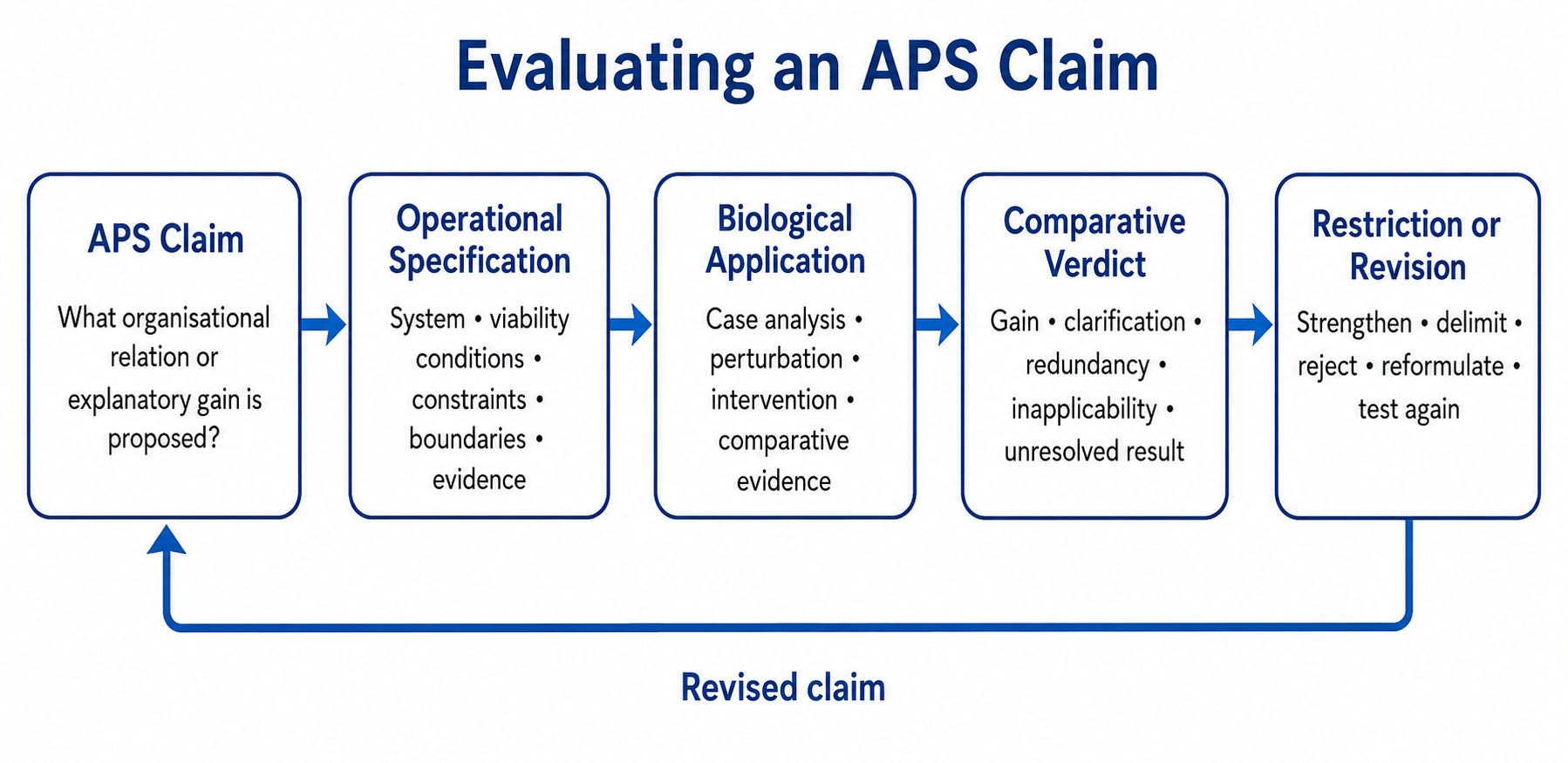
An APS claim is not confirmed merely because it can be applied to a biological case. Operational specification, biological evidence, and comparison may strengthen, restrict, or require revision of the interpretation.
Click the diagram to open a larger version.
Evaluating different kinds of claim
A definitional claim proposes how a biological phenomenon should be identified. The APS definition of biological agency, for example, must distinguish viability-oriented organisational activity from behaviour, feedback, or regulation that does not exhibit the relevant organisation. The definition of organised persistence must distinguish biological continuity from duration, physical stability, or repetition. Definitional claims are weakened when they are circular, apply indiscriminately, or fail to distinguish relevant alternatives.
An architectural claim proposes that one capacity or phenomenon depends upon organisational conditions supplied by another. A claim that cognition presupposes biological agency, or that evolutionary transformation presupposes sufficient organised continuity, cannot be established by placing concepts in a dependency diagram. It requires an account of the alleged precondition, the kind of dependency involved, relevant evidence, and possible counterexamples. Architectural elegance is not evidence of biological necessity.
A methodological claim concerns the performance of comparative organisational explanation. The Organised Persistence methodology must be explicit enough for its inferential steps to be examined, capable of preserving differences among established explanations, and able to produce negative as well as positive verdicts. A method that identifies explanatory gain in every case would not be sufficiently discriminating.
A case-specific claim interprets a particular phenomenon—for example, regeneration as organisational re-establishment. Such a claim requires accurate representation of the established biological explanation, specification of the relevant organisation, and evidence that the APS interpretation adds something beyond the existing account.
A scope claim concerns transferability. Success in regeneration does not establish usefulness in ecology, cognition, or evolutionary theory. Each extension must identify its own explanandum, evidence, comparative context, and limits.
Five tests for an APS application
A complete APS application should satisfy five tests.
1. Conceptual discrimination
The analysis must distinguish the proposed phenomenon from relevant alternatives. It should show, for example, why the case concerns organised persistence rather than duration, agency rather than isolated regulation, function rather than incidental causal contribution, or organisational transition rather than temporary adjustment.
If a concept applies equally to all relevant alternatives, it has insufficient discriminating power.
2. Biological specification
The analysis must identify:
- the biological system;
- the relevant spatial and temporal extent;
- the viability conditions;
- the organisational achievement being investigated;
- the processes and constraints involved;
- the perturbation, variation, or transition;
- the evidence of maintenance, re-establishment, reorganisation, transformation, or failure.
These elements cannot be inferred solely from the observation that the system persisted. If viability is identified only through successful continuation and then invoked to explain that continuation, the analysis becomes circular.
3. Fair comparative reconstruction
APS must represent the established explanation accurately and charitably. Mechanistic explanations, for example, identify entities, activities, and causal organisation rather than merely listing parts (Machamer, Darden, and Craver 2000). An APS analysis cannot establish an organisational contribution by presenting the comparison account as more limited than it is.
The comparison should determine:
- what the established account explains;
- which evidence it uses;
- what it deliberately leaves outside its scope;
- whether the alleged organisational omission is genuine;
- whether the existing account already supplies the proposed result.
4. An identifiable additional result
The analysis must show what changes when organised persistence is made explicit. The result may be a neglected explanandum, a newly specified dependency, a distinction between organisational outcomes, a changed interpretation of evidence, a tractable intervention, or a clearer account of failure.
Adding APS terminology to an existing explanation is not an additional result. Nor is showing that an established explanation is compatible with APS.
5. A proportionate verdict
The conclusion must match the evidence. Permissible verdicts include:
- substantive explanatory gain;
- limited or context-dependent gain;
- conceptual clarification without additional biological explanation;
- redundancy;
- unsupported interpretation;
- inapplicability;
- unresolved status pending further evidence.
The possibility of these different verdicts is essential. APS should not treat every application as confirmation.
What counts as explanatory gain?
Explanatory gain is:
An identifiable improvement in biological understanding or investigation, relative to a specified question and comparison account, produced by making the organisation of persistence explicit.
This definition requires three things:
- a specified biological question;
- an identified comparison account;
- an additional explanatory or investigative result.
Explanatory gain can take several forms.
Explanandum gain occurs when APS identifies a phenomenon requiring explanation that was previously left implicit. Restoration of cellular activity, for example, may not by itself explain the re-establishment of integrated organismal functioning.
Dependency gain occurs when the analysis identifies an organisational precondition whose role was not previously explicit.
Discriminatory gain occurs when APS distinguishes outcomes that would otherwise be grouped together, such as temporary compensation, durable reorganisation, and functional re-establishment.
Evidential gain occurs when observations from different processes become interpretable as convergent evidence of one organisational achievement.
Investigative gain occurs when the analysis generates a new comparison, intervention, measurement strategy, or counterfactual question.
Failure-analysis gain occurs when APS identifies which organisational conditions were not restored and why apparent recovery remained incomplete.
Transfer gain occurs when a distinction developed in one case improves analysis of a biologically different case without erasing their differences.
These forms of gain do not require every APS application to generate a novel quantitative prediction. Biological explanation is organised around different aims and may legitimately require plural forms of evidence and understanding (Mitchell 2003; Brigandt 2013). Love’s analysis of evolutionary novelty similarly shows how biological research can be organised around problem agendas with explicit criteria of explanatory adequacy (Love 2008). Prediction remains important where an APS interpretation supports it, but it is not the only measure of scientific contribution.
Evidence, perturbation, and counterfactuals
APS does not require one universal form of evidence. Appropriate evidence may include:
- experimental perturbation;
- loss and restoration of function;
- developmental comparison;
- physiological coordination;
- natural experiments;
- evolutionary comparison;
- temporal analysis;
- pathological breakdown;
- model-based counterfactuals;
- convergent indicators across processes.
Perturbation is especially useful because biological organisation often becomes more visible when continuity is threatened. Disrupting a proposed constraint may reveal whether it contributes to the relevant organisational achievement. Recovery may reveal whether a system has restored viable organisation or merely produced temporary compensation.
Direct intervention is not always possible, particularly in historical and evolutionary research. Comparative, phylogenetic, developmental, pathological, and modelling evidence may therefore be required. Whatever the method, the evidence must support the attributed organisational relation rather than merely confirm that the participating components are present.
Strong APS applications should also state counterfactual expectations. If a constraint is constitutive of an organisational achievement, disrupting it should affect that achievement even where some component processes continue. If recovery constitutes genuine re-establishment, restored functioning should extend beyond transient compensation. If an alleged Architectural Dependency is necessary, the dependent capacity should not remain intact when its proposed organisational precondition is absent.
Counterfactual specification prevents APS from treating every observed outcome retrospectively as evidence of organised persistence.
Redundancy, failure, and revision
APS is redundant in a case when the established account already identifies the same explanandum, dependencies, evidence, intervention, and explanatory result. Redundancy in one application does not reject the entire framework. It restricts the domain in which APS adds value.
An application fails when its concepts cannot be distinguished operationally, its viability conditions are specified circularly, its proposed constraints lack evidence, its comparison account is misrepresented, or its conclusions exceed the result. APS may also be inapplicable where the research question is adequately directed at a local mechanism and organised persistence is not relevant to the explanandum.
Repeated failures should prompt framework revision. Concepts may require narrower definitions; dependency claims may need to be abandoned; the protocol may need modification; or the scope of the methodology may need restriction. A framework that could reinterpret every negative result as further evidence of reorganisation would not be scientifically assessable.
The strongest current criticism of biological agency is that it has not yet demonstrated a research programme capable of doing work beyond established mechanistic and evolutionary explanation (DiFrisco and Gawne 2025). APS must answer that challenge through applications that make their evidential burden, comparative result, and possible failure explicit. The answer cannot be supplied by definition alone.
An APS claim is not confirmed merely because it can be applied to a biological case. Operational specification, biological evidence, and comparison may strengthen, restrict, or require revision of the interpretation.
Click the diagram to open a larger version.
Six Principal Scientific Challenges
The unresolved scientific work of APS can be organised around six principal challenges. These challenges are connected through explanatory dependency. APS cannot establish broad transferability without demonstrating comparative distinctiveness; it cannot demonstrate distinctiveness without concepts that can be operationalised and discriminated; and none of these achievements establishes scientific value unless an application produces identifiable explanatory gain.
The six challenges should not be interpreted as successive stages through which APS will automatically progress. Work on one may expose weaknesses in another. Operationalisation may reveal that a definition lacks discrimination; comparative analysis may show that an alleged contribution is already present in an established account; or a failed transfer may require the scope of the methodology to be restricted.
Challenge 1: Demonstrating Explanatory Gain
The governing scientific challenge is whether an APS analysis produces an identifiable improvement relative to a specified biological question and comparison account. The issue is not whether organised persistence provides a coherent way of describing living systems. It is whether making organised persistence explicit changes biological understanding or investigation.
This challenge is especially acute for biological agency. DiFrisco and Gawne (2025) argue that agency risks being empirically unproductive because the phenomena attributed to it can already be explained through evolved multiscale mechanisms, feedback, regulation, and natural selection. Their criticism sets an appropriate evidential burden. APS must show concretely what agency allows an investigation to identify, distinguish, test, or explain that is not already supplied by these established resources.
The same burden applies to organised persistence. A regenerative process can be described mechanistically through signalling, cell proliferation, differentiation, positional information, extracellular organisation, and tissue remodelling. Calling the result organisational re-establishment adds nothing unless the analysis identifies an additional explanandum, dependency, evidential relation, intervention, or failure condition. The organisational interpretation must alter the explanation rather than merely redescribe its successful outcome.
Explanatory gain need not mean that APS replaces or defeats the comparison account. It may arise because the approaches answer different but related questions. Mechanistic explanation may identify how causal processes produce an outcome, while comparative organisational explanation identifies what must be re-established for that outcome to restore viable functioning. The additional question can be legitimate without implying that the mechanistic account was deficient on its own terms.
The challenge is to show that this difference matters. A successful APS application should be able to state:
- the established explanandum;
- the additional organisational question;
- the evidence relevant to that question;
- the result produced by the APS analysis;
- what would have remained unrecognised without it;
- whether the gain is substantive, limited, or absent.
This requirement prevents conceptual breadth from being mistaken for explanatory depth. It also permits the possibility that APS will be useful in some domains but redundant in others.
Challenge 2: Operationalising Viability and Organised Persistence
APS defines life through viability-oriented, constraint-closed organisation, but neither viability nor organised persistence is represented by one universal biological measure. Viability conditions differ among cells, organisms, developmental stages, symbioses, and ecological circumstances. The empirical problem is therefore not to discover a single viability variable. It is to specify which conditions are relevant to the organisation under investigation and how their maintenance or loss can be evidenced.
This contextual character creates a risk of circularity. If a system is judged viable because it persisted, and its persistence is then explained by invoking viability-oriented organisation, the analysis has supplied no independent explanatory content. APS must instead specify relevant viability conditions through physiological, developmental, behavioural, ecological, or other domain-appropriate evidence.
An operational analysis should identify:
- the system whose organisation is being investigated;
- the spatial and temporal extent of that organisation;
- conditions required for continued functioning;
- processes and constraints contributing to those conditions;
- perturbations or variations that place them at risk;
- organisational responses;
- indicators of maintenance, recovery, transformation, or failure.
Perturbation may be especially informative. Living organisation often becomes more evident when established relations are disrupted and the system either compensates, reorganises, restores functioning, or fails. But perturbation does not interpret itself. Temporary continuation after disruption may represent residual functioning, compensation, delayed failure, or genuine re-establishment. APS must provide criteria capable of distinguishing these outcomes.
The organisational approach to biology offers important resources for this work. Closure-of-constraints accounts identify living organisation through mutually dependent constraints that contribute to maintaining one another and the system in which they operate (Montévil and Mossio 2015; Moreno and Mossio 2015). APS shares the concern with materially realised organisation but must establish its own operational contribution. Invoking constraint closure cannot substitute for showing which constraints matter in the case and how their organisation bears upon viability.
Operationalisation must therefore remain domain-specific while using a common explanatory structure. The same measurements will not apply to regeneration, plasticity, microbial regulation, immunity, or evolutionary transition. What can remain stable is the requirement to specify the system, viability conditions, relevant constraints, perturbation or change, organisational response, evidence, and critical verdict.
Challenge 3: Achieving Conceptual and Biological Discrimination
APS relies on broad concepts that apply across different biological domains. Their breadth makes comparison possible, but it also creates the danger that they will apply too easily. A concept that classifies every biological response as agency, every causal limitation as constraint, or every continuation as organised persistence cannot discriminate the phenomena it is intended to explain.
The first discrimination concerns agency and regulation. Biological regulation involves control relations through which variations are detected, compensated for, or modulated. Organisational accounts have distinguished regulation from constitutive constraint and described how regulatory control is generated within living systems (Bich et al. 2016). APS defines agency more broadly as viability-oriented organisational activity, but it must show when this broader attribution adds something beyond the regulatory account.
Relevant differences may concern the integration of multiple regulatory processes, system-relative viability conditions, flexible modulation among possible responses, or active re-establishment following disruption. These possibilities remain hypotheses until they support discriminating analyses. If every regulated activity is automatically classified as agency, the distinction disappears.
A second discrimination concerns constraints. Physical laws, material boundaries, environmental conditions, resource limitations, developmental relations, membranes, and regulatory controls can all restrict possibilities. Not all of them are biologically explanatory in the same sense. An APS analysis must show that a proposed constraint is materially realised and participates in organising activity relative to specified viability conditions. Its relevance cannot be inferred simply because it affects the system.
A third discrimination concerns function. APS defines function as present-tense, viability-relative organisational contribution. This distinguishes function from evolutionary origin, but it must also distinguish functional contribution from incidental causal benefit. Organisational accounts of function provide one important comparison by relating a component’s contribution to the maintenance of an organisation that also maintains the conditions under which that component can operate (Mossio, Saborido, and Moreno 2009). APS must clarify whether its viability-relative formulation produces further discrimination or restates that organisational relation.
Scale presents a related challenge. APS does not merely recommend examining several conventional biological scales, and it does not organise biology into a hierarchy of fixed levels. Scale concerns where persistence is organised across spatial and temporal extents. The relevant extent may change the system identified, the viability conditions considered, the constraints treated as constitutive, or the interpretation of maintenance and failure.
Noble’s principle of biological relativity rejects automatic causal privilege for any single level of biological description (Noble 2012). APS shares the rejection of fixed explanatory privilege but frames the problem differently. Its task is to show how material relations across spatial and temporal extents alter the organisation being explained. It should not infer a distinctive contribution merely from the familiar fact that biological phenomena are multiscale.
Architectural Dependency must also become discriminating. A dependency pathway proposes that one phenomenon presupposes organisational conditions supplied by another. Such a pathway is not a causal sequence, chronology, or reduction. But clarification of what it is not does not establish that the dependency is real. Each claim must identify the alleged precondition, the relevant kind of dependency, possible counterexamples, and evidence capable of supporting or rejecting it.
Boundary cases will be particularly important. APS should examine persistence without life, regulation without integrated agency, compensation without re-establishment, causal contribution without function, constraint without organisational relevance, and agency without cognition. These cases test whether its concepts mark biological differences rather than only organise favourable examples.
Challenge 4: Establishing Novelty and Non-Redundancy
APS belongs to a substantial family of organisational approaches. Autopoiesis, autonomy theory, process biology, systems biology, cybernetics, developmental systems theory, evolutionary transitions theory, and organisational accounts of function already address self-maintenance, regulation, agency, constraint, development, and biological continuity. The presence of these antecedents does not invalidate APS, but it prevents novelty from being established through individual concepts.
The strongest APS novelty claim is architectural and methodological. The framework relates Agency, Process, and Scale as analytic projections of one viability-oriented organisation; makes organised persistence explicit as a comparative object; and links concepts, questions, evidence, interventions, and explanatory verdicts through a systematic methodology.
That claim must be evaluated through direct comparison.
The comparison should not begin by asking whether APS is wholly new. Scientific frameworks routinely inherit and reconstruct existing concepts. It should ask:
- Which concepts does APS inherit?
- Which does it redefine or reorganise?
- What explanandum does it make explicit?
- What procedure does it introduce?
- What result does that procedure produce?
- Is the result already available within the comparison framework?
- What does the neighbouring approach explain better?
Process biology, for example, treats organisms as temporally extended processes rather than static substances (Nicholson and Dupré 2018). Autonomy theory explains self-maintaining organisation through constraint closure (Moreno and Mossio 2015). Mechanistic philosophy analyses organised entities and activities responsible for phenomena (Machamer, Darden, and Craver 2000). Integrative pluralism explains why biological complexity may require multiple models and explanatory approaches (Mitchell 2003). APS must locate its contribution relative to these achievements rather than contrasting itself with simplified versions of mechanism, reduction, or static biology.
Non-redundancy cannot be demonstrated by compatibility. Showing that established biology can be restated in APS terms may establish coherence, but it does not establish additional explanation. Nor is integration alone sufficient. A framework may place many biological domains within one architecture while leaving every domain-specific explanation unchanged.
The appropriate test is same-case benchmarking. APS and a neighbouring approach should be applied to the same biological phenomenon. Their explananda, assumptions, evidence, methods, strengths, and limitations can then be compared. The outcome may show that APS adds an organisational result, that the approaches are complementary, or that the established account already performs the relevant work.
APS should also be prepared to identify questions for which another approach is superior. A local molecular mechanism may be best explained mechanistically. A population change may be adequately explained through selection and inheritance. A dynamical model may provide precision unavailable to APS. Comparative organisational explanation gains credibility by identifying its limits rather than claiming universal priority.
Challenge 5: Explaining Evolutionary Transformation and Organisational Novelty
A framework centred on persistence risks appearing better suited to continuity than change. Living systems, however, do not merely maintain organisation. They develop, reorganise, reproduce, diversify, and participate in evolutionary transitions that alter the organisation through which persistence is achieved.
APS therefore distinguishes maintenance, re-establishment, reorganisation, and transformation. Maintenance sustains functioning within an established organisation. Re-establishment restores conditions disrupted by perturbation. Reorganisation modifies the relations through which continuity is maintained. Transformation establishes a sufficiently different organisation of persistence to require a changed explanatory account.
The scientific difficulty is identifying when these distinctions apply. Not every developmental adjustment constitutes organisational novelty. Not every altered trait establishes a new organisational regime. APS requires criteria concerning the integration and stabilisation of constraints, changes in viability relations, transformation of agential organisation, altered individuality, and the temporal durability of the new organisation.
Developmental plasticity provides an important test because organisms can generate different phenotypes in response to changing conditions without losing continuity (West-Eberhard 2003). APS interprets such cases as reorganisation of viable activity, but it must show what this adds to established accounts of reaction norms, developmental mechanisms, environmental responsiveness, and adaptive or non-adaptive plasticity.
Evolutionary transitions present a still stronger challenge. Major-transitions research examines how previously independent entities become integrated into new evolutionary individuals, often accompanied by changes in cooperation, conflict, reproduction, and inheritance (Maynard Smith and Szathmáry 1995). APS proposes that such transitions can be interpreted as transformations of organised persistence and reorganisations of agential structure.
This interpretation must be integrated with natural selection and inheritance rather than offered as an alternative to them. Evolution explains differential persistence and transformation across generations. APS must show whether its focus on viable organisation changes the specification of evolutionary individuals, the interpretation of transition conditions, the identification of constraints, or the questions asked about developmental integration.
Recent work on agency in the transition to multicellularity illustrates both the promise and difficulty of this programme. Newman and colleagues (2025) examine how cellular agency may be constrained, reorganised, and integrated during multicellular evolution while emphasising unresolved experimental and conceptual problems. Their analysis shows that agency-informed evolutionary research can generate questions about scaffolding, enablement, model selection, environmental context, and changing biological individuality. It does not establish that every such question requires one general theory of agency.
Novelty also requires explicit standards of explanatory adequacy. Love (2008) argues that evolutionary innovations are investigated through coordinated problem agendas with criteria appropriate to their explanatory aims. APS should adopt the same discipline. It must specify what kind of novelty is being explained, which evidence would establish it, and why an organisational account contributes beyond trait description or historical reconstruction.
The evolutionary challenge is therefore not merely to show that APS accepts evolution. It is to demonstrate that organised persistence and agential reorganisation can alter evolutionary investigation while remaining materially and historically grounded.
Challenge 6: Establishing Scope, Transferability, and Claim Discipline
APS ranges across life, agency, function, development, evolution, cognition, social organisation, morality, ethics, and biological explanation. This breadth may reveal genuine relationships, but it also creates a serious risk of overreach. A framework that appears relevant to every phenomenon may become too general to explain any particular phenomenon with sufficient discrimination.
Scope must be demonstrated rather than inferred from conceptual architecture. The fact that cognition depends upon living organisation does not establish that an account of life explains cognition. The fact that social organisation involves living agents does not establish that biological viability supplies moral legitimacy. Dependency provides a reason to investigate a relation, not proof that the dependent domain has been explained.
APS should therefore distinguish visibly among:
- foundational commitments;
- methodological contributions;
- demonstrated applications;
- active research claims;
- exploratory extensions;
- restricted or revised claims.
These distinctions apply especially to cognition, social organisation, morality, and ethics. APS has developed definitions and dependency pathways for these domains, but they require forms of evidence and evaluation not supplied automatically by the biological foundation. Their inclusion in the wider research programme should not make them appear equally established.
Transferability also has to be tested. The application of one methodology to regeneration, plasticity, and multicellularity provides an initial cross-case demonstration. Further work should include cases with different experimental practices, temporal organisation, forms of evidence, and explanatory aims. It should also include difficult cases chosen because the APS contribution is uncertain.
Independent application is another important test. A methodology becomes scientifically stronger when investigators other than its originator can apply it, inspect its inferential steps, disagree transparently about its verdicts, and modify it through use. Independent application need not produce identical interpretations, but differences should be traceable to evidence, system specification, viability conditions, or explanatory standards.
Negative cases are equally important. APS should identify where:
- organised persistence is irrelevant to the research question;
- the existing explanation is already sufficient;
- agency adds nothing beyond regulation;
- a proposed dependency fails;
- a constraint lacks organisational significance;
- the method does not transfer;
- the framework’s scope should be narrowed.
Public claim discipline should reflect these results. The website should distinguish conceptual proposals from demonstrated applications and make visible what evidence supports a claim, what remains unresolved, and what could count against it. Broad conceptual reach should be presented as a research agenda rather than as evidence of explanatory success.
The goal is not to establish that APS applies everywhere. It is to determine where comparative organisational explanation is useful, where it requires modification, and where it should not be applied. A restricted but discriminating methodology would have stronger scientific standing than an unrestricted framework incapable of identifying its own boundaries.
Objections and Responses
The objections below do not all have the same status. Some attribute to APS claims it does not make and can be answered through clarification. Others identify problems for which APS has developed a conceptual response but has not yet supplied sufficient comparative or empirical support. A third group identifies genuinely open scientific challenges.
Each response therefore concludes with one of three assessments:
- Clarification established — APS has a stable conceptual answer, although particular applications still require evidence.
- Partly resolved — APS has developed a principled response, but significant work remains.
- Open scientific challenge — APS has not yet demonstrated an adequate answer.
Conceptual clarification should not be mistaken for empirical resolution. Showing what APS means is different from showing that its interpretation is biologically useful.
Is APS a biological theory, a metatheory, or a methodology?
APS is a developing framework and research programme in theoretical biology. It contains substantive claims about living organisation, an explanatory grammar for relating biological questions, and a comparative methodology for investigating organised persistence. It also performs metatheoretical work when it compares how different research programmes organise explanation.
None of these descriptions alone is sufficient. Calling APS a biological theory suggests a unified predictive system that it does not provide. Calling it only a metatheory neglects its substantive commitments concerning life, viability, agency, constraint, and organisation. Calling it only a methodology neglects the framework from which that methodology is derived.
The appropriate assessment is therefore functional: the framework establishes commitments, the explanatory grammar organises questions, the methodology structures comparison, and the research programme develops and evaluates applications.
Status: Clarification established; scientific productivity remains open.
Is APS scientifically evaluable or falsifiable?
APS is not one universal hypothesis for which a single observation could provide a decisive test. Its different claims are nevertheless open to evidence and criticism.
A definition can fail to distinguish its intended phenomenon. An Architectural Dependency claim can be contradicted by the apparent independence of the phenomena it relates. A methodological application can prove arbitrary or redundant. A case-specific interpretation can be unsupported by biological evidence. A claim of broad applicability can fail when the method does not transfer.
The relevant question is therefore not whether APS as an entire framework is falsified at once. It is what kind of claim is being made and what evidence could support, restrict, revise, or reject it. APS still needs more applications that specify possible negative outcomes in advance.
Status: Partly resolved.
What would count as failure, redundancy, or absence of explanatory gain?
An application fails when its concepts cannot be operationally distinguished, its viability conditions are specified circularly, its proposed constraints lack an evidenced organisational role, or its conclusion exceeds the available result.
An application is redundant when the comparison account already identifies the same explanandum, dependencies, evidence, intervention, and explanatory conclusion. Redundancy in one case does not reject APS as a whole, but it restricts the domain in which the methodology adds value.
APS is inapplicable when organised persistence is not relevant to the research question or when adding an organisational analysis produces abstraction without biological purpose. An unresolved verdict is appropriate when available evidence cannot decide among competing interpretations.
These possibilities are defined methodologically and have been exercised in subsequent APS investigations. Completed comparative studies have recorded bounded findings of redundancy, equivalent redescription, and explanatory gain not established. These results restrict particular claims without establishing the failure of APS as a whole. Their existence within the APS research record must be distinguished from independent peer-reviewed publication and from broader confirmation of the framework’s scientific value.
Status: Open scientific challenge.
Is APS only a new vocabulary for familiar biology?
The individual concepts used by APS are not unprecedented. Agency, process, constraint, viability, function, organisation, and Scale all have substantial histories. APS should not claim originality merely because it combines these terms.
Its proposed contribution is architectural and methodological. It relates Agency, Process, and Scale as analytic projections of one viability-oriented organisation, makes organised persistence explicit as a comparative object, and provides a procedure for evaluating organisational questions across biological cases.
This contribution becomes scientifically significant only when it changes explanation or investigation. If an application merely substitutes “organised persistence” for survival, “agency” for regulation, or “constraint” for causal influence, the objection is correct. The novelty claim must therefore be established through same-case comparison and identifiable explanatory gain.
Status: Open scientific challenge.
Does the comparative methodology describe differences without evaluating them?
The comparative methodology begins by clarifying explanatory architectures. Research programmes may address different questions, use different evidence, and pursue different explanatory aims. Immediate ranking would misrepresent that plurality.
Clarification, however, is not the final scientific task. Once the explanatory targets and standards have been distinguished, an APS application must evaluate whether making organised persistence explicit adds anything relative to the specified question. The result may be substantive gain, limited gain, conceptual clarification, redundancy, inapplicability, or unresolved status.
Comparative neutrality means that APS should not predetermine which framework is superior. It does not mean that every interpretation is equally adequate or that no critical verdict can be reached.
Clarification before adjudication does not mean clarification without evaluation.
The verdict architecture is now explicit, but it requires further application across difficult and negative cases.
Status: Partly resolved.
Is organised persistence circular?
It would be circular to identify organised persistence solely because a system continued and then explain that continuation by saying the system was organised for persistence.
APS instead distinguishes duration from organised biological continuity. An analysis must identify relevant viability conditions, processes, constraints, perturbations, responses, and failure boundaries independently enough to determine what organisation contributes to continued functioning.
The distinction is conceptually clear but operationally demanding. Different biological systems require different indicators, and successful continuation cannot be the only evidence. Comparative, physiological, developmental, pathological, and intervention evidence may be needed to establish the relevant organisation.
The circularity objection is therefore not removed merely by refining the definition. It is answered only when applications specify viability and organisational contribution without inferring both from the outcome they are intended to explain.
Status: Partly resolved.
Does biological agency add anything beyond regulation?
APS defines biological agency as viability-oriented organisational activity. Regulation concerns control relations through which biological variations are detected, compensated for, or modulated. The concepts overlap, but APS proposes that agency concerns the integrated activity of the viable organisation rather than regulation considered in isolation.
That distinction may become explanatory where multiple regulatory processes are coordinated relative to system viability, where alternative responses are modulated contextually, or where an organisation actively re-establishes conditions disrupted by perturbation. These possibilities must be demonstrated rather than assumed.
If the mechanistic and regulatory account already identifies the relevant integration, system conditions, response alternatives, and recovery, adding the term agency may provide no further explanation. This is the central challenge raised by DiFrisco and Gawne (2025).
APS has an established definition of agency, and subsequent bounded comparative investigations have examined its conceptual and explanatory usefulness. Some have yielded equivalent-redescription or local dispensability findings rather than a distinctive explanatory contribution. These results demonstrate that agency terminology cannot be presumed necessary merely because viability-oriented biological activity is present. Whether agency makes a further, independently supported contribution in other biological cases remains open.
Status: Bounded comparative investigation completed; general explanatory contribution remains unestablished.
Does biological agency imply consciousness, intention, or representation?
No. Biological agency is the present-tense viability-oriented organisational activity through which living systems maintain and re-establish the conditions of their persistence.
Conscious deliberation, psychological intention, and mental representation are more specific capacities. They are not required for biological agency. Life does not require cognition; cognition presupposes life.
Purpose in foundational APS usage similarly does not mean that an organism represents a future state or that a future outcome acts as a cause. It refers to activity organised relative to viability conditions. Information and representation may have legitimate roles in particular biological or cognitive explanations, but neither belongs to the irreducible APS foundation.
Excluding consciousness and intention does not resolve the separate boundary between biological agency and regulation. That remains an open problem addressed in the preceding question.
Status: Clarification established.
Does constraint explain too much?
It could. If every physical law, environmental condition, causal influence, resource limit, or boundary were treated as a biologically explanatory constraint, the concept would lose discrimination.
APS requires more than the fact that something restricts possibilities. A biologically explanatory constraint must be materially realised and shown to participate in organising activity relative to specified viability conditions. Its relevance may be indicated by disruption, replacement, modulation, recovery, or failure.
Closure-of-constraints accounts provide a developed model of mutually dependent biological constraints (Montévil and Mossio 2015). APS draws upon this tradition but must not use “constraint” as a universal substitute for causation or organisation.
A disciplined typology and operational criteria remain necessary. Case evidence, rather than classification alone, must establish the role of any proposed constraint.
Status: Open scientific challenge.
Is Scale merely familiar multiscale analysis?
Biology already examines phenomena across multiple spatial and temporal scales. APS therefore gains nothing merely by repeating that such analysis is necessary.
Scale in APS concerns where persistence is organised across spatial and temporal extents. Changing the relevant extent may alter the system identified, its viability conditions, the constraints treated as constitutive, the biological individual under investigation, or the interpretation of continuity and failure.
APS does not treat Scale as a fixed hierarchy of biological levels. Nor does it assign automatic explanatory priority to wider or more local relations. Wider organisational relations are materially implemented through constraints that modify local causal conditions; they do not supersede local causation.
The conceptual distinction from conventional multiscale description is established. Its scientific value must be demonstrated through cases in which the APS treatment of Scale changes the analysis in a principled way.
Status: Partly resolved.
Does APS replace mechanistic explanation or neglect evolution?
APS does neither.
Mechanistic explanations identify entities, activities, interactions, and causal organisation through which biological phenomena occur. APS asks an additional organisational question only where one remains: how do those processes contribute to maintaining, re-establishing, reorganising, or transforming viable organisation?
Evolutionary explanation addresses variation, inheritance, selection, origin, and transformation across generations. APS distinguishes present-tense organisation from evolutionary history while treating them as complementary. Evolution transforms organised persistence; it is not replaced by an account of present functioning.
Compatibility is not enough, however. APS must show what its organisational analysis adds. If a mechanistic account already answers the specified question, APS may be redundant. If agency and organised persistence do not change evolutionary questions, evidence, models, or predictions, their contribution to evolutionary theory remains limited.
Status: Clarification established concerning replacement and neglect; additional explanatory contribution remains open.
Does APS claim too much across biology, cognition, and morality?
APS connects life, agency, biological evaluation, cognition, social organisation, morality, and ethics through relations of explanatory dependency. This architecture does not mean that all these domains have been explained by one biological principle or possess the same evidential status.
The biological foundation concerns viability-oriented, constraint-closed organisation. Cognition requires additional organisation of biological significance across time. Social and moral organisation introduce plurality, interdependence, standing, responsibility, contestability, and other conditions not contained in biological viability alone.
The breadth of the APS corpus can nevertheless encourage an impression of universal explanation. The framework must therefore distinguish foundational commitments, methodological contributions, demonstrated applications, active research claims, and exploratory extensions.
Later domains remain legitimate research programmes, but their position within the architecture does not count as their validation. Each must establish its own explanandum, evidence, comparative value, and limitations.
Status: Partly resolved.
From Criticism to Research
Criticism strengthens a scientific programme only when it changes what the programme investigates, how its claims are evaluated, or what it remains prepared to revise. A list of acknowledged limitations is therefore insufficient. Each major objection to APS should be converted into a research question with specified evidence, comparison, and possible outcomes.
The central objection is that APS may provide conceptual redescription without additional biological explanation. This can be converted into a comparative research question:
In which biological cases does making organised persistence explicit change the explanandum, evidence, intervention, or explanatory verdict?
The question should be investigated through same-case comparison. An established explanation must first be reconstructed on its own terms. APS can then identify any additional organisational question and determine whether the resulting interpretation produces substantive gain, limited clarification, redundancy, or no applicable result.
The circularity objection generates a different research task:
Can viability conditions and organisational contributions be specified without inferring them solely from successful persistence?
This requires cases in which viability is threatened, responses differ, or apparently similar outcomes have different organisational consequences. Perturbation, pathological breakdown, incomplete recovery, compensatory response, and delayed failure may be more informative than cases of uninterrupted functioning.
The agency objection becomes:
When does agency identify an organisation of activity not already captured by an account of regulation, feedback, mechanism, and natural selection?
This question should not be answered by selecting only examples that appear intuitively agential. It requires comparison among cases exhibiting different degrees and forms of regulation, integration, flexibility, re-establishment, and system-relative activity. A useful analysis must also identify cases in which regulation occurs without sufficient reason to attribute agency.
The constraint objection becomes:
Which materially realised constraints are biologically explanatory, and how can their organisational relevance be demonstrated?
Candidate constraints should be examined through disruption, replacement, modulation, and recovery. The fact that a condition affects a system is not enough. The analysis must show how that condition channels, enables, or coordinates activity relative to specified viability conditions.
The Scale objection becomes:
When does changing the relevant spatial or temporal extent alter the biological organisation being explained?
This may affect the system boundary, the identity of the biological individual, the viability conditions, the relevant constraints, or the interpretation of failure and transformation. The aim is not to confirm that biology is multiscale, but to identify cases in which the organisation of persistence cannot be adequately specified from one restricted explanatory extent.
The novelty objection becomes:
What distinguishes maintenance, re-establishment, reorganisation, and transformation, and what evidence identifies the emergence of a new organisational regime?
Developmental plasticity and evolutionary transitions provide important cases because continuity is maintained through substantial change. Research must establish whether an APS interpretation adds criteria of organisational transformation beyond established developmental and evolutionary accounts.
These questions turn APS criticism into a connected research programme. They also change how cases should be selected. Favourable examples can illustrate a concept, but they provide weak tests of its discrimination. Stronger cases include:
- boundary phenomena;
- competing explanations;
- incomplete recovery;
- ambiguous system boundaries;
- failed dependency claims;
- mechanisms already offering integrated explanations;
- transitions in which continuity and individuality are contested;
- cases in which APS may be unnecessary.
Negative results are scientifically informative within this programme. If an agency analysis adds nothing beyond regulation, the domain of agency attribution should be restricted. If a proposed constraint proves replaceable without loss of the relevant organisation, its constitutive status should be withdrawn. If an Architectural Dependency fails, the pathway should be revised. If organised persistence does not change a research question, the method may be inapplicable to that case.
This approach also requires cumulative research. Individual applications should not remain isolated illustrations. Each should contribute to shared questions:
- Which forms of explanatory gain recur?
- Which operational indicators transfer?
- Which concepts require domain-specific revision?
- Where do independent investigators disagree?
- Which boundary cases force sharper distinctions?
- Which APS commitments survive comparison across different biological phenomena?
A mature research programme would therefore contain not only successful applications but a record of restriction and revision. Its concepts should become more discriminating as cases accumulate, and its scope should be determined by results rather than conceptual ambition.
Subsequent APS investigations have begun to implement this discipline. Research on general biological explanation, explanatory architecture, cross-domain reconciliation, communication, and agency has produced bounded results, including compatible interfaces among biological domains and findings of redundancy or equivalent redescription. The completed cross-domain reconciliation did not warrant a further general synthesis, while the Communication investigation closed without demonstrating a comparative reader-level advantage. These outcomes establish neither general explanatory superiority nor communicative superiority for APS. They nevertheless contribute to the cumulative assessment of its scope, limitations, and research methods. The current record is maintained on the Research page.
Public scientific accountability
The same structure should guide the public presentation of APS research:
Claim → Question → Method → Evidence → Comparison → Verdict → Limitation → Next test
Claim states exactly what APS proposes.
Question identifies the biological problem being investigated.
Method explains how comparative organisational analysis is being applied.
Evidence identifies the observations, perturbations, comparisons, or models relevant to the claim.
Comparison establishes what the existing account already explains.
Verdict states whether APS produces substantive gain, limited clarification, redundancy, inapplicability, or an unresolved result.
Limitation identifies what remains unsupported or uncertain.
Next test states what evidence or case could change the conclusion.
This sequence would make the scientific development of APS visible without suggesting that every research outcome confirms it. It also provides a disciplined connection between the scholarly research programme and the website’s public function.
The movement from criticism to research is therefore not a transition from doubt to eventual vindication. It is a transformation of general objections into questions capable of producing evidence, discrimination, negative results, and revision. APS will strengthen its scientific standing to the extent that it makes this transformation explicit and allows its claims to change in response.
Research Progress and Remaining Limits
Subsequent APS investigations have applied these comparative standards to general biological explanation, explanatory architecture, cross-domain reconciliation, communication, and biological agency. Their results include clarification of explanatory dependencies, compatible interfaces across biological domains, and bounded findings of redundancy or equivalent redescription. These investigations have not established a general APS advantage in explanatory performance or communication. Nor do internal conceptual reconciliation and methodological consistency, however useful, by themselves demonstrate superiority over alternative frameworks. The Research page provides the current research record and distinguishes completed investigations from questions that remain open.
Continuing Scientific Challenges and Research Directions
The following sections identify continuing scientific challenges and possible research directions rather than the current authorised order of APS investigations. Subsequent research has completed or restricted several programmes, while leaving other questions unresolved. Future work should therefore proceed selectively, under the governing APS Developmental Strategy and the relevant programme-specific decisions. The scientific standing of APS depends not upon extending its vocabulary across more subjects, but upon whether its concepts support disciplined investigation, meaningful comparison, recognition of explanatory limits, and warranted contributions to biological understanding.
Methodological and Biological Requirements
The most immediate priority is methodological consolidation. The Organised Persistence methodology must provide a clear and reproducible procedure for moving from a biological question to an APS interpretation and then to a comparative explanatory verdict. Researchers should be able to identify the system under investigation, the relevant viability conditions, the proposed constraints and dependencies, the spatial and temporal extents across which persistence is organised, the evidence supporting these claims, and the alternative explanations against which the interpretation is being assessed.
Operationalising viability and organised persistence is equally important. Viability cannot be inferred merely from the fact that something persists, and persistence alone does not distinguish living organisation from other forms of continuity. APS applications must specify what counts as viability for the system and question under investigation, how those conditions are maintained or re-established, which perturbations threaten them, and where the boundaries of failure or organisational transformation lie. Different biological domains will require different forms of evidence; no universal measure of viability should be assumed.
APS also requires detailed biological demonstrations. A strong application should begin with a clearly defined biological problem, use independently supported evidence, and show what an APS analysis contributes beyond familiar description. The most informative cases will be those in which established explanations leave a recognisable organisational question unresolved. A case remains scientifically valuable if APS produces only limited explanatory gain or reveals that another account is sufficient.
Direct comparative benchmarking is therefore essential. APS should be evaluated against specified mechanistic, evolutionary, developmental, ecological, autonomy-based, or other relevant accounts addressing the same biological question. Such comparison should represent alternative explanations in their strongest appropriate form. The possible outcomes include substantive explanatory gain, limited or contextual gain, conceptual clarification, redundancy, inapplicability, and unresolved interpretation. Comparative analysis should determine what each account explains, what evidence it requires, and where its explanatory limits occur.
Boundary, Negative, and Failure Research
APS needs investigations designed to expose its limitations rather than merely illustrate its applicability. These may include systems whose boundaries are disputed, processes that maintain local stability without contributing to the viability of a wider organisation, proposed constraints that prove biologically irrelevant, and dependencies that appear necessary but are experimentally dispensable.
Such cases can clarify when viability-oriented activity may legitimately be attributed, when constraint language provides genuine biological discrimination, when Scale contributes explanatory value, and when Architectural Dependency identifies more than ordinary causal interaction. They can also reveal circumstances in which APS adds nothing to an existing biological explanation.
Negative results should not automatically be interpreted as failures of the entire framework. They may restrict the scope of a concept, invalidate a proposed indicator, expose an evidential weakness, or identify biological questions for which APS is not useful. A scientifically credible APS must permit these outcomes. Its boundaries will become clearer only when unsuccessful and indeterminate applications are reported alongside successful ones.
Independent Application and Transferability
APS cannot be evaluated adequately through applications produced only by those already committed to the framework. Independent researchers should be able to use its methodology, examine its assumptions, and dispute its interpretations.
Transferability research should investigate whether different researchers can identify defensible viability conditions, distinguish constraints from other causal factors, specify organisational boundaries, recognise relevant dependencies, and reach intelligible comparative verdicts. Complete agreement should not be expected. Biological organisation is often complex, historically contingent, and open to more than one explanatory perspective. The important requirement is that disagreements can be traced to identifiable differences in evidence, operational specification, system boundaries, or explanatory purpose.
Applications across different biological domains will provide a further test. Successful transfer does not require identical measures or descriptions in every case. It requires the methodological discipline of APS to remain recognisable while operational criteria respond to the biology of the system under investigation.
Evolutionary Transformation and Organisational Novelty
A framework concerned with organised persistence must explain transformation as well as continuity. Evolution can alter the boundaries, dependencies, regulatory capacities, developmental relations, and viability conditions through which biological organisation persists. APS must therefore show how persistence can be reorganised without treating it as structural conservation.
Research should examine cases in which formerly independent systems become mutually dependent, new organisational boundaries arise, existing processes acquire new constraint relations, or viability becomes organised across different spatial and temporal extents. These cases may help determine whether evolutionary transitions can be understood as transformations of agential organisation.
This work should remain closely connected to established research on natural selection, inheritance, development, evolutionary novelty, biological individuality, and major transitions. APS does not yet possess a comprehensive theory of evolutionary transformation. Its nearer task is to demonstrate whether comparative organisational explanation can clarify particular transitions or generate distinctions that are not already available from established approaches.
Testing Architectural Dependency
Architectural Dependency is potentially one of the more discriminating concepts within APS, but its explanatory value requires focused investigation. Interaction alone does not establish Architectural Dependency. Nor does the fact that one process contributes causally to another. A stronger claim is involved: the organisation of a process, capacity, or viability condition depends upon another relation in a way that matters to the persistence of the focal living system.
Proposed dependencies should therefore be examined through intervention, perturbation, comparative cases, developmental evidence, and evolutionary analysis where appropriate. Research should determine whether a dependency is necessary, conditional, substitutable, historically contingent, or unsupported. It should also investigate whether removing or altering the proposed relation changes the organisation of persistence rather than merely changing an isolated outcome.
These distinctions would prevent Architectural Dependency from becoming a general term for biological connectedness. They would also allow the concept to support empirically discriminating claims about why particular forms of biological organisation are possible.
Cautious Extensions
APS has implications extending beyond its immediate biological foundations, particularly for research on cognition, mind, collective organisation, morality, and ethics. These investigations may continue, but their claims should remain proportionate to the available evidence.
Applications to cognition must preserve the distinction between life and cognition. Life does not require cognition, although cognition presupposes living organisation. APS defines cognition as the organisation of biological significance across time; research must therefore identify what additional organisation, capacities, or dependencies justify cognitive attribution rather than treating adaptive activity in general as cognition.
Applications to collective or social organisation require similar caution. The persistence of a group, institution, or social practice does not establish that it is a biological agent or possesses constraint closure. Researchers must specify the organisation under investigation, the status of participating individuals, and the evidence supporting any attributed collective capacity. Institutions and social structures may be organisationally real without themselves becoming biological agents.
Moral and ethical conclusions require an additional boundary. APS may help explain the biological and social organisation through which values, evaluation, and normativity become possible. It cannot derive moral legitimacy, ethical obligation, or political prescription from viability, persistence, success, consensus, or organisational stability alone. Ethical conclusions require arguments that extend beyond biological explanation.
A Revisable Research Programme
The future of APS depends upon whether its concepts can survive detailed application, direct comparison, independent use, and exposure to negative evidence. Its research programme should therefore make the structure of evaluation publicly visible:
Claim → Question → Method → Evidence → Comparison → Verdict → Limitation → Next test
This structure presents APS neither as a settled doctrine nor as a vocabulary capable of unrestricted application. It presents APS as a revisable scientific programme whose claims must earn their scope through biological evidence, comparative explanatory performance, successful transfer, and informative failure.
Conclusion: A Revisable Scientific Programme
APS begins from a substantive biological proposition: life is viability-oriented, constraint-closed organisation. It investigates this organisation through Agency, Process, and Scale—analytic projections that identify what living systems do, how continuity is maintained despite change, and where persistence is organised across spatial and temporal extents. This provides a coherent basis for studying organised persistence, but coherence alone does not establish scientific adequacy.
APS must demonstrate that its concepts support disciplined biological inquiry. Its claims require operational specification, empirical application, comparison with established explanations, and exposure to cases in which the expected explanatory gain may be absent. The relevant question is not whether a biological case can be described in APS terminology. It is whether APS enables investigators to identify organisational relations, explanatory distinctions, or biological dependencies that would otherwise remain unclear.
The challenges considered in this article are therefore constitutive of the future APS research programme. Questions concerning circularity, operationalisation, conceptual discrimination, novelty, evolutionary transformation, transferability, and scope cannot be resolved through clarification alone. Some misunderstandings can be corrected by stating more precisely what APS does and does not claim. Unresolved scientific objections require evidence. Negative results may require concepts to be restricted, applications to be rejected, or parts of the framework to be revised.
This openness does not weaken APS. A framework becomes scientifically stronger when it specifies the conditions under which its interpretations may fail. APS applications should therefore permit substantive gain, limited or contextual gain, conceptual clarification, redundancy, inapplicability, unsupported interpretation, and unresolved results. No individual application should be treated as confirmation merely because the vocabulary of APS can be applied to it.
APS should consequently be understood as a developing framework, methodology, and research programme rather than as a completed theory of biology. It does not replace mechanistic, evolutionary, developmental, ecological, or other forms of biological explanation. Its proposed contribution is comparative and organisational: to investigate how different explanatory achievements relate to the organisation through which living systems maintain and re-establish the conditions of their own persistence.
The scientific standing of APS will ultimately depend upon what this approach enables researchers to discover, distinguish, compare, and explain. Progress may strengthen some claims, restrict others, and show that some applications add little to existing biology. That is the appropriate condition of a revisable scientific programme. APS will advance not by becoming immune to criticism, but by allowing criticism to shape better questions, more discriminating methods, stronger evidence, and clearer limits.