What Is Theoretical Biology? Historical Transformations and Contemporary Explanatory Practice
Theoretical biology has not possessed a single continuous disciplinary, institutional, or methodological identity. Since the early twentieth century, however, identifiable programmes have repeatedly reorganised biological explanation around partially overlapping problems including form, organisation, heredity, development, regulation, population change, information, computation, and autonomy. This article reconstructs that history across organismal, formal, mathematical, evolutionary, molecular, informational, computational, systems, and organisational traditions. It argues that theoretical biology is best understood historically as a transformation-based family resemblance constituted by typed local continuities, selective transfers, recurrent problems, institutional mobilisations, and retrospective regroupings rather than by an invariant disciplinary essence or a single theoretical method. This history clarifies why contemporary theoretical biology remains methodologically plural and raises the further question of how the explanatory contribution of theoretical representations, models, syntheses, and frameworks should be assessed.
Key Points
- Theoretical biology has never possessed one continuous disciplinary, institutional, or methodological identity.
- Historically identifiable programmes nevertheless exhibit recurrent problems, local continuities, selective transfers, and repeated theoretical mobilisation.
- Organismic, formal, mathematical, evolutionary, molecular, informational, computational, systems, and organisational approaches reorganised biological explanation in different ways.
- Mathematics and modelling form major traditions within theoretical biology but do not exhaust its historical identity.
- Molecular biology and information discourse reorganised theoretical practice rather than simply replacing theory with experiment.
- Institutions such as the Journal of Theoretical Biology and Waddington's symposia sustained theoretical mobilisation without fixing a single definition of theoretical biology.
- Computational and systems approaches transformed earlier theoretical practices without establishing an uninterrupted historical lineage.
- Theoretical biology is best reconstructed as a transformation-based family resemblance rather than an invariant essence or arbitrary retrospective category.
- Its historical plurality generates a contemporary methodological question about how theoretical explanatory contributions should be assessed.
1. The Identity Problem
What is theoretical biology? The question appears simpler than its history allows. Twentieth-century biology contains conspicuous programmes devoted to biological theory: organismic and formal approaches associated with the Theoretical Biology Club, Ludwig von Bertalanffy and Joseph Henry Woodger; Nicolas Rashevsky’s mathematical biophysics; mathematical population genetics and ecology; the theoretical consolidation associated with evolutionary synthesis; cybernetic and informational approaches; Conrad Waddington’s attempts to mobilise theoretical biology institutionally; and, later, computational, systems and organisational programmes. Yet these enterprises did not share a single institution, method, doctrine, evidential practice or disciplinary location. The historical problem is therefore not whether theory has mattered in biology, but what, if anything, identifies these different forms of work as parts of a historically intelligible enterprise called theoretical biology.
Some historical actors explicitly described their projects as theoretical biology, whereas other programmes now routinely included in histories of biological theory were organised under different disciplinary descriptions. The Theoretical Biology Club provides a clear case of actor-level mobilisation, but its participants combined experimental, conceptual and organismic concerns rather than adhering to a single theoretical technique (Peterson 2016). Woodger’s work likewise moved across biological principles, conceptual reconstruction and formal axiomatisation; formalism was one phase of a broader attempt to reconsider biological knowledge rather than evidence that theoretical biology meant formal logic (Nicholson and Gawne 2014). Bertalanffy’s organismic theoretical programme was different again, even though its concerns with organisation and general principles later participated in the development of his systemological thinking (Pouvreau and Drack 2007).
Mathematics offers another candidate for historical unity. Mathematical work has been central to many traditions retrospectively associated with theoretical biology. Rashevsky constructed mathematical biophysics as an ambitious programme of biological theorisation supported by an identifiable research community (Abraham 2004). Mathematical approaches to heredity, selection, population change and ecological interaction likewise became fundamental to twentieth-century biology (Provine 2001; Kingsland 2015). But Woodger’s logical reconstruction, Rashevsky’s quantitative modelling and population mathematics used abstraction for different purposes. Mathematical theory also flourished within genetics, evolution and ecology without requiring a separate theoretical-biology identity. Mathematics is therefore a major theoretical tradition, not a sufficient historical definition of theoretical biology.
Institutions do not solve the problem either. Rashevsky’s programme generated a comparatively strong mathematical-biological lineage; the Journal of Theoretical Biology later supplied a broad publication venue; Waddington’s symposia explicitly reopened the question of theoretical biology across a heterogeneous intellectual terrain. These are not equivalent forms of continuity. A research lineage, a journal and an episodic symposium programme can all sustain theoretical work while carrying different constituencies, purposes and degrees of conceptual continuity.
These difficulties support four rival historical interpretations. A continuous-identity account emphasises repeated actor use of the term, recurrent mathematical and organisational problems, and identifiable institutions or lineages. Its difficulty is that no common method, doctrine, membership, institution or evidential regime spans the history. A programme-succession interpretation stresses discontinuity: organismic theory, mathematical biophysics, evolutionary synthesis, molecular biology, cybernetics, computation and systems biology can appear as distinct enterprises responding to different problems with different instruments. Yet direct interaction, institutional inheritance, selective transfer and recurring problems prevent complete separation.
A third possibility treats theoretical biology principally as a retrospective classification imposed upon heterogeneous work. This objection matters because categories such as population genetics, cybernetics, bioinformatics and systems biology have been repositioned historically depending upon what later authors understand by theory and biology. Terms such as organisation, system, information and even theory change meaning across programmes. Retrospective ancestry must therefore be distinguished from demonstrated descent. But the category cannot be dismissed as arbitrary: some actors explicitly organised programmes under the name, institutions carried it, and local intellectual and institutional relations can be documented.
The fourth possibility is a transformation-based family resemblance. This does not mean identifying features common to everything subsequently classified as theoretical biology and declaring them its essence. It requires the historical relations to be discriminated. Direct interaction differs from institutional inheritance; conceptual transfer differs from recurrence of a problem; methodological resemblance does not demonstrate influence; terminological descent need not preserve meaning; retrospective ancestry is weaker than actor-level affiliation. The historical question is therefore whether these different relations together produce sufficient coherence without being collapsed into one generic continuity.
This approach also prevents conceptual analysis, mathematics, modelling and experiment from becoming rival definitions of the field. Historical programmes repeatedly reorganised the relations among them. Population mathematics remained answerable to biological problems; molecular biology intensified experimental and mechanistic investigation without eliminating theoretical representation; cybernetic and informational concepts were selectively transformed; computational methods became instruments, representations and means of theoretical exploration. The relevant history concerns changing explanatory configurations rather than a progression from conceptual to mathematical, theoretical to experimental, or one definitive method to another.
The chapters that follow test the four interpretations across a deliberately uneven history. The early programmes reveal interaction without a common origin; population genetics and evolutionary synthesis demonstrate disciplinary embedding; molecular and informational biology transform the evidential setting of theory; journals and symposia provide different kinds of institutional persistence; and computational, systems and organisational approaches generate further transformations. Only after these histories have been compared can the central question be answered: what, if anything, persisted?
2. Uneven Beginnings
The early history of theoretical biology does not disclose a single founding moment. It reveals several programmes arising from different biological problems, using different forms of abstraction and occupying different institutional settings. Some actors interacted directly; some programmes shared conceptual concerns; others developed largely independently while later being grouped under the same historical description. Their coexistence makes theoretical biology historically real without requiring a unified disciplinary origin.
The Theoretical Biology Club provides the clearest early case of organised theoretical mobilisation. Established in Britain in the 1930s, the Club brought together figures including Joseph Henry Woodger, Joseph Needham and Conrad Waddington around questions of biological organisation, development and explanatory adequacy. Peterson (2016) reconstructs it as an important centre of organismic thought and traces connections with later biological developments. Yet the Club was not a unified methodological school. Its participants combined experimental research, conceptual analysis and prospective theoretical reconstruction. Its historical continuity is therefore strongest at the level of direct interaction and shared problem engagement, not common doctrine.
Woodger’s trajectory reinforces that distinction. Nicholson and Gawne (2014) show that his programme developed through sustained engagement with biological organisation, explanation and the conceptual foundations of biology. Axiomatisation became an important strategy for increasing logical precision, but it did not exhaust his biological project. Woodger therefore exhibits continuity of biological concern alongside methodological transformation.
His formalism also shows why methodological resemblance must be handled carefully. Logical reconstruction, mathematical modelling and quantitative prediction can all abstract from biological particulars while performing different tasks. Woodger’s use of axiomatic resources belongs to the history of formal approaches to biology, but it does not establish a common lineage with Rashevsky’s mathematical biophysics or mathematical population theory.
Bertalanffy’s programme overlapped with this organismic environment while retaining its own identity. His Theoretische Biologie volumes of 1932 and 1942 document an identifiable attempt to develop theoretical biology around the organism and biological organisation. The present argument does not depend upon reconstructing an exact definition from inaccessible passages. What can be established is that Bertalanffy developed an organismic theoretical programme and that this work participated in the subsequent development of his broader systemological thinking (Pouvreau and Drack 2007). The continuity is therefore personal and conceptual but transformative, not doctrinally invariant.
The case also illustrates the weakness of recurring vocabulary as evidence. Terms such as organisation, whole and system appear across later biology, but recurrence does not itself demonstrate inheritance of a common theory. Bertalanffy’s own intellectual trajectory supports a specific continuity claim; the appearance of similar language in unrelated later programmes does not.
In the United States, Nicolas Rashevsky developed mathematical biophysics as a different route to ambitious biological theory. Abraham (2004) shows that this involved more than occasional application of mathematics to biology. Rashevsky constructed an intellectual and institutional programme around mathematical approaches to biological problems, contributing to a research community and publication trajectory important for later mathematical biology.
The similarity between Rashevsky’s programme and contemporary organismic projects should nevertheless not be exaggerated. Rashevsky’s physicomathematical strategy made mathematical representation central to theoretical development; Woodger pursued logical and conceptual reconstruction; Bertalanffy addressed organismic principles. Each sought theoretical generality, but neither shared aspiration nor abstraction establishes a single programme or common institutional origin.
Rashevsky’s later development makes this particularly clear. By the 1950s he was moving toward a relational conception of theoretical biology concerned with abstract relations among biological organisations rather than primarily with mathematical representations of physicochemical realisation (Rashevsky 1954). The strongest identifiable early mathematical-biological lineage therefore contains substantive methodological transformation within personal and institutional continuity.
Mathematical population theory followed another trajectory. Population genetics used mathematical reasoning to analyse heredity, selection and population change; population ecology formalised growth and interaction. Provine (2001) reconstructs theoretical population genetics as emerging from problems of heredity and variation into the mathematical work associated especially with Fisher, Wright and Haldane. Kingsland (2015) similarly places Lotka’s population theory within the development of ecology rather than within an already unified discipline called theoretical biology.
This difference proved historically consequential. Mathematical population genetics became integral to evolutionary biology; mathematical population ecology developed within ecology. Their durability illustrates disciplinary embedding: theoretical practices can become central to biological fields without retaining or requiring a separate theoretical-biology identity.
Mathematics therefore connects these programmes only at an appropriately general level. Rashevsky’s mathematical biophysics, population-genetic modelling and population ecology all used mathematics, but their objects and explanatory ambitions differed. Woodger’s axiomatisation broadens the contrast further. Formal reconstruction may expose relations among propositions and concepts; mathematical models may represent quantitative or structural relations; population models investigate consequences of assumptions concerning biological change. Formal similarity does not establish historical descent.
What connects the early programmes is consequently more limited and more defensible. The Club establishes direct interaction within a particular network. Bertalanffy and Woodger show identifiable intellectual programmes and transformations. Rashevsky establishes a separate mathematical-biological trajectory with stronger institutional than methodological continuity. Population mathematics develops through problem-centred programmes that become embedded in established biological disciplines.
The early history therefore supports neither a single origin nor complete fragmentation. Intellectual contacts, conceptual overlaps and recurring problems are real, but each relation carries a different evidential weight. The result is constrained: several identifiable and partly interacting theoretical programmes existed, but no single founding discipline, institution, method or doctrine can serve as the uninterrupted origin of twentieth-century theoretical biology.
3. Embedding and Episodic Mobilisation
The uneven beginnings of theoretical biology were followed not by disciplinary consolidation but by redistribution. Some theoretical practices became durable because they were incorporated into established biological fields. Other programmes continued to invoke theoretical biology explicitly while remaining less institutionally consolidated. Mathematical population genetics, the Modern Synthesis, developmental biology and Waddington’s later theoretical mobilisation reveal these contrasting routes to persistence.
Mathematical population genetics provides the clearest case of disciplinary embedding. The work associated with Fisher, Haldane and Wright linked Mendelian inheritance with variation, selection, mutation, migration and population structure, giving evolutionary change powerful mathematical representation (Provine 2001). Its importance extended beyond technique. Population-genetic theory became part of a wider reorganisation of evolutionary biology in which genetics could be related to systematics, natural history, palaeontology and other evolutionary fields. Theoretical resources thus acquired durability inside evolutionary biology rather than through a separate theoretical-biology institution.
The Modern Synthesis represents the strongest twentieth-century example of this trajectory. Mayr and Provine (1980) reconstruct it through participant and historical perspectives concerned with evolutionary unification, while Smocovitis (1996) treats it as both epistemic and disciplinary formation. These accounts support the historical reality of a major integrative achievement without requiring the Synthesis to be understood as one immutable theory or as the unification of all biology. It consolidated a powerful evolutionary framework substantially organised around population-genetic reasoning and capable of coordinating several fields.
This matters because the label theoretical biology was unnecessary to the achievement. Population genetics did not become less theoretical when it became evolutionary genetics. Its theoretical work became part of a discipline organised around biological problems and research communities. Rashevsky’s programme sought to institutionalise an explicitly mathematical biology; population genetics achieved wider authority through incorporation into evolutionary explanation.
The Synthesis nevertheless had limits. Its integrative power was substantial but bounded, and even its historical identity has been reconstructed differently. Huneman (2019) highlights the instability of treating “the Modern Synthesis” as a completely fixed object. The historical conclusion should therefore be neither that no synthesis occurred nor that it constituted the final theoretical architecture of biology. It was a successful regional disciplinary and explanatory integration.
Development makes the limits especially visible. A familiar narrative portrays embryology as excluded from the Synthesis and later restored through evolutionary developmental biology. Amundson (2005) documents the changing relation between embryological and evolutionary thought and the divergence between population-oriented evolutionary explanation and approaches concerned with the production and transformation of form. But exclusion is too coarse if it implies that development disappeared from biological research or from all evolutionary concern.
A more precise claim is that developmental mechanisms were generally not constitutive of the dominant population-genetic explanatory core. Development remained scientifically active and participated in some synthetic aspirations, but it occupied a different explanatory and disciplinary position. This avoids two opposite simplifications: that the Synthesis adequately incorporated developmental explanation, and that later evo-devo merely repaired a simple historical omission.
Waddington is revealing because his career crossed these boundaries. His work connected genetics, embryology, development and evolution while preserving concerns with the organised production of phenotype associated with the earlier theoretical-biological environment. There is therefore genuine personal and problem continuity. But his post-war programme was not the uninterrupted institutional continuation of the Theoretical Biology Club. The disciplinary context and available scientific resources had changed.
His 1968 report “Towards a Theoretical Biology” makes the contrast unusually explicit. Waddington observed that theoretical biology lacked the agreed academic identity associated with theoretical physics and reported on international efforts to explore what such an enterprise might involve (Waddington 1968). The diagnosis is historically revealing: biology contained highly successful theoretical work, especially population genetics, yet theoretical biology could still lack agreement about its subject matter and methods. Theoretical activity and theoretical-biology disciplinary identity had diverged.
Waddington’s mobilisation should not therefore be reconstructed simply as opposition to the Modern Synthesis. It accepted central achievements of genetics and evolution while pressing problems not exhausted by the dominant population-genetic framework: phenotype production, genotype–development–environment relations and broader questions of organisation. Its integration was broader but less disciplinarily consolidated than that of the Synthesis. The contrast is between different modes of theoretical integration, not successful and failed theory.
The later relation to evo-devo must be treated similarly. Gilbert (2000) identifies Waddington as an important precursor to evolutionary developmental biology. This supports genuine continuities of problem and concept, but not an uninterrupted institutional lineage. Evo-devo developed under transformed molecular, developmental-genetic and comparative conditions. Waddington could be an antecedent, resource and object of later recovery without being the founder of a continuously preserved programme.
The distinction among historical influence, problem continuity, later recovery and institutional continuity is therefore essential. Waddington’s history combines several of them, but does not establish a theoretical-biology discipline running continuously from the interwar period into evo-devo.
The contrast can now be stated directly. The Modern Synthesis achieved durability through disciplinary embedding: theoretical resources became part of evolutionary biology even as the broad theoretical-biology label receded. Waddington’s project represents episodic theoretical mobilisation: the label was explicitly reactivated around heterogeneous unresolved problems without producing an equivalent unified discipline.
These trajectories are not successive replacements. Population genetics did not eliminate organismal and developmental investigation; Waddington did not restore an unchanged interwar theoretical biology; evo-devo did not simply recover Waddington intact. Theoretical work acquired different forms of persistence. That difference now becomes important as molecular biology reorganises the relations among theory, experiment, mechanism and information.
4. Molecular and Informational Reorganisation
The rise of molecular biology altered the conditions under which biological theory was produced, evaluated and recognised. Its significance for the history of theoretical biology does not lie in a transition from theory to experiment. Molecular biology was conceptually ambitious, and its experimental achievements depended upon representations of genes, macromolecules, biological specificity and regulation. What changed was the relation among theoretical representation, experiment and evidence.
Morange (1998) reconstructs molecular biology as emerging from interactions among genetics, biochemistry, structural studies and related experimental traditions. Questions concerning heredity and specificity became increasingly connected to experimentally identifiable molecular structures and processes. The identification of genetic material, elucidation of molecular structure, study of protein synthesis and analysis of regulation altered what could count as an adequate biological explanation. Theory did not disappear; theoretical proposals became answerable to increasingly precise molecular intervention.
This differs from the disciplinary embedding of population genetics. Population theory became infrastructure for evolutionary explanation through mathematical models of heredity and change. Molecular biology integrated conceptual representation more intimately with experimental manipulation and mechanistic reconstruction. Hypotheses concerning structures, interactions and regulatory processes could increasingly be tested against experimentally discriminable molecular possibilities.
This development should not be described as mechanism replacing theory. Mechanistic investigation supplied powerful explanations, but identifying a mechanism itself required conceptual organisation. Molecular structures had to be interpreted as functionally and causally related; experiments had to be integrated into accounts of replication, transcription, translation and regulation; and findings across systems had to be rendered mutually intelligible. Molecular biology changed the evidential responsibilities of theory without eliminating it.
Informational vocabulary makes this particularly clear. Genes came to be described in terms of information, messages, codes, transcription and translation. These representations developed in an intellectual environment shaped by cybernetics, communication theory, computing and broader attempts to conceptualise communication and control. Yet their relations must be distinguished.
Kline (2017) reconstructs cybernetics as a heterogeneous post-war movement whose concepts circulated across disciplines. Feedback, control and communication proved attractive in biology because they provided ways to represent regulation and interaction. But circulation did not amount to transfer of a single unchanged cybernetic theory. Terms migrated, formal techniques were used selectively, and cybernetic framing could influence questions without supplying the detailed experimental explanations by which those questions were resolved.
The relation between Shannon information theory and molecular biology is even more restrictive. Shannon supplied a mathematically precise account of communication under specified conditions. Biological information, however, developed semantic and functional uses that were not equivalent to Shannon’s formal measure. Kay (2000) traces molecular informational discourse through communication theory, cybernetics, computing, cryptanalysis and linguistic representation. Genetic information was therefore neither wholly internal to biology nor a straightforward application of Shannon’s theory.
Terminology can consequently suggest stronger unity than the evidence supports. A genetic code does not by itself imply application of Shannon information theory; biological talk of messages does not make a cell a formal communications system; the appearance of control or feedback does not establish cybernetic descent. Direct formal transfer, conceptual borrowing, terminological adoption and representational transformation must be distinguished.
Informational language nevertheless mattered. Coding and information supplied ways of representing biological specificity and relations among nucleic acids, proteins and cellular processes. Once incorporated into biological practice, these representations acquired meanings shaped by experimental results. Their historical importance lies partly in precisely this transformation.
Keller (1996) similarly draws attention to representational change in twentieth-century biology. Metaphors and conceptual frames can affect which problems appear tractable and how relations are represented. But representation alone does not explain molecular biology’s success. Informational and coding language became consequential because it interacted with experimental programmes capable of identifying molecular structures and processes.
The resulting molecular reorganisation brought theoretical representation into unusually close association with experimentally manipulable mechanisms. A molecular proposal increasingly depended not only upon general coherence but upon experimentally establishing relevant entities and interactions. This did not impose one universal explanatory standard across biology: evolutionary, ecological and developmental explanation continued to employ mathematical, historical and comparative resources. It did, however, strengthen a form of research in which conceptual representation and experiment repeatedly constrained one another.
This also created another kind of disciplinary embedding. Theoretical work did not require a distinct institution called theoretical biology because it could be performed within genetics, biochemistry and molecular biology themselves. The absence of the theoretical-biology label therefore says little about the importance of theoretical activity.
Nor was molecular biology the historical destination of earlier theoretical programmes. Bertalanffy’s organismic theory, Woodger’s formal reconstruction, Rashevsky’s mathematics, population genetics and molecular mechanism addressed partly overlapping but non-identical problems. Molecular biology transformed biological explanation rather than absorbing all previous theoretical questions.
The same caution applies to later systems biology. Cybernetics employed systems, control and feedback, but shared vocabulary cannot establish a direct cybernetics-to-systems-biology lineage. Terminological persistence can coexist with major changes in formalism, experimental practice, biological scale and explanatory purpose.
The historical result is therefore precise: molecular biology redistributed rather than eliminated theoretical work, embedding it more closely within experimental and mechanistic practice while simultaneously generating new informational, representational and formal resources. Theoretical continuity here operates through transformed problems, selective conceptual transfer and changed evidential relations rather than through a unified discipline.
5. Institutions Without a Single Identity
The history so far creates an apparent paradox. Theoretical practices repeatedly became embedded in established biological disciplines, while explicit theoretical-biology mobilisation remained intermittent. Yet theoretical biology also acquired institutions of its own. Research communities, journals and symposia supplied genuine organisational continuity without resolving the field’s conceptual identity.
The mathematical-biology tradition associated with Rashevsky provides the strongest case of bounded institutional inheritance. Abraham (2004) reconstructs mathematical biophysics as an attempt to establish mathematical biology as a field rather than merely apply mathematics to isolated biological problems. Rashevsky’s programme generated a research community and publication infrastructure able to persist through changes in theoretical orientation.
This continuity matters because it is more than retrospective resemblance. Personnel, community and publication structure make the mathematical-biological lineage one of the strongest historically demonstrable continuities in the article. But precisely this case shows why institutional persistence cannot be equated with methodological invariance. Rashevsky’s move from quantitative mathematical biophysics toward relational biology changed what mathematical theorisation was expected to accomplish (Rashevsky 1954). Institutional continuity coexisted with theoretical transformation.
This is lineage continuity in a comparatively strict sense. Its very strength also marks its limitation: continuity within mathematical biology cannot establish institutional descent for organismic biology, molecular information, cybernetics, Waddington’s programme or contemporary organisational work.
The Journal of Theoretical Biology represents a different institutional form. Its establishment in 1961 gave the theoretical-biology designation durable publication infrastructure. Danielli’s inaugural “Preface” fixes that institutional moment bibliographically (Danielli 1961); the present evidence does not authorise reconstruction of an exact founding definition or programme.
The journal’s realised breadth is more informative for present purposes. Its early contents ranged across catalytic, membrane, organismic, ecological, molecular, logical, computational and evolutionary problems. A publication venue could therefore institutionalise the theoretical-biology label while accommodating heterogeneous forms of theoretical work.
This is venue continuity, not the narrower lineage continuity visible in mathematical biology. A journal may preserve a disciplinary designation and facilitate communication without determining a common theory or methodology among its contributors. Publication infrastructure can unify communication without unifying intellectual identity.
Waddington’s Towards a Theoretical Biology initiative supplies a third institutional form. His 1968 report confronted the absence of agreement about what theoretical biology was and described an international symposium programme organised to explore the question (Waddington 1968). The initiative was thus not the expression of an already consolidated discipline; it was an attempt to determine what broader theoretical integration might involve.
The range assembled was correspondingly heterogeneous. Mathematical, developmental, organisational and conceptual problems could be brought into common discussion without reduction to one method. In this sense the symposia made theoretical biology’s plurality institutionally explicit.
This is best described as mobilisation continuity. The symposia belong to a recurrent pattern in which researchers organised explicitly around a perceived need for broader theoretical work. The earlier Theoretical Biology Club provides another example of mobilisation, but recurrence does not establish institutional succession from the Club to Waddington.
The three forms therefore support different historical inferences. Lineage continuity concerns identifiable succession of people, research communities or infrastructure. Venue continuity concerns preservation of a recognised location and disciplinary label across heterogeneous work. Mobilisation continuity concerns organised episodes that bring theoretical approaches together without stable disciplinary consolidation.
These institutions also clarify the relation between actor self-identification and historian classification. A journal titled Journal of Theoretical Biology or a symposium explicitly organised as Towards a Theoretical Biology is stronger evidence of actor-level identity than retrospective historical grouping. But actor-level use of the term still does not establish methodological unity.
Institutional history therefore provides neither an invariant essence nor complete discontinuity. It demonstrates persistence without invariant identity. A research lineage can survive theoretical transformation; a journal can sustain a category while its content changes; symposia can reactivate theoretical ambition without founding a permanent discipline.
This conclusion prepares the later history. Computational, systems and organisational programmes again engage questions of modelling, representation, regulation and organisation, sometimes identifying earlier traditions as antecedents. Institutional persistence gives no licence to presume that those later programmes form one continuous lineage. Their relations must be established independently.
6. Computational, Systems and Organisational Transformations
The spread of computation into biology transformed theoretical practice without supplying theoretical biology with the disciplinary unity its earlier history lacked. Computation extended mathematical modelling, enabled simulation at new scales, reorganised biological data and created new representational possibilities. Bioinformatics and systems biology developed around changing relations among molecular evidence, mathematical analysis and computation, while contemporary organisational approaches renewed older questions concerning biological organisation and autonomy. These developments exhibit genuine continuities, but not one continuous lineage.
Bioinformatics is especially instructive because the history of the term itself records transformation. Hogeweg (2011) places its emergence in theoretical biology during the 1970s. Her early use of bioinformatics, developed with Ben Hesper, referred broadly to informatic processes in biotic systems. The term later acquired a substantially different disciplinary meaning centred increasingly on computational analysis of molecular and genomic data.
This is terminological descent accompanied by semantic and disciplinary transformation. Contemporary bioinformatics inherits a traceable term, but it cannot be read backwards as the mature form of an unchanged theoretical-biological programme. Nor should the early programme be redescribed as merely anticipating genomic data science.
Computation introduced transformations deeper than terminology. Earlier mathematical biology already relied on abstraction and calculation, but computational methods changed what could practicably be represented and explored. Models could incorporate larger numbers of interacting variables, iterative processes could be simulated, consequences of assumptions could be explored and large bodies of biological data could be organised comparatively. Computation altered not merely the speed of mathematics but the feasible scale and form of theoretical investigation.
Simulation is important in this respect. A computational representation can generate trajectories, permit repeated intervention in parameters and expose consequences difficult to obtain analytically. Computational models expanded the ways representations could be interrogated, although their biological significance still depended upon the relation between model and phenomenon. Computational tractability was not itself explanatory adequacy.
The growth of computational biology also changed the relation between representation and evidence. Large molecular datasets increasingly required computational organisation before many biologically relevant patterns could be identified. Algorithms, data structures and models therefore participated in determining which patterns became visible and which questions became tractable. Computation entered both production and interpretation of biological evidence.
These developments occurred within the molecular environment described in Section 4 but were not merely its continuation. Molecular and genomic data created conditions for computational biology, while computational methods changed what could be done with those data. Earlier mathematical modelling provided resources, but the emerging research configurations cannot be described adequately as mathematics performed faster.
Systems biology developed within this setting. Kitano (2002) presented it as an integrated approach involving molecular components, interactions, network organisation, mathematical modelling and computation. Its genomic and postgenomic setting differed fundamentally from early organismic theory and mid-century general systemology. Large molecular datasets, experimentally characterised networks and computational models could now be related in ways unavailable to earlier systems programmes.
The recurrence of system nevertheless invites overstatement. Bertalanffy had developed organismic and systemological approaches; cybernetics investigated communication, control and feedback; molecular biology developed regulatory representations; later systems biology again foregrounded interactions and organised wholes. These similarities justify historical comparison, not automatic lineage.
Systems biology is better reconstructed here as a postgenomic convergence. It combines molecular experimentation, network representation, quantitative modelling, computation and data analysis whose histories are only partly shared. Earlier cybernetic and system concepts can constitute antecedents or selectively inherited resources without making contemporary systems biology the direct descendant of cybernetics or Bertalanffy’s programme. Kline (2017) is particularly useful in distinguishing conceptual circulation from unified genealogy.
Contemporary organisational approaches create a related but different problem. Biological autonomy and organisation have again become explicit objects of theoretical investigation. Moreno and Mossio (2015) articulate a theoretical account of biological autonomy, while Mossio, Montévil and Longo (2016) develop organisation as a theoretical principle. Their significance here is historical rather than adjudicative: contemporary theoretical work continues to organise biological explanation around problems with antecedents in organismic, systems, relational and autonomy traditions.
Resemblance, however, is not descent. Organisation and autonomy have been reformulated under changing biological, mathematical and philosophical conditions. Contemporary organisational biology therefore has plural antecedents. The historical evidence does not establish a simple sequence from cybernetic regulation through autopoiesis to present organisational approaches, nor an uninterrupted lineage from Bertalanffy or Rashevsky.
This restriction also prevents contemporary organisational work from becoming the destination of the history. Earlier programmes should not be reconstructed as incomplete anticipations of present theories. Retrospective ancestry is useful when later communities recognise earlier work as relevant; it becomes misleading when contemporary categories are projected backwards as the hidden meaning of earlier programmes.
The later history therefore adds several distinct relations. Bioinformatics demonstrates terminological descent with semantic transformation. Computational biology exhibits methodological transformation of mathematical and modelling practice. Systems biology shows selective inheritance and convergence. Organisational approaches display recurrence of explanatory problems, selective conceptual relations and retrospective ancestry without an established unified institutional lineage.
These are real historical connections, but none licenses uninterrupted disciplinary descent. Computational, systems and organisational approaches renewed longstanding questions while changing the methods, objects, evidential environments and institutional settings through which those questions were pursued. The historical problem can therefore now be adjudicated: which continuities are strong enough to sustain a coherent history of theoretical biology, and what kinds of resemblance remain only retrospective?
7. What Persisted?
The preceding history does not yield one undifferentiated continuity. Different things persisted in different ways: people interacted directly; research communities endured; theoretical practices became embedded in disciplines; concepts travelled and changed; problems recurred; disciplinary labels survived while their meanings shifted; and later programmes retrospectively identified earlier work as ancestry. These relations are historically significant, but they support different claims.
The four interpretations introduced in Section 1 can therefore be adjudicated only by distinguishing those relations. Strong continuous identity proposes an enduring disciplinary, methodological or intellectual core. Programme succession emphasises major discontinuities among theoretical formations. Retrospective classification questions whether grouping them as theoretical biology identifies a historical object or imposes a later category. Transformation-based family resemblance asks whether overlapping but typed historical relations provide sufficient coherence without an invariant essence.
Different continuities, different claims
The evidence accumulated in Sections 2–6 can be summarised as follows.
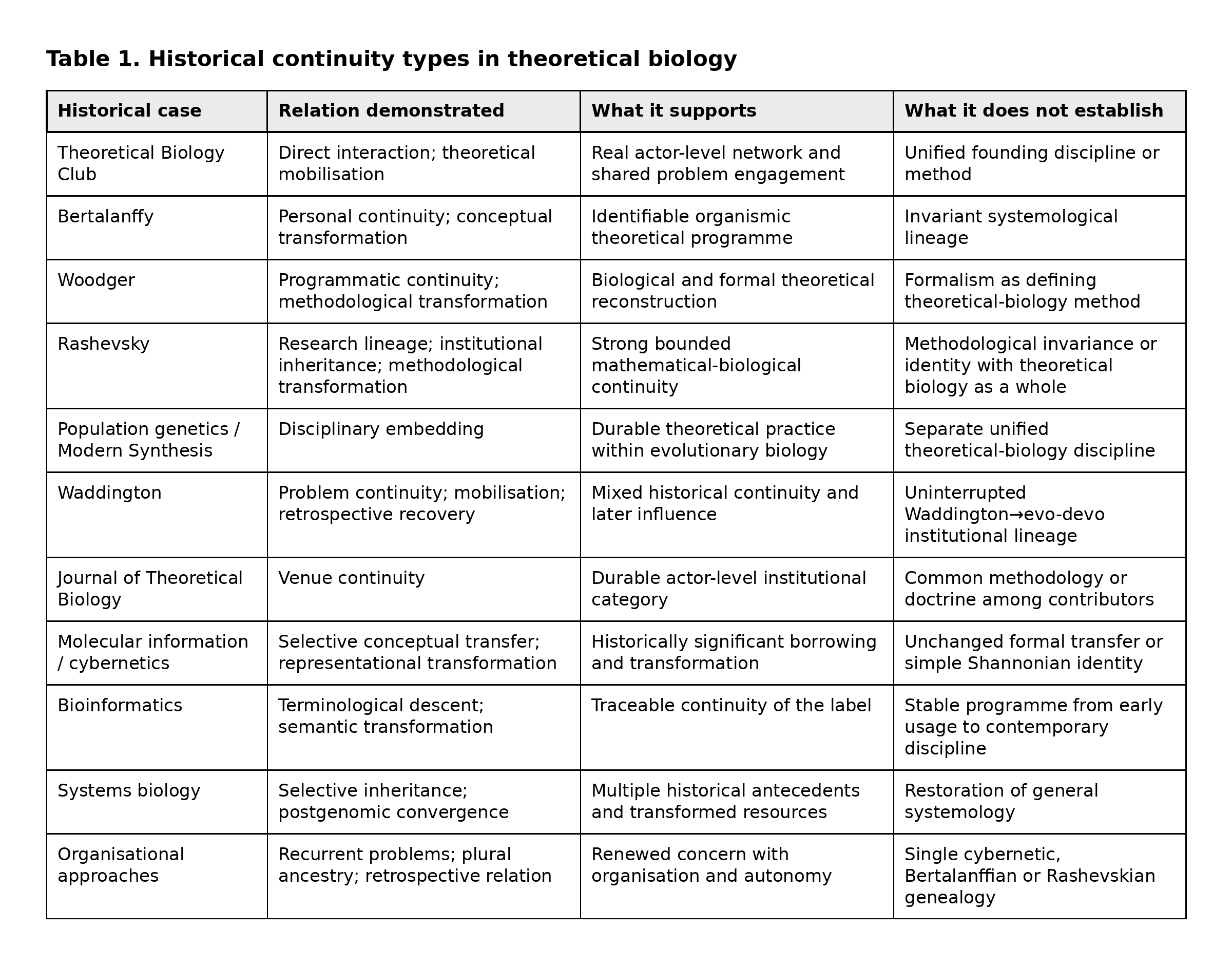
The table shows why “continuity” cannot function as one historical category. Demonstrated interaction supports a different inference from shared vocabulary. Institutional succession is stronger evidence of lineage than retrospective recognition. Terminological descent may be direct even while meaning changes. Problem recurrence supports comparison without proving transmission. Selective conceptual inheritance requires evidence beyond thematic similarity.
These continuity types are therefore historical relation types, not stages or components of theoretical biology. Their role is discriminative. A missing institutional lineage cannot be repaired by noting that two programmes discuss organisation. Shared mathematics does not demonstrate common disciplinary identity. Conversely, absence of institutional succession does not erase demonstrated conceptual transfer or recurrence of biological problems.
Adjudicating the alternatives
On this evidence, continuous identity must be rejected as a comprehensive historical architecture. No institution, membership, method, doctrine, explanatory object or evidential regime spans the history. Mathematics recurs prominently but does not define all theoretical biology. Organisation recurs while its conceptual meaning changes. Institutions persist, but with different remits and successions. Theoretical practice also flourishes in disciplines that do not carry the theoretical-biology label.
This does not mean continuity is absent. Strong continuities occur locally. The Theoretical Biology Club documents actor-level interaction; Bertalanffy’s and Woodger’s careers exhibit identifiable development; the Rashevsky lineage supplies comparatively strong institutional inheritance; mathematical population theory becomes embedded within evolutionary biology; JTB preserves a durable venue. Continuous identity therefore survives as a bounded description of particular histories, not as an architecture for the field as a whole.
Programme succession captures a second part of the evidence. Interwar organismic and formal programmes, mathematical biophysics, population genetics, molecular biology, computational biology and postgenomic systems biology operated with significantly different objects, instruments, institutions and evidential possibilities. Treating them as transformed programmes preserves discontinuities that a seamless history would erase.
But complete separation is too strong. Direct interactions occurred. Research institutions persisted. Theoretical population genetics became embedded rather than replaced. Concepts travelled selectively. Mathematical and computational practices changed while retaining historical connections. Problems concerning form, heredity, regulation, development and organisation recurred under altered conditions. Programme succession is therefore useful as a description of major discontinuity but inadequate as a complete historical architecture.
Retrospective classification is likewise indispensable but incomplete. Later communities reorganise their past. Waddington can be recognised as an evo-devo precursor; systems programmes become ancestors of contemporary systems thinking; organismic and relational theories acquire renewed significance when organisation returns to theoretical prominence. Even the boundaries of the Modern Synthesis have been reconstructed differently. Retrospective regrouping is part of the history rather than simply an error.
Yet retrospective instability does not dissolve the historical object. Historical actors themselves used theoretical biology as a meaningful designation. The Club existed; Rashevsky constructed a mathematical-biological programme; JTB institutionalised the term; Waddington explicitly mobilised a project under it; and demonstrable conceptual and institutional relations connect particular episodes. The category is therefore not merely an arbitrary retrospective invention.
The fourth interpretation best accommodates these positive and negative findings. Theoretical biology is best reconstructed historically as a transformation-based family resemblance constituted by typed local continuities, selective transfers, recurrent problems, institutional mobilisations and retrospective regroupings rather than by an invariant disciplinary essence.
The notion of family resemblance must remain constrained. It cannot mean that everything resembling theoretical biology belongs to one loose tradition. Particular historical relations must be demonstrated, and the kind of relation determines the strength of the resulting claim. Some programmes are linked through actors, some through institutions, some through disciplinary embedding, some through conceptual transfer, others through transformed terminology, recurrent problems or retrospective ancestry. No programme need share all of these relations, and none of them individually supplies necessary and sufficient membership conditions.
Negative findings are therefore constitutive of the conclusion. The absence of an uninterrupted Waddington–evo-devo lineage matters. So does the failure of systems vocabulary to establish direct descent, the rejection of a simple cybernetics-to-organisational-biology genealogy, and the distinction between JTB venue continuity and the mathematical-biology lineage. Without these negative controls, family resemblance would become too elastic to discriminate historical continuity from superficial similarity.
Recurrence without essence
What nevertheless recurs across the history? Theoretical programmes repeatedly move beyond individual observations by constructing more general representations; they formalise or model relations mathematically, logically, computationally or conceptually; they integrate findings across separated domains; and they reorganise explanation around problems of form, organisation, heredity, development, regulation, population change, information, computation and autonomy. They also repeatedly renegotiate the relation between abstraction and biological evidence.
These recurrences are not an essence. Mathematics is perhaps the most durable methodological strand, but Woodger’s formal reconstruction, Rashevsky’s mathematical biology, population genetics, computational modelling and systems biology do not instantiate one unchanged mathematical method. Conceptual analysis repeatedly participates in theoretical biology without making the field philosophy. Molecular and systems biology show that theoretical representations can be embedded deeply in experiment. Computation transforms mathematical practice without making all computational biology theoretical biology.
Methodological plurality is therefore itself historically significant. Different combinations of conceptualisation, formalisation, mathematics, modelling, computation, experiment and integrative synthesis have performed theoretical work under different biological conditions. The recurring feature is not one privileged technique but the repeated reorganisation of relations among theoretical representation, biological problems and evidence.
Theoretical biology consequently has enough continuity to be more than retrospective fiction and enough transformation to resist reduction to a continuous discipline. Its identity is comparative and historical: locally demonstrable relations overlap without converging upon an invariant core.
That conclusion changes the contemporary question. If no single method, institution or doctrine defines theoretical biology, neither the label theoretical nor historical pedigree can determine the explanatory value of a contemporary representation, model or synthesis. The history therefore leaves open a further problem:
If theoretical biology is historically transformed and methodologically plural rather than unified by one technique, how should the explanatory contribution of a theoretical representation, synthesis, model or framework be assessed?
The historical adjudication establishes why that question arises. It does not answer it.
8. Conclusion — A History of Recurrent Theoretical Reorganisation
What identifies theoretical biology across its organismal, formal, mathematical, evolutionary, molecular, developmental, systems, computational and organisational forms? The history does not support an answer in terms of a single discipline, institution, method or doctrine. Theoretical biology has not possessed a single continuous disciplinary, institutional or methodological identity. Its historical coherence lies instead in a transformation-based family resemblance constituted by typed local continuities, selective transfers, recurrent problems, institutional mobilisations and retrospective regroupings.
This conclusion preserves both continuity and discontinuity. Theoretical biology is historically real: researchers organised explicit theoretical programmes, mathematical-biology lineages developed institutional continuity, journals and symposia sustained the category, theoretical practices became embedded in established biological disciplines, and concepts and problems travelled between programmes. But these relations cannot be assembled into an uninterrupted genealogy. Different continuities occurred in different places and support different historical claims.
The negative findings matter equally. There was no unified founding field or invariant mathematical, conceptual or organisational method. The Modern Synthesis achieved substantial but regional integration. Waddington is a genuine antecedent of later developmental work without founding an uninterrupted evo-devo lineage. Molecular information was not simply Shannon theory transferred into biology. Systems biology is not restored general systemology, and contemporary organisational approaches do not complete a continuous cybernetic or organismic tradition.
What persists instead is recurrent theoretical reorganisation. Problems of form, organisation, heredity, development, regulation, population change, information, computation and autonomy repeatedly invite abstraction, modelling, conceptual reconstruction and integration. Mathematics and modelling remain major practices but do not exhaust theoretical biology; conceptual analysis, experimentation, computation and synthesis repeatedly enter in different combinations.
Historical continuity must therefore remain typed and evidentially bounded. Direct interaction differs from resemblance, institutional inheritance from persistence of terminology, disciplinary embedding from theoretical mobilisation, and retrospective ancestry from demonstrated descent. Transformation-based family resemblance names the comparative result of those distinctions rather than an underlying essence.
The scope of the claim is limited. This article has not provided a comprehensive history of all biological theory, classified every theoretical activity as theoretical biology, erased local discontinuities or recovered a suppressed unified tradition. It does not rank the historical programmes by explanatory superiority, and its contribution does not depend upon claiming novelty for the specialist histories on which the comparison rests.
Its contribution is instead comparative historical reconstruction: bringing those histories into a common analysis, distinguishing the continuity relations they actually support, and adjudicating rival interpretations of theoretical biology’s identity. The result is neither a continuously organised discipline nor a collection of arbitrarily associated episodes, but a history in which biological problems, methods, representations, institutions and evidential relations were repeatedly assembled and transformed.
Historical reconstruction can establish that theoretical biology cannot be identified solely with mathematics, modelling, conceptual analysis, computation, institutional affiliation or any other single practice. It cannot by itself determine the explanatory value of a present theoretical proposal.
The history therefore ends with the question it generates:
If theoretical biology is historically transformed and methodologically plural rather than unified by one technique, how should the explanatory contribution of a theoretical representation, synthesis, model or framework be assessed?
That question follows from the history. Its answer lies beyond it.
See Also
Related Articles
References
- (2004). Nicolas Rashevsky's Mathematical Biophysics. Journal of the History of Biology, 37(2), 333–385 . https://doi.org/10.1023/B:HIST.0000038267.09413.0d
- (2005). The Changing Role of the Embryo in Evolutionary Thought: Roots of Evo-Devo. Cambridge University Press.
- (1961). Preface. Journal of Theoretical Biology, 1(1), i .
- (2000). Diachronic Biology Meets Evo-Devo: C. H. Waddington's Approach to Evolutionary Developmental Biology. American Zoologist, 40(5), 729–737 . https://doi.org/10.1093/icb/40.5.729
- (2011). The Roots of Bioinformatics in Theoretical Biology. PLoS Computational Biology, 7(3) . https://doi.org/10.1371/journal.pcbi.1002021
- (2019). Special Issue Editor's Introduction: Revisiting the Modern Synthesis. Journal of the History of Biology, 52, 509–518 . https://doi.org/10.1007/s10739-019-09585-2
- (2000). Who Wrote the Book of Life? A History of the Genetic Code. Stanford University Press.
- (1996). Refiguring Life: Metaphors of Twentieth-Century Biology. Columbia University Press.
- (2015). Alfred J. Lotka and the Origins of Theoretical Population Ecology. Proceedings of the National Academy of Sciences of the United States of America, 112(31), 9493–9495 . https://doi.org/10.1073/pnas.1512317112
- (2002). Computational Systems Biology. Nature, 420(6912), 206–210 . https://doi.org/10.1038/nature01254
- (2017). The Cybernetics Moment: Or Why We Call Our Age the Information Age. Johns Hopkins University Press. https://doi.org/10.1353/book.40478
- (1980). The Evolutionary Synthesis: Perspectives on the Unification of Biology. Harvard University Press.
- (1998). A History of Molecular Biology. Harvard University Press.
- (2015). Biological Autonomy: A Philosophical and Theoretical Enquiry. Springer. https://doi.org/10.1007/978-94-017-9837-2
- (2016). Theoretical Principles for Biology: Organization. Progress in Biophysics and Molecular Biology, 122(1), 24–35 . https://doi.org/10.1016/j.pbiomolbio.2016.07.005
- (2014). Rethinking Woodger's Legacy in the Philosophy of Biology. Journal of the History of Biology, 47(2), 243–292 . https://doi.org/10.1007/s10739-013-9364-x
- (2016). The Life Organic: The Theoretical Biology Club and the Roots of Epigenetics. University of Pittsburgh Press.
- (2007). On the History of Ludwig von Bertalanffy's 'General Systemology', and on Its Relationship to Cybernetics: Part I: Elements on the Origins and Genesis of Ludwig von Bertalanffy's 'General Systemology'. International Journal of General Systems, 36(3), 281–337 . https://doi.org/10.1080/03081070601127961
- (2001). The Origins of Theoretical Population Genetics: With a New Afterword. University of Chicago Press.
- (1954). Topology and Life: In Search of General Mathematical Principles in Biology and Sociology. Bulletin of Mathematical Biophysics, 16, 317–348 . https://doi.org/10.1007/BF02484495
- (1996). Unifying Biology: The Evolutionary Synthesis and Evolutionary Biology. Princeton University Press.
- (1968). Towards a Theoretical Biology. Nature, 218(5141), 525–527 . https://doi.org/10.1038/218525a0